
Bahrain Liquid Packaging Cartons Market Size and Share
Market Overview
| Study Period | 2021 - 2032 |
|---|---|
| Forecast Data Period | 2027 - 2032 |
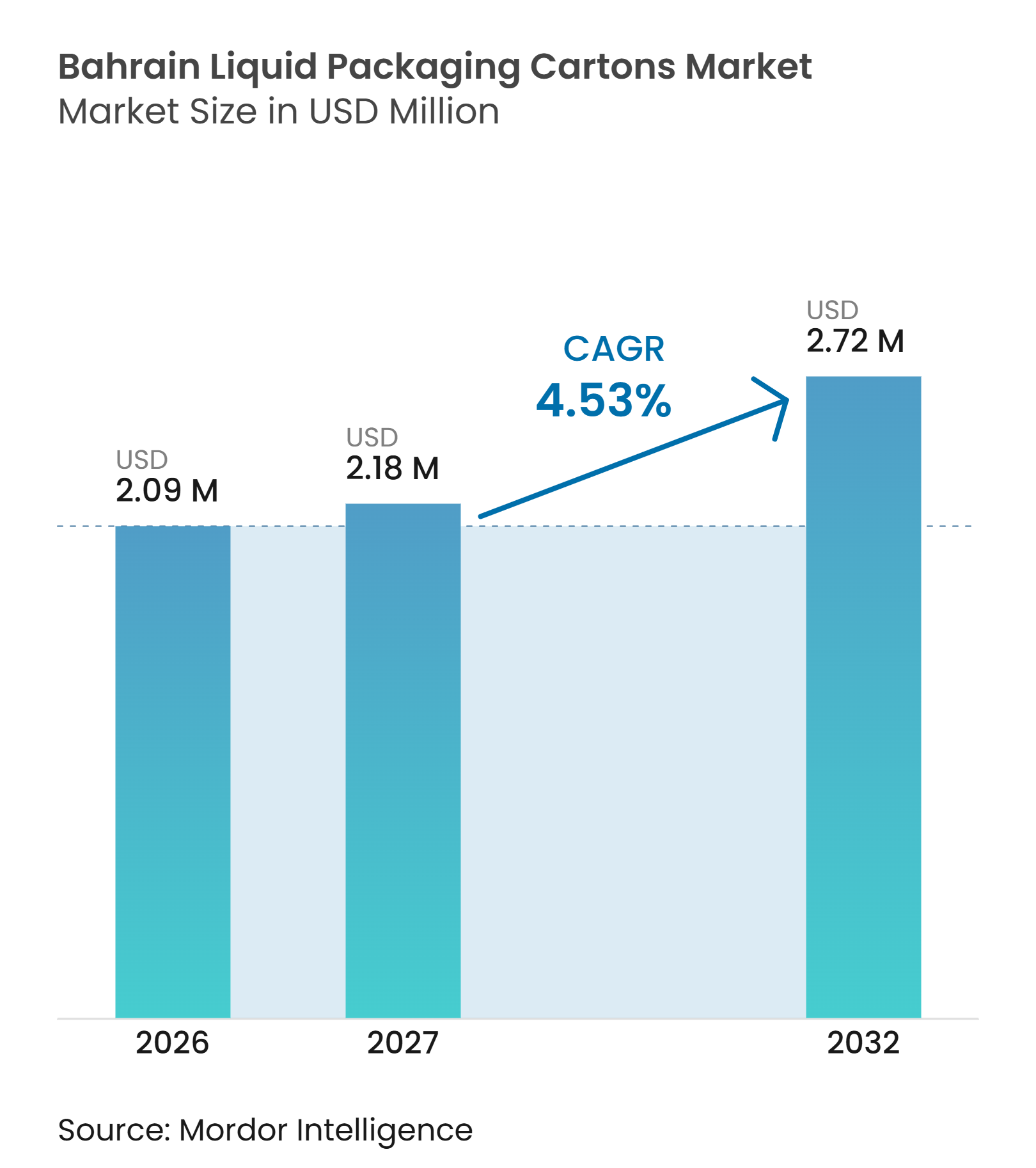
| Base Year Market Size (2026) | USD 2.09 Million |
| Market Size (2027) | USD 2.18 Million |
| Market Size (2032) | USD 2.72 Million |
| Growth Rate (2027 - 2032) | 4.53 % |
| Market Concentration | High |
Major Players *Disclaimer: Major Players sorted in no particular order Image © Mordor Intelligence. Reuse requires attribution under CC BY 4.0. | |
Bahrain Liquid Packaging Cartons Market Analysis by Mordor Intelligence
The Bahrain liquid packaging cartons market size is projected to expand from USD 2.09 million in 2026 to USD 2.72 million by 2032, registering a CAGR of 4.53% from 2027 to 2032. Bahrain’s dependence on imported food products supports demand for packaging that can protect dairy and beverages during transport and storage without refrigeration. This dependence gives the Bahrain liquid packaging cartons market a stable base in products that must move through regional supply chains before reaching local retail shelves. Organized retailers are widening the availability of packaged dairy, juices, and ready-to-drink products, which supports regular carton use across several consumer channels. Producers are also responding to demand for smaller formats, the development of paper-based materials, and the need to manage cost exposure from imported materials. Competition remains centered on filling-line compatibility, regional supply access, and the ability to offer formats that balance shelf life, convenience, and material performance.
Key Report Takeaways
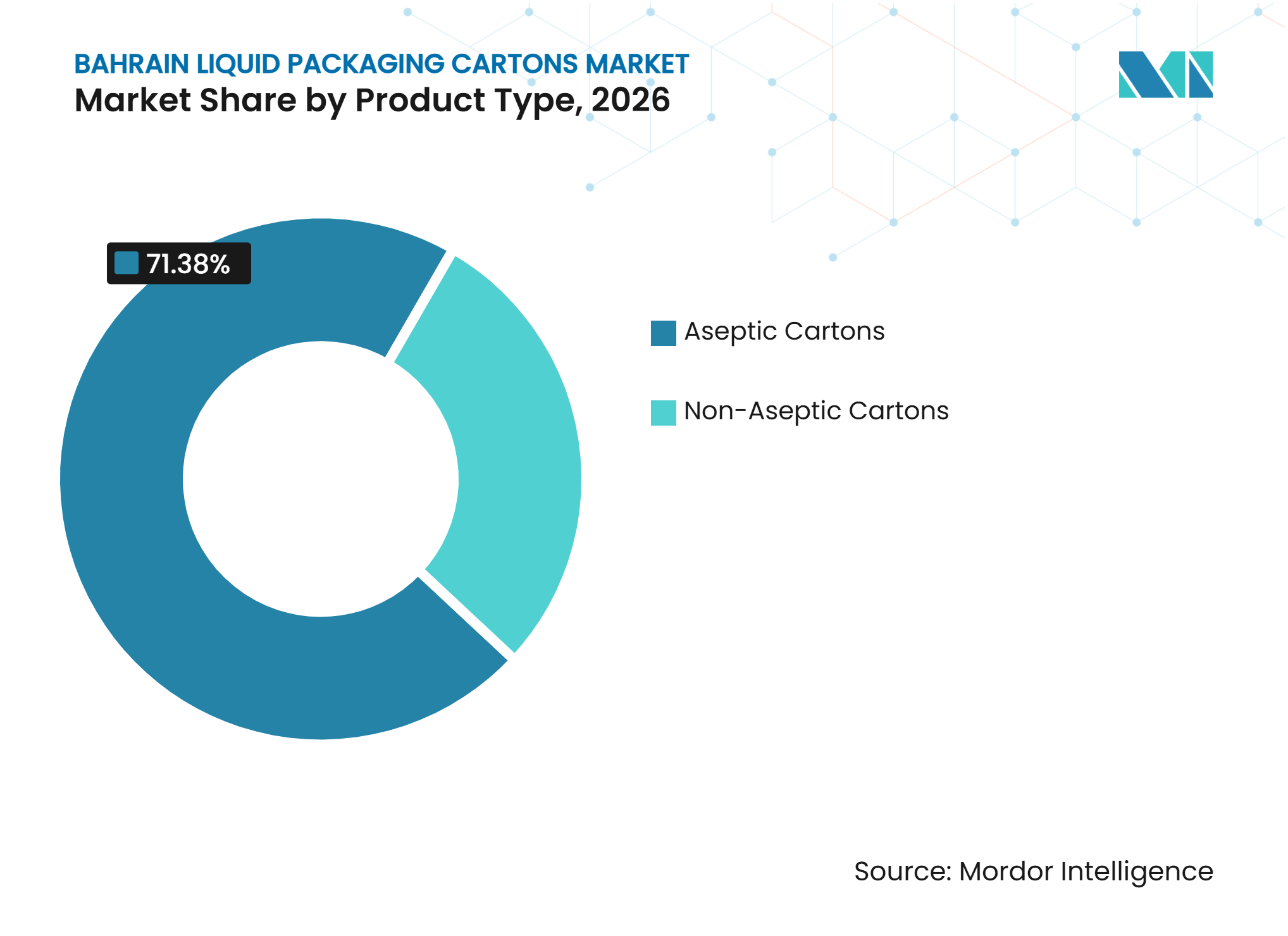
- By product type, aseptic cartons held 71.38% of the Bahrain liquid packaging cartons market share in 2026 and are projected to expand at a 5.27% CAGR through 2032.
- By application, juices accounted for 33.46% of the Bahrain liquid packaging cartons market size in 2026, while plant-based beverages are projected to expand at a 5.42% CAGR through 2032.
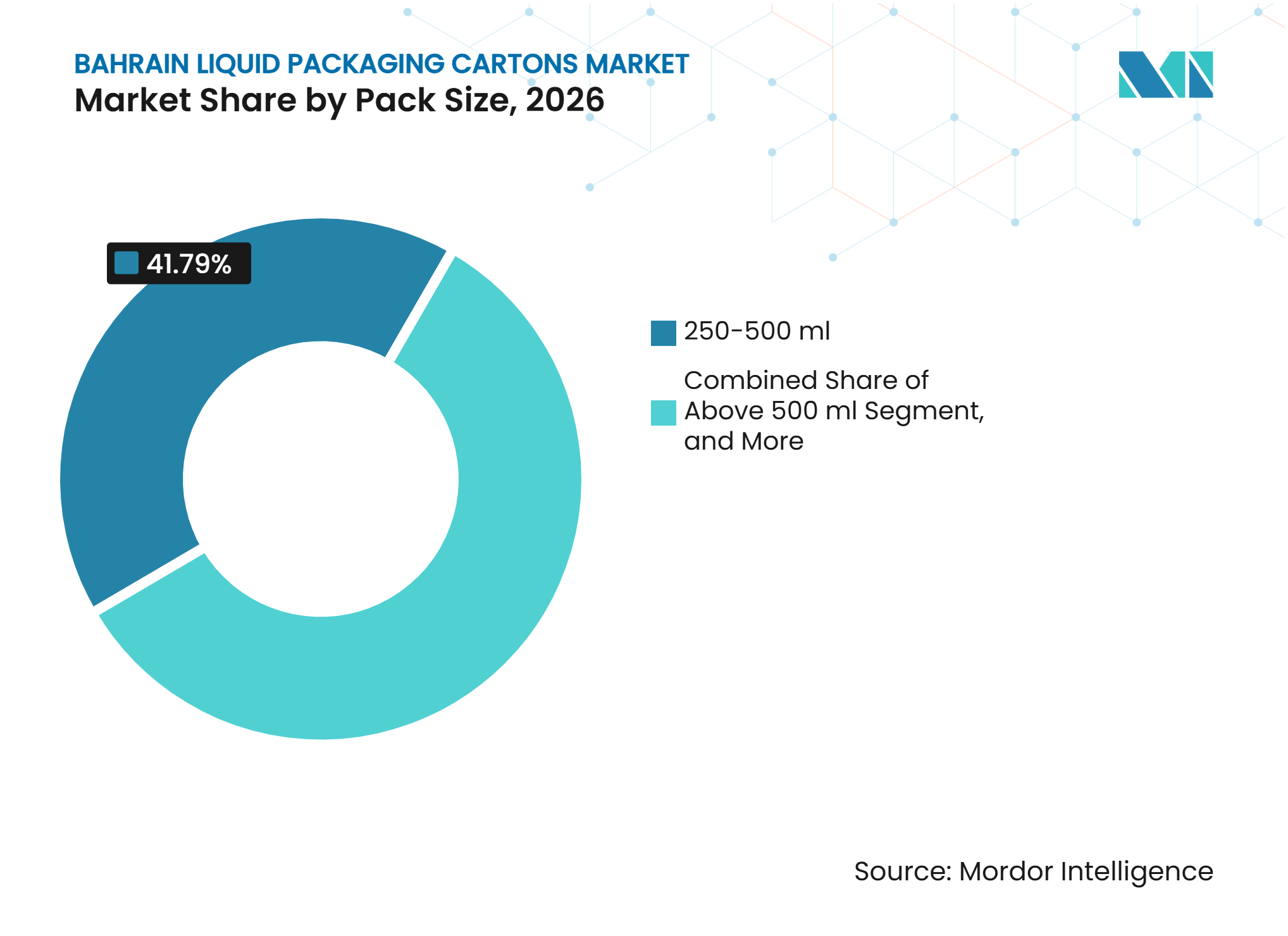
- By pack size, 250-500 ml formats held 41.79% share in 2026, while below 250 ml packs are expected to expand at a 5.13% CAGR through 2032.
Note: Market numbers in this report are based on Mordor Intelligence's proprietary estimation framework, which combines nine months of actuals with Q4 projections for base year 2026.
Market Trends and Insights
Drivers Impact Analysis of Bahrain Liquid Packaging Cartons Market*
| Driver | (~) % Impact on CAGR Forecast | Geographic Relevance | Impact Timeline |
|---|---|---|---|
| Rising Demand for Shelf-Stable Dairy and Beverage Products | +1.4% | Global, with high structural relevance in import-dependent GCC markets including Bahrain, Kuwait, and Oman | Long term (≥ 4 years) |
| Growth in Convenient Single-Serve and On-the-Go Consumption | +1.0% | National, with early gains in Manama, Muharraq, and Riffa convenience and petrol-forecourt corridors | Medium term (2-4 years) |
| Sustainability Preferences and Reduced Plastic Use | +0.7% | National, with upstream regulatory spillover from UAE and Saudi Arabia sustainability frameworks | Medium term (2-4 years) |
| Expansion of Organized Retail and Foodservice Distribution | +0.6% | National, with strongest relevance in Capital Governorate and Northern Governorate modern-trade clusters | Short term (≤ 2 years) |
| High-Temperature Distribution Increasing the Value of Ambient Packaging | +0.4% | GCC-wide, with strongest structural relevance in Bahrain, Kuwait, and Qatar where cold-chain coverage remains uneven | Long term (≥ 4 years) |
| Import-Led Access to Regional Carton Supply Networks | +0.3% | National, with supply links to Saudi Arabia and UAE converters and filling-line networks | Medium term (2-4 years) |
| Source: Mordor Intelligence | |||
Rising Demand for Shelf-Stable Dairy and Beverage Products
Bahrain’s dependence on food imports increases the importance of packaging that can preserve products over extended supply routes. Aseptic cartons protect sterilized products in multilayer structures and enable ambient storage for up to 12 months. This capability matters for UHT milk, juice, and other liquid products that would otherwise require continuous refrigeration. The Bahrain liquid packaging cartons market therefore follows retail volumes and consumer demand more closely than local agricultural output. Ambient formats also help importers reduce exposure to cold-chain breaks during transport and distribution. The result is a durable preference for carton formats in categories where shelf life and transport reliability have a direct commercial value.
Growth in Convenient Single-Serve and On-the-Go Consumption
Convenience retail is increasing the visibility of smaller carton packs in Bahrain. Service-station retail, neighborhood stores, and transit locations create frequent purchase occasions for ready-to-drink dairy, juice, and plant-based products. These channels favor products that can be held at ambient conditions before purchase. Small packs also fit school distribution, hospitality service, and vending channels that need controlled portions and easy handling. Regional filling technology is being adapted for 80-200 ml products, providing suppliers with a practical route to meet this demand. The Bahrain liquid packaging cartons market benefits when retailers can present single-serve formats in high-traffic locations without relying on refrigerated display capacity.
Sustainability Preferences and Reduced Plastic Use
Bahrain has strengthened its policy focus on lower plastic use and broader environmental commitments. The country has set a target to reduce emissions by 30% by 2035 and to reach carbon neutrality by 2060. These commitments increase attention on packaging materials that can support fiber-based design and reduced dependence on conventional plastics. Cartons are not exempt from end-of-life challenges, but their paper content can strengthen their position where buyers seek lower-plastic alternatives. SIG introduced an aluminum-free full-barrier material for multiserve aseptic cartons in 2025, illustrating the direction of material development. The Bahrain liquid packaging cartons market can benefit as regional producers adopt compatible materials without replacing established filling equipment.
Expansion of Organized Retail and Foodservice Distribution
Organized retail gives carton products predictable shelf access and broader distribution. Majid Al Futtaim launched HyperMax across 6 locations in Bahrain in September 2025, with more than 1,600 employees and partnerships with over 250 Bahraini farmers, producers, and small- and medium-sized enterprises.[1] The launch replaced Carrefour’s presence and added an integrated online grocery channel. Larger retail networks can stock a wider mix of ambient dairy, juices, and specialty beverages than small independent outlets. Foodservice operators also need formats that are easy to store, portion, and transport. These changes help the Bahrain liquid packaging cartons market reach consumers through modern trade, online fulfillment, hospitality, and neighborhood convenience channels.
Restraints Impact Analysis of Bahrain Liquid Packaging Cartons Market*
| Restraint | (~) % Impact on CAGR Forecast | Geographic Relevance | Impact Timeline |
|---|---|---|---|
| Volatility in Paperboard, Polymer, Aluminum, Energy, and Freight Costs | -0.9% | Global, with a disproportionate effect on small-volume importers such as Bahrain | Long term (≥ 4 years) |
| Competition from PET Bottles, Flexible Pouches, Cans, and Glass | -0.7% | National, with highest relevance in price-sensitive retail and economy foodservice tiers | Medium term (2-4 years) |
| Limited Domestic Carton Recycling and Recovery Infrastructure | -0.3% | National, with implications for brand-owner packaging decisions and producer-responsibility planning | Long term (≥ 4 years) |
| Small Market Scale and Dependence on Imported Carton Systems and Filling Equipment | -0.3% | National, with a structural effect on investment in local aseptic filling capacity | Long term (≥ 4 years) |
| Source: Mordor Intelligence | |||
Volatility in Paperboard, Polymer, Aluminum, Energy, and Freight Costs
Liquid cartons use paperboard, polyethylene, and barrier materials that are exposed to separate commodity and transport cost cycles. Bahrain imports both filled products and packaging inputs, which limits the purchasing leverage available to local buyers. Freight disruption can create stock gaps and increase the landed cost of packaged goods. A small market also has less capacity to secure long-term supply protections than larger GCC destinations. Retailers may respond to material cost increases by favoring lower-cost packs or limiting the range of premium products. This can pressure carton suppliers even when demand for ambient products remains steady.
Competition From PET Bottles, Flexible Pouches, Cans, and Glass
PET bottles remain widely used for bottled water and selected juice products because they are familiar and often price-competitive. Flexible pouches can also serve lower-priced juice ranges that rely on the same import routes as carton products. Cans and glass retain a place in beverage categories where branding, carbonation, or product positioning requires a different format. Cartons must therefore justify their higher value through shelf life, barrier performance, easier storage, and a fiber-based material profile. Price-sensitive shoppers and private-label suppliers can limit carton penetration in economy tiers. The Bahrain liquid packaging cartons market retains its strongest position where ambient storage and product protection matter more than the lowest unit price.
*Our forecasts treat driver/restraint impacts as directional, not additive. The impact forecasts reflect baseline growth, mix effects, and variable interactions.
Bahrain Liquid Packaging Cartons Market Segment Analysis
By Product Type:
Aseptic Cartons Support Ambient DistributionAseptic cartons held 71.38% of the Bahrain liquid packaging cartons market share in 2026 and are projected to expand at a 5.27% CAGR through 2032. Their leading position reflects the value of ambient shelf life in an import-led food supply chain. The aseptic process sterilizes both the product and the package before sealing, enabling storage without refrigeration. This feature is particularly relevant to UHT milk, juices, and liquid foods supplied through regional distribution networks. Producers can transport these products more flexibly than chilled alternatives. The format also reduces the dependence on cold-chain capacity after products enter Bahrain. Established filling systems provide a practical base for continued adoption by regional suppliers. Compatibility between cartons and installed filling lines helps preserve supplier relationships and production continuity.
Non-aseptic cartons are used for pasteurized dairy and chilled juices that move through channels with dependable refrigeration. Hypermarkets and larger supermarkets have stronger cold storage capabilities than small convenience stores. Yet chilled products carry additional distribution and handling requirements, which narrow their operational advantage in Bahrain. Aseptic cartons offer a more suitable format when goods must undergo multiple transport stages or remain on shelves for extended periods. Compliance with GSO 839:2021 can favor suppliers that already have GCC certification and established quality processes. Large carton specialists have the resources to maintain these systems across regional markets. The alignment of aseptic cartons’ leading share and highest product-type growth rate indicates that buyers continue to value ambient functionality.


By Application:
Juices Lead While Plant-Based Beverages Gain MomentumJuices accounted for 33.46% of the Bahrain liquid packaging cartons market size in 2026. The category benefits from its broad presence in supermarkets, convenience retail, hotels, and foodservice outlets. Juice products can use aseptic cartons to maintain shelf stability while preserving a practical pack weight for distribution. The format supports several serving sizes, from family packs to portions intended for immediate consumption. Juice suppliers can also use carton design to differentiate premium products from economy formats. Wider distribution arrangements can strengthen the route to market for beverages sold in Bahrain. Retail growth and higher product variety can sustain demand for shelf-stable juice packs.
Plant-based beverages are projected to expand at a 5.42% CAGR through 2032, the fastest rate among applications. Regional producers are making filling infrastructure available for small-carton almond-, oat-, and fruit-based beverages. Access to smaller-format filling lines matters because Bahrain depends on regional supply networks rather than a large domestic manufacturing base. Milk and dairy products remain important, supported by Arla Foods’ production expansion in Bahrain.[2] Arla began an expansion at Bahrain International Investment Park in February 2026, adding 8,000 square meters and targeting a 30% increase in annual production volume.
By Pack Size:
Mid-Sized Packs Lead Household PurchasesThe 250-500 ml segment held 41.79% in 2026. These formats match household purchasing patterns and work well for school distribution programs. They are also widely suitable for mainstream retail shelves, where consumers purchase dairy and juice products for shared use. Regional suppliers can fill these sizes on both aseptic and non-aseptic systems. Their broad compatibility supports production efficiency and helps suppliers serve several product categories with similar packaging configurations. Hypermarkets, supermarkets, and convenience outlets can stock these packs without major changes to handling practices. The segment also gives brands enough label space for product information and sustainability messaging. Its use across mainstream retail helps explain its leading position. For the Bahrain liquid packaging cartons market, this pack size remains a dependable link between family consumption and regular grocery purchases.
Below 250 ml packs are projected to expand at a 5.13% CAGR through 2032. Petrol-forecourt stores, vending sites, schools, and hospitality outlets are the main use settings for these smaller formats. The shift reflects a need for portability and portion control rather than a replacement of household packs. Regional producers are investing in high-speed, small-pack capabilities, which can improve supply availability in Bahrain. These systems help producers maintain consistent quality while serving a higher number of individual portions. Above-500-ml packs continue to serve larger households and foodservice buyers through HyperMax, LuLu, and Nesto stores. The mix is therefore becoming more varied, with mid-sized cartons retaining scale while small cartons gain from convenience demand. This change supports a wider range of formats within the Bahrain liquid packaging cartons industry.


Geography Analysis
Capital Governorate
Capital Governorate is the leading consumption center for the Bahrain liquid packaging cartons market because it has the highest concentration of organized grocery retail, international foodservice, and hospitality venues. Manama’s commercial activity creates demand for packaged dairy, juice, and single-serve beverages across multiple consumer settings. HyperMax launched its flagship store at City Centre Bahrain as part of its 6-location market entry in September 2025. The retailer’s online platform broadens access to products beyond physical store visits. LuLu’s established store presence provides additional shelf space for ambient dairy and beverage products. The financial district, hotels, restaurants, and airline-catering activity support demand for small-format cartons. Expatriate professionals also increase the potential audience for UHT dairy, specialty juices, and plant-based drinks. These channels favor packages that are easy to store and serve. Retail investment therefore strengthens the commercial foundation for carton demand in the governorate.
Northern Governorate
Northern Governorate has a distinct role because it includes Bahrain International Investment Park, a major industrial location. Arla Foods operates its largest production facility outside Europe at the park and began a USD 60 million expansion in February 2026. The project targets a 30% increase in annual production volume and adds local support for carton-related beverage and dairy activity. This manufacturing base differs from areas that depend mainly on imported filled products. Hamad Town, Budaiya, and nearby residential clusters also support demand for neighborhood grocery stores. The governorate’s location near Bahrain International Airport and the King Fahd Causeway enhances its connectivity to regional supply routes. Carton blanks and finished goods can move through these links to distribution centers and retailers. Food-safety requirements and GSO 839:2021 compliance remain relevant for suppliers serving formal retail and dairy production. The combination of production, logistics, and residential demand makes Northern Governorate important to the Bahrain liquid packaging cartons market.
Muharraq and Southern Governorates
Muharraq Governorate contributes through airport retail, transit foodservice, and new communities around Diyar Al Muharraq. Service-station locations and convenience retail add access points for single-serve carton beverages. Bahrain International Airport also creates purchase occasions for portable drinks and foodservice products. Southern Governorate contributes through community retail and institutional catering, while its agricultural periphery has a smaller role in carton consumption. Bahrain’s compact geography, covering 765 km², allows suppliers to serve retail locations from central warehouses within short distribution windows. Ambient cartons benefit because their product performance does not depend on continuous refrigeration across governorate boundaries. This reduces geographic differences in access for ambient beverages and dairy. Chilled formats remain more dependent on reliable cold-chain handling. The national market therefore has a connected distribution structure, with demand concentrated in commercial, industrial, and transit locations rather than separated regional systems.
Competitive Landscape
Market Concentration
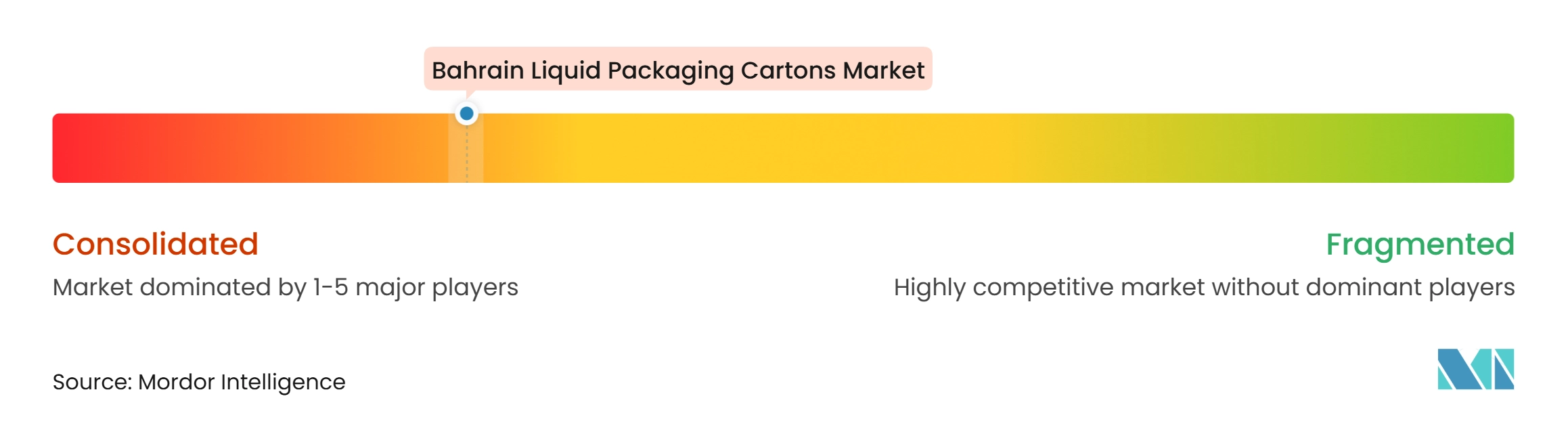
The Bahrain liquid packaging cartons market is largely served by global aseptic carton suppliers with regional operations in the UAE and Saudi Arabia. Tetra Pak International S.A. and SIG Group AG shape the filling-line systems used by many GCC food and beverage producers. Installed filling lines create high switching costs because a producer must invest in equipment, validation, technical support, and operational changes to adopt a new format. This gives established suppliers a durable advantage in aseptic categories. SIG is also developing materials that integrate with its current systems, reducing the need for producers to replace equipment when adopting new barrier designs.[3] Its aluminum-free full-barrier material demonstrates this approach to material innovation. Tetra Pak’s planned paper-based barrier pilot plant represents another strategic move toward higher renewable content. These initiatives show that competition is based on production systems and materials as well as carton supply.
Elopak ASA, Greatview Aseptic Packaging, IPI S.r.l., Shandong Bihai, and Lamipak provide additional options for converters and private-label producers. Their position can be attractive where buyers seek lower entry prices or alternative supply relationships. Obeikan Investment Group has a regional location advantage through its Saudi-origin manufacturing base. Shorter lead times can matter when freight costs increase or shipping routes experience disruption. However, alternative suppliers must still meet quality, certification, and compatibility requirements set by producers and retailers. The Bahrain liquid packaging cartons market is not defined by a large number of local carton manufacturers. Instead, it draws on regional networks that connect raw-material suppliers, converters, filling-line providers, beverage producers, distributors, and retailers. This structure can limit local manufacturing investment while still giving buyers access to multiple regional sources. It also means that supply decisions often reflect GCC-scale rather than Bahrain-only economics.
End-of-life management is becoming a more visible competitive issue. Bahrain does not yet have a comparable domestic recovery pathway for post-consumer cartons. This creates a gap between the material’s fiber-based position and the local infrastructure needed to recover it after use. Bahrain’s climate targets add pressure for companies to show practical improvements in material use and collection systems. Contract packaging could offer small producers of artisan juice, plant-based milk, and functional beverages the opportunity to use aseptic packaging without buying their own filling lines. Such arrangements would lower the capital barrier for emerging brands. The Bahrain liquid packaging cartons market also depends on how effectively suppliers coordinate carton conversion, filling support, finished-product distribution, and local retail execution.
Bahrain Liquid Packaging Cartons Industry Leaders
-
Tetra Pak International S.A.
-
SIG Group AG
-
Elopak ASA
-
Greatview Aseptic Packaging Co. Ltd.
-
Nippon Paper Industries Co., Ltd.
- *Disclaimer: Major Players sorted in no particular order
Bahrain Liquid Packaging Cartons Market Companies Covered in this Report
- Tetra Pak International S.A.
- SIG Group AG
- Elopak ASA
- IPI S.r.l.
- Lami Packaging (Kunshan) Co. Ltd.
- Klabin S.A.
- Obeikan Investment Group
- Nampak Limited
- Italpack S.r.l.
- Shandong Bihai Packaging Materials Co. Ltd.
- Southern Packaging Group Ltd.
- Lamipak (Suzhou) Co., Ltd.
- Xiamen Hexing Packaging Group Co., Ltd.
Recent Industry Developments in Bahrain Liquid Packaging Cartons Market
- November 2026: At Gulfood Manufacturing 2026 in Dubai, SIG signed agreements for 17 new filling lines with regional food and beverage producers to expand capacity for aseptic cartons, spouted pouches, and bag-in-box packaging across India, the Middle East, and Africa, and won the UAE Industrial Excellence Award for its Dubai Product Innovation and Application Hub.
- March 2026: Fonterra Co-operative Group signed a three-year supply agreement, valued at approximately USD 27.5 million annually, with a major Bahraini food distributor to expand its dairy product portfolio across Bahrain and the wider GCC. The agreement covers cream, milk products, and foodservice dairy lines, increasing the distribution volume of ambient and chilled liquid dairy cartons through Bahraini retail and hospitality channels.
- February 2026: Arla Foods broke ground on a USD 60 million (EUR 50.9 million) expansion of its Bahrain International Investment Park facility, adding 8,000 sqm and targeting a 30% increase in annual production volume. The site is Arla’s largest outside Europe and produces Puck spreadable cheese for export to more than 20 countries.
- January 2026: Tetra Pak announced a EUR 60 million (USD 65 million) investment in a pilot plant at its Lund, Sweden site to industrialize paper-based barrier technology for aseptic cartons. The project targets a renewable content of 92% and a carbon footprint reduction of up to 43% compared with conventional aseptic packaging, with pilot production expected in Q1 2027.
Bahrain Liquid Packaging Cartons Market Report Scope
The Bahrain liquid packaging cartons market comprises cartons designed to package and preserve liquid products, including milk, juices, beverages, and other food and non-food liquids. These cartons typically use paperboard combined with plastic and aluminum layers to provide product protection, extend shelf life, and support convenient storage and transportation.
The Bahrain Liquid Packaging Cartons Market Report is Segmented by Product Type (Aseptic Cartons, and Non-Aseptic Cartons), Applications (Milk, Juices, Plant Based Beverages, Dairy Products Excluding Milk, Energy and Functional Drinks, Liquid Food, and Other Applications), and Pack Size (Below 250 Ml, 250-500 Ml, and Above 500 Ml). The Market Forecasts are Provided in Terms of Value (USD).
Segmentation Overview
| Aseptic Cartons |
| Non-Aseptic Cartons |
| Milk |
| Juices |
| Plant Based Beverages |
| Dairy Products (Excluding Milk) |
| Energy and Functional Drinks |
| Liquid Food |
| Other Applications |
| Below 250 ml |
| 250-500 ml |
| Above 500 ml |
| By Product Type | Aseptic Cartons |
| Non-Aseptic Cartons | |
| By Applications | Milk |
| Juices | |
| Plant Based Beverages | |
| Dairy Products (Excluding Milk) | |
| Energy and Functional Drinks | |
| Liquid Food | |
| Other Applications | |
| By Pack Size | Below 250 ml |
| 250-500 ml | |
| Above 500 ml |
Key Questions Answered in the Report
What is the Bahrain liquid packaging cartons market size?
The Bahrain liquid packaging cartons market is projected to expand from USD 2.09 million in 2026 to USD 2.72 million by 2032, at a 4.53% CAGR during 2027-2032.
Which product type leads liquid packaging cartons in Bahrain?
Aseptic cartons lead with a 71.38% value share in 2026 and are projected to grow at a 5.27% CAGR through 2032.
Which liquid packaging carton application is growing fastest in Bahrain?
Plant-based beverages are projected to record the fastest application growth at a 5.42% CAGR through 2032.
Why are aseptic cartons important for Bahrain’s beverage supply?
They allow UHT dairy, juice, and other liquid products to be stored and distributed without refrigeration for extended periods.
Which carton pack size has the highest demand in Bahrain?
The 250-500 ml format held 41.79% share in 2026, supported by household purchasing and mainstream food retail.
What affects competition among carton suppliers in Bahrain?
Filling-line compatibility, access to regional supply networks, material innovation, certification, and recycling infrastructure shape supplier competition.