
Bagel Market Size and Share
Market Overview
| Study Period | 2021 - 2031 |
|---|---|
| Market Size (2026) | USD 6.14 Billion |
| Market Size (2031) | USD 7.89 Billion |
| Growth Rate (2026 - 2031) | 5.14 % |
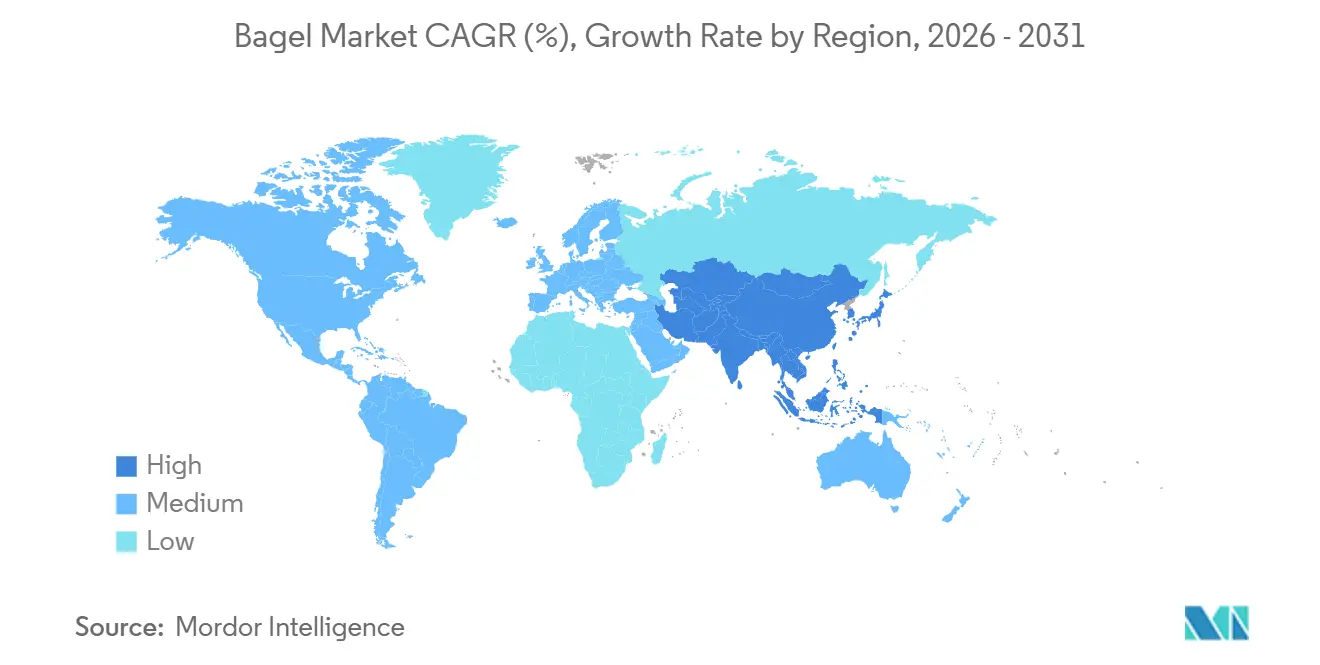
| Fastest Growing Market | Asia-Pacific |
| Largest Market | North America |
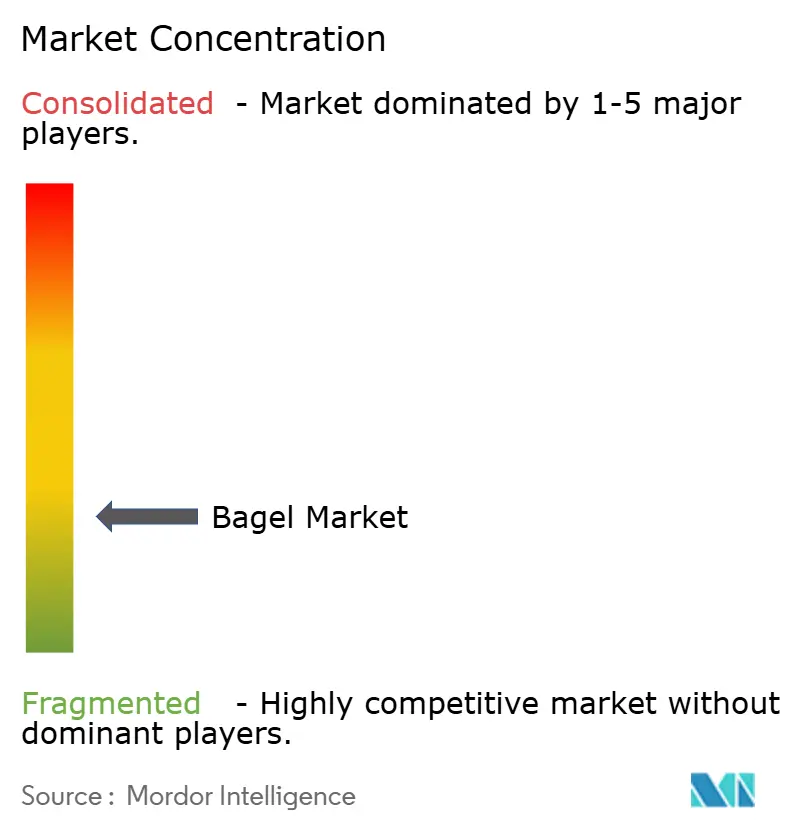
| Market Concentration | Low |
Major Players *Disclaimer: Major Players sorted in no particular order Image © Mordor Intelligence. Reuse requires attribution under CC BY 4.0. | |
Bagel Market Analysis by Mordor Intelligence
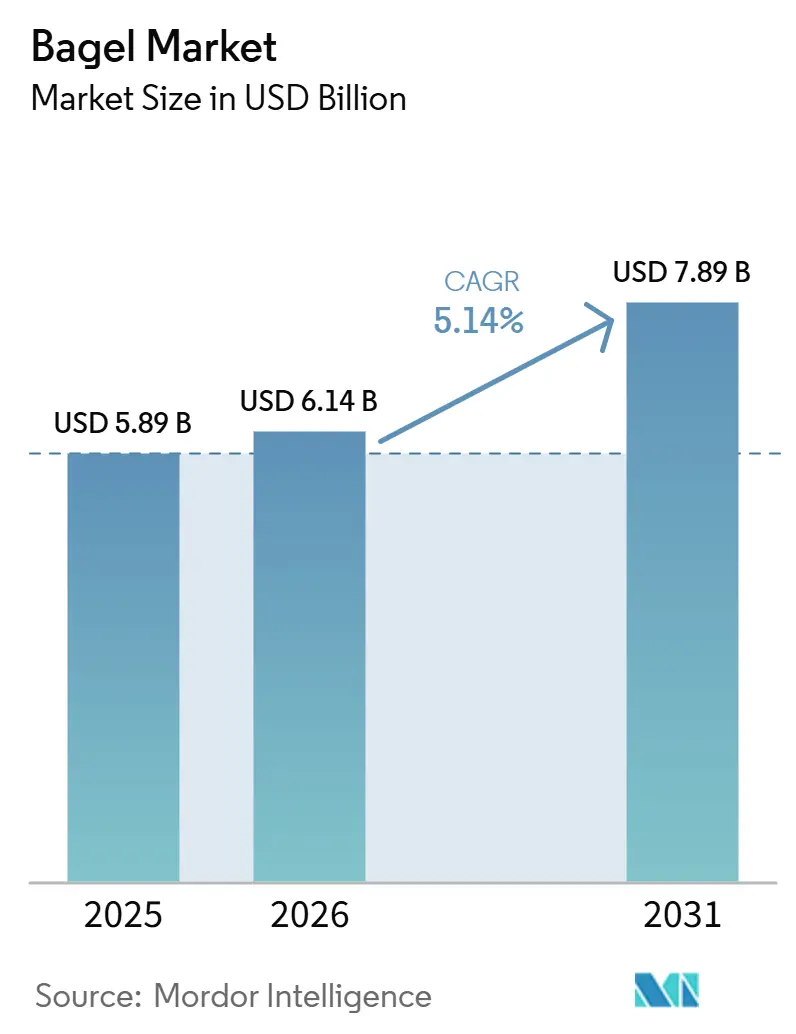
The bagel market size is expected to grow from USD 5.89 billion in 2025 to USD 6.14 billion in 2026 and is forecast to reach USD 7.89 billion by 2031 at 5.14% CAGR over 2026-2031. The bagel market is benefiting from demand for portable breakfast foods among urban professionals, households with limited preparation time, and younger consumers who consider nutrition when choosing food. Demand is extending beyond the category’s established North American and Jewish deli base as operators introduce new formats and enter additional locations. Premium products, new retail formats, and foodservice partnerships are changing how consumers encounter bagels. The bagel market also faces pressure from rising flour costs and from breakfast substitutes, which makes product quality, flavor development, and nutritional positioning important for producers.
Key Report Takeaways
- By product type, plain bagels held 31.45% of bagel market share in 2025, while flavored bagels are forecast to grow at a 5.89% CAGR through 2031.
- By form, fresh bagels held 67.34% of bagel market share in 2025, while frozen bagels are forecast to grow at a 6.42% CAGR through 2031.
- By distribution channel, retail held 62.27% of bagel market share in 2025, while foodservice is forecast to grow at a 5.78% CAGR through 2031.
- By geography, North America held 55.47% of bagel market share in 2025, while Asia-Pacific is forecast to grow at a 7.12% CAGR through 2031.
Note: Market size and forecast figures in this report are generated using Mordor Intelligence’s proprietary estimation framework, updated with the latest available data and insights as of January 2026.
Market Trends and Insights
Drivers Impact Analysis of Bagel Market*
| Driver | (~) % Impact on CAGR Forecast | Geographic Relevance | Impact Timeline |
|---|---|---|---|
| Growing Demand for Convenient Breakfast Foods | +1.2% | Global, with stronger relevance in North America and urban Asia-Pacific | Medium term (2-4 years) |
| Rising Popularity of Bakery and Ready-to-Eat Products | +0.9% | Global | Short term (≤ 2 years) |
| Increasing Demand for Premium and Artisanal Bakery Products | +0.8% | North America and Western Europe, with demand extending to urban Asia-Pacific | Medium term (2-4 years) |
| Expansion of Café and Quick-Service Restaurant Chains | +0.7% | Global, with faster expansion in Asia-Pacific and South America | Medium term (2-4 years) |
| Growing Popularity of Western-Style Foods | +0.5% | Asia-Pacific, with relevance in the Middle East and Africa | Long term (≥ 4 years) |
| Rising Consumer Interest in High-Protein and Whole-Grain Products | +0.4% | North America, Western Europe, and urban Asia-Pacific | Short term (≤ 2 years) |
| Source: Mordor Intelligence | |||
Growing Demand for Convenient Breakfast Foods
Dual-income households and longer urban commutes strengthen demand in the bagel market by reducing the time consumers have for breakfast preparation. Consumers choose bagels for occasions that require meal preparation in less than five minutes, especially when they can toast them or assemble them with spreads, proteins, or other toppings at home. In North America, consumers increasingly eat bagels beyond breakfast, including as snacks and quick meals during the day. Einstein Bros. Bagels reported that rewards members younger than 35 made 22% more store visits year over year in 2025, indicating broader use occasions among younger consumers. Frozen and packaged formats support this demand by allowing consumers to store bagels at home and reducing the need to visit specialty bakeries. Single-serve and resealable packages also encourage impulse purchases, improve convenience, and support online grocery orders in the bagel market.
Rising Popularity of Bakery and Ready-to-Eat Products
Changing consumer lifestyles, urbanization, and increasingly busy work schedules are driving demand for convenient food products that require little or no preparation. Bakery and ready-to-eat products are gaining popularity as consumers seek quick breakfast and snack solutions that fit easily into their daily routines. Bagels benefit from this trend because they can be consumed immediately or customized with spreads, fillings, and other ingredients to create convenient meals. Their availability across supermarkets, bakeries, cafés, quick-service restaurants, and online grocery platforms is further improving consumer accessibility. The growing popularity of fresh, packaged, and frozen bakery products is also expanding consumption occasions beyond traditional breakfast routines. In addition, consumers are increasingly exploring diverse bakery products as alternatives to conventional bread and other staple foods.
Increasing Demand for Premium and Artisanal Bakery Products
Consumer preference is increasingly shifting toward bakery products that offer higher perceived quality, authenticity, and differentiated product experiences, supporting demand for premium and artisanal bagels. According to Puratos’ Taste Tomorrow research, 28% of consumers globally were willing to pay more for bakery products made with natural and clean-label ingredients, while 71% indicated they would purchase more from bakeries that use natural ingredients in 2024[1]Source: Puratos, “The 3 hottest bakery trends for 2024”, puratos.us. These preferences are encouraging bakery manufacturers and foodservice operators to focus on high-quality ingredients, traditional preparation methods, distinctive flavors, and premium product positioning. In the bagel market, this trend is supporting the development of specialty products such as handcrafted bagels, unique flavor combinations, whole-grain variants, and formulations featuring natural or clean-label ingredients.
Expansion of Café and Quick-Service Restaurant Chains
The continued growth of cafés, snack outlets, and quick-service restaurants is expanding the availability of convenient breakfast and snack products, thereby creating new consumption opportunities for bagels. According to the National Restaurant Association, U.S. restaurant industry sales are projected to reach USD 1.55 trillion in 2026, highlighting the significant scale of the foodservice sector[2]Source: National Restaurant Association, “State of the Restaurant Industry 2026”, restaurant.org. As restaurant chains expand their outlet networks, they are increasingly adding versatile bakery items to their menus to meet demand from consumers with busy lifestyles. Bagels can be served in multiple formats, including with cream cheese, spreads, meats, vegetables, and other fillings, making them suitable for diverse menu offerings. The growing presence of cafés and limited-service restaurants is also increasing consumer exposure to bagels beyond traditional bakery and retail channels.
Restraints Impact Analysis of Bagel Market*
| Restraint | (~) % Impact on CAGR Forecast | Geographic Relevance | Impact Timeline |
|---|---|---|---|
| High Competition From Alternative Breakfast Products | -0.8% | Global, with stronger relevance in North America and Western Europe | Short term (≤ 2 years) |
| Rising Prices of Wheat and Other Raw Materials | -0.7% | Global | Short term (≤ 2 years) |
| Limited Consumer Awareness in Emerging Markets | -0.5% | Asia-Pacific outside Japan and South Korea, South America, and the Middle East and Africa | Long term (≥ 4 years) |
| Supply Chain and Cold-Storage Challenges | -0.4% | Middle East and Africa, South America, and emerging Asia-Pacific | Medium term (2-4 years) |
| Source: Mordor Intelligence | |||
High Competition from Alternative Breakfast Products
The bagel market competes with a broad range of portable breakfast foods, not only bakery products. Greek yogurt, overnight oats, protein bars, breakfast burritos, croissants, and private-label bagels all target similar morning consumption occasions and attract consumers seeking convenience, value, or specific nutritional benefits. Private-label products compete strongly in supermarket fresh sections, as they often use lower prices to influence purchase decisions. Branded producers can defend shelf space and consumer loyalty by emphasizing product quality, broader flavor variety, and nutritional differentiation. This pace of product development highlights why participants in the bagel market need to invest in regular innovation to maintain shelf visibility, address changing consumer preferences, and compete across multiple breakfast formats.
Rising Prices of Wheat and Other Raw Materials
Wheat flour costs continue to constrain margins in the bagel market, even when commodity conditions improve for short periods. In June 2026, the U.S. Producer Price Index for wheat flour stood at 242.8, underscoring the sustained cost pressure on bagel producers[3]Source: Federal Reserve Bank of St.Louis, “Producer Price Index by Commodity: Processed Foods and Feeds: Wheat Flour”, fred.stlouisfed.org. The Food and Agriculture Organization reported that higher input and processing costs, particularly those linked to energy prices, kept retail wheat flour prices in net-importing countries elevated or pushed them higher month over month in April and May 2026. Labor, energy, and packaging costs also limit manufacturers’ and retailers’ ability to use promotional pricing without further pressuring profitability. In South Korea, median bagel prices increased by 44% between June 2022 and June 2025 across more than 37,000 bakery point-of-sale records, marking the largest increase among tracked bread categories. Cost pass-through can support revenue in the bagel market, but it can also test consumers’ willingness to pay, particularly in price-sensitive retail and foodservice channels.
*Our forecasts treat driver/restraint impacts as directional, not additive. The impact forecasts reflect baseline growth, mix effects, and variable interactions.
Bagel Market Segment Analysis
By Product Type:
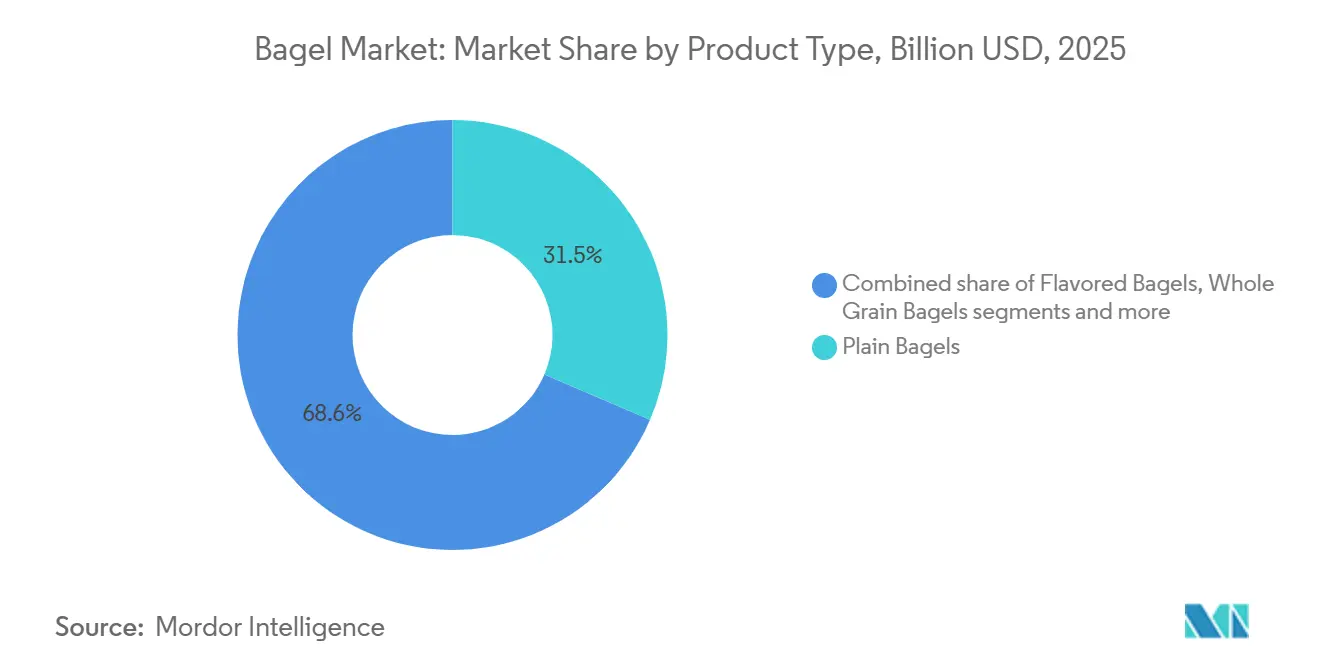
Flavor Innovation Narrows the Gap With PlainPlain bagels represented the largest product type segment in the bagel market, accounting for 31.45% of the market share in 2025. Their leading position is supported by broad consumer acceptance and their suitability across different consumption occasions. Plain bagels are commonly preferred as breakfast items and can be paired with a wide range of spreads, toppings, and fillings. Their neutral flavor profile also makes them versatile for both sweet and savory applications, increasing their appeal among households and foodservice operators. In addition, plain bagels are generally perceived as a familiar and dependable option, supporting consistent demand across retail and foodservice channels. The segment is further strengthened by its availability across fresh, frozen, and packaged formats, enabling manufacturers and retailers to serve diverse consumer preferences.
Flavored bagels are projected to be the fastest-growing product type segment in the bagel market, registering a CAGR of 5.89% through 2031. The segment is benefiting from increasing consumer interest in variety, novel taste experiences, and differentiated bakery products. Manufacturers are expanding their portfolios with flavors that range from savory options, such as cheese, onion, and jalapeño, to sweet varieties incorporating fruits, cinnamon, chocolate, and other ingredients. This growing product innovation is helping flavored bagels appeal to younger consumers and customers seeking alternatives to traditional plain products. The segment is also gaining traction as consumers increasingly look for convenient breakfast and snack options with more distinctive taste profiles.



By Form:
Frozen's Momentum Tests Fresh's Structural DominanceFresh bagels accounted for the largest share of the bagel market by form, representing 67.34% of the market in 2025. Their dominant position is primarily supported by consumer preference for products with a soft texture, fresh taste, and ready-to-eat characteristics. Fresh bagels are widely available through bakeries, cafés, supermarkets, and other foodservice outlets, providing consumers with convenient access across multiple purchasing channels. The segment also benefits from the strong appeal of freshly baked bakery products, particularly among consumers seeking higher perceived quality and freshness. In addition, fresh bagels can be consumed immediately without requiring thawing or extended preparation, which supports their use during breakfast and snack occasions.
Frozen bagels are projected to be the fastest-growing form segment in the bagel market, expanding at a CAGR of 6.42% through 2031. The segment is gaining momentum as consumers increasingly seek convenient bakery products with longer shelf lives and reduced food wastage. Frozen bagels can be stored for extended periods and prepared when required, making them suitable for households with varying consumption patterns. Their convenience is particularly relevant for consumers seeking quick breakfast and snack solutions without the need to purchase fresh products frequently.
By Distribution Channel:
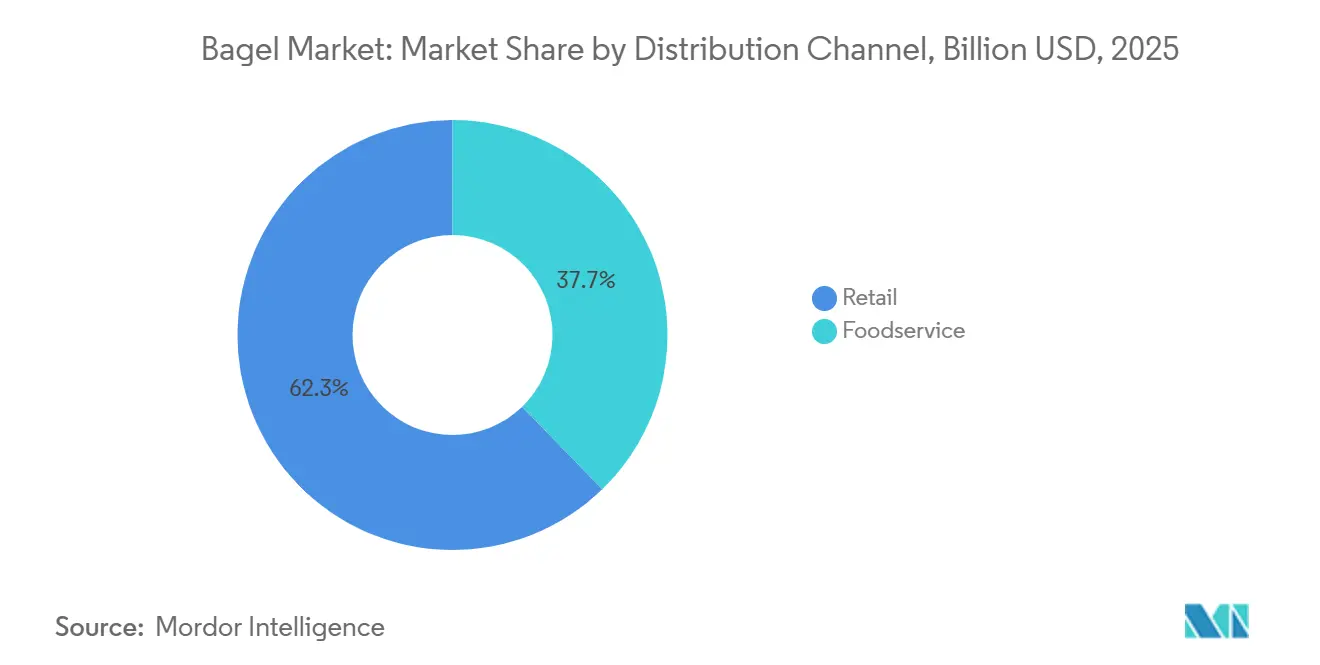
Foodservice Acceleration Reshapes Retail StrategyRetail remained the dominant distribution channel in the bagel market, accounting for 62.27% of the market share in 2025. The channel benefits from the broad availability of bagels through supermarkets, hypermarkets, convenience stores, specialty retailers, and online grocery platforms. Retail distribution enables consumers to purchase bagels for regular household consumption and provides access to a wide variety of product types, forms, flavors, and pack sizes. The growing presence of packaged and frozen bagels in retail outlets is also supporting the channel by extending product availability beyond traditional bakery locations.
Foodservice is projected to be the fastest-growing distribution channel in the bagel market, expanding at a CAGR of 5.78% through 2031. The segment is benefiting from the continued expansion of cafés, quick-service restaurants, bakeries, hotels, and other foodservice establishments that offer bagels as breakfast and snack items. Rising consumer preference for convenient out-of-home eating is increasing demand for ready-to-serve bakery products across foodservice outlets. Bagels are also gaining popularity as versatile menu items that can be served with cream cheese, spreads, meats, vegetables, and other fillings.
Geography Analysis
North America Bagel Market
North America held the dominant position in the bagel market, accounting for 55.47% of the global market share in 2025. The region benefits from the long-established popularity of bagels as a breakfast and snack food, particularly in the United States and Canada. Strong consumer familiarity, widespread bakery and café networks, and the presence of established bagel manufacturers support the region’s market leadership. Bagels are also widely available through supermarkets, convenience stores, foodservice outlets, and online retail platforms, ensuring broad consumer access. In addition, product innovation across flavors, fillings, health-oriented formulations, and frozen formats is helping sustain demand.
APAC Bagel Market
Asia-Pacific is projected to be the fastest-growing regional market for bagels, registering a CAGR of 7.12% through 2031. Growth is being supported by increasing urbanization, rising disposable incomes, and the expansion of Western-style cafés, bakeries, and quick-service restaurants. Changing consumer lifestyles are also increasing demand for convenient breakfast and snack products, creating opportunities for bagels beyond their traditional markets. International bakery chains and local foodservice operators are introducing bagels in new formats and flavors to suit regional preferences.
EMEA and South America Bagel Market
Europe, South America, and the Middle East and Africa represent developing markets for bagels, with growth supported by expanding bakery and café cultures, urbanization, and rising interest in international food products. Europe benefits from its established bakery industry and strong demand for convenient breakfast products, while South America is gradually seeing greater adoption through modern retail and foodservice channels. The Middle East and Africa are also gaining opportunities from the growth of cafés, hotels, tourism, and Western-style foodservice concepts.

Competitive Landscape
The bagel market remains fragmented, with competition distributed among large multinational bakery companies, regional producers, artisan bakeries, specialty food manufacturers, and café chains. Bimbo Bakeries USA, supported by its parent company Grupo Bimbo, holds a strong position through its extensive retail distribution, broad bakery portfolio, and established production capabilities. However, the market does not have a single dominant player controlling the category, allowing regional and specialized competitors to maintain meaningful market positions. Competition is influenced by brand recognition, product variety, distribution reach, freshness, pricing, and the ability to develop differentiated offerings.
Large bakery companies are strengthening their competitive positions by expanding product portfolios across fresh, frozen, flavored, and specialty bagel formats. These players benefit from established supply chains, extensive retail networks, and the ability to achieve economies of scale in production and distribution. At the same time, regional specialists and artisan producers are differentiating themselves through premium ingredients, handcrafted production, unique flavors, and localized brand identities. Specialty café chains are also increasing competition by integrating bagels into broader breakfast and snack menus, while developing scalable store formats.
Investment in premium bagel concepts is also contributing to the evolving competitive landscape, particularly as successful specialty stores demonstrate the potential for expansion through standardized and repeatable operating formats. Smaller brands can build customer loyalty by focusing on product quality, distinctive recipes, customization, and experiential retail environments. Franchise and multi-location expansion models are allowing selected specialty operators to extend their geographic presence while maintaining a consistent brand proposition. Meanwhile, established bakery and foodservice companies continue to leverage their financial resources and distribution infrastructure to defend market share.
Bagel Industry Leaders
Bimbo Bakeries USA, Inc.
Panera Brands, Inc.
Bruegger's Enterprises, Inc.
Lender's Bagels, Inc.
H&H Bagels, LLC
- *Disclaimer: Major Players sorted in no particular order
Bagel Market Companies Covered in this Report
- Bimbo Bakeries USA, Inc.
- Panera Brands, Inc.
- Bruegger's Enterprises, Inc.
- Lender's Bagels, Inc.
- H&H Bagels, LLC
- Manhattan Bagel Company, Inc.
- Bagel Nash Limited
- New York Bakery Company Limited
- Just Bagels Manufacturing, Inc.
- Western Bagel Baking Corp.
- Davidovich Bakery, Inc.
- Vandemoortele UK Ltd.
- The Bagel Factory Ltd.
- Katz Bagel Bakery, Inc.
- Bagel Boss, LLC
- Kettleman's Bagel Co.
- Montreal Bagel Bakery Ltd.
- St-Viateur Bagel & Café, Inc.
- Fairmount Bagel, Inc.
- Bagel World International, Inc.

Recent Industry Developments in Bagel Market
- June 2026: Einstein Bros. Bagels announced plans to open more than 300 new bakeries across the United States by 2030, with the goal of expanding its network to more than 1,000 locations. The expansion relied on the “Elevate the Morning” scalable store prototype, which supported consistent store development and operational scalability, and marked a significant acceleration in the brand’s growth strategy under Panera Brands.
- May 2026: George Weston Foods, a subsidiary of Associated British Foods, acquired New Zealand-based Abe’s Bagels after the brand recorded annual revenue of more than USD 50 million across Australia and New Zealand. The deal expanded ABF’s fresh bakery portfolio in the high-growth Oceania market and strengthened its presence in the regional fresh bakery category.
- January 2026: Panera Bread permanently added Asiago Bagel Stacks to its lunch and dinner menu at USD 7.99 and introduced the Asiago Everything Bagel, the brand’s first new bagel variety since 2014. These launches reinforced Panera Bread’s renewed strategic focus on bakery-led menu differentiation and broadened its bagel-based offerings across dayparts.


Global Bagel Market Report Scope
A bagel is a ring-shaped baked bread product traditionally made from wheat flour, yeast, water, salt, and sometimes sweeteners. The bagel market is segmented by product type, form, distribution channel and geography. Based on product type, the market is segmented into plain bagels, flavored bagels, whole grain bagels and other product types. Based on form, the market is segmented into fresh and frozen. By distribution channel, the market is segmented into retail and foodservice. For each segment, the market sizing and forecasting have been done in value terms (USD) and volume (Tons).
| Plain Bagels |
| Flavored Bagels |
| Whole Grain Bagels |
| Other Product Types |
| Fresh |
| Frozen |
| Retail | Supermarkets/Hypermarkets |
| Convenience Stores | |
| Online Retail Stores | |
| Other Distribution Channels | |
| Foodservice |
| North America | United States |
| Canada | |
| Mexico | |
| Rest of North America | |
| Europe | Germany |
| United Kingdom | |
| Italy | |
| France | |
| Spain | |
| Netherlands | |
| Poland | |
| Belgium | |
| Sweden | |
| Rest of Europe | |
| Asia-Pacific | China |
| India | |
| Japan | |
| Australia | |
| Indonesia | |
| South Korea | |
| Thailand | |
| Singapore | |
| Rest of Asia-Pacific | |
| South America | Brazil |
| Argentina | |
| Colombia | |
| Chile | |
| Peru | |
| Rest of South America | |
| Middle East & Africa | South Africa |
| Saudi Arabia | |
| United Arab Emirates | |
| Nigeria | |
| Egypt | |
| Morocco | |
| Turkey | |
| Rest of Middle East and Africa |
| By Product Type | Plain Bagels | |
| Flavored Bagels | ||
| Whole Grain Bagels | ||
| Other Product Types | ||
| By Form | Fresh | |
| Frozen | ||
| By Distribution Channel | Retail | Supermarkets/Hypermarkets |
| Convenience Stores | ||
| Online Retail Stores | ||
| Other Distribution Channels | ||
| Foodservice | ||
| By Geography | North America | United States |
| Canada | ||
| Mexico | ||
| Rest of North America | ||
| Europe | Germany | |
| United Kingdom | ||
| Italy | ||
| France | ||
| Spain | ||
| Netherlands | ||
| Poland | ||
| Belgium | ||
| Sweden | ||
| Rest of Europe | ||
| Asia-Pacific | China | |
| India | ||
| Japan | ||
| Australia | ||
| Indonesia | ||
| South Korea | ||
| Thailand | ||
| Singapore | ||
| Rest of Asia-Pacific | ||
| South America | Brazil | |
| Argentina | ||
| Colombia | ||
| Chile | ||
| Peru | ||
| Rest of South America | ||
| Middle East & Africa | South Africa | |
| Saudi Arabia | ||
| United Arab Emirates | ||
| Nigeria | ||
| Egypt | ||
| Morocco | ||
| Turkey | ||
| Rest of Middle East and Africa | ||


Key Questions Answered in the Report
What is the projected value of the bagel market by 2031?
The category is forecast to reach USD 7.89 billion by 2031, growing at a 5.14% CAGR from 2026.
Which product type leads global bagel sales?
Plain bagels led with 31.45% share in 2025 because they work with sweet and savory toppings.
Why are frozen bagels growing faster than fresh products?
Frozen bagels are forecast to grow at a 6.42% CAGR because they reduce waste, simplify inventory, and improve access where fresh supply is limited.
Which sales channel is growing fastest for bagels?
Foodservice is the fastest-growing channel, with a projected 5.78% CAGR through 2031.
Page last updated on:





