
B2B Autonomous Commerce Software Market Size and Share
Market Overview
| Study Period | 2020 - 2031 |
|---|---|
| Market Size (2026) | USD 10.21 Billion |
| Market Size (2031) | USD 28.96 Billion |
| Growth Rate (2026 - 2031) | 23.18 % |
| Fastest Growing Market | Asia-Pacific |
| Largest Market | North America |
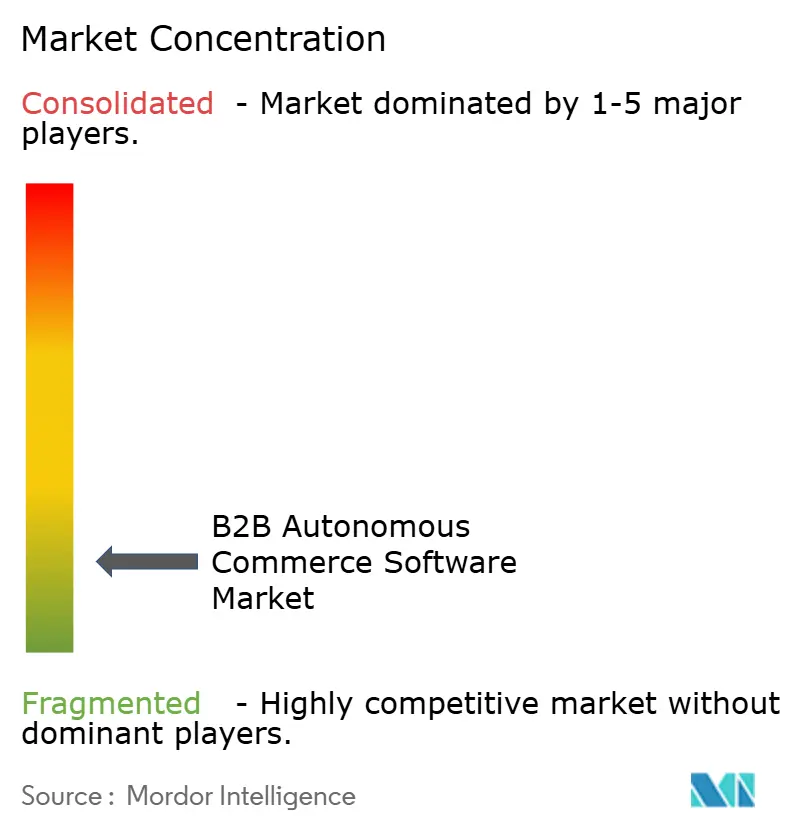
| Market Concentration | Low |
Major Players *Disclaimer: Major Players sorted in no particular order Image © Mordor Intelligence. Reuse requires attribution under CC BY 4.0. | |
B2B Autonomous Commerce Software Market Analysis by Mordor Intelligence
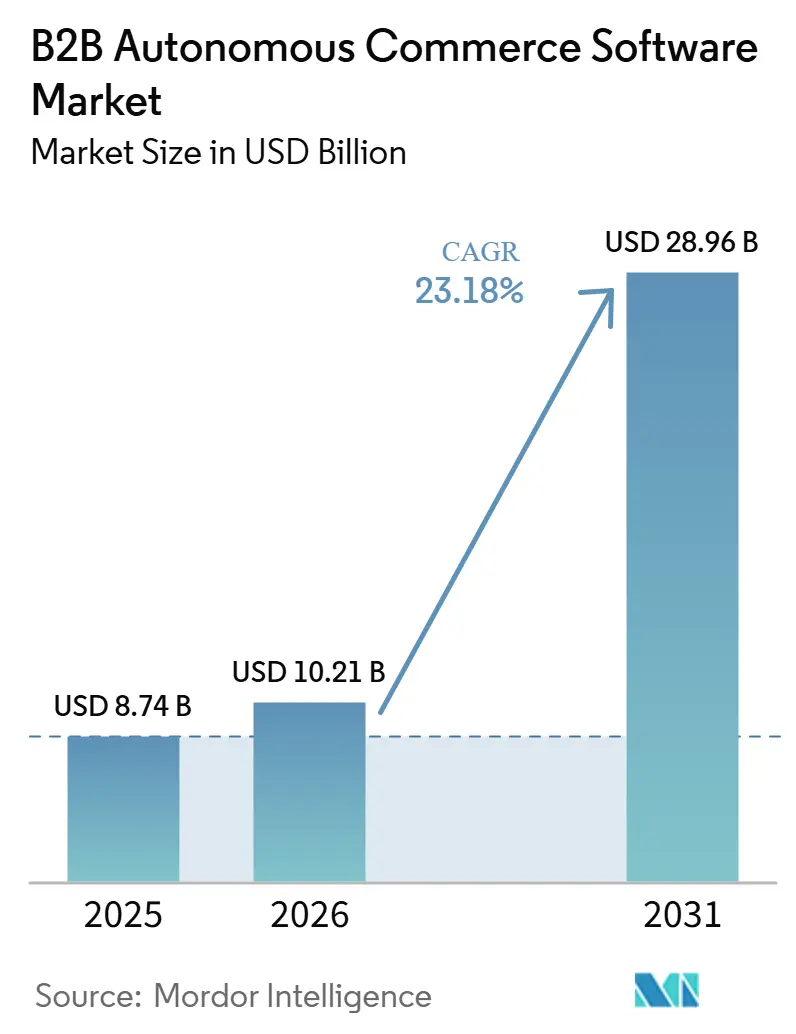
The B2B Autonomous Commerce Software Market size is expected to grow from USD 8.74 billion in 2025 to USD 10.21 billion in 2026 and is forecast to reach USD 28.96 billion by 2031 at 23.18% CAGR over 2026-2031. Growth reflects enterprise demand to automate repetitive commercial work across procurement, payments, order handling, and supplier coordination without matching increases in staffing, particularly in high-volume processes where staff spend time checking routine requests, matching documents, or moving information between systems. Companies are favoring platforms that integrate workflows, enterprise resource planning systems, and transaction execution in a single environment, since isolated tools can leave the same commercial process dependent on separate approvals, disconnected data, and manual handoffs. This is increasing pressure on narrowly focused providers that lack integration depth, even where those providers offer strong capabilities for a single step, such as sourcing, quote creation, payment matching, or fulfillment. The B2B Autonomous Commerce Software Market also benefits as buyers move from legacy electronic data interchange channels toward application programming interface-ready commerce channels. Implementation complexity, compliance demands, and limited negotiated-pricing data still slow some deployments, especially where older systems remain central to operations.
Key Report Takeaways
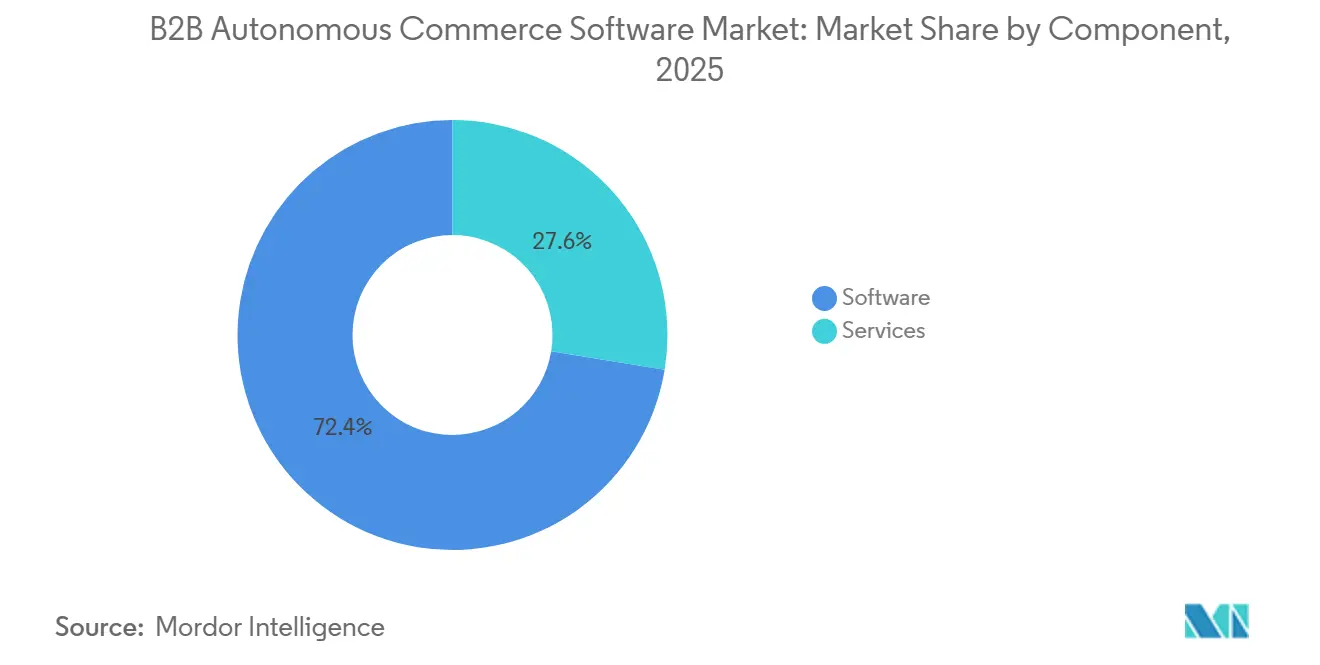
- By component, software held 72.41% of the B2B Autonomous Commerce Software Market in 2025, while services are projected to expand at a 26.83% CAGR through 2031.
- By deployment model, cloud held a 74.18% share in the B2B Autonomous Commerce Software Market in 2025, while hybrid is projected to expand at a 25.42% CAGR through 2031.
- By enterprise size, large enterprises accounted for 68.42% of the market share in 2025, while small and medium-sized enterprises are projected to expand at a 27.16% CAGR through 2031.
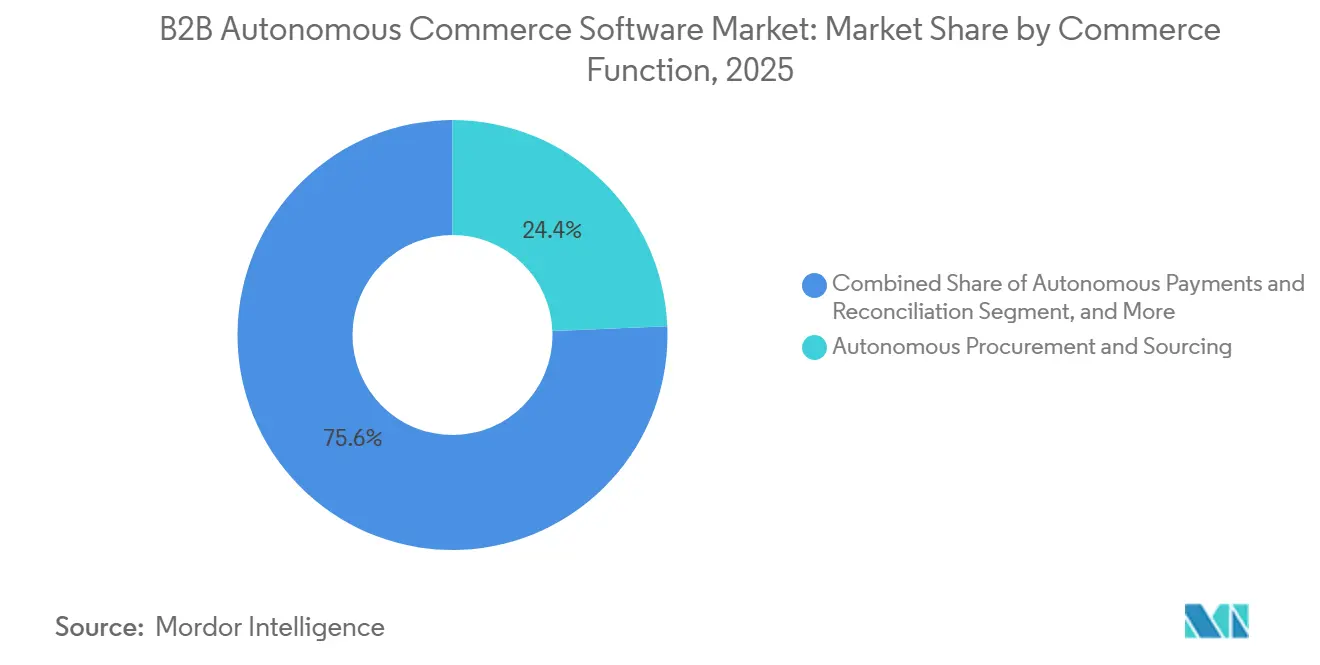
- By commerce function, autonomous procurement and sourcing held 24.36% share in the B2B Autonomous Commerce Software Market 2025, while autonomous payments and reconciliation are projected to expand at a 28.74% CAGR through 2031.
- By end user, retail and e-commerce held 22.19% share in 2025, while healthcare and life sciences are projected to expand at a 26.91% CAGR through 2031.
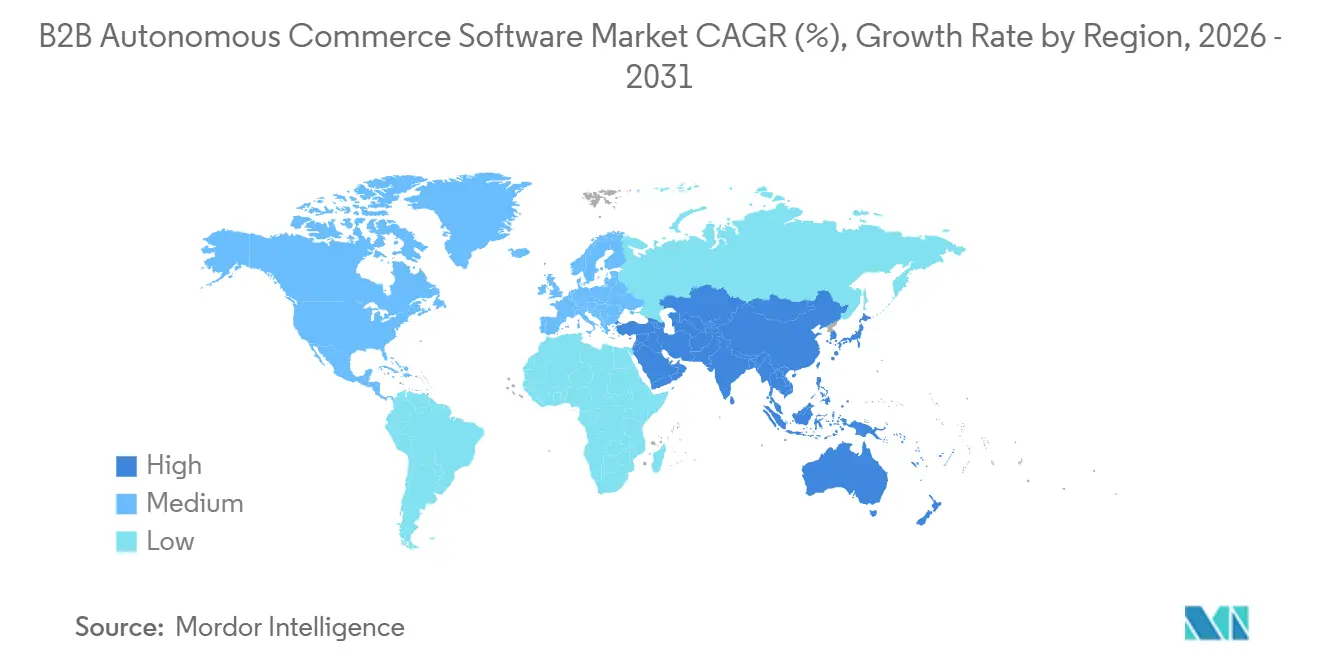
- By geography, North America held 36.73% share in 2025, while Asia-Pacific is projected to expand at a 27.84% CAGR through 2031.
Note: Market size and forecast figures in this report are generated using Mordor Intelligence’s proprietary estimation framework, updated with the latest available data and insights as of January 2026.
Market Trends and Insights
Drivers Impact Analysis of B2B Autonomous Commerce Software Market*
| Driver | (~) % Impact on CAGR Forecast | Geographic Relevance | Impact Timeline |
|---|---|---|---|
| Enterprise Demand for Hyper-Automation and Cost Efficiency | +5.8% | Global | Short term (≤ 2 years) |
| Rapid Advances in Large Language Models and Tool Orchestration | +5.2% | Global | Short term (≤ 2 years) |
| Cloud Infrastructure Expansion and Lower Inference Costs | +4.1% | North America and Europe, Asia-Pacific core | Medium term (2-4 years) |
| ERP Modernization and API-Ready B2B Transaction Channels | +3.4% | North America and Europe | Medium term (2-4 years) |
| Machine-Readable Commercial Data as a Competitive Requirement | +2.3% | Global, North America and European Union early movers | Long term (≥ 4 years) |
| Autonomous Exception Resolution for High-Volume, Long-Tail Orders | +1.9% | Global | Medium term (2-4 years) |
| Source: Mordor Intelligence | |||
Enterprise Demand for Hyper-Automation and Cost Efficiency
Labor cost pressure in procurement and order management has made the case for automation clearer for finance and operations leaders. Manual B2B buying processes can create poor customer experiences and lost sales opportunities, which increases the value of faster, more reliable transactions. A global manufacturer automated 75% of procurement work that it had previously outsourced within 6 months after deploying Lio Technologies' AI-native procurement workforce. The focus is not limited to lower labor costs, as faster invoice processing can improve cash collection and supplier coordination, while fewer manual exceptions can give teams more time to address unusual orders and supplier issues that require judgment. The B2B Autonomous Commerce Software Market is therefore attracting attention from finance leaders who need measurable improvements in cash cycles and procurement productivity. Providers that show both types of value are better placed than those competing only on the number of features.
Rapid Advances in Large Language Models and Tool Orchestration
Specialized agents can now handle supplier discovery, bid analysis, contract review, and exception routing under a coordinating layer. This approach reduces the limits of earlier rules-based procurement tools, which were most effective only when data fields were consistent and each decision could be expressed through predefined conditions. Agents that can work with unstructured documents, product catalogs, and pricing information extend automation into areas that were too variable for fixed logic. SAP introduced its Autonomous Enterprise vision and SAP Autonomous Suite in May 2026, including Joule assistants for procurement and sourcing within its enterprise software environment.[1]SAP SE, “Advanced AI Solutions for Procurement,” SAP, sap.com The B2B Autonomous Commerce Software Market is benefiting as larger platform providers add agent capabilities to systems already used for core commercial operations. Faster improvements in model capabilities are also shortening product release cycles and reducing the time vendors have to sustain a technical lead.
Cloud Infrastructure Expansion and Lower Inference Costs
Lower costs for running AI models make automation more practical for smaller transactions and lower-margin procurement categories. This broadens the commercial case beyond the highest-value purchasing decisions, including recurring small-ticket orders and tail-spend categories that had not justified extensive manual attention or custom automation work. Hybrid deployments let vendors run agents in cloud environments while connecting to transaction data held in on-premises enterprise systems. That model matters for companies that cannot complete a full cloud enterprise resource planning migration in the near term. The B2B Autonomous Commerce Software Market is seeing greater demand for platforms with connectors that support both cloud-native and on-premises systems. Such flexibility can help vendors serve enterprises with partially modernized technology estates that pure software-as-a-service offerings may not reach.
ERP Modernization and API-Ready B2B Transaction Channels
The move from monolithic enterprise resource planning systems to API-first integration is creating a stronger foundation for autonomous agents. Companies completing moves to SAP S/4HANA can use governed data access, published interfaces, and event-based connectivity for agent workflows. Suppliers are supporting more channels, including self-service portals, electronic data interchange alternatives, and application programming interfaces, as buyer needs become more varied. This allows agents to collect bids, assess suppliers, and place orders with less manual work, while giving enterprise teams a clearer record of the information and rules used at each stage of the transaction. The B2B Autonomous Commerce Software Market gains when master data becomes readable across supplier histories, contract terms, and pricing records. Companies that complete interface modernization sooner can deploy agents faster than those that still rely on older middleware.
Restraints Impact Analysis of B2B Autonomous Commerce Software Market*
| Restraint | (~) % Impact on CAGR Forecast | Geographic Relevance | Impact Timeline |
|---|---|---|---|
| High Implementation Costs and Legacy Integration Challenges | -3.8% | Global | Short term (≤ 2 years) |
| Data Privacy, Cybersecurity, and Regulatory Uncertainty | -3.2% | European Union-led, global spillover | Medium term (2-4 years) |
| Sparse Training Data for Negotiated B2B Pricing and Contract Terms | -2.1% | Global | Medium term (2-4 years) |
| Low-Trust Failure Modes in Multi-Party Autonomous Transactions | -1.5% | Global | Medium term (2-4 years) |
| Source: Mordor Intelligence | |||
High Implementation Costs and Legacy Integration Challenges
Connecting autonomous agents to enterprise resource planning systems, supplier portals, contract repositories, and payment systems remains a major barrier to adoption. Many of these systems were not built for machine-readable application programming interface access. Older systems can require custom adapters, manual electronic data interchange mapping, and product taxonomy work, which can lengthen deployment from weeks to quarters. The burden is often heavier for small and medium-sized enterprises because integration spending represents a larger share of their first-year software cost, and these organizations may have fewer staff who understand both purchasing processes and older enterprise software environments. The B2B Autonomous Commerce Software Market is responding with prebuilt connectors, standardized onboarding, and outcome-based pricing. Even so, implementation work remains a material constraint for many organizations considering their first deployment.
Data Privacy, Cybersecurity, and Regulatory Uncertainty
A compromised autonomous agent could create fraudulent purchase orders or redirect payments before conventional monitoring identifies the problem. The risk grows when agents work across several parties and systems. The European Union AI Act requires risk management, documentation, traceability, and human oversight for systems within its scope, while its requirements are phased in over time. NIS2 and the Digital Operational Resilience Act also increase security and vendor-management obligations for affected organizations. The B2B Autonomous Commerce Software Market must meet these governance demands while addressing the underlying transaction-level exposure created by machine-led decisions. Compliance reviews can lengthen vendor onboarding and increase deployment costs for buyers and providers.[2]European Parliament and Council, “Regulation (EU) 2024/1689,” EUR-Lex, eur-lex.europa.eu
*Our forecasts treat driver/restraint impacts as directional, not additive. The impact forecasts reflect baseline growth, mix effects, and variable interactions.
B2B Autonomous Commerce Software Market Segment Analysis
By Component:
Software Leads the Platform Layer While Services Support Enterprise DeploymentSoftware held 72.41% of the B2B Autonomous Commerce Software Market share in 2025. Enterprises commonly begin with licensed modules for procurement, order management, or payments before adding services for configuration and integration. This platform-first approach reflects a preference for reusable capabilities rather than fully custom builds, because organizations can begin with a defined workflow and extend the deployment after early operating results are established, and the defined workflow may focus on a specific purchasing category, a recurring order process, or a limited group of suppliers before the same operating model is applied more widely. Services are projected to expand at a 26.83% CAGR through 2031. The faster growth of services shows that production deployments still require substantial work across enterprise resource planning systems, supplier networks, payment rails, contract repositories, and internal approval processes that were often developed independently.
Implementation, consulting, and managed services help organizations move beyond pilots that might otherwise stall at the integration stage. GEP Worldwide and JAGGAER are among the providers supporting this work through their software offerings. Labviva launched The Agentic Crew in June 2026, combining specialized small language models and a coordinating model for life sciences research and development procurement. Its design includes compliance and auditability requirements from the start. As enterprise programs expand, the B2B Autonomous Commerce Software Market is likely to see services support ongoing model governance and enterprise resource planning synchronization.[3]Labviva, “Labviva Launches The Agentic Crew, A Purpose-Built AI Architecture to Transform Procurement in Regulated Industries,” Labviva, globenewswire.com


By Deployment Model:
Cloud Holds the Largest Base While Hybrid Gains GroundCloud accounted for 74.18% of the B2B Autonomous Commerce Software Market share in 2025. Its lead reflects the speed of software-as-a-service deployment and subscription pricing that avoids large initial infrastructure costs. Cloud systems also allow organizations to scale agent use as transaction volumes increase, while hybrid is projected to expand at a 25.42% CAGR through 2031. This reflects the needs of enterprises that retain significant on-premises enterprise resource planning investments and cannot move their systems of record fully to the public cloud in the near term, and their new services need to work with established records, approval paths, and security controls rather than requiring those processes to be rebuilt before automation begins.
Hybrid systems can pair cloud-based agents with access to transaction data maintained in local environments. This arrangement preserves connectivity to older systems while allowing new automation services to be introduced without requiring changes to the core recordkeeping system or disrupting established transaction controls. European data sovereignty requirements are also encouraging interest in European Union-hosted and on-premises options. German providers such as mysupply, Procuras, and Valora have positioned their offerings around data remaining in the European Union. On-premises deployment remains the smallest model, but it is important in defense, regulated financial services, and public procurement. The B2B Autonomous Commerce Software Market, therefore, needs deployment options that align with both modernization plans and local data regulations.
By Enterprise Size:
Large Enterprises Hold the Base While SMEs Form the Growth FrontierLarge enterprises held 68.42% of the B2B Autonomous Commerce Software Market share in 2025. Their scale, available data, and integration resources support deployments across complex supplier networks. Small and medium-sized enterprises are projected to expand at a 27.16% CAGR through 2031. No-code workflow builders, preconfigured agent templates, and usage-based pricing are lowering entry barriers for these buyers, enabling procurement teams to start with repeatable tasks and adapt the workflow as internal confidence, data availability, and supplier participation improve. The changing product model reduces the extent to which initial deployment depends on a large internal procurement technology team, which is important for smaller organizations that lack dedicated integration centers or large data-management groups.
JPMorgan Chase Institute reported that the 2025 small-business adoption cohort reached 10% AI service use within 6 months, compared with 77 months for the 2019 cohort. The Institute also found that 26.1% of small employer firms had adopted AI services by December 2025.[4]JPMorgan Chase Institute, “Understanding the Use of AI Among Small Businesses,” JPMorgan Chase Institute, jpmorganchase.com This supports demand for procurement and order management tools across professional services, retail, and manufacturing. Coupa Software, GEP Worldwide, and JAGGAER compete by offering deeper enterprise integration and broader supplier network reach. Procol Technologies, Mercanis, and Keelvar compete more directly on speed to value and total ownership cost for smaller organizations.
By Commerce Function:
Procurement Holds the Largest Base While Payments Grow FastestAutonomous procurement and sourcing accounted for 24.36% of the B2B Autonomous Commerce Software Market share in 2025. E-sourcing and spend-management platforms have accumulated supplier transaction information for many years. Providers are using this information for autonomous negotiation and bid analysis, allowing prior supplier behavior, contract conditions, and purchasing records to be considered in workflows that previously relied on manual review. Autonomous payments and reconciliation are projected to expand at a 28.74% CAGR through 2031. AI-supported cash application, programmable payment networks, and real-time invoice matching address reconciliation workloads that consume finance-team time in high-volume environments, which is especially relevant where payment information, invoice details, dispute records, and enterprise resource planning entries are reviewed in separate systems.
Ordway launched Ordway Payments in July 2026 to automate invoice-to-cash work, including cash application, dispute resolution, and enterprise resource planning posting. This focus reflects the continuing reconciliation burden in finance operations. Autonomous sales and quoting, as well as order capture and order execution, are also expanding as manufacturers and distributors use configure-price-quote agents. commercetools and Mirion Technologies announced a partnership in June 2026 to develop an AI-supported capability that converts unstructured order requests into quotes and carts for complex industrial products. Pricing, promotion, contract compliance, replenishment, and fulfillment tools connect demand signals, contractual terms, and inventory positions more quickly, extending automation from commercial decision-making into supply-chain execution.

By End User:
Retail Holds the Largest Share While Healthcare and Life Sciences Lead GrowthRetail and e-commerce held 22.19% of the B2B Autonomous Commerce Software Market share in 2025. Its position reflects high procurement volumes across retail supply chains and the value of autonomous order routing, replenishment, and supplier exception handling. The healthcare and life sciences industry is projected to expand at a 26.91% CAGR through 2031. The segment combines strict procurement controls with pressure to shorten manual sourcing cycles for clinical and research supplies, and buyers need systems that preserve the information needed for review when product requirements, supplier qualifications, and approval conditions are more detailed than in general purchasing. These requirements favor tools that can combine automation with compliance and clear audit records, rather than generic systems that treat regulatory controls as a later configuration task.
Labviva's June 2026 product launch illustrates the demand for vertical systems built for regulated procurement. Information technology and telecommunications, banking, financial services and insurance, automotive and transportation, and industrial manufacturing also have large transaction-heavy procurement operations. Banking, financial services, and insurance serve both as end users and as enablers of programmable payment networks. Government, education and research, energy and utilities, and other users are at an earlier stage because governance rules often require human approval thresholds. The B2B Autonomous Commerce Software Market may expand in these areas as governance practices for agent systems become more established.
Geography Analysis
North America B2B Autonomous Commerce Software Market
North America held 36.73% of the B2B Autonomous Commerce Software Market share in 2025. The region has a high concentration of enterprise software buyers, agent-focused startups, and companies with established procurement technology systems, and the United States has the largest number of deployments across source-to-pay, order management, and agent-supported payments. Coupa Software and GEP Worldwide have built buyer and supplier networks from substantial North American enterprise customer bases. Canada and Mexico add demand from manufacturing and automotive supply chains, where cross-border procurement creates a need for invoice reconciliation and multi-currency payment management.
Europe and South America B2B Autonomous Commerce Software Market
Europe is a sizable but distinct regional environment for the B2B Autonomous Commerce Software Market. European Union compliance requirements are shaping product design around auditability, traceability, and human override functions. The European Union AI Act and NIS2 are increasing the importance of governance and supply-chain security features, while data sovereignty has led German and nearby buyers to examine whether procurement platforms keep data within the European Union. Germany is the largest European market and has an underpenetrated base of small- and medium-sized industrial manufacturers. The United Kingdom and France are growing deployment markets, while Brazil supports South American demand through manufacturing and agribusiness exports that work with multilingual, multi-currency suppliers.
APAC and MEA B2B Autonomous Commerce Software Market
Asia-Pacific is projected to expand at a 27.84% CAGR through 2031. Growth is supported by enterprise resource planning cloud migration in India and Southeast Asia, public digital procurement programs, and export-oriented companies managing multi-currency trade. India is both an end-user market and a development base for agent-led procurement software, including Procol Technologies, while China has a large manufacturing base and growing B2B digital commerce infrastructure, although data localization rules affect cross-border platform designs. Saudi Arabia and the United Arab Emirates are pursuing government-led enterprise digitization and procurement modernization. South Africa and Nigeria are emerging commercial hubs where mobile-first enterprise platforms are reducing implementation barriers.

Competitive Landscape
The B2B Autonomous Commerce Software Market is fragmented, with different supplier groups serving separate parts of the commercial workflow. Coupa Software, GEP Worldwide, and JAGGAER have installed-base advantages from long-running source-to-pay contracts with global buyers. Their strategies increasingly add agent coordination to existing supplier network capabilities. Coupa Software acquired Tonkean in May 2026, adding more than 250 native connectors, a no-code process builder, and multi-agent orchestration capabilities. The company stated that the acquisition expanded its ability to automate workflows from initial requests to final payment, showing how established platforms can buy agent capabilities rather than develop every function internally.
commercetools introduced the Autonomous Commerce category and Sphere platform in June 2026. Its Agentic Commerce Suite, developed with Stripe, is intended to govern pricing, promotions, and fulfillment decisions in real time. The company also announced modular offerings in July 2026 for cart, order management, and product catalog functions. This approach allows enterprises to adopt specific functions without a full platform migration, while opportunities remain in small and medium-sized enterprise procurement, cross-border payment reconciliation, and vertical tools designed for regulated sectors. These areas do not yet have a clearly dominant supplier.
Lio Technologies, Go Autonomous, Mercanis, Didero, and Keelvar compete through rapid deployment and the depth of language-model-enabled action. Their differentiation centers on agent coordination, enterprise resource planning connectors, and the ability to process requests for quotation, contracts, invoices, and shipping notices without fully structured inputs. Keelvar combines sourcing optimization across large numbers of award scenarios with autonomous execution, an approach relevant to complex sourcing where rules-based tools struggled and human analysts had been essential. SAP is also building procurement AI through Joule and its broader Autonomous Suite, and its enterprise transaction data can support a durable advantage, while newer providers may respond by finding alternative data sources or specializing in spend categories where enterprise resource planning data is limited.
B2B Autonomous Commerce Software Industry Leaders
commercetools GmbH
Coupa Software Incorporated
GEP Worldwide LLC
Spryker Systems GmbH
VTEX, Inc.
- *Disclaimer: Major Players sorted in no particular order
B2B Autonomous Commerce Software Market Companies Covered in this Report
- commercetools GmbH
- Spryker Systems GmbH
- Oro Inc.
- Sana Commerce B.V.
- VTEX, Inc.
- Go Autonomous ApS
- Lio Technologies GmbH
- Procure Technologies, Inc.
- Mercanis GmbH
- Didero, Inc.
- Zinit GmbH
- Procol Technologies Private Limited
- Keelvar, Inc.
- GEP Worldwide LLC
- Coupa Software Incorporated
- JAGGAER, LLC
- Zycus Inc.
- Punchout2Go
- KIBO Commerce, Inc.
- Tacton Systems AB
- CommerceFlow, Inc.
- Endless Commerce, Inc.

Recent Industry Developments in B2B Autonomous Commerce Software Market
- July 2026: Ordway launched Ordway Payments, a comprehensive AI-powered payments platform unifying billing and payments into a single application that automates the full invoice-to-cash lifecycle, including AI-powered cash application, dispute resolution, and ERP posting. The platform is designed to eliminate the manual reconciliation burden that persists in enterprise finance operations despite prior automation investments, positioning automated cash application as a commodity capability rather than a differentiated feature.
- July 2026: commercetools launched standalone modular commerce offerings for cart, order management, and product catalog, enabling enterprises to adopt individual autonomous commerce capabilities incrementally without a full platform migration or replatform. The announcement continued the company's strategy of reducing commercial and technical barriers to digital commerce modernization for large enterprises with existing platform investments.
- June 2026: commercetools launched commercetools for Builders and the Commerce Integration Layer, reducing enterprise digital commerce deployment timelines from months to days by simplifying development and third-party integration complexity using AI-assisted developer tooling. The Commerce Integration Layer was announced for later availability in 2026, enabling faster connection to third-party systems as a foundation for autonomous agent workflows.
- June 2026: commercetools announced a co-design partnership with Mirion Technologies to develop an AI-powered capability converting unstructured customer order requests into ready-to-action quotes and carts. The partnership advances the autonomous B2B order capture vision for complex industrial products and builds on commercetools' Autonomous Commerce platform strategy unveiled at Shoptalk Europe in June 2026.


Global B2B Autonomous Commerce Software Market Report Scope
The B2B autonomous commerce software market refers to the ecosystem of software solutions and associated services that leverage artificial intelligence, machine learning, and advanced automation to execute complex business-to-business transactions with minimal to no human intervention. This market encompasses a wide array of commerce functions designed to create a self-driving commercial lifecycle, including autonomous procurement and sourcing, automated sales quoting, order capture and execution, dynamic pricing and contract compliance, automated inventory replenishment, and self-driving payment reconciliation. Deployed across cloud, hybrid, or on-premises models, these solutions cater to organizations of varying sizes across diverse industries, including manufacturing, IT, BFSI, and automotive. By eliminating manual bottlenecks in the order-to-cash and procure-to-pay cycles, B2B autonomous commerce software enables organizations to operate continuously, drastically reduce operational costs, minimize human error, respond to supply-and-demand fluctuations in real time, and scale their commercial operations efficiently in an increasingly digital, fast-paced B2B landscape.
The B2B Autonomous Commerce Software Market Report is Segmented by Component (Software, and Services), Deployment Model (Cloud, Hybrid, and On-Premises), Enterprise Size (Large Enterprises, and Small and Medium-Sized Enterprises), Commerce Function (Autonomous Procurement and Sourcing, Autonomous Sales and Quoting, Order Capture and Order Execution, Pricing, Promotion, and Contract Compliance, Inventory Replenishment and Fulfillment, and Autonomous Payments and Reconciliation), End User (IT and Telecommunication, BFSI, Automotive and Transportation, Healthcare and Life Sciences, Retail and E-Commerce, Industrial Manufacturing, Education and Research Institutions, Government and Administration, Energy and Utilities, and Other End Users), and Geography (North America, South America, Europe, Asia-Pacific, and Middle East and Africa). The Market Forecasts are Provided in Terms of Value (USD).
| Software |
| Services |
| Cloud |
| Hybrid |
| On-Premises |
| Large Enterprises |
| Small and Medium-Sized Enterprises |
| Autonomous Procurement and Sourcing |
| Autonomous Sales and Quoting |
| Order Capture and Order Execution |
| Pricing, Promotion, and Contract Compliance |
| Inventory Replenishment and Fulfillment |
| Autonomous Payments and Reconciliation |
| IT and Telecommunication |
| BFSI |
| Automotive and Transportation |
| Healthcare and Life Sciences |
| Retail and E-Commerce |
| Industrial Manufacturing |
| Education and Research Institutions |
| Government and Administration |
| Energy and Utilities |
| Other End Users |
| North America | United States | |
| Canada | ||
| Mexico | ||
| South America | Brazil | |
| Argentina | ||
| Rest of South America | ||
| Europe | Germany | |
| United Kingdom | ||
| France | ||
| Russia | ||
| Spain | ||
| Rest of Europe | ||
| Asia-Pacific | China | |
| Japan | ||
| India | ||
| South Korea | ||
| Southeast Asia | ||
| Rest of Asia-Pacific | ||
| Middle East and Africa | Middle East | Saudi Arabia |
| United Arab Emirates | ||
| Rest of Middle East | ||
| Africa | South Africa | |
| Nigeria | ||
| Rest of Africa | ||
| By Component | Software | ||
| Services | |||
| By Deployment Model | Cloud | ||
| Hybrid | |||
| On-Premises | |||
| By Enterprise Size | Large Enterprises | ||
| Small and Medium-Sized Enterprises | |||
| By Commerce Function | Autonomous Procurement and Sourcing | ||
| Autonomous Sales and Quoting | |||
| Order Capture and Order Execution | |||
| Pricing, Promotion, and Contract Compliance | |||
| Inventory Replenishment and Fulfillment | |||
| Autonomous Payments and Reconciliation | |||
| By End User | IT and Telecommunication | ||
| BFSI | |||
| Automotive and Transportation | |||
| Healthcare and Life Sciences | |||
| Retail and E-Commerce | |||
| Industrial Manufacturing | |||
| Education and Research Institutions | |||
| Government and Administration | |||
| Energy and Utilities | |||
| Other End Users | |||
| By Geography | North America | United States | |
| Canada | |||
| Mexico | |||
| South America | Brazil | ||
| Argentina | |||
| Rest of South America | |||
| Europe | Germany | ||
| United Kingdom | |||
| France | |||
| Russia | |||
| Spain | |||
| Rest of Europe | |||
| Asia-Pacific | China | ||
| Japan | |||
| India | |||
| South Korea | |||
| Southeast Asia | |||
| Rest of Asia-Pacific | |||
| Middle East and Africa | Middle East | Saudi Arabia | |
| United Arab Emirates | |||
| Rest of Middle East | |||
| Africa | South Africa | ||
| Nigeria | |||
| Rest of Africa | |||


Key Questions Answered in the Report
What is the size of the B2B Autonomous Commerce Software Market?
It is projected to increase from USD 10.21 billion in 2026 to USD 28.96 billion by 2031, at a 23.18% CAGR.
What is driving adoption of autonomous commerce software?
Enterprises use it to automate procurement, payments, order management, and supplier processes.
Which component holds the largest share?
Software held 72.41% share in 2025, while services is projected to grow at a 26.83% CAGR through 2031.
Which commerce function is growing fastest?
Autonomous payments and reconciliation is projected to expand at a 28.74% CAGR through 2031.
Which region is expanding the fastest?
Asia-Pacific is projected to expand at a 27.84% CAGR through 2031.
What limits adoption of autonomous commerce software?
Legacy integration, cybersecurity exposure, data privacy requirements, and regulatory obligations can delay deployments.
Page last updated on:


 Your data is secure and never sold or shared.


