
Auxins Market Size and Share
Market Overview
| Study Period | 2022 - 2032 |
|---|---|
| Market Size (2027) | USD 693.75 Million |
| Market Size (2032) | USD 924.02 Million |
| Growth Rate (2027 - 2032) | 5.90 % |
| Fastest Growing Market | South America |
| Largest Market | Asia-Pacific |
| Market Concentration | Medium |
Major Players *Disclaimer: Major Players sorted in no particular order Image © Mordor Intelligence. Reuse requires attribution under CC BY 4.0. | |
Auxins Market Analysis by Mordor Intelligence
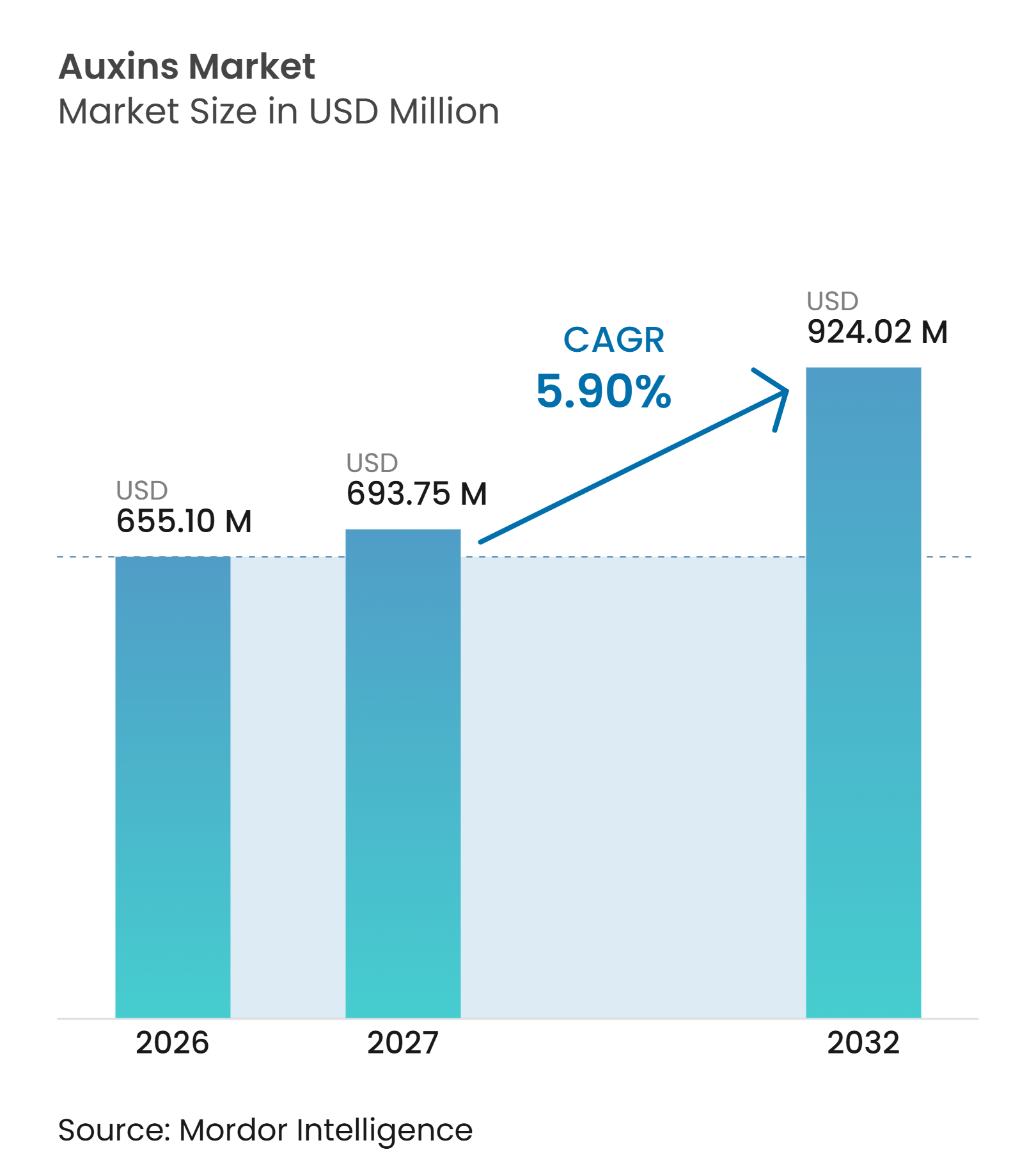
The auxins market size was valued at USD 655.10 million in 2026 and is forecast to grow from USD 693.75 million in 2027 to USD 924.02 million by 2032, at a CAGR of 5.90% during the forecast period 2027 to 2032. Market growth is supported by the increasing use of plant growth regulators to improve root development, fruit set, fruit size, and crop uniformity across field crops, horticulture, nurseries, and tissue culture applications. Demand for auxin-based herbicides is also supported by the need for alternative weed management solutions as resistance to commonly used herbicide groups, including glyphosate and acetolactate synthase (ALS) inhibitors, reduces their effectiveness against certain broadleaf weeds. The expansion of controlled-environment agriculture and protected cultivation further supports demand for auxins in plant propagation, rooting, and nursery production, where consistent growth and uniformity are important. Manufacturers are focusing on formulation improvements, application-specific product development, and technical support to address demand across agricultural and horticultural applications. However, market growth remains influenced by regulatory requirements, product registration costs, and competition from alternative crop protection and plant growth management solutions.
Key Report Takeaways
- By type, synthetic auxins were the largest segment and held 44.8% of the auxins market share in 2026, and are also forecast to grow at a CAGR of 10.2% from 2027 to 2032.
- By formulation, liquid formulations were the largest segment and held 33.9% of the auxins market size in 2026, while they are also forecast to grow at a CAGR of 6.9% from 2027 to 2032.
- By crop type, fruits and vegetables were the largest segment and held 36.0% of the market share in 2026, while they are also forecast to grow at a CAGR of 7.6% from 2027 to 2032.
- By geography, Asia-Pacific was the largest segment and held 35.3% of the market share in 2026, while South America is forecast to grow at a CAGR of 7.4% from 2027 to 2032.
Note: Market numbers in this report are based on Mordor Intelligence's proprietary estimation framework, which combines nine months of actuals with Q4 projections for base year 2026.
Market Trends and Insights
Drivers Impact Analysis of Auxins Market*
| Driver | (~) % Impact on CAGR Forecast | Geographic Relevance | Impact Timeline |
|---|---|---|---|
| Rising Demand for Higher Crop Productivity | +1.4% | Global, concentrated in Asia-Pacific and South America | Medium term (2-4 years) |
| Expansion of Commercial Horticulture and Controlled-Environment Agriculture | +1.2% | Global, with early intensity in North America, Europe, and Asia-Pacific | Medium term (2-4 years) |
| Adoption of Precision Agriculture and Targeted Application | +0.8% | North America and Europe, with adoption spreading to Asia-Pacific | Long term (≥ 4 years) |
| Growth of Sustainable and Bio-Based Crop Inputs | +0.7% | Europe, North America, and Asia-Pacific | Medium term (2-4 years) |
| Increasing Weed Resistance and Need for Alternative Modes of Action | +0.9% | North America, South America, Australia, and Europe | Short term (≤ 2 years) |
| Auxin Compatibility With Crop-Specific Propagation Protocols | +0.5% | Global, concentrated in Asia-Pacific and Europe | Long term (≥ 4 years) |
| Source: Mordor Intelligence | |||
Rising Demand for Higher Crop Productivity
Increasing pressure to improve crop yields, enhance fruit development, and maximize agricultural output is supporting demand for auxins across commercial farming systems. Auxins regulate important plant-growth processes, including cell elongation, root initiation, fruit set, and the development of plant tissues, making them relevant to productivity improvement across cereals, fruits, vegetables, and horticultural crops. Their application can support root establishment, improve crop development, and reduce premature fruit drop when used at appropriate growth stages and concentrations. A 2025 study published in Biology and Biotechnology Communications reported that foliar application of indole-3-acetic acid (IAA) at 20 micromolar increased rice grain yield by 32% compared with untreated controls, alongside improvements in tiller formation and panicle count. Similarly, a 2024 study conducted at ICAR-IIHR's Central Horticultural Experiment Station in Bhubaneswar found that NAA application at 100 ppm in sapota resulted in 34.76% fruit set, 57.46% fruit retention at 30 days after fruit set, and a yield of 47.77 kg per tree[1]. These findings demonstrate the potential of auxin-based treatments to improve crop performance through targeted plant-growth regulation. As growers seek to increase output from existing agricultural land while improving crop quality and production efficiency, demand for synthetic and naturally derived auxin formulations is anticipated to strengthen. This creates opportunities for manufacturers offering crop-specific formulations, application guidance, and agronomic support to help growers achieve consistent field performance.
Expansion of Commercial Horticulture and Controlled-Environment Agriculture
The expansion of commercial horticulture, greenhouse cultivation, and controlled-environment agriculture (CEA) is creating additional demand for auxins used in plant propagation and crop establishment. These production systems depend on uniform rooting, successful transplant establishment, and consistent plant development to maintain production schedules and meet quality requirements. Auxins such as indole-3-butyric acid (IBA) and indole-3-acetic acid (IAA) support root initiation and development, making them relevant to tissue culture, micropropagation, cutting propagation, and nursery operations. In 2025, Qualterra announced its expansion into a 297-acre next-generation horticulture greenhouse campus in Mabton, Washington, featuring a tissue-culture micropropagation laboratory designed to produce more than 15 million plants annually. The expansion illustrates the growing scale of commercial plant propagation and the need for consistent production inputs. As greenhouse operators, commercial nurseries, and tissue-culture facilities expand their capacity, demand for reliable auxin formulations anticipated a to increase. Manufacturers offering consistent product quality, crop-specific formulations, and technical guidance can benefit from the standardization of propagation inputs across larger horticultural operations.
Adoption of Precision Agriculture and Targeted Application
The adoption of precision agriculture technologies is supporting demand for more targeted and efficient application of auxin-based herbicides and plant growth regulators. Computer vision, artificial intelligence, and variable-rate spraying systems allow growers to identify specific treatment areas and adjust chemical application according to crop conditions, weed pressure, and growth requirements. A 2025 field study published in Precision Agriculture found that computer-vision-guided variable-rate application in a mature apple orchard achieved fruit-thinning results comparable to broadcast treatment while reducing active ingredient use by 18%. Similarly, research reported by the University of Arkansas Agricultural Experiment Station in March 2025 found that See & Spray technology reduced herbicide use by 43% to 59% compared with broadcast applications across trial sites[2]. These developments highlight the potential of targeted application to improve input efficiency and reduce unnecessary chemical deposition. For synthetic auxin herbicides, improved application precision can also help manage off-target movement and reduce the risk of unintended damage to susceptible crops. As growers increasingly adopt sensor-guided spraying and variable-rate application systems, manufacturers have opportunities to develop compatible formulations and application guidance that support accurate dosing, effective weed control, and responsible plant-growth regulation.
Growth of Sustainable and Bio-Based Crop Inputs
Growing interest in sustainable agriculture and biological crop inputs is creating opportunities for naturally derived auxins and auxin-producing microbial formulations. Farmers and commercial growers are increasingly exploring biological inputs that support root development, nutrient uptake, and crop productivity while complementing integrated crop-management and soil-health practices. This trend is particularly relevant to premium horticultural supply chains, where growers and retailers place greater emphasis on responsible input use, residue management, and sustainable production practices. Naturally derived auxins and microbial formulations can support plant-growth regulation while providing alternatives or complements to conventional synthetic products. Regulatory developments are also influencing the broader biological-input landscape. In July 2025, the European Commission proposed a Chemicals Omnibus package intended to simplify certain chemical regulatory requirements, including provisions affecting fertilising products[3]. This reflects wider efforts to streamline the regulatory framework for agricultural inputs. As growers increasingly incorporate biological products into crop-management programs, manufacturers offering naturally derived auxins, microbial formulations, and compatible biostimulant products may gain opportunities across horticultural and sustainable crop-production systems.
Restraints Impact Analysis of Auxins Market*
| Restraint | (~) % Impact on CAGR Forecast | Geographic Relevance | Impact Timeline |
|---|---|---|---|
| Complex Registration and Re-Registration Requirements | -1.1% | Global, most acute in Europe and North America | Short term (≤ 2 years) |
| Environmental and Crop-Non-Target Concerns | -0.9% | North America, Europe, and Asia-Pacific | Medium term (2-4 years) |
| Variable Field Performance Under Stress and Application-Window Constraints | -0.7% | Asia-Pacific, Western Asia, and Africa | Medium term (2-4 years) |
| Inconsistent Product Classification Across Biostimulant and Pesticide Frameworks | -0.8% | Europe, North America, and emerging Asia-Pacific markets | Long term (≥ 4 years) |
| Source: Mordor Intelligence | |||
Complex Registration and Re-Registration Requirements
Complex registration procedures and recurring compliance obligations can increase product development costs and delay market entry for auxin manufacturers. Synthetic auxins used as plant growth regulators or herbicides must meet applicable regulatory requirements in individual markets, with approvals often involving toxicological, environmental, residue, efficacy, and product-safety assessments. In the European Union, Regulation (EC) No 1107/2009 governs the approval of active substances and authorization of plant protection products, requiring manufacturers to submit extensive scientific dossiers and comply with periodic review requirements. These processes can extend registration timelines and increase expenditure on testing, documentation, and regulatory management, particularly for companies seeking to commercialize multiple formulations across different countries. Smaller manufacturers and new market entrants may face greater financial and administrative constraints than established suppliers with dedicated regulatory teams. Extended approval timelines and compliance costs can delay product launches, restrict portfolio expansion, and limit competition in regulated markets.
Variable Field Performance Under Stress and Application-Window Constraints
Variable field conditions can affect the efficacy and consistency of auxin-based products, creating challenges for growers and manufacturers across different agricultural regions. Auxin activity is influenced by temperature, humidity, crop growth stage, cultivar characteristics, soil conditions, and water availability, which can alter plant responses and treatment outcomes. A 2025 review published in Nature Reviews Molecular Cell Biology examined how PIN-mediated auxin transport responds to changes in apoplastic pH, highlighting the sensitivity of auxin distribution to the plant's physiological environment. These variations can make application timing and dosage particularly important, as treatments applied outside suitable growth stages or under unfavorable environmental conditions may deliver inconsistent results or cause unintended plant responses. Differences between controlled research conditions and commercial field environments further complicate the transfer of recommended application practices across regions. This is particularly relevant in South Asia, Southeast Asia, and Sub-Saharan Africa, where climatic variability and differences in irrigation and crop-management practices can influence treatment performance. Consequently, the need for localized application recommendations, field validation, farmer training, and technical support can increase commercialization costs and slow the adoption of auxin-based products.
*Our forecasts treat driver/restraint impacts as directional, not additive. The impact forecasts reflect baseline growth, mix effects, and variable interactions.
Auxins Market Segment Analysis
By Type:
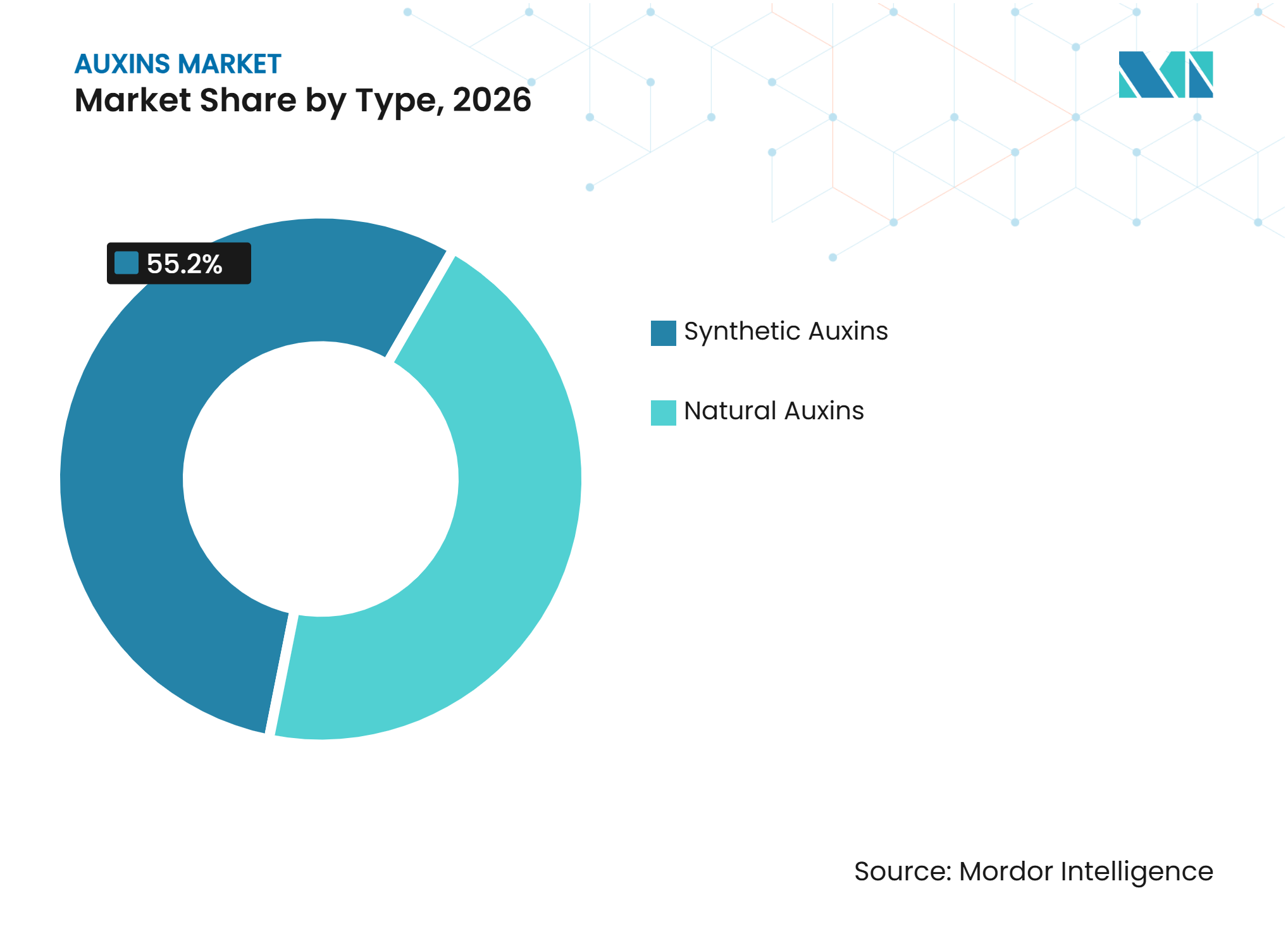
Synthetic Auxins Lead the Market and Drive Growth Through Weed ManagementSynthetic auxins held 44.8% of the auxins market share in 2026, making them the largest product category. Their position reflects extensive use in selective weed control across broadleaf crops, pastures, and non-crop areas. Compounds such as 2,4-D, dicamba, and 2-Methyl-4-chlorophenoxyacetic acid (MCPA) remain important tools for controlling broadleaf weeds, while combination formulations help broaden weed-control coverage. Demand is further supported by the need for diversified herbicide programs to manage resistant weed populations. A 2025 study documented resistance to multiple herbicide modes of action, including synthetic auxins, in European Bassia scoparia populations, highlighting the importance of herbicide rotation, effective mixtures, and resistance-management practices.
Synthetic auxins are forecast to grow at a CAGR of 10.2% from 2027 to 2032, making them the fastest-growing type segment. Their growth prospects are supported by continued demand for selective weed control across major crop-production systems and the need for diversified resistance-management programs. These factors are anticipated to sustain demand for established synthetic auxin herbicides and combination formulations, while encouraging manufacturers to strengthen product portfolios and provide application and stewardship guidance.



By Formulation:
Liquid Formulations Support Broad Application and Address Specific UsesLiquid formulations held 33.9% of the auxins market share in 2026, making them the largest formulation category. Their position reflects compatibility with established spray equipment, ease of mixing with adjuvants, and suitability for different application methods. Liquid products are used in row-crop herbicide spraying as well as horticultural drench and foliar treatments, allowing growers to apply auxin-based products across diverse crop-management requirements. Their compatibility with conventional and precision spraying systems further supports adoption among commercial farms seeking consistent application and convenient handling.
Liquid formulations are forecast to grow at a CAGR of 6.9% from 2027 to 2032, supported by continued demand for convenient application formats and compatibility with existing farm-spraying infrastructure. Granular formulations remain relevant where soil incorporation and controlled release are preferred, including selected cereal and turf applications. Powder formulations serve specialized uses such as tissue-culture media preparation and offer handling and distribution advantages in certain markets. These alternative formats continue to address specific application requirements, while liquid products are anticipated to maintain their leading position through their broad applicability across agricultural uses.
By Crop Type:
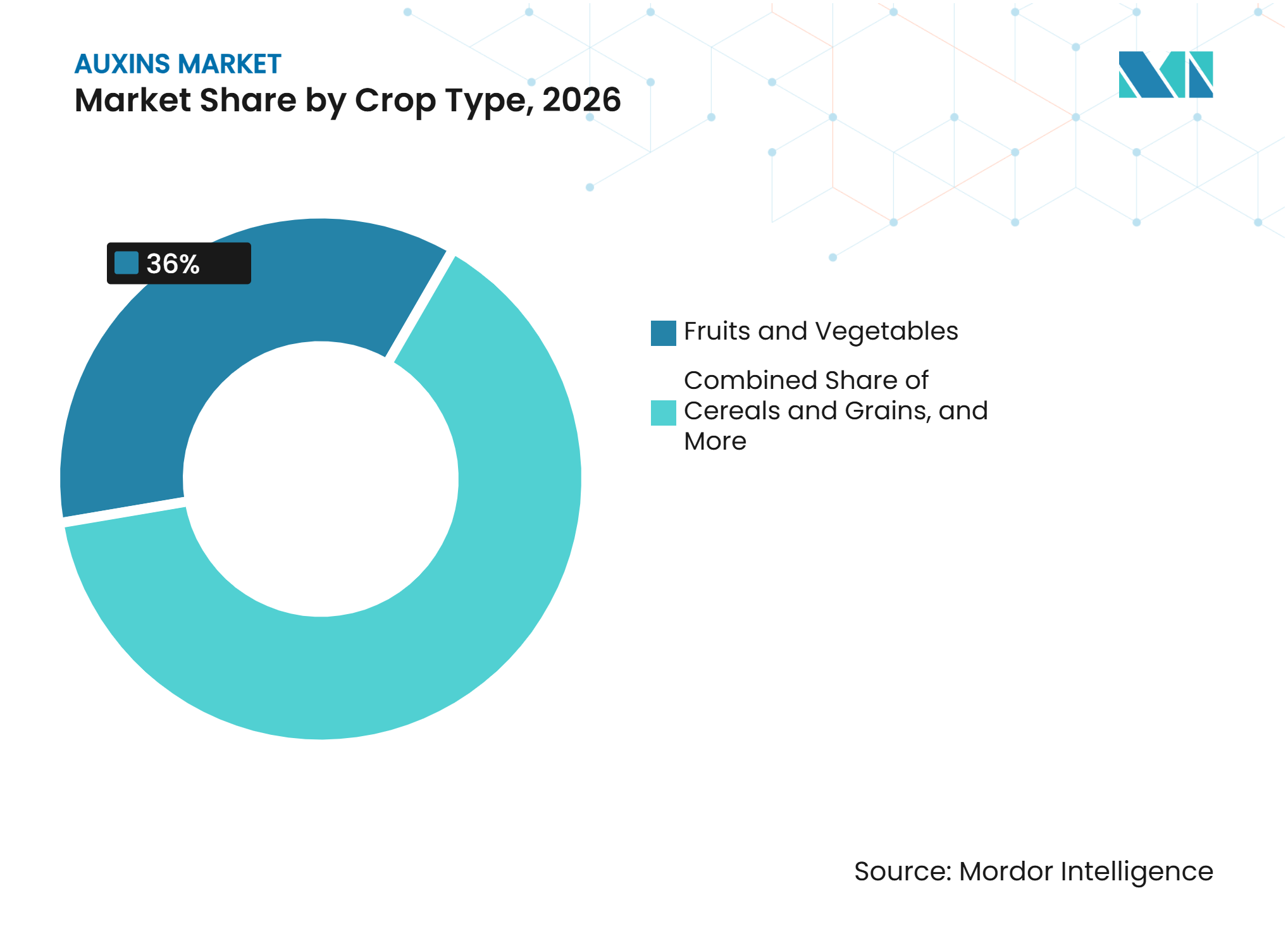
Fruits and Vegetables Combine High Value With the Fastest GrowthFruits and vegetables held 36.0% of the auxins market share in 2026, making them the largest crop category. Their position reflects the high commercial value of horticultural production, where fruit set, retention, size, and uniformity directly influence marketable yield and sales returns. Auxins are used in fruit and vegetable cultivation to regulate flowering, improve fruit development, reduce premature fruit drop, and support crop quality. These applications are particularly relevant to intensive horticultural systems, where growers closely monitor crop treatments to meet quality and productivity targets. A 2025 review reported auxin-related improvements in fruit weight and yield quality across tomato, cucurbit, and okra production, highlighting the role of plant-growth regulators in horticultural productivity. Demand from export-oriented fresh-produce systems across Southeast Asia, East Africa, and South America further supports the segment's market position.
Fruits and vegetables are forecast to grow at a CAGR of 7.6% from 2027 to 2032, making them the fastest-growing crop category. Growth prospects are supported by expanding commercial horticulture and increasing demand for consistent fruit quality, improved retention, and higher marketable yields. Cereals and grains remain an important application segment by volume, supported by the use of synthetic auxin herbicides in wheat, barley, maize, and rice production. Oilseeds and pulses, particularly soybean and canola, also contribute to demand through broadleaf weed-control applications and resistance-management programs. Meanwhile, turf, ornamentals, and nursery crops support specialized demand for rooting formulations, while plantation and industrial crops such as sugarcane, oil palm, and rubber use auxins in crop management and clonal propagation.

Geography Analysis
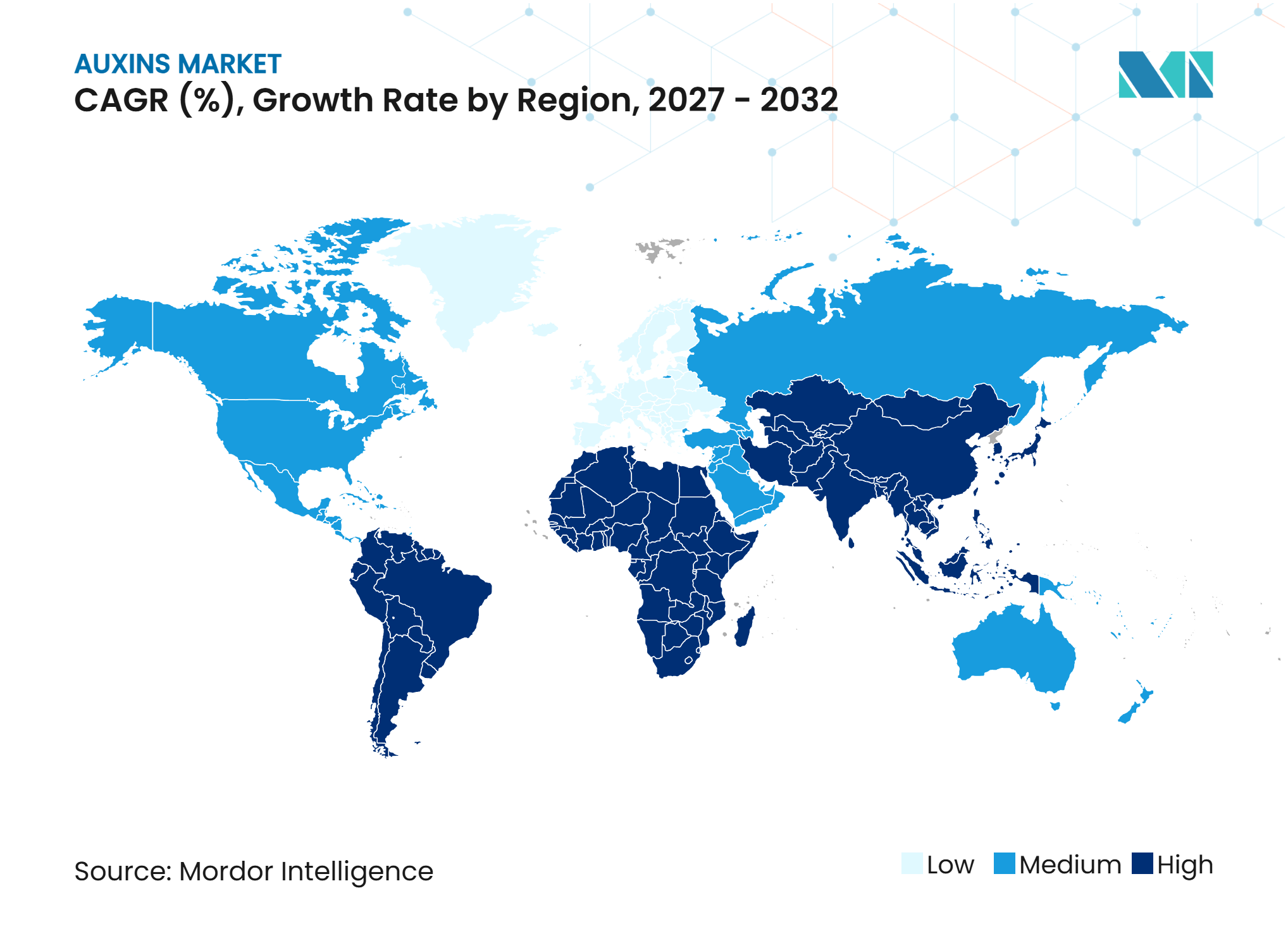
Asia-Pacific held 35.3% of the auxins market share in 2026, supported by extensive rice, cereal, fruit, vegetable, and plantation-crop production across China, India, Japan, and Southeast Asia. Demand is driven by the use of natural and synthetic auxins for root initiation, fruit development, crop propagation, and tissue culture applications. India's expanding horticulture and protected cultivation activities create opportunities for auxin-based plant growth regulators, particularly in nursery production and high-value vegetable cultivation. Japan also has an established plant growth regulator research and application framework, supported by the Japan Plant Regulator Research Association (JAPR), which conducts technical trials and provides guidance on appropriate product use. Research published in the Journal of Experimental Botany in 2025 highlighted the role of indole-3-acetic acid (IAA) biosynthesis in de novo root regeneration, reinforcing the relevance of auxins in commercial plant propagation and tissue culture.
South America is forecast to grow at a CAGR of 7.4% from 2027 to 2032, the fastest rate among regions. Growth opportunities are associated with extensive soybean and maize cultivation, increasing herbicide resistance, and the adoption of diversified weed-management programs in Brazil and Argentina. Synthetic auxin herbicides, including 2,4-D and dicamba, are used to control broadleaf weeds in commercial cropping systems. In Brazil, the Herbicide Resistance Action Committee (HRAC-BR) documented 58 herbicide resistance cases across 29 weed species in 2025, highlighting the need for diversified weed-control strategies. However, resistance to multiple herbicide modes of action also increases the importance of resistance stewardship and appropriate application practices. Commercial fruit and vegetable production in Brazil, Chile, and Argentina further supports opportunities for plant growth regulators used in fruit development, rooting, and crop management.
North America and Europe represent established markets for auxins, supported by commercial horticulture, nursery production, plant biotechnology, and large-scale agricultural activities. In North America, demand is associated with soybean, maize, cereal, and horticultural production, while Europe benefits from established horticultural and plant propagation industries in countries such as the Netherlands, Germany, France, and Spain. The Middle East and Africa offer emerging opportunities through the expansion of protected cultivation, commercial horticulture, and agricultural modernization. Countries such as Israel, Saudi Arabia, and the United Arab Emirates are investing in greenhouse production and controlled-environment agriculture, creating applications for auxin-based products in rooting, propagation, and fruit development. Across Africa, investments in commercial horticulture and improved crop productivity can support longer-term demand for plant growth regulators. Australia also represents an established market, supported by broadacre agriculture and commercial horticultural production. Regional market development will depend on crop composition, product registration, regulatory requirements, affordability, and access to agricultural input distribution networks.
Competitive Landscape
Market Concentration

The auxins market was moderately consolidated in 2026, with Bayer AG, Sumitomo Chemical Co., Ltd., Nufarm Limited, Gowan Company, LLC, and Corteva, Inc. holding a major share in the market. Their competitive positions are supported by established crop protection portfolios, active-ingredient expertise, product registrations, formulation capabilities, and extensive agricultural distribution networks. These companies compete through herbicide efficacy, formulation stability, crop compatibility, application flexibility, and regulatory coverage. Competition also extends to natural auxins used in rooting, plant propagation, and tissue culture, where specialized suppliers differentiate themselves through application-specific formulations and technical expertise.
Product development and formulation improvements are shaping competitive differentiation in the plant growth regulator segment. Manufacturers are focusing on auxin-based formulations for root initiation, plant propagation, fruit development, and crop establishment. IBA-based rooting powders and solutions are used by commercial nurseries and ornamental plant growers to improve root development in cuttings, while NAA-based formulations support fruit retention, thinning, and management of premature fruit drop in horticultural crops. Suppliers are also developing application-specific products for greenhouse cultivation, tissue culture, and commercial propagation, where consistent rooting and uniform plant development are important. These developments highlight the role of formulation versatility, concentration optimization, application guidance, and crop-specific performance in strengthening manufacturers' competitive positions in the global auxins market.
Long-term competitive positioning depends on active-ingredient availability, product registration, formulation performance, resistance-management support, and distribution coverage. Manufacturers with established regulatory capabilities and access to major agricultural markets can leverage their portfolios to address different crop protection requirements, while specialized plant growth regulator suppliers compete through application-specific formulations and propagation expertise. Opportunities remain for companies developing low-volatility synthetic auxin herbicides, improved liquid formulations, and products suited to horticulture and commercial plant propagation. However, competition will continue to depend on regulatory compliance, product stewardship, resistance management, and the ability to demonstrate consistent performance under regional growing conditions.
Auxins Industry Leaders
-
Bayer AG
-
Sumitomo Chemical Co., Ltd.
-
Nufarm Limited
-
Gowan Company, LLC
-
Corteva, Inc.
- *Disclaimer: Major Players sorted in no particular order
Auxins Market Companies Covered in this Report
- Bayer AG
- Sumitomo Chemical Co., Ltd.
- Nufarm Limited
- Gowan Company, LLC
- Corteva, Inc.
- BASF SE
- PI Industries Ltd.
- AMVAC Chemical Corporation (American Vanguard Corporation)
- Rhizopon B.V.
- Kelp Products International (Pty) Ltd
Recent Industry Developments in Auxins Market
- March 2026: Katyayani promoted FIX IT, an NAA-based plant growth regulator in India. Katyayani's FIX IT, formulated with alpha-naphthaleneacetic acid (NAA) 4.5% SL, was featured in a product publication dated March 11, 2026. The formulation is positioned for flowering regulation, fruit retention and reduction of premature flower and fruit drop across crops including mango, pineapple, tomato, chilli, cotton and grapes.
- February 2026: Rhizopon introduced a new professional rooting product trial kit. Dutch rooting-hormone manufacturer Rhizopon introduced a trial kit containing its existing IBA-based rooting powders at concentrations of 0.1%, 0.25%, 0.4% and 0.8%, alongside Rhizopon AA powders at 0.5%, 1% and 2%, and AA tablets. The kit enables commercial growers to compare different auxin concentrations under actual production conditions before committing to larger quantities.
- October 2025: Sumitomo Chemical announced the integration of Sumitomo Biorational, MGK and Valent North America into a unified organization. The companies announced that they would operate under Sumitomo Biorational Company LLC from April 2026, establishing a global center of excellence for biorational innovation. The integration is intended to expand research and development, manufacturing, supply-chain capabilities and global commercialization of biological agricultural solutions. Sumitomo Biorational also markets PoMaxa, a plant growth regulator containing NAA for apple and pear thinning and harvest management.
Global Auxins Market Report Scope
Auxins are a class of plant hormones that regulate plant growth and development by controlling cell elongation, cell division, and differentiation. They play an important role in root initiation, shoot development, apical dominance, fruit set, and fruit growth. Naturally occurring auxins, such as indole-3-acetic acid (IAA), and synthetic auxins, such as indole-3-butyric acid (IBA) and 1-naphthaleneacetic acid (NAA), are used in agriculture, horticulture, plant tissue culture, and commercial propagation. Synthetic auxins are also used as selective herbicides to control broadleaf weeds in crops such as cereals, maize, and pastures.
The Auxins Market is Segmented by Type (Natural Auxins and Synthetic Auxins), by Formulation (Liquid Formulations, Granular Formulations, and Powder Formulations), by Crop Type (Fruits and Vegetables, Cereals and Grains, Oilseeds and Pulses, Turf, Ornamentals, and Nursery Crops, and Plantation and Industrial Crops), and by Geography (North America, South America, Europe, Asia-Pacific, Africa, and the Middle East). The Market Forecasts are Provided in Terms of Value (USD).
Segmentation Overview
| Natural Auxins |
| Synthetic Auxins |
| Liquid Formulations |
| Granular Formulations |
| Powder Formulations |
| Fruits and Vegetables |
| Cereals and Grains |
| Oilseeds and Pulses |
| Turf, Ornamentals, and Nursery Crops |
| Plantation and Industrial Crops |
| North America | United States |
| Canada | |
| Mexico | |
| Rest of North America | |
| South America | Brazil |
| Argentina | |
| Rest of South America | |
| Europe | Germany |
| France | |
| United Kingdom | |
| Italy | |
| Spain | |
| Russia | |
| Rest of Europe | |
| Asia-Pacific | China |
| India | |
| Japan | |
| South Korea | |
| Australia | |
| Vietnam | |
| Rest of Asia-Pacific | |
| Middle East | Turkey |
| Saudi Arabia | |
| United Arab Emirates | |
| Rest of Middle East | |
| Africa | South Africa |
| Egypt | |
| Rest of Africa |
| By Type | Natural Auxins | |
| Synthetic Auxins | ||
| By Formulation | Liquid Formulations | |
| Granular Formulations | ||
| Powder Formulations | ||
| By Crop Type | Fruits and Vegetables | |
| Cereals and Grains | ||
| Oilseeds and Pulses | ||
| Turf, Ornamentals, and Nursery Crops | ||
| Plantation and Industrial Crops | ||
| By Geography | North America | United States |
| Canada | ||
| Mexico | ||
| Rest of North America | ||
| South America | Brazil | |
| Argentina | ||
| Rest of South America | ||
| Europe | Germany | |
| France | ||
| United Kingdom | ||
| Italy | ||
| Spain | ||
| Russia | ||
| Rest of Europe | ||
| Asia-Pacific | China | |
| India | ||
| Japan | ||
| South Korea | ||
| Australia | ||
| Vietnam | ||
| Rest of Asia-Pacific | ||
| Middle East | Turkey | |
| Saudi Arabia | ||
| United Arab Emirates | ||
| Rest of Middle East | ||
| Africa | South Africa | |
| Egypt | ||
| Rest of Africa | ||
Key Questions Answered in the Report
What is the size of the Auxins market?
The auxins market was valued at USD 655.10 million in 2026 and is forecast to grow from USD 693.75 million in 2027 to USD 924.02 million by 2032, at a CAGR of 5.90% during the forecast period 2027 to 2032.
Which crop application leads demand for auxins?
Fruits and vegetables held 36.0% in 2026 and are forecast to grow at a 7.6% CAGR between 2027 and 2032, supported by crop-quality and fruit-management needs.
What is the primary challenge for natural auxin products?
Different rules for biostimulants and plant-protection products can create varying approval requirements, label limits, and commercialization timelines across countries.
What is driving demand for auxin products?
Demand is supported by crop-productivity needs, the expansion of controlled-environment agriculture (CEA), precision application, biological input demand, resistance management, and crop-specific propagation protocols.