
Automotive Wrap Market Size and Share
Market Overview
| Study Period | 2021 - 2031 |
|---|---|
| Market Size (2026) | USD 6.5 Billion |
| Market Size (2031) | USD 11.06 Billion |
| Growth Rate (2026 - 2031) | 11.22 % |
| Fastest Growing Market | Asia-Pacific |
| Largest Market | Asia-Pacific |
| Market Concentration | Medium |
Major Players *Disclaimer: Major Players sorted in no particular order Image © Mordor Intelligence. Reuse requires attribution under CC BY 4.0. | |
Automotive Wrap Market Analysis by Mordor Intelligence
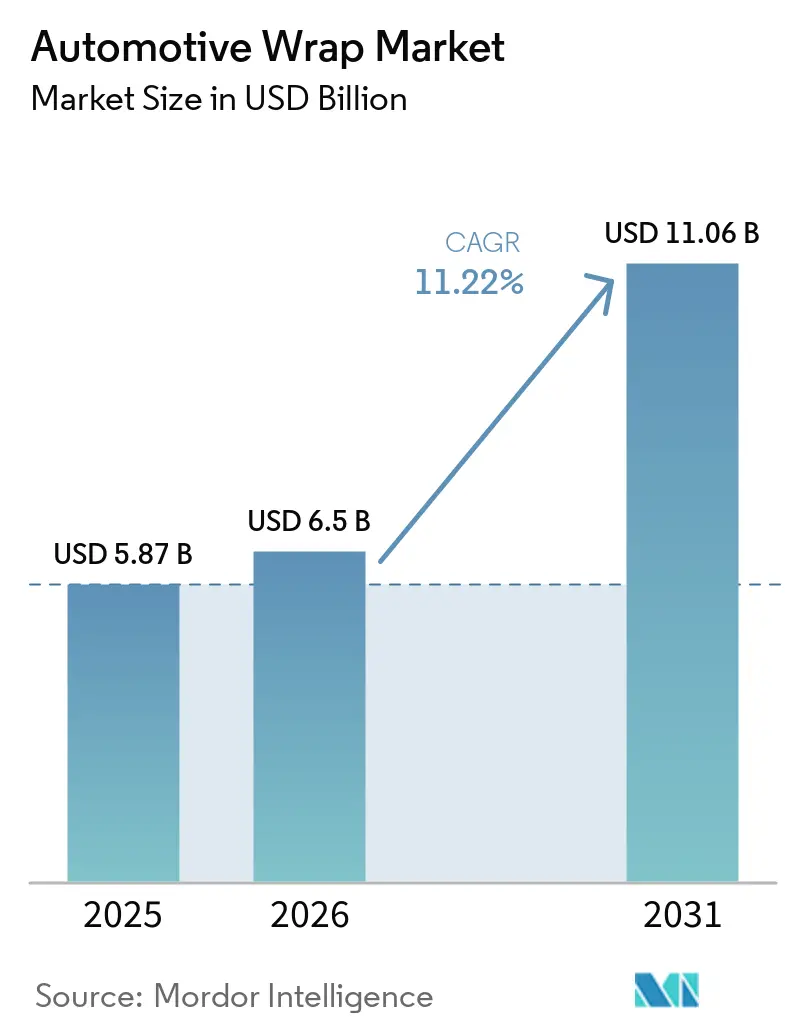
The automotive wrap market size was valued at USD 5.87 billion in 2025 and is estimated to grow from USD 6.50 billion in 2026 to reach USD 11.06 billion by 2031, at a CAGR of 11.22% during the forecast period (2026-2031). Demand is shifting from permanent paint changes to removable films that enhance vehicle appearance, provide surface protection, and support commercial identity. This shift allows buyers to refresh a vehicle's appearance, protect the factory surface, or apply branded livery without permanent exterior changes. It also generates work for installers across consumer customization, vehicle care, commercial fleets, and replacement applications. U.S. consumers spent USD 52.65 billion on vehicle accessories and modifications in 2024, supporting a broad aftermarket base for appearance products. Global electric vehicle sales reached 17 million units in 2024, expanding the pool of owners seeking visual differentiation and protective solutions. Color paint protection films are increasing competitive pressure at the premium end by combining color change with surface protection, while suppliers respond with product launches, installer support, cutting software, and broader distribution networks.
Key Report Takeaways
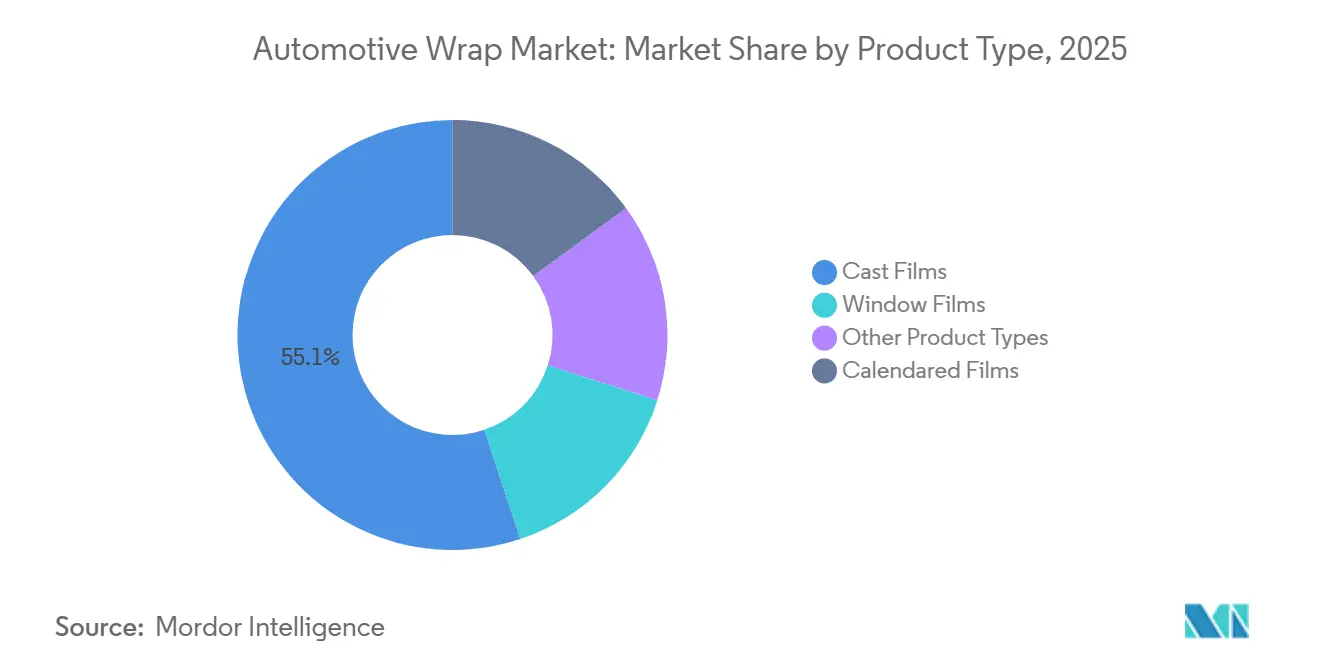
- By product type, cast films held 55.13% of revenue in 2025, while calendered films are forecast to grow at a 12.78% CAGR through 2031.
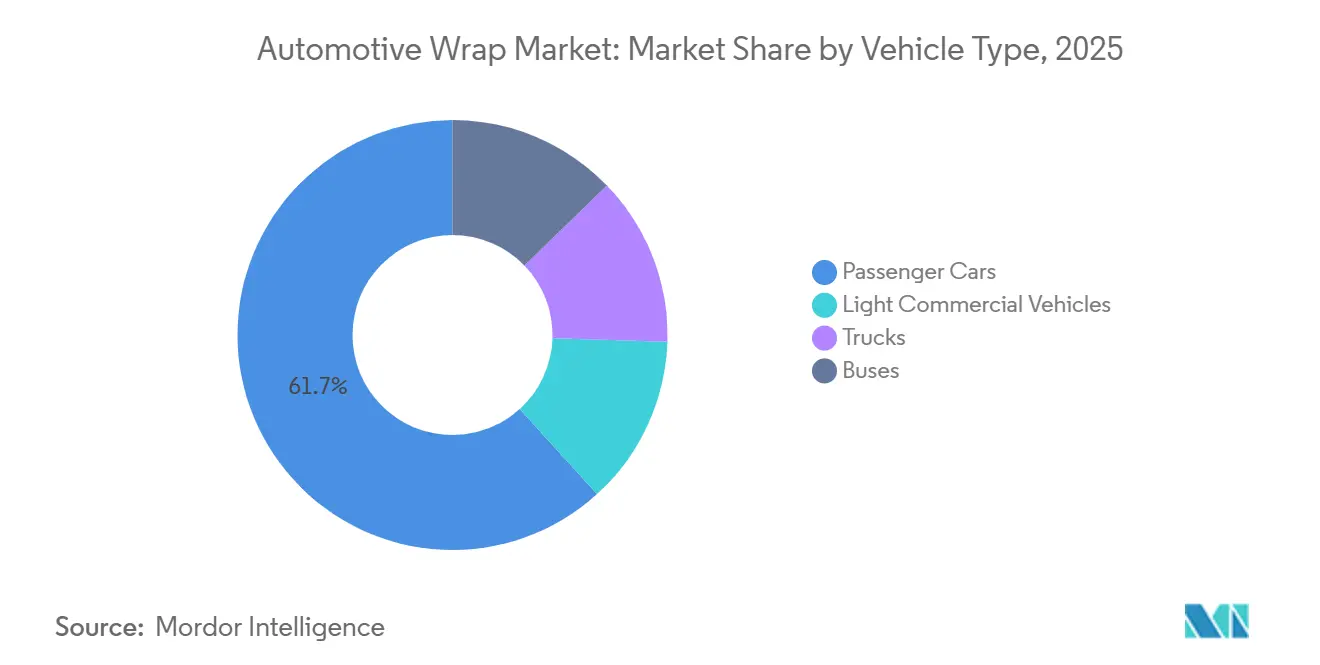
- By vehicle type, passenger cars held 61.74% of revenue in 2025, while light commercial vehicles are forecast to grow at a 13.45% CAGR through 2031.
- By geography, Asia-Pacific held 32.56% of revenue in 2025 and is forecast to grow at a 13.82% CAGR through 2031.
Note: Market size and forecast figures in this report are generated using Mordor Intelligence’s proprietary estimation framework, updated with the latest available data and insights as of January 2026.
Market Trends and Insights
Drivers Impact Analysis of Automotive Wrap Market*
| Drivers | (~) % Impact on CAGR Forecast | Geographic Relevance | Impact Timeline |
|---|---|---|---|
| Vehicle Customization and Aesthetic Personalization | +3.2% | Global | Short term (≤ 2 years) |
| Fleet Branding and Mobile Advertising | +2.5% | Global, concentrated in North America and the Asia-Pacific | Medium term (2-4 years) |
| Paint Preservation and Reversible Vehicle Modification | +1.8% | Global | Short term (≤ 2 years) |
| Expansion of Automotive Aftermarket and Detailing Networks | +1.4% | Asia-Pacific and North America | Medium term (2-4 years) |
| Increasing Adoption of Electric and Premium Vehicles | +2.0% | Global, including China, Europe, and North America | Medium term (2-4 years) |
| Source: Mordor Intelligence | |||
Vehicle Customization and Aesthetic Personalization
Vehicle personalization has expanded beyond a narrow enthusiast audience as professional films have become more accessible to consumers. Buyers seek full-color changes and finishes such as matte, satin, chrome, and color-shifting options that conventional repainting cannot match with the same flexibility. U.S. specialty vehicle modification spending reached USD 52.65 billion in 2024, with vehicle appearance products forming a growing share of this aftermarket activity. The automotive wrap market benefits from this trend because an applied film can change a vehicle's appearance without permanently altering its factory finish. Some vehicle manufacturers are testing dealer-adjacent programs for factory-matched designs, creating a potential business-to-business channel alongside retail demand. These programs also raise performance expectations for installers and films across the automotive wrap market.
Fleet Branding and Mobile Advertising
Wrapped vehicles in dense urban areas can generate 30,000 to 70,000 visual impressions each day, depending on local traffic conditions. This visibility gives fleet operators a measurable reason to use vehicle graphics alongside other advertising formats. Logistics and e-commerce operators increasingly view vehicle branding as a practical part of their operating model. Replacement cycles of 3 to 5 years provide film suppliers and installers with recurring orders rather than one-time retail work. Last-mile delivery, ride-hailing, and food-delivery fleets expand the addressable base for the automotive wrap market in Asia-Pacific and Europe. Partial wraps also lower the entry cost for smaller operators by covering key identification and branding areas.
Paint Preservation and Reversible Vehicle Modification
Wrap films allow owners to change a vehicle's exterior appearance while preserving the original paint beneath. This feature is relevant to owners of premium and high-performance vehicles, for whom repainting can be expensive and may affect resale value. It also supports corporate and government fleets that cannot make permanent exterior changes under lease terms. The automotive wrap market therefore serves fleet operators that require branded liveries without permanent vehicle modification. Owners who trade vehicles frequently may also value a removable finish because the original surface remains protected. Suppliers that communicate this use case through product information, training, and warranty materials can reach buyers who treat films as a vehicle-care purchase rather than solely a styling purchase.
Expansion of Automotive Aftermarket and Detailing Networks
Organized detailing and wrap service networks are extending access to professionally installed films across more locations. The U.S. vehicle appearance and protection category grew 6.1% year over year in the second quarter of 2025[1]. Franchise models support this expansion by providing new outlets with common training, service processes, and approved supplier relationships. India recorded passenger vehicle sales of 4.643 million units in fiscal year 2025-26, up 7.9% year over year, expanding the installed vehicle base available to organized detailing providers. CarzSpa operated more than 125 studios across India and Nepal, while Detailing Devils had more than 140 Franchise-Owned, Franchise-Operated (FOFO) outlets by January 2026, demonstrating broader organized service coverage in the country. Each additional outlet represents a recurring point of demand for automotive wrap market suppliers, particularly where franchise procurement identifies preferred film brands.
Restraints Impact Analysis of Automotive Wrap Market*
| Restraints | (~) % Impact on CAGR Forecast | Geographic Relevance | Impact Timeline |
|---|---|---|---|
| High Installation Cost and Skilled-Labor Dependency | -1.3% | Global, acute in North America and Europe | Short term (≤ 2 years) |
| Film Performance Degradation Under Severe Climate Exposure | -0.9% | Asia-Pacific, concentrated in ASEAN, the Middle East, and Africa | Long term (≥ 4 years) |
| Polyvinyl Chloride (PVC), Adhesive, and End-of-Life Recycling Constraints | -0.6% | European Union, with spillover to North America | Long term (≥ 4 years) |
| Source: Mordor Intelligence | |||
High Installation Cost and Skilled-Labor Dependency
A professional full-vehicle wrap requires 14 to 28 labor hours, depending on vehicle size and body complexity. Master installer hourly rates in high-demand North American locations have reached USD 95, increasing the cost of premium installations. The United States has no federally mandated installer certification standard, which contributes to uneven application quality. Buyers may delay purchases when qualified installers are not available in their area. Manufacturer and association training programs help develop technicians, including professional development work supported by the Specialty Equipment Market Association (SEMA). However, limited training capacity continues to constrain growth in the automotive wrap market in smaller cities across North America, Europe, and Asia-Pacific.
Film Performance Degradation Under Severe Climate Exposure
Calendered films can shrink, lift at the edges, or delaminate under repeated heat exposure due to internal stress generated during manufacturing. 3M specifies cast films for durable applications on complex vehicle surfaces, reinforcing the importance of product selection for demanding use cases. High temperatures and strong ultraviolet exposure in parts of ASEAN can shorten the useful life of standard-grade films. Frequent replacement increases the cost of ownership for consumers and fleet operators. Climate-stressed areas, therefore, tend to favor premium cast films and thermoplastic polyurethane (TPU)-based products over lower-cost alternatives. This shift limits the addressable demand for calendered films in parts of the automotive wrap market where thermal exposure is persistent.
*Our forecasts treat driver/restraint impacts as directional, not additive. The impact forecasts reflect baseline growth, mix effects, and variable interactions.
Automotive Wrap Market Segment Analysis
By Product Type:
Cast Films Lead Revenue While Calendered Films Gain Fleet UseCast films accounted for 55.13% of the automotive wrap market share in 2025. Their manufacturing process produces low internal stress, allowing the film to conform to compound curves, deep channels, and riveted surfaces. These characteristics make cast films suitable for full-vehicle applications where finish quality and edge stability are important. 3M provides vehicle wrap films designed for demanding applications, supporting professional installers' preference for premium film systems. Cast films remain the reference product for difficult three-dimensional surfaces, which contributes significantly to their revenue within the automotive wrap market.
Calendered films are forecast to grow at a 12.78% CAGR through 2031. They are well-suited to commercial fleet and partial-wrap work, where flat panels reduce the need for high conformability. Their lower material cost is relevant when fleet operators seek broad coverage within controlled budgets. Improved plasticizers, air-release adhesives, and structured liners are improving handling and durability compared with earlier products. These changes expand the use of calendered film on moderate curves that previously relied more heavily on cast films. Window films serve distinct functions through heat rejection, ultraviolet attenuation, and privacy, while specialty films offer chrome, textured, carbon-fiber-effect, and color-shifting finishes. ORAFOL expanded its ORACAL 970RA range to 139 color variants in 2025, reflecting the continued importance of color choice in premium specialty applications.

By Vehicle Type:
Passenger Cars Form the Revenue Base, While Light Commercial Vehicles Grow FastestPassenger cars accounted for 61.74% of revenue in 2025. Individual owners, automotive enthusiasts, and premium vehicle buyers create a broad base of demand for color and protective films. Electric passenger vehicles add to this demand, as owners may seek a distinct appearance for models with similar factory designs. China's new energy vehicle ownership exceeded 35 million units in the first quarter of 2026, supporting the size of this potential owner base. Passenger vehicles also drive demand for specialty finishes and protective films at the higher end of the automotive wrap market, with these applications depending heavily on skilled installation and a reliable local service network.
Light commercial vehicles are forecast to grow at a 13.45% CAGR through 2031. Delivery, ride-hailing, and food-service fleets use wraps for identification, branding, and mobile advertising. Operators often treat consistent livery as an operating requirement, creating repeat installation cycles. Trucks prioritize durability, ease of installation on broad flat panels, and resistance to road contamination. Buses use removable graphics for transit identity, route changes, municipal programs, and time-limited advertising. These commercial uses sustain demand for calendered films, while premium products remain relevant for visible transport branding. The automotive wrap market serves both practical fleet requirements and higher-value presentation needs across these vehicle types.
Geography Analysis
APAC Automotive Wrap Market
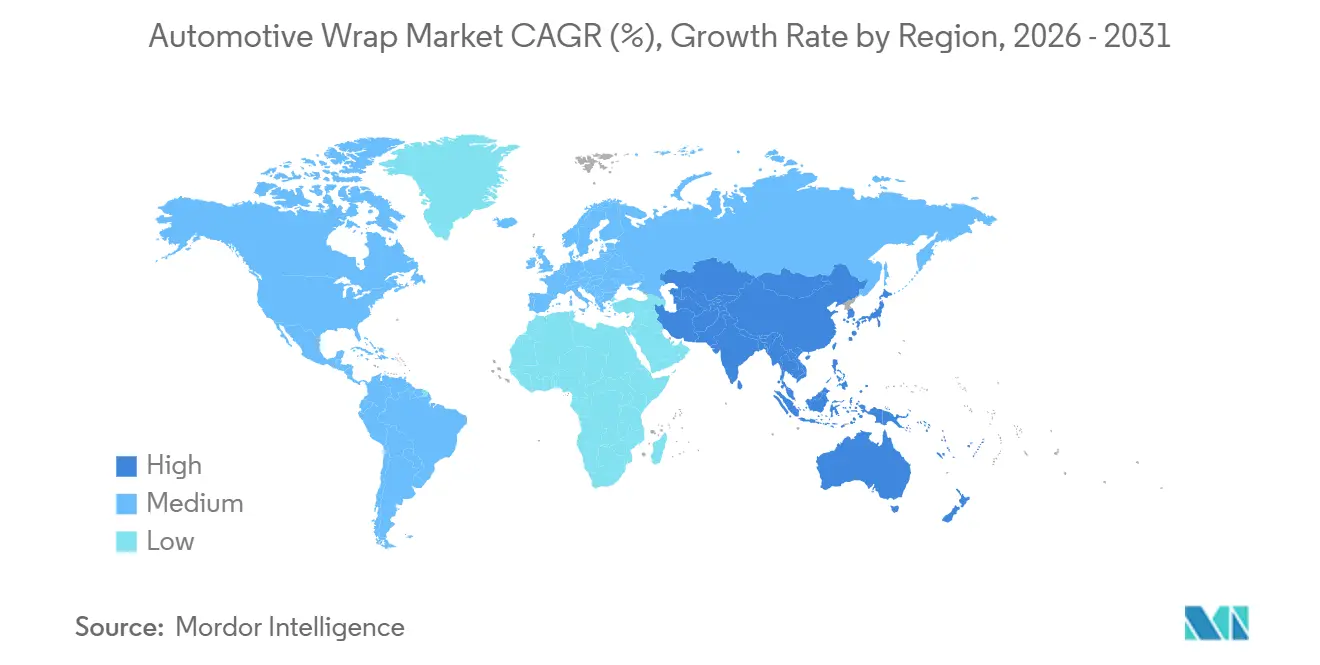
Asia-Pacific held 32.56% of the automotive wrap market share in 2025 and is forecast to grow at a 13.82% CAGR through 2031. New energy vehicle ownership in China exceeded 35 million units in the first quarter of 2026, thereby supporting demand for premium wrap and protection products[2]. India is expanding its organized detailing base, with more than 125 CarzSpa studios operating across India and Nepal. Japan and South Korea support premium applications through high vehicle ownership density and demand for precise installation. ASEAN countries contribute additional units as vehicle ownership and aftermarket adoption expand.
The Americas and EMEA Automotive Wrap Market
North America has a mature vehicle customization ecosystem. U.S. vehicle modification spending reached USD 52.65 billion in 2024, with appearance products among the key aftermarket activities. Europe has strong demand in Germany, the United Kingdom, France, and the Nordic countries, where premium cast films and certified installation are well established. South America shows growing demand in Brazil and Argentina, although economic volatility affects spending consistency. Fleet branding and organized automotive service chains support baseline demand in these markets. The Middle East and Africa combine high spending on luxury vehicles in Gulf Cooperation Council markets with growing demand from logistics and transport programs.
Europe and Middle East Automotive Wrap Market
Markets with mature detailing networks, including North America, Germany, and Japan, tend to support higher per-vehicle spending. India, Southeast Asia, and Brazil offer stronger unit growth as franchise service networks expand. Asia-Pacific is also shifting toward higher-value cast and thermoplastic polyurethane (TPU) films as premium vehicle ownership and electric vehicle adoption increase. Distribution partnerships and authorized installer networks in Dubai, Riyadh, and Johannesburg support access to premium customers. North America and Europe retain advantages in average selling prices, installer sophistication, and revenue per installation. These factors support continued geographic expansion of the automotive wrap market through 2031.
Competitive Landscape
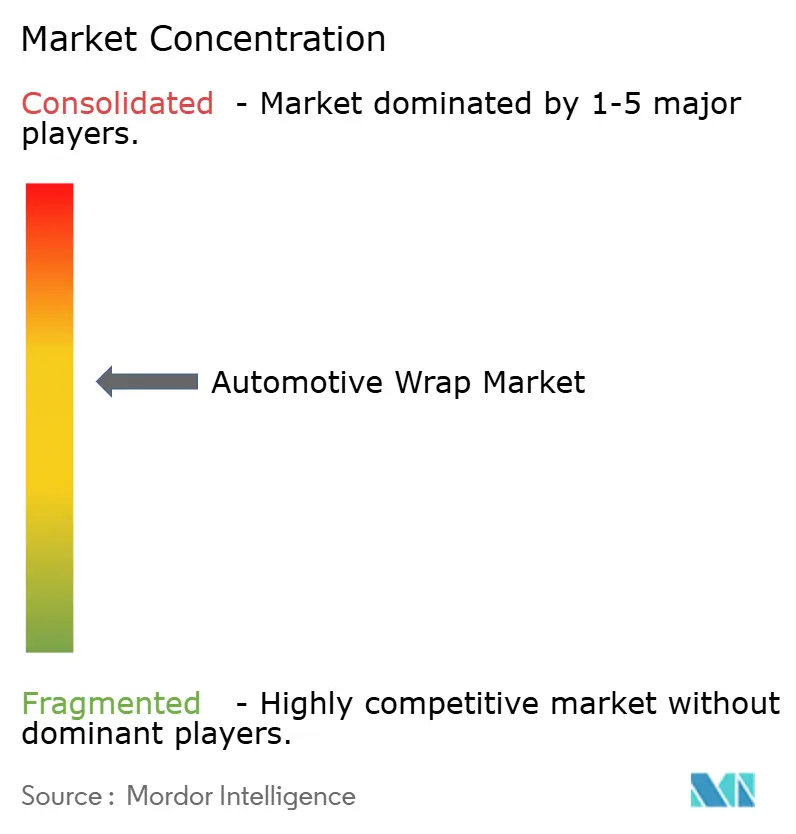
The automotive wrap market is moderately consolidated. Global suppliers include 3M, Avery Dennison, ORAFOL Europe, Eastman Chemical, and XPEL, while regional specialists and Asian producers address lower-priced and direct-to-consumer demand. Leading suppliers compete through film selection, adhesive technologies, installer certification, design tools, and distribution coverage. XPEL offers its Design Access Program (DAP) software, which includes more than 80,000 vehicle-specific cutting patterns, providing installers with precise film-fitment information. This type of software strengthens the relationship between film suppliers and authorized installers. Smaller producers compete through price, color variety, and e-commerce availability.
Color paint protection film is narrowing the distinction between protective and decorative products. XPEL's product range includes paint protection film and its Design Access Program (DAP) cutting platform, which reinforces the importance of a connected product-and-installer system. Avery Dennison offers PrismaPro dry-apply color paint protection film, combining Thermoplastic Polyurethane (TPU) construction, IntelliTack adhesive, and a self-healing top coat. ORAFOL introduced additional ORACAL 970RA colors and ProSlide technology in 2025, focusing on color choice and improved repositioning during installation. Arlon Graphics introduced Omni Cast Wrap in August 2025 for vehicle, fleet, and architectural applications, reducing the need for installers to source separate materials for each use. These product developments raised performance and workflow expectations in the automotive wrap market.
Opportunities remain in Asia-Pacific's mid-tier commercial fleet segment, where service and installation networks are still developing. Polyvinyl Chloride (PVC)-free, TPU-based, and low-Volatile Organic Compound (VOC) products also present a premium opportunity, although their higher cost limits adoption. Digital color previews, pattern-cutting tools, and installer training can make a supplier's system more difficult to replace once an installer has invested in it. Distribution remains an important route to wider market coverage. Grimco expanded access to 3M Personal Auto products through its nationwide distribution network, alongside its existing 3M Wrap Film Series 2080 offering. The presence of global suppliers, regional specialists, and direct-to-consumer brands maintains competitive pressure across price points and service models.
Automotive Wrap Industry Leaders
-
3M
-
Avery Dennison Corporation
-
HEXIS S.A.S.
-
ORAFOL Europe GmbH
-
Arlon Graphics, LLC
- *Disclaimer: Major Players sorted in no particular order
Automotive Wrap Market Companies Covered in this Report
- 3M
- A.P.A. S.p.A.
- Arlon Graphics, LLC
- Avery Dennison Corporation
- Eastman Chemical Company
- Fedrigoni S.P.A.
- Grafityp
- Guangzhou Carbins Film Co., Ltd.
- HEXIS S.A.S.
- JMR Graphics, Inc.
- KPMF
- Mactac
- ORAFOL Europe GmbH
- TeckWrap International
- The VViViD Shop
- XPEL
Recent Industry Developments in Automotive Wrap Market
- October 2025: Avery Dennison launched Neo Matte Black Paint Protection Film at the Specialty Equipment Market Association (SEMA) 2025. The 8.5 mil polyurethane film features a nonreflective finish and a 7-year warranty, expanding the company's wet-apply color paint protection film line for automotive wrap applications.
- August 2025: Arlon Graphics launched Omni Cast Wrap, a 2.0 mil gloss white cast film for full and partial automotive wraps, fleet graphics, and architectural applications. The product carries a 10-year unprinted outdoor durability rating.
Global Automotive Wrap Market Report Scope
An automotive wrap is a thin, adhesive vinyl film applied over a vehicle's original paint to change its color, finish, or design without permanent repainting.
The automotive wrap market is segmented by product type, vehicle type, and geography. By product type, the market is segmented into cast films, calendared films, window films, and other product types. By vehicle type, the market is segmented into passenger cars, light commercial vehicles, trucks, and buses. The report also covers market size and forecasts for automotive wrap across 16 countries in major regions. The market sizes and forecasts are provided in terms of value (USD).
Segmentation Overview
| Cast Films |
| Calendared Films |
| Window Films |
| Other Product Types |
| Passenger Cars |
| Light Commercial Vehicles |
| Trucks |
| Buses |
| Asia-Pacific | China |
| India | |
| Japan | |
| South Korea | |
| ASEAN Countries | |
| Rest of Asia-Pacific | |
| North America | United States |
| Canada | |
| Mexico | |
| Europe | Germany |
| United Kingdom | |
| France | |
| Italy | |
| NORDIC Countries | |
| Russia | |
| Rest of Europe | |
| South America | Brazil |
| Argentina | |
| Rest of South America | |
| Middle East and Africa | Saudi Arabia |
| South Africa | |
| Rest of Middle East and Africa |
| By Product Type | Cast Films | |
| Calendared Films | ||
| Window Films | ||
| Other Product Types | ||
| By Vehicle Type | Passenger Cars | |
| Light Commercial Vehicles | ||
| Trucks | ||
| Buses | ||
| By Geography | Asia-Pacific | China |
| India | ||
| Japan | ||
| South Korea | ||
| ASEAN Countries | ||
| Rest of Asia-Pacific | ||
| North America | United States | |
| Canada | ||
| Mexico | ||
| Europe | Germany | |
| United Kingdom | ||
| France | ||
| Italy | ||
| NORDIC Countries | ||
| Russia | ||
| Rest of Europe | ||
| South America | Brazil | |
| Argentina | ||
| Rest of South America | ||
| Middle East and Africa | Saudi Arabia | |
| South Africa | ||
| Rest of Middle East and Africa | ||
Key Questions Answered in the Report
What is current market size of Automotive Wrap Market?
The automotive wrap market size was valued at USD 5.87 billion in 2025 and is estimated to grow from USD 6.50 billion in 2026 to reach USD 11.06 billion by 2031, at a CAGR of 11.22% during the forecast period (2026-2031).
Which automotive wrap product type holds the largest share?
Cast films held 55.13% of revenue in 2025. Their low-stress construction supports installation on complex curves, channels, and demanding vehicle surfaces.
Which vehicle category is growing fastest for automotive wraps?
Light commercial vehicles are forecast to grow at a 13.45% CAGR through 2031. Delivery, ride-hailing, and food-service fleets use wraps for identification, consistent livery, and mobile advertising.
Which region leads demand for automotive wraps?
Asia-Pacific held 32.56% of revenue in 2025 and is forecast to expand at a 13.82% CAGR through 2031.