
Automotive OEM Coatings Market Size and Share
Market Overview
| Study Period | 2021 - 2031 |
|---|---|
| Market Size (2026) | USD 19.82 Billion |
| Market Size (2031) | USD 25.35 Billion |
| Growth Rate (2026 - 2031) | 5.04 % |
| Fastest Growing Market | Asia-Pacific |
| Largest Market | Asia-Pacific |
| Market Concentration | Medium |
Major Players *Disclaimer: Major Players sorted in no particular order Image © Mordor Intelligence. Reuse requires attribution under CC BY 4.0. | |
Automotive OEM Coatings Market Analysis by Mordor Intelligence
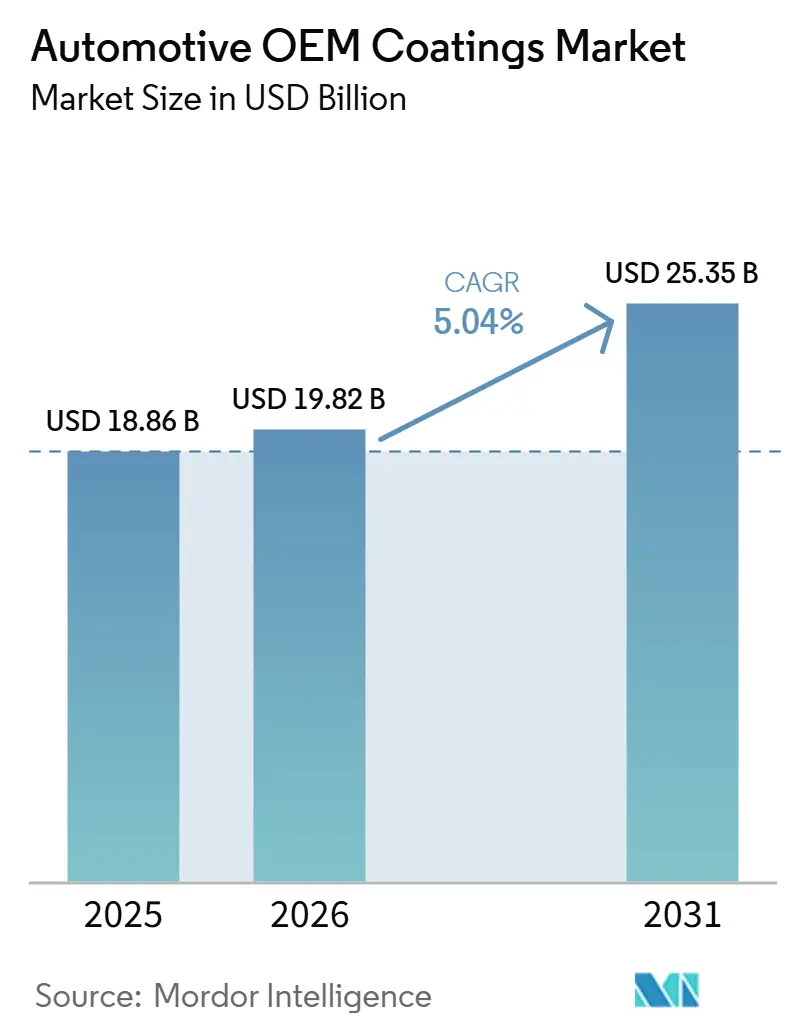
The Automotive OEM coatings market size was estimated at USD 18.86 billion in 2025 and is estimated to grow from USD 19.82 billion in 2026 to USD 25.35 billion by 2031, at a CAGR of 5.04% during the forecast period (2026-2031). The automotive OEM coatings market is supported by the recovery in light-vehicle output, which reached 92.5 million units in 2024 and is expected to exceed 95 million units in 2026. Each additional vehicle requires electro-coat, primer, basecoat, and clearcoat layers, consuming 3-5 kilograms of coating material. Electric vehicle (EV) programs, lightweight structures, and increasingly complex color options are raising formulation and approval requirements for the automotive OEM coatings market. BASF Coatings developed Xiaomi EV's Nightfall Rose color using dual-color cool- and warm-toned pastes and red aluminum flakes, illustrating how customized finishes add complexity to paint systems.
Key Report Takeaways
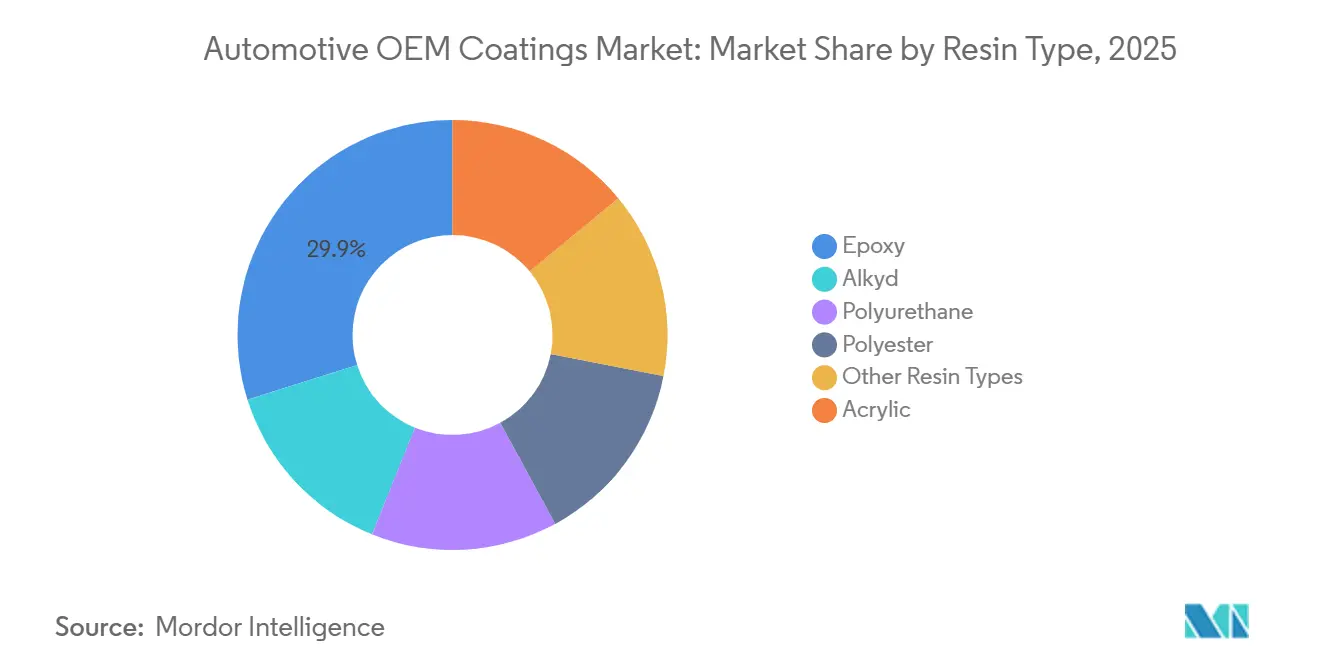
- By resin type, epoxy held 29.86% of demand in 2025, while polyurethane is projected to grow at a 5.14% CAGR through 2031.
- By technology, waterborne coatings accounted for 48.61% of the Automotive OEM coatings market size in 2025, while UV-Curable and Low-Bake coatings are forecast to advance at a 7.13% CAGR through 2031.
- By coat type, basecoat represented 27.55% of demand in 2025, while clearcoat is forecast to grow at a 5.86% CAGR through 2031.
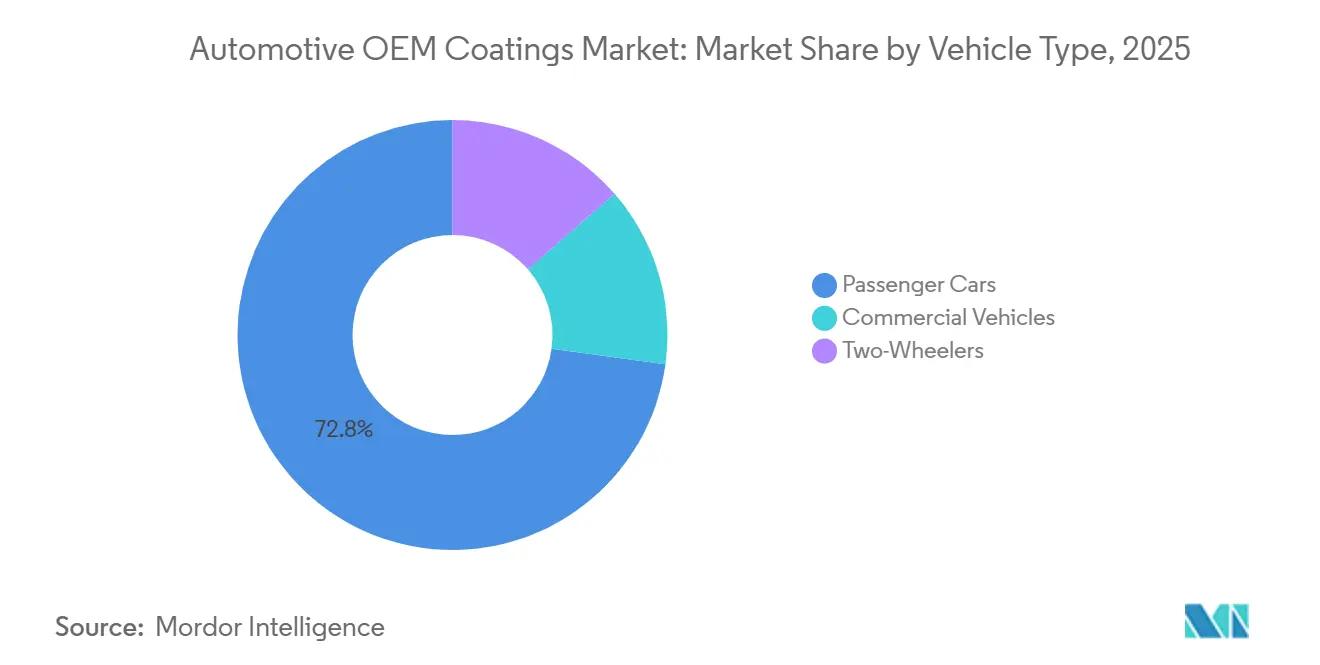
- By vehicle type, passenger cars held 72.82% of demand in 2025, while commercial vehicles are projected to expand at a 6.15% CAGR through 2031.
- By geography, Asia-Pacific captured 52.44% of demand in 2025 and is forecast to grow at a 5.89% CAGR through 2031.
Note: Market size and forecast figures in this report are generated using Mordor Intelligence’s proprietary estimation framework, updated with the latest available data and insights as of January 2026.
Market Trends and Insights
Drivers Impact Analysis of Automotive OEM Coatings Market*
| Drivers | (~) % Impact on CAGR Forecast | Geographic Relevance | Impact Timeline |
|---|---|---|---|
| Vehicle Production and Model Portfolio Growth | +1.4% | Global, with Asia-Pacific at the core and spillover to South America, the Middle-East, and Africa | Medium term (2-4 years) |
| Low-VOC and Low-Carbon Coating Regulations | +1.0% | North America and Europe are primary markets, with Asia-Pacific following through China GB standards and the Ministry of Ecology and Environment enforcement | Short term (≤ 2 years) |
| Specialized EV Battery and Component Coatings | +0.9% | Asia-Pacific is the core region, led by China and South Korea, while North America and Europe are advancing | Medium term (2-4 years) |
| Lightweight and Multi-Material Vehicle Structures | +0.7% | Europe and North America lead adoption, while Asia-Pacific is accelerating | Long term (≥ 4 years) |
| Premium Finishes and Advanced Surface Aesthetics | +0.6% | China, Germany, South Korea, and the United States, especially premium vehicle programs | Long term (≥ 4 years) |
| Source: Mordor Intelligence | |||
Growth in Global Vehicle Production and Expansion of Vehicle Model Portfolios
Rising vehicle production is the most direct driver for the automotive OEM coatings market. Global light-vehicle production recovered to 92.5 million units in 2024 and surpassed 95 million units in 2026 as supply conditions improved. Each vehicle requires a complete sequence of electrocoat, primer, basecoat, and clearcoat applications. India's USD 3.5 billion Production-Linked Incentive scheme is expected to generate 180,000 metric tons of incremental annual coating demand by 2027 through OEM capacity expansion. A wider range of vehicle models requires new approval cycles and increases supplier activity at each assembly plant. New assembly activity in India and Southeast Asia is also encouraging suppliers to establish local blending capacity, which reduces tariffs and lead times but adds logistics management requirements.
Stringent Regulations Promoting Low-VOC and Low-Carbon Coating Technologies
Emission requirements are moving OEM programs toward low-emission coating systems. U.S. regulations set VOC limits of 420 grams per liter for primer surfacers and 250 grams per liter for topcoats, effective January 2025[1]U.S. Environmental Protection Agency, “National Volatile Organic Compound Emission Standards,” Federal Register, govinfo.gov. China's GB 24409-2020 standard requires domestic formulators to redesign resin systems. The Ministry of Ecology and Environment's dual-carbon objectives have halted new solventborne production permits in Shandong and Hebei, shifting investment toward waterborne and powder capacity. Regulations do not follow the same schedule across the United States, Europe, and China. As a result, suppliers need to maintain parallel product lines while customers adjust at different times, which increases working-capital requirements for smaller formulators.
Increasing Demand for Specialized Coatings for EV Battery Packs and Electric Vehicle Components
EV battery packs have created a specialized coating category within the automotive OEM coatings market. Suppliers are developing dielectric, powder, fire-protection, and electrocoat systems for battery safety applications. These products address electrical insulation, corrosion protection, fire resistance, and thermal management around battery enclosures. Coatings for these applications must tolerate thermal cycling beyond conventional body-shell requirements. OEM qualification can therefore extend to 18-24 months, compared with shorter approval timelines for standard body coatings. Longer approval periods raise switching costs once a supplier secures a production specification.
Rising Adoption of Lightweight and Multi-Material Vehicle Structures
Lightweight vehicle design is changing requirements across the coating stack. Aluminum-rich structures, carbon-fiber-reinforced plastic panels, and mixed-material assemblies require adhesion systems that differ from standard steel treatments. Phosphate pretreatments used for steel do not deposit reliably on aluminum, so manufacturers require zirconium conversion coatings or dedicated wash-primer systems. Thermoplastic composites and plastic modules also cannot tolerate traditional 170-180°C bake cycles. This requirement supports UV-curable and low-bake systems, while premium finish programs add more color and layering work for suppliers.
Restraints Impact Analysis of Automotive OEM Coatings Market*
| Restraints | (~) % Impact on CAGR Forecast | Geographic Relevance | Impact Timeline |
|---|---|---|---|
| Resin, Pigment, Solvent, and Energy Price Volatility | -0.8% | Global, with greater pressure in Europe and Asia-Pacific, where energy costs and geopolitical risks are high | Short term (≤ 2 years) |
| Advanced Coating Qualification and Validation Costs | -0.5% | Global, with North America and Europe most affected by overlapping EPA National Emission Standards for Hazardous Air Pollutants (NESHAP), Authorization and Restriction of Chemicals (REACH), and Industrial Emissions Directive (IED) requirements | Medium term (2-4 years) |
| Multi-Material Substrate Compatibility and Repair Challenges | -0.3% | Europe and North America lead multi-material platform adoption, while Asia-Pacific follows | Long term (≥ 4 years) |
| Source: Mordor Intelligence | |||
Volatility in Prices of Resins, Pigments, Solvents, and Energy
Input-cost instability remains the largest margin risk for formulators in the automotive OEM coatings market. Epoxy resin prices rose by more than 12% in one week during early 2026, following disruptions to petrochemical supply chains. Crude oil-linked feedstocks account for 40% of total coating production costs. Contract adjustment clauses in the OEM supply chain can take 90 to 180 days to revise, while raw material price movements affect margins much sooner. Smaller formulators without resin-production assets must absorb these costs while customers resist price increases during a contract period. This mismatch is driving consolidation among second-tier suppliers.
High Qualification and Validation Costs for Advanced Automotive Coating Systems
New automotive coating systems require extensive testing before production approval. Qualification programs cover corrosion resistance, weathering, chip resistance, and chemical resistance before a formulation can be used in a plant. EV coatings require additional validation for thermal cycling, dielectric strength, and fire-propagation resistance. Multiple regulatory regimes impose separate reporting and testing requirements before sales can begin. The cost burden is significant for waterborne polyurethane and bio-based resin systems, which require both technical qualification and regulatory documentation. Multi-material platforms create further repair and compatibility challenges, as aluminum and steel often require different pretreatment configurations.
*Our forecasts treat driver/restraint impacts as directional, not additive. The impact forecasts reflect baseline growth, mix effects, and variable interactions.
Automotive OEM Coatings Market Segment Analysis
By Resin Type:
Epoxy Holds Broad Demand While Polyurethane Gains in ClearcoatsEpoxy accounted for 29.86% of demand in 2025 and remains central to the automotive OEM coatings market. It provides uniform deposition on complex three-dimensional parts, including battery enclosures, door cavities, and underbody structures. This performance supports its widespread use in electrocoat primers throughout OEM assembly facilities. Acrylic resins support basecoat formulations through pigment compatibility and outdoor weathering performance. Alkyd and polyester resins serve cost-sensitive interior and commercial vehicle applications where exterior durability and UV resistance are less critical.
Polyurethane is forecast to be the fastest-growing resin type, with a CAGR of 5.14% through 2031. It is used in clearcoat applications that require hardness, gloss retention, and scratch resistance without added mass for battery-electric vehicles. Waterborne polyurethane dispersions are gaining interest at European and Chinese OEM plants. They support lower-emission coating objectives while retaining the surface protection associated with aliphatic isocyanate-based layers. Chinese automakers have adopted these systems more quickly because newer paint shops were designed for waterborne infrastructure. Traditional European plants can face higher costs when converting legacy solventborne lines.



By Technology:
Waterborne Leads While UV-Curable and Low-Bake Systems AdvanceWaterborne coatings accounted for 48.61% of the automotive OEM coatings market in 2025. Their position reflects the long-term shift toward lower-emission basecoat systems in mature markets. Solventborne systems continue to be used in commercial vehicle and heavy equipment applications that require cure flexibility and substrate tolerance. Powder coatings are gaining ground in electrocoat and underbody applications. Their zero-VOC profile is particularly relevant for EV battery housings. Technology choice depends on both the coating layer and the operating conditions of the assembly plant.
UV-curable and low-bake technologies are forecast to grow at a CAGR of 7.13% through 2031. They reduce paint shop energy use by replacing high-temperature baking with lower-energy curing methods, supporting plants in reducing energy consumption and meeting carbon commitments. In-mold coating technology can eliminate the application booth and post-coating drying oven for some automotive components. Such approaches make process design as important as coating chemistry in the automotive OEM coatings market.
By Coat Type:
Basecoat Remains Stable While Clearcoat Drives GrowthBasecoat held 27.55% of demand in 2025. Its position is directly tied to vehicle color strategy and exterior appearance. OEMs are increasing color options from 12-15 per model to 20-30 or more for premium EV lines. Each color variation requires its own basecoat qualification, inventory, and formulation work. Electrocoat provides the first corrosion barrier and has the highest cost per vehicle among coating applications. Its fixed position in the coating sequence supports steady demand but limits suppliers' pricing flexibility.
Clearcoat is forecast to grow at a CAGR of 5.86% through 2031. OEMs use it to improve scratch resistance, gloss retention, and self-healing performance. PPG introduced its Deltron D8178 Rapid Low Energy clearcoat across Europe, the Middle-East, and Africa in March 2026. Primer and pretreatment layers change more slowly, but mixed-material bodies require greater line flexibility. Zirconium pretreatments for aluminum structures require different line configurations than iron-phosphate systems for steel. Assembly plants capable of managing both systems will be better positioned to support mixed-material architectures after 2027.
By Vehicle Type:
Passenger Cars Dominate While Commercial EVs Drive Specification ChangesPassenger cars accounted for 72.82% of vehicle-type demand in 2025. Their large production base and complex body geometries result in high coating consumption per vehicle. A passenger car commonly uses 4-5 coating layers across the body. OEMs, including Xiaomi Auto, BYD, and the Volkswagen Group, specify full coating systems for differentiated color programs. BASF Coatings' work on Xiaomi EVs demonstrates the level of customization involved in certain premium vehicles.
The commercial vehicles segment is forecast to grow at a CAGR of 6.15% through 2031. Electric buses and delivery vans require thermal management coatings and fire-resistant battery enclosure treatments, which differ from the specifications of conventional diesel platforms. India's manufacturing incentives are supporting the expansion of assembly capacity and procurement of electric buses, increasing demand for coatings in a segment that previously generated lower revenue per vehicle for formulators. Two-wheelers remain a smaller but notable category in India, Indonesia, and Vietnam, where suppliers use simplified two-coat systems designed for high throughput.
Geography Analysis
APAC Automotive OEM Coatings Market
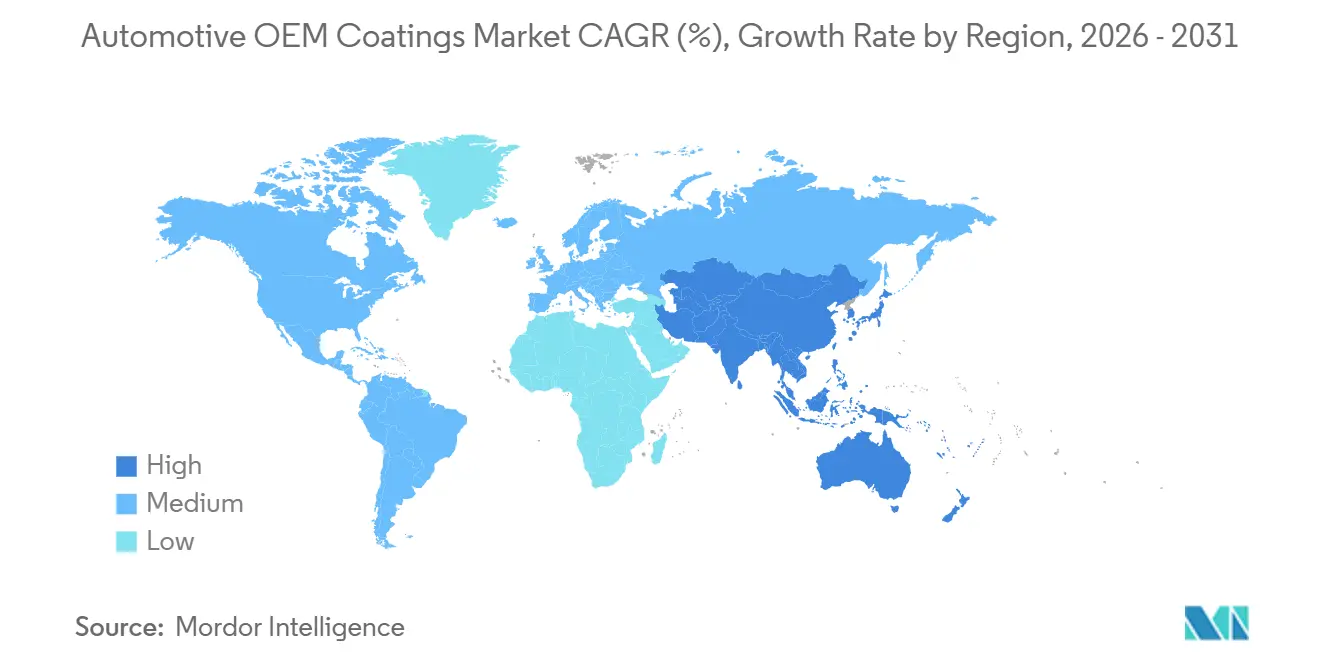
Asia-Pacific accounted for 52.44% of demand in 2025 and is projected to grow at a 5.89% CAGR through 2031. China produced 31.28 million light vehicles in 2024. The region is shifting from solventborne products to waterborne and powder alternatives as compliance requirements evolve. China's dual-carbon objectives have halted solventborne permits in Shandong and Hebei. India's Production Linked Incentive (PLI) scheme is expected to generate an additional 180,000 metric tons of coating demand by 2027.
East and South Asia Automotive OEM Coatings Market
India is emerging as a second regional growth center, driven by OEM expansion and electric bus procurement. Japan and South Korea contribute through low-temperature cure and premium finish systems, which can be transferred to assembly operations in Southeast Asia and other regions. China's GB 24409-2020 standard and Japan's carbon-neutrality roadmap influence supplier research and development priorities. The combination of vehicle production volume, regulatory requirements, and technology capacity keeps Asia-Pacific central to the automotive OEM coatings market.
The Americas and EMEA Automotive OEM Coatings Market
North America and Europe are mature regions with established plants and stricter compliance requirements. U.S. Volatile Organic Compound (VOC) limits are accelerating the shift to waterborne coatings at OEM facilities in Michigan, Ohio, and Tennessee. BASF commissioned a new automotive OEM coatings plant in Münster, Germany, in November 2025[2]BASF SE, “BASF and Carlyle Complete Coatings Transaction,” BASF Global, basf.com. South America, the Middle East, and Africa remain smaller in value, though Brazil provides a stable base and new assembly investments could generate further demand. South Africa and Morocco are likely entry points due to their established OEM assembly operations for export.

Competitive Landscape
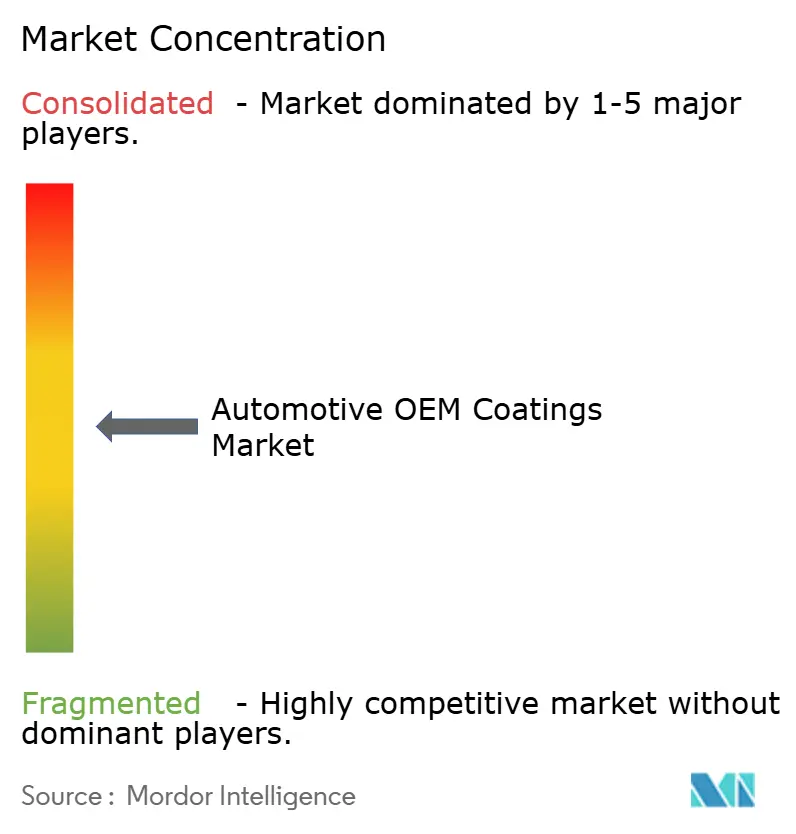
The automotive OEM coatings market is moderately fragmented. PPG Industries, the proposed combined AkzoNobel-Axalta entity, Surventis, Nippon Paint Holdings, and Kansai Paint form the core group of full-service global suppliers. Competition increasingly centers on formulation speed, technical service, digital tools, and proximity to vehicle assembly plants. PPG has used its Knowledge Navigator platform to evaluate more formulation combinations prior to laboratory validation, supporting faster development of clearcoat and low-VOC systems. Axalta received a 2025 R&D 100 Award for a fast-cure, low-energy collision repair paint system.
BASF and The Carlyle Group completed the coatings transaction in July 2026. BASF received pre-tax cash proceeds of EUR 5.8 billion (~USD 6.59 billion) and retained a 40% equity interest in Surventis, with the transaction valued at EUR 7.7 billion (~USD 8.75 billion). Additionally, AkzoNobel and Axalta announced a merger with a combined enterprise value of USD 25 billion, with shareholder approval pending as of August 2026. These transactions reduce the number of global full-service suppliers and increase pressure on mid-tier competitors, reinforcing the market's preference for companies that can combine formulation capability with local supply support.
Kansai Paint and KCC Corporation are responding by expanding OEM technical support and geographic reach rather than competing directly on revenue scale with larger consolidated suppliers. Bio-based resin platforms and EV thermal-management coatings remain areas where no supplier has established a standardized global platform, creating opportunities for specialized challengers with strong validation capability. However, long approval cycles continue to favor suppliers that already hold specifications at assembly plants. The competitive balance therefore depends on access to technology, testing resources, and customer relationships, with the market evolving through both consolidation and specialized product development.
Automotive OEM Coatings Industry Leaders
PPG Industries, Inc.
BASF
Axalta Coating Systems, LLC
The Sherwin-Williams Company
Akzo Nobel N.V.
- *Disclaimer: Major Players sorted in no particular order
Automotive OEM Coatings Market Companies Covered in this Report
- Akzo Nobel N.V.
- Asian Paints Limited
- Axalta Coating Systems, LLC
- BASF
- Beckers Group
- Berger Paints India Limited
- Covestro AG
- Hempel
- Jotun
- Kansai Paint Co., Ltd.
- KCC Corporation
- Nippon Paint Holdings Co., Ltd.
- PPG Industries, Inc.
- RPM International Inc.
- The Sherwin-Williams Company
- TOA Paint (Thailand) Public Company Limited

Recent Industry Developments in Automotive OEM Coatings Market
- July 2026: BASF and The Carlyle Group completed their automotive coatings transaction, with BASF receiving pre-tax cash proceeds of EUR 5.8 billion (~USD 6.59 billion) and retaining a 40% equity stake in the new entity, Surventis.
- November 2025: BASF commissioned a new automotive OEM coatings production plant at its Münster, Germany site, with a focus on sustainability and process stability, in response to growing European OEM demand for low-carbon coating systems.


Global Automotive OEM Coatings Market Report Scope
Automotive OEM coatings are specialized multi-layer paint and treatment systems applied to new vehicles during manufacturing. They consist of electrocoat, primer, basecoat, and clearcoat layers.
The automotive OEM coatings market is segmented by resin type, technology, coat type, vehicle type, and geography. By resin type, the market is segmented into epoxy, acrylic, alkyd, polyurethane, polyester, and other resin types. By technology, the market is segmented into waterborne, solventborne, powder-based, UV-curable and low-bake, and other technologies. By coat type, the market is segmented into E-coat, primer, basecoat, clearcoat, and pretreatment. By vehicle type, the market is segmented into passenger cars, commercial vehicles, and two-wheelers. The report also covers market size and forecasts for automotive OEM coatings across 16 countries in major regions. The market sizes and forecasts are provided in terms of value (USD).
| Epoxy |
| Acrylic |
| Alkyd |
| Polyurethane |
| Polyester |
| Other Resin Types |
| Waterborne |
| Solventborne |
| Powder-Based |
| UV-Curable and Low-Bake |
| Other Technologies |
| E-Coat |
| Primer |
| Basecoat |
| Clearcoat |
| Pretreatment |
| Passenger Cars |
| Commercial Vehicles |
| Two-Wheelers |
| Asia-Pacific | China |
| India | |
| Japan | |
| South Korea | |
| Rest of Asia-Pacific | |
| North America | United States |
| Canada | |
| Mexico | |
| Europe | Germany |
| United Kingdom | |
| France | |
| Italy | |
| Russia | |
| Rest of Europe | |
| South America | Brazil |
| Argentina | |
| Rest of South America | |
| Middle-East and Africa | Saudi Arabia |
| South Africa | |
| Rest of Middle-East and Africa |
| By Resin Type | Epoxy | |
| Acrylic | ||
| Alkyd | ||
| Polyurethane | ||
| Polyester | ||
| Other Resin Types | ||
| By Technology | Waterborne | |
| Solventborne | ||
| Powder-Based | ||
| UV-Curable and Low-Bake | ||
| Other Technologies | ||
| By Coat Type | E-Coat | |
| Primer | ||
| Basecoat | ||
| Clearcoat | ||
| Pretreatment | ||
| By Vehicle Type | Passenger Cars | |
| Commercial Vehicles | ||
| Two-Wheelers | ||
| By Geography | Asia-Pacific | China |
| India | ||
| Japan | ||
| South Korea | ||
| Rest of Asia-Pacific | ||
| North America | United States | |
| Canada | ||
| Mexico | ||
| Europe | Germany | |
| United Kingdom | ||
| France | ||
| Italy | ||
| Russia | ||
| Rest of Europe | ||
| South America | Brazil | |
| Argentina | ||
| Rest of South America | ||
| Middle-East and Africa | Saudi Arabia | |
| South Africa | ||
| Rest of Middle-East and Africa | ||


Key Questions Answered in the Report
What is current market size of Automotive OEM Coatings Market?
The Automotive OEM coatings market size was estimated at USD 18.86 billion in 2025 and is estimated to grow from USD 19.82 billion in 2026 to USD 25.35 billion by 2031, at a CAGR of 5.04% during the forecast period (2026-2031).
Which resin type held the largest share in 2025?
Epoxy led with a 29.86% share in 2025, supported by its use in electrocoat primers and complex vehicle structures.
Which coating technology is growing fastest?
UV-Curable and Low-Bake systems are projected to grow at a 7.13% CAGR through 2031 because they support lower-energy curing.
Which region leads to demand for automotive OEM coatings?
Asia-Pacific led with 52.44% share in 2025 and is forecast to grow at a 5.89% CAGR through 2031.
Page last updated on:





