
Automated Decision Management Software Market Size and Share
Market Overview
| Study Period | 2020 - 2031 |
|---|---|
| Market Size (2026) | USD 9.96 Billion |
| Market Size (2031) | USD 21.87 Billion |
| Growth Rate (2026 - 2031) | 17.04% CAGR |
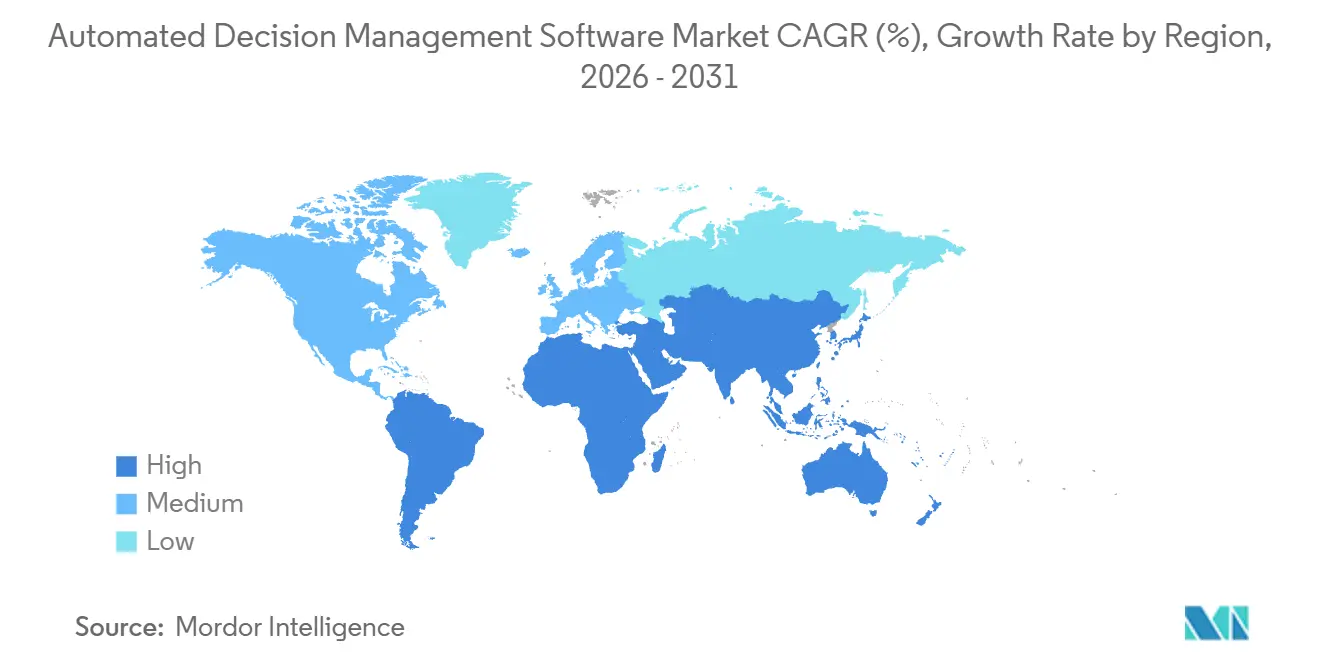
| Fastest Growing Market | Asia-Pacific |
| Largest Market | North America |
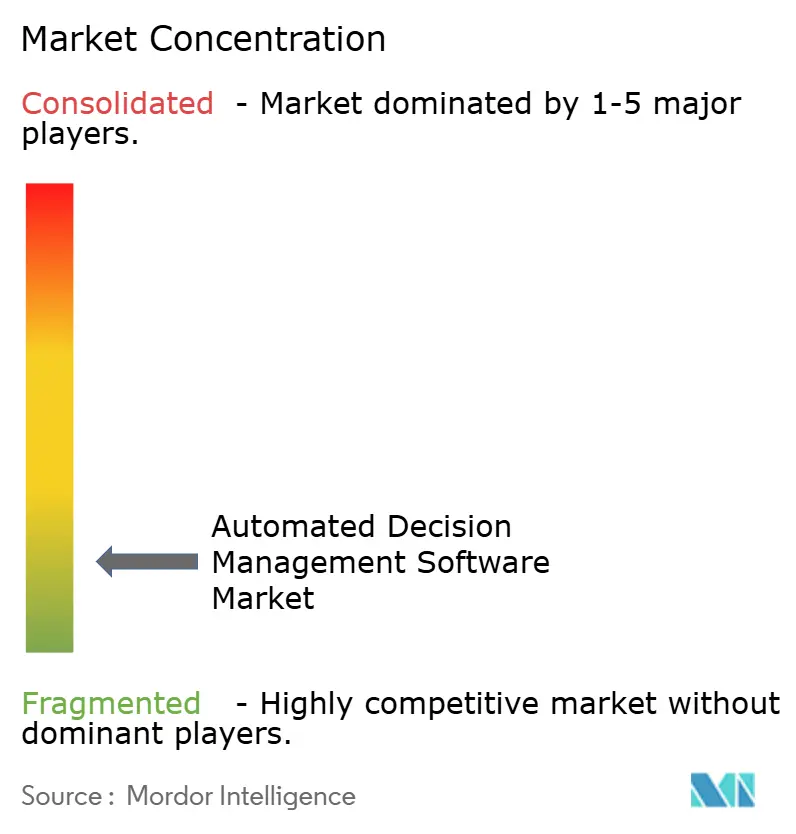
| Market Concentration | Low |
Major Players *Disclaimer: Major Players sorted in no particular order Image © Mordor Intelligence. Reuse requires attribution under CC BY 4.0. | |
Automated Decision Management Software Market Analysis by Mordor Intelligence
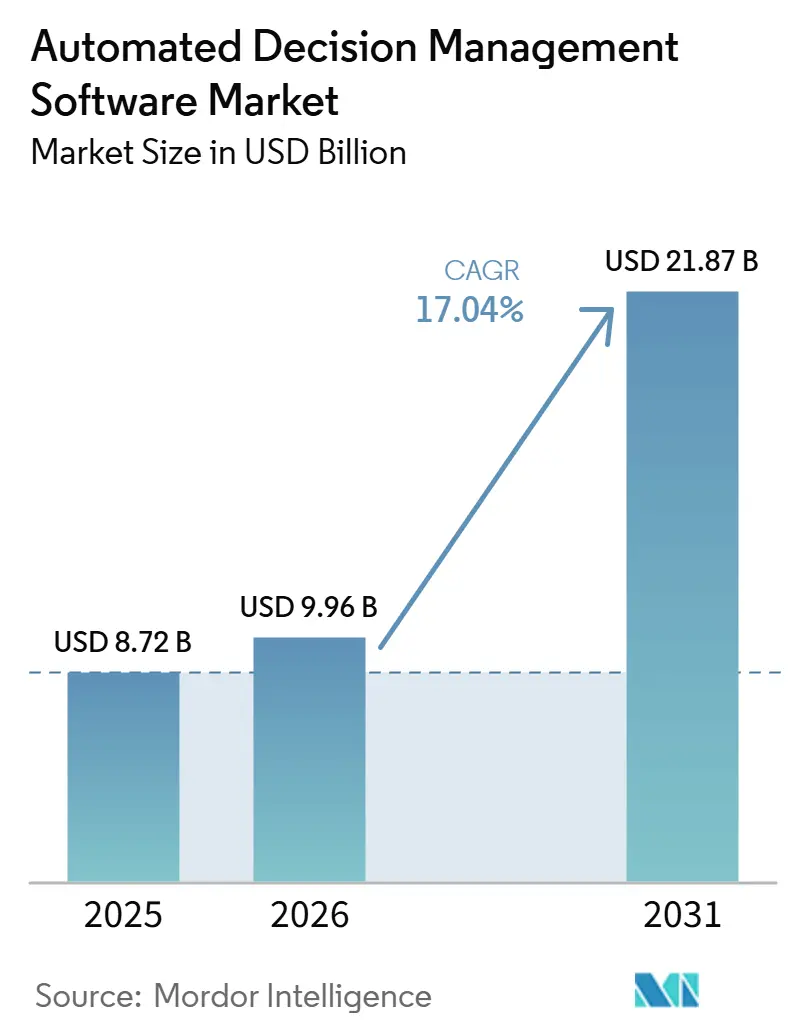
The Automated Decision Management Software Market size was valued at USD 8.72 billion in 2025 and is estimated to grow from USD 9.96 billion in 2026 to reach USD 21.87 billion by 2031, at a CAGR of 17.04% during the forecast period (2026-2031). The market is moving from decisions handled through manual review toward systems that apply policies at high speed and at scale across transactions, customer journeys, and internal operations. Demand is strongest where organizations must make frequent decisions while retaining clear records of how each outcome was reached. Regulation is also changing purchasing priorities, as companies need human oversight, documentation, and audit trails for high-risk uses of artificial intelligence. Agentic AI adds to this need because organizations must set boundaries for actions that software can take without case-by-case approval. Competition, therefore, centers on governance, integration depth, and the ability to make decision logic accessible to business teams without removing appropriate control.
Key Report Takeaways
- By offering, software held 71.26% of the Automated Decision Management Software Market share in 2025, while services are projected to expand at a CAGR of 18.14% through 2031.
- By deployment model, cloud accounted for 66.83% of revenue in Automated Decision Management Software Market 2025, while hybrid is expected to record the highest CAGR of 17.92% through 2031.
- By function, risk and compliance management held 26.47% share in 2025, while pricing and revenue optimization is projected to grow at a CAGR of 18.21% through 2031.
- By enterprise size, large enterprises accounted for 63.58% of the market share in the Automated Decision Management Software Market 2025, while small and mid-sized enterprises are projected to expand at a CAGR of 18.36% through 2031.
- By end user, BFSI held 24.19% share in 2025, while healthcare and life sciences are expected to grow at a CAGR of 17.74% through 2031.
- By geography, North America held 39.82% share in 2025, while the Asia-Pacific is projected to expand at a CAGR of 18.08% through 2031.
Note: Market size and forecast figures in this report are generated using Mordor Intelligence’s proprietary estimation framework, updated with the latest available data and insights as of January 2026.
Global Automated Decision Management Software Market Trends and Insights
Drivers Impact Analysis*
| Driver | (~) % Impact on CAGR Forecast | Geographic Relevance | Impact Timeline |
|---|---|---|---|
| Demand for Real-Time, High-Volume Operational Decisions | +4.2% | Global | Short term (≤ 2 years) |
| Expansion of Explainable AI and Model Governance Requirements | +3.8% | Europe, North America, with spillover to Asia-Pacific and Middle East and Africa | Medium term (2-4 years) |
| Low-Code Decision Modeling Expanding Business-User Adoption | +3.1% | Global, with emphasis on Asia-Pacific and North America | Short term (≤ 2 years) |
| Embedded Decisioning Across Digital Channels and Core Applications | +2.6% | Global | Medium term (2-4 years) |
| Decision Intelligence Investment in Regulated Industries | +2.2% | North America and Europe | Medium term (2-4 years) |
| Agentic AI Requiring Governed Action and Policy Execution | +1.9% | Global, led by North America | Long term (≥ 4 years) |
| Source: Mordor Intelligence | |||
Demand for Real-Time, High-Volume Operational Decisions
Organizations that process large volumes of payments, insurance claims, and online transactions cannot rely on human review for every routine decision, particularly when delayed action can increase losses or interrupt a customer interaction. The need is especially clear in fraud management, where a 2025 AWS and Stripe case study reported that automated engines identified 95% of card-testing attacks in real time and reduced unnecessary customer friction by 20%.[1]Amazon Web Services, “Production-Grade AI Agents for Financial Compliance: Lessons from Stripe,” AWS Machine Learning Blog, aws.amazon.com. This supports demand for the Automated Decision Management Software Market because buyers need both faster outcomes and consistent application of policy across a growing number of channels. As real-time decisioning becomes more common, buyers place greater value on systems that explain why a decision was made, record the relevant data, and retain evidence for later review. Banks also need adaptable controls as fraud patterns change and as new products alter the profile of transactions that must be assessed. The OCC called for a dynamic and adaptive approach to risk management in its Spring 2026 risk perspective, which supports continued investment in automated risk processes.
Expansion of Explainable AI and Model Governance Requirements
The European Union AI Act increases the importance of governance for high-risk automated decisions that affect individuals, access to services, or safety-related processes. The European Commission explains that the Act establishes transparency obligations for certain AI systems and related information duties for providers and deployers.[2]European Commission, “Transparency Obligations Under Article 50 of the AI Act,” European Commission Digital Strategy, digital-strategy.ec.europa.eu. This makes explainability, auditability, and human oversight part of the operating requirements for many enterprise use cases, rather than optional features added after deployment. The Automated Decision Management Software Market benefits when organizations choose platforms that provide decision records and controls instead of deploying isolated models with separate governance processes. These capabilities can reduce the work needed to document decisions in areas such as credit, insurance, employment, and clinical triage, where a policy outcome may later need to be examined. They also make it easier for compliance teams to review policy changes before they affect customers or patients, and to identify when a decision requires human intervention.
Low-Code Decision Modeling Expanding Business-User Adoption
Low-code tools reduce the delay between a policy change and its use in an operational workflow, which matters when a business must respond to a new rule or a changing fraud pattern. Visual rule tables and guided authoring let analysts express decision logic without depending on development teams for every adjustment, test, or release. A 2024 Mendix survey found that 98% of respondents used low-code in their development process and 84% said it enabled more people to participate in application development.[3]Mendix, “A Survey of the Low-Code Market,” Mendix, mendix.com. This approach broadens the addressable market for the Automated Decision Management Software Market, enabling smaller organizations to use packaged tools with less specialized technical work and fewer lengthy development cycles. The OECD found that ready-to-use tools were more common than customized AI systems among small and medium-sized enterprises in surveyed economies. Vendors can respond with narrower, preconfigured applications for tasks such as fraud checks, pricing decisions, and eligibility assessments, rather than requiring each buyer to build a broad decision platform from the start.[4]Organisation for Economic Co-operation and Development, “Empowering SMEs in the Age of AI,” OECD, oecd.org.
Embedded Decisioning Across Digital Channels and Core Applications
Decision engines are increasingly embedded in customer relationship management, enterprise resource planning, and digital banking environments, where the business data needed for decision-making is already available. This design reduces the need to move data between separate systems before a decision can be made and can limit the risk of a workflow being delayed by disconnected applications. Experian introduced its Agent Operating System in June 2026 with agents for fraud, identity, credit risk, and governance within the lending lifecycle. The same company reported that 48% of surveyed senior financial services decision-makers found it difficult to integrate data into AI workflows. The Automated Decision Management Software Market can benefit from platforms that bring data, rules, governance, and workflow actions together in a single, controlled environment. Embedded records can also help organizations respond when customers question an automated outcome or when a regulator asks for evidence of the controls used.
Restraints Impact Analysis*
| Restraint | (~) % Impact on CAGR Forecast | Geographic Relevance | Impact Timeline |
|---|---|---|---|
| High Implementation and Integration Costs | -2.8% | Global | Short term (≤ 2 years) |
| Shortage of Domain-Specific Data and Decision Expertise | -2.1% | Global, concentrated in emerging markets and specialized verticals | Medium term (2-4 years) |
| Vendor Lock-In Across Proprietary Cloud Decision Stacks | -1.7% | North America and Europe | Long term (≥ 4 years) |
| Uncertain Liability and Regulatory Treatment of Automated Decisions | -1.2% | Europe and North America | Medium term (2-4 years) |
| Source: Mordor Intelligence | |||
High Implementation and Integration Costs
Deploying decision management software often requires connections to data pipelines, model registries, rule-authoring tools, monitoring systems, and the core applications where business decisions are carried out. These connections can extend project schedules and add costs beyond the initial license, especially when the client has to reconcile inconsistent data definitions across systems. Governance, security, and integration requirements can remain barriers even when an organization has budgeted for AI-related work. For mid-sized companies, the cost includes monitoring, model updates, user training, and support for compliance reviews after the first implementation. Legacy systems in banking and insurance can create an additional burden because existing policy rules may be dispersed across old, undocumented code, making them difficult to formalize. This constraint supports demand for services, but it can delay entry into the Automated Decision Management Software Market for buyers with limited implementation capacity.
Shortage of Domain-Specific Data and Decision Expertise
Automated decision models need labeled data that reflects a business's exceptions, risks, and policies, not just the most common cases. Such data can be incomplete, spread across internal systems, or unavailable in specialized fields where past outcomes were not consistently recorded. A 2026 paper in the Journal of the Knowledge Economy noted that data constraints can make it harder for small and medium-sized enterprises to develop accurate and interpretable AI systems. The issue extends to expertise because clinical triage, anti-money-laundering monitoring, and industrial fault prediction each require detailed subject knowledge alongside technical skills. The OECD also identified time constraints, maintenance costs, and skills gaps as barriers to the effective use of AI by small and medium-sized enterprises. These limits can slow adoption in specialized and emerging markets even when suitable software is available, because buyers may be unable to validate a decision model before putting it into operation.
*Our forecasts treat driver/restraint impacts as directional, not additive. The impact forecasts reflect baseline growth, mix effects, and variable interactions.
Segment Analysis
By Offering: Services Growth Narrows the Software Platform Lead
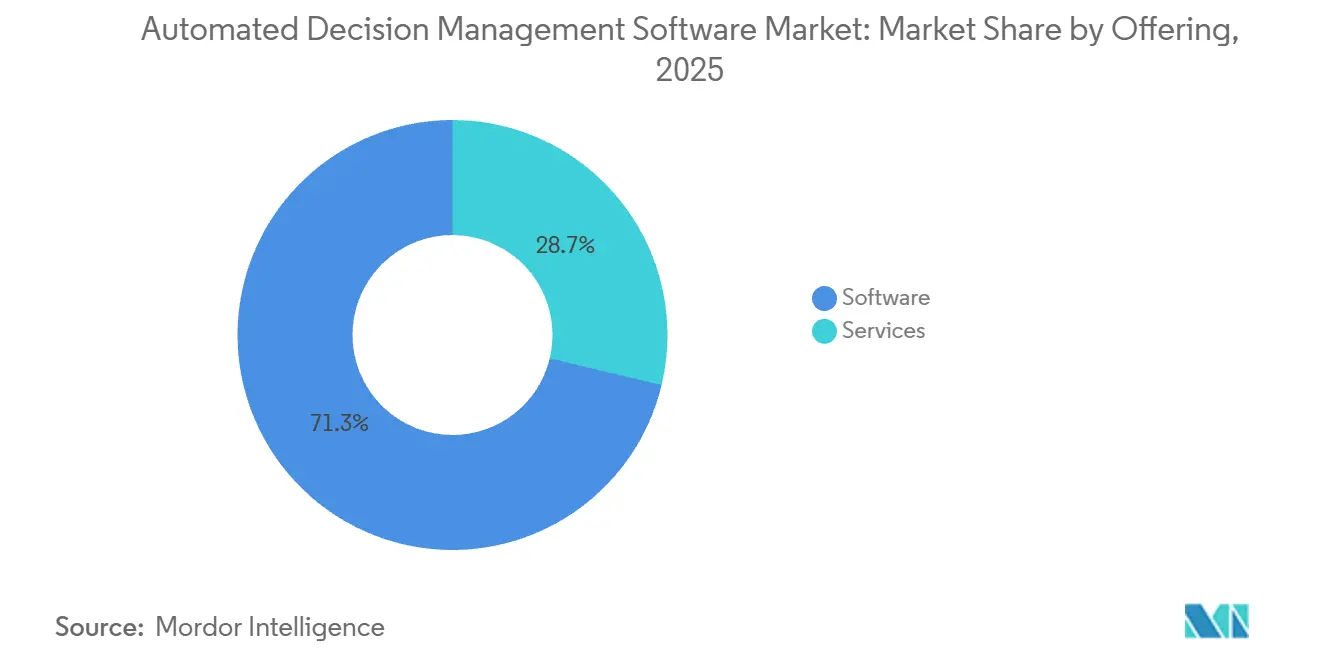
Software held 71.26% of the Automated Decision Management Software Market share in 2025. Enterprises favored integrated subscriptions that combine rules engines, model deployment, explainability functions, monitoring dashboards, and a common workspace for policy management. A single platform can reduce the number of vendors to be assessed during a compliance review and simplify responsibility for updates. It can also give large organizations a more consistent way to manage policy changes across business units, products, and geographic operations. The software model is particularly relevant where decision rules and analytical models need to work together within the same governed workflow. This preference keeps software as the leading commercial component of the Automated Decision Management Software Market.
Services is projected to grow at a CAGR of 18.14% from 2026 to 2031. Buyers need support to connect decision systems with legacy applications and to configure documentation, audit trails, test cases, and controls that align with their operating procedures. Managed decision operations are also becoming more important as vendors assume responsibility for monitoring models, detecting drift, applying policy updates, and helping teams respond to changing requirements. IBM released ODM 9.5.0.1 in December 2025 with Decision Assistant integration to help translate business policy into decision logic. Embedded tools may reduce some technical work, but complex deployments still require implementation and governance expertise, particularly when a company is replacing undocumented rules. Service providers can therefore remain involved after go-live rather than ending their role when the initial software configuration is complete.


By Deployment Model: Hybrid Becomes a Lasting Architecture
Cloud accounted for 66.83% of the Automated Decision Management Software Market in 2025. Technology and retail companies often favor cloud delivery because it enables rapid updates, flexible capacity, and reduced internal infrastructure management. Cloud systems also suit organizations with flexible data rules and variable demand, including seasonal peaks in customer interactions or transactions. Vendor-managed upgrades can help users adopt new governance or analytics features more quickly than they could through a self-managed installation. The model can also shorten the time between a product release and its availability to business users. These advantages keep the cloud as the largest deployment model.
Hybrid deployment is projected to grow at a 17.92% CAGR through 2031. Banking and healthcare organizations use hybrid designs to retain sensitive workloads on private infrastructure while using cloud capacity when demand changes or when less sensitive processes can be handled externally. This approach can support data residency needs, response-time requirements, continuity planning, and access to cloud services without requiring every component to use the same environment. On-premises installations retain a role in defense, government, and central-bank settings that require isolated operations and direct control over systems. A hybrid model can also give buyers more flexibility when they need to adjust a vendor relationship or move a workload between environments. The Automated Decision Management Software Market is therefore likely to retain more than one viable deployment route rather than move entirely to a single architecture.
By Function: Risk and Compliance Management Leads While Pricing Expands
Risk and compliance management accounted for 26.47% of the function segment in 2025. The segment has mature applications in credit approval, anti-money laundering monitoring, insurance underwriting, fraud screening, and regulatory reporting. These activities involve high decision volumes, formal requirements for policy control, and a need to show how a result was produced. Banks continue to treat fraud as a material operational issue because new transaction patterns can expose gaps in existing checks. The OCC identified fraud as a key driver of operational losses in its Spring 2026 assessment. This established use base keeps risk and compliance management central to the Automated Decision Management Software Market.
Pricing and revenue optimization is projected to grow at a CAGR of 18.21% through 2031. Companies are moving away from static annual pricing toward systems that assess margins, customer terms, promotions, and commercial conditions more often. NIQ introduced its Price and Promo Optimizer in May 2026 to let manufacturers simulate pricing and promotion scenarios before retailer negotiations. This function provides commercial teams with a practical entry point into the Automated Decision Management Software Market, as the results can be linked to an existing pricing process. It also places greater importance on decision records when several teams need to understand why a particular offer or promotion was recommended. Supply chain routing, human resources decisions, and customer personalization are additional areas where data availability and decision frequency are supporting adoption.
By Enterprise Size: Small and Mid-Sized Enterprises Gain Access
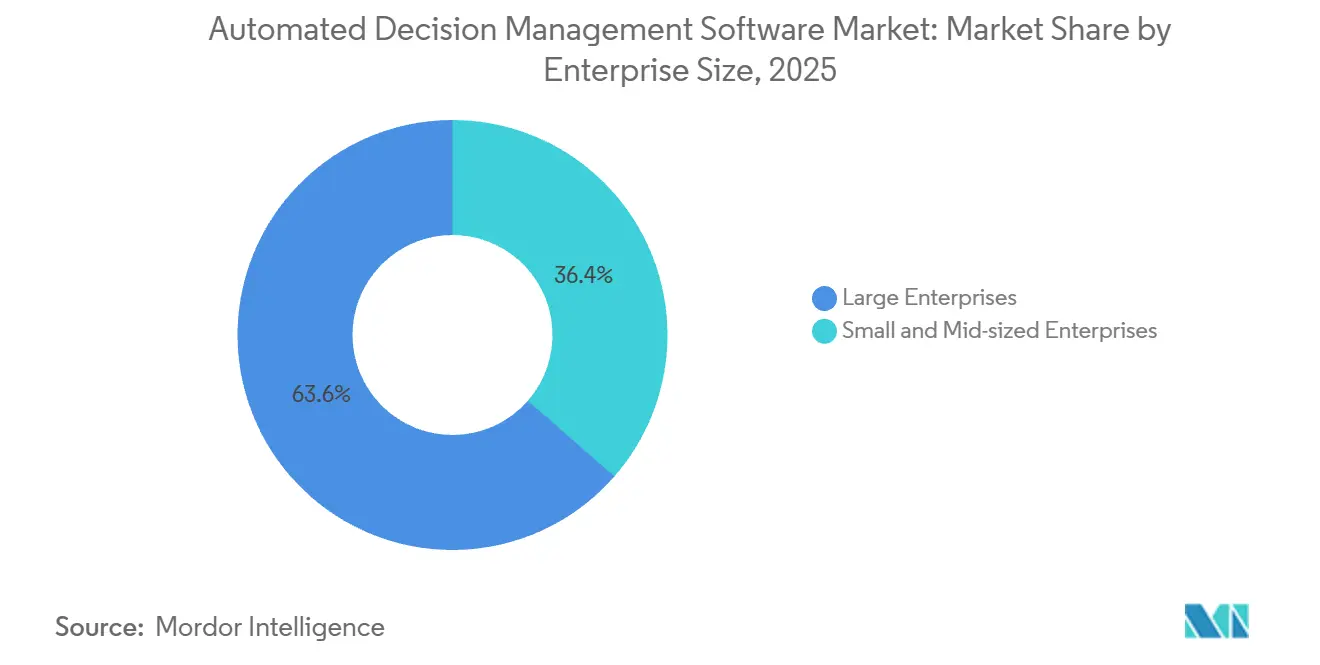
Large enterprises held 63.58% of the enterprise-size segment in 2025. Financial institutions, insurers, and telecommunications companies have the transaction volumes and compliance needs to justify broad platform deployments across several functions. They can also fund professional services, governance teams, integration work, and the ongoing maintenance needed to keep models and rules current. Their established use of decision tools supports the segment's leading position and gives vendors reference customers for complex deployments. Large accounts remain important for vendors offering enterprise-wide platforms with extensive integration and control requirements. Their buying decisions often favor platforms that can standardize governance across separate business units.
Small and mid-sized enterprises are projected to expand at a CAGR of 18.36% from 2026 to 2031. Consumption-based pricing and low-code tools lower the initial investment and reduce the need for specialized teams that were previously required to build decision systems. The OECD found continued uptake of ready-to-use AI applications among small and medium-sized enterprises, with efficiency and growth among the main motivations for adoption. Adoption is concentrated in focused modules, including fraud screening for fintech lenders, pricing support for distributors, and eligibility assessments for digital insurers. Vendors can better serve this group through vertical applications at prices that fit smaller operating budgets and with templates that shorten the period before a tool can be used. This pattern supports growth without requiring smaller buyers to implement a full enterprise decision suite.
By End User: BFSI Leads While Healthcare and Life Sciences Accelerate
BFSI accounted for 24.19% of the end-user segment in 2025. The sector has used automated decisioning for credit, fraud, compliance, and customer onboarding processes for decades, creating a base of established use cases. These decisions take place at the transaction level and require predictable rules, clear records, timely responses, and the ability to direct exceptions to human reviewers. The size of the installed base gives BFSI a strong lead over other end-user groups, making financial services a key source of product requirements for vendors. Organizations in the sector also face high costs when a decision is delayed or when a fraud control fails. These conditions keep BFSI at the center of demand in the Automated Decision Management Software Market.
The healthcare and life sciences industry is expected to grow at a CAGR of 17.74% through 2031. The need to distinguish clinical decision functions that require different forms of oversight is increasing the importance of clear system controls. Healthcare providers need systems that combine clinical decision support with documented controls, review processes, and human oversight when a recommendation affects care. Other end users include IT and telecommunications, automotive and transportation, energy and utilities, industrial manufacturing, and travel and hospitality. Their use is currently concentrated in functions such as network fault prediction, maintenance decisions, dynamic yield management, and other high-value decisions that occur repeatedly. These applications can expand as organizations improve the availability and quality of the data needed to support them.
Geography Analysis
North America held 39.82% of the geographic segment in 2025. The region has a large base of BFSI institutions that already use automated decisions in credit, fraud, compliance, and customer onboarding workflows. Its technology companies also have deep AI engineering capabilities, established enterprise software buying processes, and a large base of suppliers with experience in regulated deployments. The United States drives most regional demand, while Canada contributes through financial services and public-sector digitization. Mexico is developing use cases in banking and manufacturing compliance, while this mix of mature users and technology providers supports North America's leading position in the Automated Decision Management Software Market.
Asia-Pacific is projected to grow at a CAGR of 18.08% from 2026 to 2031. Growth is concentrated in India, China, Japan, and Southeast Asia, where enterprise AI activity is being matched by a growing need to control automated decisions. India has an expanding base of enterprise AI and public programs that support access to computing infrastructure. The region's digital banks are driving demand for automated credit and fraud decision-making systems capable of handling high transaction volumes. Asia-Pacific, therefore, offers vendors a large group of buyers who need localized products, local implementation support, and systems that meet diverse data and regulatory requirements. The region's pace of digital financial services adoption offers a practical path for decision platforms to move beyond early pilots.
Europe is seeing stronger demand for governance tools as companies prepare for AI regulation and seek clearer ways to document automated outcomes. Germany's enterprise adoption of AI has increased, supporting broader deployment of software that manages decisions and related records. South America is gaining momentum, particularly in Brazil, where companies are giving AI a higher strategic priority and are examining its use in financial services and enterprise operations. The Middle East and Africa are moving from early exploration into more structured pilots in banking and government services. Saudi Arabia, the United Arab Emirates, South Africa, and Nigeria are among the markets with relevant early activity. Data localization rules and sovereign deployment needs will influence vendor selection across these regions.

Competitive Landscape
The Automated Decision Management Software Market is fragmented among large analytics and decision-platform providers with broad product coverage and experience in regulated workflows. These companies have long-standing positions in BFSI and government workflows and offer tools across rules management, analytics, and operational decisioning. Below this group, many specialized providers compete in low-code rules, credit decisions, and open-standard Decision Model and Notation implementations. Established vendors emphasize governance depth, compliance experience, ecosystem integrations, and the ability to support large deployments across business units. Cloud-native competitors focus on faster deployment, easier access for business users, and consumption-based pricing that is more accessible to smaller organizations. The resulting structure gives buyers a choice between broad platforms and more focused products that address a single operational need.
Leading companies are adding generative and agentic capabilities to reduce the work required to model, test, deploy, and update decision logic. FICO announced its Foundation Model for Financial Services in September 2025, with models designed for financial decisioning and trust-related use cases. Experian launched the Agent Operating System in June 2026, integrating fraud, identity, credit risk, and governance agents into its lending workflow. Kyndryl introduced a policy-as-code capability in February 2026 to translate organizational rules and regulatory requirements into machine-readable controls for agentic AI workflows. These moves show that policy execution, explainability, monitoring, audit trails, and defined action boundaries are becoming core product requirements for the Automated Decision Management Software Market.
Opportunities remain in vertical packages for regulated small and medium-sized enterprises, in sovereign deployment options for government and defense, and in governance tools for organizations using multiple AI suppliers. Open-source alternatives such as Drools and OpenL Tablets continue to create pricing pressure at the lower end and require suppliers to show where their additional governance or integration capabilities create value. Vendors that fit into existing business software environments can gain an advantage because data and workflows are already present in those systems. The Automated Decision Management Software Market also rewards companies that can provide evidence of how a decision was formed, the policy that applied, and the point at which a person can intervene. Buyers will continue to compare platform breadth with the speed, ease of deployment, and long-term flexibility of a provider's approach.
Automated Decision Management Software Industry Leaders
Fair Isaac Corporation
Pegasystems Inc.
SAS Institute Inc.
Experian plc
Equifax Inc.
- *Disclaimer: Major Players sorted in no particular order

Recent Industry Developments
- July 2026: Genpact launched Banking Analyst Suite, an agentic AI platform for regulated banking operations, purpose-built for anti-money laundering and financial crime compliance workflows. The solution coordinates multiple AI agents to assess customer behavior, analyze transactions, validate profiles, and recommend next steps while preserving human approval for regulated actions, addressing the governance gap that had previously slowed agentic AI adoption in financial crime operations.
- July 2026: Pegasystems released Pega Infinity 26, its AI suite combining advanced agentic AI with built-in governance and a flat fee per resolved case pricing model that eliminates consumption-based token charges. The release introduced agentic orchestration for Pega and third-party AI agents within governed workflows, with runtime MCP compatibility enabling direct integration with Claude, GitHub Copilot, and OpenAI Codex for governed enterprise decision automation.
- June 2026: Experian launched Agent Operating System within its Ascend Platform at Money20/20 Europe, embedding purpose-built agents for fraud, identity, credit risk, and governance directly into the lending lifecycle. The platform's first integration partner, ServiceNow, connected Experian's decisioning and governance layer with enterprise workflow automation, signaling a channel expansion beyond direct financial services clients toward broad enterprise distribution.
- June 2026: Pegasystems announced Pega Customer Engagement Studio at PegaWorld, bringing together Pega and third-party AI agents in a unified workspace that allows marketers to move from a marketing brief to live personalized decisioning actions in minutes while maintaining governance and regulatory control.


Global Automated Decision Management Software Market Report Scope
The automated decision management software market refers to the ecosystem of software solutions and services that enable the design, build, test, deployment, and execution of automated business rules and predictive models. These platforms combine traditional business rules management systems (BRMS) with advanced analytics, machine learning, and artificial intelligence to automate high-volume, complex operational decisions in real-time or batch modes. Deployed across cloud, hybrid, and on-premises environments, these solutions cater to organizations of varying sizes across diverse industries, including BFSI, healthcare, IT, and manufacturing. By utilizing ADM software for critical functions such as risk and compliance management, fraud detection, dynamic pricing and revenue optimization, and credit decisioning, organizations can eliminate manual bottlenecks, reduce human bias, ensure consistent regulatory compliance, and respond to dynamic market conditions with unprecedented speed and accuracy.
The Automated Decision Management Software Market Report is Segmented by Offering, (Software and Services), Deployment Model, (Cloud, Hybrid, and On-Premises), Function, (Risk and Compliance Management, Customer Experience and Personalization, Fraud Management, Pricing and Revenue Optimization, Credit Decisioning, and Other Functions), Enterprise Size, (Large Enterprises and Small and Mid-sized Enterprises), End Users, (IT and Telecommunication, BFSI, Automotive and Transportation, Healthcare and Life Sciences, Energy and Utilities, Industrial Manufacturing, Travel and Hospitality, and Other End Users), and Geography, (North America, South America, Europe, Asia-Pacific, and Middle East and Africa). The Market Forecasts are Provided in Terms of Value (USD).
| Software |
| Services |
| Cloud |
| Hybrid |
| On-Premises |
| Risk and Compliance Management |
| Customer Experience and Personalization |
| Fraud Management |
| Pricing and Revenue Optimization |
| Credit Decisioning |
| Other Functions |
| Large Enterprises |
| Small and Mid-sized Enterprises |
| IT and Telecommunication |
| BFSI |
| Automotive and Transportation |
| Healthcare and Life Sciences |
| Energy and Utilities |
| Industrial Manufacturing |
| Travel and Hospitality |
| Other End Users |
| North America | United States | |
| Canada | ||
| Mexico | ||
| South America | Brazil | |
| Argentina | ||
| Rest of South America | ||
| Europe | Germany | |
| United Kingdom | ||
| France | ||
| Russia | ||
| Spain | ||
| Rest of Europe | ||
| Asia-Pacific | China | |
| Japan | ||
| India | ||
| South Korea | ||
| Southeast Asia | ||
| Rest of Asia-Pacific | ||
| Middle East and Africa | Middle East | Saudi Arabia |
| United Arab Emirates | ||
| Rest of Middle East | ||
| Africa | South Africa | |
| Nigeria | ||
| Rest of Africa | ||
| By Offering | Software | ||
| Services | |||
| By Deployment Model | Cloud | ||
| Hybrid | |||
| On-Premises | |||
| By Function | Risk and Compliance Management | ||
| Customer Experience and Personalization | |||
| Fraud Management | |||
| Pricing and Revenue Optimization | |||
| Credit Decisioning | |||
| Other Functions | |||
| By Enterprise Size | Large Enterprises | ||
| Small and Mid-sized Enterprises | |||
| By End Users | IT and Telecommunication | ||
| BFSI | |||
| Automotive and Transportation | |||
| Healthcare and Life Sciences | |||
| Energy and Utilities | |||
| Industrial Manufacturing | |||
| Travel and Hospitality | |||
| Other End Users | |||
| By Geography | North America | United States | |
| Canada | |||
| Mexico | |||
| South America | Brazil | ||
| Argentina | |||
| Rest of South America | |||
| Europe | Germany | ||
| United Kingdom | |||
| France | |||
| Russia | |||
| Spain | |||
| Rest of Europe | |||
| Asia-Pacific | China | ||
| Japan | |||
| India | |||
| South Korea | |||
| Southeast Asia | |||
| Rest of Asia-Pacific | |||
| Middle East and Africa | Middle East | Saudi Arabia | |
| United Arab Emirates | |||
| Rest of Middle East | |||
| Africa | South Africa | ||
| Nigeria | |||
| Rest of Africa | |||


Key Questions Answered in the Report
What is the size of the Automated Decision Management Software Market?
The Automated Decision Management Software Market was valued at USD 8.72 billion in 2025, is estimated at USD 9.96 billion in 2026, and is forecast to reach USD 21.87 billion by 2031 as organizations increase use of governed, repeatable operational decisions.
What is driving demand for automated decision management software?
Demand for the Automated Decision Management Software Market is supported by high-volume decisions in fraud, payments, insurance, and digital commerce, along with stronger requirements for governance, auditability, human oversight, and clear records of decision outcomes.
Which offering leads automated decision management software sales?
Software led with 71.26% share in 2025 because buyers favor integrated platforms for rules, models, explainability, monitoring, policy changes, and more consistent control across operational workflows.
Which deployment model is growing fastest?
Within the Automated Decision Management Software Market, hybrid deployment is projected to grow at a CAGR of 17.92% through 2031 as regulated organizations balance private infrastructure with cloud capacity, data residency requirements, continuity planning, operational resilience, sensitive data controls, and access to vendor-managed capabilities without placing every workload in the same environment.
Which end user is expected to grow fastest?
Healthcare and life sciences is expected to grow at a CAGR of 17.74% through 2031 in the Automated Decision Management Software Market, supported by the need for governed clinical decision functions, documented controls, human review when recommendations affect patient care, and clearer processes for showing the policy or information that informed a recommendation.
Which region has the largest share?
North America held 39.82% share in 2025, supported by its concentration of BFSI institutions and technology enterprises with mature automated workflows, established purchasing processes, and demand for compliance-focused decision records.
Page last updated on:






