
Automated Compliance Testing Software Market Size and Share
Market Overview
| Study Period | 2020 - 2031 |
|---|---|
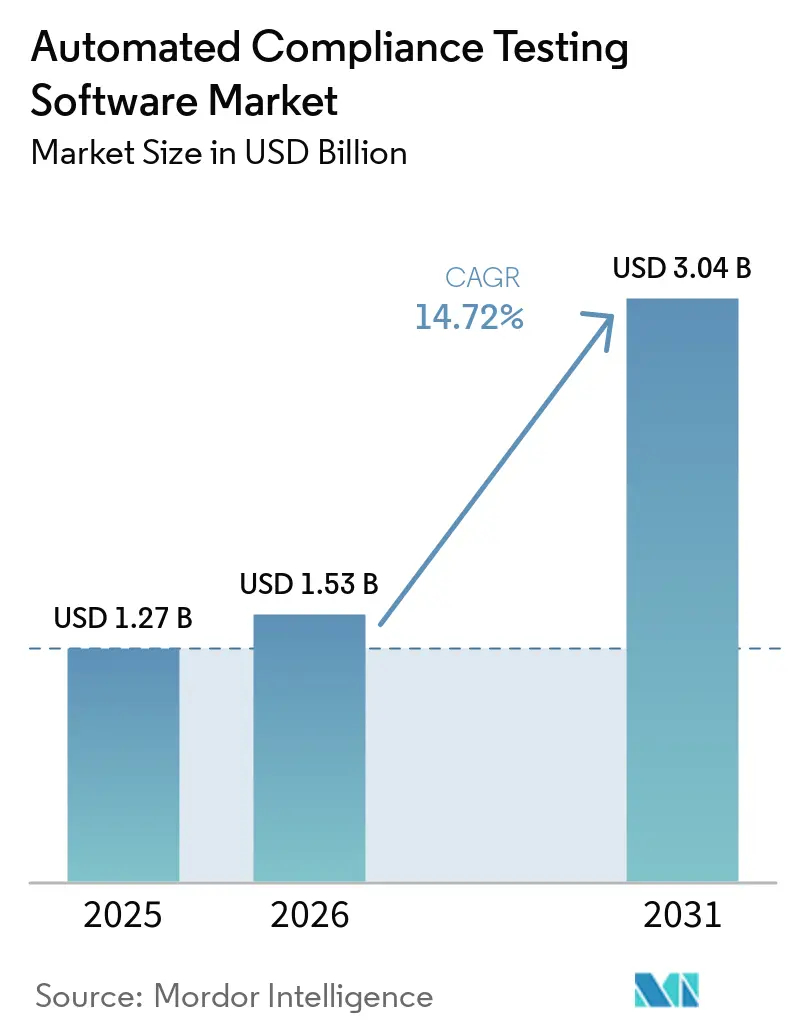
| Market Size (2026) | USD 1.53 Billion |
| Market Size (2031) | USD 3.04 Billion |
| Growth Rate (2026 - 2031) | 14.72 % |
| Fastest Growing Market | Asia-Pacific |
| Largest Market | North America |
| Market Concentration | Low |
Major Players *Disclaimer: Major Players sorted in no particular order Image © Mordor Intelligence. Reuse requires attribution under CC BY 4.0. | |
Automated Compliance Testing Software Market Analysis by Mordor Intelligence
The Automated compliance testing software market size was valued at USD 1.27 billion in 2025 and is estimated to grow from USD 1.53 billion in 2026 to reach USD 3.04 billion by 2031, at a CAGR of 14.72% during the forecast period 2026-2031. Enterprises are replacing periodic audit work with continuous control assurance because systems, applications, and regulatory obligations are becoming harder to manage through manual testing. Demand is strengthened by requirements for traceable evidence across cloud infrastructure, software applications, identity systems, and operational environments. Buyers are also seeking platforms that reuse evidence across several frameworks, which can reduce repeated control mapping and documentation work. The Automated compliance testing software market is therefore expanding beyond audit preparation into a permanent operating function for risk, security, and compliance teams. Vendors are responding with broader integrations, machine-readable controls, and AI-enabled workflows, while legacy systems and varied regulatory rules continue to slow some deployments.
Key Report Takeaways
- By solution type, solutions held 89.79% of the Automated compliance testing software market in 2025, and it is projected to expand at a 14.86% CAGR through 2031.
- By deployment, cloud held 81.59% of revenue in 2025 and is projected to expand at a 15.07% CAGR through 2031.
- By organization size, large enterprises held 65.07% of revenue in 2025 and are projected to expand at a 16.21% CAGR through 2031.
- By end-user industry, BFSI held 22.21% of revenue in 2025, while energy and utilities is projected to expand at a 17.24% CAGR through 2031.
- By compliance framework, SOC 2 held 21.47% of revenue in 2025, while ISO/IEC 42001 and AI governance frameworks are projected to expand at a 19.83% CAGR through 2031.
- By geography, North America held 40.12% of revenue in 2025, while Asia-Pacific is projected to expand at a 17.86% CAGR through 2031.
Note: Market size and forecast figures in this report are generated using Mordor Intelligence’s proprietary estimation framework, updated with the latest available data and insights as of January 2026.
Market Trends and Insights
Drivers Impact Analysis of Automated Compliance Testing Software Market*
| DRIVER | (~) % IMPACT ON CAGR FORECAST | GEOGRAPHIC RELEVANCE | IMPACT TIMELINE |
|---|---|---|---|
| Proliferation of Cybersecurity, Privacy, and AI Regulations | +4.2% | Global | Short term (≤ 2 years) |
| Shift From Periodic Audits to Continuous Controls Monitoring | +3.1% | Global, concentrated in North America and EU | Medium term (2-4 years) |
| Cloud-Native and DevSecOps Adoption | +2.3% | North America and Asia-Pacific core, spillover to Europe | Medium term (2-4 years) |
| Rising Enterprise Demand for Audit-Ready Evidence | +1.8% | North America, United Kingdom, and Australia | Medium term (2-4 years) |
| Machine-Readable Controls for Autonomous AI Workflows | +1.2% | Global, led by North America and Europe | Long term (≥ 4 years) |
| Interoperable Evidence Across Multi-Framework Programs | +0.9% | North America and Europe | Long term (≥ 4 years) |
| Source: Mordor Intelligence | |||
Proliferation of Cybersecurity, Privacy, and AI Regulations
The growth of cybersecurity, privacy, and AI rules is raising the amount of evidence that organizations must maintain. DORA has applied across the European Union since January 2025 and requires financial entities to manage ICT risk, test resilience, and report incidents. The EU AI Act adds transparency obligations from August 2, 2026, for providers and deployers that serve EU users. These obligations create demand for records that show when a control operated and how exceptions were addressed. The Automated compliance testing software market benefits when one platform can organize evidence for overlapping frameworks rather than separate review cycles. NIST, FedRAMP, and the German BSI C5 catalog add further requirements for organizations that sell to public-sector or regulated buyers.
Shift From Periodic Audits to Continuous Controls Monitoring
Continuous controls monitoring is becoming a baseline requirement as organizations manage more systems and more frequent changes. Periodic tests can leave a long interval between a control failure and the point at which an auditor detects it. Automated validation can collect evidence from cloud, identity, and enterprise systems while the control is operating. Archer expanded its Archer Evolv portfolio with continuous controls monitoring capabilities in November 2025, showing how established GRC providers are moving toward continuous assurance workflows. This model can make internal reviews more frequent and provide audit teams with a record that is easier to examine. It also supports organizations that need to show that controls remained effective between formal certification events.
Cloud-Native and DevSecOps Adoption
Cloud adoption is making compliance testing part of software delivery rather than a separate task after deployment. DevSecOps teams need policy rules that can test infrastructure changes as code is built and released. RegScale uses an OSCAL-native approach that keeps compliance documentation aligned with changing control states.[1] Drata's integration with CI/CD tools such as GitHub Actions and Bitbucket links cloud tests with SOC 2, NIST, and HIPAA control libraries. This approach reduces the separation between engineering work and the collection of audit evidence. The Automated compliance testing software market benefits from these architectures because each deployment can create a controlled, time-stamped evidence record.
Rising Enterprise Demand for Audit-Ready Evidence
Organizations increasingly need evidence that can be reviewed immediately instead of documents gathered shortly before an audit. Forescout introduced Automated Security Controls Assessment in March 2026 within its Forescout 4D Platform for automated evidence collection across IT, OT, IoT, and IoMT assets.[2] The company stated that the capability can eliminate up to 80% of manual GRC audit preparation effort. Timely evidence also matters when incident reporting and continuous monitoring obligations require records from defined periods. Automated collection gives compliance teams a clearer record of the control condition at the time of a review. This need supports demand in the Automated compliance testing software market among organizations with complex audit schedules and many connected assets.
Restraints Impact Analysis of Automated Compliance Testing Software Market*
| RESTRAINT | (~) % IMPACT ON CAGR FORECAST | GEOGRAPHIC RELEVANCE | IMPACT TIMELINE |
|---|---|---|---|
| Legacy-System Integration and Total Cost of Ownership | -2.2% | Global | Short term (≤ 2 years) |
| Fragmented Regulatory Taxonomies Across Jurisdictions | -1.6% | Global, particularly multi-state Europe | Medium term (2-4 years) |
| Liability and Evidence-Provenance Risk in AI-Assisted Testing | -0.8% | North America and Europe | Long term (≥ 4 years) |
| Blind Spots in Non-API and Operational Technology Environments | -0.6% | Asia-Pacific and Middle East and Africa | Long term (≥ 4 years) |
| Source: Mordor Intelligence | |||
Legacy-System Integration and Total Cost of Ownership
Organizations with on-premises and hybrid technology estates can face difficult implementation work. Automated platforms often depend on API connections to infrastructure, applications, identity tools, and data repositories. Custom enterprise resource planning connectors and proprietary databases may not provide the interfaces needed for automated evidence pulls. Licensing, integration labor, maintenance, and internal staffing can weaken the purchase case for smaller buyers. These costs can lengthen procurement cycles and favor vendors that offer managed services with integration work included. The Automated compliance testing software market may therefore see uneven adoption where technical debt is high or system ownership is dispersed.
Fragmented Regulatory Taxonomies Across Jurisdictions
Organizations operating in several jurisdictions often need to translate different legal requirements into separate testable controls. NIST SP 800-53, ISO/IEC 27001, privacy laws, and sector rules can request similar evidence but apply different terms and review methods. Multi-framework mapping can reduce duplicate work, but it cannot remove every jurisdiction-specific requirement. The problem is especially acute when a regional rule is implemented differently across countries. Buyers may delay deployment until they understand which control library fits their local obligations. This complexity can limit the efficiency gains that the Automated compliance testing software market promises to multinational enterprises.
*Our forecasts treat driver/restraint impacts as directional, not additive. The impact forecasts reflect baseline growth, mix effects, and variable interactions.
Automated Compliance Testing Software Market Segment Analysis
By Solution Type - Platforms Lead as Services Address Integration Needs
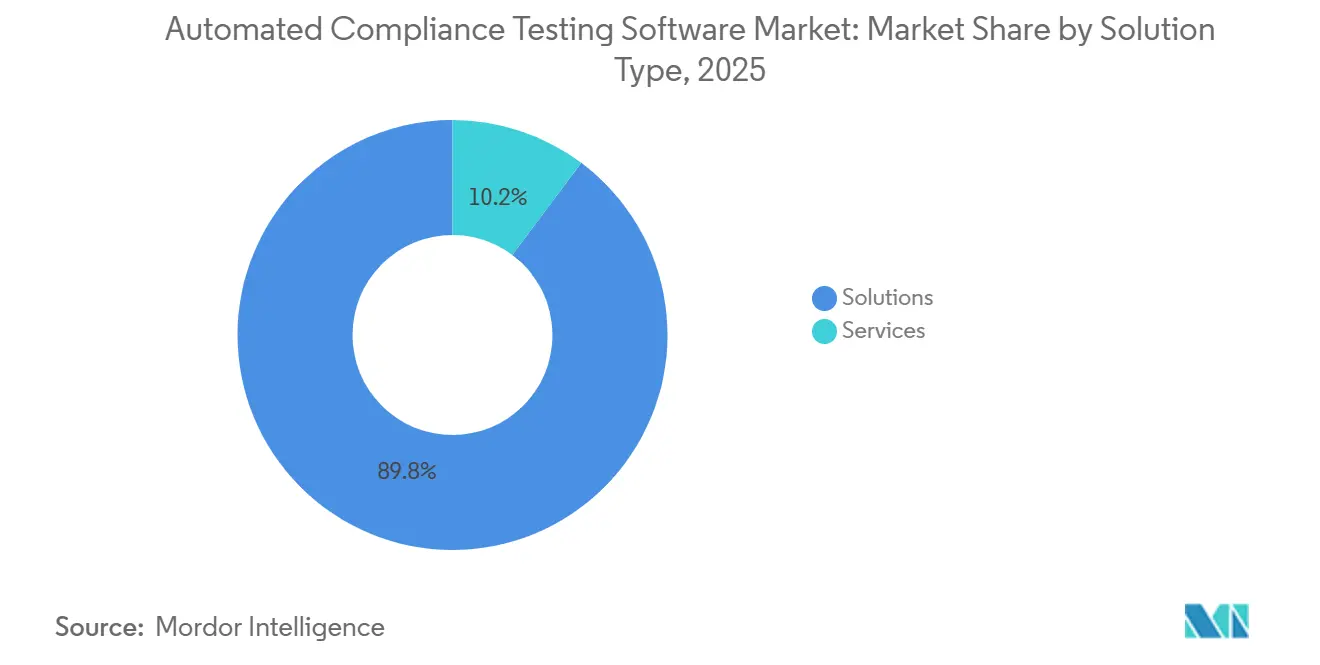
Solutions accounted for 89.79% of the Automated compliance testing software market share in 2025. This position reflects a purchasing model centered on packaged software that supports recurring testing and evidence collection. Embedded workflows can become difficult to replace after a company maps its controls, users, and systems into the platform. Compyl connects through more than 125 proprietary integrations, while Sprinto supports more than 300 integrations. These connections can make a platform more useful across security, IT, and compliance teams. They can also increase the cost and effort of moving records to another provider. The Automated compliance testing software industry is therefore shaped by software vendors that can expand coverage without requiring customers to redesign their control programs. Vanta reported more than 12,000 customers across 58 countries by mid-2025, following a July 2025 Series D round that raised USD 150 million. The round brought Vanta's total funding since 2021 to USD 504 million and was intended to support AI development and U.S. government compliance work.
Services held on to the remaining revenue, but their role is shifting from conventional implementation work toward managed compliance delivery. Some buyers need providers to handle the integration work connecting legacy systems to a testing platform. This model can help organizations that lack internal specialists or have inconsistent data across applications. Sprinto launched its Autonomous Trust Platform in March 2026, featuring autonomous agents designed to detect posture changes, assess risk, and execute remediation across compliance programs. Such product design moves more operating work into the subscription platform and can reduce reliance on discrete services. The AICPA and the PCI Security Standards Council recognize evidence-based assessment methods within their respective assurance environments. As software supports a larger share of ongoing control work, services can focus on system integration, specialized reviews, and difficult operational environments. The Automated compliance testing software industry may continue to need services where automation alone cannot access records or interpret local requirements.
By Deployment - Cloud Leads While Hybrid Supports Controlled Environments
Cloud deployment held 81.59% of the Automated compliance testing software market share in 2025 and is projected to expand at a 15.07% CAGR through 2031. Cloud platforms can pull evidence from cloud infrastructure, SaaS identity services, and containerized applications through API-first connections. This creates live control records without requiring an agent to be installed on every system. RegScale's compliance-as-code model links control documentation with CI/CD workflows and OSCAL-native documentation. The model is designed to keep records current as software environments change. Cloud delivery also allows vendors to update control libraries and integrations across their customer base. The Automated compliance testing software market is supported when buyers can deploy coverage across many distributed applications through a common platform. The BITMi TRUST project began in July 2026 with EUR 8 million, equivalent to USD 8.7 million, in EU Horizon Europe funding for AI-powered compliance tools that address GDPR and EU AI Act requirements.[3] The project includes cloud and on-premises use cases for European small and medium-sized enterprises.
On-premises and hybrid models continue to serve buyers with data residency, sovereign cloud, or restricted-network requirements. Defense contractors may need to protect compliance data within controlled environments under CMMC requirements. Financial entities may also retain local data arrangements while addressing DORA obligations for ICT continuity and supplier oversight. German BSI C5 expectations and Singapore MAS technology risk management requirements can influence deployment decisions. Hybrid models allow organizations to use cloud functions while keeping sensitive records in jurisdiction-specific data centers. ISO/IEC 27001:2022 controls for cloud service use and data handling can also affect configuration choices. These needs create a defended role for hybrid architectures within the Automated compliance testing software market. Vendors that support both API-based cloud evidence and controlled local connections can address a wider set of regulated customers.
By Organization Size - Large Enterprises Combine Scale and Faster Growth
Large enterprises held 65.07% of revenue in 2025, and the Automated compliance testing software market size for this segment is projected to expand at a 16.21% CAGR through 2031. Large organizations typically operate across more locations, applications, suppliers, and regulatory regimes. Each added framework can require control mapping, fresh evidence, and employee training. A scalable platform can reduce the repeated work involved in maintaining these obligations across business units. These buyers also have the resources to integrate the platform with enterprise identity, cloud, and reporting systems. Their spending can become recurring when a platform is used for annual reviews, vendor assessments, and new framework adoption. The Automated compliance testing software market benefits from this pattern because complex organizations do not treat compliance automation as a single project.
Small and medium-sized enterprises hold the remaining revenue and face a different implementation challenge. They often need lower-cost packages, faster deployment, and evidence collection that works with existing tools. Channel programs, marketplaces, and bundled services can reduce the effort needed to begin using a platform. Thoropass launched Smart Sort AI in January 2026 to convert GRC export files into audit-ready evidence without native integrations. This approach can serve firms that do not want to replace their full GRC stack. The BITMi TRUST project plans pilots with 500 organizations in nine European countries from 2026. Policy-backed tools may reduce perceived deployment risk for smaller companies. The Automated compliance testing software industry can broaden its customer base when products fit existing records, staff capacity, and budgets.
By End-User Industry - BFSI Leads While Energy and Utilities Grow Fastest
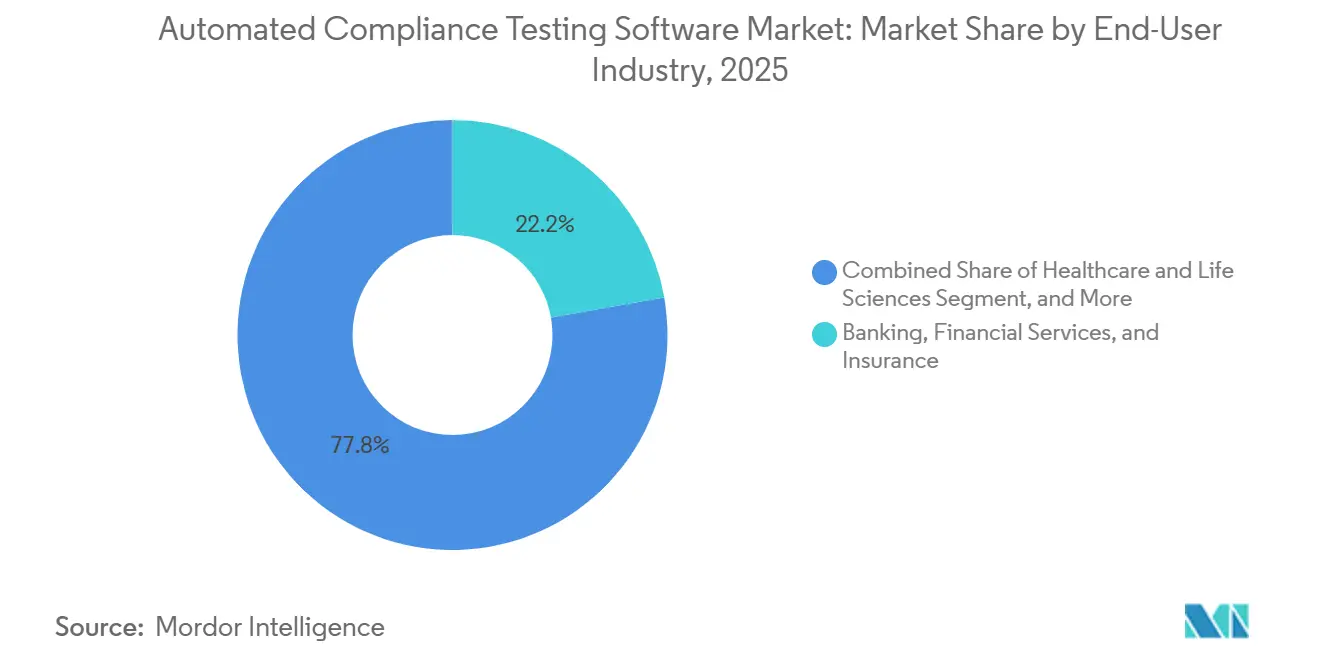
BFSI held 22.21% of revenue in 2025, giving it the leading position in the Automated compliance testing software market. Financial institutions face dense requirements for ICT risk management, operational resilience, third-party oversight, and incident reporting. DORA has been applied since January 2025 and has made these requirements more immediate for affected EU firms. Banks also need records that connect technology controls with business processes and supplier relationships. The use of AI creates another documentation need, as institutions must explain how automated decisions are governed. These factors favor platforms that can gather records from identity tools, cloud systems, core applications, and vendor assessments. Information technology and telecommunications, healthcare and life sciences, government and public sector, manufacturing, retail, and e-commerce each add demand shaped by their own compliance obligations. HIPAA, HITRUST, FedRAMP, CMMC, and PCI DSS create distinct control sets that require ongoing testing. The Automated compliance testing software market remains attractive to BFSI because regulatory evidence is a recurring operating need rather than an occasional administrative activity.
Energy and utilities are projected to expand at a 17.24% CAGR through 2031, the fastest rate among end-user industries. Grid modernization is connecting IT systems with industrial equipment and distributed energy infrastructure. NERC CIP and IEC 62443 requirements encourage operators to document the security status of these mixed environments. Xage Security reported in March 2026 that its Zero Trust platform secured more than 60% of midstream energy infrastructure in the United States. Operational technology systems may lack REST API endpoints, making automated collection harder than in cloud-native environments. This limitation creates a specialized role for vendors capable of working across both IT and OT assets. The Automated compliance testing software market can grow in this sector when platforms provide evidence coverage without disrupting industrial operations. The opportunity is supported by the need to bridge control testing across equipment, networks, and corporate systems.

By Compliance Framework - SOC 2 Leads While AI Governance Frameworks Advance
SOC 2 held 21.47% of revenue in 2025, the largest share by compliance framework in the Automated compliance testing software market. It is widely used as a trust credential in North American enterprise software procurement. Vendors and buyers use the framework to show how security, availability, confidentiality, processing integrity, and privacy controls are managed. Its established role makes repeatable evidence collection valuable for software providers that respond to customer assurance requests. Vanta reported that its platform had processed more than 26,000 successful SOC 2 audits by mid-2025. ISO/IEC 27001, HIPAA and HITRUST, GDPR and privacy frameworks, PCI DSS, NIST, CMMC, FedRAMP, DORA, and NIS2 provide other important sources of demand. Each framework has different oversight structures and evidence expectations. The Automated compliance testing software market benefits when platforms map common technical evidence across these requirements without concealing their differences.
ISO/IEC 42001 and AI governance frameworks are projected to expand at a 19.83% CAGR through 2031. The standard gives organizations a structure for an AI management system and for documenting the governance of AI use. Changi Airport Group received the first Singapore Accreditation Council-accredited ISO/IEC 42001 certification in February 2025, covering 5 AI-driven commercial and passenger applications.[4] The EU AI Act raises the importance of traceability and transparency for AI systems that serve EU users. ISO/IEC 42001 does not provide automatic compliance with every legal requirement, but it can support documented control design. These platforms have an opportunity to connect AI system inventories, policy controls, testing evidence, and audit records. This demand is distinct from traditional cybersecurity testing because it includes governance over models, agents, and organizational decisions.
Geography Analysis
North America Automated Compliance Testing Software Market
North America held 40.12% of regional revenue in 2025. The region combines major demand from BFSI, healthcare, government, and enterprise software providers. SOC 2, HIPAA, FedRAMP, CMMC, and state privacy laws can create overlapping control requirements. Organizations often need evidence across many cloud services, identity systems, and vendor relationships. The United States is the main regional demand center because its enterprises manage complex assurance programs and public-sector requirements. Vanta's July 2025 funding round included plans to expand U.S. government compliance work, including FedRAMP and NIST SP 800-53 coverage. Canada and Mexico add privacy and data protection obligations for companies that operate across the North American trade corridor. This environment supports platforms that can preserve evidence while addressing several frameworks.
Europe Automated Compliance Testing Software Market
Europe is a major growth area because DORA, NIS2, and the EU AI Act create a broad compliance agenda. DORA has applied uniformly since January 2025, while NIS2 implementation can still vary by country. This difference increases the value of platform libraries that can be adapted for local requirements. Germany is important because enterprises must manage obligations related to the EU AI Act, NIS2, BSI C5, and other corporate compliance rules. The BITMi TRUST project started in July 2026 to develop AI-powered compliance tools for GDPR and EU AI Act requirements across 9 countries. The United Kingdom, France, and other markets add regional depth through data protection and sector-specific rules. The Automated compliance testing software market in Europe is supported by the need to keep evidence usable across several national and EU-level obligations.
APAC, MEA and South America Automated Compliance Testing Software Market
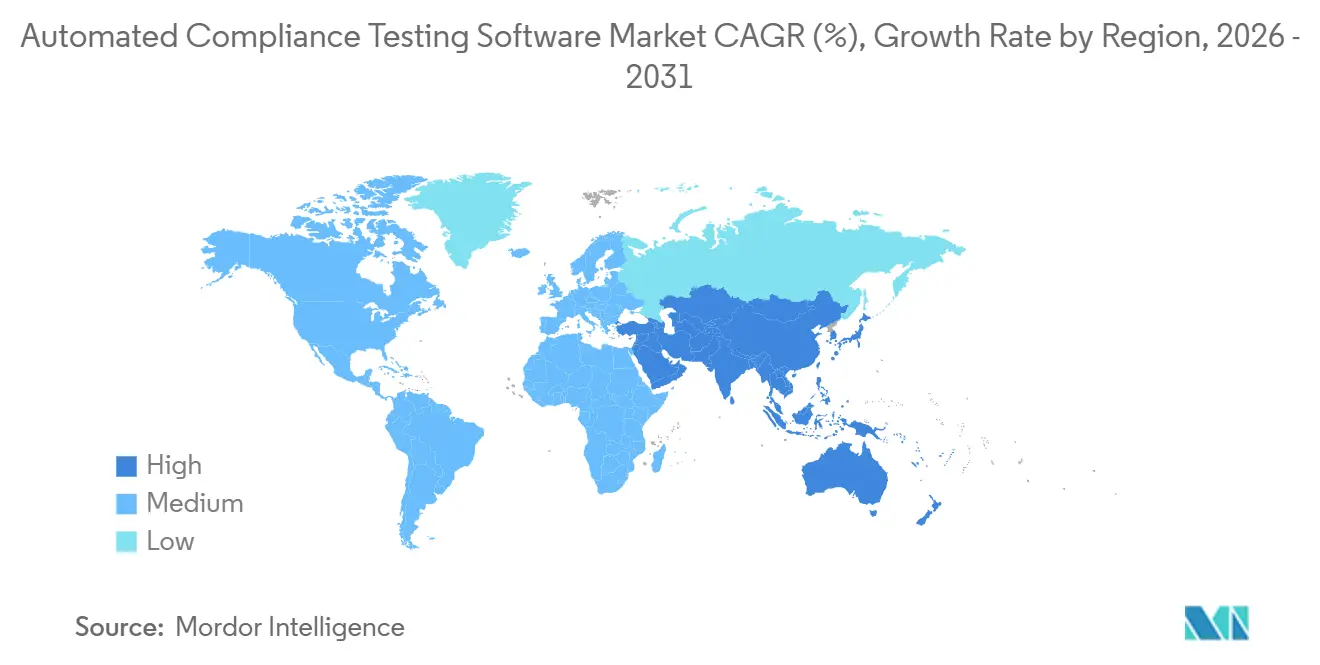
Asia-Pacific is projected to expand at a 17.86% CAGR through 2031, making it the fastest-growing region in the Automated compliance testing software market. India, China, Singapore, and Japan are contributing different privacy, security, and technology risk requirements. India's Digital Personal Data Protection Act includes 30-day data deletion rights. China's Personal Information Protection Law can impose fines of up to CNY 50 million, equivalent to USD 7 million, for noncompliance. Japan's revised Act on the Protection of Personal Information requires 72-hour breach reporting. Singapore's technology risk management guidance has encouraged financial institutions to invest in compliance automation. Australia, South Korea, and Taiwan add further regulatory diversity across the region. South America, the Middle East, and Africa remain smaller but growing opportunities as data protection rules mature in Brazil, the UAE, Saudi Arabia, South Africa, and Nigeria.
Competitive Landscape
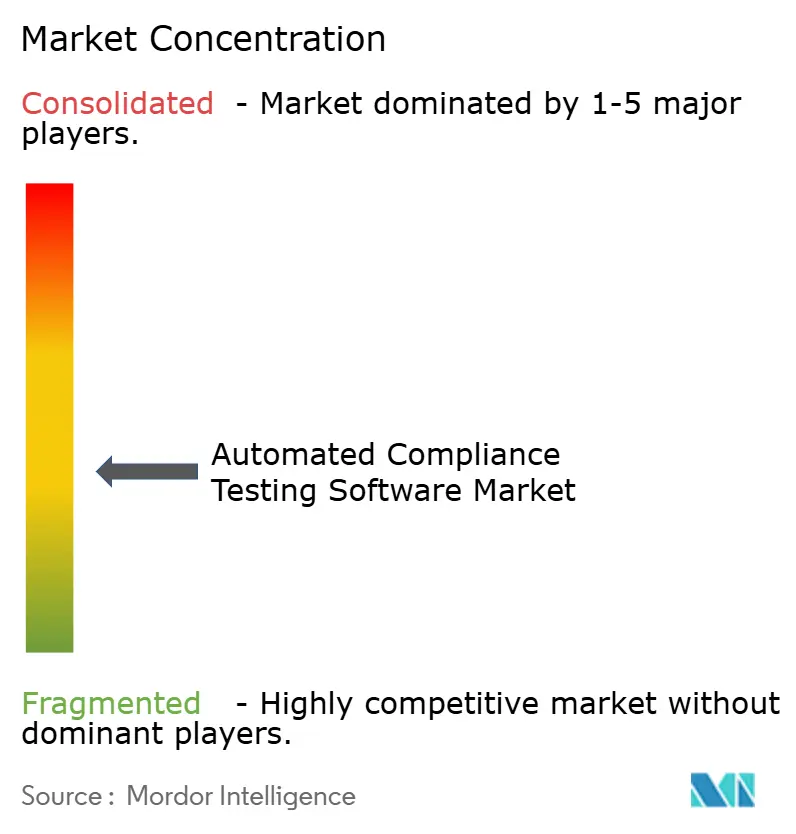
The Automated compliance testing software market is fragmented across compliance-native specialists, integrated GRC suites, and enterprise infrastructure vendors. Specialist providers include Vanta, Drata, Sprinto, Thoropass, Secureframe, Hyperproof, Scytale, Strike Graph, Centraleyes, CyberSaint, Compyl, Scrut Automation, and Onspring. These firms compete through integration depth, automated evidence collection, AI-supported workflows, and coverage across several frameworks. Larger GRC providers such as Workiva, Archer Integrated Risk Management, and OneTrust compete through reporting, risk management, and established enterprise relationships. No company share data for the leading firms was provided, which supports a fragmented characterization. The Automated compliance testing software market is consequently defined by product breadth and implementation fit rather than a single dominant supplier. Vendor choice also depends on whether a buyer needs SOC 2 automation, public-sector control coverage, privacy workflows, or operational technology evidence. This varied demand gives specialists room to compete even where established GRC suites have deeper enterprise deployments.
AI governance is an important area of competitive development because organizations need records for AI models, agents, and autonomous workflows. Drata opened limited availability for AI Agent Governance in August 2026. The product was designed to discover, monitor, govern, and demonstrate the traceability of AI agents, initially supporting Anthropic.[5] Workiva launched 3 specialized AI agents and Workiva Knowledge in July 2026. Workiva Knowledge is a persistent intelligence layer grounded in organizational data, past filings, and institutional guidance. These releases show that vendors are adding governed AI functions to compliance and reporting workflows. Machine-readable controls, OSCAL-native formats, and support for ISO/IEC 27001:2022 and ISO/IEC 42001 are becoming more relevant during enterprise evaluation. Buyers increasingly need evidence formats that can be reviewed by auditors without depending on a vendor-specific data structure.
Basic evidence collection may become easier to replicate as AI capabilities become standard product features. This could increase price pressure among specialists that rely on a narrow set of automated checks. Differentiation is likely to depend on trusted integrations, multi-framework evidence reuse, and support for difficult IT and OT environments. Archer's November 2025 continuous controls monitoring release showed how established vendors are defending their position through broader automated control validation. Vanta's July 2025 financing supported further AI work and expansion into U.S. government compliance. The Automated compliance testing software market will continue to reward vendors that combine continuous evidence, sound governance, and practical deployment options.
Automated Compliance Testing Software Industry Leaders
-
Vanta, Inc.
-
Drata, Inc.
-
LogicGate, Inc.
-
Sprinto Technology Private Limited
-
Thoropass, Inc.
- *Disclaimer: Major Players sorted in no particular order
Automated Compliance Testing Software Market Companies Covered in this Report
- Vanta, Inc.
- Drata, Inc.
- LogicGate, Inc.
- Sprinto Technology Private Limited
- Thoropass, Inc.
- Secureframe, Inc.
- Hyperproof, Inc.
- Scytale Solutions, Inc.
- Strike Graph, Inc.
- Centraleyes Ltd.
- CyberSaint, Inc.
- Compyl, Inc.
- Scrut Automation Private Limited
- Onspring Technologies, Inc.
- OneTrust, LLC
- Archer Integrated Risk Management, Inc.
- NAVEX Global, Inc.
- Workiva Inc.
- International Business Machines Corporation
- SAP SE
- Thomson Reuters Corporation
Recent Industry Developments in Automated Compliance Testing Software Market
- August 2026: Drata opened limited availability for AI Agent Governance, a product designed to discover, monitor, govern, and prove the traceability of AI agents inside enterprises, shipping first for Anthropic with full lifecycle support. The product uses a three-layer architecture, a sensor, an MCP Proxy enforcing agent policies, and a tamper-evident evidence feed, positioning Drata as an early mover in the compliance testing of autonomous AI systems.
- July 2026: Workiva launched 3 purpose-built AI agents and Workiva Knowledge, a persistent intelligence layer grounded in organizational data, past filings, and institutional guidance, on July 29, 2026. The launch targets GRC, finance, and sustainability reporting teams in the Office of the CFO, embedding governed AI at enterprise scale with full auditability and traceability across reporting workflows.
- March 2026: Forescout Technologies introduced Automated Security Controls Assessment within its Forescout 4D Platform on March 10, 2026, replacing manual, spreadsheet-driven audit processes with real-time, automated evidence collection across IT, OT, IoT, and IoMT assets. The capability, based on Center for Internet Security benchmarks, is positioned to eliminate up to 80% of GRC audit preparation time.
- March 2026: Sprinto launched its Autonomous Trust Platform on March 21, 2026, claiming first-of-kind compliance infrastructure built around autonomous agents capable of detecting posture changes, determining risk impact in real time, and executing remediation across vendor risk, AI governance, and multi-framework compliance programs.
Global Automated Compliance Testing Software Market Report Scope
The automated compliance testing software market includes software platforms that automatically assess products, systems, applications, and processes against regulatory, industry, and organizational standards. These solutions streamline compliance validation by conducting predefined tests, monitoring control effectiveness, identifying nonconformities, and generating audit-ready reports. The market caters to highly regulated industries, including financial services, healthcare, telecommunications, manufacturing, and government organizations, that aim to reduce compliance costs and enhance operational efficiency.
The Automated Compliance Testing Software Market Report is Segmented by Solution Type (Solutions, and Services), Deployment (Cloud, On-Premises, and Hybrid), Organization Size (Large Enterprises, and Small and Medium-Sized Enterprises), End-User Industry (Banking, Financial Services, and Insurance, Information Technology and Telecommunications, Healthcare and Life Sciences, Government and Public Sector, Industrial Manufacturing, Retail and E-Commerce, Energy and Utilities, and Other End-User Industries [Media, Entertainment, and Professional Services, Education]) Compliance Framework (SOC 2, ISO/IEC 27001, HIPAA and HITRUST, GDPR and Privacy Frameworks, PCI DSS, NIST, CMMC, and FedRAMP, DORA, NIS2, and Operational Resilience Frameworks, ISO/IEC 42001 and AI Governance Frameworks, and Other Compliance Frameworks), and Geography (North America, South America, Europe, Asia-Pacific, Middle East, and Africa). The Market Sizes and Forecasts are Provided in Terms of Value in (USD).
| Solutions |
| Services |
| Cloud |
| On-Premises |
| Hybrid |
| Large Enterprises |
| Small and Medium-Sized Enterprises |
| Banking, Financial Services, and Insurance |
| Information Technology and Telecommunications |
| Healthcare and Life Sciences |
| Government and Public Sector |
| Manufacturing and Industrial |
| Retail and E-Commerce |
| Energy and Utilities |
| Other End-User Industries (Media, Entertainment, and Professional Services, Education) |
| SOC 2 |
| ISO/IEC 27001 |
| HIPAA and HITRUST |
| GDPR and Privacy Frameworks |
| PCI DSS |
| NIST, CMMC, and FedRAMP |
| DORA, NIS2, and Operational Resilience Frameworks |
| ISO/IEC 42001 and AI Governance Frameworks |
| Other Compliance Frameworks |
| North America | United States |
| Canada | |
| Mexico | |
| South America | Brazil |
| Rest of South America | |
| Europe | Germany |
| United Kingdom | |
| France | |
| Russia | |
| Rest of Europe | |
| Asia-Pacific | China |
| Japan | |
| India | |
| Australia | |
| Singapore | |
| Rest of Asia-Pacific | |
| Middle East | Israel |
| United Arab Emirates | |
| Saudi Arabia | |
| Turkey | |
| Rest of Middle East | |
| Africa | South Africa |
| Nigeria | |
| Rest of Africa |
| By Solution Type | Solutions | |
| Services | ||
| By Deployment | Cloud | |
| On-Premises | ||
| Hybrid | ||
| By Organization Size | Large Enterprises | |
| Small and Medium-Sized Enterprises | ||
| By End-User Industry | Banking, Financial Services, and Insurance | |
| Information Technology and Telecommunications | ||
| Healthcare and Life Sciences | ||
| Government and Public Sector | ||
| Manufacturing and Industrial | ||
| Retail and E-Commerce | ||
| Energy and Utilities | ||
| Other End-User Industries (Media, Entertainment, and Professional Services, Education) | ||
| By Compliance Framework | SOC 2 | |
| ISO/IEC 27001 | ||
| HIPAA and HITRUST | ||
| GDPR and Privacy Frameworks | ||
| PCI DSS | ||
| NIST, CMMC, and FedRAMP | ||
| DORA, NIS2, and Operational Resilience Frameworks | ||
| ISO/IEC 42001 and AI Governance Frameworks | ||
| Other Compliance Frameworks | ||
| By Geography | North America | United States |
| Canada | ||
| Mexico | ||
| South America | Brazil | |
| Rest of South America | ||
| Europe | Germany | |
| United Kingdom | ||
| France | ||
| Russia | ||
| Rest of Europe | ||
| Asia-Pacific | China | |
| Japan | ||
| India | ||
| Australia | ||
| Singapore | ||
| Rest of Asia-Pacific | ||
| Middle East | Israel | |
| United Arab Emirates | ||
| Saudi Arabia | ||
| Turkey | ||
| Rest of Middle East | ||
| Africa | South Africa | |
| Nigeria | ||
| Rest of Africa | ||
Key Questions Answered in the Report
What is the size of the automated compliance testing software market?
The Automated compliance testing software market size was valued at USD 1.27 billion in 2025 and is estimated to grow from USD 1.53 billion in 2026 to reach USD 3.04 billion by 2031, at a CAGR of 14.72% during the forecast period 2026-2031.
What is driving demand for automated compliance testing software?
Demand is supported by continuous controls monitoring, cloud and DevSecOps adoption, and rising requirements for audit-ready evidence across security, privacy, AI, and sector-specific control programs.
Which deployment model leads automated compliance testing software adoption?
Cloud deployment led with 81.59% of revenue in 2025 and is projected to grow at a 15.07% CAGR through 2031, aided by API-based collection from cloud infrastructure and SaaS applications.
Which end-user sector has the largest share of automated compliance testing software?
BFSI led end-user demand with a 22.21% revenue share in 2025 because of its extensive ICT risk, resilience, incident reporting, and third-party supplier oversight requirements.
Which compliance framework is growing fastest?
ISO/IEC 42001 and AI governance frameworks are projected to grow at a 19.83% CAGR through 2031, as organizations seek formal structures for AI management, traceability, and auditable governance.
Which region is growing fastest for automated compliance testing software?
Asia-Pacific is projected to grow at a 17.86% CAGR through 2031, supported by evolving privacy, data protection, breach reporting, and technology risk requirements across major economies.