
Autologous Fat Grafting Market Size and Share
Market Overview
| Study Period | 2020 - 2031 |
|---|---|
| Market Size (2026) | USD 243.05 Million |
| Market Size (2031) | USD 352.18 Million |
| Growth Rate (2026 - 2031) | 7.70 % |
| Fastest Growing Market | Asia-Pacific |
| Largest Market | North America |
| Market Concentration | Medium |
Major Players *Disclaimer: Major Players sorted in no particular order Image © Mordor Intelligence. Reuse requires attribution under CC BY 4.0. | |
Autologous Fat Grafting Market Analysis by Mordor Intelligence
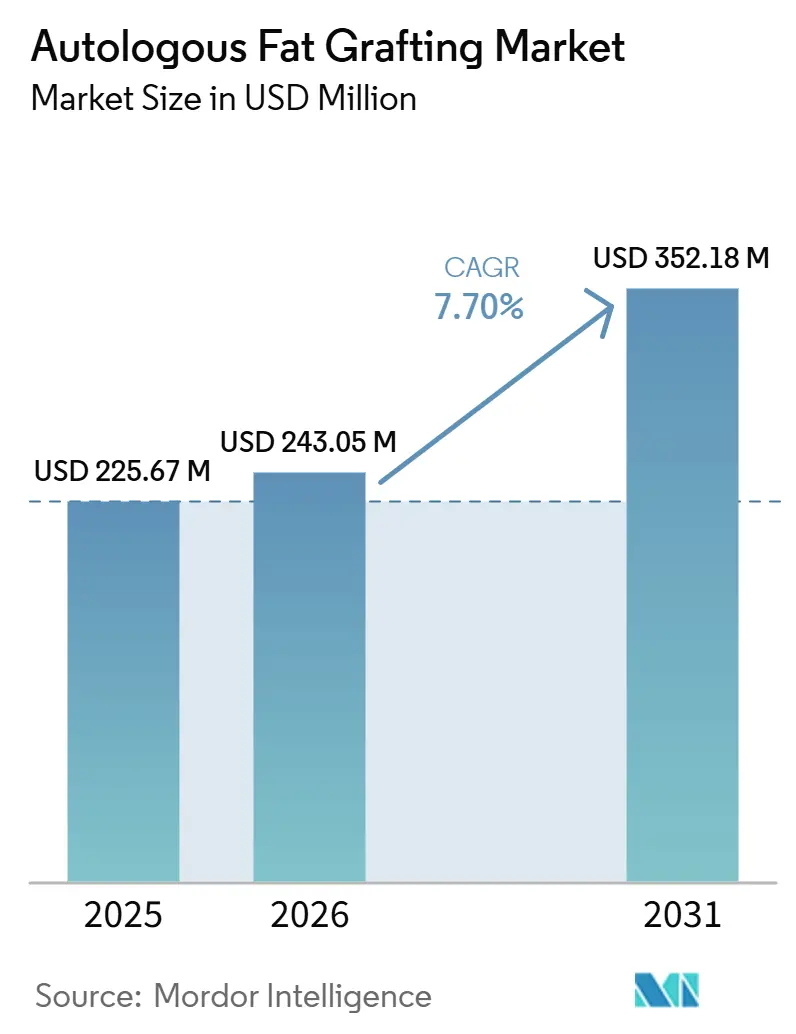
The Autologous Fat Grafting Market size is projected to expand from USD 225.67 million in 2025 and USD 243.05 million in 2026 to USD 352.18 million by 2031, registering a CAGR of 7.70% between 2026 to 2031.
The autologous fat grafting market benefits from rising demand for procedures that use a patient’s own tissue instead of synthetic fillers or implants. Reconstructive care after mastectomy remains a key contributor to procedure volumes, supported by favorable safety and patient satisfaction outcomes. Providers are adopting closed processing systems to improve consistency in harvesting, purification, and injection during procedures. Research and selected protocols involving adipose-derived stem cells and stromal vascular fraction may improve tissue retention, while regulation and clinical standardization will determine broader adoption. The market also faces constraints, including variable retention, self-pay costs for elective care, and the need for surgeons to maintain consistent processing methods.
Key Report Takeaways
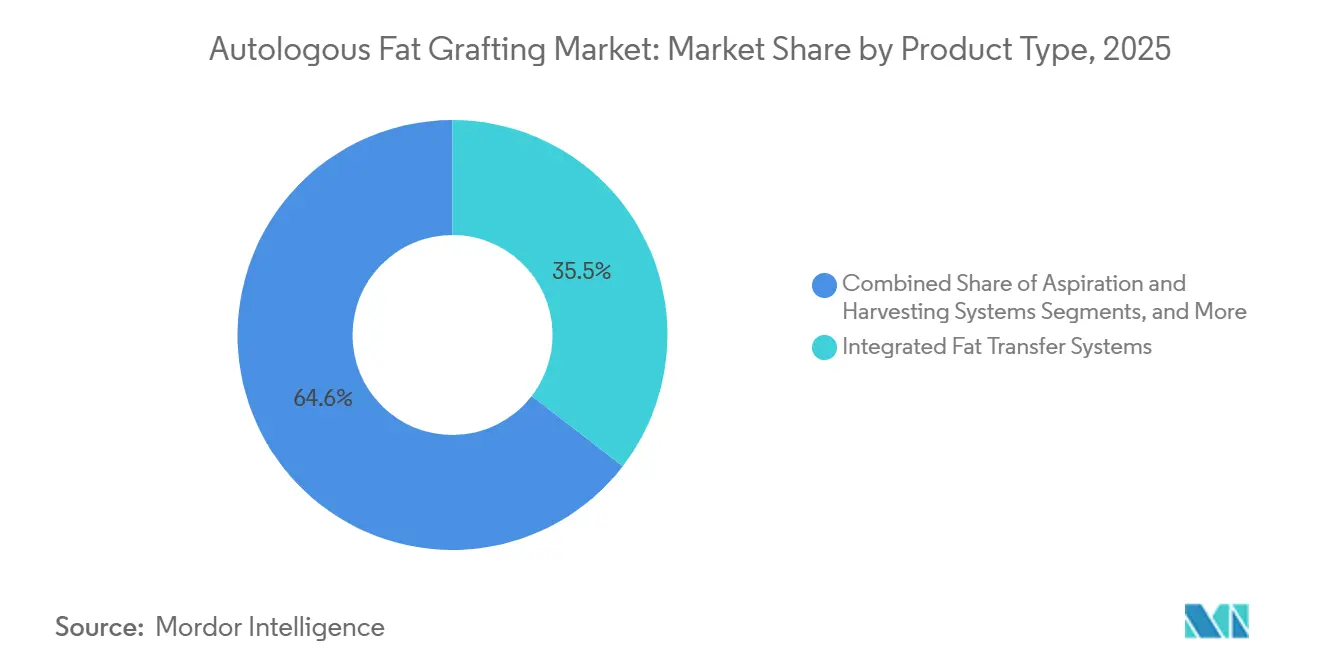
- By product type, integrated fat transfer systems led with 35.45% revenue share in 2025, while fat processing systems are projected to expand at a 9.15% CAGR through 2031.
- By application, breast augmentation accounted for 37.56% of revenue in 2025, while buttock augmentation recorded the highest projected CAGR at 8.80% through 2031.
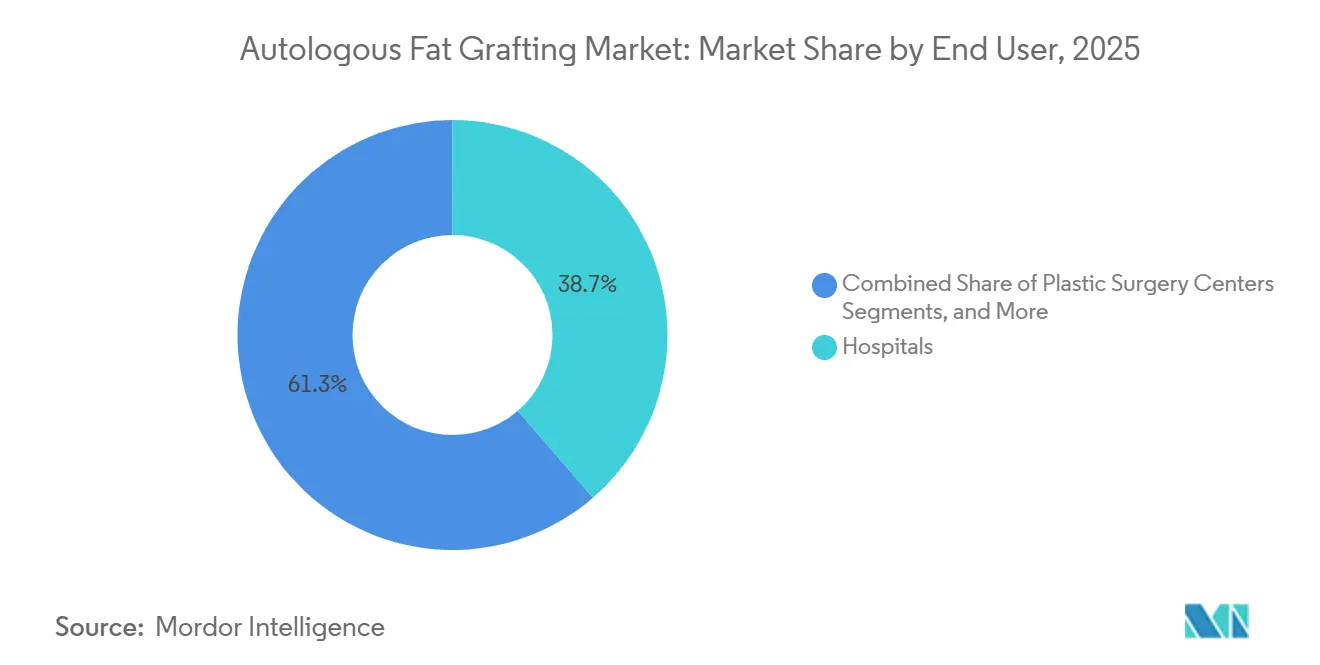
- By end user, hospitals held 38.66% of revenue in 2025, while plastic surgery centers are projected to grow at a 10.45% CAGR through 2031.
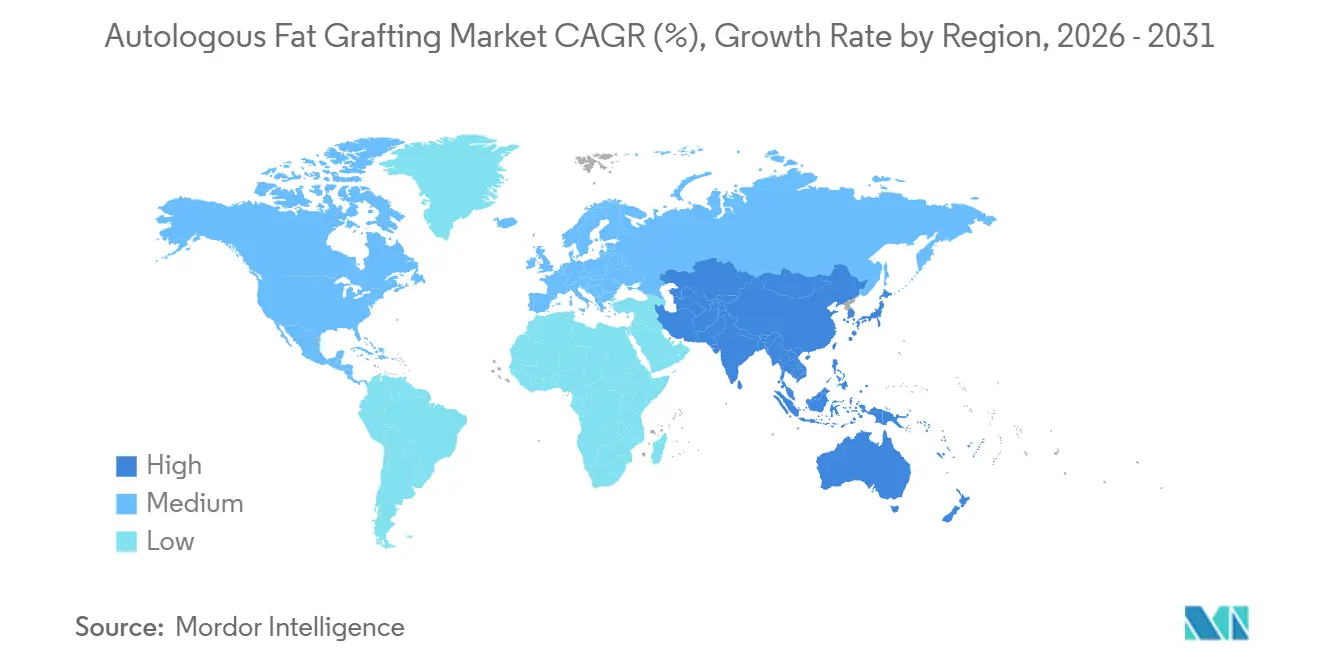
- By geography, North America held 42.44% of revenue in 2025, while Asia-Pacific is projected to expand at a 10.88% CAGR through 2031.
Note: Market size and forecast figures in this report are generated using Mordor Intelligence’s proprietary estimation framework, updated with the latest available data and insights as of January 2026.
Market Trends and Insights
Drivers Impact Analysis of Autologous Fat Grafting Market*
| DRIVER | (~) % IMPACT ON CAGR FORECAST | GEOGRAPHIC RELEVANCE | IMPACT TIMELINE |
|---|---|---|---|
| Preference for autologous restoration and breast reconstruction | +1.8% | Global, concentrated in North America and Europe | Long term (≥ 4 years) |
| Body contouring after major weight loss | +1.0% | North America, with growth in South America | Medium term (2-4 years) |
| Use for scars, radiation injury, and soft-tissue defects | +0.7% | Global, with early gains in North America and EU research centers | Long term (≥ 4 years) |
| Closed-system processing and regenerative protocols | +0.9% | Global, with fastest adoption in North America and Asia-Pacific | Short term (≤ 2 years) |
| Improved closed-system fat processing and transfer workflows | +1.0% | North America, with growth in South America | Medium term (2-4 years) |
| Integration of fat grafting with regenerative and precision-aesthetic protocols | +0.7% | Global, with early gains in North America and EU research centers | Long term (≥ 4 years) |
| Source: Mordor Intelligence | |||
Preference for Autologous and Biocompatible Volume Restoration
In the autologous fat grafting market, patients and surgeons often prefer volume restoration procedures that use the patient’s own adipose tissue. This preference supports market growth because the procedure avoids the immunogenic concerns associated with nonautologous materials. A 2026 review of 35 clinical studies and 3,757 breast augmentation patients reported mean volume retention of 58%, with results ranging from 44% to 83%. The same evidence showed vascular integration and tissue improvement in irradiated or fibrosed areas, supporting use in both cosmetic and reconstructive settings.[1] Patients seeking alternatives after implant removal may further support demand, as fat transfer can restore volume using tissue collected from the individual receiving care rather than an externally supplied implant.
Expansion of Post-Mastectomy and Breast Reconstruction Procedures
Post-mastectomy reconstruction continues to provide a stable clinical base for the autologous fat grafting market. A 2026 systematic review and meta-analysis of 13 comparative studies found no statistically significant increase in complications when surgeons used fat grafting as a reconstructive adjunct instead of implant-based approaches.[2] The review also reported better outcomes on validated BREAST-Q patient satisfaction measures for the fat-grafting approach. Its pooled BREAST-I and BREAST-II data included 242 autologous fat transfer patients and 19,936 controls, with an 8.0-year mean follow-up and 10-year overall survival of 97.6% for the fat transfer cohort versus 75.7% for controls. These findings may help breast units incorporate fat grafting earlier in reconstructive planning and increase demand for reliable processing and delivery equipment.
Body Contouring Demand After Major Weight Loss
In the autologous fat grafting market, major weight loss can create volume deficits in the face, breasts, buttocks, and extremities. Autologous fat grafting can address these deficits while using liposuction to collect donor tissue during the same procedural session. This combined approach can benefit patients after bariatric surgery or other substantial weight loss because it integrates body contouring with volume restoration. The opportunity depends on patient suitability, donor tissue availability, clinical expectations, and elective procedure costs, especially when patients need treatment across several areas or a later refinement session. Providers must clearly explain that achievable volume and contour can vary by anatomical site and individual.
Growing Use of Fat Grafting for Scars, Radiation Injury, and Soft-Tissue Defects
The use of fat grafting for scars, radiation injury, and soft-tissue defects expands its role beyond elective aesthetic procedures. A 2025 study found that nanofat accelerated wound healing in irradiated skin compared with platelet-rich plasma controls, with smaller residual wound areas on day 14 and greater perfused microvessel density.[3] These findings supported the role of adipose tissue in vascular regeneration in damaged tissue. A 2025 systematic review identified 2 ongoing randomized controlled trials, including studies of post-mastectomy radiation injury and microsized adipose tissue for diabetic foot ulcers.[4] For the autologous fat grafting market, these applications could support future therapeutic pathways and create demand less directly tied to cosmetic spending cycles.
Restraints Impact Analysis of Autologous Fat Grafting Market*
| RESTRAINT | (~) % IMPACT ON CAGR FORECAST | GEOGRAPHIC RELEVANCE | IMPACT TIMELINE |
|---|---|---|---|
| Variable retention and inconsistent processing protocols | -1.5% | Global, particularly acute in Asia-Pacific and South America | Long term (≥ 4 years) |
| Procedure cost, limited reimbursement, and svf regulation | -1.2% | North America and Western Europe | Medium term (2-4 years) |
| Surgeon-dependent outcomes and inconsistent processing protocols | -1.3% | Global, particularly acute in Asia-Pacific and South America | Long term (≥ 4 years) |
| Regulatory uncertainty around stromal vascular fraction and cell-enriched grafts | -1.7% | North America and Western Europe | Medium term (2-4 years) |
| Source: Mordor Intelligence | |||
Variable Fat Retention and Need for Repeat Procedures
Variable fat retention remained a key limitation in the autologous fat grafting market and a continuing commercial concern for providers. The 2026 systematic review reported a 47% pooled mean volume retention rate for conventional non-enriched grafting, with a 95% confidence interval of 31.5% to 62.5%. Individual studies in the review reported retention rates ranging from 26.0% to 74.8% over 3 to 12 months, making precise preoperative volume planning difficult. Patients may require repeat procedures when retained volume falls below the expected level, increasing treatment time and cost.
Procedure Cost and Limited Reimbursement for Elective Applications
In the autologous fat grafting market, out-of-pocket spending limits access to elective procedures. Major payer frameworks may cover reconstructive applications after mastectomy, but facial fat grafting, hand rejuvenation, and buttock augmentation are generally self-pay procedures. Anthem’s CG-SURG-123 policy, revised in November 2025 and effective January 6, 2026, distinguished medically necessary reconstructive uses from noncovered cosmetic applications. This coverage boundary restricts demand among patients who cannot independently fund elective procedures. In regions with low private insurance coverage, the full cost burden may make providers more cautious about purchasing premium closed-system platforms.
*Our forecasts treat driver/restraint impacts as directional, not additive. The impact forecasts reflect baseline growth, mix effects, and variable interactions.
Autologous Fat Grafting Market Segment Analysis
By Product Type:
Closed-System Automation Concentrates Upgrade CyclesIntegrated fat transfer systems are expected to account for 35.45% of the autologous fat grafting market share in 2025. Hospitals and established plastic surgery centers favor these systems because a single platform supports harvesting, processing, and injection with fewer handoffs. The integrated format can reduce contamination risk and simplify staff training across the procedure. Regulatory clearances, including U.S. Food and Drug Administration 510(k) clearances and European Union Medical Device Regulation certifications, also support the adoption of established platforms.
Within the autologous fat grafting market, fat processing systems are forecast to grow at a CAGR of 9.15% from 2026 to 2031. Their growth reflects clinical interest in processing methods that may affect cell viability and long-term retention. A 2026 Scientific Reports comparison of commercial nanofat preparation systems found meaningful differences in technical performance and biological quality across products. Aspiration and harvesting systems, liposuction equipment, cannulas, syringes, filters, washers, and collection vessels remain necessary across the workflow. As closed-loop platforms expand, vendors offering only point products may face pressure from facilities that prefer platform-level purchasing, consumables, service arrangements, training, and standardized procedural steps.

By Application:
Breast Reconstruction Anchors Volume While Gluteal Demand Requires Clinical ControlsWithin the autologous fat grafting market, breast augmentation is expected to account for 37.56% of revenue in 2025. The category includes cosmetic breast volume augmentation and oncoplastic reconstruction, giving it a broad clinical base. A 2025 early clinical series on immediate fat grafting during lumpectomy reported an average BREAST-Q satisfaction score of 74.5 and a 0% 30-day major complication rate. The available evidence on satisfaction and safety supports its use in multidisciplinary breast cancer centers. Facial fat grafting and hand rejuvenation remain steady physician-led applications, with nanofat and microfat protocols used for superficial tissue renewal.
Buttock augmentation is forecast to grow at a CAGR of 8.80% through 2031. It is the fastest-growing application in the autologous fat grafting market, although providers must apply strict safety and compliance controls. A 2024 meta-analysis of 38 studies and 22,151 patients found that ultrasound-guided gluteal fat grafting had lower major complication rates than nonguided procedures, at 0.02% versus 0.08%, along with lower minor complication rates. This evidence supports subcutaneous-only injection practices and imaging guidance for providers serving this application. Strong clinical protocols remain necessary because patient demand alone does not reduce procedural risk.
By End User:
Hospital Dominance Persists While Specialist Centers Drive GrowthWithin the autologous fat grafting market, hospitals are expected to account for 38.66% of revenue in 2025. Their role reflects the concentration of oncoplastic programs, breast reconstruction services, complex patient cases, and capital budgets for closed-system platforms. Academic hospitals also help generate the clinical evidence used to assess new grafting protocols. Their purchasing decisions can signal which systems other care settings may later adopt. Ambulatory care centers and regenerative medicine clinics provide additional access points for facial fat grafting and selected regenerative applications, although equipment costs, practitioner training requirements, and clinical protocol availability continue to limit their role.
Plastic surgery centers are forecast to grow at a CAGR of 10.45% from 2026 to 2031. This represents the strongest end-user growth rate in the autologous fat grafting market and reflects a shift toward outpatient specialist care. Easier-to-use devices and patient preference for focused surgical settings may support this movement. Manufacturers that reduce the technical complexity of harvesting and processing may help more qualified clinics offer these procedures. Regenerative medicine clinics remain smaller but strategically relevant because they operate between standard fat grafting and cell-therapy development, while specialist settings offer a practical route for measured expansion in procedure availability.
Geography Analysis
North America Autologous Fat Grafting Market
North America held 42.44% of the autologous fat grafting market share in 2025. The region benefited from a high concentration of board-certified plastic surgeons, established reconstructive care guidelines, and mature device use across hospitals and ambulatory settings. The United States supported demand through breast reconstruction and body contouring procedures, while U.S. Food and Drug Administration pathways encouraged closed-system processing product development for domestic use. Canada contributed through reconstructive and elective care, and Mexico added demand through cross-border aesthetic care and medical tourism.
Europe Autologous Fat Grafting Market
Europe remains an important but varied regional setting for the autologous fat grafting market. Differences in clinical practice, reimbursement, and device oversight across national healthcare systems influence the adoption pace of new processing technologies. The European Union Medical Device Regulation and Advanced Therapy Medicinal Product frameworks guide fat-derived processing systems and cell-related products. Germany, the United Kingdom, France, Italy, and Spain account for much of the region’s procedure activity, with French and Italian academic institutions contributing to nanofat and microfat protocols.
APAC, MEA and South America Autologous Fat Grafting Market
Asia-Pacific is forecast to grow at a 10.88% CAGR through 2031, giving it the highest regional growth rate. Rising disposable incomes, expanding private healthcare capacity, medical tourism, and demand for facial and body contouring support the regional outlook. South Korea leads in precision facial fat grafting, while China’s demand for minimally invasive contouring and India’s expanding private healthcare network add procedure capacity. The Middle East and Africa absorb premium reconstructive platforms in Gulf Cooperation Council countries, while South America remains relevant due to Brazil’s established aesthetic body-contouring practice.
Competitive Landscape
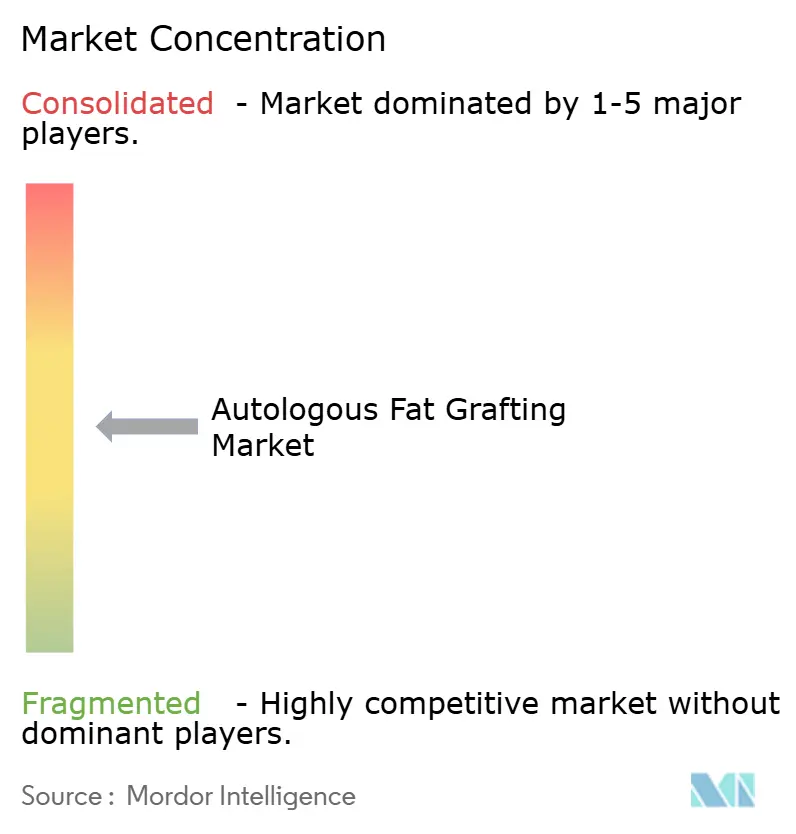
The autologous fat grafting market is moderately fragmented, as no company dominates every product tier. Competition remains strongest in integrated platforms, where Bimini Health Tech, MicroAire Surgical Instruments, and EmCyte Corporation differentiate through regulatory clearances and clinical evidence. Leading suppliers are shifting from standalone consumables to systems that connect harvesting, processing, and injection, improving workflow continuity and increasing vendor-switching costs.
MicroAire Surgical Instruments completed its acquisition of NEOSYAD in January 2025, combining its power-assisted liposuction offering with automated adipose tissue purification technology. The AdiPure single-use kit and AdiMate device support a workflow that integrates infiltration, liposuction, and lipofilling, with tissue purification completed in under 10 minutes. In January 2026, Etienna Bio secured an exclusive worldwide license from UMass Chan Medical School for an adipose-derived progenitor cell and hydrogel matrix platform. The company intends to develop non-drug, cell-enabled products for regenerative and aesthetic applications, which could help address regulatory complexity associated with gene-modified or allogeneic approaches.
Clinical validation is becoming more important as procurement teams compare processing quality and retention outcomes. The 2026 comparison of commercial nanofat systems found material differences in technical and biological performance, increasing the value of published benchmarking data. Advanced Biomedical Concept states that its EXAFAT fat dialysing system is used for breast surgery in several European and Middle Eastern countries and processes up to 200 mL of lipoaspirate in a single cycle. Intellectual property, disposable formats, and evidence-based processing performance will remain key differentiators as purchasing decisions also consider equipment and disposable costs, on-site support, staff training, and repeatable clinical workflows.
Autologous Fat Grafting Industry Leaders
-
AbbVie Inc.
-
Alma Lasers Ltd.
-
Emcyte Corporation
-
Lipogems International S.p.A.
-
Medikan International Inc.
- *Disclaimer: Major Players sorted in no particular order
Autologous Fat Grafting Market Companies Covered in this Report
- Abbvie
- Alma Lasers
- Andrew Technologies LLC
- Bimini Health Tech, Inc.
- Emcyte Corporation
- Genesis Biosystems, Inc.
- Harvest Technologies
- HK Surgical, Inc.
- Human Med
- Lipogems International S.p.A.
- Marizyme, Inc.
- Medical Device Resource Corporation
- Medikan International
- MicroAire
- Millennium Medical Technologies, Inc.
- Proteal Bioregenerative Solutions
- Ranfac
- Sterimedix Limited
- Syntr Health Technologies, Inc.
Recent Industry Developments in Autologous Fat Grafting Market
- July 2026: Advanced Biomedical Concept confirmed the international clinical rollout of EXAFAT, a closed-loop fat dialysis system for breast surgery, across Europe, the Middle East, and Chile, supporting large-volume breast grafting and precision contouring.
- January 2026: Etienna Bio secured an exclusive global license from UMass Chan Medical School for an adipose-derived cellular and matrix technology platform for regenerative and aesthetic applications.
- January 2025: MicroAire Surgical Instruments acquired NEOSYAD, adding the AdiPure kit and AdiMate device, which automated infiltration, liposuction, lipofilling, and tissue purification in under 10 minutes.
Global Autologous Fat Grafting Market Report Scope
As per the scope of the report, autologous fat grafting is a surgical method that moves fat from one part of your body to another. It uses your own fat tissue to fill in hollow areas, smooth wrinkles, or add fullness to places like the face, breasts, or hands.
The autologous fat grafting market is segmented by product type, application, end user, and geography. By product type, the market includes integrated fat transfer systems, aspiration and harvesting systems, liposuction systems, fat processing systems, de-epithelialization devices, injection and delivery systems, single-use cannulas, transfer syringes and collection vessels, filters, washers, and processing accessories, and other autologous fat grafting products. By application, the market is segmented into breast augmentation, buttock augmentation, facial fat grafting, hand rejuvenation, and others. By end user, the market is segmented into hospitals, plastic surgery centers, ambulatory care centers, academic and research hospitals, regenerative medicine clinics, and others. By geography, the market is analyzed across North America, Europe, Asia-Pacific, the Middle East and Africa, and South America. The report also covers the estimated market sizes and trends for 17 countries across major regions globally. The report offers the market sizes and forecasts in terms of value (USD) for the above segments.
| Integrated Fat Transfer Systems |
| Aspiration and Harvesting Systems |
| Liposuction Systems |
| Fat Processing Systems |
| De-epithelialization Devices |
| Injection and Delivery Systems |
| Single-Use Cannulas |
| Transfer Syringes and Collection Vessels |
| Filters, Washers and Processing Accessories |
| Other Autologous Fat Grafting Products |
| Breast Augmentation |
| Buttock Augmentation |
| Facial Fat Grafting |
| Hand Rejuvenation |
| Others |
| Hospitals |
| Plastic Surgery Centers |
| Ambulatory Care Centers |
| Academic and Research Hospitals |
| Regenerative Medicine Clinics |
| Others |
| North America | United States |
| Canada | |
| Mexico | |
| Europe | Germany |
| United Kingdom | |
| France | |
| Italy | |
| Spain | |
| Rest of Europe | |
| Asia-Pacific | China |
| India | |
| Japan | |
| Australia | |
| South Korea | |
| Rest of Asia-Pacific | |
| Middle East and Africa | GCC |
| South Africa | |
| Rest of Middle East and Africa | |
| South America | Brazil |
| Argentina | |
| Rest of South America |
| By Product Type | Integrated Fat Transfer Systems | |
| Aspiration and Harvesting Systems | ||
| Liposuction Systems | ||
| Fat Processing Systems | ||
| De-epithelialization Devices | ||
| Injection and Delivery Systems | ||
| Single-Use Cannulas | ||
| Transfer Syringes and Collection Vessels | ||
| Filters, Washers and Processing Accessories | ||
| Other Autologous Fat Grafting Products | ||
| By Application | Breast Augmentation | |
| Buttock Augmentation | ||
| Facial Fat Grafting | ||
| Hand Rejuvenation | ||
| Others | ||
| By End User | Hospitals | |
| Plastic Surgery Centers | ||
| Ambulatory Care Centers | ||
| Academic and Research Hospitals | ||
| Regenerative Medicine Clinics | ||
| Others | ||
| By Geography | North America | United States |
| Canada | ||
| Mexico | ||
| Europe | Germany | |
| United Kingdom | ||
| France | ||
| Italy | ||
| Spain | ||
| Rest of Europe | ||
| Asia-Pacific | China | |
| India | ||
| Japan | ||
| Australia | ||
| South Korea | ||
| Rest of Asia-Pacific | ||
| Middle East and Africa | GCC | |
| South Africa | ||
| Rest of Middle East and Africa | ||
| South America | Brazil | |
| Argentina | ||
| Rest of South America | ||
Key Questions Answered in the Report
What is the projected value of autologous fat grafting by 2031?
The autologous fat grafting market is forecast to reach USD 352.18 million by 2031, growing at a 7.70% CAGR from 2026.
Which product category has the largest revenue share?
Integrated fat transfer systems held 35.45% of revenue in 2025 because facilities value combined harvesting, processing, and injection workflows.
Which application is growing fastest through 2031?
Buttock augmentation is projected to grow at an 8.80% CAGR through 2031, supported by demand for surgical volume restoration and the use of stronger safety protocols.
Why are hospitals important in autologous fat grafting?
Hospitals held 38.66% of revenue in 2025 because they provide complex oncoplastic care, breast reconstruction, and access to capital equipment.
Which region is forecast to grow the fastest?
Asia-Pacific is forecast to grow at a 10.88% CAGR through 2031, supported by private healthcare expansion, medical tourism, and aesthetic procedure demand.
What limits the wider use of autologous fat grafting?
Variable retention, repeat-procedure needs, limited coverage for elective care, and regulatory uncertainty around cell-enriched grafts can limit adoption.