
Autoclaved Aerated Concrete (AAC) Market Size and Share
Market Overview
| Study Period | 2021 - 2031 |
|---|---|
| Market Size (2026) | USD 17.59 Billion |
| Market Size (2031) | USD 23.68 Billion |
| Growth Rate (2026 - 2031) | 6.12 % |
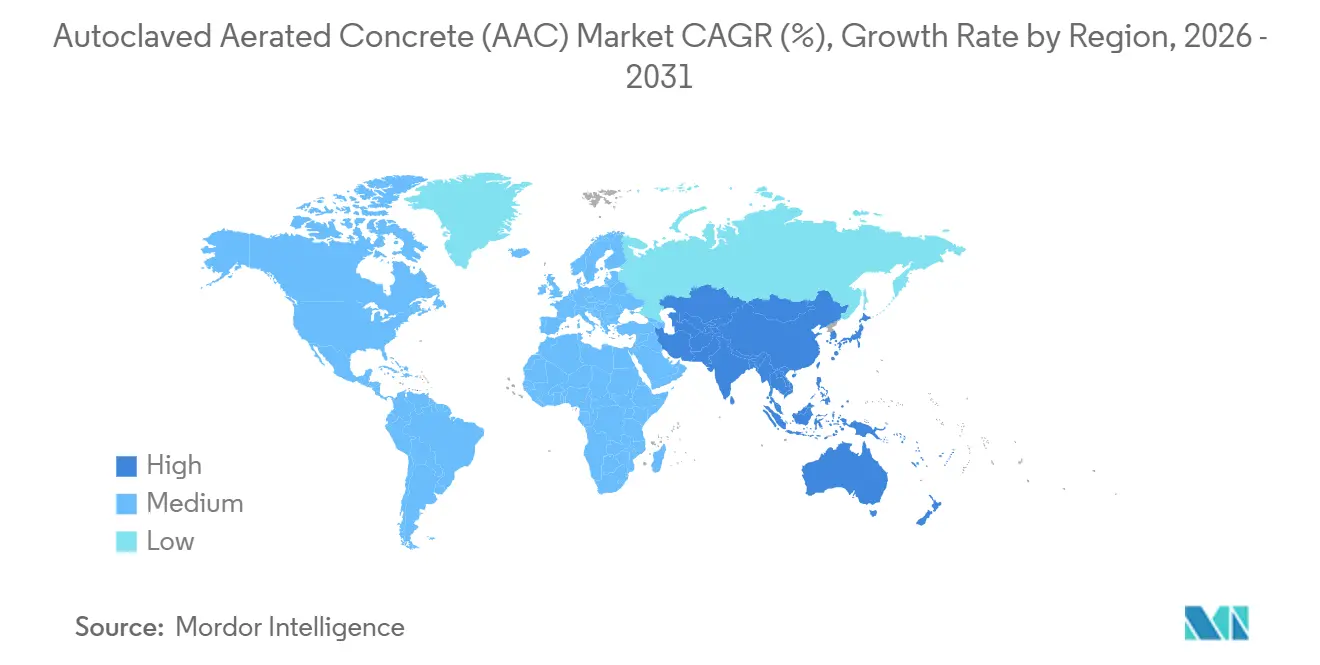
| Fastest Growing Market | Asia Pacific |
| Largest Market | Asia Pacific |
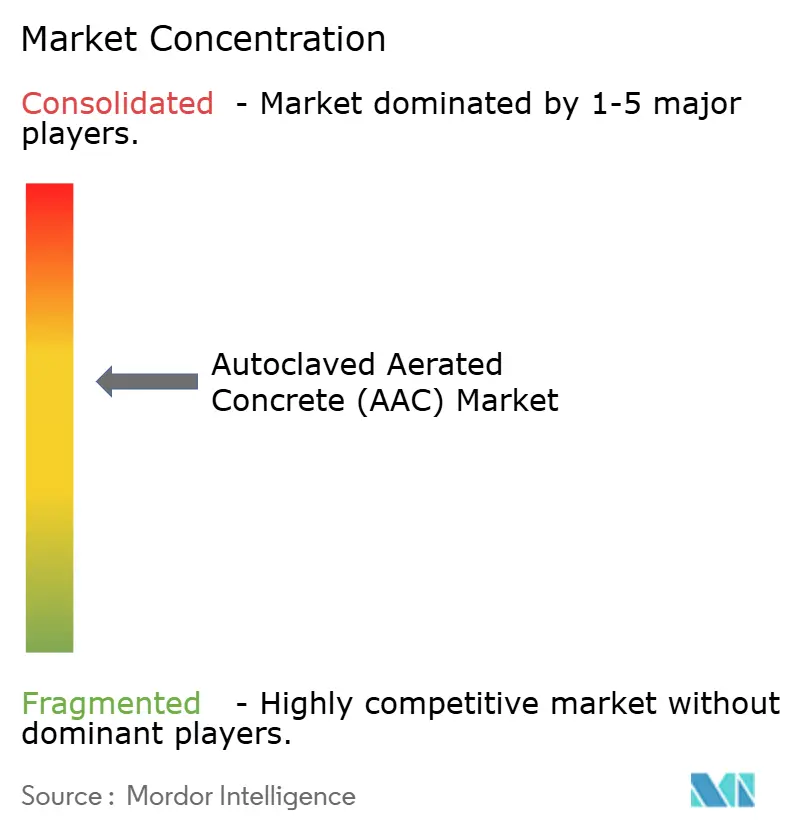
| Market Concentration | Medium |
Major Players *Disclaimer: Major Players sorted in no particular order Image © Mordor Intelligence. Reuse requires attribution under CC BY 4.0. | |
Autoclaved Aerated Concrete (AAC) Market Analysis by Mordor Intelligence
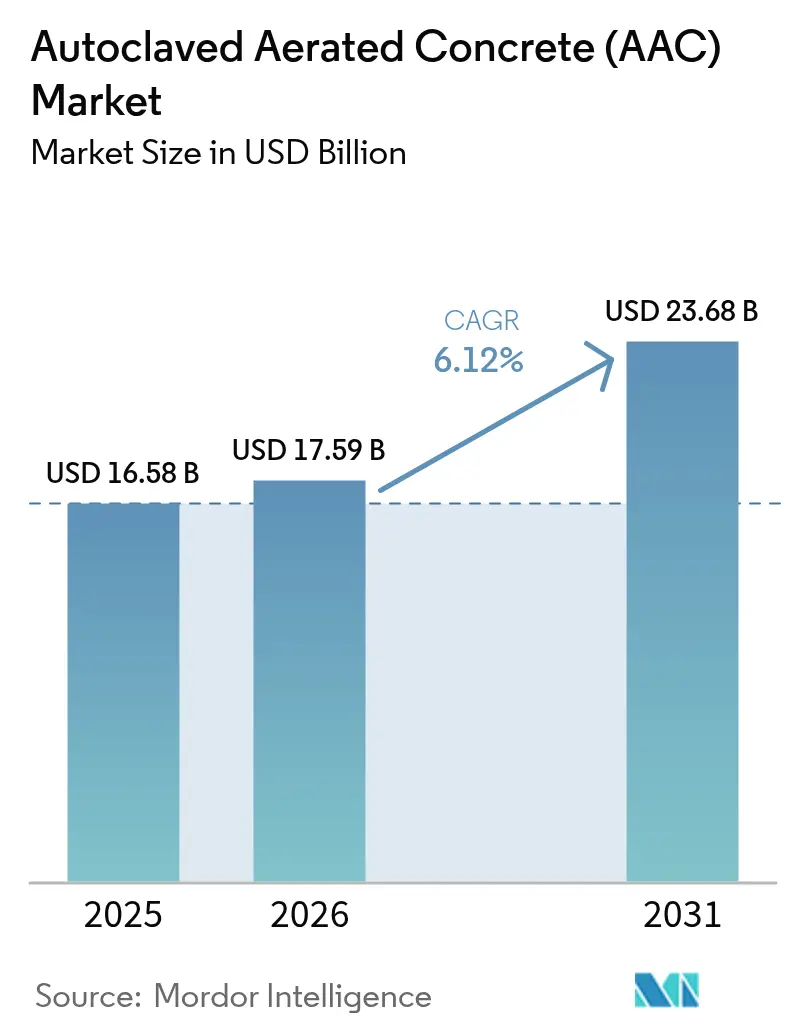
The Autoclaved Aerated Concrete Market size is projected to be USD 16.58 billion in 2025, USD 17.59 billion in 2026, and reach USD 23.68 billion by 2031, growing at a CAGR of 6.12% from 2026 to 2031. Multiple public-procurement rules now reward low-embodied-carbon products, tilting specifications toward factory-cured mineral systems and away from kiln-fired clay or dense concrete masonry. Asia-Pacific’s dominance reflects urbanization, seismic code updates, and government-funded affordable-housing pipelines that favor lightweight walls able to cut foundation loads and speed construction. Europe’s renovation mandates and North America’s low-carbon procurement programs reinforce demand for insulating AAC panels that meet Energy Performance Certificate C ratings in a single lift. Capacity additions in China, India, Romania, and the United States illustrate how the Autoclaved aerated concrete market is scaling to serve prefabrication yards that require millimeter-level panel tolerances and just-in-time logistics.
Key Report Takeaways
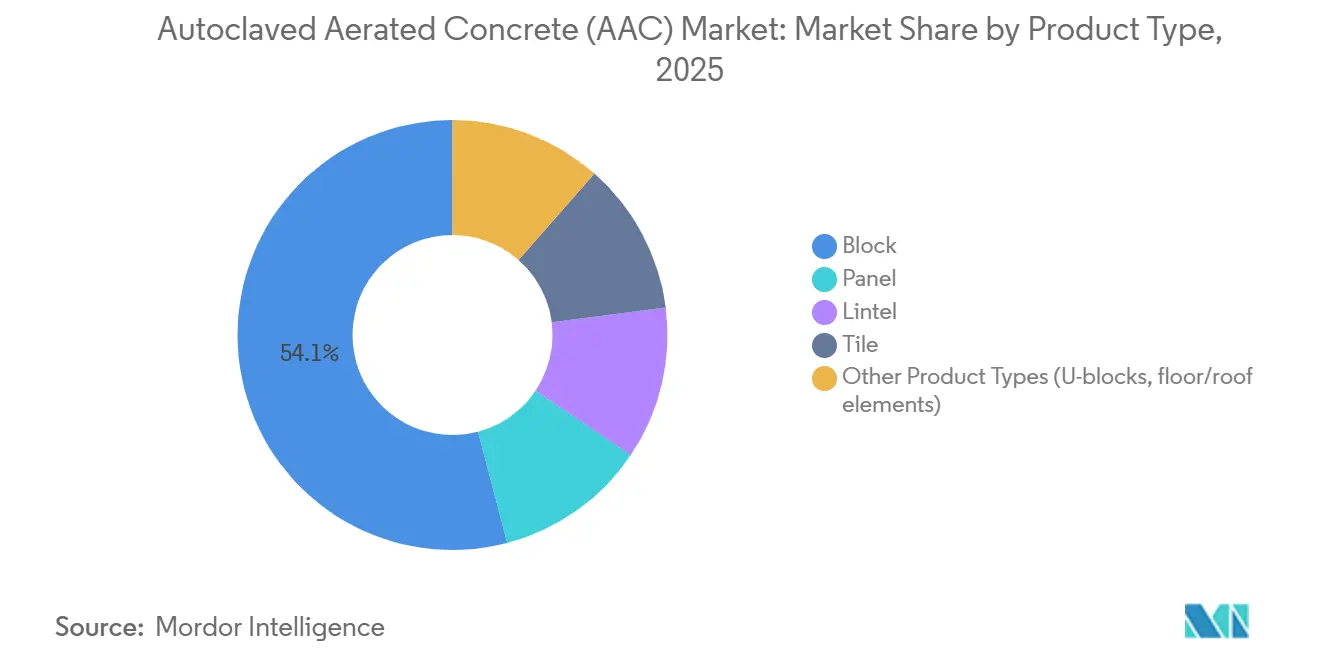
- By product type, block captured 54.10% of 2025 revenue, while panels are projected to expand at a 7.55% CAGR through 2031.
- By construction method, on-site masonry held 79.20% of the 2025 Autoclaved aerated concrete market share, whereas prefabricated/modular methods are forecast to grow at an 8.31% CAGR through 2031.
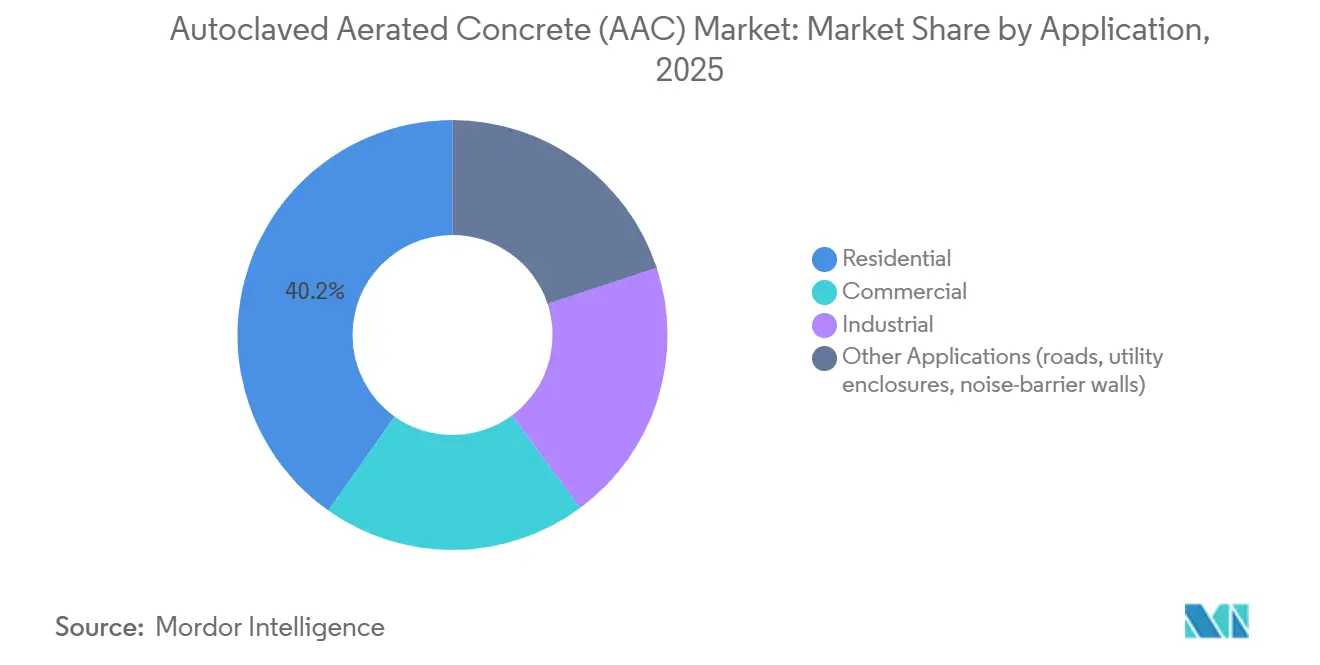
- By application, residential accounted for 40.20% of 2025 revenue and is advancing at a 6.63% CAGR through 2031.
- By geography, Asia-Pacific led with 46.40% of 2025 revenue and is poised to grow at a 7.11% CAGR through 2031.
Note: Market size and forecast figures in this report are generated using Mordor Intelligence’s proprietary estimation framework, updated with the latest available data and insights as of 2026.
Market Trends and Insights
Drivers Impact Analysis of Autoclaved Aerated Concrete (AAC) Market*
| Driver | (~) % Impact on CAGR Forecast | Geographic Relevance | Impact Timeline |
|---|---|---|---|
| Growing demand from new-build and renovation construction | +1.8% | Global, with concentration in Asia-Pacific (China, India, ASEAN) and Europe (Germany, France, Netherlands) | Medium term (2-4 years) |
| Stringent green-building codes and LEED adoption | +1.5% | North America, Europe, APAC core markets (Japan, South Korea, Singapore) | Short term (≤ 2 years) |
| Government incentives for low-carbon materials | +1.3% | North America (USA, Canada), Europe (EU member states), spill-over to MEA | Medium term (2-4 years) |
| Modular off-site construction uptake | +1.1% | North America, Europe, APAC (Japan, Australia) | Long term (≥ 4 years) |
| Demand for seismic-resilient lightweight blocks | +0.9% | APAC (Japan, Indonesia, Philippines), North America (California, Pacific Northwest) | Medium term (2-4 years) |
| Source: Mordor Intelligence | |||
Growing Demand from New-Build and Renovation Construction
Urban housing shortages and mandatory energy-efficiency retrofits are simultaneously expanding new-build pipelines and refurbishment budgets. India targets 25 million affordable units by 2031, while China funded USD 1.4 trillion in 2024 construction outlays. The European Renovation Wave aims to upgrade 35 million buildings by 2030, channeling orders toward insulating AAC envelopes. ISO 16745 whole-life-carbon assessment is becoming a default tender requirement, meaning bids increasingly weigh embodied-carbon disclosures alongside first cost. Large panel-fabrication lines able to deliver cut-to-size elements in days are best positioned to win renovation work that demands schedule compression. Consequently, the Autoclaved aerated concrete market is shifting capital toward automated plants with higher panel output.
Stringent Green-Building Codes and LEED Adoption
Low-carbon clauses in the U.S. Inflation Reduction Act, Canada’s Green Buildings Strategy, and the EU’s Energy Performance of Buildings Directive require Environmental Product Declarations for public works[1]. LEED v4.1 and analogous Indian Green Building Council criteria reward materials with verified emissions profiles. Suppliers that cannot furnish third-party EPDs risk exclusion from high-value public and commercial bids. Certified producers therefore command price premiums of 5%-8%, reinforcing a two-tier Autoclaved aerated concrete market in which uncertified blocks compete mainly in price-sensitive housing.
Government Incentives for Low-Carbon Materials
Grants under the U.S. EPA’s C-MORE program cover up to 50% of incremental costs for low-carbon products purchased by federal projects. The United Kingdom’s Buy Clean initiative and Ireland’s IGBC rules similarly preference low-embodied-carbon wall systems. These policies create predictable, multi-year offtake volumes that justify new autoclaving lines and localized raw-material quarries. Tier 1 manufacturers are expanding capacity to secure these contracts, while smaller firms without public-sector access face scale disadvantages in the Autoclaved aerated concrete market.
Modular Off-Site Construction Uptake
Labor scarcity and schedule-reliability pressures are accelerating factory-built construction that can trim on-site labor by 30%-40%. AAC panels arrive pre-finished with utility chases, aligning with the takt-time discipline of modern production lines. DVI Production opened Europe’s largest AAC panel plant in Romania in 2025 to supply modular builders across Central Europe. If wall-panel suppliers fail to meet the precision and just-in-sequence delivery demands of automated yards, developers may backward-integrate, compressing margins across the Autoclaved aerated concrete market.
Restraints Impact Analysis of Autoclaved Aerated Concrete (AAC) Market*
| Restraint | (~) % Impact on CAGR Forecast | Geographic Relevance | Impact Timeline |
|---|---|---|---|
| High upfront cost vs. clay and concrete blocks | -1.2% | Global, with acute impact in South Asia, Sub-Saharan Africa, and Latin America | Short term (≤ 2 years) |
| Structural limitations in load-bearing applications | -0.7% | Global, with regulatory tightening in Europe (UK, Ireland) and APAC (Singapore, Japan) | Medium term (2-4 years) |
| Volatile supply and price of aluminum powder foaming agent | -0.5% | Global, with supply concentration in China, India, and Middle-East | Short term (≤ 2 years) |
| Source: Mordor Intelligence | |||
High Upfront Cost Versus Clay and Concrete Blocks
AAC commands a 20%-30% price premium over conventional masonry, a hurdle for budget-constrained housing. Lifecycle savings from reduced mortar and quicker erection rarely sway developers targeting immediate cash flow. Public-sector subsidies like EPA C-MORE offset only institutional projects, leaving private residential builders to favor cheaper brick. Until incentives expand, cost sensitivity will cap residential penetration in the Autoclaved aerated concrete market.
Structural Limitations in Load-Bearing Applications
AAC’s compressive strength of 3-5 MPa restricts unreinforced walls to four-story structures. The United Kingdom’s RAAC school-closure emergency underscored durability concerns when reinforcement corrodes[2]. Singapore now mandates pre-consultation for structural RAAC, while ACI 526R-19 demands steel spreader plates under point loads. Such scrutiny confines AAC to infill unless detailed engineering support is provided, limiting high-rise adoption in the Autoclaved aerated concrete market.
*Our forecasts treat driver/restraint impacts as directional, not additive. The impact forecasts reflect baseline growth, mix effects, and variable interactions.
Autoclaved Aerated Concrete (AAC) Market Segment Analysis
By Product Type:
Panels Accelerate on Precision and SpeedBlocks generated 54.10% of 2025 revenue, yet panels are forecast to grow at 7.55% through 2031, representing the fastest rising slice of the Autoclaved aerated concrete market size. Aircrete Europe and Yuanzhu’s 500,000 m³ annual plant embodies the automation required to hit ±2 mm tolerances demanded by prefab yards. In markets where labor costs outstrip material premiums, contractors prefer ready-to-install panels that shorten wall cycles by two days per floor. The block segment still underpins rural and low-budget projects because it relies on low-skill labor and readily available small-batch mortar. Lintels and specialty elements capture niche demand for thermal-bridge-free openings and fire-rated floor plates, but they lack the volume to move the overall Autoclaved aerated concrete market.
The differential growth path means block-only producers risk stagnation unless they retrofit factories with tilt-cake cutters and reinforcement cages. Such upgrades can lift capital intensity by USD 8-10 million per line, which smaller regional players struggle to finance. Panel producers meanwhile lock in multiyear offtake contracts with modular builders, stabilizing factory utilization at 85%-90%. As more public tenders specify whole-wall U-values rather than R-values per course, integrated panels that combine structure, insulation, and finish gain competitive traction inside the Autoclaved aerated concrete market.

By Construction Method:
Prefabrication Gains Momentum Despite Masonry DominanceOn-site masonry held 79.20% of 2025 revenue, illustrating AAC’s historical role as a drop-in brick substitute. Prefabricated and modular is projected to rise at 8.31% CAGR through 2031. Factory assembly slashes weather downtime and rework, curbing total installed cost even when material premiums persist. Large U.S. yard operators integrate AAC panels with steel frames to deliver hurricane-resistant hotel rooms; Asian developers use panels in school dormitories to reduce project schedules by 30%.
Yet masonry will not disappear overnight. Availability of low-cost labor in India and Sub-Saharan Africa sustains block demand, and contractors there lack digital modeling skills to sequence panel deliveries. The transition is likely to follow a tipping pattern: once modular commands 15%-20% of yearly starts, distributors retool around panel logistics, accelerating the pivot. Suppliers that bridge both channels—offering blocks for infill and panels for prefab—can hedge demand swings, a strategic hedge increasingly visible in the Autoclaved aerated concrete market.
By Application:
Residential Provides Volume, Commercial Delivers MarginResidential contributed 40.20% of 2025 revenue and will advance at a 6.63% CAGR. Affordable-housing drives unit volume, such as India’s Pradhan Mantri Awas Yojana, where lightweight AAC cuts footing costs by 10% and meets thermal mandates without cavity insulation. Commercial command higher price premiums because hotels and offices need 2-hour fire walls that AAC meets at half the thickness of dense concrete. Industrial warehouses adopt AAC to stabilize HVAC loads, especially in cold-chain logistics hubs.
In unit economics, residential orders keep kilns loaded year-round, giving scale economies that lower unit cost and defend share within the Autoclaved aerated concrete market size. Commercial wins, by contrast, fund R&D and panel-line upgrades because margins can exceed 20% EBIT when bundled with design-assist services. A balanced portfolio across housing, commercial, and industrial therefore maximizes both capacity utilization and profitability, a critical lesson for mid-tier players eyeing expansion inside the Autoclaved aerated concrete market.
Geography Analysis
APAC Autoclaved Aerated Concrete (AAC) Market
Asia-Pacific generated 46.40% of 2025 revenue and is forecast to expand at 7.11% CAGR, reinforcing its role as the core growth engine of the Autoclaved aerated concrete market. India’s 60% urbanization target and China’s USD 1.4 trillion 2024 construction outlay prioritize lightweight walls that cut foundation loads. ASEAN’s adoption of seismic codes that limit wall mass further strengthens regional demand. Local giants such as Infra.Market now run nine AAC factories totaling 3 million m³ per year to serve tier-2 cities where clay brick shortages and rising labor costs make AAC blocks attractive.
Europe Autoclaved Aerated Concrete (AAC) Market
Europe demand is fueled by the EU Renovation Wave that mandates upgrades for 35 million buildings by 2030. Germany, France, and the Netherlands retrofit aging masonry with AAC panels to hit EPC C ratings, while Romania’s DVI facility positions Central Europe for prefab uptake. The United Kingdom’s RAAC crisis creates mixed signals: unreinforced blocks gain share, but reinforced planks undergo heavier scrutiny, pressing suppliers to certify products under BS EN 12602.
The Americas and Middle East Autoclaved Aerated Concrete (AAC) Market
North America contributes a smaller yet growing slice, hinging on state modular codes and embodied-carbon procurement. California, Washington, and New York lead in factory-built housing, while AAC East’s South Carolina expansion targets hurricane-prone coastal counties where the material’s impact and termite resistance add value. Canada’s 30% embodied-carbon reduction by 2030 boosts prospects, but clay-brick incumbents lobby aggressively, slowing momentum. South America and the Middle-East present nascent yet strategic options. Brazil’s São Paulo industrial corridor is investing in AAC for warehouse envelopes, whereas Saudi mega-projects like NEOM need fire-resistant, termite-proof walls for desert climates. Education of local contractors remains the gating factor in these emerging slices of the Autoclaved aerated concrete market.
Value Chain Analysis
AAC production begins upstream with mineral inputs (silica sand or fly ash), binders (Portland cement and lime), gypsum, water, and aluminum powder as the aeration agent. Suppliers of cement, lime, gypsum, and especially aluminum powder influence plant economics through input availability and pricing volatility. Energy and steam-generation equipment also matter because autoclaving is a high-pressure, high-temperature process with meaningful utility intensity.
Manufacturing is capital-intensive (mixing, casting, pre-curing, wire cutting, and autoclaving), which concentrates output in fewer, larger facilities. It also raises the role of automation and in-plant quality systems, since panels require tight dimensional control. Downstream, AAC is typically distributed through building-material dealers and direct-to-project supply, with growing reliance on prefabrication and modular yards that need just-in-time deliveries of panels and reinforced elements. Logistics is a constraint because AAC is low density and high volume, so producers site plants near demand centers and manage distribution radius to protect delivered costs. Post-use, the value chain is also adding circular-economy nodes: Europe-focused initiatives highlight whole-life carbon reporting and the revised Construction Products Regulation as drivers for better product data, while research indicates mechanical recycling of post-demolition AAC becomes economically workable at industrial scale (around 25,000 tonnes per annum), linking demolition contractors, recyclers, and producers seeking secondary raw materials.
Competitive Landscape
The Autoclaved aerated concrete market is fragmented: Xella International, H+H International, UltraTech Cement Ltd., ACICO Group, and Biltech Building Elements Ltd. together held roughly 54% of 2025 global revenue. Vertical integration into lime, cement, and aluminum powder allows these leaders to hedge input volatility and sustain 18%-22% gross margins. Regional specialists exploit localized logistics to offer two-day delivery in India, Indonesia, and Central Europe, compensating for smaller scale with speed.
Technology is the second battleground. Aircrete Europe’s In Control 4.0 system uses IoT sensors to maintain slice variation below 1 mm, enabling glued-joint installation without site trimming. DVI Production and Holcim Romania are adopting similar automation to meet prefab tolerances and reduce waste by 5%-7%. Integrated cement majors such as UltraTech and Holcim leverage distribution heft to cross-sell AAC blocks alongside bagged cement, squeezing stand-alone producers on channel access.
Reputational risk is rising after the U.K. RAAC school-plank failures. Suppliers now publish 50-year warranties and accelerated-aging test data to reassure specifiers, adding certification overhead that favors well-capitalized firms. Precontech’s lower-cost non-autoclaved technology could disrupt by slashing capex two-thirds, but its lower compressive strength limits initial reach to non-load-bearing walls. The outcome is an Autoclaved aerated concrete market where scale, certification, and automation determine long-run survivability.
Autoclaved Aerated Concrete (AAC) Industry Leaders
-
Xella International
-
ACICO Group
-
H+H UK Limited
-
UltraTech Cement Ltd.
-
Biltech Building Elements Ltd.
- *Disclaimer: Major Players sorted in no particular order
Autoclaved Aerated Concrete (AAC) Market Companies Covered in this Report
- ACICO Group
- AERCON AAC
- Asahi Kasei Corporation
- Bauroc AS
- Biltech Building Elements Ltd.
- BirlaNu Limited
- DVI Production
- Eastland Building Materials Co., Ltd
- Eco Green
- Ecostone AAC
- H+H UK Limited
- JK Lakshmi Cement Ltd.
- Renacon
- SOLBET
- Starken AAC Sdn Bhd
- STT Türk Gazbeton
- Thomas Armstrong (Concrete Blocks) Ltd
- UAL Industries Limited
- UltraTech Cement Ltd.
- Xella International
Market Opportunities and Future Outlook
System-selling around AAC (blocks or panels plus compatible mortars, adhesives, and finishing compounds) stands out as a whitespace as contractors and prefabrication yards push for fewer interfaces and more predictable installation. In India, Bigbloc Constructions 2026 commissioning of a construction-chemicals facility in Umargaon, Gujarat illustrates how manufacturers are bundling ancillary materials with core walling units, widening share of wallet and improving channel control. This system approach also tackles a core adoption barrier, installed-cost sensitivity, by reducing rework and labor time rather than competing only on unit price.
Regulatory tightening on operational energy and carbon disclosure is expanding addressable specifications for insulating wall systems that can document performance through standardized product information. In the United Kingdom and Wales, 2026 building-regulation amendments introduced updated performance metrics and requirements tied to higher energy efficiency and on-site renewable generation for new dwellings, steering design toward envelopes that simplify compliance. In Europe, the EAACA agenda in 2026 emphasized mandatory whole-life carbon reporting and the revised Construction Products Regulation, strengthening demand for AAC producers that can supply EPD-backed products, digital product information, and validated circularity pathways (including recycling and recarbonation work) aligned with procurement scoring in public and large private projects.
Recent Industry Developments in Autoclaved Aerated Concrete (AAC) Market
- April 2026: ACICO Group accelerated restructuring and expanded its one-stop-shop construction materials platform in GCC markets where AAC is part of its broader building-material baskets. The company strengthened its position in modular and panel-based building systems across the Gulf region.
- October 2025: Holcim announced the acquisition of Xella, owner of AAC walling brands such as Ytong and Hebel. The transaction strengthened Holcim's portfolio in sustainable walling systems and increased the scale and distribution leverage behind AAC in key European markets.
- March 2024: Xella had its emissions-reduction targets (Scopes 1, 2, and 3) approved by the Science Based Targets initiative (SBTi). The approval reinforced third-party credibility for decarbonization roadmaps that increasingly influence public procurement and specification of lower-carbon walling materials.
Autoclaved Aerated Concrete (AAC) Market Report Scope and Research Methodology
Market Definition and Coverage
This market is defined as the revenue generated from autoclaved aerated concrete (AAC) building products sold for construction use, including AAC blocks and related structural and enclosure elements that are cured in an autoclave and supplied through organized channels.
Scope exclusions: We exclude non-AAC concrete and conventional lightweight concrete products, along with raw material mining value that is not billed as an AAC product sale.
Segments Covered in This Report
- By Product Type
- Block
- Panel
- Lintel
- Tile
- Other Product Types (U-blocks, floor/roof elements)
- By Construction Method
- On-site masonry
- Prefabricated/Modular
- By Application
- Residential
- Commercial
- Industrial
- Other Applications (roads, utility enclosures, noise-barrier walls)
- By Geography
- Asia-Pacific
- China
- India
- Japan
- South Korea
- ASEAN Countries
- Rest of Asia-Pacific
- North America
- United States
- Canada
- Mexico
- Europe
- Germany
- United Kingdom
- France
- Italy
- Spain
- NORDIC Countries
- Poland
- Netherlands
- Romania
- Czech Republic
- Rest of Europe
- South America
- Brazil
- Argentina
- Colombia
- Rest of South America
- Middle-East and Africa
- Saudi Arabia
- Israel
- Qatar
- South Africa
- Rest of Middle-East and Africa
- Asia-Pacific
Data Sources, Market Sizing, and Validation
Desk Research
Desk work started with public construction and building-material indicators so the demand picture stayed realistic before any model math was applied. We used sources such as national statistical offices, building permit and housing start releases, and customs import or export tables where AAC and related building products can be tracked under relevant codes.
To keep assumptions grounded, we also reviewed documents such as standards and test methods for AAC from recognized bodies, energy-efficiency and building-code updates from public agencies, and technical papers that explain density classes, compressive strength ranges, and thermal performance (which often affects project specification). Company annual reports, investor presentations, and reputable press were used to confirm capacity additions, plant restarts, and regional expansion plans, and a paid subscription focused on company financials and another on shipment-level trade were referenced where it helped validate scale. The sources listed here are illustrative only, and we also referred to many other public documents for data collection, validation, and research clarification.
Primary Interviews and Surveys
Primary work was used to pressure-test the desk assumptions on pricing, utilization, and mix, especially where published series do not separate AAC from adjacent walling materials. We spoke with manufacturers, distributors, contractors, and project-side stakeholders across key regions so the model could be adjusted for local construction cycles, typical wall thickness choices, and transport-radius limits that shape delivered pricing.
Distribution of primary research fieldwork respondents
| Company type | Respondent position | Region |
|---|---|---|
| Top tier: 39% | CXOs: 13% | APAC: 48% |
| Mid tier: 40% | Functional/Unit leaders: 35% | EMEA: 33% |
| Smaller Players: 21% | Managers: 52% | Americas: 19% |
Market-Sizing & Forecasting
Sizing was built using a top-down and bottom-up combination, where construction activity and walling demand signals were converted into an AAC demand pool, and then translated into value using region-specific price logic. In practice, indicators like floor area added, housing starts and permits, non-residential construction output, and the share of masonry and panelized wall systems were used to guide how much AAC volume is likely to be placed.
From there, the value model depended on a few practical inputs that interviewees could confirm, such as typical product mix between blocks and panels, delivered average selling price ranges by density and thickness, transport cost sensitivity by distance from plants, and utilization changes when new kilns and autoclaves come online. Results were then corroborated with selective bottom-up checks, including sampled supplier revenue disclosures, channel checks on regional price points, and capacity-based sanity checks where plant information was available. When direct volume signals were missing for smaller markets, gaps were handled using proxy construction output and import reliance, followed by rechecks with local feedback.
For forecasting, scenario analysis was used and then narrowed using expert consensus on variables that move AAC adoption, such as energy-efficiency regulation tightening, labor availability that shifts demand toward faster installation systems, and housing affordability cycles. Assumptions were kept consistent across regions with local adjustments only where the data supported it.
Data Validation & Update Cycle
Outputs were validated through multiple checks so one data series did not over-influence the result. We compared implied per-capita AAC spend and implied wall area coverage against independent construction indicators, and then reviewed any sharp jumps against capacity changes, trade swings, or known policy shifts.
Before sign-off, anomalies were challenged in analyst reviews, followed by re-contacting sources when pricing, utilization, or mix inputs fell outside expected ranges for a country. Reports are refreshed annually, with interim updates when material events occur, such as major plant commissioning, trade disruptions, or policy changes that affect insulation and walling choices. Right before delivery, we do a final pass to ensure the numbers reflect the latest public releases and confirmed assumptions.
Mordor Intelligence's Autoclaved Aerated Concrete Aac Market Sizing Compared With Other Published Estimates
Published AAC market values do not always line up because the inputs behind pricing, currency timing, and the way product mix is handled can vary more than it first appears. Differences also come from how firms treat the boundary between AAC blocks, panels, and nearby lightweight wall products, and whether values reflect factory-gate pricing or delivered pricing.
A refresh-led factor is often the biggest driver because fast-changing construction conditions can move average selling prices and utilization within a short window, which then changes the value outcome even if volume is stable. By rechecking recent AAC price points and conversion rates during the final review, and then locking the same currency timing across regions, Mordor Intelligence keeps the 2025 total tied to what buyers and suppliers report as current transaction reality.
Benchmark comparison
| Source | Market Size | Gaps in Research Methodology |
|---|---|---|
| Mordor Intelligence | USD 16.58 B (2025) | |
| Global Consultancy A | USD 26.99 B (2025) | This estimate can rise when a wider material bucket is used that blends AAC with adjacent lightweight wall products, and when a higher delivered-price assumption is applied without transport-radius checks by country. |
| Industry Publisher B | USD 18.32 B (2025) | The gap can come from slower updates to average selling prices and currency conversion timing, especially when product mix weights between blocks and panels are not revalidated against current channel pricing. |
Taken together, the spread is mainly explained by scope edges and the timing of pricing and currency inputs, not by a single universal growth assumption. Our approach stays repeatable because each step is linked to visible construction signals, a clear AAC-only boundary, and practical pricing checks that can be revalidated as the market moves.
Key Questions Answered in the Report
What is the forecast revenue for the Autoclaved aerated concrete market in 2031?
The market is projected to reach USD 23.68 billion by 2031.
How fast is the Autoclaved aerated concrete market expected to grow between 2026 and 2031?
It is forecast to register a 6.12% CAGR over the period.
Which region is expanding the fastest in Autoclaved aerated concrete adoption?
Asia-Pacific is growing at a 7.11% CAGR, the highest among regions.
Why are AAC panels gaining share over blocks?
Panels arrive factory-cut, reduce wet trades, and align with modular construction, enabling a 7.55% CAGR compared with blocks.