
Austria Plastic Waste Management Services Market Size and Share
Market Overview
| Study Period | 2020 - 2031 |
|---|---|
| Forecast Data Period | 2026 - 2031 |
| Base Year Market Size (2025) | USD 0.32 Billion |
| Market Size (2026) | USD 0.33 Billion |
| Market Size (2031) | USD 0.39 Billion |
| Growth Rate (2026 - 2031) | 3.40 % |
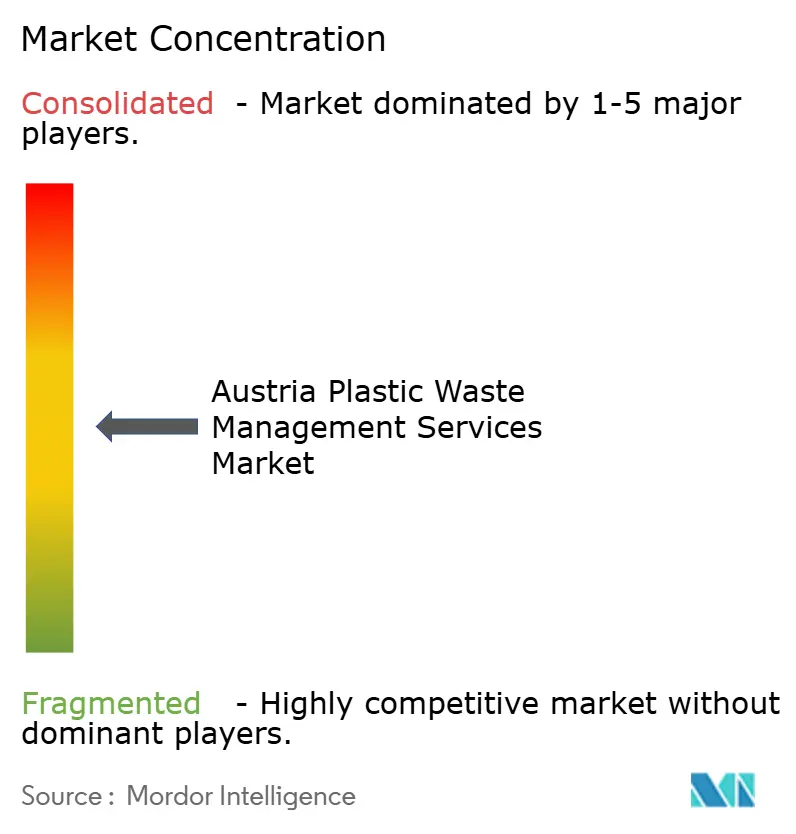
| Market Concentration | Medium |
Major Players *Disclaimer: Major Players sorted in no particular order Image © Mordor Intelligence. Reuse requires attribution under CC BY 4.0. | |
Austria Plastic Waste Management Services Market Analysis by Mordor Intelligence
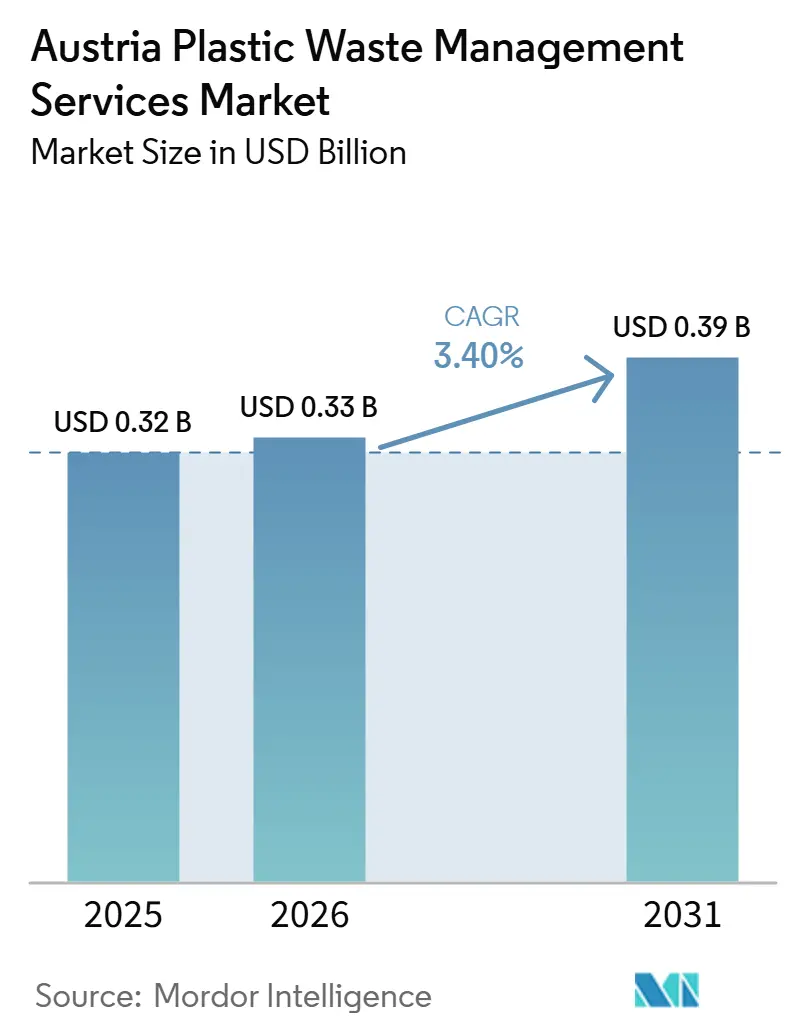
The Austria Plastic Waste Management Services Market size is projected to expand from USD 0.32 billion in 2025 and USD 0.33 billion in 2026 to USD 0.39 billion by 2031, registering a CAGR of 3.40% between 2026 to 2031.
Austria plastic waste management services market demand remains steady because packaging waste rules, deposit return obligations, and recycled content mandates are tied to compliance timelines rather than discretionary spending cycles. Austria’s nationwide deposit return system for single-use PET bottles and aluminum cans reached an 81.5% collection rate in its first year, lifting separately collected volumes and improving feedstock quality for bottle-to-bottle recycling. The market also benefits from producer responsibility funding and from infrastructure projects such as the TriPlast facility and the Sort4cycle project, which are expanding Austria’s ability to collect, sort, and process plastic packaging at scale. Corporate demand for recycled materials is strengthening the business case for improved sorting and recovery, as Austrian retailers and brand owners must align their packaging portfolios with recycled content and recyclability requirements. At the same time, low-density films, contamination at source, and uneven economics along rural routes continue to limit margins, keeping efficiency tools such as AI-based sorting, fill-level sensing, and route optimization central to competition in the Austria plastic waste management services market.
Key Report Takeaways
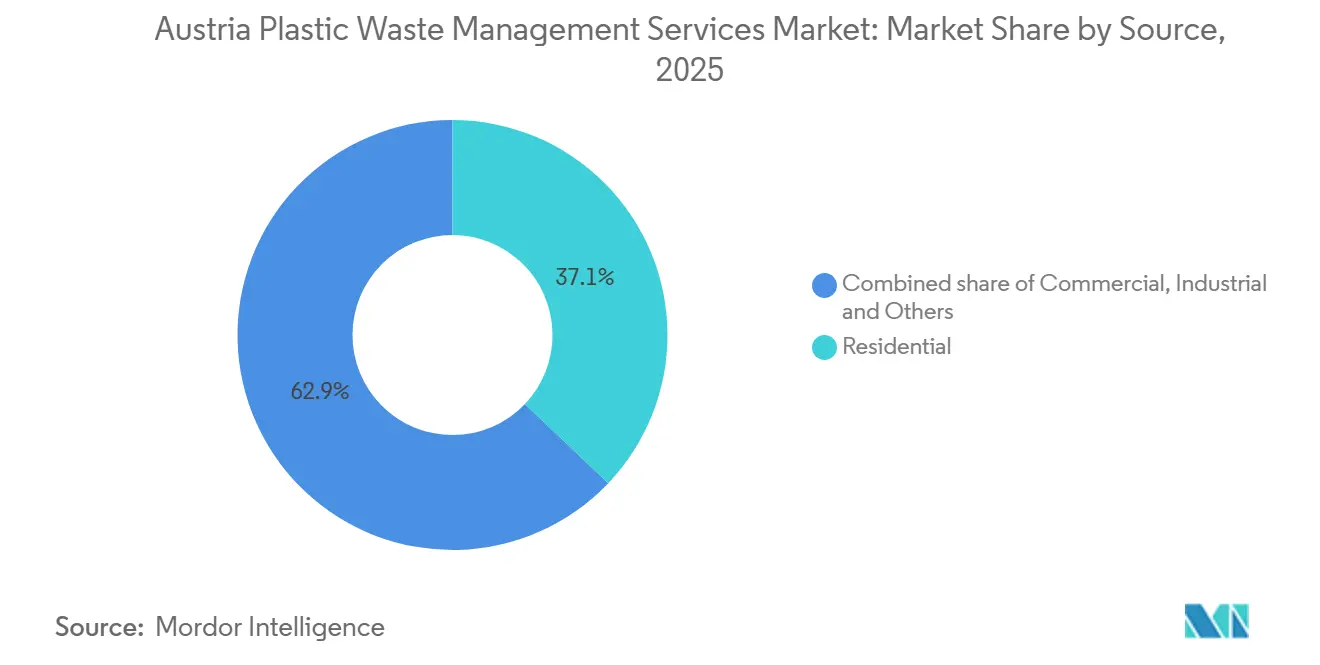
- By source, residential streams held 37.1% of the Austria plastic waste management services market share in 2025 and were also the fastest-growing source segment at a 4.9% CAGR through 2031.
- By service provider, public or municipal operators accounted for 45.5% of the Austria plastic waste management services market size in 2025, while private waste management companies recorded the highest projected CAGR at 5.2% through 2031.
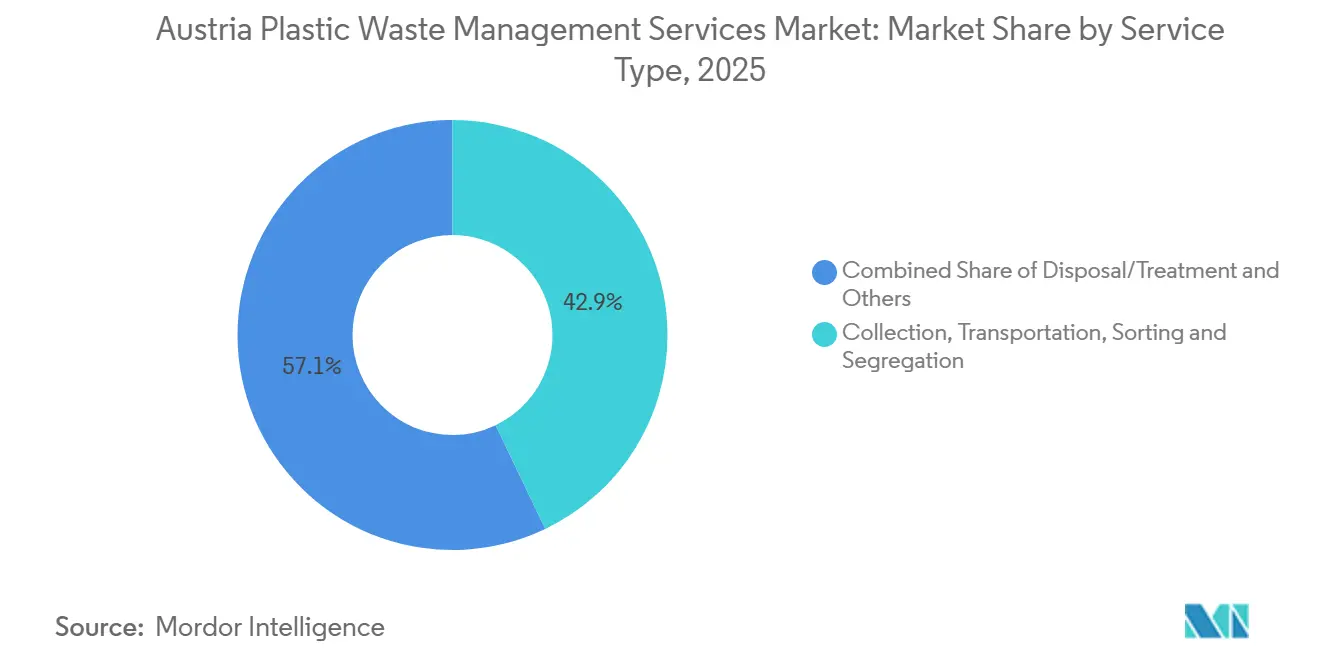
- By service type, collection, transportation, sorting, and segregation represented 42.9% of the Austria plastic waste management services market size in 2025, while disposal and treatment advanced at the fastest projected CAGR of 5.9% through 2031
Note: Market size and forecast figures in this report are generated using Mordor Intelligence’s proprietary estimation framework, updated with the latest available data and insights as of January 2026.
Austria Plastic Waste Management Services Market Trends and Insights
Drivers Impact Analysis*
| Driver | (~) % Impact on CAGR Forecast | Geographic Relevance | Impact Timeline |
|---|---|---|---|
| Development of Deposit Return Systems for Beverage Packaging | +0.8% | Austria-wide, with the strongest near-term volume uplift in Vienna, Styria, and Upper Austria | Short term (≤ 2 years) |
| Growth of Corporate Recycled Content Commitments | +0.7% | Austria-wide, concentrated in FMCG and food and beverage retail channels | Medium term (2-4 years) |
| Increasing Investments in Municipal Collection Infrastructure | +0.6% | Austria-wide, with early gains in Vienna, Tyrol, and Vorarlberg | Medium term (2-4 years) |
| Rapid Expansion of E-commerce and Flexible Plastic Packaging | +0.5% | Austria-wide, with higher intensity in Vienna, Graz, and Linz | Short term (≤ 2 years) |
| Digitalization of Waste Collection and Material Traceability | +0.4% | Urban and peri-urban municipalities, including Horn, Tulln, Villach, and Krems | Medium term (2-4 years) |
| Rising Industrial Plastic Scrap Recovery Programs | +0.3% | Industrial areas in Upper Austria, Styria, and Lower Austria | Long term (≥ 4 years) |
| Source: Mordor Intelligence | |||
Development of Deposit Return Systems (DRS) for Beverage Packaging
Austria launched its nationwide deposit return system on January 1, 2025, with a EUR 0.25 (USD 0.28) deposit on sealed PET bottles and aluminum cans of 0.1 to 3 liters. The system collected 81.5% of eligible containers in its first year, exceeding the 80% statutory threshold and immediately increasing the volume of separately sorted beverage packaging entering the recovery chain.[1]Bundesministerium für Land- und Forstwirtschaft, Klima- und Umweltschutz, Regionen und Wasserwirtschaft, “Ein Jahr Einwegpfand – Ergebnis 2025,” BMLUK Official Publication, bmluk.gv.at Most returns moved through more than 6,400 reverse vending machines, which improved convenience and helped produce cleaner PET feedstock than mixed household streams typically deliver. The system’s digital backbone also provides operators with real-time visibility into return flows, enabling compliance tracking and more precise service planning for retailers and collection partners. The next step is to lift collection toward 90% by 2027, which will keep demand firm for return logistics, sorting support, and retail network upgrades across the Austria plastic waste management services market.
Growth of Corporate Recycled Content Commitments
Austria’s packaging rules require a minimum 25% post-consumer recycled content in PET packaging from 2025, turning sustainability targets into direct purchasing obligations for brand owners and retailers.[2]Rechtsinformationssystem des Bundes, “Verpackungsverordnung 2014 – Recyclingquoten §5,” Austrian Legal Information System, ris.bka.gv.at This matters for the Austria plastic waste management services market because better-sorted output and a more reliable recycled resin supply now carry greater commercial value than before. REWE Austria has already documented 100% recycled material use in PET and folding-box packaging for its bi good care line, which shows that demand for compliant recycled material is already present in the downstream market. ARA stated in May 2026 that a recyclate supply gap could emerge by 2030 if current capacity trajectories remain unchanged, which will keep pressure on collection, sorting, and treatment operators to improve yield and purity. Fee modulation under the EU packaging rules also favors formats that are easier to recycle, thereby gradually improving the economics of mono-material streams and reducing the penalty attached to hard-to-sort designs. Over time, that shift should support higher-value recovery across the Austria plastic waste management services market rather than simply raising collection volumes without quality gains.
Increasing Investments in Municipal Collection Infrastructure
Collection infrastructure is expanding because ARA’s kerbside network covers 2.2 million households as of mid-2026, while separately collected plastic and metal packaging reached 230,000 tons in 2024. Vienna recorded a 14% net increase in collection volumes in 2025, while Tyrol and Vorarlberg reported gains of 10% and 8%, demonstrating that service demand has expanded across both dense urban areas and more challenging regional routes. The TriPlast facility in Ennshafen, which opened in June 2024, processes 100,000 tons per year of lightweight packaging and represents a major increase in national sorting capacity. ARA and its partners also broke ground in April 2026 on the Sort4cycle project, which is expected to recover value from residues that still fall outside conventional mechanical recycling routes. Lower Austria’s Waste Management Plan 2024 provides regional policy support by embedding deposit return expansion and long-term recycling targets into public planning. Together, these projects make infrastructure investment one of the strongest growth drivers for the Austria plastic waste management services market.[3]Amt der NÖ Landesregierung, “Executive Summary – Lower Austrian Waste Management Plan 2024,” Lower Austria State Government Official Publication, noe.gv.at
Rapid Expansion of E-commerce and Flexible Plastic Packaging
E-commerce is changing the waste mix by adding more films, pouches, air cushions, and other lightweight plastic formats that do not move through the collection chain as easily as rigid containers do. This matters in the Austria plastic waste management services market because flexible packaging requires different sorting settings, produces lower route density, and often carries a lower recovery value than cleaner rigid streams. Austria’s Parliament received a 2026 response confirming that parcel packaging waste is not yet systematically tracked as a separate stream, meaning pressure from online retail is still not fully reflected in official waste accounting. The greenPLAST-food project, launched in October 2025 with partners including PreZero Austria, AIT, and Montanuniversität Leoben, is directly aimed at scalable recycling solutions for PP and PE food-contact packaging, which is closely tied to this wider flexible packaging challenge. Operators that can process flexible and composite fractions more effectively are positioned to capture waste volumes that still move to thermal treatment today. This keeps flexible packaging one of the clearest service gaps in the Austria plastic waste management services market.
Restraints Impact Analysis*
| Restraint | (~) % Impact on CAGR Forecast | Geographic Relevance | Impact Timeline |
|---|---|---|---|
| High Cost of Collecting Low-Density Plastic Waste | -0.5% | Austria-wide, with the strongest pressure in rural and Alpine regions, including Tyrol, Carinthia, and Burgenland | Short term (≤ 2 years) |
| Poor Segregation at Source Increasing Collection Costs | -0.4% | Austria-wide, especially in urban high-density residential and multi-family housing areas | Medium term (2-4 years) |
| Volatility in Recovered Plastic Bale Prices | -0.3% | Linked to wider European secondary material markets and Austrian recycler margins | Long term (≥ 4 years) |
| Limited Commercial Viability of Multi-layer and Composite Plastics | -0.2% | Austria-wide, concentrated at the sorting and treatment stage | Long term (≥ 4 years) |
| Source: Mordor Intelligence | |||
High Cost of Collecting Low-Density Plastic Waste
Low-density plastic waste remains expensive to collect because films, carrier bags, air cushions, and agricultural plastics quickly fill vehicle space, generating limited tonnage per route. This is a direct cost issue for the Austria plastic waste management services market because route productivity declines faster for these materials than for rigid plastics, glass, or metals. PRO-Europe’s 2025 participation cost overview showed that ARA’s household plastic compliance fee increased to EUR 0.99/kg (USD 1.12/kg) from January 2025, up from EUR 0.87/kg (USD 0.98/kg) in 2024, which reflects the rising cost of managing more difficult plastic streams. Austria’s Alpine geography adds another burden, as longer travel distances in Tyrol, Carinthia, and Salzburg further raise route costs for sparse settlements. Research funded under Austria’s resources transition program is working to improve mechanical recycling performance for plastics, but the economics of low-density recovery remain challenging in the near term. Until these fractions can be handled more efficiently, pricing pressure will remain embedded across collection and transport contracts in the Austria plastic waste management services market.
Poor Segregation at Source Increasing Collection Costs
Source segregation quality is still uneven because Austria’s Digicoll project documentation states that 50% to 70% of residual household waste contains materials that should have been collected separately. This raises costs in Austria's plastic waste management services market because operators must spend more on sorting, contamination removal, and quality control before materials can re-enter recycling channels. The City of Krems introduced Brantner Green Solutions AI-based contamination scanner in 2025 to identify problematic materials in biowaste collections, demonstrating that municipalities are already using digital tools to address source-quality failures. ARA also reported in May 2026 that material quality gaps persisted even after Austria met the 50% household plastic recycling quota for 2025, indicating that higher volumes alone have not solved the quality issue. As a result, behavior change, clearer sorting rules, and local enforcement still matter as much as physical infrastructure in improving system performance. Without stronger gains at the household level, the Austria plastic waste management services market will continue to carry avoidable processing costs.
*Our forecasts treat driver/restraint impacts as directional, not additive. The impact forecasts reflect baseline growth, mix effects, and variable interactions.
Segment Analysis
By Source: Residential Streams Anchor Volume, Industrial Recovery Gains Momentum
Residential streams held 37.1% share in 2025 and remained the largest source segment in the Austria plastic waste management services market. The segment is also projected to grow at a 4.9% CAGR through 2031, which keeps households at the center of incremental demand. This growth reflects the expansion of kerbside coverage, stronger sorting discipline under unified collection systems, and the influence of deposit return on consumer participation. ARA’s network covered 2.2 million households by mid-2026, which gives the residential system the widest operational reach of any source category. The Austria plastic waste management services market size tied to residential streams continues to rise because policy tools are still translating into more complete household capture nationwide.
Commercial waste from retail and office activities remained the next most important source, as compliance with producer responsibility rules requires organized handling and documented collection. Industrial scrap contributed a smaller share, but it is gaining relevance where plastics processing clusters in Upper Austria, Styria, and Lower Austria can support recovery programs and cleaner material streams. The other category, which includes agriculture and institutions, remained comparatively limited in scale, though targeted recovery efforts are improving their visibility within the Austrian plastic waste management services industry. The residential segment’s dual role as the largest and fastest-growing source shows that the Austria plastic waste management services market is still being shaped most strongly by household collection rules rather than by industrial scrap alone. That also means future growth depends not only on increased volume but also on higher-quality capture from everyday consumer disposal.



By Service Provider: Municipal Incumbency Holds, Private Operators Accelerate
Public and municipal providers accounted for 45.5% of revenue in 2025, maintaining their leading position in the Austria plastic waste management services market. This lead reflects Austria’s long-established municipal collection structure, where local authorities or municipal associations remain responsible for many household waste functions. Long contract cycles and legal assignment of collection duties make the public position durable, especially in household streams where service continuity matters more than frequent rebidding. Even so, private waste management companies are projected to expand at a 5.2% CAGR through 2031, which is faster than the overall market pace. That growth shows that municipalities are relying more on specialist partners for sorting, advanced treatment, route technology, and project execution in areas that need more capital or technical depth.
The REMONDIS transaction with Saubermacher, completed in June 2026 after competition clearance, illustrates how private capital is moving into Austrian waste infrastructure without displacing local incumbents. Producer responsibility organizations also influence provider dynamics by channeling compliance funding into collection and processing capacity, thereby linking public systems and private operators more closely than a simple public-versus-private split suggests. ARA’s investment program in TriPlast and Sort4cycle is a clear example of this shared model. Digital tools are narrowing the cost gap between provider types, so competition in the Austria plastic waste management services industry is moving more toward execution quality and technology use than toward coverage alone. In practical terms, the Austria plastic waste management services market is maintaining its public base while opening more space for private growth in higher-value specialist services.
By Service Type: Collection and Sorting Leads, Treatment Scales Fastest
Collection, transportation, sorting, and segregation are projected to account for 42.9% of revenue in 2025, making them the largest service block in the Austria plastic waste management services market. This position reflects Austria’s need to manage household kerbside material, deposit return flows, and business collections across a national network. Interzero reported that Austria collected 230,000 tons of plastic and metal packaging through the yellow bag and yellow bin system in 2024, highlighting the scale of upstream handling before any treatment value is realized. Disposal and treatment are forecast to record a 5.9% CAGR through 2031, making them the fastest-growing service type in the Austria plastic waste management services market. New plants and process upgrades commissioned from 2024 onward are expected to convert capital spending into operating throughput, driving this growth.
Recycling and resource recovery remain the main engines of treatment because policy and customer demand both favor recovered material over disposal whenever specifications can be met. The Sort4cycle project is important here because it targets residues that have often been sent for thermal treatment, thereby expanding the range of plastics that can generate service revenue in future years. Incineration still keeps a role for contaminated or composite plastics that are hard to recycle, while landfill use continues to fall under Austrian and EU waste rules. Consulting, audit, and training services are also becoming more visible because packaging producers need support in meeting recyclability and compliance requirements. This mix shows that the Austria plastic waste management services market share is still led by upstream logistics today, while future growth is steadily moving toward more advanced treatment and recovery capacity.
Geography Analysis
The Austria plastic waste management services market was valued at USD 0.32 billion in 2025 and is projected to reach USD 0.39 billion by 2031, so geographic performance depends more on how efficiently each region converts policy into operational results than on large differences in national waste generation. Austria uses a nationwide regulatory framework, but execution still varies by state because municipalities, regional waste associations, and operator partnerships shape local collection intensity and service quality. The deposit return system changed collection geography quickly in 2025 because higher return activity strengthened separately sorted beverage packaging flows across both dense cities and more dispersed regions. Vienna recorded a 14% net increase in packaging collection in 2025, while Tyrol and Vorarlberg posted gains of 10% and 8%, indicating that a single urban center is not driving the Austria plastic waste management services market.
Upper Austria has a particularly strong role because the TriPlast facility in Ennshafen handles 100,000 tons per year of lightweight packaging and anchors a large part of the country’s sorting capacity. The Sort4cycle project in the same broader industrial corridor adds another layer because it is aimed at materials that have not been commercially recovered at scale before. Lower Austria remains important because its 2024 Waste Management Plan makes deposit return expansion and long-term recycling targets part of formal planning, giving service providers clearer visibility into future needs. Styria also stands out for combining an operating presence from large waste companies with research and digital pilots that support improvements in collection, sorting, and treatment. ANDRITZ’s Smart Waste Factory works in St. Michael, and related Austrian research partnerships show that the Austria plastic waste management services market is using regional industrial clusters to test technologies before wider rollout.
Digitalization is becoming more visible at the municipal level as well. Villach’s Digicoll initiative focused on digital waste management tools, while Krems used AI-based contamination scanning to address collection quality. Regional differences, therefore, reflect route density, infrastructure access, and local execution rather than different national targets. Alpine states still face higher transport costs for low-density plastics, while industrial and urban areas can reach better economies of scale more quickly. This means the Austria plastic waste management services market will continue to expand nationwide. Still, the strongest margin gains are more likely in regions that combine scale, modern infrastructure, and better source segregation.
Competitive Landscape
Austria’s plastic waste management services sector is moderately consolidated, and a limited set of established operators across household collection and large-scale sorting leads the market. Municipal structures still hold an important position, but national producer responsibility organizations and major private companies increasingly shape investment priorities. Competition now rests less on basic access to waste volumes and more on who can deliver cleaner output, lower route costs, and more reliable compliance support. That is why the Austria plastic waste management services market is seeing a shift in strategy toward infrastructure control, technology deployment, and closer alignment with packaging producers and retailers.
The clearest recent ownership move was REMONDIS's acquisition of a 27.79% stake in Saubermacher in June 2026, following Austrian competition clearance. This did not remove Saubermacher’s established municipal relationships, but it did strengthen access to capital, regional scale, and long-term circular economy positioning. ARA’s capital program offers another example because the company and its partners committed major funds to TriPlast and Sort4cycle, which tie compliance funding directly to sorting and treatment expansion. A third example comes from digital operations, where Saubermacher’s smart collection pilots and municipal technology partnerships show that process visibility and route intelligence are becoming competitive tools rather than optional add-ons. These moves show a market where scale still matters, but execution quality matters more each year.
There is still room for specialist entrants in treatment, contamination control, data services, and hard-to-recycle fractions. Chemical recovery of sorting residues remains an area to watch because Sort4cycle aims to address a stream that most operators still send to thermal treatment. At the same time, technology suppliers can influence the Austria plastic waste management services market without running full collection networks if their tools become embedded in municipal and operator workflows. That pattern is visible in sensor platforms, contamination scanners, and AI-driven optimization projects supported by Austrian public funding. Overall, the Austria plastic waste management services market remains defendable for incumbents in core collection and sorting. In contrast, adjacent service layers remain open to companies that can solve cost and quality problems more effectively.
Austria Plastic Waste Management Services Industry Leaders
Remondis SE & Co. KG
Veolia Environnement
FCC Environment
PreZero International
Saubermacher Dienstleistungs AG
- *Disclaimer: Major Players sorted in no particular order

Recent Industry Developments
- June 2026: REMONDIS SE & Co. KG completed its acquisition of a 27.79% minority stake in Saubermacher Dienstleistungs AG following clearance by Austria's Federal Competition Authority, formalizing a strategic partnership targeting long-term circular economy infrastructure investment and geographic expansion into Southeast Europe.
- May 2026: ARA Altstoff Recycling Austria AG announced at its annual press briefing that it achieved the EU's 50% plastic packaging recycling quota for household streams in 2025, confirmed a combined EUR 100 million (USD 112.9 million) investment with partners by end-2026, and reported 607,000 tons of secondary raw materials provided to industry in 2025.
- April 2026: ARA and partners broke ground on the Sort4cycle plant in Upper Austria, a EUR 40 million (USD 45.1 million) facility expected to be operational from 2027, which will use ARA's UPCYCLE process to recover materials from sorting residues currently routed to incineration.


Austria Plastic Waste Management Services Market Report Scope
The Austria Plastic Waste Management Services Market Report is Segmented by Source (Residential, Commercial, Industrial, and Others), by Service Provider (Public/Municipal, Private Waste Management Companies, and Others), by Service Type (Collection, Transportation, Sorting & Segregation, Disposal / Treatment, and Others). The Report Offers Market Size and Forecasts in Value (USD) for All the Above Segments.
| Residential |
| Commercial (Retail, Office, etc.) |
| Industrial |
| Others (Institutional, Agricultural, etc) |
| Public/Municipal |
| Private Waste Management Companies |
| Others - Producer Responsibility Organizations (PROs), etc. |
| Collection, Transportation, Sorting & Segregation | |
| Disposal / Treatment | Landfill |
| Recycling & Resource Recovery | |
| Incineration & Waste-to-Energy | |
| Others (Chemical Treatment, etc.) | |
| Others (Consulting, Audit & Training, etc.) |
| By Source | Residential | |
| Commercial (Retail, Office, etc.) | ||
| Industrial | ||
| Others (Institutional, Agricultural, etc) | ||
| By Service Provider | Public/Municipal | |
| Private Waste Management Companies | ||
| Others - Producer Responsibility Organizations (PROs), etc. | ||
| By Service Type | Collection, Transportation, Sorting & Segregation | |
| Disposal / Treatment | Landfill | |
| Recycling & Resource Recovery | ||
| Incineration & Waste-to-Energy | ||
| Others (Chemical Treatment, etc.) | ||
| Others (Consulting, Audit & Training, etc.) | ||


Key Questions Answered in the Report
What is the current outlook for the size of plastic waste management services in Austria?
The Austria plastic waste management services market size stood at USD 0.32 billion in 2025, rose to USD 0.33 billion in 2026, and is forecast to reach USD 0.39 billion by 2031 at a 3.40% CAGR.
Why are private operators gaining traction in Austria?
They are gaining ground in specialist functions such as sorting, advanced treatment, digital systems, and higher-complexity operating services.
Which source segment generates the most revenue in Austria?
Residential waste streams accounted for 37.1% of the market in 2025 and were also the fastest-growing source segment, supported by broad household collection coverage and stronger consumer participation.
Which service category is growing the fastest through 2031?
Disposal and treatment are projected to grow the fastest at 5.9% CAGR, supported by new capacity such as Sort4cycle and broader investment in higher-value recovery.
Why are private companies gaining ground against municipal operators?
Private waste management companies are expanding faster, at a 5.2% CAGR, as municipalities increasingly rely on specialist partners for sorting, advanced treatment, and digital efficiency tools.
What are the main operational challenges in Austria’s plastics collection system?
The main issues are high collection costs for low-density plastics and poor source segregation, which raise sorting costs, reduce output quality, and weaken recovery economics.
Page last updated on:





