
Australia Tank Trucking Market Size and Share
Market Overview
| Study Period | 2021 - 2032 |
|---|---|
| Forecast Data Period | 2027 - 2032 |
| Base Year Market Size (2026) | USD 4.40 Billion |
| Market Size (2027) | USD 4.61 Billion |
| Market Size (2032) | USD 5.63 Billion |
| Growth Rate (2027 - 2032) | 4.08 % |
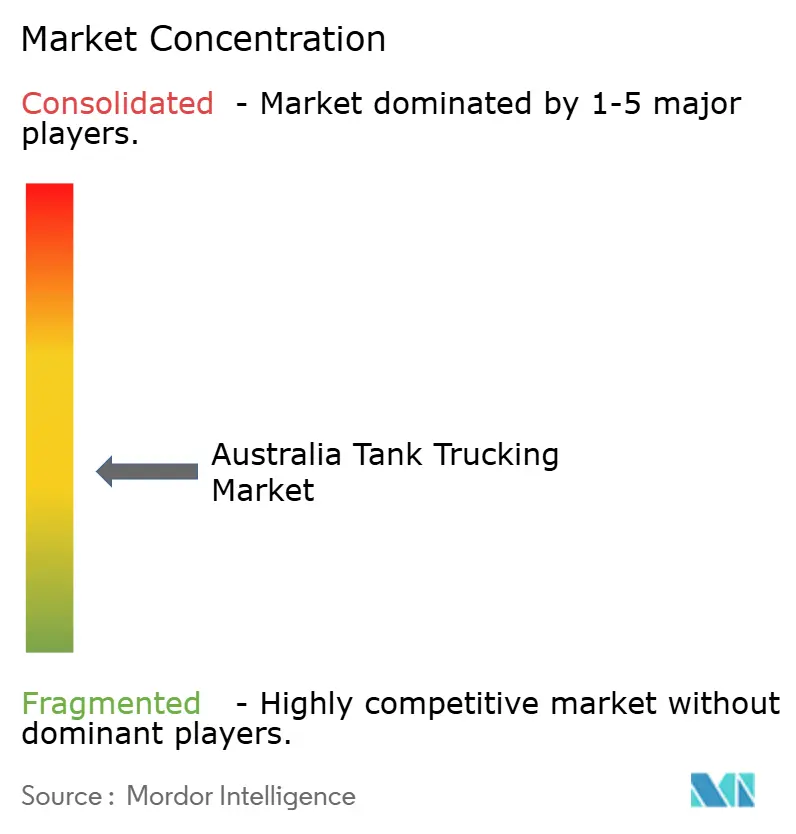
| Market Concentration | Medium |
Major Players *Disclaimer: Major Players sorted in no particular order Image © Mordor Intelligence. Reuse requires attribution under CC BY 4.0. | |
Australia Tank Trucking Market Analysis by Mordor Intelligence
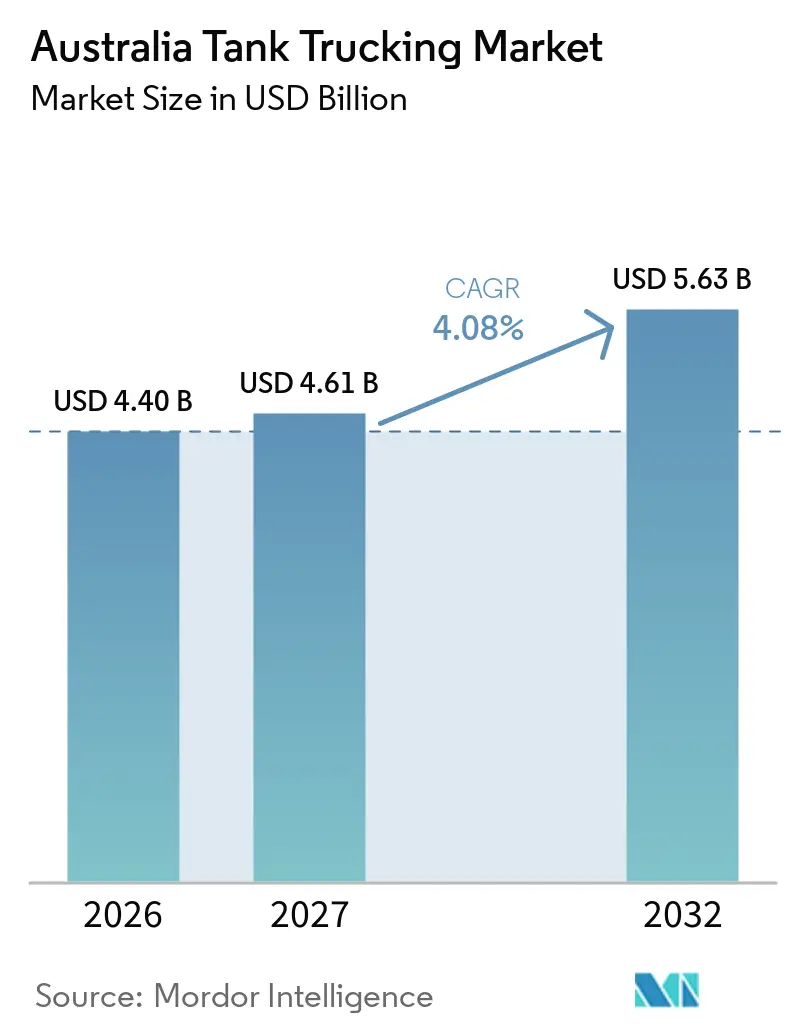
The Australia tank trucking market size is valued at USD 4.40 billion in 2026 and is estimated to grow from USD 4.61 billion in 2027 to reach USD 5.63 billion by 2032, at a CAGR of 4.08% during the forecast period (2027-2032).
Fuel, food-grade liquids, chemicals, and water continue to require road delivery across long distances where pipeline alternatives are limited. Mining sites and regional industrial facilities create recurring demand for specialized fuel, chemical, and water deliveries. Operators are pursuing higher payloads, depot coverage, certified fleets, and digital compliance capabilities to improve asset use and secure contracts. Compliance obligations for dangerous goods, food safety, fatigue, and vehicle access favor carriers that can maintain accredited equipment and records. Labor availability, fuel cost movements, and road access rules remain material constraints on margins and fleet expansion.
Key Report Takeaways
- By product category, fuel and petroleum products held 47.31% of the Australia tank trucking market share in 2026, while food and beverage are forecast to register a 5.05% CAGR through 2032.
- By capacity, heavy-duty vehicles accounted for 52.36% of the Australia tank trucking market size in 2026, while light-duty vehicles are forecast to advance at a 4.66% CAGR through 2032.
- By distance, short haul represented 62.08% of revenue in 2026, while long haul is forecast to register a 4.39% CAGR through 2032.
- By geography, Western Australia held 30.03% of revenue in 2026, while Queensland is forecast to expand at a 5.41% CAGR through 2032.
Note: Market numbers in this report are based on Mordor Intelligence's proprietary estimation framework, which combines nine months of actuals with Q4 projections for base year 2026.
Market Trends and Insights
Drivers Impact Analysis of Australia Tank Trucking Market*
| Driver | (~) % Impact on CAGR Forecast | Geographic Relevance | Impact Timeline |
|---|---|---|---|
| Outsourced Liquid Logistics for Mining and Remote Operations | +1.4% | Western Australia, Northern Territory | Medium term (2-4 years) |
| Food-Grade and Dairy Collection Networks | +0.9% | Queensland, New South Wales, Victoria, Western Australia | Medium term (2-4 years) |
| Higher-Payload PBS Tankers and Road-Train Productivity | +0.7% | National, with early gains in NSW and QLD corridors | Short term (≤ 2 years) |
| Chemical and Water-Treatment Supply-Chain Complexity | +0.6% | National, particularly Queensland and New South Wales | Long term (≥ 4 years) |
| Real-Time Telematics and Compliance-Visible Service Contracts | +0.5% | National, mandatory in Queensland and New South Wales for Higher Mass Limits operations | Short term (≤ 2 years) |
| Backhaul Utilization Through Multi-Compartment Tankers | +0.4% | National, east coast corridors in New South Wales, Queensland, and Victoria | Medium term (2-4 years) |
| Source: Mordor Intelligence | |||
Outsourced Bulk-Liquid Logistics for Mining and Remote Operations
The Australia tank trucking market benefits when resource operators outsource fuel, process water, and chemical deliveries to specialist carriers rather than maintaining dedicated captive fleets at isolated locations. Remote mines often need regular supply services that are difficult to provide through fixed infrastructure, especially across the Pilbara, Goldfields, Bowen Basin, and other areas outside metropolitan freight networks. This gives operators a role in refueling, chemical dosing, and water delivery under longer-duration service contracts that can support investment in specialized tanker and road-train equipment. The work requires tank configurations, trained drivers, route planning, maintenance planning, and safety systems suited to demanding remote conditions and changing mine-site operating schedules. Growth in critical minerals activity can extend road-based liquid logistics to new production areas where rail and pipeline connections remain unavailable or uneconomic. The Australia tank trucking market is, therefore, supported by the continuing need for specialized deliveries to locations with limited transport alternatives and persistent high-volume liquid requirements.
Growth in Food-Grade and Dairy Collection Networks
Food-grade liquid transport is expanding the range of work available to dedicated tanker fleets in the Australia tank trucking market, particularly across dairy collection and processed-food distribution routes. The freight network serving Australia’s dairy industry includes raw milk collection, inter-factory transport, and processed-product distribution. Food-grade tankers are also needed for edible oils, liquid sugar, wine, and beverage concentrates, creating a range of freight tasks beyond raw milk collection. These loads require cleaning, segregation, and handling processes that prevent cross-contamination and protect the quality of each product between collections and deliveries. Food transport vehicles must be designed and maintained to protect food from contamination. This requirement supports investment in dedicated fleets rather than general-purpose equipment and limits the ability of fuel or chemical carriers to switch directly into food transport.
Higher-Payload PBS Tankers and Road-Train Productivity
Performance-based standards (PBS) vehicles give the Australia tank trucking market a way to move more liquid volume with fewer vehicle movements on routes that can accommodate approved combinations. PBS vehicles had 46% fewer major crashes per kilometer traveled than conventional heavy vehicles in a 2025 enforcement operation.[1] Higher payloads can lower cost per liter on suitable long-distance routes, while reducing the number of individual journeys required to meet a customer’s delivery schedule. The PBS framework links these productivity gains to vehicle safety, performance, and access requirements rather than allowing larger combinations to operate without defined technical controls. The National Class 2 Road Train Authorisation Notice 2025 updated routes and operating conditions for eligible road trains.[2] The Australia tank trucking market can gain where approved access, fleet capability, driver availability, and customer volumes align on routes that justify the higher investment in specialized equipment.
Chemical and Water-Treatment Supply-Chain Complexity
Chemical and water-treatment deliveries require specialized equipment, licenses, segregated loading systems, and planned handling procedures that are not required for general freight. The Australia tank trucking market serves industrial water treatment, mining reagents, agricultural chemical distribution, and municipal supply through these capabilities and related compliance processes. Operators can expand chemical logistics capacity through licensed fleet assets, storage capability, and carefully controlled loading procedures. Dangerous goods obligations create a higher entry barrier for operators without certified assets, trained personnel, established loading procedures, and systems for demonstrating compliance to customers. Fragmented industrial and warehousing footprints can preserve the need for regional road delivery. The Australia tank trucking market is supported by delivery tasks that require regular, compliant transport rather than simple price-based substitution, including planned supply to water and industrial facilities.
Restraints Impact Analysis of Australia Tank Trucking Market*
| Restraint | (~) % Impact on CAGR Forecast | Geographic Relevance | Impact Timeline |
|---|---|---|---|
| Driver, Dangerous-Goods Competency and Fatigue-Management Constraints | -0.9% | National, most acute in Western Australia and Queensland remote regions | Long term (≥ 4 years) |
| Diesel Cost Volatility and Low-Margin Contracting | -0.7% | National, most severe in Northern Territory and remote Western Australia and Queensland | Short term (≤ 2 years) |
| Tank Cleaning, Segregation and Cross-Contamination Risk | -0.5% | National, particularly food-grade states in Queensland, New South Wales, and Victoria | Medium term (2-4 years) |
| Corridor Access, Permit and Road-Condition Variability | -0.4% | National, particularly remote Western Australia, Queensland, and Northern Territory corridors | Medium term (2-4 years) |
| Source: Mordor Intelligence | |||
Driver, Dangerous-Goods Competency and Fatigue-Management Constraints
Driver availability limits the Australia tank trucking market because tanker work requires capabilities beyond a standard heavy-vehicle role, including credentials for dangerous goods and fatigue management. The truck-driving workforce faces recruitment and retention pressures, particularly where specialized qualifications are required. Dangerous goods transport requires additional licensing and training, which narrows the qualified candidate pool for chemical and petroleum tanker services. Fatigue management adds operational requirements for drivers, consignors, and fleet operators, including scheduling and documented compliance across long-distance routes. Safe Work Australia identifies truck driving as an occupation with material work health and safety considerations.[3] Remote routes can require higher pay, more complex scheduling, and longer recruitment lead times, which raises the cost of meeting service commitments.
Diesel Cost Volatility and Low-Margin Contracting
Fuel price movements can reduce margins when transport contracts cannot be adjusted quickly enough to reflect changes in a carrier’s largest variable operating cost. The Australian Competition and Consumer Commission reported an average retail diesel price of AUD 1.82 (USD 1.21) per liter across Australia’s 5 largest cities in the September 2025 quarter.[4] This was AUD 0.34 (USD 0.23) per liter above the June 2025 quarter and followed a 7% rise in the Singapore Gasoil benchmark. Fixed-rate contracts can leave operators carrying sudden fuel increases during the contract period, particularly where rate reviews and fuel levies are limited. Larger carriers may be better placed to use fuel levies, hedging, and other mechanisms that manage short-term cost movements. Diesel volatility, therefore, places more pressure on smaller and regional operators in the Australia tank trucking market.
*Our forecasts treat driver/restraint impacts as directional, not additive. The impact forecasts reflect baseline growth, mix effects, and variable interactions.
Australia Tank Trucking Market Segment Analysis
By Product Category:
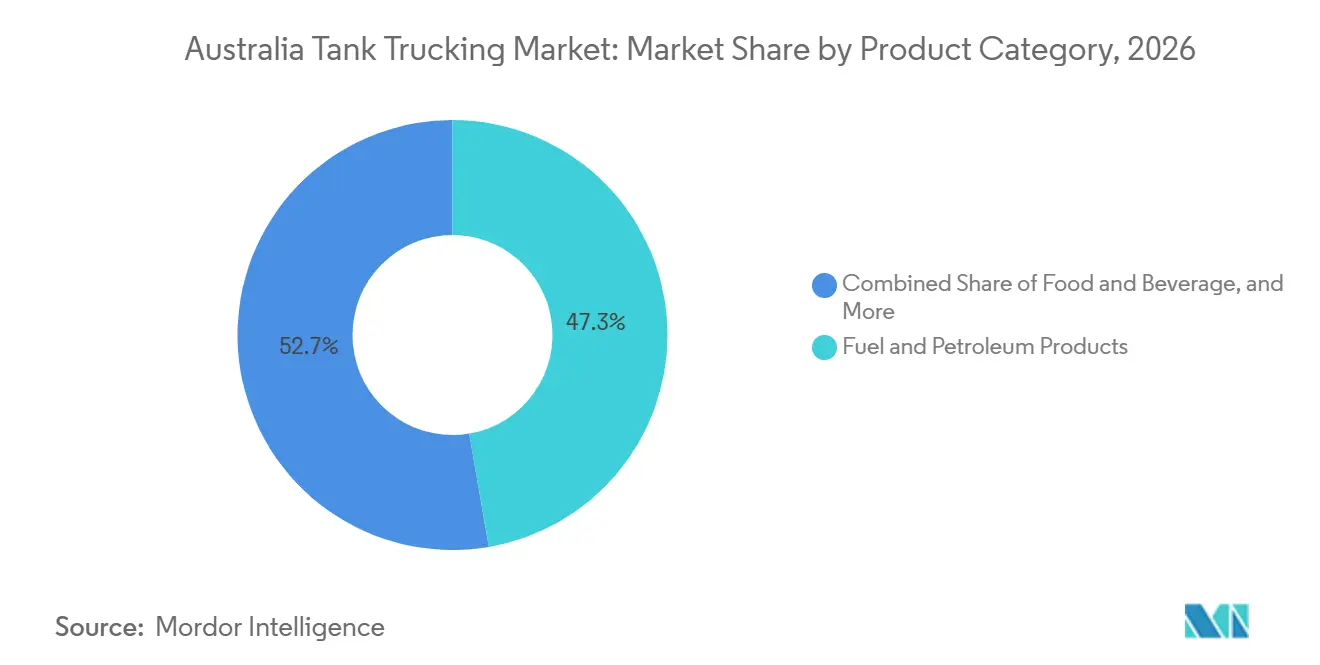
Fuel Leads While Food-Grade Transport ExpandsFuel and petroleum products held 47.31% of the Australia tank trucking market share in 2026. Service-station replenishment, mine-site refueling, and terminal-to-customer deliveries support this category. Long distances between supply points and end users keep road transport central to petroleum distribution. Crude petroleum, chemicals, dangerous goods, and water require different tank specifications and operating procedures. Food and beverage provide a growing specialized liquid-transport task.
Food and beverage are forecast to register a 5.05% CAGR through 2032, reinforcing the importance of dedicated equipment that cannot readily be used for fuel or industrial chemical loads. Food safety requirements call for controlled cleaning and purpose-built food transport assets. Water and wastewater work provides recurring demand from municipal, industrial, and remote-site customers. Potable water delivery to remote mines is one part of this task. The Australia tank trucking market can serve these categories through specialized fleets rather than a common tanker model.
By Capacity:
Heavy-Duty Fleets Hold Revenue While Light-Duty Fleets GrowHeavy-duty vehicles accounted for 52.36% of Australia tank trucking market size in 2026. Their position reflects high volumes moved on long-distance fuel and chemical routes. Road trains and B-double combinations are used where payloads, access conditions, and delivery points allow. Medium-duty fleets serve regional depots, agricultural chemical deliveries, and shorter dairy collection work. Light-duty capacity serves more constrained urban and local delivery tasks.
Light-duty vehicles are forecast to register a 4.66% CAGR through 2032 as customers require smaller, more frequent deliveries. Heavy-duty equipment remains important because remote corridors favor high-volume loads. Urban restrictions and constrained loading locations can limit the use of larger configurations. Higher-mass operations may require telematics participation in New South Wales and Queensland. These requirements can favor operators that can demonstrate compliant fleet operations.
By Distance:
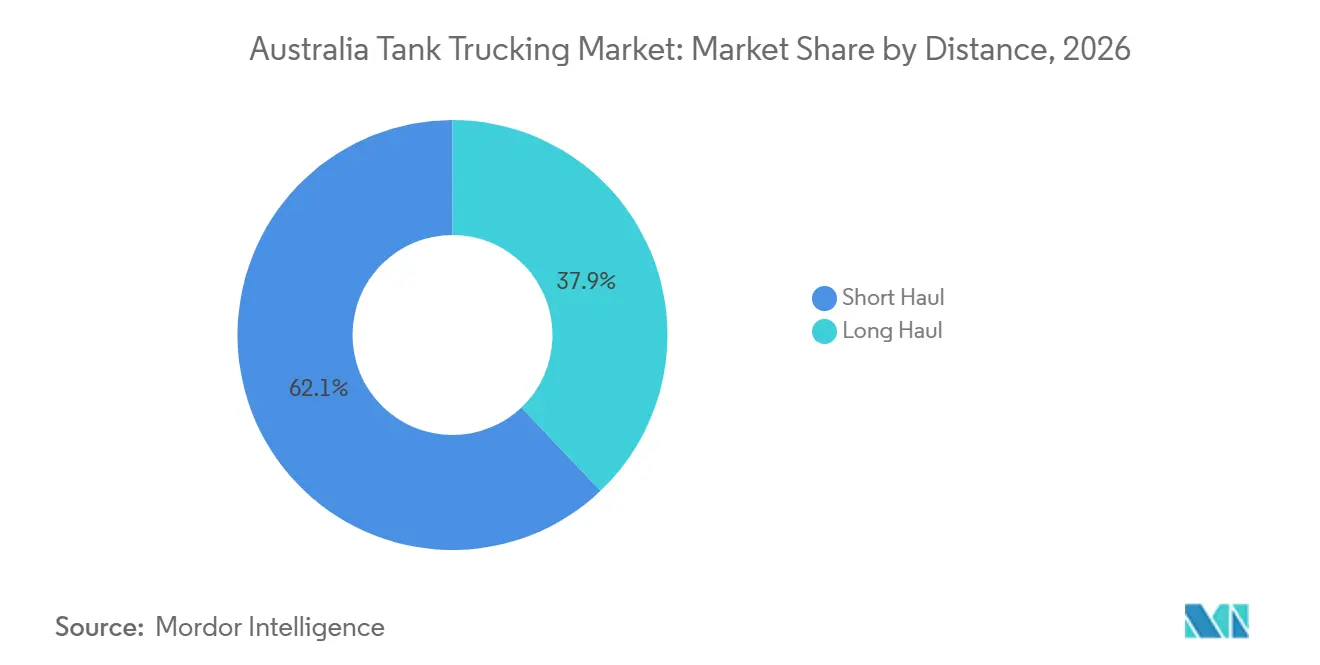
Short Haul Holds the Largest Revenue Base While Long Haul AdvancesShort-haul work held 62.08% of revenue in 2026. Metropolitan fuel distribution, dairy collection, and chemical cycles support frequent shorter trips. These routes can allow multiple daily loads and predictable vehicle scheduling. Operators near major population centers and industrial districts benefit from this recurring work. Long haul serves interstate routes, remote mine supply, and resource-related freight corridors.
The Australia tank trucking market size for long-haul transport is forecast to register a 4.39% CAGR through 2032. Long-distance operations need equipment and planning suited to remote conditions. PBS combinations can improve payload performance on approved routes. Multi-compartment tankers can reduce empty return journeys where product controls allow. The Australia tank trucking industry needs both high-frequency urban transport and longer-distance specialist supply work.
Geography Analysis
Western Australia held 30.03% of the Australia tank trucking market share in 2026. Iron ore, gold, nickel, and lithium operations support recurring fuel and chemical deliveries. The Pilbara, Goldfields, and Kimberley depend on road logistics for many remote supply tasks. Limited pipeline coverage keeps tanker delivery central to the state’s bulk-liquid supply chain.
Queensland is forecast to register a 5.41% CAGR through 2032. Coal activity, mineral projects, and a diverse food supply chain provide several sources of demand. The Bowen and Galilee Basin corridors need fuel and chemical delivery to mine-support facilities. Operators are investing in logistics infrastructure near demand centers across the state. The Australia tank trucking market in Queensland faced diesel price exposure, with Brisbane diesel at USD 1.86 (USD 1.25) per liter in the September 2025 quarter.
New South Wales and Victoria are dense urban markets for fuel, dairy, and food-grade beverage transport. These states depend on high-frequency trips across constrained road networks. South Australia provides links to eastern and southern freight corridors. Tasmania has specialized food and beverage transport needs. The Northern Territory and the Australian Capital Territory require accredited operators for remote fuel and compliance-intensive chemical distribution work.
Competitive Landscape
The Australia tank trucking market is moderately fragmented. National carriers and regional specialists compete by product, capacity, and corridor. No operator is identified as holding a dominant position across every product category. Larger carriers can combine broader licenses, depot networks, and telematics capabilities. Smaller operators can compete through local relationships, specialized routes, and product expertise.
Leading carriers are adding hazardous cargo capability, storage capacity, and terminal infrastructure to expand service coverage. These moves show the value of assets and network coverage near demand centers. Certified food-grade fleets can serve tasks that petroleum carriers cannot take on without fleet changes. Depot investment can also improve proximity to fuel terminals, processors, and chemical production sites. Operators that align fleet capability with local demand can improve service reliability and asset utilization.
Telematics supports visible compliance records in higher-mass operations. Operators need to demonstrate dangerous-goods, food safety, and fatigue-management compliance. PBS approval can create an advantage on suitable long-haul routes. Road-train access conditions can also affect which equipment is viable on particular routes. Competitive conditions depend on combining fleet productivity with consistent regulatory compliance.
Australia Tank Trucking Industry Leaders
-
Friesian Pty Ltd (McColl’s Transport)
-
Hills Tankers
-
JLP Australia
-
DGL Group Limited
-
Booth Transport
- *Disclaimer: Major Players sorted in no particular order
Australia Tank Trucking Market Companies Covered in this Report
- Friesian Pty Ltd (McColl’s Transport)
- Hills Tankers
- JLP Australia
- DGL Group Limited
- Booth Transport
- Centurion Transport
- Coogee Chemicals
- Ron Finemore Transport
- Emerald Carrying Company
- Mitchell Corporation
- Atlas Fuel Australia
- Refuelling Solutions
- Varley Transport
- Shackell Transport
- SRH Milk Haulage
- Reeve Bulk Food Transport
- 7R Logistics
- AAW Bulk Liquid Logistics
- Kemsea Services International
- Unanderra Tanker Hire Pty Ltd
Recent Industry Developments in Australia Tank Trucking Market
- August 2026: The NHVR implemented updates to the PBS Scheme following the Heavy Vehicle National Law Amendment Bill 2025, expanding authorized operating conditions for PBS tanker combinations and revising the 16 vehicle performance standards. The changes broaden access for high-productivity tank configurations across approved national road networks, reducing permit lead times for operators transitioning to PBS B-double and A-double tankers.
- May 2026: Ron Finemore Transport took delivery of Australia’s first Mercedes-Benz Actros L with ProCabin from Daimler Trucks Albury, a vehicle incorporating advanced driver assistance systems, improved fuel efficiency, and a reduced emissions profile. The deployment reflects the company’s strategy to operate one of the country’s most modern bulk liquids and food transport fleets, with a focus on safety standards and operational cost reduction.
- December 2025: K&S Corporation completed major upgrades to its Coopers Plains, Brisbane, facility, adding a new dangerous goods storage yard and increased container storage and handling capability. Simultaneously, construction of a new purpose-built terminal in Townsville commenced, with the facility targeted for completion by the end of H2 2026 to expand Queensland bulk logistics capacity.
- May 2025: Hills Tankers opened its first South Australian depot in Dry Creek, Adelaide, seven months ahead of schedule, following a new contract with Viva Energy and OTR. The depot extends the carrier’s fuel distribution network across the eastern and southern freight corridors, supported by a Beresfield head-office scheduling model.
Australia Tank Trucking Market Report Scope
Segmentation Overview
| Crude Petroleum |
| Fuel and Petroleum Products |
| Chemicals and Dangerous Goods |
| Food and Beverage |
| Water and Wastewater |
| Other Product Categories |
| Light Duty |
| Medium Duty |
| Heavy Duty |
| Long Haul |
| Short Haul |
| New South Wales |
| Victoria |
| Queensland |
| Western Australia |
| South Australia |
| Tasmania |
| Northern Territory |
| Australian Capital Territory |
| By Product Category | Crude Petroleum |
| Fuel and Petroleum Products | |
| Chemicals and Dangerous Goods | |
| Food and Beverage | |
| Water and Wastewater | |
| Other Product Categories | |
| By Capacity | Light Duty |
| Medium Duty | |
| Heavy Duty | |
| By Distance | Long Haul |
| Short Haul | |
| By Geography | New South Wales |
| Victoria | |
| Queensland | |
| Western Australia | |
| South Australia | |
| Tasmania | |
| Northern Territory | |
| Australian Capital Territory |
Key Questions Answered in the Report
What is the projected size of Australia’s tank trucking sector?
The sector is projected to increase from USD 4.61 billion in 2027 to USD 5.63 billion by 2032, at a 4.08% CAGR. The forecast reflects demand for road delivery of fuel, chemicals, food-grade liquids, and water.
Which cargo category has the largest role in Australia’s tank trucking sector?
Fuel and petroleum products held 47.31% of revenue in 2026. The category is supported by service-station replenishment, downstream distribution, and mine-site refueling.
Which segment is expected to grow fastest by product category?
Food and beverage are expected to register a 5.05% CAGR through 2032. Dedicated dairy collection and food-grade tanker requirements support this growth.
Why are PBS tankers important for Australian liquid transport?
PBS vehicles can improve payload productivity on approved routes. They also operate under safety and performance requirements overseen by the NHVR.
Which Australian state is expected to grow fastest for tank trucking services?
Queensland is forecast to register a 5.41% CAGR through 2032. Mining, agriculture, and related logistics requirements support the state’s outlook.
What are the main operational constraints for tanker operators?
Qualified driver shortages, fatigue obligations, diesel cost volatility, and access requirements can limit fleet expansion. They can also place pressure on fixed-rate transport contracts.