
Australia Robotic Lawn Mower Market Size and Share
Market Overview
| Study Period | 2021 - 2031 |
|---|---|
| Forecast Data Period | 2026 - 2031 |
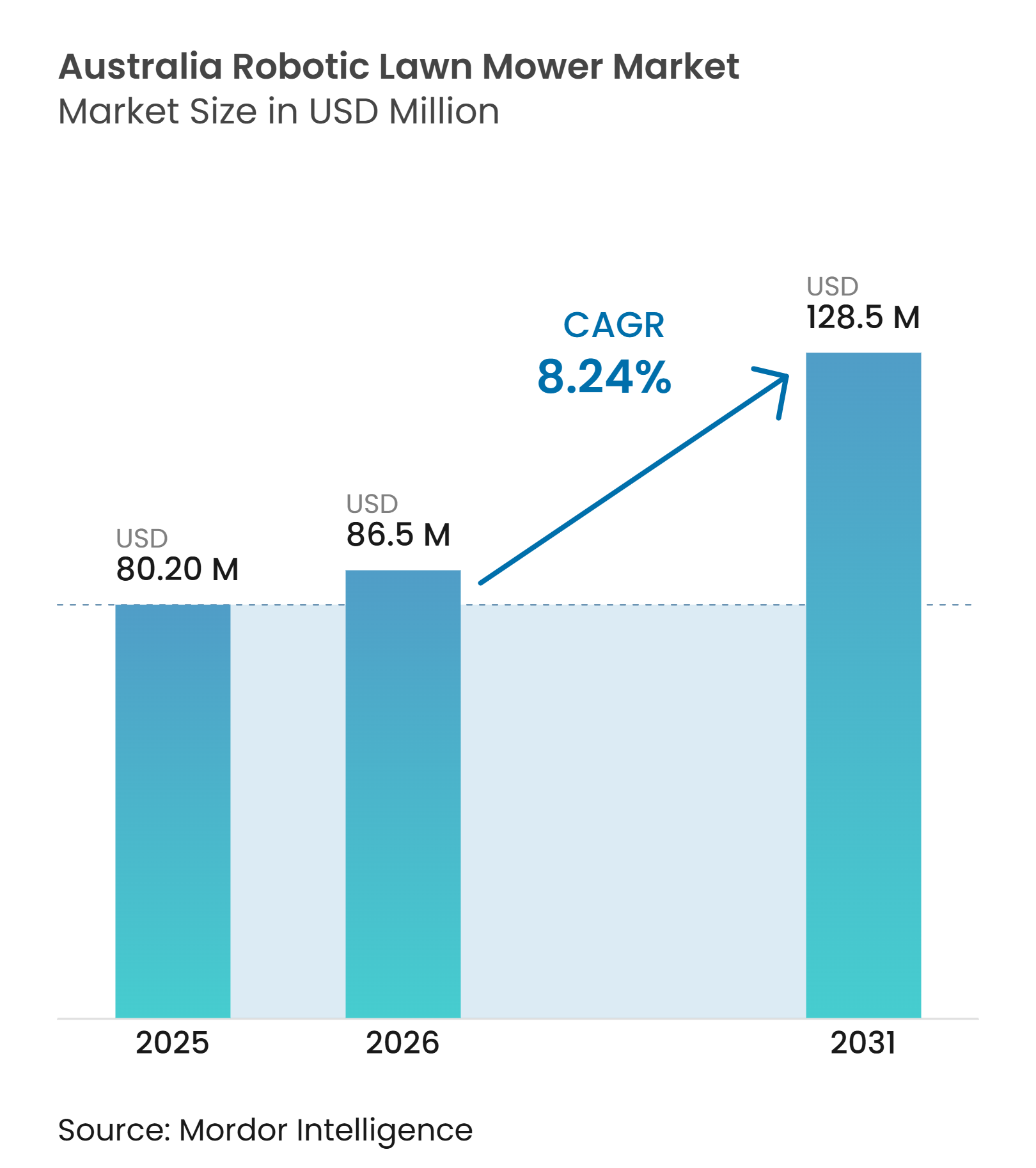
| Base Year Market Size (2025) | USD 80.20 Million |
| Market Size (2026) | USD 86.5 Million |
| Market Size (2031) | USD 128.5 Million |
| Growth Rate (2026 - 2031) | 8.24 % |
| Market Concentration | Medium |
Major Players *Disclaimer: Major Players sorted in no particular order Image © Mordor Intelligence. Reuse requires attribution under CC BY 4.0. | |
Australia Robotic Lawn Mower Market Analysis by Mordor Intelligence
The Australia robotic lawn mower market size was valued at USD 80.2 million in 2025 and is estimated at USD 86.5 million in 2026, reaching USD 128.5 million by 2031, and is forecast to grow at a CAGR of 8.2% from 2026 to 2031. Labor shortages in grounds maintenance strengthen the case for equipment that can perform routine cutting without continuous operator time. The December 2024 Core Skills Occupation List included landscape gardeners and irrigation technicians among shortage occupations, which supports the relevance of labor-saving equipment for professional turf users. Household spending on outdoor spaces and stronger online purchasing activity provide a base for residential demand, while commercial users are assessing fleet deployment and service support.
Key Report Takeaways
- By range, Low Range was the largest category with 52.2% of the Australia robotic lawn mower market share in 2025, while High Range is forecast to grow at a CAGR of 10.5% from 2026 to 2031.
- By battery capacity, 20 to 30 V was the largest category with 55.9% of revenue in 2025, while More Than 30 V is forecast to grow at a CAGR of 13.8% from 2026 to 2031.
- By sales channel, retailers were the largest category with 39.3% of revenue in 2025, while Online is forecast to grow at a CAGR of 12.5% from 2026 to 2031.
- By application, Residential was the largest category with 56.4% of revenue in 2025, while Commercial is forecast to grow at a CAGR of 11.3% from 2026 to 2031.
- By end-user, Homeowners were the largest category with 51.1% of revenue in 2025, while Sports Grounds and Parks a forecast to grow at the fastest CAGR of 13.1% from 2026 to 2031.
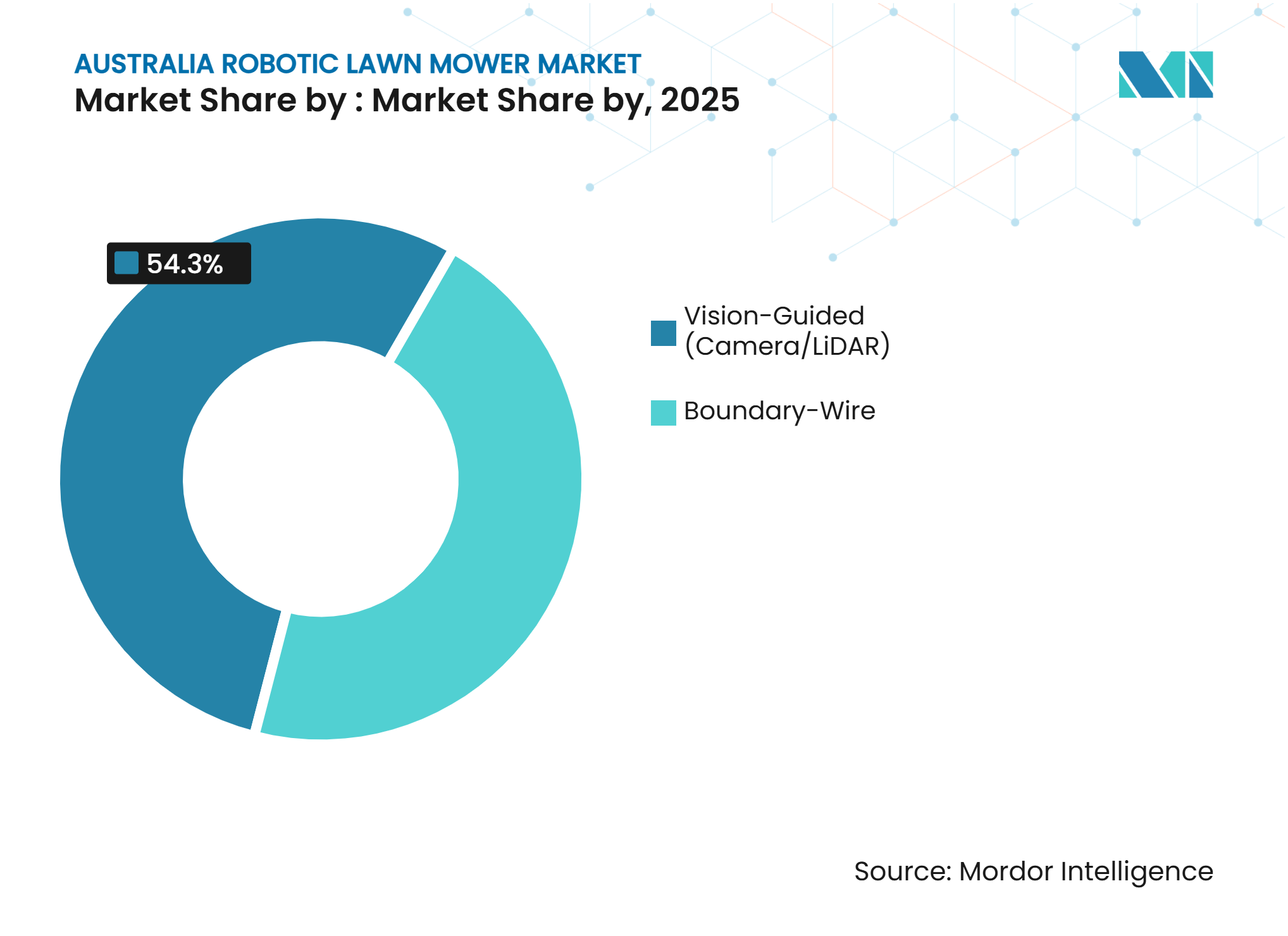
- By connectivity, Boundary-Wire was the largest category with 45.7% of revenue in 2025, while Vision-Guided systems are forecast to grow at the fastest CAGR of 15.5% from 2026 to 2031.
Note: Market size and forecast figures in this report are generated using Mordor Intelligence’s proprietary estimation framework, updated with the latest available data and insights as of January 2026.
Market Trends and Insights
Drivers Impact Analysis of Australia Robotic Lawn Mower Market*
| Driver | (~) % Impact on CAGR Forecast | Geographic Relevance | Impact Timeline |
|---|---|---|---|
| Labor shortages and rising turf-maintenance costs | +2.1% | National, strongest in metropolitan and peri-urban turf operations, golf corridors, sports facilities across New South Wales, Victoria, and Queensland | Short term (≤ 2 years) |
| Residential convenience and Australia’s outdoor-living culture | +1.8% | National, with capital cities and outer suburbs driving volume | Short term (≤ 2 years) |
| Expansion into commercial turf and public-garden applications | +1.5% | National, with early activity in east-coast golf, sports grounds, and council properties | Medium term (2-4 years) |
| Demand for quiet, low-emission lawn maintenance | +1.4% | National, with the strongest near-term effect in metropolitan areas with varied suburban lot profiles | Medium term (2-4 years) |
| Wire-free navigation improving suitability for Australian lawns | +1.2% | National, with capital cities leading and regional demand supported by online channels | Short term (≤ 2 years) |
| Falling early-adopter premiums and broader retail availability | +1.0% | Urban and suburban councils in New South Wales, Victoria, and South Australia | Medium term (2-4 years) |
| Source: Mordor Intelligence | |||
Labor Shortages and Rising Turf-Maintenance Costs
The Australia robotic lawn mower market is supported by persistent difficulty in hiring personnel for routine turf work. The Australian Government placed landscape gardeners and irrigation technicians on the December 2024 Core Skills Occupation List[1]. Golf courses, parks, and sports venues need mowing completed on fixed schedules despite staffing constraints. Autonomous equipment can move repetitive cutting work away from grounds teams, allowing them to focus on irrigation, surface preparation, disease management, and plant health. The commercial value is not limited to reduced labor requirements; it can also improve the consistency of maintenance schedules when skilled workers are scarce.
Residential Convenience and Australia’s Outdoor-Living Culture
The residential base remains important to the Australia robotic lawn mower market because outdoor areas are a regular part of household maintenance. In 2025, 5.1 million households purchased home and garden products online, according to Australia Post. That purchasing pattern makes online comparison of product features and prices more relevant to robotic mower sales. Homeowners may value scheduled mowing and reduced time spent on routine lawn work, particularly when garden appearance is part of a property-maintenance decision. Direct online brands can reach this buyer group without relying entirely on physical dealer coverage, although clear product information and support remain important for first-time purchasers.
Expansion into Commercial Turf and Public-Garden Applications
Commercial sites offer a growing segment of the Australia robotic lawn mower market because they often require frequent and consistent cutting. Husqvarna and Nuturf entered a February 2026 partnership to support robotic and battery-powered solutions for Australian professional turf customers. The arrangement links commercial equipment to a local professional-turf distribution network that already serves golf, sports, and municipal environments. Managed turf customers can deploy multiple units and require ongoing installation, service, and technical support. These requirements create a sales model based on equipment availability and continuing operational support rather than a single residential product purchase.
Wire-Free Navigation Improving Suitability for Australian Lawns
Wire-free navigation is expanding the set of properties that can be considered for robotic mowing. MAMMOTION describes its LUBA 3 AWD series as using LiDAR, its NetRTK positioning system, and dual-camera navigation, which is designed to reduce dependence on boundary-wire installation. Such systems may reduce installation work for sites with irregular boundaries, changing lawn layouts, tree cover, or difficult access points. Reliable performance on slopes and around obstacles remains necessary before broader commercial deployment can occur. Products must also maintain a dependable mowing pattern when the property changes throughout the year.
Restraints Impact Analysis of Australia Robotic Lawn Mower Market*
| Restraint | (~) % Impact on CAGR Forecast | Geographic Relevance | Impact Timeline |
|---|---|---|---|
| High upfront purchase and deployment cost | -1.80% | National, with a stronger effect on outer-suburban residential buyers and small landscaping contractors | Medium term (2-4 years) |
| Lawn-layout, terrain and grass-condition limitations | -1.60% | National, with a stronger effect in Queensland and New South Wales coastal areas and rural properties | Medium term (2-4 years) |
| Dependence on mobile, Wi-Fi and satellite connectivity | -1.10% | Peri-urban, regional, and remote Australia with inconsistent mobile broadband | Long term (≥ 4 years) |
| Battery-safety, reliability and consumer-trust concerns | -0.90% | National, with heightened relevance for commercial buyers and unattended operation | Medium term (2-4 years) |
| Source: Mordor Intelligence | |||
High Upfront Purchase and Deployment Cost
Upfront cost remains a constraint for the Australia robotic lawn mower market, especially where installation or site preparation is required. Buyers may need to assess equipment, charging, mapping, ongoing support, and the cost of service arrangements as part of the decision. Large sites can also require several units, increasing the initial commitment and placing greater emphasis on procurement planning. Smaller commercial organizations may face longer procurement and budget approval cycles than large facilities, even where recurring labor needs are clear. Adoption can therefore differ across commercial customer groups because the financial and operational requirements of a municipal site, a golf club, and a small contractor differ.
Lawn-Layout, Terrain and Grass-Condition Limitations
Australian lawns can present terrain, grass, and obstacle conditions that not every product can manage effectively. Dense buffalo and kikuyu grass, steep lots, narrow passages, water features, and irregular edges increase the need for suitable cutting and navigation capability. ANKER Innovations lists grass-related operating exclusions for its eufy E15 model, illustrating the need for buyers to match product specifications to site conditions. These conditions can delay purchases until customers have greater confidence in site compatibility, and an installer can set realistic expectations for operation. Buyers may also need to adjust their mowing plan when seasonal grass growth changes the workload.
*Our forecasts treat driver/restraint impacts as directional, not additive. The impact forecasts reflect baseline growth, mix effects, and variable interactions.
Australia Robotic Lawn Mower Market Segment Analysis
By Range:
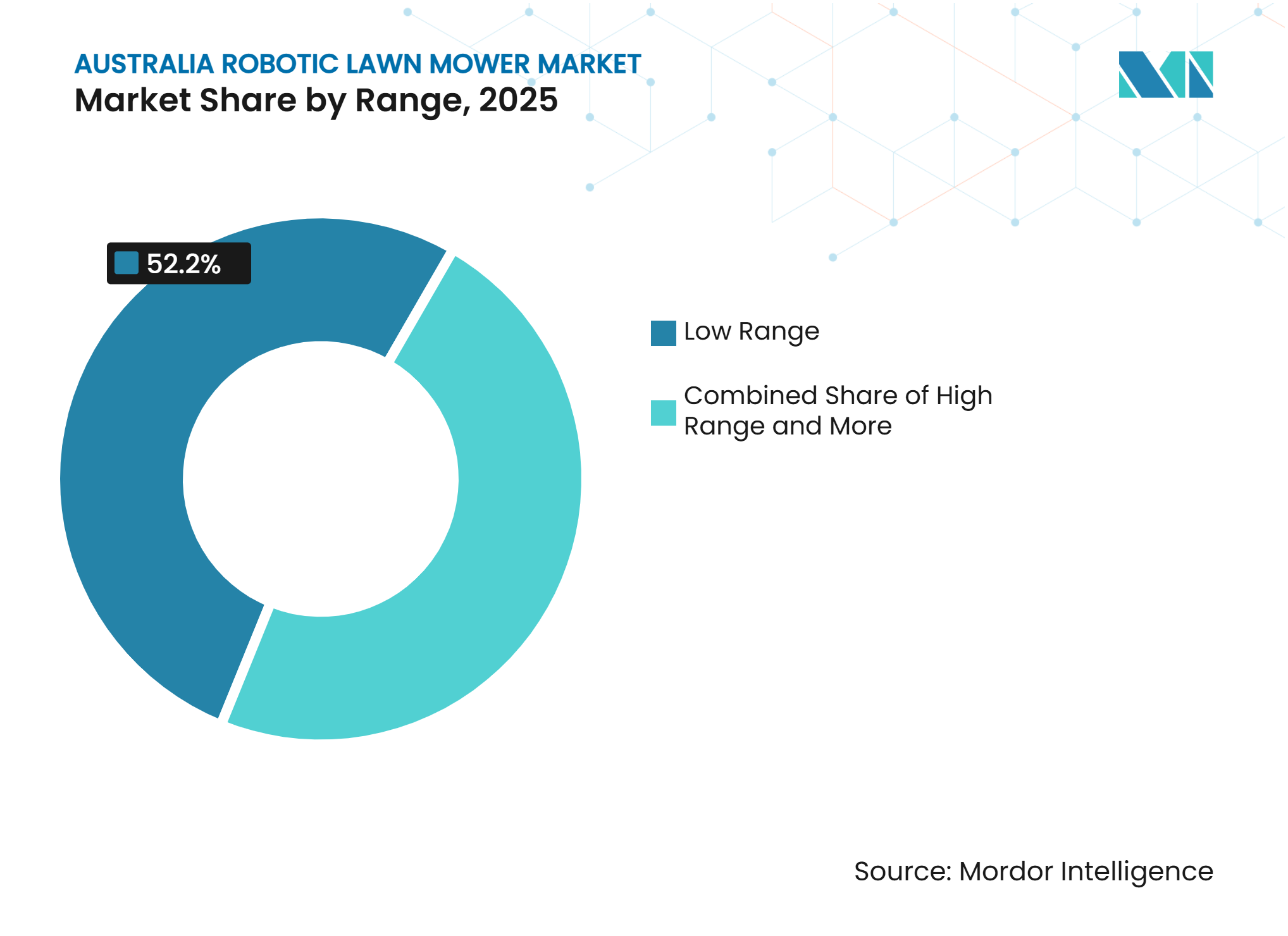
Low Range Leads Residential Demand While High Range Supports Larger SitesLow Range held 52.2% of Australia robotic lawn mower market revenue in 2025, making it the largest range category. These mowers serve homeowners with smaller, defined lawns and relatively simple coverage needs. Buyers in this group usually seek a practical alternative to routine manual mowing. The category supports first-time adoption by offering a lower-complexity entry point. Competition centers on price, basic navigation, warranty coverage, and retailer support.
Medium-range products serve larger suburban lawns and properties with more than 1 mowing area. They offer greater coverage without moving into the highest-capacity equipment tier. High Range is forecast to grow at the fastest CAGR of 10.5% from 2026 to 2031. This tier is relevant to large residential properties, institutional sites, and commercial fleets that need higher capacity and durability. Husqvarna’s iQ series is available in Australia in 2026 for properties up to 5,000 m², while MAMMOTION offers the LUBA 3 AWD in Australia[2].



By Battery Capacity:
Mid-Voltage Products Lead While Higher Voltage Fits Longer Operating CyclesThe 20 to 30 V category held 55.9% of revenue in 2025 and was the largest battery-capacity segment. It aligns with the operating needs of many residential mowers on standard suburban lawns. Less-than-20-V systems are relevant where shorter runtimes and lighter mowing loads meet site needs. Buyers assess these products on coverage, charging convenience, and ease of use. Battery capacity must be considered alongside terrain, grass density, and mowing frequency.
More Than 30 V is forecast to grow at the fastest CAGR of 13.8% from 2026 to 2031. Higher-voltage platforms are relevant for longer operating periods and demanding cutting conditions at managed turf sites. The Australian robotic lawn mower market opportunity in this category is tied to equipment capable of handling commercial workloads. Husqvarna markets commercial solutions for professional turf settings, where equipment use and service needs differ from residential ownership
By Sales Channel:
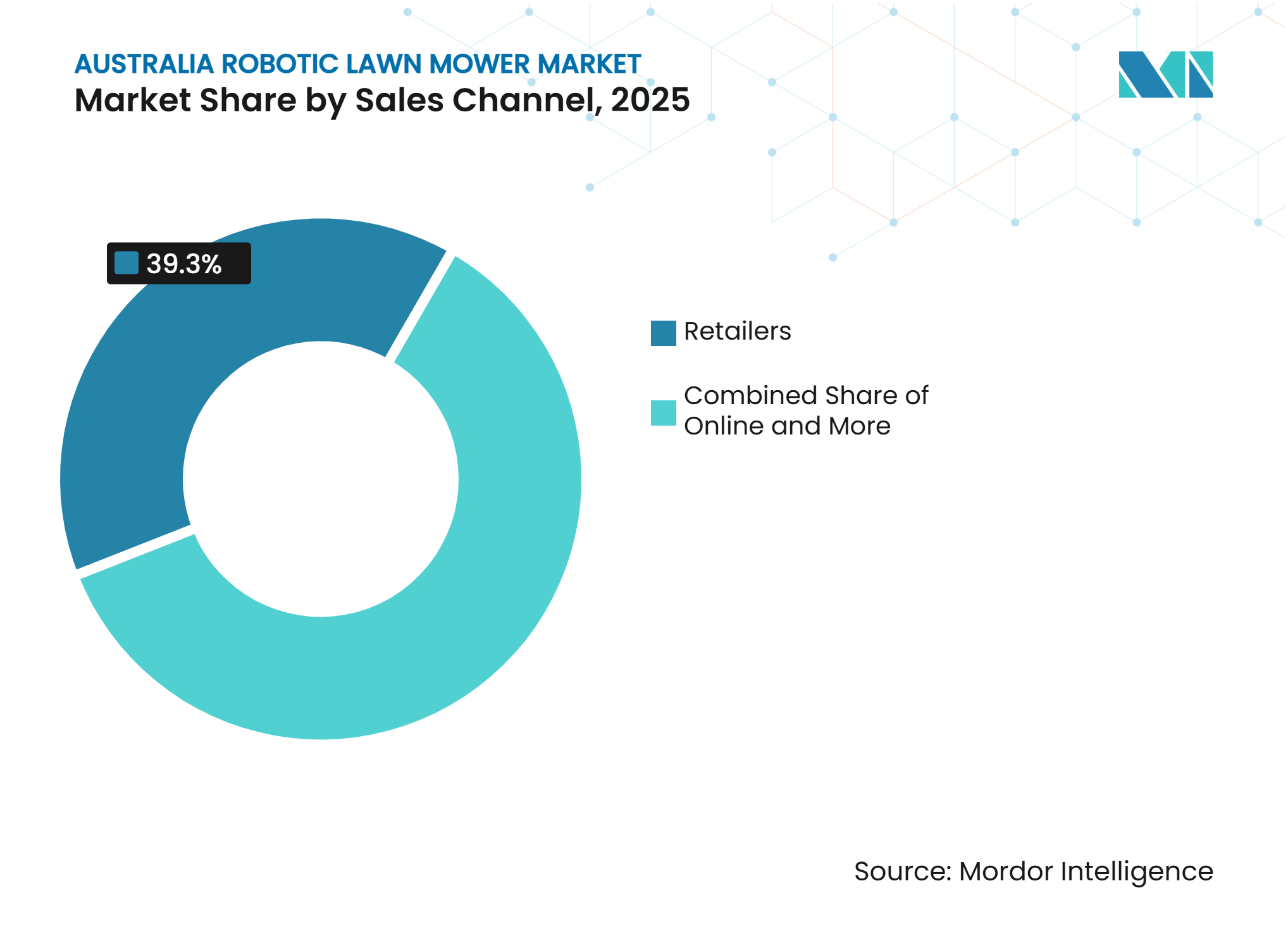
Retailers Lead While Online Sales ExpandRetailers accounted for 39.3% of revenue in 2025 and were the largest sales-channel segment. Physical stores help customers compare models, view demonstrations, and discuss installation. This support is useful for buyers who are unfamiliar with operating autonomous mowers. Retailers also allow customers to discuss lawn conditions before selecting a product. Dealer networks can remain important for installation, repairs, and after-sales assistance.
Specialty Stores serve buyers who need detailed advice on navigation, coverage, site design, or commercial deployment. Online is forecast to grow at the fastest CAGR of 12.5% from 2026 to 2031. In 2025, capital cities accounted for 74% of online home and garden spending, according to Australia Post. Online channels enable customers to compare products across price bands and navigation methods. The Australia robotic lawn mower market benefits when online sales include accessible technical support and service options.

By Application:
Residential Leads While Commercial Use ExpandsResidential represented 56.4% of revenue in 2025 and was the largest application in the Australia robotic lawn mower market. Demand is driven by the convenience of scheduled, automated lawn maintenance. Residential products are visible across metropolitan and suburban areas, with manageable turf. Buyers often focus on price, setup, cutting coverage, and lawn compatibility. These products also need practical obstacle detection and straightforward customer support.
Commercial is forecast to grow at the fastest CAGR of 11.3% from 2026 to 2031. Commercial users treat autonomous mowing as part of a broader grounds-maintenance process. Golf courses, parks, sports grounds, campuses, and resorts may require several units and planned servicing. Husqvarna’s February 2026 partnership with Nuturf targets golf courses, sporting facilities, and municipal environments in Australia. Suppliers that provide installation, training, and responsive service are better placed to meet these needs.
By End-User:
Homeowners Lead While Sports Grounds and Parks Grow FastestHomeowners held 51.1% of end-user revenue in 2025 and were the largest end-user group. Their purchases support demand for smaller and mid-range robotic lawn mowers. Household users generally need products that are simple to operate and suited to predictable lawns. Online research helps them compare navigation methods, coverage claims, and warranty terms. This group supports wide distribution but remains sensitive to cost and site suitability.
Sports Grounds and Parks is forecast to grow at the fastest CAGR of 13.1% from 2026 to 2031. These sites need consistent surface conditions and often follow fixed maintenance schedules. Landscaping Companies can use autonomous mowing to keep staff available for edging, hedging, irrigation checks, and horticultural work. Golf Courses are also important because they maintain large areas of turf on an ongoing basis. The Australia robotic lawn mower industry can benefit when suppliers provide reliable operation and ongoing service support.
By Connectivity:
Boundary-Wire Leads While Vision-Guided Systems Grow FastestBoundary-Wire held 45.7% of revenue in 2025 and was the largest connectivity segment. Its position reflects products already installed through established residential and professional channels. Boundary-wire systems provide predictable perimeter control on lawns with stable layouts. Installation requirements can increase the effort involved in first-time adoption. The category suits buyers who prefer a defined setup process or dealer assistance.
Smart-GPS and Wi-Fi systems serve sites where installing boundary wire is less attractive. Vision-Guided systems are forecast to grow at the fastest CAGR of 15.5% from 2026 to 2031. Husqvarna announced artificial intelligence (AI) vision technology for 7 robotic lawn mowers in March 2026, including products for residential and professional use. Camera and light detection and ranging (LiDAR) systems seek to improve navigation around obstacles where satellite-only performance is limited. Their adoption will depend on reliable operation across lawns with varied grass, tree cover, terrain, and layouts.
Geography Analysis
The Australia robotic lawn mower market has no formal subnational segmentation, although demand differs by state and urban corridor. New South Wales, Victoria, and Queensland have large concentrations of suburban lawns, golf courses, sports facilities, and commercial properties. These conditions support both household purchases and managed-turf applications. Husqvarna’s 2026 activity with Nuturf serves Australian golf, sporting, and municipal customers. Local deployments can reduce uncertainty for nearby professional buyers, but they do not create separate state-level markets.
Queensland has year-round lawn-maintenance needs that can be supported by autonomous cutting. Dense buffalo and kikuyu grass can also increase demands on cutting performance and navigation. MAMMOTION states that its LUBA 3 AWD is designed for slopes up to 80%, which is relevant to uneven residential sites. Product choice depends on grass conditions, slope, and obstacles. New South Wales and Victoria also offer commercial opportunities where turf quality and operating schedules matter.
Western Australia and South Australia are served through retailers, dealers, and online sales. Australia Post reported online home and garden purchasing activity in inner regional areas during 2025. This gives suppliers a route to areas with fewer specialist outlets. Peri-urban and remote locations may have weaker mobile, Wi-Fi, or satellite connectivity. These conditions can limit wire-free systems on large semi-rural properties. The Australian Communications and Media Authority manages spectrum policy relevant to wireless services. Buyers still need a site-level assessment of signal stability, tree cover, property scale, and support availability.
Competitive Landscape
Market Concentration
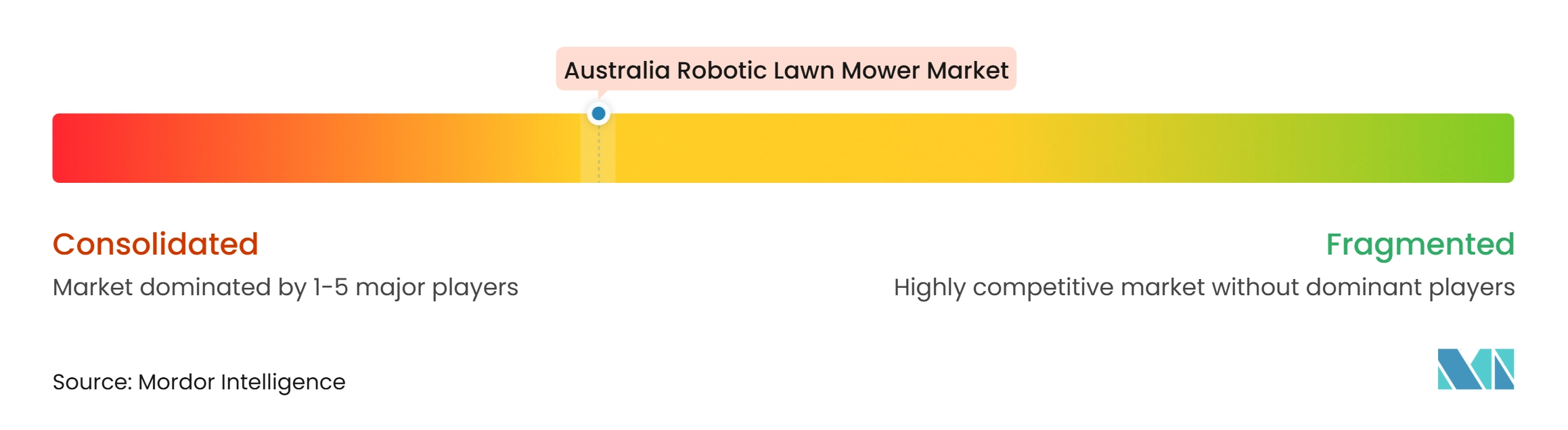
The Australia robotic lawn mower market includes established dealer-led suppliers and newer wire-free brands. Husqvarna has a strong position in professional and dealer-led channels. Its Australian portfolio includes Automower products and professional CEORA and EPOS solutions for managed turf sites. STIHL, Positec Group Ltd., Navimow, MAMMOTION, ANKER INNOVATIONS AUSTRALIA PTY LTD, Sunseeker, Zucchetti Centro Sistemi S.p.a., FJDYNAMICS PTE.LTD., YAMABIKO Corporation, Spacewalker Technology Hong Kong Co., Limited, ECOVACS, AL-KO Geräte GmbH, Roborock Technology (Shanghai) Co., Ltd., and HOOKII All are also included in the company universe. No validated company-share data is available for the leading suppliers.
Husqvarna and Nuturf formed a partnership in February 2026 to expand commercial robotic and battery-powered solutions for professional turf customers[3]. Husqvarna Group announced AI Vision technology in March 2026 for 7 robotic lawn mowers, including a commercial Automower 540 EPOS configuration. MAMMOTION published an Australian update on its LUBA 3 AWD series in June 2026. These moves combine product development with broader access to commercial or direct online customers. Installation support and reliable operation can influence supplier selection alongside product specifications.
The competitive field includes boundary-wire products and newer wire-free systems. Boundary-wire suppliers retain relevance where installation and servicing are already part of the sales process. Wire-free suppliers seek to reduce setup work through cameras, LiDAR, satellite positioning, and software. Product safety is also important because the Australian Competition and Consumer Commission administers consumer product-safety obligations and recalls. Suppliers must address battery safety, warranty support, and customer trust alongside mowing performance.
Australia Robotic Lawn Mower Industry Leaders
-
Husqvarna AB
-
Positec Group Ltd.
-
STIHL Pty Ltd
-
Navimow
-
MAMMOTION
- *Disclaimer: Major Players sorted in no particular order
Australia Robotic Lawn Mower Market Companies Covered in this Report
- Husqvarna AB
- STIHL Pty Ltd
- Positec Group Ltd.
- Navimow
- MAMMOTION
- ANKER INNOVATIONS AUSTRALIA PTY LTD
- Sunseeker
- Zucchetti Centro Sistemi S.p.a.
- FJDYNAMICS PTE.LTD.
- YAMABIKO Corporation (Belrobotics)
- Spacewalker Technology Hong Kong Co., Limited(Mova Tech Australia)
- ECOVACS
- AL-KO Geräte GmbH
- Roborock Technology (Shanghai) Co., Ltd.
- HOOKII All
Recent Industry Developments in Australia Robotic Lawn Mower Market
- March 2026: Husqvarna Group announced AI Vision integration across seven new robotic lawn mowers globally, including the commercial-grade Automower 540 EPOS for sites up to 8,000 m², with a camera accessory extending vision capability to previously launched EPOS models.
- February 2026: Husqvarna AB and Nuturf formalized a commercial partnership to advance robotic and battery-powered solutions across Australian golf courses, elite sporting facilities, and municipal environments.
- June 2026: MAMMOTION published an Australian update on the LUBA 3 AWD series, describing its LiDAR, NetRTK, and dual-camera navigation approach.
Australia Robotic Lawn Mower Market Report Scope
A robotic lawn mower is an autonomous device equipped with sensors and programming to perform grass-cutting tasks without human intervention. These are used for residential and commercial purposes by homeowners, apartment owners, in parks and playgrounds, and in other places.
The Europe Robotic Lawn Mower Market Report is Segmented by Range (Low Range, Medium Range, and High Range), by Battery Capacity (Less Than 20 V, 20 to 30 V, and More Than 30 V), by Sales Channel (Retailers, Specialty Stores and Online), by Application (Residential and Commercial), by End-User (Homeowners, Landscaping Companies, Sports Grounds and Parks, Municipalities, Golf Courses and Others), and by Connectivity (Boundary-Wire, Smart-GPS / Wi-Fi and Vision-Guided). The Market Forecasts are Provided in Terms of Value (USD).
Segmentation Overview
| Low Range |
| Medium Range |
| High Range |
| Less Than 20 V |
| 20 to 30 V |
| More Than 30 V |
| Retailers |
| Specialty Stores |
| Online |
| Residential |
| Commercial |
| Homeowners |
| Landscaping Companies |
| Sports Grounds and Parks |
| Municipalities |
| Golf Courses |
| Others |
| Boundary-Wire |
| Smart-GPS / Wi-Fi |
| Vision-Guided (Camera/LiDAR) |
| By Range | Low Range |
| Medium Range | |
| High Range | |
| By Battery Capacity | Less Than 20 V |
| 20 to 30 V | |
| More Than 30 V | |
| By Sales Channel | Retailers |
| Specialty Stores | |
| Online | |
| By Application | Residential |
| Commercial | |
| By End-User | Homeowners |
| Landscaping Companies | |
| Sports Grounds and Parks | |
| Municipalities | |
| Golf Courses | |
| Others | |
| By Connectivity | Boundary-Wire |
| Smart-GPS / Wi-Fi | |
| Vision-Guided (Camera/LiDAR) |
Key Questions Answered in the Report
What is driving demand for robotic lawn mowers in Australia?
Labor shortages, homeowner convenience, commercial turf needs, and wire-free navigation are supporting demand.
How large is Australia’s robotic lawn mower sector?
The sector is estimated at USD 86.5 million in 2026 and is forecast to reach USD 128.5 million by 2031.
Which users are adopting robotic lawn mowers most quickly?
Sports Grounds and Parks is forecast to grow at the fastest CAGR of 13.1% from 2026 to 2031.
What should commercial buyers assess before purchasing a robotic mower?
Commercial buyers should assess site conditions, navigation reliability, service coverage, battery safety, and deployment cost.