
Australia Project Logistics Market Size and Share
Market Overview
| Study Period | 2020 - 2031 |
|---|---|
| Forecast Data Period | 2026 - 2031 |
| Base Year Market Size (2025) | USD 7.44 Billion |
| Market Size (2026) | USD 7.88 Billion |
| Market Size (2031) | USD 10.27 Billion |
| Growth Rate (2026 - 2031) | 5.52 % |
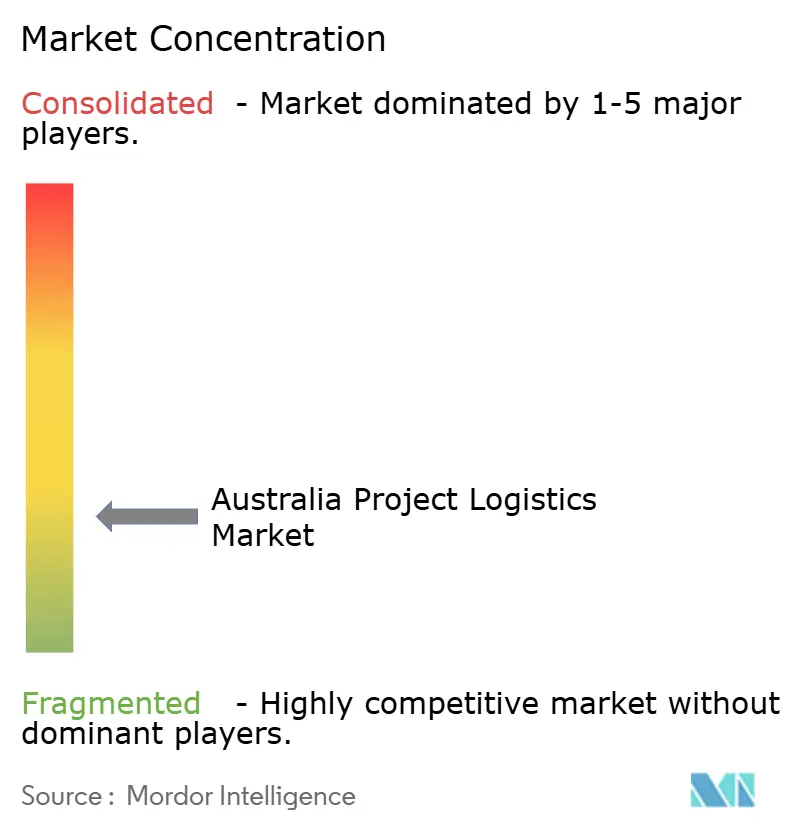
| Market Concentration | Low |
Major Players
*Disclaimer: Major Players sorted in no particular order Image © Mordor Intelligence. Reuse requires attribution under CC BY 4.0. |
|
Australia Project Logistics Market Analysis by Mordor Intelligence
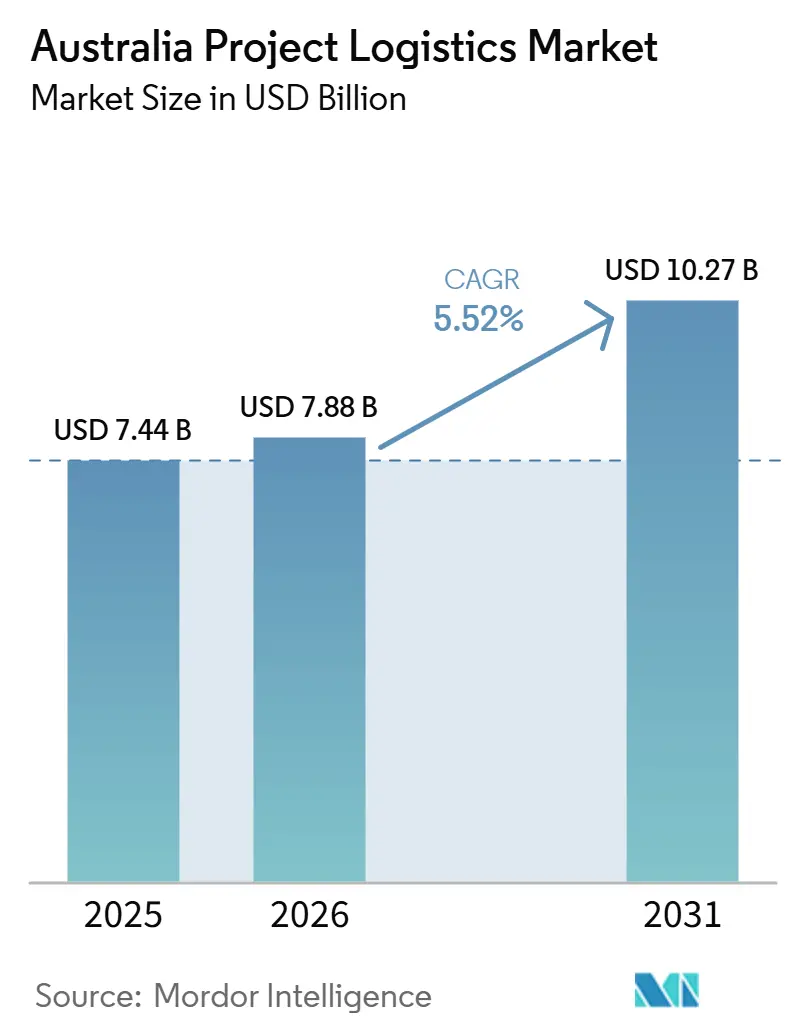
The Australia project logistics market size is expected to grow from USD 7.44 billion in 2025 to USD 7.88 billion in 2026 and is forecast to reach USD 10.27 billion by 2031 at 5.52% CAGR over 2026-2031.
The Australia project logistics market is being supported by resource investment, decarbonization-linked infrastructure, and steady demand for specialist transport across remote corridors. Australia’s public infrastructure pipeline reached AUD 242 billion (USD 162.17 billion) over the five years to 2028-29, and transmission projects are projected to more than double to AUD 36 billion (USD 24.12 billion) in the same period. This project mix is expanding freight demand beyond traditional mining corridors and creating more work in route engineering, sequencing, and multimodal execution. Western Australia remains the main operating center, Queensland stays the second cluster, and New South Wales is gaining relevance as renewable energy corridors take shape. The Australia project logistics market still faces labor shortages, permit friction, and commodity-linked capital discipline, but providers with early engineering engagement and specialist teams are better placed to defend margins and win complex scopes[1]"2025 Infrastructure Market Capacity Report." Infrastructure Australia. infrastructure. australia.gov.au/publications/2025.
Key Report Takeaways
- By service, transportation led with a 60.66% share of the Australia project logistics market size in 2025, while value-added services and others are forecast to expand at a 6.33% CAGR through 2031.
- By cargo type, oversized cargo accounted for 30.94% of the Australia project logistics market share in 2025, while heavy-lift cargo is projected to grow at the fastest 5.92% CAGR through 2031.
- By end-user industry, oil and gas, mining, and quarrying accounted for 24.53% of the Australia project logistics market size in 2025, while energy generation and transmission is expected to record the fastest 6.14% CAGR through 2031.
Note: Market size and forecast figures in this report are generated using Mordor Intelligence’s proprietary estimation framework, updated with the latest available data and insights as of January 2026.
Australia Project Logistics Market Trends and Insights
Drivers Impact Analysis*
| Driver | (~) % Impact on CAGR Forecast | Geographic Relevance | Impact Timeline |
|---|---|---|---|
| Mining and Energy Project Pipelines Requiring Oversized and Critical Cargo Movement | +1.5% | Western Australia, Queensland, Northern Territory | Short term (≤ 2 years) |
| Renewable Grid Buildout and Transmission Equipment Relocation Needs | +1.3% | New South Wales REZ corridors, Victoria, South Australia, Western Australia | Medium term (2-4 years) |
| Port, Rail, and Intermodal Capacity Upgrades Improving Project Cargo Reach | +0.9% | National, with gains at Port Hedland, Port of Townsville, Port of Newcastle, and Somerton | Medium term (2-4 years) |
| Remote-Area Project Execution Driving Outsourced Heavy Haul and Lifting Services | +0.7% | Western Australia, Queensland | Short term (≤ 2 years) |
| Decarbonization Reporting and Route Optimization Pressuring Integrated Logistics Planning | +0.4% | National | Long term (≥ 4 years) |
| Skilled Labor Scarcity in Craneage, Rigging, and Escort Operations Increasing Reliance on Specialists | +0.2% | Western Australia, Queensland, with spillover to New South Wales and Northern Territory | Short term (≤ 2 years) |
| Source: Mordor Intelligence | |||
Mining and Energy Project Pipelines Drive Cargo Volumes
Mining and energy projects continue to generate the deepest cargo pool in the Australia project logistics market because they combine high asset values with difficult site access. Demand is tied to construction, shutdown, and capacity work across iron ore, gas, copper, and lithium operations. Woodside reported that the Scarborough floating production unit, weighing 70,000 tonnes, arrived off Karratha in January 2026 after a tow of more than 4,000 nautical miles from China. Woodside also stated that 51 Pluto Train 2 modules totaling 56,000 metric tonnes were delivered to Karratha between February 2024 and 2025. Projects of this scale raise the minimum technical threshold for carriers, because remote delivery windows, marine interfaces, and site constraints leave little room for generic transport capability. That dynamic supports operators that can combine engineered lifting, corridor planning, and long-haul execution across Australia’s resource regions.
Renewable Grid Buildout Creates a Parallel, Durable Cargo Stream
Renewable grid buildout is creating a second, long-duration demand stream for the Australia project logistics market and reducing dependence on a single project cycle. Infrastructure Australia reported that energy transmission projects within the national infrastructure pipeline are projected to rise to AUD 36 billion (USD 24.12 billion) over the five years to 2028-29. This buildout is increasing the movement of transformers, tower sections, and other oversized equipment into previously less active inland corridors. It is also redistributing freight flows toward states where renewable generation and grid reinforcement are moving from planning into delivery. As component dimensions increase, route surveys, bridge assessments, and staging plans become more central to project design rather than a late procurement task. The result is a more diversified opportunity base for the Australia project logistics market across mining, utilities, and renewable energy-linked civil works.
Port, Rail, and Intermodal Capacity Upgrades Expand Project Cargo Reach
Port, rail, and intermodal upgrades are expanding the physical reach of the Australia project logistics market and enabling larger cargo to be consolidated before final delivery. The Beveridge Intermodal Precinct in Melbourne’s north is under construction and is targeting initial rail terminal operations in mid-2028 with 200,000 TEU annual capacity. Additional intermodal capacity reduces reliance on pure road delivery for recurring heavy cargo streams and improves inland positioning options. It also helps providers stage project equipment closer to installation windows, thereby reducing idle time and pressure on port-side storage. Better multimodal infrastructure should gradually broaden the set of routes that can support large industrial cargo without excessive corridor risk. This supports a more competitive operating environment in the Australia project logistics market for providers that can integrate rail, road, and port handling into one plan.
Remote-Area Project Execution Demands Specialist Outsourced Logistics
Remote project execution is pushing more cargo owners and EPC contractors toward specialist outsourcing in the Australia project logistics market. Long inland distances, difficult road conditions, and tight construction schedules make transport errors far more expensive than standard freight overruns. Infrastructure Australia projected a shortfall of 141,000 workers needed to deliver the five-year public infrastructure pipeline, with acute pressure in specialist trades that overlap with heavy logistics activity. That labor gap makes it harder for project owners to self-manage complex lifting, escort coordination, and remote corridor planning. It also strengthens the position of operators that engage during front-end engineering and design, because early route planning can prevent schedule losses later in execution. Over time, this favors providers that bring workforce depth, engineered methods, and remote-area operating discipline to the Australia project logistics market.
Restraints Impact Analysis*
| Restraint | (~) % Impact on CAGR Forecast | Geographic Relevance | Impact Timeline |
|---|---|---|---|
| Road Permits, Axle Load Limits, and Corridor Restrictions Extending Project Timelines | -1.2% | National, with the sharpest effects at New South Wales, Queensland, and Western Australia crossings and remote corridors | Short term (≤ 2 years) |
| Capital Discipline and Delays in Large Resource Projects Reducing Near-Term Cargo Volumes | -0.9% | Western Australia, Queensland, South Australia | Short term (≤ 2 years) |
| Cost Inflation in Heavy Lift Equipment, Insurance, and Piloted Escorts Compressing Margins | -0.8% | National, with highest exposure in FIFO-dependent Pilbara and remote Queensland corridors | Medium term (2-4 years) |
| Weather Disruptions and Cyclone Exposure Affecting North-South and Coastal Movements | -0.5% | Western Australia, North Queensland, with spillover to Northern Territory | Short term (≤ 2 years) |
| Source: Mordor Intelligence | |||
Road Permits, Axle Load Limits, and Corridor Restrictions Extending Project Timelines
Road permits and corridor restrictions remain one of the most persistent operating burdens in the Australia project logistics market. The National Heavy Vehicle Regulator manages permit applications, but complex multi-jurisdiction movements still depend on separate road manager consent from each relevant authority. In April 2026, the regulator introduced a national notice that lifted general mass limits by 1 to 2 tonnes for heavy vehicle combinations ahead of planned Heavy Vehicle National Law amendments[2]"National Notice Set to Fast-Track Higher Heavy Vehicle Mass Limits." National Heavy Vehicle Regulator (NHVR), www.nhvr.gov.au. That change reduces friction for standard freight, but class 1 oversize and overmass loads still face individualized approvals, blackout windows, and route-specific conditions. For project cargo, those delays can extend convoy planning, hold equipment at port longer, and raise escort and labor costs before a move even begins. Until cross-state corridor rules become more consistent, permit complexity will continue to suppress execution speed in the Australia project logistics market.
Capital Discipline and Large Resource Project Delays
Capital discipline at large resource companies is a second brake on near-term volume in the Australia project logistics market. The Department of Industry, Science and Resources forecasts Australian iron ore export earnings will fall from AUD 116 billion (USD 77.73 billion) in 2024-25 to AUD 107 billion (USD 71.70 billion) in 2026-27. Softer earnings reduce the urgency of some expansion programs and make new-build heavy-lift decisions more sensitive to price signals. This is especially relevant in lithium and selected iron ore developments, where staged investment or delayed sanctioning can quickly thin outbound equipment schedules. Brownfield maintenance, shutdown work, and replacement cargo still provide a steadier base than greenfield construction, so the volume effect is not uniform across all contracts. Providers with a balanced mix of shutdown, maintenance, and new-build exposure should stay more resilient when capital timing shifts across the Australia project logistics market.
*Our forecasts treat driver/restraint impacts as directional, not additive. The impact forecasts reflect baseline growth, mix effects, and variable interactions.
Segment Analysis
By Service: Transportation Commands Scale, Value-Added Capabilities Redefine Margin
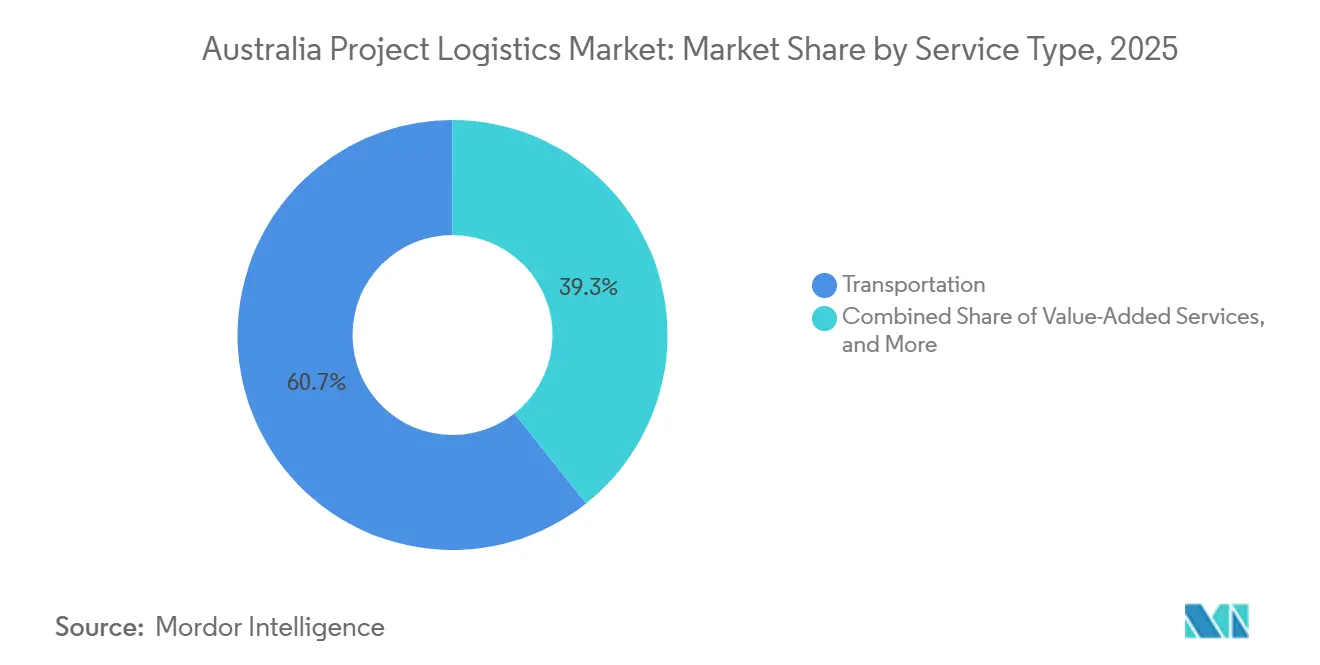
Transportation held 60.66% of the Australia project logistics market share in 2025, making it the scale anchor within the service mix. Road transport remained the main backbone because remote mine sites, port-to-site convoys, and cross-state heavy-haul movements depend on flexible inland execution. Sea and barge transport stayed critical for offshore and coastal sites, especially where direct land access is limited or uneconomic. Air freight served a smaller role, but it remained important for time-critical parts when downtime costs outweighed freight premiums. Rail is still secondary, yet expanding intermodal infrastructure is gradually improving its role in recurring industrial cargo programs.
The Australia project logistics market for value-added services and other services is projected to expand at a 6.33% CAGR from 2026 to 2031, making it the fastest-growing segment. The Australia project logistics industry is moving beyond pure haulage because project owners increasingly want route studies, cargo sequencing, compliance support, and visibility tools in the same contract. AASB S2 requires entities above defined thresholds to disclose climate-related information, and the first group includes entities with revenue of at least AUD 500 million (USD 335.07 million) from FY26. That requirement is making auditable freight emissions data more relevant during supplier selection, especially where logistics forms part of Scope 3 reporting. Providers that cannot combine physical execution with reporting and planning support are more likely to stay in subcontract roles as the Australia project logistics market matures[3]"South Australia Crane Notices to Cut Red Tape and Deliver Efficient Movements." National Heavy Vehicle Regulator (NHVR), www.nhvr.gov.au.



By Cargo Type: Oversized Cargo Anchors Revenue, Heavy-Lift Registers Fastest Expansion
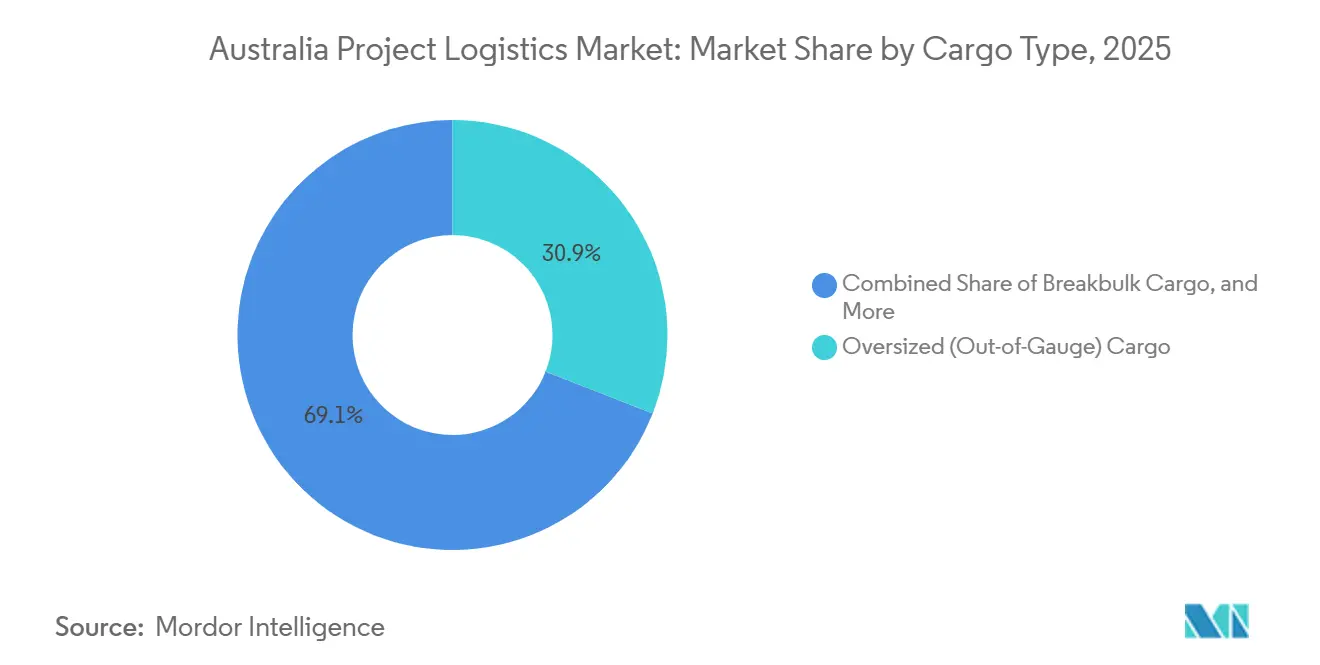
Oversized cargo held 30.94% of the Australia project logistics market share in 2025, giving it the largest cargo-type position in the market. Demand came from iron ore processing equipment, LNG-related modules, and large civil and energy components that exceed standard transport envelopes. This category also captures imported structures and plant items that require custom port handling before inland dispatch. Breakbulk cargo remained important because many industrial loads still exceed container limits even when they do not meet the most extreme oversized thresholds. That combination gives the segment a stable base across both construction activity and ongoing maintenance programs.
The Australia project logistics market size for heavy-lift cargo is projected to grow at a 5.92% CAGR through 2031, making it the fastest-expanding cargo type. DEUGRO reported that it delivered 4 Liebherr cranes totaling more than 2,000 metric tonnes from Rostock to Brisbane and Port Kembla in February 2025. That shipment shows how vessel selection, lift engineering, and port coordination are becoming more complex as project units get heavier. Offshore gas, pumped hydro, and utility-scale battery projects are all increasing the average unit weight that logistics teams must manage. This is shifting more value toward operators with engineered lift capability, large-tonnage transport assets, and stronger project controls within the Australia project logistics industry.
By End-User Industry: Resources Sustain Revenue Base While Energy Drives Growth
Oil and gas, mining, and quarrying accounted for 24.53% of the Australian project logistics market size in 2025, keeping resources as the largest end-user base. The segment benefits from the constant logistics intensity of Pilbara iron ore systems, Bowen Basin operations, and recurring shutdown work at established LNG facilities. That operating pattern creates steadier cargo needs than one-off project headlines might suggest, because maintenance and replacement cycles continue even when sanctioning slows. Construction and infrastructure remained a significant secondary user group, supported by the national public pipeline, which reached AUD 242 billion (USD 162.17 billion) over the five years to 2028-29. Manufacturing, aerospace and defense, and other smaller end users added diversification across the long tail of the Australia project logistics market.
The Australia project logistics market for energy generation and transmission is projected to grow at a 6.14% CAGR from 2026 to 2031, making it the fastest-growing end-user segment. Renewable energy equipment and transmission assets are now moving across more state corridors, so demand is no longer concentrated in traditional resource regions. Infrastructure Australia expects transmission investment to expand sharply within the current pipeline, which supports a longer run of cargo tied to grid buildout. Sarens stated that the Brisbane 2032 Olympic venue program will require more than AUD 7.1 billion (USD 4.75 billion) in investment, which points to additional heavy transport and lifting demand from event-linked infrastructure later in the decade. This widening end-user base should help the Australia project logistics market balance commodity exposure with infrastructure and energy-led work.
Geography Analysis
Western Australia is the dominant geography in the Australia project logistics market in 2026, supported by Pilbara iron ore, LNG hubs near Karratha, and a growing critical minerals base. The state combines long inland corridors with some of the heaviest unit movements in the country, which raises both transport intensity and contract value. Woodside’s Scarborough floating production unit arrived off Karratha in January 2026 after a tow of more than 4,000 nautical miles, underscoring the scale of marine-linked project execution in Western Australia. The same geography also benefits from cargo tied to offshore gas, processing plant upgrades, and mine expansions that require specialized route planning. Port disruption remains a material risk in this state, and GAC reported closures and operating impacts across multiple Western Australian ports during Tropical Cyclone Narelle in March 2026.
Queensland represents the second-largest activity cluster in the Australia project logistics market, with demand linked to Bowen Basin coal, North Queensland minerals, the Gladstone LNG precinct, and renewable buildout. Its mix of operating mines and new energy investment creates both recurring haulage demand and one-off heavy equipment moves. Remote north and inland corridors keep escort planning, staging, and asset availability central to successful execution. Queensland also stands to benefit from event-led infrastructure spend, because Sarens stated that the Brisbane 2032 Olympic venue program requires more than AUD 7.1 billion (USD 4.75 billion) in investment. This combination should keep Queensland important for both traditional resources cargo and newer civil and energy-linked scopes.
New South Wales and South Australia are growing in strategic importance within the Australia project logistics market even though their current scale remains below Western Australia and Queensland. In New South Wales, renewable energy corridors and road upgrades are improving the case for port-to-inland movements of oversized equipment, which is broadening the state’s role beyond general freight. In South Australia, copper province activity is strengthening the case for longer-term multimodal project cargo programs connected to mine and processing assets. Together, these states show that the Australia project logistics market is becoming more geographically diverse as energy transition and specialized mineral projects gain weight[4]"AASB S2 Climate-Related Financial Disclosures." Australian Accounting Standards Board (AASB), www.aasb.gov.au.
Competitive Landscape
The Australia project logistics market is moderately fragmented, with global heavy-lift specialists and domestic carriers competing across different layers of complexity. Firms such as Mammoet, Sarens, and deugro are strongest where engineered lifting, SPMT execution, and multi-party coordination determine project success. Domestic operators, including Toll, Linfox, and Centurion, remain relevant because they bring local fleet depth, corridor familiarity, and broader national coverage. Competition, therefore, turns less on basic freight price and more on engineering credibility, route access, safety performance, and the ability to enter a project early. That mix supports moderate to high competitive intensity across the Australia project logistics market rather than a winner-take-most structure.
Strategic positioning is becoming more deliberate as providers invest in capabilities rather than solely in fleet scale. Deugro’s February 2025 delivery of 4 Liebherr cranes, totaling more than 2,000 metric tonnes, into Brisbane and Port Kembla demonstrated how project specialists are using engineered vessel selection and coordinated port execution to win complex scopes. Sarens expanded heavy fabrication support in Western Australia in November 2025 by installing 3 new overhead cranes at Roy Sheds’ workshop expansion in Forrestdale. In February 2026, Macquarie Asset Management signed a scheme implementation deed to acquire Qube Holdings, a move that would place a broad logistics network of more than 200 sites under institutional ownership if approvals are completed. The ACCC was reviewing that transaction in 2026, which shows that consolidation around major infrastructure and intermodal assets can still influence how the Australia project logistics market evolves.
Another line of differentiation is compliance support, because AASB S2 is increasing the value of emissions reporting and auditable freight data in complex contracts. Providers that combine engineering, tracking, and reporting should gain an edge as project owners tighten procurement standards. Multimodal design will also matter more as new intermodal capacity changes corridor economics and expands inland staging options. Overall, the Australia project logistics market rewards specialists that can connect physical execution with planning, data, and long-cycle customer relationships.
Australia Project Logistics Industry Leaders
-
Toll Group
-
DHL Group
-
Linfox Pty Ltd.
-
QUBE Holdings, Ltd.
-
Mainfreight Limited
- *Disclaimer: Major Players sorted in no particular order

Recent Industry Developments
- June 2026: Linfox Australia deployed 26 battery-electric prime movers across heavy-haul routes in Melbourne, Brisbane, and Adelaide, backed by AUD 19.63 million (USD 12.6 million) in ARENA funding under the federal Driving the Nation program. Trucks are expected to operate approximately 500 km per day, supported by a 25-station industrial fast-charging network.
- April 2026: Port of Townsville unveiled its completed 14-hectare project cargo laydown area at the East Port Precinct, constructed by Mendi Constructions. The facility provides dedicated handling and temporary storage for oversized components, including wind turbine blades up to 100 meters, anchoring Townsville as North Queensland's primary gateway for cargo from renewable energy and critical minerals projects.
- February 2026: Macquarie Asset Management, together with managed funds and co-investors, signed a Scheme Implementation Deed to acquire 100% of Qube Holdings by scheme of arrangement at AUD 5.20 (USD 3.48) per share, implying a total transaction value of approximately AUD 11.7 billion (USD 7.5 billion). The acquisition, pending ACCC review and shareholder approval, would direct significant institutional capital into Qube's logistics network spanning over 200 sites across Australia, New Zealand, and Southeast Asia.
- November 2025: Sarens Australia installed 3 new overhead cranes at Roy Sheds' workshop expansion in Forrestdale, Perth, expanding the facility's heavy fabrication capacity as part of Sarens' broader strategy to deepen its presence in Western Australia's growing construction and industrial sector.


Australia Project Logistics Market Report Scope
| Transportation | Road |
| Rail | |
| Air | |
| Sea/Barge | |
| Warehousing, Distribution and Inventory Management | |
| Value-added Services and Others |
| Oversized (Out-of-Gauge) Cargo |
| Heavy-Lift Cargo |
| Breakbulk Cargo |
| Others |
| Oil and Gas, Mining and Quarrying |
| Energy Generation and Transmission (Includes Renewable Energy) |
| Construction and Infrastructure |
| Manufacturing and Industrial Plants |
| Aerospace and Defense |
| Others (Maritime and Shipbuilding, Telecommunications, etc.) |
| By Service | Transportation | Road |
| Rail | ||
| Air | ||
| Sea/Barge | ||
| Warehousing, Distribution and Inventory Management | ||
| Value-added Services and Others | ||
| By Cargo Type | Oversized (Out-of-Gauge) Cargo | |
| Heavy-Lift Cargo | ||
| Breakbulk Cargo | ||
| Others | ||
| By End-User Industry | Oil and Gas, Mining and Quarrying | |
| Energy Generation and Transmission (Includes Renewable Energy) | ||
| Construction and Infrastructure | ||
| Manufacturing and Industrial Plants | ||
| Aerospace and Defense | ||
| Others (Maritime and Shipbuilding, Telecommunications, etc.) |


Key Questions Answered in the Report
What is the Australia project logistics market size in 2026?
The Australia project logistics market stands at USD 7.88 billion in 2026 and is projected to reach USD 10.27 billion by 2031 at a 5.52% CAGR.
Which service segment leads revenue in Australia project logistics?
Transportation is the largest service segment, holding 60.66% of revenue in 2025 because road, sea, and rail links remain central to remote and oversized cargo delivery.
Which cargo type is growing the fastest through 2031?
Heavy-lift cargo is the fastest-growing cargo type, with a projected 5.92% CAGR through 2031 as unit weights rise across offshore gas, pumped hydro, and battery projects.
Why is Western Australia so important for project cargo movement?
Western Australia thrives because it combines Pilbara iron ore, LNG hubs near Karratha, long inland corridors, and a growing critical minerals pipeline that requires specialized transport.
What is driving demand from end-user industries?
Oil and gas, mining and quarrying remain the largest end-user base at 24.53% of 2025 revenue, while energy generation and transmission is growing fastest at 6.14% CAGR on the back of grid and renewable buildout.
What are the biggest constraints on growth?
Permit complexity, corridor restrictions, labor shortages, and cautious capital spending in some resource projects remain the main barriers to faster execution and volume growth.
Page last updated on:





