
Australia Pet Treats Market Size and Share
Market Overview
| Study Period | 2021 - 2031 |
|---|---|
| Forecast Data Period | 2026 - 2031 |
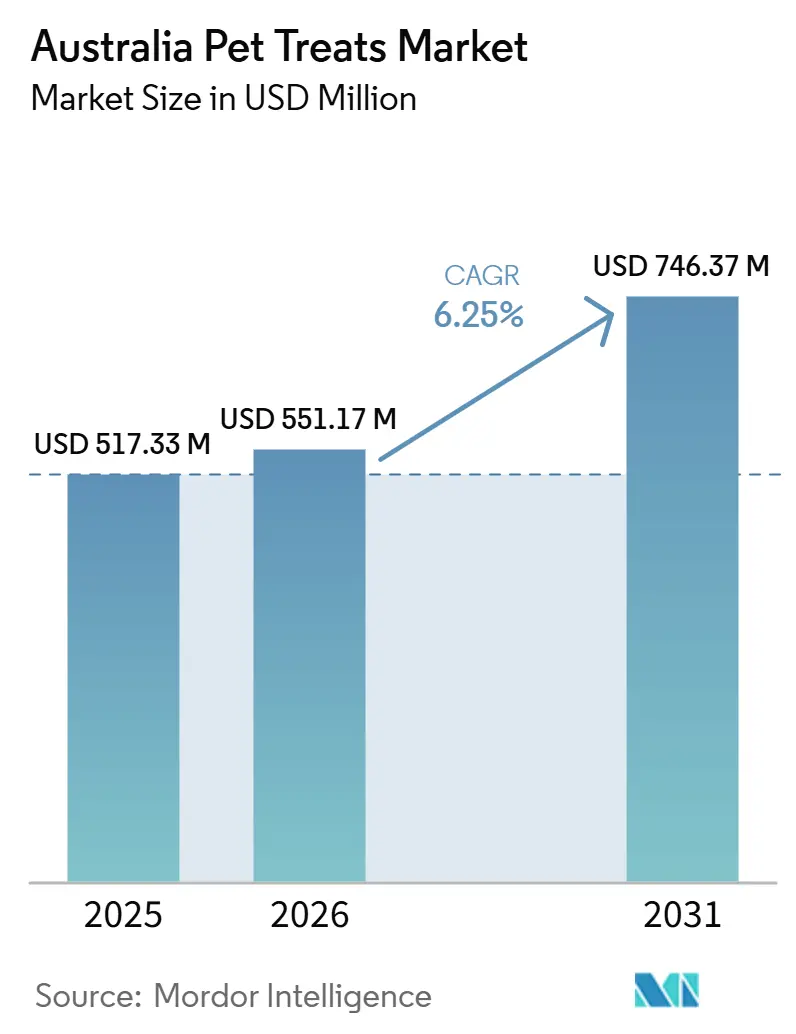
| Base Year Market Size (2025) | USD 517.33 Million |
| Market Size (2026) | USD 551.17 Million |
| Market Size (2031) | USD 746.37 Million |
| Growth Rate (2026 - 2031) | 6.25 % |
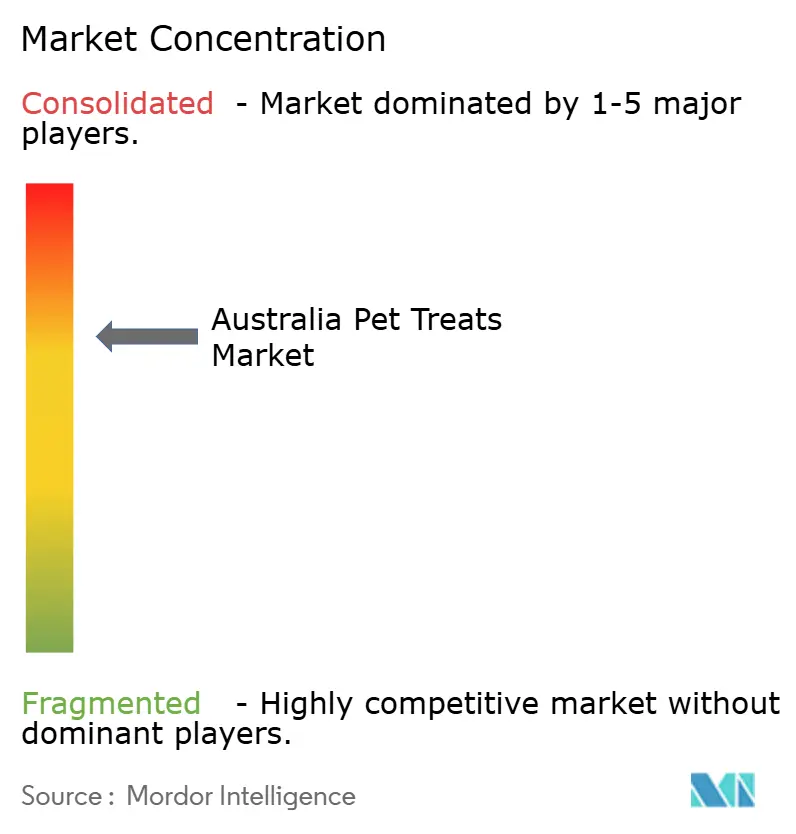
| Market Concentration | Medium |
Major Players
*Disclaimer: Major Players sorted in no particular order Image © Mordor Intelligence. Reuse requires attribution under CC BY 4.0. |
|
Australia Pet Treats Market Analysis by Mordor Intelligence
The Australia pet treats market size was valued at USD 517.33 million in 2025 and is projected to reach USD 551.17 million in 2026 and USD 746.37 million by 2031, growing at a CAGR of 6.25% during 2026-2031. According to Animal Medicines Australia, Australia enters this period with one of the highest pet ownership rates in the world: 73% of households had at least 1 pet in 2025, bringing the total companion animal population to 31.6 million. Annual pet spending reached AUD 21.3 billion (USD 13.9 billion), which supports steady demand for treat products across daily reward, training, and health-led use cases[1]Source: Animal Medicines Australia, “Australia’s Most Comprehensive Pet Survey Shows Nearly Three Quarters of Australian Homes Now Have a Pet,” Animal Medicines Australia, animalmedicinesaustralia.org.au. The Australian pet treats market is also supported by younger families, who are more willing to spend on pet nutrition, while digital retail and click-and-collect models improve access to premium and specialized products. Functional formats such as dental, calming, joint, and digestive treats are shifting the category toward routine wellness spending rather than occasional indulgence, reshaping product development and retail placement. Cost pressure remains the primary near-term challenge, though the category continues to offer growth potential, as spending is supported by pet care habits that are generally more resilient than those for discretionary consumer purchases.
Key Report Takeaways
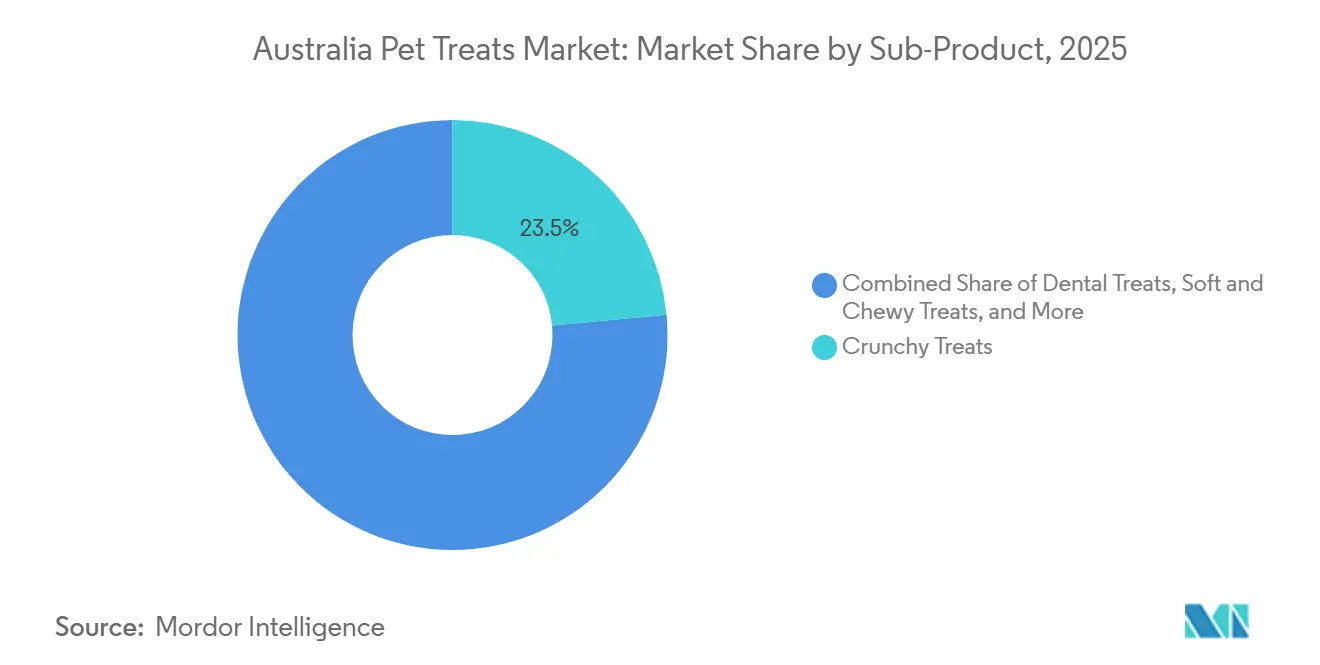
- By sub-product, crunchy treats held 23.5% of the Australia pet treats market size in 2025, while freeze-dried and jerky treats are forecast to grow at a 7.4% CAGR through 2031.
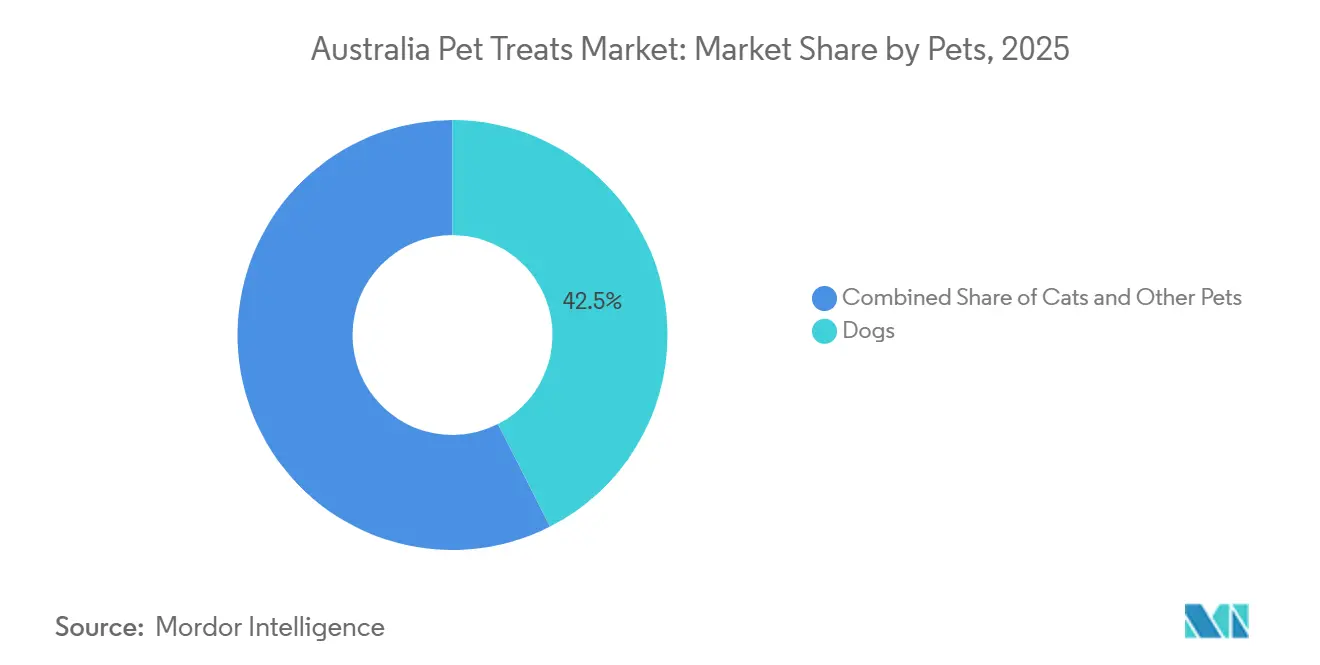
- By pets, dogs held 42.5% of the Australia pet treats market share in 2025, while cats recorded the fastest projected CAGR at 9.3% through 2031.
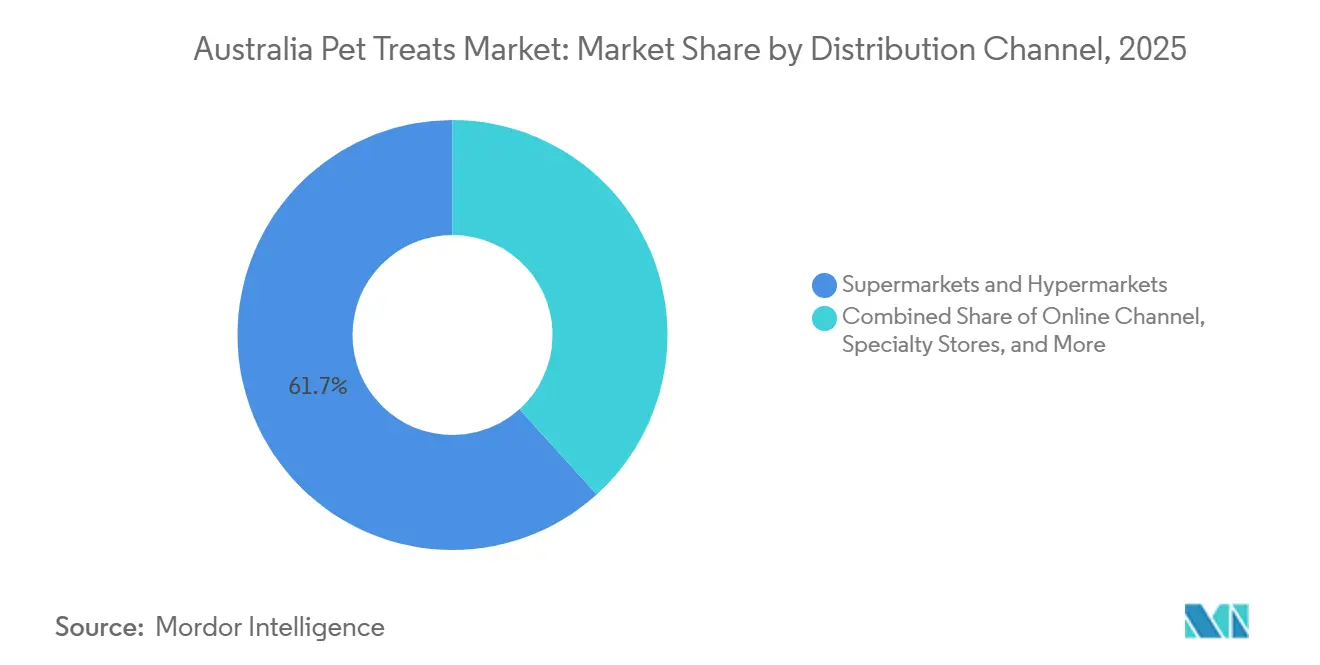
- By distribution channel, supermarkets and hypermarkets accounted for 61.7% of the Australia pet treats market size in 2025, while specialty stores are projected to grow at a 7.0% CAGR through 2031.
Note: Market size and forecast figures in this report are generated using Mordor Intelligence’s proprietary estimation framework, updated with the latest available data and insights as of January 2026.
Australia Pet Treats Market Trends and Insights
Drivers Impact Analysis*
| Driver | (~) % Impact on CAGR Forecast | Geographic Relevance | Impact Timeline |
|---|---|---|---|
| Rising premiumization of pet treats and functional positioning | +1.6% | National, strongest in major urban centers including Sydney, Melbourne, and Brisbane | Medium term (2-4 years) |
| Strong humanization of pets and willingness to pay for health-led treats | +1.5% | National, with broad relevance across high-income and family households | Long term (≥ 4 years) |
| E-commerce penetration is expanding assortment access in Australia | +1.1% | National, with earlier momentum in metropolitan markets and growing reach in regional areas | Short term (≤ 2 years) |
| Retail private label and value tier expansion is broadening trial | +0.7% | National, concentrated in major grocery chains | Short term (≤ 2 years) |
| Demand for oral care, calming, and digestive-health treats is rising | +0.9% | National, strongest in specialty retail and vet-adjacent channels | Medium term (2-4 years) |
| Subscription and auto-replenishment models are improving repeat purchase behavior | +0.5% | National, strongest in direct-to-consumer and online channels | Short term (≤ 2 years) |
| Source: Mordor Intelligence | |||
Rising Premiumization of Pet Treats and Functional Positioning
The Australia pet treats market is shifting from conventional reward products toward treats that support daily pet care routines. This transition is reflected in the growing demand for products that promote dental care, calming support, and digestive health. In 2026, Mars, Incorporated strengthened this trend by introducing Greenies Pill Pockets in Australia, a treat format designed to simplify medication administration while supporting pet health. Australian pet owners are also increasing expenditure on pet food and related care, supporting greater willingness to purchase premium snacks and treats. As a result, products without a strong health benefit or clear ingredient proposition are facing reduced consumer preference and shelf visibility. The Australia pet treats market is becoming increasingly driven by product value, transparent labeling, and functional benefits rather than price-based variety. This transition is also supporting premium pricing, as consumers increasingly view treats as part of routine pet care rather than as discretionary snacks. Over time, this trend strengthens the position of manufacturers that consistently deliver product quality, proven formulations, and trusted brand credibility.
Strong Humanization of Pets and Willingness to Pay for Health-Led Treats
The Australia pet treats market is benefiting from changing consumer attitudes toward pets as an integral part of daily family life. Animal Medicines Australia reported that 73% of households owned at least one pet in 2025, up from 69% in 2022, and that the national companion animal population reached 31.6 million. Australian households also continue to demonstrate a strong commitment to pet care spending, reflecting sustained demand for pet-related products[2]Source: Animal Medicines Australia, “Australia’s Most Comprehensive Pet Survey Shows Nearly Three Quarters of Australian Homes Now Have a Pet,” Animal Medicines Australia, animalmedicinesaustralia.org.au. Younger adults and families are playing an important role in driving this demand, supported by a greater preference for premium nutrition and specialized treat formats. In 2025, Mars, Incorporated reported that one in three dog feeding occasions includes treats, highlighting the growing role of treats in routine care and owner interaction. This frequent usage creates greater opportunities for health-focused products to become part of everyday pet care. The Australia pet treats market is therefore being driven not only by a large pet population but also by increasingly regular and purposeful treat consumption, supporting premium products, functional innovation, and stronger brand loyalty.
E-Commerce Penetration is Expanding Assortment Access in Australia
The Australia pet treats market is also being reshaped by the growing role of online product discovery and repeat purchasing. The expansion of e-commerce has enabled premium and emerging brands to reach a wider consumer base without relying solely on physical retail shelf space. In March 2025, Petbarn expanded digital convenience through its Uber Eats loyalty integration, allowing members to access loyalty pricing and faster home delivery. Digital platforms also enable consumers to compare ingredient lists, protein sources, and functional claims more easily before making purchasing decisions. This is particularly important in a category where product transparency and formulation quality increasingly influence consumer preferences. The Australia pet treats market is anticipated to continue benefiting from stronger online adoption, as digital channels are well-suited to premium and specialized products with clear value propositions. As delivery networks expand beyond major metropolitan areas, online retail is also improving regional consumers' access to a broader range of brands.
Demand for Oral Care, Calming, and Digestive-Health Treats Is Rising
The Australia pet treats market is seeing faster product activity around oral care, calming support, and digestive wellness. This trend aligns with high veterinary engagement, as 89% of dogs and 75% of cats visited a veterinarian in the 12 months before the 2025 Animal Medicines Australia survey. Frequent vet contact increases owner awareness of preventive care and makes health-led treat formats easier to explain and accept. The Australian Veterinary Association has also highlighted how cost pressure interacts with pet care decisions, keeping attention on products that support routine maintenance and preventive care. Greenies Pill Pockets is a recent example of a treat positioned around a practical health task rather than simple flavor or indulgence. The category effect is important because it gives treats a more stable role in household spending. The Australia pet treats market can therefore expand through use cases that are harder to cut than purely discretionary purchases. Brands that can clearly link a treat to a pet care routine should be better placed to defend price and frequency.
Restraints Impact Analysis*
| Restraint | (~) % Impact on CAGR Forecast | Geographic Relevance | Impact Timeline |
|---|---|---|---|
| Volatile ingredient costs and packaging inflation pressure margins | -1.2% | National, with heavier pressure on producers exposed to imported inputs and smaller procurement scales | Short term (≤ 2 years) |
| Higher scrutiny of claims and ingredient transparency slows launches | -0.6% | National, strongest in specialty and health-led product categories | Medium term (2-4 years) |
| Shelf space competition limits visibility for smaller brands | -0.5% | National, especially in major grocery and pet specialty chains | Medium term (2-4 years) |
| Treats remain vulnerable to macro trade-down behavior during cost shocks | -0.8% | National, strongest among lower-income households and renters | Short term (≤ 2 years) |
| Source: Mordor Intelligence | |||
Volatile Ingredient Costs and Packaging Inflation Pressure Margins
The Australia pet treats market faces ongoing cost pressure from protein ingredients, packaging materials, and sourcing volatility. This challenge is particularly significant for domestic independent brands, which generally have lower purchasing power and shorter procurement cycles than multinational manufacturers. Australian-made products commonly rely on proteins such as kangaroo, chicken, and lamb, making production costs sensitive to domestic agricultural conditions and broader supply chain disruptions. In its fiscal 2026 guidance, Colgate-Palmolive Company (Hill’s Pet Nutrition, Inc.) highlighted continued inflation in raw materials and packaging costs, while also noting tariff-related impacts during the first half of the year. As production costs increase, manufacturers must either raise prices, reduce promotional activity, or absorb lower profit margins. Each of these responses creates challenges in a market where consumers can easily compare products across multiple retail channels. The Australia pet treats market may therefore experience slower premium category expansion if input cost inflation remains elevated over an extended period. This risk is greatest for manufacturers with limited product portfolios and lower flexibility to offset rising costs across broader product offerings.
Higher Scrutiny of Claims and Ingredient Transparency Slows Launches
The Australia pet treats market is becoming more challenging for brands seeking to position products with health-focused claims without strong scientific support. As consumers place greater emphasis on ingredient transparency and functional benefits, manufacturers must provide clearer formulations, accurate labeling, and credible evidence to support product claims. This is particularly relevant for treats marketed for calming support, digestive health, joint care, or medication assistance. The regulatory and veterinary environment in Australia continues to encourage responsible product positioning, reinforcing the importance of evidence-based health claims. As a result, product development timelines may become longer as manufacturers undertake additional formulation and validation before commercialization. Larger companies are generally better positioned to manage these requirements because of their greater technical expertise and regulatory capabilities. The Australia pet treats market may therefore experience slower product launches among smaller manufacturers, while functional category growth increasingly favors companies with established compliance and product development capabilities.
*Our forecasts treat driver/restraint impacts as directional, not additive. The impact forecasts reflect baseline growth, mix effects, and variable interactions.
Segment Analysis
By Sub Product: Crunchy Formats Hold Ground as Freeze-Dried Gains Conversion
Crunchy treats held 23.5% of segment revenue in 2025, making them the largest product category in the Australia pet treats market. Their leadership reflects broad availability, established use for training and rewards, and a strong presence across grocery and mass retail channels. These products benefit from high consumer traffic, where treats are frequently purchased alongside regular pet food, making crunchy treats a dependable volume segment for households seeking affordable and convenient options.
Freeze-dried and jerky treats are projected to grow at a CAGR of 7.4% through 2031, making them the fastest-growing product category in the Australian pet treats market. Growth is supported by increasing demand for high-protein, air-dried, and single-ingredient products that align with premium purchasing preferences. In 2025, WAG expanded its portfolio with the launch of Bully Chips and an insect-based jerky range, highlighting how domestic brands are using alternative proteins and sustainability-focused positioning to attract consumers[3]Source: WAG, “Benefits of Air-Dried Dog Treats,” WAG, getwag.com.au. Open Paddock Pet also demonstrates how Australian-made products can combine local sourcing, animal welfare standards, and premium quality positioning. The Australian pet treats market is gradually shifting from product-format-driven purchasing toward use-case-driven purchasing, supporting stronger growth for premium and specialized treat categories.



By Pets: Dogs Anchor Volume, Cat Treating Emerges as the Growth Engine
Dogs accounted for 42.5% of category revenue in 2025, making them the largest pet segment in the Australia pet treats market. Their leadership reflects high ownership levels and the frequent use of treats for training, rewarding, and daily interaction. Mars, Incorporated and The J.M. Smucker Company continue to strengthen this segment through ongoing product innovation and portfolio expansion. Dogs also remain the primary focus for functional treats, as owners are already accustomed to incorporating treats into everyday care routines.
Cats are projected to grow at a CAGR of 9.3% through 2031, making them the fastest-growing pet category in the Australia pet treats market. Growth is supported by rising cat ownership, increasing urbanization, and stronger consumer demand for premium nutrition[4]Source: Pet Industry Association Australia, "Latest Industry Stats Behind Australia's 33 Billion Pet Industry," Pet Industry Association Australia (PIAA), piaa.org.au.. In August 2025, Inaba Australia expanded the availability of its Churu range across national grocery retailers, reflecting growing retail interest in cat-specific treats. Other pets continue to represent a niche segment, with demand largely concentrated in specialty retail channels. The Australia pet treats market is therefore developing a second major growth engine beyond dogs, encouraging greater investment in cat-focused innovation, product variety, and retail shelf space.
By Distribution Channel: Supermarkets Anchor Volume, Specialty Stores Lead Premium Growth
Supermarkets and hypermarkets accounted for 61.7% of revenue in 2025, making them the largest distribution channel in the Australia pet treats market. Their leadership is driven by convenience, broad household reach, and the routine purchase of pet products at the grocery store. This channel remains the primary outlet for mainstream treats, value-oriented products, and high-frequency purchases.
Specialty stores are projected to grow at a CAGR of 7.0% through 2031, making them the fastest-growing distribution channel in the Australia pet treats market. Their competitive advantage lies in curated product assortments, expert guidance, and stronger support for premium and health-focused products. In 2025, Petbarn enhanced its omnichannel offering through its Uber Eats loyalty integration, improving digital convenience for specialty retail customers. Online channels are also expanding as consumers increasingly purchase premium pet products through digital platforms, while convenience stores and other retail formats continue to serve impulse purchases. The Australia pet treats market is therefore anticipated to remain volume-driven by supermarkets, while premium growth increasingly shifts toward specialty and online channels, requiring brands to tailor product assortments, pricing strategies, and marketing across different retail formats.
Geography Analysis
Australia accounted for the full regional scope of this study, and the Australia pet treats market continues to be supported by one of the highest pet ownership rates globally. In 2025, 73% of households owned at least one pet, providing a strong foundation for sustained demand for pet care products. Pet food remains the largest area of household spending, supporting consistent replenishment of food related products, including treats. Demand is concentrated across major metropolitan areas such as Sydney, Melbourne, Brisbane, and Adelaide, where higher incomes and urban pet ownership patterns encourage greater spending on premium and functional pet treats. These cities also serve as key markets for the introduction of innovative and digitally enabled products.
Regional and semi rural Australia is also becoming increasingly important for market expansion. In August 2024, Trusty (Garth Group) expanded its national presence through the launch of a broad pet product range across Bunnings Warehouse, demonstrating the potential of regional retail channels beyond specialty pet stores. Open Paddock Pet further reflects this trend by combining Australian sourcing, animal welfare standards, and nationwide retail distribution, highlighting growing consumer preference for locally produced, high quality products.
Australia also plays an important role within the broader Asia Pacific pet care industry by attracting both international manufacturers and domestic investment. In July 2026, Mars, Incorporated opened its new manufacturing facility in Wodonga to expand local production capacity for Australia and New Zealand. This investment strengthens supply chain resilience, supports domestic manufacturing, and improves responsiveness to local consumer demand. It also demonstrates the long term attractiveness of the Australia pet treats market, supported by strong household demand, well established retail infrastructure, and increasing manufacturing capability.
Competitive Landscape
The Australia pet treats market has a moderately concentrated competitive structure, with a strong presence of global manufacturers alongside a fragmented base of domestic brands. Mars, Incorporated is the market leader, followed by Nestlé S.A. (Purina). Their scale provides significant advantages in procurement, retail distribution, marketing, and product innovation, while numerous Australian brands continue to compete through differentiated product offerings and strong local positioning.
Leading multinational companies are focusing on functional nutrition, portfolio expansion, and local manufacturing capability. In July 2026, Mars, Incorporated commissioned its Wodonga manufacturing facility to strengthen domestic production capacity. The company also introduced Greenies Pill Pockets in 2026, reinforcing its focus on health oriented pet treats. The J.M. Smucker Company further expanded production capacity in 2025 through upgrades to support growing demand for its Soft 'N Chewy product range.
Australian companies, including WAG, Loyalty Pet Treats, Open Paddock Pet, Pawtion, Farmers Mate For Pets, PawPure, Floof, Laft Pet, and My Little Tails, primarily compete through Australian sourcing, single-ingredient formulations, freeze-dried and dehydrated products, and strong brand authenticity. These companies are well positioned in premium niche segments where provenance, transparency, and product quality are key purchasing factors. The Australia pet treats market is therefore anticipated to remain led by global companies in overall scale, while domestic manufacturers continue to strengthen their presence across premium and specialized product categories.
Australia Pet Treats Industry Leaders
-
Mars, Incorporated
-
Nestle S.A. (Purina)
-
Colgate-Palmolive Company (Hill’s Pet Nutrition, Inc.)
-
General Mills, Inc.
-
The J.M. Smucker Company
- *Disclaimer: Major Players sorted in no particular order

Recent Industry Developments
- July 2026: Mars, Incorporated opened its Wodonga manufacturing facility in Victoria, strengthening local production capacity and supply chain resilience while supporting long term growth of the Australia pet treats market.
- June 2026: Mars, Incorporated launched Greenies Pill Pockets in Australia, expanding the functional treats segment and reinforcing the shift toward health focused pet nutrition.
- June 2026: Mars, Incorporated introduced the Advance Sniffari in store activation across Petbarn, increasing consumer engagement, supporting premium treat adoption, and strengthening retail visibility.


Australia Pet Treats Market Report Scope
Pet treats are commercial food products formulated specifically for pets. They are not designed to provide complete and balanced nutrition but are intended for occasional feeding as rewards, during training, or for enjoyment. As a subset of pet food, these treats are typically made from ingredients such as meat, grains, or vegetables and should be offered in moderation to maintain a balanced diet.
The Australia Pet Treats Market Report is Segmented by Sub Product (Dental Treats, Crunchy Treats, Soft and Chewy Treats, Freeze-Dried and Jerky Treats, and Other Pet Treats), by Pets (Cats, Dogs, and Other Pets), and by Distribution Channel (Convenience Stores, Online Channel, Specialty Stores, and More). The Market Forecasts are Provided in Terms of Value (USD) and Volume (Metric Tons).
| Dental Treats |
| Crunchy Treats |
| Soft and Chewy Treats |
| Freeze-Dried and Jerky Treats |
| Other Pet Treats |
| Dogs |
| Cats |
| Other Pets |
| Supermarkets and Hypermarkets |
| Specialty Stores |
| Online Channel |
| Convenience Stores |
| Other Distribution Channels |
| By Sub Product | Dental Treats |
| Crunchy Treats | |
| Soft and Chewy Treats | |
| Freeze-Dried and Jerky Treats | |
| Other Pet Treats | |
| By Pets | Dogs |
| Cats | |
| Other Pets | |
| By Distribution Channel | Supermarkets and Hypermarkets |
| Specialty Stores | |
| Online Channel | |
| Convenience Stores | |
| Other Distribution Channels |


Key Questions Answered in the Report
What is the current size of the Australia pet treats space?
The Australia pet treats market size is USD 551.17 million in 2026.
Which pet category is growing fastest in Australia?
Cats are projected to grow at a 9.3% CAGR through 2031, faster than dogs, supported by rising urban adoption and stronger retail focus on cat treats.
Which product type leads sales in Australia pet treats?
Crunchy treats led with 23.5% share in 2025 because they are widely available, affordable, and suited to frequent reward use.
Which product type is forecasted to expand fastest?
Freeze-dried and jerky treats are forecast to grow at a 7.4% CAGR through 2031 as consumers show more interest in premium, high-protein, and single-ingredient formats.
Which sales channel matters most for pet treats in Australia?
Supermarkets and hypermarkets led with 61.7% share in 2025, but specialty stores are growing faster at a 7.0% CAGR because they support premium and health-led purchases.
Page last updated on:





