
Australia Gummy Market Size and Share
Market Overview
| Study Period | 2021 - 2031 |
|---|---|
| Forecast Data Period | 2026 - 2031 |
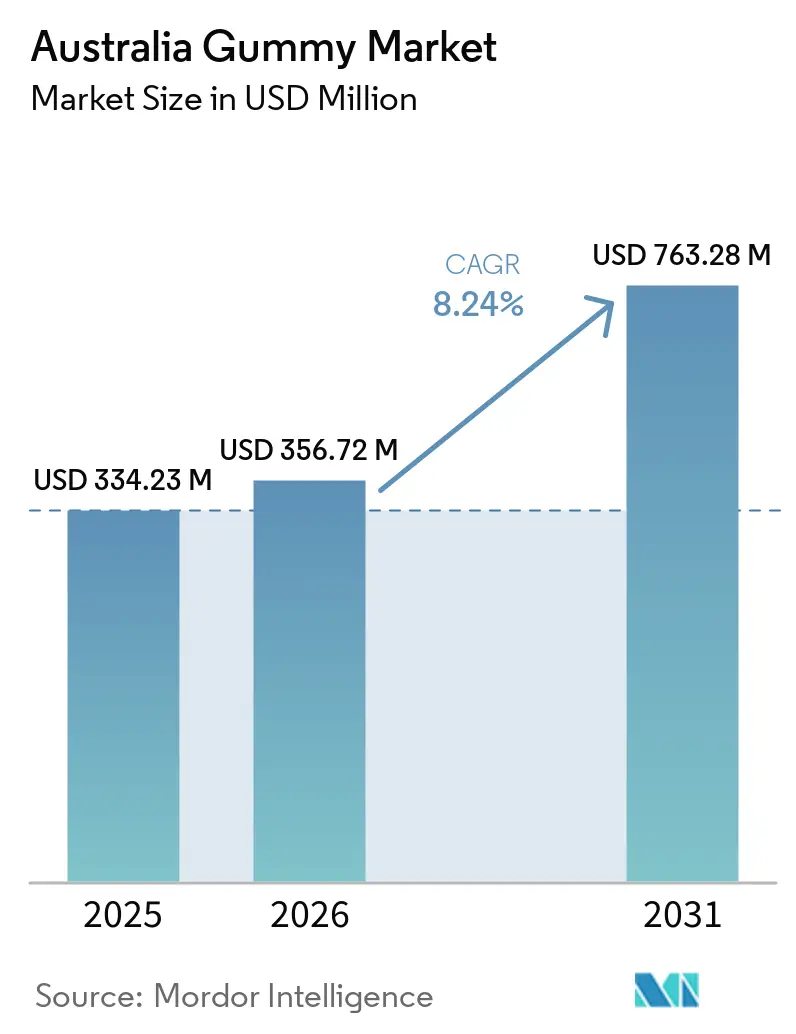
| Base Year Market Size (2025) | USD 334.23 Million |
| Market Size (2026) | USD 356.72 Million |
| Market Size (2031) | USD 763.28 Million |
| Growth Rate (2026 - 2031) | 8.24 % |
| Market Concentration | Low |
Major Players *Disclaimer: Major Players sorted in no particular order Image © Mordor Intelligence. Reuse requires attribution under CC BY 4.0. | |
Australia Gummy Market Analysis by Mordor Intelligence
The Australia gummy market size was USD 356.72 million in 2026 and is forecast to reach USD 763.28 million by 2031, growing at a CAGR of 8.24% from 2026 to 2031. Daily supplementation is increasingly part of personal wellness routines, and gummies benefit because they are easier to consume than tablets or capsules. Rising consumer spending on preventive health, ongoing product upgrades, and the listed-medicine pathway continue to support demand for gummy supplements in Australia. However, regulatory requirements, compliance processes, and formulation costs can slow the pace of new product launches. The Australia gummy market also benefits from the credibility of pharmacy distribution channels, the expanding reach of digital platforms, and growing cross-border demand for Australian-made supplements.
Key Report Takeaways
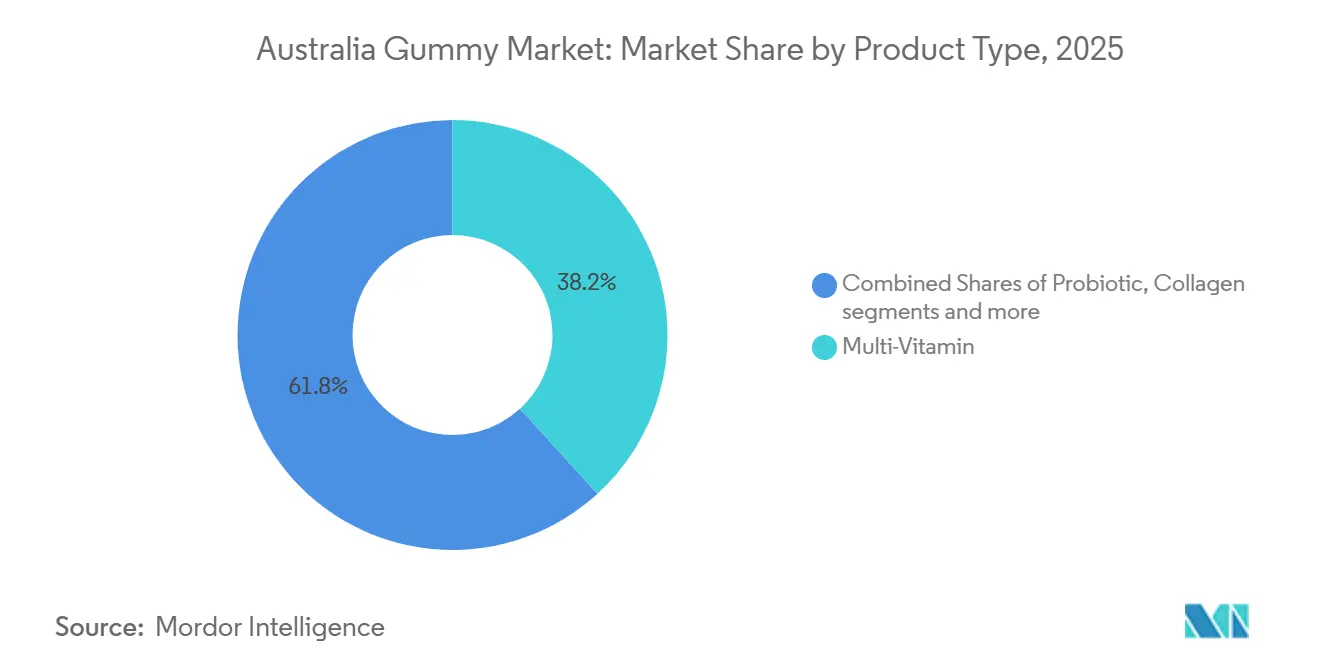
- By product type, multivitamin gummies held 38.21% of the Australia gummy market share in 2025, while Omega-3 gummies are projected to grow at a 9.66% CAGR through 2031.
- By source, animal-based gummies accounted for 57.46% of the Australia gummy market share in 2025, while plant-based gummies are forecast to expand at a 9.78% CAGR through 2031.
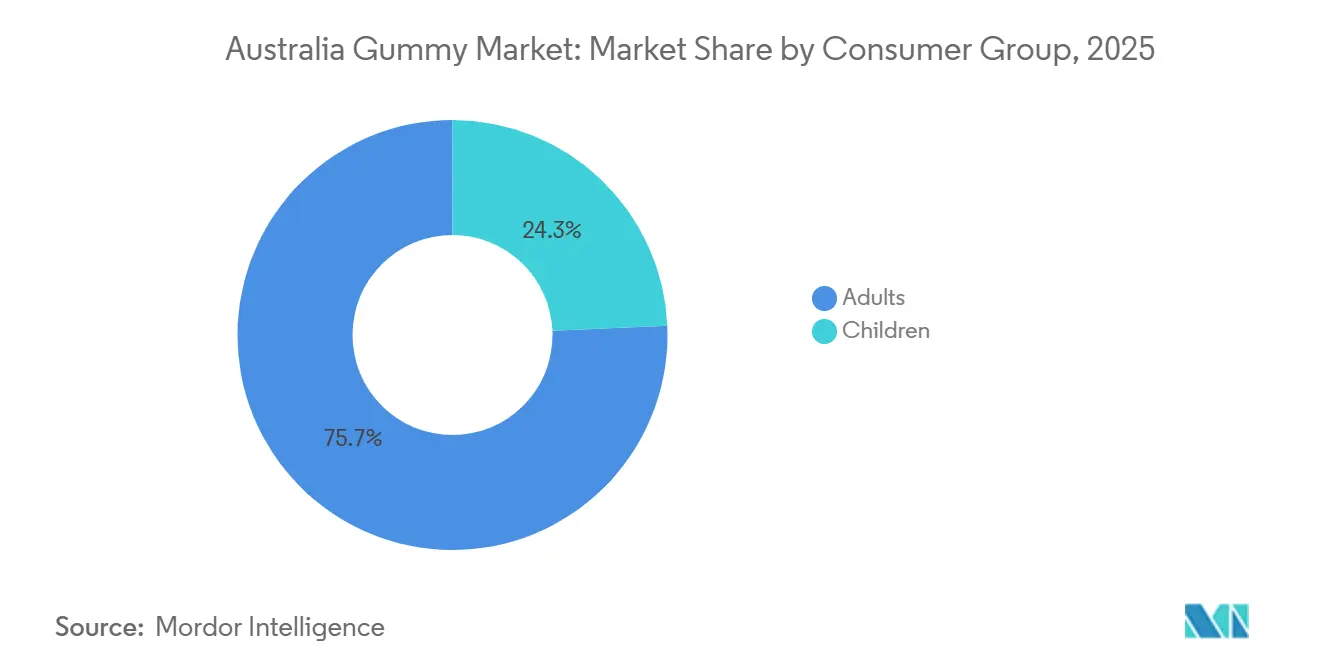
- By consumer group, adults held 75.68% of the Australia gummy market share in 2025, while children’s gummies are forecast to grow at a 9.56% CAGR through 2031.
- By packaging type, bottles and jars represented 64.58% of the Australia gummy market share in 2025, while stand-up pouches are forecast to advance at a 9.78% CAGR through 2031.
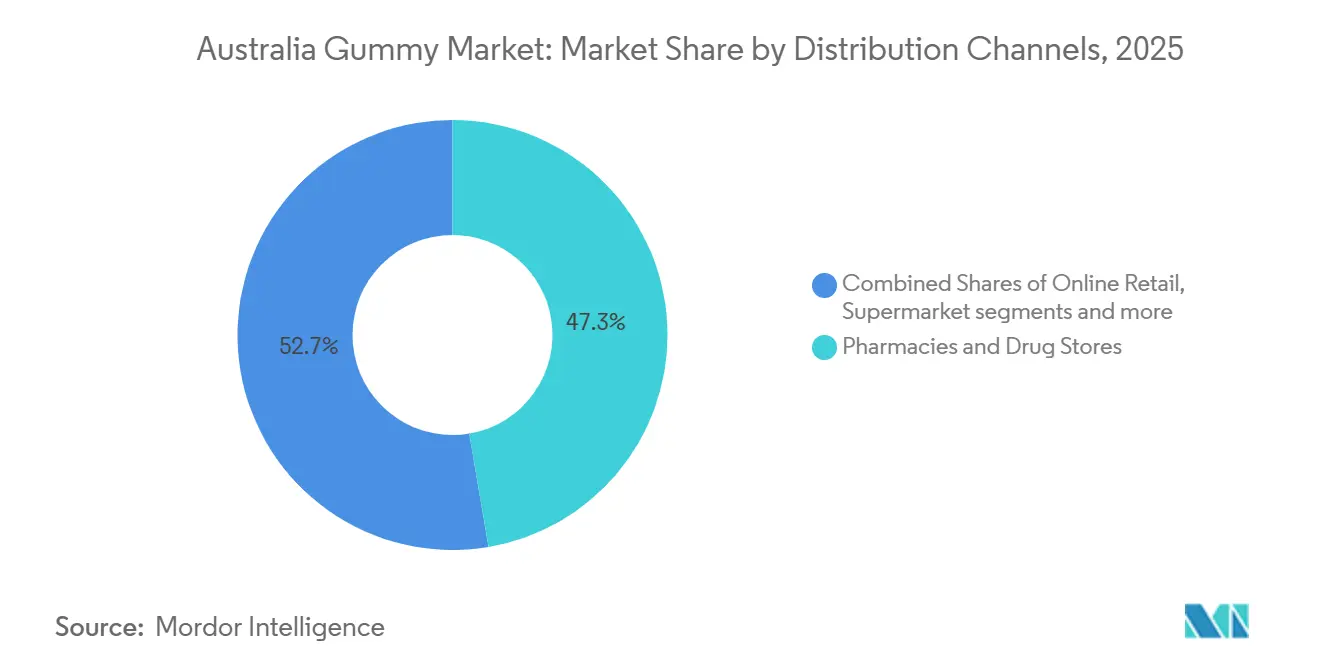
- By distribution channel, pharmacies and drug stores held 47.32% of the Australia gummy market share in 2025, while online retail is projected to grow at a 9.72% CAGR through 2031.
Note: Market size and forecast figures in this report are generated using Mordor Intelligence’s proprietary estimation framework, updated with the latest available data and insights as of January 2026.
Australia Gummy Market Trends and Insights
Drivers Impact Analysis*
| Driver | (~) % Impact on CAGR Forecasts | Geographic Relevance | Impact Timeline |
|---|---|---|---|
| Growing consumer interest in convenient nutritional supplements | +1.8% | National; highest intensity in metro areas (Sydney, Melbourne, Brisbane) | Short term (≤ 2 years) |
| Rising demand for vitamins and mineral gummies among adults | +1.5% | National | Short term (≤ 2 years) |
| Increasing popularity of children's vitamin and supplement gummies | +1.4% | National; concentrated in family-formation household demographics | Medium term (2-4 years) |
| Growing preference for easy-to-consume alternative dosage forms | +0.9% | National; skews toward older adults (65+) and younger adults (18–34) | Short term (≤ 2 years) |
| Expansion of functional and condition-specific gummies | +1.0% | National; premium uptake concentrated in higher-income urban segments | Medium term (2-4 years) |
| Growing product innovation in multi-ingredient and targeted gummies | +0.8% | National; DTC channels as the primary trial-acquisition vehicle | Long term (≥ 4 years) |
| Source: Mordor Intelligence | |||
Growing Consumer Interest in Convenient Nutritional Supplements
The Australia gummy market is supported by a shift from occasional supplement purchases toward daily habits. Gummies reduce swallowing and taste barriers that can limit use of standard supplements. This feature is relevant for adults aged 65 and above, a group that benefits from simpler daily routines. The wider complementary medicines sector reached AUD 6.30 billion, equivalent to USD 4.0 billion, in 2025 and is expected to grow by 3.0% to 4.0% annually through 2030[1]Source: Complementary Medicines Australia, “Australia’s Complementary Medicines Industry, CMA 2025 Industry Snapshot,” Complementary Medicines Australia, cmaustralia.org.au. Gummy products are growing faster than that sector because they fit both routine use and casual wellness purchasing. Demand is strongest in large metropolitan areas, where supermarket, pharmacy, and online availability make product trial easier. Swisse Wellness used its “Functional. Fun. Gummies.” campaign and a “Sweet Treat” creative chapter in 2026 to promote the format across pharmacy and supermarket settings. The campaign shows how branded format education can increase product trial and repeat purchase. Wider access to easy-to-consume products also supports adults who may avoid large tablets or fish-oil softgels. This affects the Australia gummy market because a pleasant format may strengthen adherence after the first purchase. Products designed for convenience can therefore achieve repeat demand without relying only on changes in core ingredients. The same preference supports alternative dosage forms among younger adults and older consumers, who have different needs but share a preference for straightforward consumption.
Rising Demand for Vitamins and Mineral Gummies Among Adults
Adult buyers increasingly use supplements for energy, immune support, beauty, sleep, cognitive support, and other wellness needs. A single product can combine nutritional ingredients with beauty or condition-related positioning. This reduces the need for separate purchases and supports premium price points. Nature’s Way registered Collagen Beauty Complex in October 2024 and Adult Vita Gummies Omega-3 in June 2025 on the Australian Register of Therapeutic Goods[2]Source: Therapeutic Goods Administration, “Proposed Changes to the Permissible Ingredients Determination, Low-Negligible Risk Changes 2024-25,” Therapeutic Goods Administration, consultations.tga.gov.au. These registrations show the use of targeted adult products across more than one health need. Adult formats can generate higher returns for brands and retailers when they combine specialized ingredients with clear product positioning. Premium products often use collagen, magnesium, Omega-3, or multiple ingredients to address a defined use case. The Australia gummy market benefits when these products encourage consumers to move beyond basic multivitamins. New products also give pharmacy retailers a reason to refresh shelf space and feature differentiated ranges. Adult growth supports a broader move toward targeted gummies, including products for women’s health, sleep, and brain health. The resulting product range makes the format relevant across more stages of adult life.
Increasing Popularity of Children’s Vitamin and Supplement Gummies
Parents often choose gummies when they want to improve acceptance of routine supplements. The category now includes immune support, probiotics, sleep, iron, and multivitamin products rather than only basic vitamins. This gives households more reasons to purchase products for specific needs. Swisse registered Little Swisse Multivitamin Gummies under ARTG IDs 477829 and 489134 during 2025. The range extended the company’s family offer into iron, probiotic, and sleep-related products. Children’s products can also establish a household relationship with a brand. A parent who trusts a children’s range may be more likely to consider the same company’s adult products. This supports both pharmacy purchasing and online subscriptions. The Australia gummy market gains from this connection because a child-focused product can lead to future purchases in other consumer groups. Bayer’s One A Day Kids Multi with Iron introduced 12.00 mg of iron per serving in July 2025, alongside a product containing probiotics, according to company disclosures supplied in the draft. The product range illustrates how companies are serving concerns around selective eating and nutrient intake.
Functional and Condition-Specific Gummies
Functional and condition-specific products extend the Australia gummy market beyond basic vitamin use. Collagen, cognitive support, hormonal support, gut health, and energy products give brands ways to stand apart. Nature’s Way listed Platinum Strength Vita Gummies Brain & Energy under ARTG ID 514370 in October 2025. The company also expanded collagen and beauty-linked offerings through ARTG registrations in 2024 and 2025. These moves show a product ladder that serves different consumer needs at different price points. Functional formats commonly carry prices 30.00% to 50.00% above standard multivitamin gummies, according to the supplied research draft. Formulation work is becoming more important because manufacturers must meet product, ingredient, and labeling requirements. At the Complementary Medicines Australia Innovation Day in May 2026, participants discussed collagen-based gelling agents as an alternative to conventional pectin or gelatin matrices. This approach can combine a structural role with a nutrition-related ingredient proposition. The Australia gummy market benefits from such work when it creates products that are harder to substitute with standard tablets. It also creates opportunities for multi-ingredient products that bring together beauty, nutrition, or wellness needs. However, the value of new concepts depends on whether they can be made consistently within the listed-medicine framework.
Restraints Impact Analysis*
| Restraint | (~) % Impact on CAGR Forecasts | Geographic Relevance | Impact Timeline |
|---|---|---|---|
| Strict regulatory requirements for therapeutic gummy products | -1.4% | National; most acute for smaller entrants lacking TGA compliance infrastructure | Short term (≤ 2 years) |
| Restrictions on health claims and product advertising | -0.9% | National | Short term (≤ 2 years) |
| High sugar content in conventional gummy formulations | -0.8% | National; consumer pushback concentrated in children's and health-conscious adult segments | Medium term (2-4 years) |
| Competition from conventional supplements | -0.7% | National | Long term (≥ 4 years) |
| Source: Mordor Intelligence | |||
Strict Regulatory Requirements for Therapeutic Gummy Products
The Australia gummy market operates within rules for listed medicines when products make relevant health-related claims. The Therapeutic Goods Act 1989 sets requirements for ingredients, manufacturing quality, and labeling[3]Source: Australian Government, “Therapeutic Goods Act 1989,” Federal Register of Legislation, legislation.gov.au. Compliance adds time and cost for companies developing new products. Complementary Medicines Australia counted 81.00 TGA-licensed complementary medicine manufacturing facilities in 2025, while only a limited number were equipped for gummy production. This limits contract-manufacturing options for brands that do not own licensed facilities. Small businesses and new concepts can be affected most because they may lack the resources to manage certification and compliance work. Star Combo Pharma reported TGA manufacturing approval for its gummy facility in May 2024, identifying it as a large-scale licensed gummy contract manufacturer in Australia. The facility shows why manufacturing approvals can create a meaningful barrier to entry. The Permissible Ingredients Determination was updated in March 2025, with a 12-month transition period ending in March 2026. Companies need continued regulatory monitoring when they use ingredients in listed products. Health claim and advertising rules also reduce how directly brands can explain a product’s clinical rationale. These limits can make customer education more difficult, especially for new functional gummies that need clear communication.
High Sugar Content in Conventional Gummy Formulations
Sugar remains a concern for the Australia gummy market, particularly in products designed for children. Conventional gelatin gummies often rely on glucose syrup and added sugars for texture and taste. This may conflict with consumer expectations for clean-label and wellness-oriented products. Parents can compare ingredient panels across brands in pharmacy and supermarket settings. Swisse stated that its Little Swisse Kids Gummies range was 99.00% sugar-free or contained no added sugars, according to company information in the supplied draft. This response reflects pressure to reduce sugar while retaining an acceptable texture and flavor. Reformulating products can increase costs because alternative gelling agents and sweetening systems may require additional work. Pectin, tapioca syrup, and other materials can change product texture, flavor, and manufacturing processes. These challenges may be greater for companies with large portfolios of existing gelatin-based products. Newer companies that start with low-sugar or zero-sugar products can avoid some legacy reformulation needs. Conventional tablets and capsules also remain established alternatives for consumers who prioritize ingredients, price, or dosage accuracy. The Australia gummy market therefore faces ongoing competition from familiar supplement formats even as consumer preference shifts toward more palatable products.
*Our forecasts treat driver/restraint impacts as directional, not additive. The impact forecasts reflect baseline growth, mix effects, and variable interactions.
Segment Analysis
By Product Type: Omega-3 Leads Specialty Growth Beyond the Multivitamin Core
Omega-3 gummies are forecast to expand at a 9.66% CAGR through 2031. The format gives consumers an alternative to fish-oil softgels, which some find difficult to swallow or unpleasant to taste. Demand relates to interest in cardiovascular, cognitive, and joint health uses. Nature’s Way Adult Vita Gummies Omega-3 was listed on the ARTG in June 2025 under ID 490672. This listing supported the company’s broader move into specialty gummy products. Vegan and algae-derived Omega-3 options also appeal to consumers seeking plant-based products or alternatives to fish-derived ingredients. Probiotic gummies have different technical needs because manufacturers must protect shelf-stable probiotic systems and manage higher ingredient loads.
Multivitamin gummies commanded 38.21% of the Australia gummy market share in 2025, making them the core revenue category. They are often the first gummy product used by consumers across age groups. Single-vitamin products meet more targeted needs, including Vitamin D, Vitamin C, biotin, and iron. These formats can benefit from recommendations by health professionals, which can support product trial. Their broad availability also gives pharmacies and supermarkets a familiar base range. Multivitamins are likely to remain important even as specialty products expand because they serve everyday routine use.



By Source: Plant-Based Premiumization Challenges Animal-Derived Formats
Animal-based gummies held 57.46% of the Australia gummy market share in 2025. Gelatin supports this position because it is relatively cost-efficient, easy to work with, and familiar to consumers. Brands continue to use animal-derived formats for mainstream products where price and texture consistency matter. Premium animal-derived products are increasingly differentiated through ingredient sourcing and bioavailability rather than price. This creates a range of positions within the same source category. Consumer familiarity also supports continued shelf presence for gelatin-based multivitamin and single-vitamin products.
Plant-based gummies are forecast to grow at a 9.78% CAGR through 2031. Their growth is linked to vegan preferences, clean-label purchasing, and interest in sustainability-related product choices. Pectin and algae-based matrices fit this positioning. Vegan certification can make dietary compatibility easier to identify for shoppers who have not chosen a brand before entering a pharmacy. This visual signal matters in stores where consumers compare several products. The Australia gummy market has room for plant-based products where companies can make their value clear without making unsupported claims.
By Consumer Group: Adult Scale and Children’s Growth Define a Dual-Trajectory Market
Adults accounted for 75.68% of the Australia gummy market share in 2025, giving the segment the largest revenue base. Adult demand spans immune support, energy, beauty, cognitive health, sleep, joint health, and cardiovascular wellness. This breadth allows companies to develop products for women’s health, men’s health, and age-related needs. People aged 50 and above may seek products suited to joint, cognitive, and cardiovascular concerns. Adult products can also use more specialized ingredients and premium positions. This makes adults central to category value even when some other groups grow faster.
Children’s gummies are projected to grow at a 9.56% CAGR through 2031. This Australia gummy market size growth reflects parental interest in formats that children will accept as part of a daily routine. Immune, probiotic, sleep, and iron products have extended the category beyond basic multivitamins. Each product type can address a different parental concern. Swisse’s ARTG registrations for Little Swisse products in 2025 covered a broader family-oriented portfolio. The registrations support a structured range across several child-related needs.
By Packaging Type: Bottles Anchor the Category but Pouches Redefine Premium Positioning
Bottles and jars held 64.58% of the Australia gummy market share in 2025. Their position reflects practical features, including child-resistant closures, label space, and familiar shelf presentation. The larger surface area can accommodate required product disclosures. Bottle formats also suit multivitamin and single-vitamin products sold in pack sizes from 60 to 120 units. This creates a useful fit between common use patterns and mainstream packaging economics. Pharmacies and supermarkets can display bottles within established supplement planograms.
Stand-up pouches are forecast to grow at a 9.78% CAGR through 2031. The format offers visibility on shelves and can use less material than rigid packaging. Pouches may reduce shipping volume and damage risk for e-commerce orders. These qualities support online-first and subscription-focused brands. Swisse launched its zero-sugar Glam Bites beauty gummy range in late December 2025 in lifestyle-focused packaging, according to the supplied company release. The product illustrates how packaging can support premium presentation in both beauty and supplement retail settings.
By Distribution Channel: Pharmacy Leadership Increasingly Contested by Online Momentum
Pharmacies and drug stores held 47.32% of the Australia gummy market share in 2025. Consumers often use pharmacies when they want a health-product setting and visible product information. Pharmacy stores provide shelf space for a broad supplement range and a setting associated with professional credibility. Chemist Warehouse has extensive store coverage, a strong digital presence, and price-focused positioning. This makes the channel both a high-volume destination and a price reference point. Pharmacy leadership is likely to remain important for products that rely on trust and comparison shopping.
Australia's online retail market is forecast to grow at a CAGR of 9.72% through 2031, driven by the increasing adoption of digital purchasing channels among consumers. This widespread connectivity enables retailers and brands to strengthen their direct-to-consumer sales channels while allowing consumers to discover products, compare prices and features, and complete purchases across a range of digital platforms. As consumer reliance on online channels continues to increase, online retail is expected to remain a key component of Australia's broader retail landscape through the forecast period.
Geography Analysis
The Australia gummy market is concentrated in Sydney, Melbourne, and Brisbane, where pharmacy density, household incomes, and established wellness purchasing support demand. These cities also provide strong online access and broad supermarket assortments. The eastern seaboard therefore forms the main domestic demand area for both pharmacy and online sales. Major retailers carry deeper product ranges in higher-income suburban areas. Australia’s national internet-access rate of 96.10% in 2024 also supports digital product discovery and ordering across these metropolitan areas. The mix of physical retail and online access helps brands reach consumers with both routine multivitamin products and higher-priced functional formats.
Australia’s export position adds an important geographic dimension to the category by extending the reach of products beyond the domestic market. Products that gain acceptance in Australian retail channels can also attract cross-border consumers who value Australian origin, quality standards, and product authenticity. This connection between domestic retail success and export demand encourages manufacturers to invest in differentiated gummy formats, tailored product offerings, and innovations that can appeal to both local and international consumers.
Perth and Adelaide represent important secondary markets, characterized by a greater reliance on pharmacy retail channels and stronger demand for conventional multivitamin and single-vitamin products. In these cities, pharmacies continue to play a central role in product access and consumer purchasing decisions, particularly for traditional vitamin formulations. As a result, the growing adoption of online purchasing is increasingly supporting demand in these locations by improving access to vitamin products where local pharmacy availability remains constrained.
Competitive Landscape
The Australia gummy market is fragmented because no company has a structurally dominant position. Swisse Wellness, PharmaCare Laboratories through Nature’s Way, and Blackmores compete with global brands including Haleon, Bayer, Church & Dwight, and Garden of Life. Smaller direct-to-consumer and specialty companies also serve condition-specific niches. Competition depends on formulation, listed-product registrations, channel access, and brand visibility.
A national pharmacy network and strong internet access create a dual-channel environment where brands need both retail credibility and digital capability. The market’s structure creates room for new entrants but requires them to differentiate clearly. Swisse and PharmaCare operate as important domestic category leaders. PharmaCare used repeated ARTG listings across 2024 and 2025 for collagen, Omega-3, magnesium, sleep, and brain-health gummy products. This approach allows a company to build a wider shelf presence across several consumer needs.
Star Combo Pharma represents a supply-side strategic example. Its TGA gummy manufacturing approval in May 2024 expanded access to licensed contract manufacturing. The company reported AUD 25.82 million, equivalent to USD 16.40 million, in OEM revenue during FY2025, up 11.00%, and added 41.00 customer accounts in 12.00 months. Its Living Healthy brand secured national Coles distribution beginning in February 2025, adding 4.00 gummy products. This combination of contract manufacturing and branded retail entry can lower production barriers for some companies while increasing competition in supermarket and online channels. Companies that already understand TGA processes may retain an advantage because they can move products through development and listing work more quickly.
Australia Gummy Industry Leaders
Swisse Wellness Pty Ltd
Bayer AG
Herbaland Naturals Inc.
Amway Corporation
Haleon plc
- *Disclaimer: Major Players sorted in no particular order


Recent Industry Developments
- May 2026: Sirio Pharma launched seven TGA-compliant gummy supplement concepts targeting beauty-from-within, gut, cardiovascular and metabolic, immune, eye health, and daily nutrition. The launch marks the company’s entry into Australia’s complementary medicine-grade gummy segment and highlights growing opportunities for functional gummies that combine convenient formats with specific health benefits.
- June 2025: Novomins Australia Pty Ltd registered its Advanced Formula Energy Vitamin B12 Gummies with Australia’s Therapeutic Goods Administration (TGA) under ARTG ID 493731. The gummy contains a blend of B vitamins, including biotin, cyanocobalamin (vitamin B12), niacinamide, pyridoxine, riboflavin, and thiamine.
- June 2025: PharmaCare Laboratories (Nature's Way) listed Nature's Way Adult Vita Gummies Omega-3 on TGA's ARTG, expanding the brand's Omega-3 gummy range in a product type forecast to grow at a 9.66% CAGR through 2031.


Australia Gummy Market Report Scope
| Single-Vitamin |
| Multivitamin |
| Probiotic |
| Omega-3 |
| Collagen |
| Other Gummies |
| Animal-Based |
| Plant-Based |
| Children |
| Adults |
| Bottles and Jars |
| Stand-up Pouches |
| Others |
| Supermarkets/Hypermarkets |
| Pharmacy/Drug Stores |
| Online Retail Stores |
| Other Distribution Channels |
| By Product Type | Single-Vitamin |
| Multivitamin | |
| Probiotic | |
| Omega-3 | |
| Collagen | |
| Other Gummies | |
| By Source | Animal-Based |
| Plant-Based | |
| By Consumer Group | Children |
| Adults | |
| By Packaging Type | Bottles and Jars |
| Stand-up Pouches | |
| Others | |
| By Distribution Channels | Supermarkets/Hypermarkets |
| Pharmacy/Drug Stores | |
| Online Retail Stores | |
| Other Distribution Channels |


Key Questions Answered in the Report
What is the forecast growth rate for gummy supplements in Australia?
The category is forecast to grow at an 8.24% CAGR from 2026 to 2031, reaching USD 763.28 million by 2031.
Which gummy product type is growing fastest in Australia?
Omega-3 gummies are forecast to record the fastest product-type growth, at a 9.66% CAGR through 2031.
Why are plant-based gummies gaining traction in Australia?
Plant-based formats align with vegan, clean-label, and sustainability preferences, supporting a projected 9.78% CAGR through 2031.
Which consumer group generates the most gummy supplement revenue?
Adults held 75.68% of category revenue in 2025, supported by demand across wellness, beauty, sleep, and targeted health uses.
Page last updated on:





