
Australia Fixed Wireless Access Market Size and Share
Market Overview
| Study Period | 2020 - 2031 |
|---|---|
| Forecast Data Period | 2026 - 2031 |
| Base Year Market Size (2025) | USD 1.15 Billion |
| Market Size (2026) | USD 1.32 Billion |
| Market Size (2031) | USD 2.60 Billion |
| Growth Rate (2026 - 2031) | 14.52 % |
| Market Concentration | Medium |
Major Players *Disclaimer: Major Players sorted in no particular order Image © Mordor Intelligence. Reuse requires attribution under CC BY 4.0. | |
Australia Fixed Wireless Access Market Analysis by Mordor Intelligence
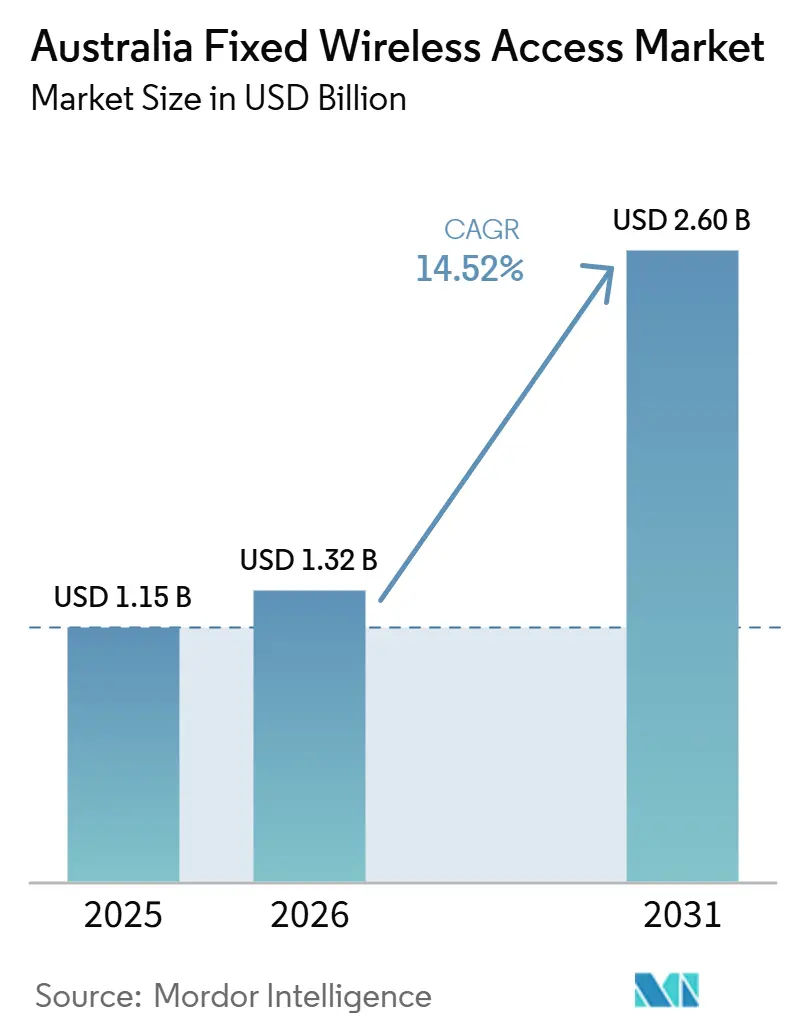
The Australia fixed wireless access market size is expected to grow from USD 1.15 billion in 2025 to USD 1.32 billion in 2026 and is forecast to reach USD 2.60 billion by 2031 at 14.52% CAGR over 2026-2031. This expansion is closely tied to the completion of NBN Co’s fixed wireless and satellite upgrade program, which widened network reach, increased capacity, and raised wholesale speed tiers enough to make fixed wireless a practical primary broadband option for a much larger user base. The Australia fixed wireless access market is also benefiting from the broader 5G rollout by national operators, because every additional high-capacity site improves the economics of serving homes and small businesses without the long lead times that come with fixed-line builds. Government-backed regional connectivity programs continue to support demand, especially where broadband access is treated as an infrastructure and resilience need rather than only a consumer service. At the same time, enterprise demand for backup connectivity and managed continuity services is widening the revenue base beyond household subscriptions and one-time device sales. The main limits remain the faster pace of fiber upgrades in commercially attractive urban areas, pressure on shared spectrum in dense corridors, and the performance sensitivity of higher-frequency bands in some climates, but the Australia fixed wireless access market still has its strongest runway in regional coverage expansion, managed business connectivity, and mmWave-led performance upgrades.
Key Report Takeaways
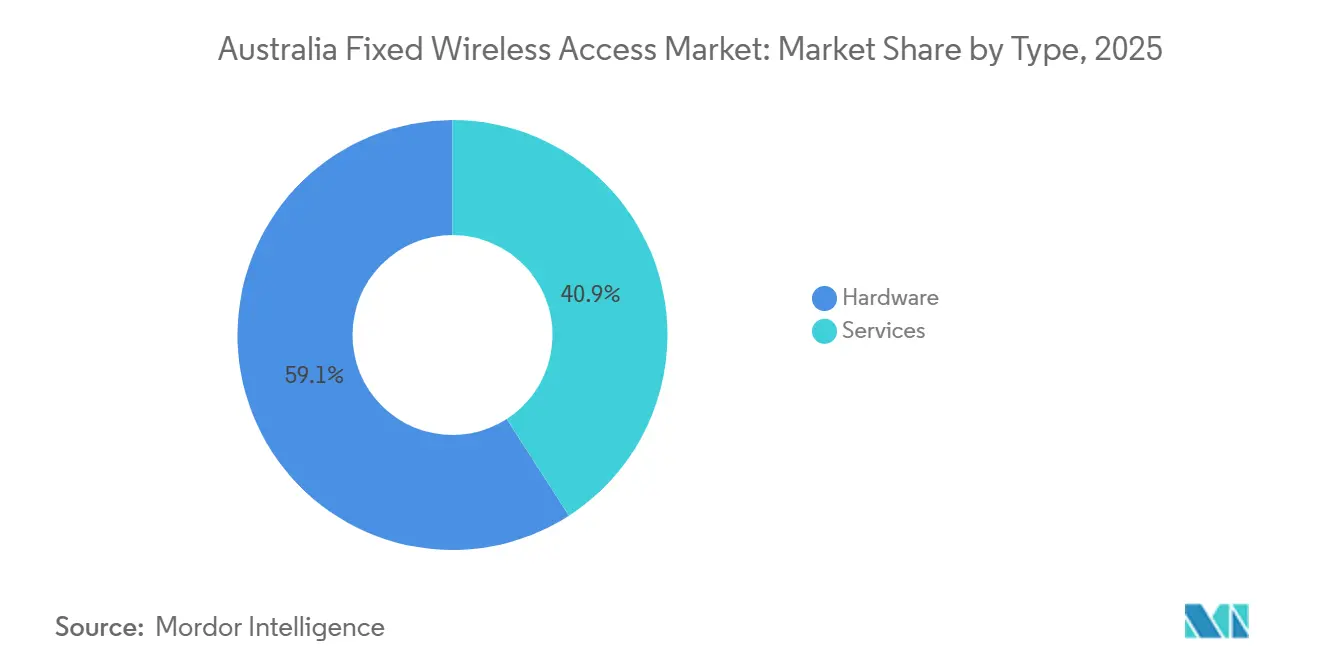
- By type, hardware held 59.11% share in 2025, while services is projected to expand at a 15.42% CAGR through 2031 in the Australia fixed wireless access market.
- By application, residential connections held 66.86% share in 2025, while government and public safety is projected to expand at a 14.87% CAGR through 2031.
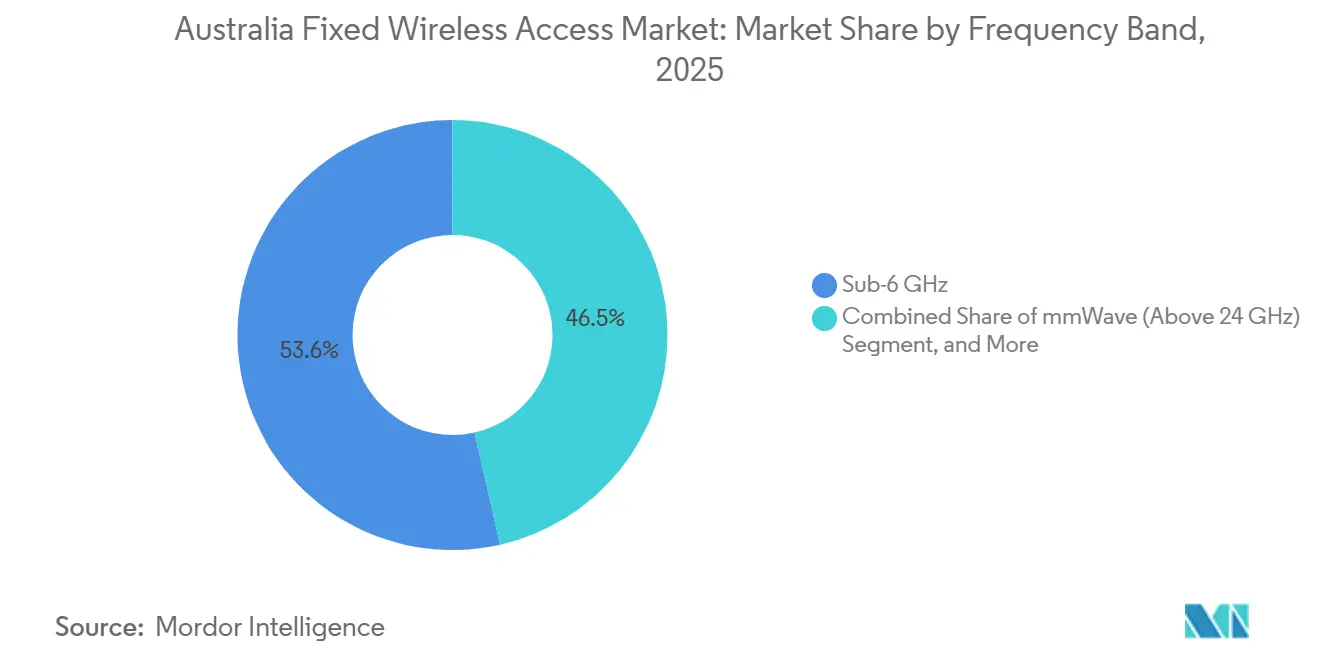
- By frequency band, sub-6 GHz accounted for 53.55% share of the Australia fixed wireless access market size in 2025, while mmWave above 24 GHz is projected to grow at a 15.64% CAGR through 2031.
- By deployment mode, indoor CPE held 62.11% share in 2025, while self-install window-mount CPE is projected to expand at a 15.88% CAGR through 2031.
Note: Market size and forecast figures in this report are generated using Mordor Intelligence’s proprietary estimation framework, updated with the latest available data and insights as of January 2026.
Australia Fixed Wireless Access Market Trends and Insights
Drivers Impact Analysis*
| DRIVER | (~) % IMPACT ON CAGR FORECAST | GEOGRAPHIC RELEVANCE | IMPACT TIMELINE |
|---|---|---|---|
| 5G Rollout Expanding FWA Coverage | +3.8% | National, with core adoption in metropolitan corridors including Sydney, Melbourne, and Brisbane, and faster regional uptake | Medium term (2-4 years) |
| Government-Backed Regional Broadband Substitution | +3.2% | Regional, rural, and remote Australia, with state-level gains in New South Wales, Victoria, and Queensland | Short term (≤ 2 years) |
| FWA as a Faster Time-to-Connect Alternative to Fiber | +2.5% | Metropolitan and suburban Australia, especially greenfield estates and churn-heavy NBN FTTN areas | Short term (≤ 2 years) |
| Enterprise Demand for Backup and Business Continuity Connectivity | +1.8% | National, with stronger concentration in Sydney, Melbourne, Brisbane, and Perth business districts | Medium term (2-4 years) |
| Low-Touch CPE and Self-Install Models Reducing Acquisition Friction | +1.2% | National, especially metropolitan and suburban residential markets | Short term (≤ 2 years) |
| Carrier Spectrum Refarming Supporting More Efficient FWA Capacity | +0.9% | National, with earlier gains in high-density metro areas after legacy network shutdowns | Long term (≥ 4 years) |
| Source: Mordor Intelligence | |||
5G Rollout Expanding Addressable FWA Coverage
The 5G buildout remains the strongest structural growth force shaping the Australia fixed wireless access market. NBN Co, Ericsson, and Qualcomm reported a live field trial in March 2025 that delivered wholesale download speeds above 1 Gbps over a 14 km range using 28 GHz spectrum, materially widening the practical case for higher-performance wireless broadband beyond a narrow urban footprint.[1]Ericsson, “Ericsson, NBN Co and Qualcomm Achieve 5G mmWave Breakthrough Extending Range to 14 km with Gigabit Speeds,” Ericsson The same program showed that mmWave can support a broader service radius than operators previously assumed, improving the return on tower upgrades and expanding where premium wireless plans can be sold. NBN Co also confirmed that the completed upgrade program expanded the fixed wireless footprint from 220,000 to 345,000 square kilometers and increased network capacity by 4 times, changing the service proposition from a fallback option to a more credible broadband substitute.[2]NBN Co, “nbn Fixed Wireless Upgrade Program Completed,” NBN Co As 5G layers spread across more sites, the added cost of connecting a new fixed wireless customer falls because much of the radio investment has already been made for wider network use. That makes coverage expansion in second-tier and outer-suburban locations more commercially attractive than extending fixed-line infrastructure into every address cluster.
Government-Backed Regional Broadband Substitution
Public funding continues to directly and measurably shape the Australia fixed wireless access market. NBN Co said its fixed wireless and satellite upgrade program was backed by AUD 480 million (USD 332.89 million) from the Australian Government and AUD 270 million (USD 187.25 million) from NBN Co, and the program upgraded more than 2,300 towers while moving 120,000 premises from satellite to fixed wireless service. The New South Wales Government’s Regional Digital Connectivity Program also set out a framework to improve access across 44 regional communities, supporting a steady pipeline of tower builds and service activations in underserved areas.[3]New South Wales Government, “Regional Digital Connectivity Program,” NSW Government This funding matters because once a premise becomes serviceable, activation is usually far faster and less disruptive than a fixed-line construction project. That shortens the time between network availability and revenue capture, which is one reason regional rollout programs can generate demand quickly after completion. It also makes broadband policy more durable, because wireless coverage is increasingly tied to resilience, education, health care access, and regional economic participation rather than solely to consumer internet demand.
FWA as a Faster Time-to-Connect Alternative to Fiber
Provisioning speed is creating a durable use case for the Australian fixed wireless access market, especially for households and businesses that want a working connection quickly. NBN Co’s FY25 annual report showed that 430,000 premises were converted from copper to full fiber in the year, but the fixed-line upgrade path still depends on design work, lead-ins, and technician activity that can stretch connection timeframes. By contrast, the main fixed wireless offer often relies on self-install equipment and can move from order to service much more quickly. ACCC data for the December 2025 quarter showed NBN fixed wireless met the 98% standard connection service level, which helped reduce older concerns that wireless service quality would lag too far behind fixed-line alternatives.[4]Australian Competition and Consumer Commission, “December Quarter 2025 Data,” Service Quality and Network Performance Record Keeping Rule for Superfast Broadband Networks Telstra also widened its 5G home internet lineup in 2026 with lower entry-price tiers that do not require technician installation, enabling faster switching for cost-conscious or dissatisfied users.[5]Telstra, “5G Home Internet Plans,” Telstra This combination of short installation cycles, simpler equipment logistics, and improving service consistency gives wireless broadband a lasting place even while the fiber base continues to grow.
Enterprise Demand for Backup and Business Continuity Connectivity
Enterprise demand is opening a second growth lane for the Australia fixed wireless access market beyond consumer broadband. Businesses increasingly use fixed wireless as a backup link, a temporary primary connection, or part of a managed connectivity package because it can be deployed quickly and layered into wider continuity plans. The commercial value is stronger in this segment because recurring service contracts, service-level commitments, and managed overlays generally carry better retention than one-off hardware sales. Indara’s disaster recovery skids program, which became ready for deployment in New South Wales and Victoria from June 2026, reflects a wider push to keep critical digital infrastructure connected during emergencies. That operating environment supports fixed wireless solutions that can be activated faster than new fixed-line builds or used as a parallel path when networks are under stress. It also means enterprise churn is likely to remain lower than residential churn because the service is often embedded within a broader operating and risk framework rather than treated as a standalone monthly utility.
Restraints Impact Analysis*
| RESTRAINT | (~) % IMPACT ON CAGR FORECAST | GEOGRAPHIC RELEVANCE | IMPACT TIMELINE |
|---|---|---|---|
| Fiber Network Upgrades Limiting Premium FWA Upsell Potential | -1.8% | Metropolitan and inner-regional Australia, especially FTTN areas eligible for FTTP upgrade | Long term (≥ 4 years) |
| Spectrum Congestion in Dense Metro Footprints | -1.4% | Sydney, Melbourne, Brisbane, and Perth metropolitan corridors | Medium term (2-4 years) |
| Weather Sensitivity and Line-of-Sight Constraints in Higher Bands | -0.8% | Coastal and tropical Queensland, Northern Territory, and all mmWave deployments | Short term (≤ 2 years) to Long term (≥ 4 years) |
| Wholesale and Regulatory Controls on Network Economics | -0.6% | National | Long term (≥ 4 years) |
| Source: Mordor Intelligence | |||
Fiber Network Upgrades Limiting Premium FWA Upsell Potential
The fastest-growing structural limit on the Australian fixed wireless access market is the stronger upgrade path to fiber in dense, commercially attractive areas. NBN Co reported that FTTP connections rose from 2.165 million to 2.665 million in FY25, and that full fiber had become the largest fixed-line technology on its network. NBN’s regulatory proposal overview also pointed to a network where 94% of fixed-line premises are expected to have access to gigabit-capability by 2030. This matters most in inner-metro areas because those are the same places where premium wireless plans can command better pricing and where customer acquisition costs are often justified by higher revenue potential. As fiber reaches more of these postcodes, wireless providers will need to lean harder on convenience, mobility, and rapid activation rather than absolute performance leadership.
Spectrum Congestion in Dense Metro Footprints
Shared spectrum capacity in dense urban areas remains a practical constraint on the Australia fixed wireless access market. Fixed wireless traffic uses radio resources that are also needed for other network demands, so the customer experience can tighten during busy periods when metropolitan usage loads rise. The ACMA’s five-year spectrum outlook confirmed continued attention on mid-band allocations for wireless broadband, which supports long-term investment, but it also highlights how scarce and valuable these bands remain for operators with large traffic obligations. AMTA’s update on expiring spectrum licenses also underlines that operators face a structured renewal environment in the 700 MHz to 3.4 GHz range, which can limit how easily smaller players expand capacity or reposition holdings without regulatory clearance. This pressure is strongest in the largest capitals, where the same high-value corridors attract both dense mobile usage and aggressive home internet marketing. The result is a market where top-tier operators with scale, existing sites, and more mature spectrum portfolios are better placed to defend service quality than smaller challengers.
*Our forecasts treat driver/restraint impacts as directional, not additive. The impact forecasts reflect baseline growth, mix effects, and variable interactions.
Segment Analysis
By Type: Services Revenue Momentum Outpacing the Hardware Base
Hardware held 59.11% of the Australia fixed wireless access market share in 2025, reflecting the strong volume of CPE deployments across NBN Co’s expanded fixed wireless footprint and the wider push by national operators to place 5G home internet gateways in more homes. Consumer-premises equipment remained the largest hardware block because most residential connections still rely on gateway-led installation models rather than complex multi-device bundles. NBN Co said the completed upgrade program expanded fixed wireless availability to 800,000 homes and businesses, which directly enlarged the installed base for indoor and outdoor access equipment. The Australia fixed wireless access industry also continued to favor hardware designs that simplify activation and reduce on-site work, because those features support faster conversion and lower provisioning cost. GSA reported that indoor CPE accounted for the majority of global FWA CPE shipments in 2024, which supports the same product direction seen in Australia as operators seek easier residential rollout.
Services is the fastest-growing segment, with a 15.42% CAGR through 2031, pointing to a gradual shift from one-time equipment revenue toward recurring access and managed connectivity income. This change matters because service contracts can absorb hardware price pressure more effectively than a model based solely on device transactions. In the Australia fixed wireless access market, managed enterprise packages, failover subscriptions, and residential broadband plans are all increasing the weight of monthly revenue relative to upfront unit sales. Solace Power and NetComm commercialized a wirelessly powered, window-mounted 5G CPE in December 2025, and that launch showed how device innovation is increasingly being used to strengthen a recurring service proposition rather than simply refresh hardware inventory. The Australia fixed wireless access industry is therefore moving toward a model where equipment still matters, but service quality, installation simplicity, and retention economics define a greater share of the long-run value.


By Application: Residential Demand Leads While Public Safety Sets the Pace
Residential connections accounted for 66.86% of the Australia fixed wireless access market in 2025, keeping households as the clear volume anchor for the sector. That position was supported by regional users who still lack full-fiber access and by metropolitan renters and households seeking a simpler alternative to underperforming fixed-line options. ACCC service quality reporting for the December 2025 quarter showed that NBN fixed wireless met the 98% standard connection service level, which helped reduce historical concerns over activation and reliability. Commercial use remained the next important layer because small and medium-sized businesses value fast deployment and continuity support rather than viewing fixed wireless only through a price lens. The Australia fixed wireless access market also draws growing interest from industrial settings such as smart agriculture, remote infrastructure monitoring, and mining telemetry where coverage economics work better than fixed-line extension.
Government and public safety are projected to expand at a 14.87% CAGR through 2031, which makes it the fastest-growing application area, even though it does not yet match residential scale. The growth case is supported by the way agencies increasingly treat communications resilience as part of core operating readiness rather than a secondary network choice. Indara’s disaster recovery skids program, deployment-ready from June 2026 in New South Wales and Victoria, showed how wireless capability is being built directly into emergency response support for critical digital infrastructure. The New South Wales Government’s regional connectivity framework also reinforces this pattern by tying wireless access to broad public service reach in areas that remain hard to serve through fixed-line builds alone. Once public procurement frameworks are in place, renewal cycles tend to be longer, and supplier switching is lower than in the household segment. That gives this application a different revenue profile, with stronger visibility and less dependence on monthly consumer plan churn.
By Frequency Band: Sub-6 GHz Holds Scale While mmWave Lifts Performance
Sub-6 GHz accounted for 53.55% share in 2025, and that lead reflected the practical value of broad coverage, acceptable throughput, and tower economics that work across residential and SME use cases. These bands remain central to wide-area service because they offer stronger propagation characteristics than higher-frequency options and can serve more geography from each site. NBN Co said its completed upgrade program expanded fixed wireless coverage from 220,000 to 345,000 square kilometers, and that the wider reach reinforced the importance of mid-band spectrum in supporting national-scale coverage. ACMA’s spectrum outlook also confirmed ongoing focus on mid-band allocations that support wireless broadband investment. In the Australia fixed wireless access market, sub-6 GHz therefore remains the core delivery layer for volume deployment even as higher-frequency technologies improve.
The Australia fixed wireless access market for mmWave above 24 GHz is projected to expand at a 15.64% CAGR through 2031, making it the fastest-growing band segment. That acceleration follows a meaningful change in the band’s perceived commercial range. Ericsson, NBN Co, and Qualcomm demonstrated in March 2025 that 28 GHz spectrum could deliver more than 1 Gbps over 14 km in live field conditions, materially strengthening the case for semi-rural and outer-suburban deployment rather than only dense small-cell settings. Airspan also highlighted a private 5G mmWave deployment model in Australia that used 28 GHz radio equipment to support residential community broadband, which showed the band’s relevance beyond traditional operator-led rollouts. Even so, mmWave growth is likely to build on targeted use cases where performance and density justify the investment, while sub-6 GHz continues to carry most of the national service base.

By Deployment Mode: Self-Install Models Reshaping Customer Acquisition
Indoor CPE held a 62.11% share in 2025, confirming that the dominant deployment path in the Australia fixed wireless access market remains the compact, self-install gateway used for home internet activation. This format works because it shortens installation time, reduces truck rolls, and gives operators a cleaner route from marketing to service start. GSA reported that indoor CPE accounted for the majority of global FWA CPE shipments in 2024, consistent with the local shift toward lower-touch installation models. Outdoor CPE remains important in regional deployments where line-of-sight, signal gain, and peak performance still justify a more involved setup. That means the market is not moving away from outdoor equipment, but it is reserving it for cases where the performance benefit clearly outweighs the extra installation effort.
The Australia fixed wireless access market for self-install window-mount CPE is projected to expand at a 15.88% CAGR through 2031, making it the fastest-growing deployment mode. This product direction is important because it aims to narrow the performance gap between simple indoor placement and more complex outdoor mounting. Solace Power and NetComm said in December 2025 that they had commercialized the world’s first wirelessly powered, window-mounted 5G CPE, and the design removes several of the installation barriers that previously slowed adoption of higher-performing self-install hardware. The benefit for operators is direct: easier installation lowers acquisition costs, reduces order friction, and speeds time to revenue. GSA also noted that flexible indoor and outdoor CPE designs accounted for a large share of outdoor shipments in 2024, which supports the view that hybrid form factors will play a larger role in future deployment mixes. As a result, the Australia fixed wireless access market is likely to keep shifting toward equipment that combines stronger signal quality with simpler customer setup.
Geography Analysis
The eastern seaboard states represented the largest concentration of demand in the Australia fixed wireless access market in 2025 because they combine high household density, large SME clusters, and strong operator investment focus. New South Wales, Victoria, and Queensland together accounted for the main contestable base where wireless broadband competes directly with fixed-line offers and where customer switching is driven by convenience, price, and service quality. Telstra held a significant share of the NBN broadband as of December 2025, which shows how concentrated the retail broadband relationship remains around a small set of national operators, even as delivery models differ. In these same states, the commercial value of faster activation is higher because renters, apartment users, and smaller businesses change providers more often than users in remote areas. The Australia fixed wireless access market therefore treats the eastern corridor as both a scale engine and a test bed for performance-led plan competition.
Regional Australia remained the operating core of the Australia fixed wireless access market because this is where fixed wireless solves access gaps that fixed-line networks cannot close as quickly or as economically. NBN Co said its fixed wireless network served 800,000 homes and businesses across 345,000 square kilometers after the upgrade program was completed in early 2025. The New South Wales Government’s Regional Digital Connectivity Program and related NBN fixed wireless activity also support a wider pipeline of service expansion across underserved communities. In these areas, broadband access affects health, education, agriculture, remote work, and local business continuity, so usage growth depends on more than just new subscriber counts. Once service becomes available, higher-speed tiers often follow, as users quickly shift more of their work and household activities online. That pattern creates a compounding revenue effect in regional deployments that is less visible in purely urban comparisons.
Remote and outer-regional locations form a separate layer of the Australia fixed wireless access market because they sit at the edge of commercial viability yet remain strategically important. NBN Co’s migration of 120,000 premises from satellite to fixed wireless after the upgrade program showed that the addressable base in remote areas is larger than previously assumed. Airspan’s Australian work with Prospecta Utilities also showed that private mmWave networks can support community-scale broadband in targeted residential settings outside the standard national operator model. This gives remote and niche communities a broader set of service pathways, especially where social equity goals or specialized site economics justify solutions that a conventional mass-market model would not prioritize.
Competitive Landscape
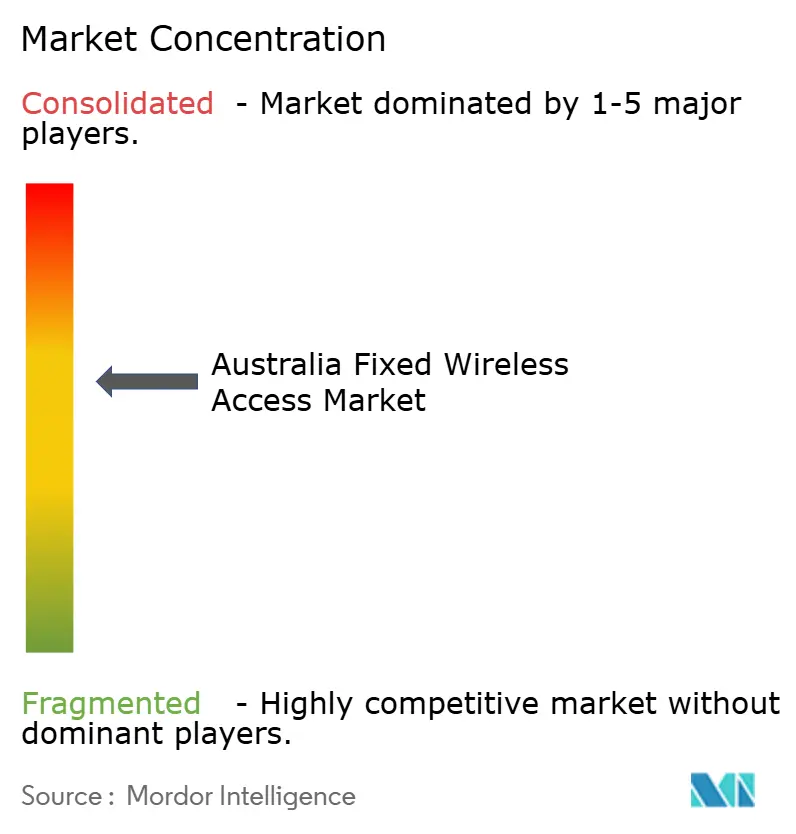
The Australia fixed wireless access market shows moderate concentration at the retail operator layer and much broader fragmentation across infrastructure, radio, and CPE suppliers. Telstra, Optus, and TPG Telecom remain the main consumer-facing operators, while NBN Co plays a distinct wholesale role that shapes coverage, pricing discipline, and access conditions across much of the network. This structure means scale matters, but it does not create a closed market because vendors still compete on radios, gateways, spectrum efficiency, and deployment design. Ericsson’s long-running work with NBN Co and its March 2025 mmWave milestone with NBN Co and Qualcomm strengthened its position in high-performance fixed wireless infrastructure. The Australia fixed wireless access market also remains open to product-level differentiation because service growth increasingly depends on how quickly and easily providers can turn network capacity into activated revenue.
Competitive strategy is becoming more visible through targeted partnerships and product moves rather than broad national price wars alone. Google and Telstra announced a strategic partnership in June 2026 to strengthen the reach, resilience, security, and reliability of Australia’s digital infrastructure, which supports Telstra’s wider connectivity proposition beyond simple access plans. Telstra also broadened its 5G home internet range in 2026 with lower-tier plan options that simplify switching for price-sensitive users and users seeking installation-free service. Solace Power and NetComm introduced a new self-install window-mount CPE format in late 2025, giving operators another way to compete by improving installation ease without fully sacrificing signal performance. These moves show that competitive advantage is increasingly tied to service activation, product form factor, and ecosystem partnerships rather than only raw network footprint.
A second competitive track is emerging around private and community-scale wireless models. Airspan’s work with Prospecta Utilities in Australia showed that private 5G mmWave networks can serve residential communities with a delivery model that sits outside the traditional national operator and wholesale-only framework. That matters because it opens a path for specialized providers to target retirement communities, multi-dwelling projects, and managed estates with tailored broadband offers. At the same time, ACMA and broader-spectrum renewal settings still favor operators and suppliers that can demonstrate sustained network investment, technical compliance, and long-term delivery capacity. The result is a market where leadership remains stable at the top, but competition below that layer is widening through technology specialization and narrower deployment models.
Australia Fixed Wireless Access Industry Leaders
Telstra Corporation Limited
Singtel Optus Pty Limited
TPG Telecom Limited
NBN Co Limited
Vodafone Group Plc
- *Disclaimer: Major Players sorted in no particular order

Recent Industry Developments
- June 2026: Google and Telstra announced a strategic partnership to enhance the reach, reliability, resilience, and security of Australia's digital and AI infrastructure. The partnership combines both companies' deep network infrastructure expertise to deliver faster, more secure connectivity for Australian businesses and consumers across the Asia-Pacific region.
- May 2026: Indara's Disaster Recovery Skids program became ready for deployment in NSW and Victoria from June 2026 under the Australian Government's Mobile Network Hardening Program Round 2, designed to maintain connectivity for critical digital infrastructure during natural disasters.
- December 2025: Solace Power and NetComm commercialized the world's first wirelessly powered, window-mounted 5G CPE, a self-install form factor that delivers outdoor-grade signal performance without rooftop antenna mounting, with operator evaluations expected to commence in 2026, targeting self-install FWA residential and enterprise deployments.
- March 2025: Ericsson, NBN Co, and Qualcomm Technologies achieved a 5G mmWave breakthrough in live field trials on NBN Co's fixed wireless network, extending the effective range to 14 km with wholesale download speeds exceeding 1 Gbps and upload speeds over 100 Mbps. The trial used 400 MHz of 28 GHz n257 spectrum with commercial hardware, significantly expanding the commercially viable deployment radius of mmWave FWA.


Australia Fixed Wireless Access Market Report Scope
The Australia Fixed Wireless Access Market Report is Segmented by Type (Hardware [Consumer Premise Equipment and Access Units] and Services), Application (Residential, Commercial, Industrial, and Government and Public Safety), Frequency Band (Sub-6 GHz, mmWave (Above 24 GHz), and Unlicensed/Shared CBRS), and Deployment Mode (Indoor CPE, Outdoor CPE, and Self-Install Window-Mount CPE). The Market Forecasts are Provided in Terms of Value (USD).
| Hardware | Consumer Premise Equipment (CPE) |
| Access Units (Femto and Picocells) | |
| Services |
| Residential |
| Commercial |
| Industrial |
| Government and Public Safety |
| Sub-6 GHz |
| mmWave (Above 24 GHz) |
| Unlicensed / Shared CBRS |
| Indoor CPE |
| Outdoor CPE |
| Self-Install Window-Mount CPE |
| By Type | Hardware | Consumer Premise Equipment (CPE) |
| Access Units (Femto and Picocells) | ||
| Services | ||
| By Application | Residential | |
| Commercial | ||
| Industrial | ||
| Government and Public Safety | ||
| By Frequency Band | Sub-6 GHz | |
| mmWave (Above 24 GHz) | ||
| Unlicensed / Shared CBRS | ||
| By Deployment Mode | Indoor CPE | |
| Outdoor CPE | ||
| Self-Install Window-Mount CPE |


Key Questions Answered in the Report
What is the size of the Australia fixed wireless access market in 2026?
The Australia fixed wireless access market was valued at USD 1.32 billion in 2026 and is forecast to reach USD 2.60 billion by 2031 at a 14.52% CAGR.
What is driving broadband wireless growth across Australia?
The main growth factors are NBN Co's network upgrade, wider 5G coverage, government-backed regional rollout, and faster connection times compared with many fixed-line alternatives.
Which application area is expanding the fastest through 2031?
Government and public safety are projected to grow at a 14.87% CAGR, supported by resilience planning and public-sector connectivity programs.
Why does sub-6 GHz still lead even though mmWave is growing faster?
Sub-6 GHz held 53.55% share in 2025 because it provides broader coverage and practical throughput across residential and SME use cases, while mmWave is being used more selectively for higher-performance needs.
How important is self-install equipment in this space?
It is very important because indoor CPE held a 62.11% share in 2025, and self-install window-mount CPE is expected to grow at a 15.88% CAGR as operators seek to reduce installation friction.
What is the biggest competitive risk to wireless broadband providers in Australia?
The biggest long-term risk is the accelerating spread of fiber upgrades in premium urban areas, which can pull higher-value users toward fixed-line connections where fiber is available.
Page last updated on:





