
Australia Enterprise Content Management (ECM) Market Size and Share
Market Overview
| Study Period | 2020 - 2031 |
|---|---|
| Forecast Data Period | 2026 - 2031 |
| Base Year Market Size (2025) | USD 0.69 Billion |
| Market Size (2026) | USD 0.81 Billion |
| Market Size (2031) | USD 1.79 Billion |
| Growth Rate (2026 - 2031) | 17.19 % |
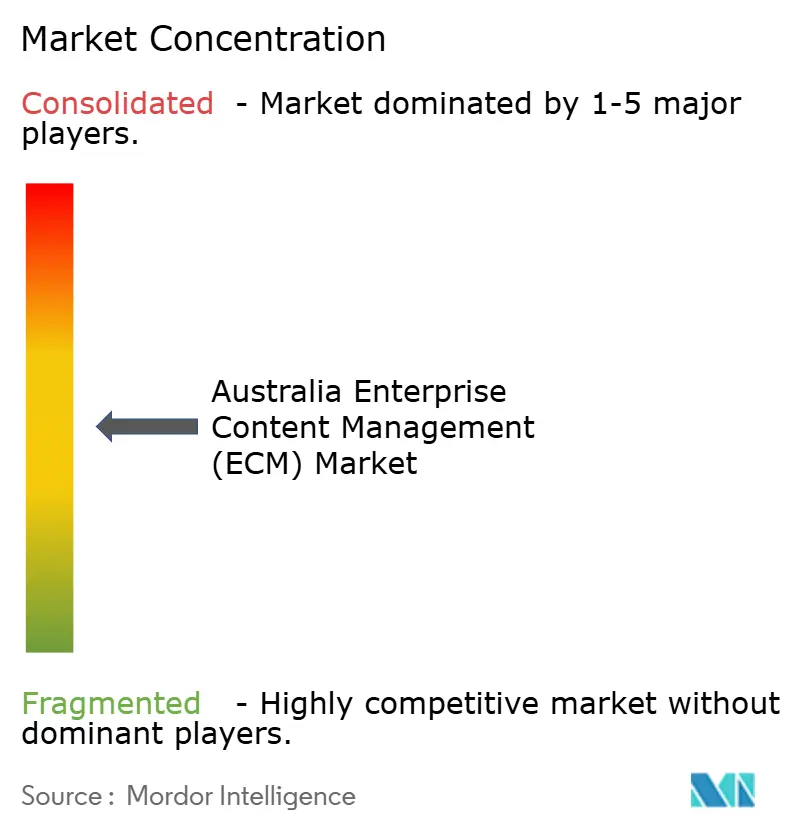
| Market Concentration | Medium |
Major Players *Disclaimer: Major Players sorted in no particular order Image © Mordor Intelligence. Reuse requires attribution under CC BY 4.0. | |
Australia Enterprise Content Management (ECM) Market Analysis by Mordor Intelligence
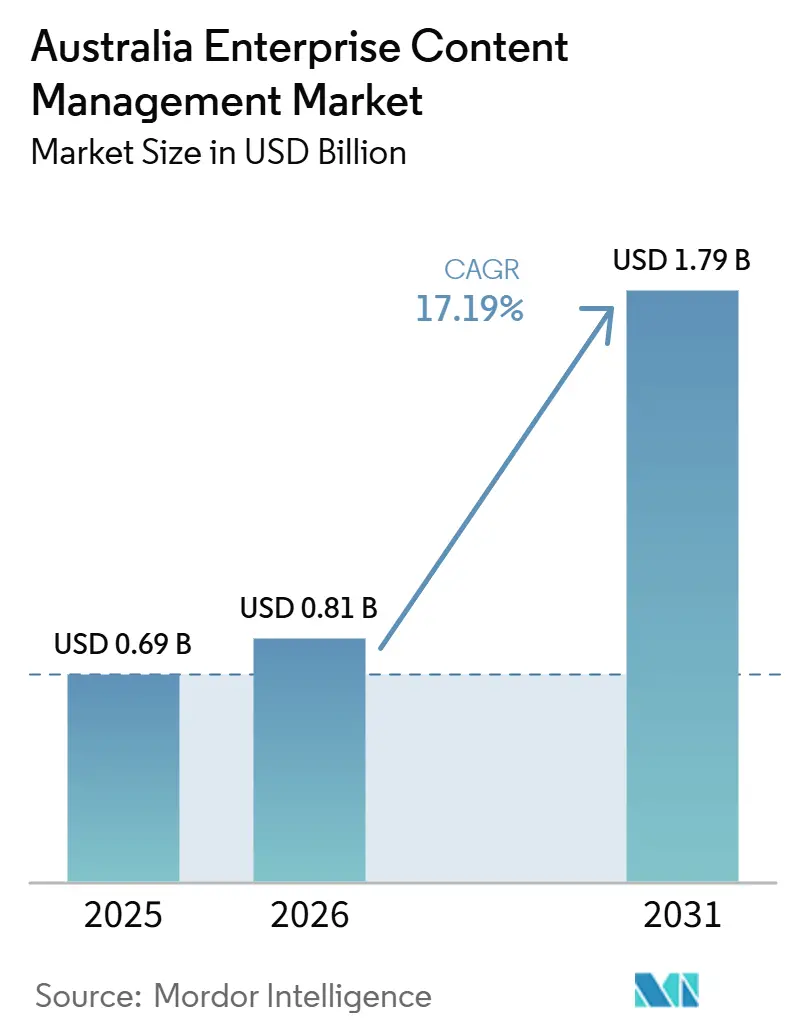
The Australia enterprise content management (ECM) market size stood at USD 0.69 billion in 2025 and is estimated to grow from USD 0.81 billion in 2026 to reach USD 1.79 billion by 2031 at a CAGR of 17.19% from 2026 to 2031. Growth in the Australia enterprise content management (ECM) market is being shaped by a cloud-first public sector policy environment, rising enterprise use of AI tools, and a wider shift toward governed digital workflows across regulated organizations. Public agencies and large private institutions are treating content systems less as passive storage and more as operating infrastructure that supports retrieval, workflow control, audit readiness, and secure collaboration. Demand is also moving toward platforms that can work across cloud and legacy environments, because many buyers still need to manage sensitive data, older repositories, and changing privacy expectations at the same time. Leading vendors are responding by strengthening local processing, sovereign hosting, AI-enabled automation, and deployment flexibility, which is raising the competitive standard across the market. At the same time, migration complexity, governance skill gaps, and stricter privacy controls continue to slow some deployments even as long-term spending momentum remains strong.
Key Report Takeaways
- By solution type, document management held 29.43% of the Australia enterprise content management (ECM) market share in 2025, while workflow and business process management are projected to expand at a 17.98% CAGR through 2031.
- By deployment mode, cloud captured 76.29% of the market in 2025, while hybrid is expected to record the highest CAGR at 18.26% through 2031.
- By enterprise size, large enterprises commanded 64.58% of the market in 2025, while small and medium enterprises are projected to grow fastest at an 18.57% CAGR through 2031.
- By end-user industry, BFSI accounted for 27.36% of the market in 2025, while healthcare is projected to expand at an 18.29% CAGR through 2031.
Note: Market size and forecast figures in this report are generated using Mordor Intelligence’s proprietary estimation framework, updated with the latest available data and insights as of January 2026.
Australia Enterprise Content Management (ECM) Market Trends and Insights
Drivers Impact Analysis*
| DRIVER | (~) % IMPACT ON CAGR FORECAST | GEOGRAPHIC RELEVANCE | IMPACT TIMELINE |
|---|---|---|---|
| Rising Digital Transformation Across Regulated Enterprises | +4.5% | National, concentrated in Canberra, Sydney, and Melbourne government and enterprise clusters | Long term (≥ 4 years) |
| Growing Shift to Cloud-Based Content Repositories | +3.8% | National, with early gains concentrated in New South Wales and Victoria | Medium term (2-4 years) |
| AI-Assisted Content Classification and Retrieval | +3.2% | National, with early concentration in BFSI and healthcare in Sydney and Melbourne | Medium term (2-4 years) |
| Tighter Records Retention and Audit Readiness Requirements | +2.5% | National, strongest in Canberra and Sydney | Long term (≥ 4 years) |
| Expansion of Remote and Distributed Workflows | +1.8% | National, with pronounced relevance in regional and rural areas | Short term (≤ 2 years) |
| Integration Demand from ERP, CRM, and Collaboration Suites | +1.6% | National | Medium term (2-4 years) |
| Source: Mordor Intelligence | |||
Rising Digital Transformation Across Regulated Enterprises
Regulated organizations are pushing the Australia enterprise content management (ECM) market forward because digital transformation programs now reach deeper into daily operations, records handling, and service delivery. The Australian Government’s Data and Digital Government Strategy Implementation Plan for 2025 set clearer expectations around information use, service modernization, and digital capability uplift across the public sector, which supports more disciplined investment in governed content platforms.[1] This matters because many agencies and regulated enterprises have moved beyond basic digitization and are now trying to connect documents, workflows, approvals, and searchable records in a single operating environment. AWS research showed that 50% of Australian businesses were using AI regularly by 2025, and one business adopted AI every 3 minutes between 2024 and 2025, which increases the need for controlled and searchable information layers beneath those tools. Microsoft also reported that 17 of the ASX Top 20 companies and 57 government agencies had already deployed Microsoft 365 Copilot, which shows how quickly AI use is spreading through large organizations that depend on enterprise content control. As a result, the Australia enterprise content management (ECM) market is benefiting from a shift in buyer priorities, because information governance is now being treated as part of digital execution rather than as a separate back-office task.
Growing Shift to Cloud-Based Content Repositories
Cloud adoption remains a central force in the Australia enterprise content management (ECM) market, but local buying behavior shows that this shift is being shaped by policy and sovereignty needs rather than by infrastructure economics alone. Cloud accounted for 76.29% of the market in 2025, which shows that most new deployments already favor hosted delivery, while Hybrid is still set to grow faster as buyers balance modernization with control. The whole-of-government cloud computing policy made cloud-first the required path for new APS digital and ICT initiatives from 1 July 2026, which gives cloud-native platforms a stronger position in public procurement. At the same time, the same policy framework places strong weight on secure handling, local control, and sound operating discipline, which keeps hybrid and sovereign models relevant for agencies and regulated enterprises.[2] Microsoft addressed this pressure in November 2025 by extending in-country data processing for Microsoft 365 Copilot to Australia, which showed that global vendors were already adapting product architecture to local expectations. SAP made a similar move by expanding its Sovereign Cloud capabilities in Australia, including an On-Site model for public sector organizations, which supports the view that cloud growth in the market will favor vendors that can combine scale with local control.
AI-Assisted Content Classification and Retrieval
AI-assisted classification and retrieval are becoming a practical buying criterion in the Australia enterprise content management (ECM) market because enterprises want faster search, better tagging, cleaner workflows, and stronger control over document handling. Microsoft’s 2025 economic impact report showed that Copilot use had already spread across top Australian companies and public agencies, which confirms that intelligent assistance is moving into mainstream work environments that depend on governed records and permissions. This adoption pattern matters because AI tools perform best when repositories are well structured, access rules are clear, and content can be classified consistently across systems. The pressure is no longer limited to productivity, because once organizations deploy AI at scale, they also need content systems that can surface reliable material without exposing the wrong records to the wrong users. Western Australia’s Digital Medical Record rollout shows the scale that these environments can reach, with 44 million documents digitized and 140 million records made available across the system by 2025. The Australia enterprise content management market is therefore gaining from AI not only as a feature cycle, but also as a driver of better repository design, stronger metadata discipline, and more structured retrieval models.
Tighter Records Retention and Audit Readiness Requirements
Records retention and audit readiness are supporting the Australia enterprise content management (ECM) market because organizations are operating under closer scrutiny around privacy, accountability, and the use of sensitive information. The Data and Digital Government Strategy Implementation Plan for 2025 linked digital modernization with stronger information handling and public service delivery expectations, which reinforces the need for content controls that are durable and auditable. The Whole-of-Government Cloud Computing Policy also stressed secure management, which means content systems are expected to support governance as well as storage and access. The Governance Institute of Australia warned organizations to take a proactive approach to privacy, AI, and higher-risk technology use, which supports demand for systems that can document retention, access history, and controlled workflows more clearly. In practice, buyers are looking for platforms that reduce manual handling, make audit trails easier to verify, and support consistent rules across departments and business units. That pushes the Australia enterprise content management (ECM) market toward vendors that can combine records governance, workflow orchestration, and policy-aligned controls in one environment.
Restraints Impact Analysis*
| RESTRAINT | (~) % IMPACT ON CAGR FORECAST | GEOGRAPHIC RELEVANCE | IMPACT TIMELINE |
|---|---|---|---|
| Legacy Repository Migration Complexity | -2.8% | National, strongest in Canberra and large enterprise clusters in Sydney and Melbourne | Long term (≥ 4 years) |
| Data Security and Privacy Concerns in Cloud ECM | -2.2% | National, concentrated in BFSI, healthcare, and defense | Medium term (2-4 years) |
| Skills Gap in Information Governance and ECM Administration | -1.5% | National, with more severe impact in regional areas | Medium term (2-4 years) |
| High Customization and Integration Costs for Enterprise Rollouts | -1.2% | National, concentrated in large enterprises and the public sector | Short term (≤ 2 years) |
| Source: Mordor Intelligence | |||
Legacy Repository Migration Complexity
Legacy migration remains a major restraint on the Australia enterprise content management (ECM) market because many organizations still hold years of content across disconnected systems, formats, and ownership structures. This issue is especially difficult in large institutions where content is tied to old processes, local naming habits, and application-specific integrations that were never designed for clean transfer. Even when buyers choose modern platforms, they often have to sort, classify, and validate large volumes of material before they can move workflows at full scale. Western Australia’s Digital Medical Record program, which digitized 44 million documents and exposed 140 million records across the system, illustrates how large enterprise and public sector repositories can become before modernization is complete. The challenge is not only technical, because migration also affects governance, user retraining, operating continuity, and confidence in search and retrieval after cutover. For that reason, the Australia enterprise content management (ECM) market continues to grow, but many deployments move in stages rather than through a single full replacement event.
Data Security and Privacy Concerns in Cloud ECM
Security and privacy concerns continue to slow parts of the Australia enterprise content management (ECM) market because buyers in regulated sectors need more than standard cloud availability and broad compliance claims. The Whole-of-Government Cloud Computing Policy requires secure cloud decision-making and places strong emphasis on control, which raises the bar for vendors that want access to public sector and adjacent regulated demand. The Governance Institute of Australia also highlighted the need for active planning around privacy and AI, which means enterprise buyers are increasingly testing how content platforms handle permissions, auditability, data exposure, and policy change. Microsoft’s move to add in-country data processing for Copilot in Australia and SAP’s expansion of sovereign cloud options both show that vendors see local processing and hosting control as competitive necessities rather than optional upgrades. Buyers who manage financial records, health data, or sensitive government files are therefore more likely to favor vendors with clear local operating models and stronger governance design. This keeps demand strong overall, but it also lengthens procurement, technical review, and vendor qualification cycles across the Australia enterprise content management (ECM) market.
*Our forecasts treat driver/restraint impacts as directional, not additive. The impact forecasts reflect baseline growth, mix effects, and variable interactions.
Segment Analysis
By Solution Type: Document Management Anchors Revenue While Workflow Automation Lifts Future Demand
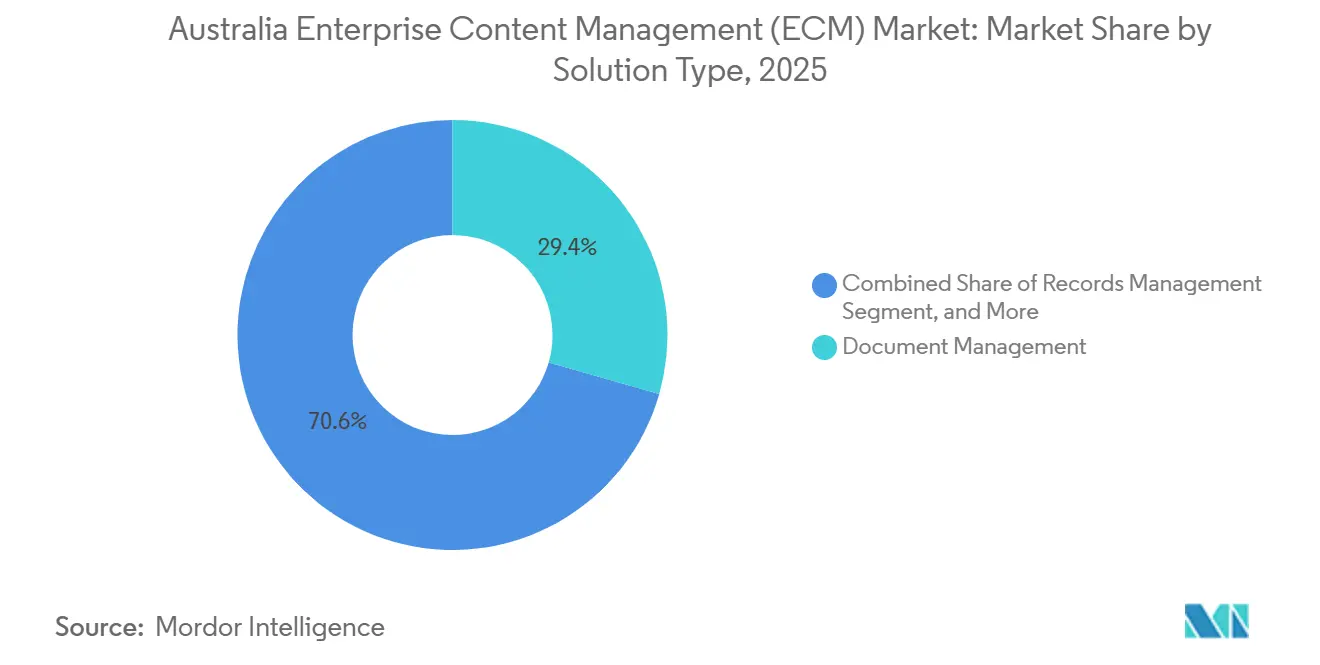
Document management held 29.43% of the Australia enterprise content management (ECM) market in 2025, while workflow and business process management is projected to grow at a 17.98% CAGR through 2031. Document management remains the core layer for many buyers because it supports controlled storage, retrieval, versioning, and retention across regulated operating environments. In the Australia enterprise content management (ECM) market, this category remains central in government, financial services, and healthcare because those buyers need dependable record handling before they can scale broader automation. The market is also moving beyond passive storage because organizations now expect repositories to feed approvals, case handling, and searchable workspaces that support faster decisions. Microsoft’s rapid Copilot adoption across top Australian companies and public agencies points to that change, because AI tools rely on well-governed underlying content rather than isolated file archives. As a result, document systems that once served mainly as archives are increasingly being judged on how well they prepare content for wider workflow and AI use.
Workflow and business process management is gaining faster than any other solution group because buyers want to reduce handoffs, standardize routing, and connect documents directly with operational systems. This growth fits the broader direction of the Australia enterprise content management industry, where content value now depends on how quickly information moves through approvals, claims, service requests, and regulated decisions. Newgen Software’s 2025 partnership with NCS Australia supports that view, because it focused on enterprise-scale low-code modernization across finance, insurance, the public sector, and utilities.[3] Case management is also gaining practical relevance in public and health settings where a file is only one part of a wider service process that spans teams, deadlines, and review points. Records Management continues to hold a stable role because compliance needs do not disappear when organizations modernize their front-end workflows. Digital asset management and web content management remain smaller portions of demand, but they are becoming more relevant where large content libraries, customer communications, and omnichannel publishing need to connect with governed enterprise repositories.

By Deployment Mode: Cloud Commands the Market, But Hybrid Remains a Practical Choice
Cloud accounted for 76.29% of the market in 2025, while hybrid is projected to expand at an 18.26% CAGR through 2031. That combination shows that the Australia enterprise content management (ECM) market is already cloud-led, but not cloud-only, because many buyers still need mixed architectures to manage local control and legacy content. The whole-of-government cloud computing policy strengthened the case for cloud-first deployment from 1 July 2026, which supports continued migration toward hosted and subscription-based platforms in public programs. Even so, many institutions cannot move everything at once, so hybrid models remain attractive where some repositories are ready for cloud workflows, and others still need to remain in controlled environments. Microsoft’s November 2025 decision to provide in-country processing for Copilot in Australia shows how strongly sovereign data expectations are shaping hosted platform design. The Australia enterprise content management (ECM) market size for cloud-led deployments should therefore keep rising, but the fastest practical path for many large accounts is still a staged hybrid model rather than a full immediate shift.
Hybrid grows faster because it lets organizations protect continuity while modernizing in steps. Many large enterprises and public bodies have sensitive workloads, existing integrations, and internal review processes that make a single-mode deployment harder to execute cleanly. SAP’s 2025 Sovereign Cloud expansion in Australia, including an On-Site model for the public sector, shows that major vendors now see controlled and mixed-hosting options as necessary parts of their local offering. On-premises systems still hold ground where organizations require tighter facility-level control or need to keep older content stores in place until cleanup and migration plans are complete. Buyers are also using hybrid models to connect new AI-enabled workflows with older repositories instead of forcing immediate bulk transfer. This means the Australia enterprise content management (ECM) market is not moving away from control, because it is blending cloud scale with gradual repository transition in a way that fits local governance conditions.
By Enterprise Size: Large Enterprises Lead While SMEs Gain Through Easier Access
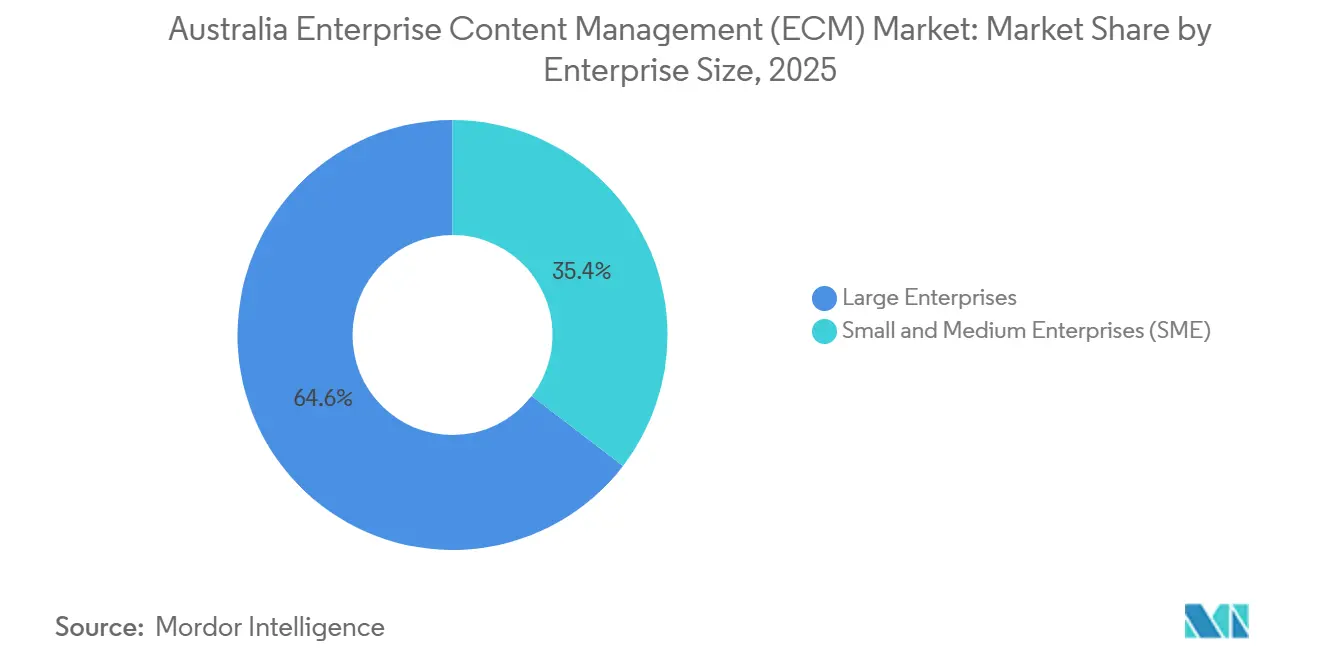
Large enterprises held 64.58% of the market in 2025, while small and medium enterprises are forecast to grow at an 18.57% CAGR through 2031. Large organizations remain the revenue base of the Australia enterprise content management market because they carry the highest document volumes, the deepest compliance demands, and the broadest integration needs across departments and systems. These buyers often need a platform that can support records control, workflow routing, security permissions, and large user populations at the same time. They are also more likely to invest in AI-enabled content tools because they already manage large repository footprints and want to improve how staff find, classify, and act on information. Microsoft’s reported spread of Copilot across major Australian companies and government agencies shows that large institutions are moving quickly when governance and productivity goals align. This is why large enterprises still anchor spending across the Australia enterprise content management (ECM) market even as a wider customer base begins to open.
SMEs are growing faster because the cost and complexity barriers that once limited adoption are falling. Subscription pricing, lighter implementation models, and packaged automation are making enterprise-grade control more reachable for mid-sized organizations that still handle regulated or operationally important documents. AWS research found that 50% of Australian businesses used AI regularly by 2025, which suggests that smaller organizations are also becoming more willing to invest in smarter digital workflows. Box added to this shift in April 2026 when it launched Box Automate and Box Agent, extending its platform for AI-enabled workflow handling and content tasks through a simpler cloud delivery model. The Australia enterprise content management industry is therefore widening beyond large institutional buyers, because SMEs now have clearer reasons to adopt governed content tools for efficiency, customer service, and compliance support. Over time, this should make the market less dependent on a small number of very large deployments and more balanced across organization sizes.
By End-User Industry: BFSI Holds the Lead While Healthcare Delivers the Fastest Growth
BFSI held 27.36% of the Australia enterprise content management (ECM) market in 2025, while Healthcare is projected to grow at an 18.29% CAGR through 2031. BFSI remains the largest end-user group because banks, insurers, and financial service providers depend on tight document handling, access control, and auditable workflows across customer records, risk files, and regulated decisions. The sector also faces growing pressure to manage AI responsibly, which adds value to platforms that can show stronger governance over enterprise content and retrieval. APRA’s 2025 letter to industry on artificial intelligence called for a step change in how regulated entities manage AI-related risks, and that reinforces demand for platforms that can support cleaner information control.[4] In this setting, the Australia enterprise content management (ECM) market share held by BFSI reflects more than scale alone, because the sector treats content governance as part of operating discipline. Large financial institutions are therefore likely to remain priority accounts for global vendors that can combine workflow depth, security, and integration with broader enterprise systems.
Healthcare is growing faster because statewide digitization, clinical document access, and privacy-sensitive records management are expanding together. Western Australia completed a major rollout in 2025 that digitized 44 million documents and made 140 million records available across the Digital Medical Record system, which shows the scale and urgency of healthcare content modernization. This makes healthcare one of the strongest forward demand pools in the Australia enterprise content management (ECM) market, especially where hospitals and health networks need secure retrieval and long-term record control across many users and locations. Government and public sector demand also remains important, supported by the data and digital government strategy implementation plan and the whole-of-government cloud computing policy, both of which reinforce modernization across agency workflows. IT and telecommunications, manufacturing, retail, media, education, energy, and utilities add breadth to the market as each group digitizes field documentation, customer-facing content, regulated reports, and internal approvals. This spread across end users gives the Australia enterprise content management (ECM) market a wider demand base even though BFSI and healthcare remain the clearest anchors.
Geography Analysis
Demand in the Australia enterprise content management (ECM) market is concentrated in Sydney, Melbourne, and Canberra, where large regulated institutions set the pace for adoption. Sydney and Melbourne form the largest commercial demand base because banking, insurance, professional services, major hospitals, and large corporate headquarters are concentrated there. Canberra operates as a separate procurement center because Commonwealth agencies face stricter public sector requirements around secure digital service delivery and cloud transition. The data and digital government strategy implementation plan and the whole-of-government cloud computing policy are reinforcing this public sector demand pattern through clearer modernization and cloud-first expectations. Microsoft’s reported spread of Copilot across major companies and government agencies also suggests that many buyers are upgrading existing repositories and workflows rather than replacing content environments from the ground up.
State-led health digitization programs are creating a second layer of demand within the Australia enterprise content management (ECM) market, especially outside Canberra. Western Australia completed its AUD 247 million (USD 160.6 million) digital medical record and single sign-on rollout in 2025, with 44 million documents digitized and 140 million records available across the system. That scale shows why hospitals and health networks are becoming major buyers of governed document workflows, secure retrieval, and long-term archive control. The same pattern is likely to support further adoption across other state-led service systems where case files, forms, and regulated records move across multiple agencies.
Regional and rural areas represent a smaller installed base today, but they form an important expansion area for the Australia enterprise content management (ECM) market over the forecast period. The Australian Public Service AI Plan 2025 identified cloud adoption as foundational to AI capability uplift, which supports wider deployment in agencies serving non-metropolitan communities. This matters for resources, agriculture, utilities, education, and government organizations that need governed access to documents across dispersed locations. Cloud-native delivery, local data handling, and simpler administration can help vendors reach sites that were previously harder to serve with traditional on-premises systems.
Competitive Landscape
The Australia enterprise content management (ECM) market is moderately concentrated at the top tier, but competition is broad enough to prevent any single vendor from controlling demand across all buyer groups. Microsoft, OpenText, and IBM retain strong positions with large enterprises and public sector accounts because they are embedded in long-running workflows and enterprise software stacks. At the same time, Hyland, Newgen Software, M-Files, Laserfiche, and Box are using AI functions, workflow depth, and simpler deployment models to widen their reach. The result is a market where incumbency still matters, but differentiation increasingly depends on how well vendors support governance, retrieval, automation, and sovereign data requirements. The Governance Institute of Australia has warned organizations to take a proactive approach to privacy, AI, and higher-risk technology use, which strengthens demand for vendors that can show clear control frameworks.
Microsoft strengthened its position in late 2025 by extending in-country data processing for Microsoft 365 Copilot to Australia, which directly addressed sovereign handling concerns for enterprise and government users.[5] SAP also expanded its Australian Sovereign Cloud capabilities in 2025, including an On-Site model for public sector organizations that need tighter control over hosting environments. These moves show that leading vendors are not competing only on features, because they are also competing on where data is processed, how securely it is governed, and how easily customers can satisfy local procurement rules. Vendors that cannot offer local processing, sovereign deployment options, or clear auditability face a weaker position in high-value contracts.
Newgen software used partnerships and project wins to build visibility in workflow-heavy accounts, including its 2025 alliance with NCS Australia and its 2025 automation project for Movigo Group. Laserfiche added another competitive lever in 2026 when it launched its platform on AWS Marketplace, which can shorten procurement cycles for organizations already aligned with AWS. The middle of the Australia enterprise content management (ECM) market is therefore becoming more contested, especially among buyers that want AI-enabled content control without the heavier deployment model associated with older platforms. Competitive intensity should stay elevated as vendors balance installed-base loyalty in large accounts with faster sales cycles in the mid-market.
Australia Enterprise Content Management (ECM) Industry Leaders
-
OpenText Corporation
-
Hyland Software, Inc.
-
M‑Files Corporation
-
Box, Inc.
-
Laserfiche, Inc.
- *Disclaimer: Major Players sorted in no particular order
Recent Industry Developments
- June 2026: Laserfiche made its intelligent content management platform available through AWS Marketplace, enabling streamlined procurement for AWS-aligned Australian organizations in regulated industries seeking agentic AI and document workflow capabilities without separate vendor contracting cycles.
- June 2026: Box released Box Automate, an AI-powered workflow automation solution routing work dynamically across people, agents, and enterprise systems, alongside Box Agent, a natural language AI engine for enterprise content tasks, extending the company’s competitive position in the Australian mid-market and regulated industry segments.
- January 2026: Box announced the general availability of Box Extract, powered by generative AI models from Google, Anthropic, and OpenAI, enabling Australian enterprises to intelligently extract and automate content metadata workflows at scale.
- September 2025: SAP announced expansion of Sovereign Cloud capabilities in Australia including the On-Site model giving public sector organizations the ability to host SAP solutions within their own facilities, with SAP Business Data Cloud and SAP AI Services sovereign capabilities planned for 2026.
Australia Enterprise Content Management (ECM) Market Report Scope
The Australia enterprise content management (ECM) market refers to the market for platforms and solutions that enable organizations in Australia to manage, store, organize, and secure enterprise digital content in a centralized and scalable environment. ECM solutions help businesses manage documents, records, compliance data, customer communications, and marketing assets, while supporting workflow automation, regulatory compliance, and cross-functional collaboration across industries such as government, banking, healthcare, telecom, and retail. The market continues to expand as Australian organizations prioritize digital transformation, data privacy compliance, and AI-powered automation to improve operational efficiency and deliver consistent omnichannel customer engagement.
The Australia Enterprise Content Management (ECM) Market Report is Segmented by Solution Type (Document Management, Records Management, Workflow and Business Process Management, Case Management, Digital Asset Management, Web Content Management, and Other Solutions), Deployment Mode (On-Premises, Cloud, and Hybrid), Enterprise Size (Small and Medium Enterprises (SME), and Large Enterprises). and End-User Industry (BFSI, Government and Public Sector, Healthcare, IT and Telecommunications, Manufacturing, Retail, Media and Entertainment, Education, Energy and Utilities, and Other End-User Industries). The Market Forecasts are Provided in Terms of Value (USD).
| Document Management |
| Records Management |
| Workflow and Business Process Management |
| Case Management |
| Digital Asset Management |
| Web Content Management |
| Other Solution Types |
| On-Premises |
| Cloud |
| Hybrid |
| Small and Medium Enterprises (SME) |
| Large Enterprises |
| BFSI |
| Government and Public Sector |
| Healthcare |
| IT and Telecommunications |
| Manufacturing |
| Retail |
| Media and Entertainment |
| Education |
| Energy and Utilities |
| Other End-User Industries |
| By Solution Type | Document Management |
| Records Management | |
| Workflow and Business Process Management | |
| Case Management | |
| Digital Asset Management | |
| Web Content Management | |
| Other Solution Types | |
| By Deployment Mode | On-Premises |
| Cloud | |
| Hybrid | |
| By Enterprise Size | Small and Medium Enterprises (SME) |
| Large Enterprises | |
| By End-User Industry | BFSI |
| Government and Public Sector | |
| Healthcare | |
| IT and Telecommunications | |
| Manufacturing | |
| Retail | |
| Media and Entertainment | |
| Education | |
| Energy and Utilities | |
| Other End-User Industries |
Key Questions Answered in the Report
How large is the Australia enterprise content management (ECM) market in 2025 and what is it expected to reach by 2031?
The Australia enterprise content management (ECM) market was valued at USD 0.69 billion in 2025 and is estimated to grow from USD 0.81 billion in 2026 to reach USD 1.79 billion by 2031 at a CAGR of 17.19% from 2026 to 2031
Which solution area is leading revenue and which one is growing fastest?
Document Management led with 29.43% share in 2025, while Workflow and Business Process Management is expected to grow fastest at a 17.98% CAGR through 2031.
Why is cloud adoption rising so quickly in Australia for enterprise content management?
Cloud adoption is rising because policy settings now favor cloud-first deployment, while enterprises also want easier scaling, AI readiness, and faster rollout across teams and locations.
Which end-user sector is creating the strongest demand today?
BFSI is the largest end-user segment with 27.36% share in 2025, as banks and insurers need stronger document governance, auditability, and secure workflow control.
What is making healthcare one of the fastest-growing buyer groups?
Healthcare is projected to grow at an 18.29% CAGR through 2031, supported by large clinical digitization programs such as Western Australia’s rollout with 44 million documents digitized and 140 million records made available.
What are the main challenges holding deployments back?
The main barriers are legacy repository migration, stricter security and privacy expectations, governance skill gaps, and the cost of integrating content systems with older enterprise environments.