
Asia-Pacific Wire and Cable Market Size and Share
Market Overview
| Study Period | 2020 - 2031 |
|---|---|
| Forecast Data Period | 2026 - 2031 |
| Base Year Market Size (2025) | USD 127.11 Billion |
| Market Size (2026) | USD 135.56 Billion |
| Market Size (2031) | USD 180.32 Billion |
| Growth Rate (2026 - 2031) | 5.87 % |
| Market Concentration | Medium |
Major Players
*Disclaimer: Major Players sorted in no particular order Image © Mordor Intelligence. Reuse requires attribution under CC BY 4.0. |
|
Asia-Pacific Wire and Cable Market Analysis by Mordor Intelligence
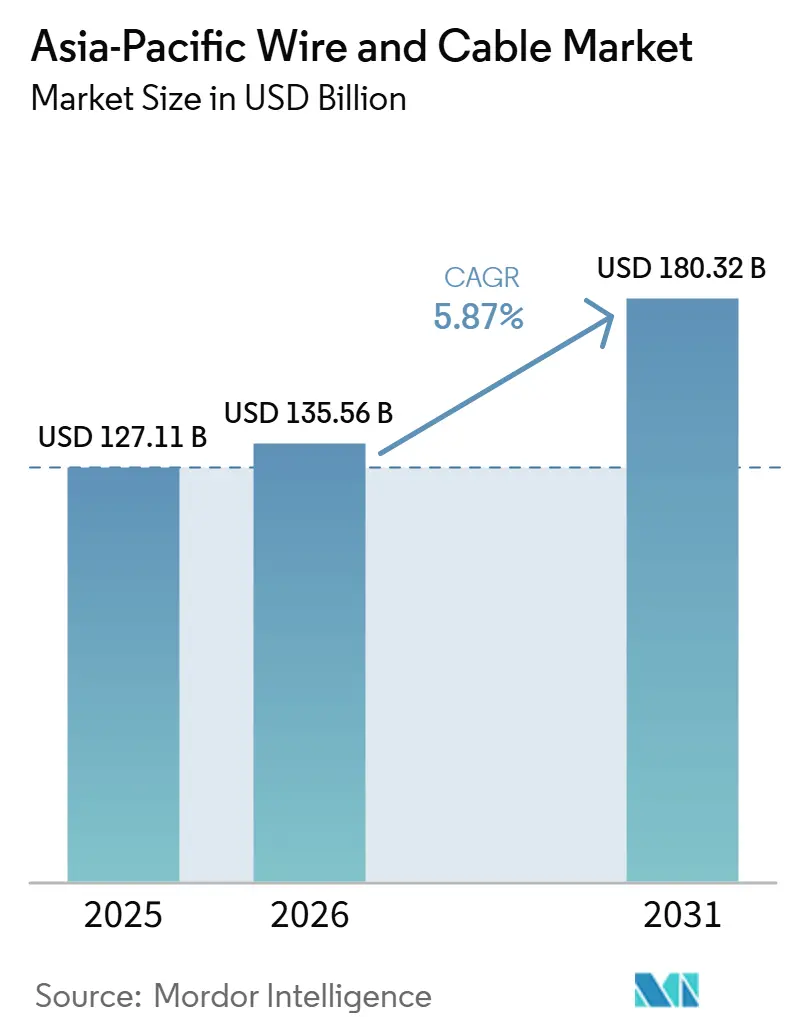
The Asia-Pacific wire and cable market size was valued at USD 127.11 billion in 2025 and estimated to grow from USD 135.56 billion in 2026 to reach USD 180.32 billion by 2031, at a CAGR of 5.87% during the forecast period (2026-2031). Demand in the Asia-Pacific wire and cable market is supported by transmission upgrades for renewable power, denser digital networks, and urban electrification projects. These needs are occurring simultaneously across the region's largest economies, driving demand for power and communications applications. The Asia-Pacific wire and cable market is also moving toward products that meet higher technical specifications, including high-voltage, fire-resistant, and high-density fiber products. Producers with qualified capacity, access to raw materials, and established high-voltage capabilities are better placed to compete for these projects. Copper price volatility and the practical difficulty of offshore cable installation remain important limits on project execution and manufacturer margins.
Key Report Takeaways
- By voltage, low-voltage cables held 52.84% of the Asia-Pacific wire and cable market share in 2025, while extra- and high-voltage cables are projected to expand at a 6.48% CAGR through 2031.
- By cable type, power cables accounted for 60.92% of revenue in 2025, while fiber-optic cables are projected to expand at a 6.83% CAGR through 2031.
- By conductor material, copper held 58.76% of revenue in 2025, while optical glass/polymer is projected to expand at a 6.41% CAGR through 2031.
- By installation, overhead systems accounted for 54.18% of revenue in 2025, while submarine installations are projected to expand at a 6.12% CAGR through 2031.
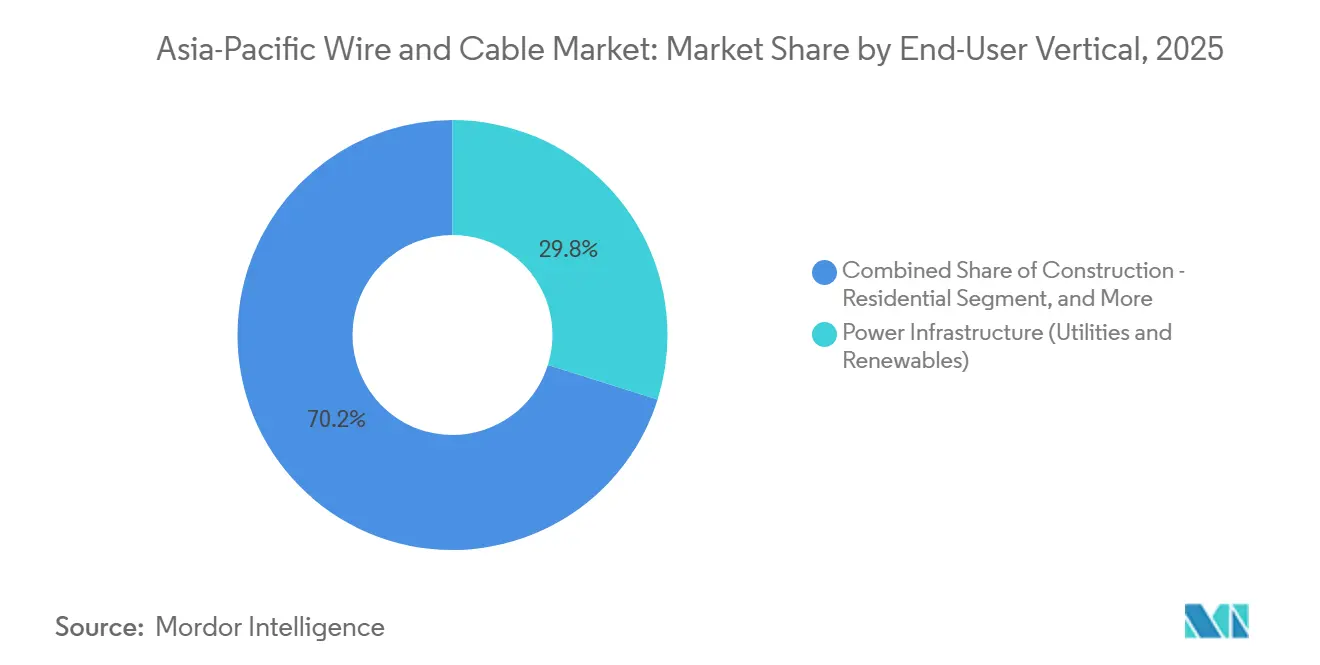
- By end-user vertical, power infrastructure, utilities, and renewables held 29.84% of revenue in 2025, while telecommunications and data centers are projected to expand at a 6.73% CAGR through 2031.
- By insulation, insulated cables held 90.21% of revenue in 2025 and are projected to expand at a 6.02% CAGR through 2031 in the Asia-Pacific wire and cable market.
- By geography, China held 44.67% of revenue in 2025, while India is projected to grow at a 7.12% CAGR through 2031.
Note: Market size and forecast figures in this report are generated using Mordor Intelligence’s proprietary estimation framework, updated with the latest available data and insights as of January 2026.
Market Trends and Insights
Drivers Impact Analysis of Asia-Pacific Wire and Cable Market*
| Driver | (~) % Impact on CAGR Forecast | Geographic Relevance | Impact Timeline |
|---|---|---|---|
| Renewable Energy Expansion and Grid Modernization | +2.0% | China, India, South Korea, Japan, Australia | Long term (≥ 4 years) |
| Urban Infrastructure, Electrification, and Smart-City Investment | +1.2% | China, India, ASEAN, Australia | Medium term (2-4 years) |
| 5G, Cloud, and Data-Center Network Expansion | +1.0% | China, India, Japan, Singapore, South Korea | Medium term (2-4 years) |
| Electric Vehicle and Charging-Infrastructure Electrification | +0.7% | China, India, South Korea, Japan | Short term (≤ 2 years) |
| AI Data-Center Power-Density and Liquid-Cooling Cable Requirements | +0.6% | China, India, Japan, Singapore, Malaysia | Medium term (2-4 years) |
| Inter-Island Interconnection and Subsea Cable Localization | +0.4% | Philippines, Indonesia, Pacific Island nations, Japan, Taiwan | Long term (≥ 4 years) |
| Source: Mordor Intelligence | |||
Renewable Energy Expansion and Grid Modernization
China’s State Grid Corporation plans to build 15 additional ultra-high-voltage transmission lines between 2026 and 2030. The program is expected to raise cross-provincial transmission capacity by 35% and connect 200 GWh of renewable capacity each year. The Shaanbei-Anhui ±800 kV UHVDC project entered service on June 30, 2026, with a CNY 20.50 billion (USD 3.03 billion) investment, a route of 1,055 km, and a rated capacity of 8 million kW.[1]China Daily, “Shaanbei-Anhui ±800-Kilovolt Ultra-High Voltage Direct Current Transmission Project Commences Operation,” China Daily Such projects require large volumes of specialty high-voltage cable and have extended delivery schedules for qualified suppliers. India’s rising renewable output also requires new generation-to-transmission capacity. Power Grid Corporation of India signed a JPY 80 billion (USD 490 million) green loan agreement with JBIC in June 2026 for the Khavda-Nagpur HVDC project.[2]The Hindu BusinessLine, "Power Grid Secures Loan from JBIC to Advance India's HVDC Push," The Hindu BusinessLine
Urban Infrastructure, Electrification, and Smart-City Investment
Urban development is increasing demand for low-voltage wiring and underground distribution systems in the Asia-Pacific wire and cable market. Project specifications increasingly favor fire-resistant, low-smoke, zero-halogen cable products over basic building wire. India’s BharatNet program aims to connect 270,000 villages with fiber infrastructure by 2030. A proposed INR 10,000 crore (USD 1.04 billion) viability gap funding scheme for underground power cable manufacturing could help meet domestic demand for high-capacity cables.[3]Economic Times Now, "Government Plans INR 10,000 Crore Underground Power Cable Manufacturing Scheme," Economic Times Now BIS compliance requirements and the production-linked incentive program direct formal procurement toward certified domestic suppliers. This provides established producers with some protection against unregulated imports.
5G, Cloud, and Data-Center Network Expansion
5G network densification is raising fiber-optic cable requirements across China, India, and Southeast Asia. A 5G base station needs 3-4 times as much fiber fronthaul as a 4G equivalent, while urban networks require many more nodes. India’s BharatNet program supports demand for single-mode fiber and hardened splice closures. China accounted for 25% of global data center electricity consumption in 2024, concentrating demand for high-capacity fiber systems.[4]International Energy Agency, “Electricity 2026,” International Energy Agency In the Asia-Pacific wire and cable market, this favors suppliers that can provide specialized optical glass and polymer products. It also separates higher-value data center requirements from standard broadband cable demand.
Electric Vehicle and Charging-Infrastructure Electrification
Electric vehicle production is expanding demand for charging cables and grid-side distribution cable. Each high-power charging location requires a medium-voltage connection, local distribution cable, and specialized charging cable. Liquid-cooled cable assemblies are becoming more relevant at high-current charging sites. These specifications favor companies that can manufacture flexible and high-current products. The effect is most relevant in China, India, South Korea, and Japan. It broadens cable demand beyond the cable supplied directly with a vehicle.
Restraints Impact Analysis of Asia-Pacific Wire and Cable Market*
| Restraint | (~) % Impact on CAGR Forecast | Geographic Relevance | Impact Timeline |
|---|---|---|---|
| Copper and Aluminum Price Volatility | -0.8% | Global, with acute impact on China, India, and ASEAN manufacturing hubs | Short term (≤ 2 years) |
| High Capital Intensity and Installation Complexity | -0.6% | Submarine markets, Philippines, Indonesia, Pacific Islands, and EHV corridor projects | Long term (≥ 4 years) |
| Inconsistent Standards and Substandard Cable Competition | -0.4% | ASEAN, South Asia, Rest of Asia-Pacific | Medium term (2-4 years) |
| Permitting, Right-of-Way, Vessel, and Port Bottlenecks | -0.3% | India, Indonesia, Japan, Taiwan, Pacific Islands | Long term (≥ 4 years) |
| Source: Mordor Intelligence | |||
Copper and Aluminum Price Volatility
Copper and aluminum prices can change rapidly, creating uncertainty for cable manufacturers. Fixed-price contracts signed before a price increase can place material costs above planned levels. Aluminum substitution may preserve cable volumes in lower-voltage applications, but it can reduce revenue per unit. Long-term metal exposure is, therefore, difficult to manage when contract pricing is fixed. Producers are seeking price-adjustment mechanisms that link material costs to metal reference prices. This environment rewards manufacturers that can manage metal exposure and pass through cost changes.
High Capital Intensity and Installation Complexity
Submarine cable projects require dedicated cable-lay vessels, shore-end equipment, and deep-water survey capability. These requirements lengthen project schedules and increase capital costs in the Asia-Pacific wire and cable market. KEPCO began full-scale construction of South Korea’s West Coast HVDC Energy Highway in March 2026, with 4 lines planned through 2038 at an estimated KRW 12 trillion (USD 8.36 billion). Furukawa Electric committed JPY 100 billion (USD 612 million) to a Chiba plant to produce 500 kV-class HVDC cables, with production targeted for 2030. The scale of these investments limits the number of credible bidders for high-voltage submarine work. It also makes project timing sensitive to vessel, port, and permitting constraints.
*Our forecasts treat driver/restraint impacts as directional, not additive. The impact forecasts reflect baseline growth, mix effects, and variable interactions.
Asia-Pacific Wire and Cable Market Segment Analysis
By Voltage:
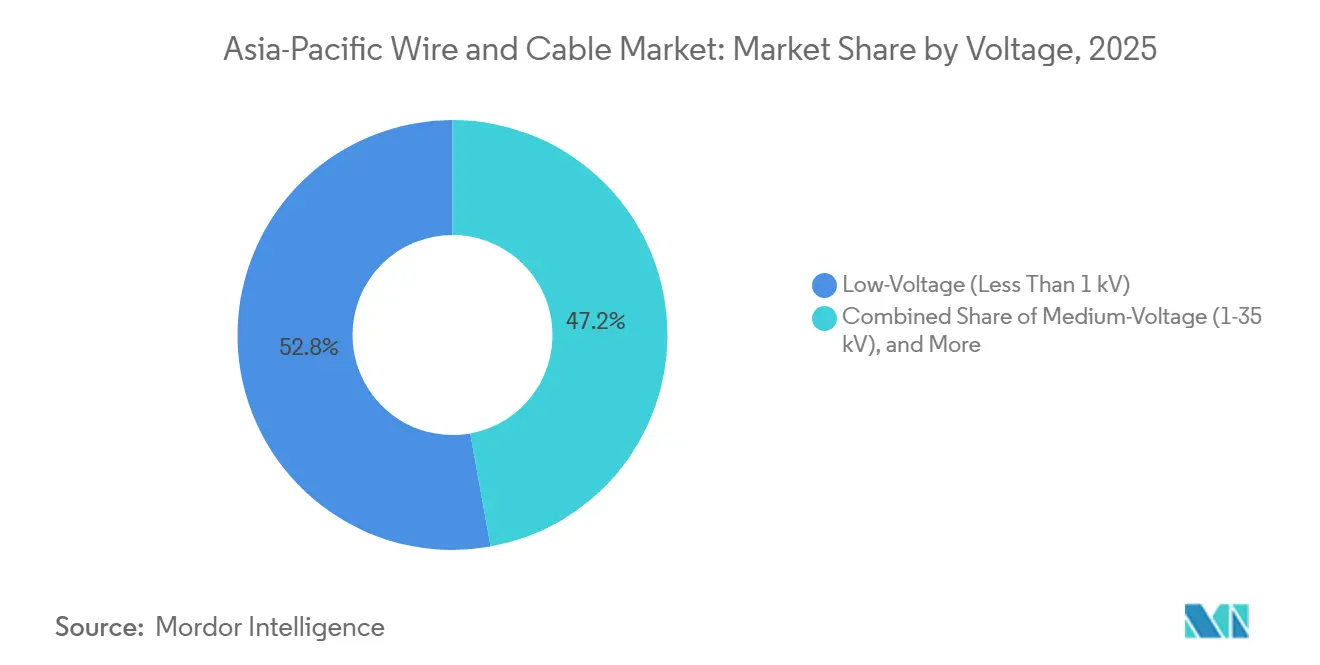
Higher-Voltage Projects Support Grid InvestmentLow-voltage cables held 52.84% of revenue by voltage in 2025. Their scale reflects demand from construction and residential distribution across China, India, and Southeast Asia. Medium-voltage products support renewable connections and urban distribution upgrades. XLPE adoption is increasing under China’s GB/T standards and India’s BIS requirements. Extra- and high-voltage cables are projected to expand at a 6.48% CAGR from 2026 to 2031. These cables have higher unit values and are linked to large grid projects.
The Shaanbei-Anhui ±800 kV UHVDC project was commissioned in June 2026 as the first UHVDC line under China’s 15th Five-Year Plan. It spans 1,055 km and has a rated capacity of 8 million kW. Construction of the Xizang-Guangdong UHV line began in April 2026, and the route will span 2,681 km. India’s planned transmission investment is INR 5-6 lakh crore (USD 52-62 billion) over FY27-FY32. The plan targets annual additions of 20,000 circuit km of transmission lines. These programs support demand for qualified high-voltage cable producers.



By Cable Type:
Fiber-Optic Products Gain From Digital InfrastructurePower cable held 60.92% of the Asia-Pacific wire and cable market revenue by cable type in 2025. Utilities, renewables, construction, and industrial projects support this large base. Signal and control products serve industrial automation and process facilities. Coaxial and data products continue to support broadcast and legacy last-mile networks. Fiber-optic cable is projected to expand at a 6.83% CAGR from 2026 to 2031. The growth reflects 5G networks, data center construction, and national broadband programs.
Furukawa Electric’s Lightera subsidiary began mass production of a 13,824-count optical fiber cable in March 2026. The product raises fiber density within a fixed cable cross-section. Sterlite Technologies secured a USD 1.11 billion multi-year product award in May 2026 for AI data center optical connectivity. Its Neuralis portfolio addresses specialized AI data center requirements. The Asia-Pacific wire and cable market is therefore separating into basic broadband fiber and high-density connectivity for computing clusters. Suppliers with advanced fiber manufacturing can compete in the latter category.
By Conductor Material:
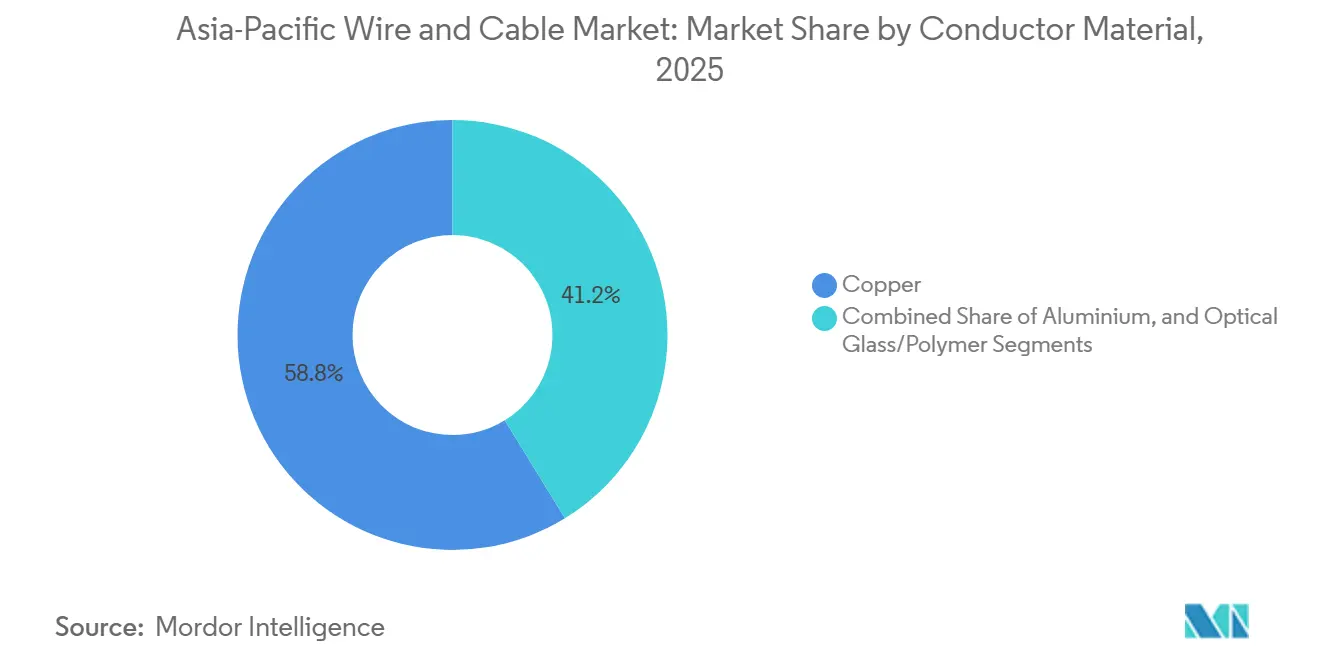
Copper Leads While Optical Materials GrowCopper cables held 58.76% of revenue by conductor material in 2025. Copper remains important for high-power transmission, charging, and industrial uses where aluminum substitution is limited. Aluminum is used in long-distance overhead lines and lower-voltage distribution networks. Higher copper costs encourage engineers to use aluminum where applications permit it. This can place pressure on copper volumes in selected distribution applications. Material selection, therefore, depends on both technical requirements and cost.
Optical glass/polymer is the fastest-growing material category, with a projected 6.41% CAGR through 2031. Its expansion is driven by demand for telecommunications and fiber for data centers. Optical material production requires precision processing that differs from metal conductor manufacturing. Furukawa Electric approved an investment of up to JPY 300 billion (USD 1.84 billion) in March 2026 to expand optical fiber and cable capacity up to 3x. Fujikura is investing JPY 260 billion (USD 1.63 billion) in expanded fiber-optic capacity. These investments reinforce the importance of specialized fiber production capacity.
By Installation:
Submarine Cable Projects Require Specialized CapabilityOverhead systems held 54.18% of revenue by installation type in 2025. They remain a cost-effective choice for rural and long-distance transmission in China, India, and Southeast Asia. Underground systems are expanding in cities where land constraints and local requirements favor buried infrastructure. India’s proposed viability gap funding scheme addresses underground cable manufacturing. Submarine installation is projected to expand at a 6.12% CAGR from 2026 to 2031. Offshore wind and inter-island links are the principal sources of this demand.
LS Cable and System and LS Marine Solution were selected as preferred bidders in May 2026 for the Haesong Offshore Wind Project in South Korea. The project combines cable supply and offshore installation into a single contract. SUBCO’s SMAP cable system was scheduled for readiness in June 2026 and will connect Australia’s 5 states. A Bernacchi-1 branch to Tasmania is expected to begin operation in Q2 2027. These projects show why cable manufacturing and installation capabilities are increasingly linked. The Asia-Pacific wire and cable market benefits most when it can deliver both services.
By End-User Vertical:
Data Centers Outpace Other Demand AreasPower infrastructure, utilities, and renewables accounted for 29.84% of the Asia-Pacific wire and cable market by end-user vertical in 2025. Generation, transmission, and distribution investment supports this position. Residential and commercial construction represent the next major demand segment for low-voltage wiring. Oil, gas, and petrochemicals use specialized fire-resistant and chemical-resistant products. Automotive and mobility demand is linked to electrification. Telecommunications and data centers are projected to expand at a 6.73% CAGR from 2026 to 2031.
China, India, Singapore, Japan, and South Korea are the main locations for hyperscale data center investment. Nxera opened its 58 MW, AI-ready DC Tuas facility in Singapore in 2026, with more than 90% of capacity committed before launch. KDDI’s Osaka AI data center used liquid cooling, reducing cooling energy by 94% and achieving a PUE of 1.05. These facilities require high-flex and thermally durable cable assemblies. They also need higher-density power and communications infrastructure. This increases the value of specialized cable designs within the Asia-Pacific wire and cable market.
By Insulation:
Certified Insulated Products Retain the Largest PositionInsulated cables are expected to account for 90.21% of the Asia-Pacific wire and cable market share in 2025 and are projected to grow at a CAGR of 6.02% through 2031. Power, data, and signal applications generally require insulated products. Non-insulated conductors remain concentrated in overhead transmission uses. Their growth potential is limited by the move toward underground and submarine installations. Higher-performance formulations support this expansion.
XLPE, low-smoke zero-halogen, and EPR compounds are gaining importance in public infrastructure, commercial buildings, and data centers. IEC 60332 fire-testing standards and low-smoke requirements are increasingly referenced in procurement specifications. This directs demand toward certified suppliers in the Asia-Pacific wire and cable market. Prysmian introduced a power cable in Southeast Asia in January 2026 that can operate at 110°C rather than 90°C. The design uses less copper while retaining its power rating. This helps manufacturers reduce material use when copper costs are high.
Geography Analysis
China and Japan Wire and Cable Market
China held 44.67% of the Asia-Pacific wire and cable market share in 2025. State Grid had constructed and put into operation 43 UHV projects by mid-2026, including 22 AC and 21 DC lines. Cross-regional capacity exceeded 380 million kW. China’s plan to build 15 additional UHV lines by 2030 is expected to raise cross-provincial transmission capacity by 35%. This sustains demand for extra-high-voltage conductors. Japan also remains an important revenue contributor through offshore wind and fiber investment.
India and South Korea Wire and Cable Market
India is projected to be the fastest-growing national market, at a 7.12% CAGR from 2026 to 2031. The country plans INR 5-6 lakh crore (USD 52-62 billion) of transmission capital expenditure between FY27 and FY32. The Khavda-Nagpur HVDC project is backed by a JPY 80 billion (USD 490 million) JBIC green loan. South Korea is concentrating on high-voltage submarine supply chains. KEPCO’s West Coast HVDC Energy Highway has 4 lines planned through 2038. Taihan Cable and Solution won a KRW 146.3 billion (USD 102 million) contract in June 2026 for 86 km of XLPE cable for KEPCO’s 500 kV HVDC East Coast-East Seoul project.
APAC Wire and Cable Market
Australia and New Zealand are increasing demand for interconnection and renewable transmission projects. Prysmian received notice to proceed for New Zealand’s Cook Strait HVDC Link Upgrade in June 2026. Southeast Asia is supported by data center construction, renewable projects, and regional infrastructure spending. Indonesia, Vietnam, the Philippines, Thailand, and Malaysia contribute to this demand. The Asian Development Bank supported the 411 km Tamtam submarine cable between Vanuatu and New Caledonia, which is targeted for December 2027. This expands the Asia-Pacific wire and cable market’s need for submarine connectivity.
Competitive Landscape
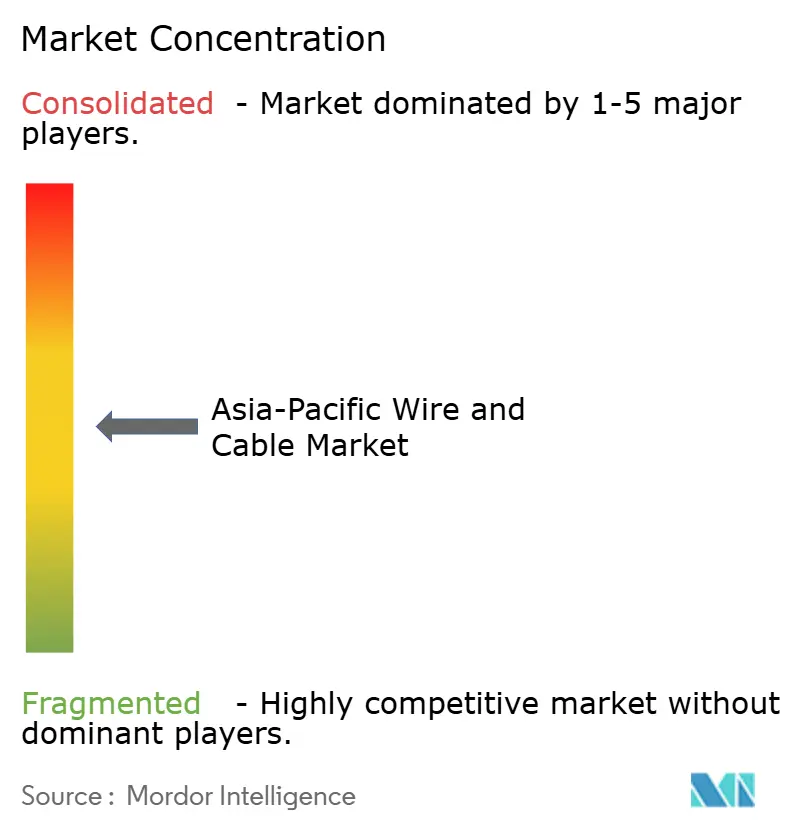
The Asia-Pacific wire and cable market is moderately fragmented across the region. Chinese producers hold a substantial market share in power and fiber cables. Japanese and Korean suppliers have stronger positions in high-specification high-voltage and submarine projects. Regional utility contracts favor suppliers with qualified production capacity.
Prysmian signed a 10-year fiber-optic supply agreement with Molex, valued at up to EUR 5.5 billion (USD 6.4 billion), in July 2026. The company also committed EUR 1.25 billion (USD 1.43 billion) through 2031 to more than double fiber-optic cable capacity in the United States and Europe. Furukawa Electric approved an investment of up to JPY 300 billion (USD 1.84 billion) to expand optical fiber and cable production capacity by up to 3x. LS Cable and System began construction of an undersea cable facility in the United States in June 2026. These moves show how major suppliers are adding capacity and expanding beyond their domestic markets.
Indian companies are building capability in higher-voltage products. KEI Industries began Phase 1 commercial production at its Sanand plant in December 2025, and Phase 2 is expected to produce EHV cable up to 500 kV by March 2027. The facility has a total planned investment of INR 2,000 crore (USD 209 million) and capacity of 60,732 km. Regional utility and government buyers increasingly require IEC 60228 and ISO-certified production.
Asia-Pacific Wire and Cable Industry Leaders
-
Prysmian S.p.A.
-
HENGTONG GROUP CO.,LTD.
-
Jiangsu Zhongtian Technology Co., Ltd.
-
Sumitomo Electric Industries, Ltd.
-
LS Cable & System
- *Disclaimer: Major Players sorted in no particular order
Asia-Pacific Wire and Cable Market Companies Covered in this Report
- Prysmian S.p.A.
- HENGTONG GROUP CO.,LTD.
- Jiangsu Zhongtian Technology Co., Ltd.
- Sumitomo Electric Industries, Ltd.
- LS Cable & System
- Furukawa Electric Co., Ltd.
- Fujikura Ltd.
- Nexans
- Taihan Cable & Solution Co., Ltd.
- KEI Industries Limited
- Polycab India Limited
- Finolex Cables Limited
- R R Kabel Limited
- Sterlite Technologies Limited
- APAR Industries Limited
- NKT A/S
- Belden Inc.
- LEONI AG
- Amphenol Corporation
- TE Connectivity Ltd.

Recent Industry Developments in Asia-Pacific Wire and Cable Market
- July 2026: Prysmian signed a 10-year fiber optic cable supply agreement with Molex, Koch Industries, valued at up to EUR 5.5 billion (USD 6.4 billion), for intra-data center fiber cables, and committed EUR 1.25 billion (USD 1.4 billion) through 2031 to more than double optical fiber and cable production capacity in the United States and Europe. The deal is part of broader hyperscaler agreements projected to add over EUR 10 billion (USD 11.52 billion) in cumulative incremental revenue by 2035, compared with the 2025 baseline.
- June 2026: China’s State Grid Corporation commissioned the Shaanbei-Anhui ±800 kV UHVDC project, the first UHVDC line under the 15th Five-Year Plan, spanning 1,055 km, with a total investment of CNY 20.50 billion (USD 3.03 billion) and a rated capacity of 8 million kW. The project is expected to deliver over 36 billion kWh annually, with renewable energy accounting for over 50%.
- May 2026: Sterlite Technologies secured a multi-year Product Award Letter valued at over USD 1.11 billion from a global hyperscaler to supply optical connectivity products for AI data center buildouts. The company also secured multiple hyperscaler orders worth over USD 100 million for its Neuralis AI data center connectivity portfolio and achieved a net debt-free balance sheet after an INR 1,500 crore (USD 157 million) qualified institutional placement.
- May 2026: LS Cable and System and LS Marine Solution were selected as preferred bidders to supply and install submarine cables for the Haesong Offshore Wind Project in South Korea’s South Jeolla Province, in an integrated cable manufacturing and installation contract.


Asia-Pacific Wire and Cable Market Report Scope
The Asia-Pacific Wire and Cable Market Report is Segmented by Voltage (Low, Medium, and Extra- and High-Voltage), Cable Type (Power, Fiber-Optic, Signal/Control, and Coaxial/Data), Conductor (Copper, Aluminum, and Optical Glass/Polymer), Installation (Overhead, Underground, and Submarine), End-User (Construction - Residential, Construction - Commercial, Power Infrastructure (Utilities and Renewables), Telecommunications and Data Centers, Oil and Gas and Petrochemicals, Automotive and Mobility, and Industrial Manufacturing), Insulation (Insulated and Non-Insulated), and Geography (China, India, Japan, South Korea, ANZ, and Rest of Asia-Pacific). The Market Forecasts are Provided in Terms of Value (USD).
| Extra- and High-Voltage (Greater Than 35 kV) |
| Medium-Voltage (1-35 kV) |
| Low-Voltage (Less Than 1 kV) |
| Power Cable |
| Fiber-Optic Cable |
| Signal and Control Cable |
| Coaxial and Data Cable |
| Copper |
| Aluminum |
| Optical Glass/Polymer |
| Overhead |
| Underground |
| Submarine |
| Construction - Residential |
| Construction - Commercial |
| Power Infrastructure (Utilities and Renewables) |
| Telecommunications and Data Centers |
| Oil and Gas and Petrochemicals |
| Automotive and Mobility |
| Industrial Manufacturing |
| Insulated |
| Non-Insulated |
| China |
| India |
| Japan |
| South Korea |
| Australia and New Zealand |
| Rest of Asia-Pacific |
| By Voltage | Extra- and High-Voltage (Greater Than 35 kV) |
| Medium-Voltage (1-35 kV) | |
| Low-Voltage (Less Than 1 kV) | |
| By Cable Type | Power Cable |
| Fiber-Optic Cable | |
| Signal and Control Cable | |
| Coaxial and Data Cable | |
| By Conductor Material | Copper |
| Aluminum | |
| Optical Glass/Polymer | |
| By Installation | Overhead |
| Underground | |
| Submarine | |
| By End-User Vertical | Construction - Residential |
| Construction - Commercial | |
| Power Infrastructure (Utilities and Renewables) | |
| Telecommunications and Data Centers | |
| Oil and Gas and Petrochemicals | |
| Automotive and Mobility | |
| Industrial Manufacturing | |
| By Insulation | Insulated |
| Non-Insulated | |
| By Country | China |
| India | |
| Japan | |
| South Korea | |
| Australia and New Zealand | |
| Rest of Asia-Pacific |


Key Questions Answered in the Report
What is the Asia-Pacific wire and cable market size?
The Asia-Pacific wire and cable market size is estimated at USD 135.56 billion in 2026 and is forecast to reach USD 180.32 billion by 2031, at a CAGR of 5.87%.
Which voltage category held the largest revenue share?
Low-voltage cables held 52.84% of revenue by voltage in 2025, supported by construction and distribution demand.
Which cable type is projected to grow fastest?
Fiber-optic cable is projected to grow at a 6.83% CAGR through 2031 as 5G and data center networks expand.
Which country is expected to grow fastest in the region?
India is projected to grow at a 7.12% CAGR from 2026 to 2031, supported by transmission and renewable energy investment.
What is driving submarine cable demand in Asia-Pacific?
Offshore wind projects and inter-island power and communications links are expected to support a 6.12% CAGR for submarine installation through 2031.
Why are higher-specification cables becoming more important?
Utility, data center, and infrastructure buyers increasingly require certified high-voltage, fiber-dense, and fire-resistant products.
Page last updated on:





