
Asia-Pacific Watch Components Manufacturing Market Size and Share
Market Overview
| Study Period | 2021 - 2032 |
|---|---|
| Forecast Data Period | 2027 - 2032 |
| Base Year Market Size (2026) | USD 7.93 Billion |
| Market Size (2027) | USD 8.33 Billion |
| Market Size (2032) | USD 11.62 Billion |
| Growth Rate (2027 - 2032) | 6.88 % |
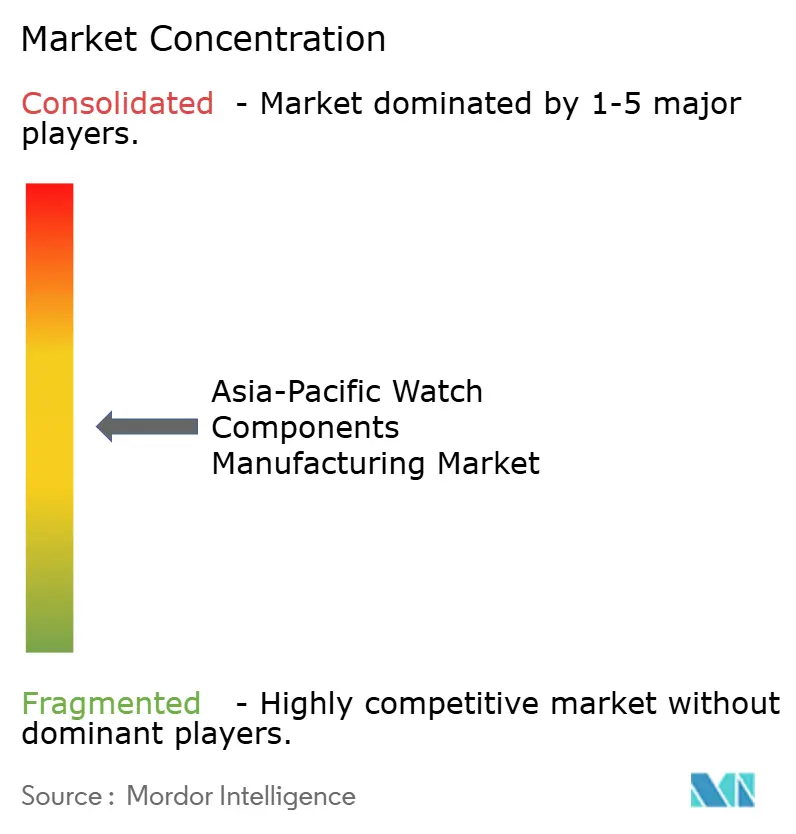
| Market Concentration | Medium |
Major Players *Disclaimer: Major Players sorted in no particular order Image © Mordor Intelligence. Reuse requires attribution under CC BY 4.0. | |
Asia-Pacific Watch Components Manufacturing Market Analysis by Mordor Intelligence
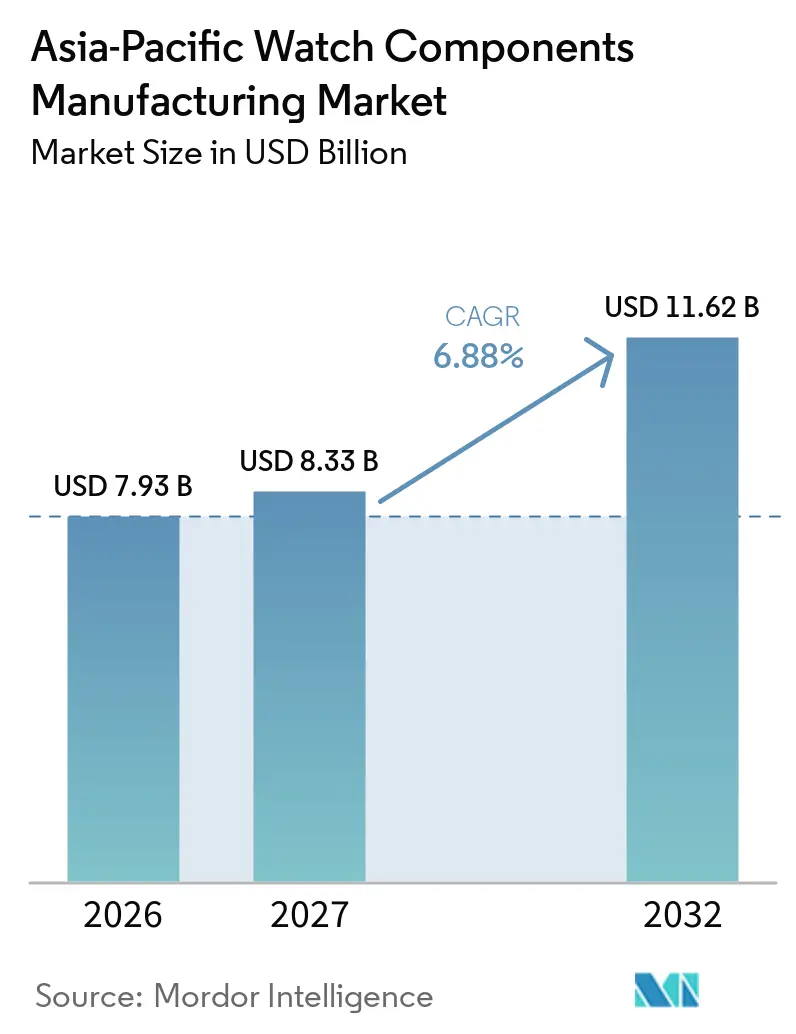
The Asia-Pacific Watch Components Manufacturing Market size is projected to expand from USD 7.93 billion in 2026 and USD 8.33 billion in 2027 to USD 11.62 billion by 2032, registering a CAGR of 6.88% between 2027 and 2032.
The region combines specialized production centers for movement parts, crystals, dials, cases, bracelets, and finishing, which allows brands to source different precision inputs within the same broad manufacturing region. Premium watchmaking is raising the value of the materials and finishing required for each unit, even when watch volumes do not rise at the same pace. Integrated producers are better placed to manage quality, timing, and material availability because they control more of the component flow. China remains the principal production base, while India and ASEAN manufacturing locations are widening the regional customer and production base. Increasing demand for sapphire crystal, precision-engineered metal components, ceramic parts, and customized exterior finishes is also encouraging manufacturers to invest in advanced machining, surface treatment, and quality-control capabilities. In parallel, the expansion of domestic watch brands and independent microbrands is creating opportunities for component suppliers that can accommodate smaller production runs, differentiated designs, and flexible order volumes. These requirements are increasing the importance of supplier specialization, production flexibility, and consistent component quality.
Key Report Takeaways
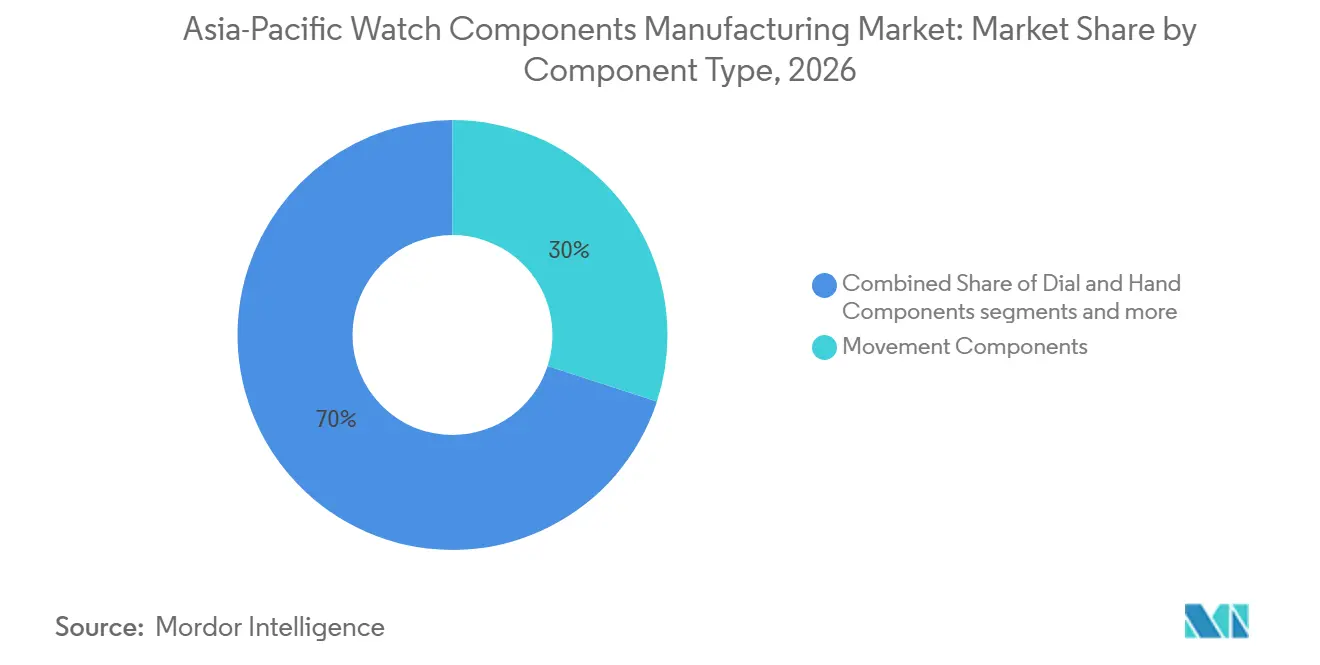
- By component type, movement components held 30% of the Asia-Pacific watch components manufacturing market share in 2026, while crystal components are forecast to expand at a 7.6% CAGR through 2032.
- By watch type, quartz watches accounted for 55.7% of the Asia-Pacific watch components manufacturing market size in 2026, while smart and hybrid watches are projected to grow at the highest CAGR of 10.9% through 2032.
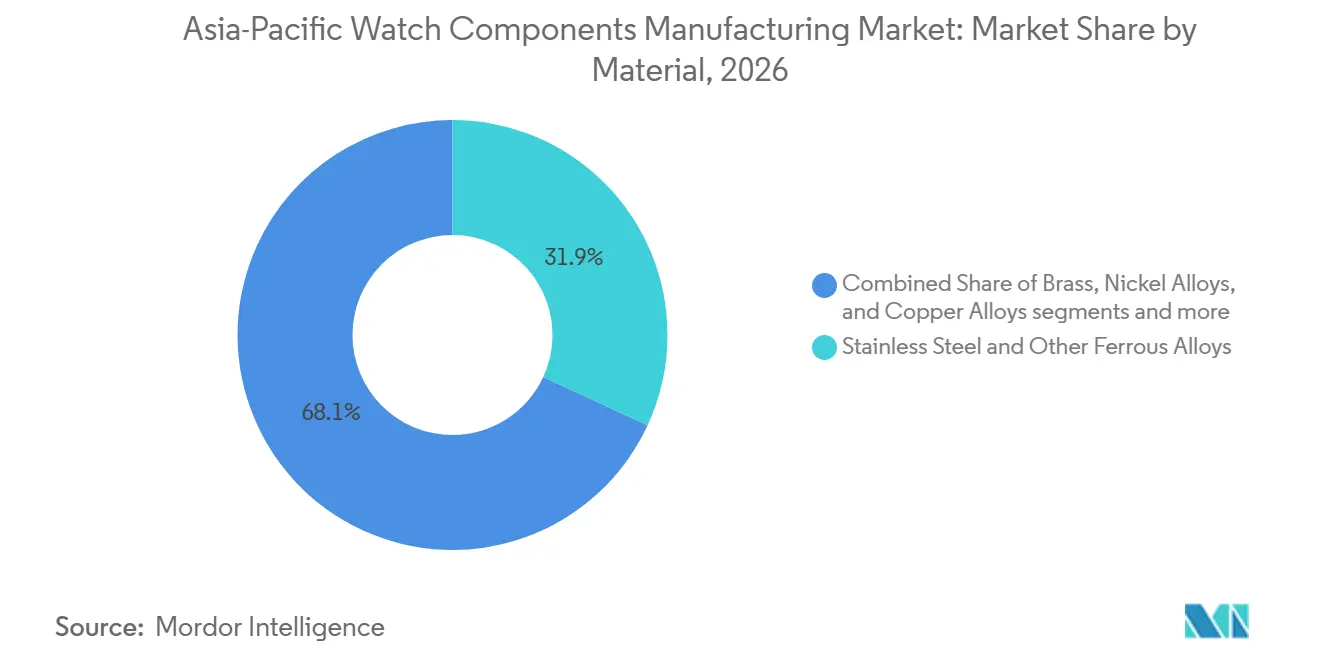
- By material, stainless steel and other ferrous alloys accounted for 31.9% of revenue in 2026, while silicon, nickel-phosphorus, and silicon-based materials are forecast to grow at a 9.6% CAGR through 2032.
- By geography, China held 44% of revenue in 2026, while India recorded the highest projected CAGR at 9.6% through 2032.
Note: Market numbers in this report are based on Mordor Intelligence's proprietary estimation framework, which combines nine months of actuals with Q4 projections for base year 2026.
Market Trends and Insights
Drivers Impact Analysis of Asia-Pacific Watch Components Manufacturing Market*
| Driver | (~) % Impact on CAGR Forecast | Geographic Relevance | Impact Timeline |
|---|---|---|---|
| Premiumization and Revival of Mechanical and Luxury Watchmaking | +1.8% | China, Japan, South Korea, and India | Long term (≥ 4 years) |
| Rising Asia Pacific Watch Production and Regional Brand Development | +1.5% | China, Japan, India, South Korea, and Thailand | Medium term (2-4 years) |
| Silicon, Ceramic, Sapphire, Titanium and Other Advanced Material Adoption | +1.2% | Japan, China, Taiwan, Thailand, and India | Long term (≥ 4 years) |
| Regionalization of Sourcing and ASEAN Capacity Diversification | +0.9% | Vietnam, Thailand, Cambodia, Malaysia, Indonesia, and India | Medium term (2-4 years) |
| Low-Volume Flexible Supply for Microbrands and Independent Watchmakers | +0.7% | China, Japan, Singapore, and Hong Kong | Short term (≤ 2 years) |
| Repairability and Long-Tail Spare-Parts Demand | +0.5% | Core Asia-Pacific Market | Medium term (2-4 years) |
| Source: Mordor Intelligence | |||
Premiumization and Revival of Mechanical and Luxury Watchmaking
Premiumization allows component suppliers to grow revenue through higher-value inputs rather than through a simple increase in unit output. Demand for sapphire crystals, high-grade movement blanks, coated cases, detailed dials, and finished bracelets raises the value attached to each watch. This favors producers that can maintain consistent dimensions, cosmetic quality, and material performance across repeated production runs. Seagull Watch demonstrated this movement toward higher-value products when it debuted a split-seconds chronograph at Watches and Wonders 2025 and presented its vertically integrated capability across components. The Asia-Pacific watch components manufacturing market, therefore, benefits when premium brands require parts that are harder to substitute and more demanding to qualify. The result is greater importance for finishing, precision tooling, material validation, and dependable supply relationships that begin with design discussions, continue through pilot samples and testing, and remain important when a product enters regular production, because premium brands must protect consistency across models, colors, case sizes, and production batches.
Rising Asia-Pacific Watch Production and Regional Brand Development
China, Japan, India, and Southeast Asia provide production capacity across movements, exterior parts, dials, hands, crystals, bracelets, and final assembly. Regional brands increasingly create component demand closer to the place where products are designed and assembled. This gives suppliers a customer base that is not limited to export orders from established overseas houses. India’s component sector has gained relevance through bracelets, dials, hands, and precision-engineering activity serving both domestic and international customers. The Asia-Pacific watch components manufacturing market gains resilience when local brand development adds another route to demand for qualified components. This development also makes speed, shorter production runs, and direct engineering coordination more important for suppliers, since new or growing regional brands often need to adjust designs, confirm samples, place repeat orders, and maintain product identity without the long planning cycles associated with large global collections.
Silicon, Ceramic, Sapphire, Titanium and Other Advanced Material Adoption
Silicon, ceramic, sapphire, titanium, coated steel, and engineered alloys are changing the mix of materials used in precision watch parts. These materials can support corrosion resistance, low weight, magnetic resistance, scratch resistance, or distinctive design finishes, depending on the part and application. Silicon components are especially relevant to escapement and regulating systems, where accuracy and low friction can support higher-value mechanical designs. Seagull Watch’s 2025 product presentation illustrated the broader regional push toward technically demanding mechanical products rather than only basic movement supply. Suppliers with clean production environments, specialized tooling, coating capability, or material knowledge can secure a more important place in the value chain. The Asia-Pacific watch components manufacturing market also gains from related optics, precision machining, and surface-treatment capabilities that can be used across several advanced materials, allowing the same production base to support watch components while applying closely related knowledge to material preparation, controlled finishing, inspection, and high-precision production processes.
Regionalization of Sourcing and ASEAN Capacity Diversification
Brands and component buyers are spreading selected production activities across several Asian locations to reduce dependence on one manufacturing center. Vietnam, Thailand, Cambodia, Malaysia, Indonesia, and India can support this diversification through assembly, finishing, crystal production, bracelet production, and related precision work. The pattern does not remove China’s importance, since Chinese clusters remain deeply connected to regional tooling, materials, and component flows. Instead, it creates a regional supply structure in which production can be assigned according to cost, lead time, technical capability, and customer requirements. China and ASEAN signed the upgraded ASEAN-China Free Trade Agreement in October 2026, adding a policy framework that supports deeper regional economic links.[1] For the Asia-Pacific watch components manufacturing market, a wider manufacturing footprint can reduce delivery risk and create room for process development outside established hubs, while allowing suppliers to retain technical links with Chinese production centers and build customer relationships across a larger set of regional manufacturing locations.
Restraints Impact Analysis of Asia-Pacific Watch Components Manufacturing Market*
| Restraint | (~) % Impact on CAGR Forecast | Geographic Relevance | Impact Timeline |
|---|---|---|---|
| Luxury Watch Demand and Export-Market Volatility | -1.6% | China, Hong Kong, and Japan-facing suppliers | Medium term (2-4 years) |
| Skilled Micromechanics and Precision-Manufacturing Labor Shortages | -1.2% | Japan, Switzerland-linked Asia-Pacific suppliers, India, and South Korea | Long term (≥ 4 years) |
| Long Supplier Qualification Cycles and High Switching Costs | -0.8% | Core Asia-Pacific markets, particularly new ASEAN entrants | Medium term (2-4 years) |
| Aftermarket Traceability Gaps and Counterfeit Risk | -0.6% | China, Hong Kong, ASEAN, India, and Southeast Asia | Medium term (2-4 years) |
| Source: Mordor Intelligence | |||
Luxury Watch Demand and Export-Market Volatility
Component orders move with the demand outlook of the brands that buy finished parts, especially when a supplier serves export-oriented premium watch programs. A demand reduction can affect dials, hands, movement parts, cases, and bracelets before a final watch reaches the retail market. This leaves suppliers with less visibility on capacity planning and inventory purchases. The risk is greater for companies that have a narrow set of customers or heavy exposure to one export destination. The Asia-Pacific watch components manufacturing market needs broader customer portfolios and a balanced mix of mechanical, quartz, smart, and aftermarket work to manage this exposure. Domestic watch demand in India and other regional markets provides a partial counterweight. Still, it does not remove the need for flexible operations that can shift labor, tooling, material orders, and production schedules across different component programs when premium export orders change.
Skilled Micromechanics and Precision-Manufacturing Labor Shortages
High-value watch components require skills in micromachining, toolmaking, assembly, polishing, quality inspection, surface treatment, and movement adjustment. Those skills take time to develop and are difficult to replace through automation alone, particularly when the work includes detailed finishing or complex mechanical calibration. A shortage of trained staff can constrain output even when equipment is available and demand improves. The concern is especially important for suppliers moving from standard parts toward more complex mechanical or material-intensive programs. The Asia-Pacific watch components manufacturing market depends on training pathways that build specialist skills while retaining experienced technical workers. This need also reinforces the advantage of companies that have established engineering teams and long-standing production know-how, because those companies can link practical shop-floor knowledge with process control, supplier coordination, inspection routines, and the detailed finishing standards expected by their customers.
*Our forecasts treat driver/restraint impacts as directional, not additive. The impact forecasts reflect baseline growth, mix effects, and variable interactions.
Asia-Pacific Watch Components Manufacturing Market Segment Analysis
By Component Type:
Movement Complexity Sustains Revenue LeadershipMovement Components held 30% of the Asia-Pacific watch components manufacturing market share in 2026, reflecting the high value carried by mainplates, bridges, gear trains, escapements, and regulating parts. These inputs form the operating core of mechanical watches and need close coordination between design, materials, tooling, and assembly. Their value is not based on size alone, because small parts can determine the accuracy, reliability, and serviceability of a finished watch. Extended customer qualifications also give established suppliers a stronger position once a movement design has been accepted. The Asia-Pacific watch components manufacturing market includes deep movement expertise in Tianjin, Japan, and other specialist locations. Seagull Watch reported 3 million movements of annual capacity in 2025, which shows the scale of movement manufacturing available in China.[2] The company also reported 1,457 worldwide patents, including technical work related to high complications. This combination of scale and technical capability supports the continued revenue leadership of movement components.
Crystal Components are forecast to grow at a 7.6% CAGR through 2032, making them the fastest-growing component category. Sapphire demand is central to this growth because premium mechanical, hybrid, and smart watch designs need scratch-resistant transparent covers with consistent optical quality. Crystal suppliers must manage material processing, cutting, shaping, coating, and quality control while also serving different case designs. Thailand and China remain important to the regional crystal supply base, alongside related optics and wafer-processing capabilities. Exterior and habillage components, including cases, bezels, lugs, crowns, and casebacks, remain the next major group because they define the appearance and wearability of a watch. Dial and hand suppliers retain a practical role in product differentiation through color, texture, indices, print, and finishing. Sealing and authentication components are smaller categories, but they matter as brands seek reliable water resistance and clearer supply-chain documentation.

By Watch Type:
Quartz Scale Provides Volume Floor, Smart Watches Drive Margin EvolutionQuartz Watches held 55.7% of revenue in 2026, providing the highest volume base across the watch-type categories. Their production supports ongoing demand for cases, bracelets, crystals, dials, hands, batteries, and standardized movement inputs. Large quartz programs help factories spread the cost of precision equipment, tooling, inspection, and workforce training across high production volumes. This makes quartz work important even when premium mechanical models generate more value per unit. The Asia-Pacific watch components manufacturing market uses this volume base to sustain the broader ecosystem of suppliers and subcontractors. Established production clusters in Guangdong, Shenzhen, and Greater China provide close access to component makers and assembly capability. The scale also supports shorter lead times for brands that need regular replenishment. Quartz production, therefore, remains a practical foundation for component capacity, even as product design and materials continue to develop.
Smart and Hybrid Watches are forecast to grow at a 10.9% CAGR through 2032, the highest rate among watch types. The relevant opportunity for component producers lies mainly in exterior and mechanical elements, rather than in electronic modules outside the report scope. Sapphire crystals, stainless steel and titanium cases, metal bracelets, and crown mechanisms allow connected watches to match the durability and finish expected from conventional watchmaking. Mechanical Watches continue to hold the highest component value per unit because they use more specialized movement parts and finishing processes. Seagull Watch’s 2025 presentation emphasized in-house capability from hairsprings through column wheels, showing that regional manufacturers are extending their mechanical capability. The Asia-Pacific watch components manufacturing market serves all 3 watch formats, which helps suppliers balance volume requirements with higher-value product work. This mix also creates a reason for suppliers to maintain both standardized production and flexible finishing capacity.
By Material:
Stainless Steel Anchors, Volumes, Silicon Changes the Value MixStainless Steel and Other Ferrous Alloys held 31.9% of revenue in 2026, making them the largest material group. These materials remain widely used in cases, bracelets, casebacks, movement plates, and other parts that need strength, machinability, and corrosion resistance. Their established supply chains help manufacturers manage large product ranges across mid-tier and premium price positions. Surface treatments such as coating and polishing allow similar base materials to produce different visual and performance outcomes. The Asia-Pacific watch components manufacturing market size for ferrous materials is supported by the large installed base of case and bracelet production across the region. Steel also remains compatible with the production methods and tooling already used by many component makers. These practical advantages keep it central to current output, despite growing interest in alternative materials. The result is a stable material foundation for both traditional watches and newer connected formats.
Silicon, Nickel-Phosphorus, and Silicon-Based Materials are forecast to grow at a 9.6% CAGR through 2032, the fastest rate among materials. Their use is linked to components where low weight, magnetic resistance, corrosion resistance, or precise geometry are important design requirements. Silicon has particular relevance in advanced movement systems, while nickel-phosphorus can support specialized precision applications. Ceramic, sapphire, glass, and carbon composites remain more concentrated in premium designs and specialized exterior parts. Gold, platinum, and precious-metal alloys command high value per component but serve lower-volume watch programs. Leather, rubber, textiles, and engineering polymers continue to serve strap and bracelet requirements, including interest in recycled and bio-sourced inputs. The Asia-Pacific watch components manufacturing market gains from this broader material portfolio because it allows manufacturers to address several product positions without depending on a single substrate. Material capability is becoming an important source of differentiation when brands seek both technical performance and a distinct product finish.
Geography Analysis
Guangdong, Shenzhen and Tianjin Watch Components Manufacturing Market
China held 44% of the Asia-Pacific watch components manufacturing market share in 2026, supported by manufacturing clusters in Guangdong, Shenzhen, and Tianjin. Guangdong and Shenzhen combine production and assembly capabilities for cases, bracelets, dials, crystals, and related precision inputs. Tianjin has a long movement-manufacturing history and remains important to China’s technical depth in mechanical watchmaking. Seagull Watch marked the 70th anniversary of China’s first domestic watch in 2025, highlighting the city’s long role in domestic production. Its stated capacity of 3 million movements and 200,000 complete watches each year illustrates the industrial scale available in this production base. China’s importance is therefore based on an interconnected system of tooling, component suppliers, assembly, and export capability. This concentration gives customers access to production depth, but it also encourages other Asian locations to build complementary capacity.
India and Japan Watch Components Manufacturing Market
India is forecast to expand at a 9.6% CAGR through 2032. Rising domestic demand, a developing microbrand base, and expanding component exports support this trajectory. Indian suppliers contribute through bracelets, dials, hands, precision engineering, and production relationships with global brands. This creates a useful demand channel that is less dependent on a single overseas luxury destination. Japan remains the region’s high-value manufacturing anchor because its established producers combine engineering depth with quality control and advanced production processes. Japanese facilities remain important in movements, material processing, precision machine tools, and premium watchmaking. The Asia-Pacific watch components manufacturing market benefits when India adds scale and Japan maintains technical leadership. Together, these roles create a wider regional base than one production center could provide.
APAC Watch Components Manufacturing Market
Vietnam, Cambodia, Thailand, and Malaysia are increasingly relevant as ASEAN components and assembly locations. Their roles include production support, finishing, bracelet work, crystal-related capability, and routes for regional supply diversification. The ASEAN-China Free Trade Agreement upgrade, signed in October 2026, may reinforce regional connections in digital and green-economy areas.[3] The agreement sits alongside existing regional trade arrangements and supports closer economic links across the bloc. Thailand retains significance for sapphire and related production activity, while Vietnam is becoming more relevant to the broader manufacturing network. Taiwan contributes specialist expertise in crystal and sapphire optics that can serve watch and adjacent industrial applications. South Korea, Hong Kong, Singapore, Indonesia, Australia, and other regional economies contribute trade, distribution, premium retail, specialist supply, and technical capabilities. The Asia-Pacific watch components manufacturing market is therefore geographically diverse, even though China remains its largest current production base.
Competitive Landscape
The Asia-Pacific watch components manufacturing market exhibits a medium level of market concentration, with integrated Japanese and Chinese manufacturers operating beside many specialists focused on one component category or process. Seiko-related manufacturing operations, Citizen and Miyota, and Tianjin Seagull Watch Group have broad capability across movements, blanks, precision parts, and finished watches. This scope gives integrated companies more control over quality, timing, engineering feedback, and supply continuity. Specialist producers remain important because cases, crystals, dials, hands, bracelets, surface treatments, and sealing inputs require different process knowledge. China’s largest clusters have an advantage in dense supplier networks and flexible production runs. Japan retains strength in premium production, movement engineering, and demanding quality systems. India is building a larger role through component manufacturing and precision engineering. The competitive balance depends on the ability to supply reliable parts at the right quality level rather than on assembly capacity alone.
Intellectual property, production know-how, and customer qualification create practical barriers for new suppliers. Seagull Watch reported 1,457 worldwide patents in 2025 and cited independent development of tourbillon, perpetual calendar, and minute-repeater capabilities. The company’s Watches and Wonders 2025 launch also showed its effort to present higher-value products directly to international collectors and watch buyers. That move reflects a strategy in which component capability supports both supply relationships and branded product development. Companies that control movement production and finishing can respond more directly to design changes and material requirements. Suppliers without these capabilities can still compete through specialization, quicker lead times, or closer support for small brands. The Asia-Pacific watch components manufacturing market is therefore not defined by a single business model. It includes large vertically integrated producers, regional specialists, and smaller suppliers that address specific parts or finishing needs. The integrated model is especially useful where a brand needs component changes to be evaluated quickly across several departments, because movement design, case design, crystal fit, dial layout, hand clearance, bracelet attachment, and final assembly can affect one another. A specialist model can remain effective when a supplier has a clear advantage in one process, such as precision stamping, surface finishing, crystal processing, dial work, or bracelet construction. In either case, customers assess suppliers on repeatability, quality records, engineering support, production discipline, and the ability to preserve the intended appearance and performance of the finished product.
The mid-tier contains active competition because many suppliers can produce common exterior parts, yet fewer can meet demanding quality and qualification requirements consistently. Bracelet, dial, hands, and crystal producers can strengthen their position through flexible production, strong inspection, and dependable delivery. Smaller watch brands also create demand for suppliers willing to handle lower order quantities and frequent product changes. Traceability is becoming more relevant when premium brands want clearer documentation for materials and components. The October 2026 ASEAN-China agreement provides a policy setting that may support more integrated regional production relationships. Seagull Watch’s 2025 international product launch is one example of a company using vertical integration to move closer to end customers. Its reported patent portfolio is another example of how technical development can support a competitive position.
Asia-Pacific Watch Components Manufacturing Industry Leaders
-
Seiko Instruments Inc.
-
CITIZEN WATCH CO., LTD.
-
MIYOTA Movement
-
Tianjin Seagull Watch Group Co., Ltd.
-
KDDL Limited
- *Disclaimer: Major Players sorted in no particular order
Asia-Pacific Watch Components Manufacturing Market Companies Covered in this Report
- Seiko Instruments Inc.
- CITIZEN WATCH CO., LTD.
- MIYOTA Movement
- Tianjin Seagull Watch Group Co., Ltd.
- KDDL Limited
- Nihon Seimitsu Co., Ltd.
- NV Vision Group
- Ching Mei Optics Co., Ltd.
- Orbray Co., Ltd.
- Yu Hing Precision Technology (Shenzhen) Company Limited
- Baoruihua (Dongguan) Precision Technology Co., Ltd.
- Shenzhen Shijin Watch Co., Ltd.
- HHV Crystals
- Braloba AG
- Megaage Watchband Manufacturing Limited
- TAY I TANG INDUSTRIAL CO., LTD.
- NISSEY VIETNAM CO., LTD.
- Paragon Crystal Manufacturing Co., Ltd.
Recent Industry Developments in Asia-Pacific Watch Components Manufacturing Market
- July 2025: Tianjin Seagull Watch Group in China debuted at Watches and Wonders 2025, launching a split-seconds rattrapante chronograph at USD 3,499 alongside a high-complication flagship for collectors. The company described the launch as part of its international development, supported by a vertically integrated mechanical watchmaking capability.
- March 2025: Tianjin Seagull Watch Group marked the 70th anniversary of China’s first domestic watch. The company confirmed an annual capacity of 3 million movements and 200,000 complete watches, along with 1,457 worldwide patents, including 1,370 granted patents.
Asia-Pacific Watch Components Manufacturing Market Report Scope
The Asia-Pacific Watch Components Manufacturing Market is Segmented by Component Type (Movement Components, Dial and Hand Components, and More), by Watch Type / End Use (Mechanical Watches, Quartz Watches, and More), by Material (Gold, Platinum, and Precious-Metal Alloys, Titanium, Aluminum, Magnesium, and Zirconium and More), by Geography (China, Japan, India, and More). The Market Forecasts are Provided in Terms of Value (USD).
Segmentation Overview
| Movement Components | Mainplates, Bridges, and Plates |
| Gear Trains, Wheels, and Pinions | |
| Escapements, Anchors, and Regulating Components | |
| Springs, Barrels, and Shock-Protection Components | |
| Rotors, Oscillating Weights, Screws, Jewels, and Other Movement Components | |
| Watch Exterior / Habillage Components | Cases, Case Middles, and Casebacks |
| Bezels, Lugs, Flanges, and Casing Rings | |
| Crowns, Tubes, Pushers, and Correctors | |
| Dial and Hand Components | Dial Plates, Indexes, Applied Markers, and Decorative Dial Elements |
| Hour, Minute, Seconds, and Chronograph Hands | |
| Crystal Components | Sapphire Crystals |
| Mineral Glass Crystals | |
| Acrylic and Specialty Crystals | |
| Bracelet, Strap, and Clasp Components | Metal Bracelets and Links |
| Leather, Rubber, Textile, and Polymer Straps | |
| Buckles, Clasps, Spring Bars, and End Links | |
| Sealing and Other Watch-Specific Components | Gaskets, Seals, and Water-Resistance Components |
| Decorative, Authentication, and Specialty Components |
| Mechanical Watches |
| Quartz Watches |
| Smart and Hybrid Watches - Watch-Specific Mechanical and Exterior Components Only |
| Stainless Steel and Other Ferrous Alloys |
| Gold, Platinum, and Precious-Metal Alloys |
| Titanium, Aluminium, Magnesium, and Zirconium |
| Brass, Nickel Alloys, and Copper Alloys |
| Ceramic, Sapphire, Glass, and Carbon Composites |
| Silicon, Nickel-Phosphorus, and Silicon-Based Materials |
| Leather, Rubber, Textile, and Engineering Polymers |
| China |
| Japan |
| India |
| Thailand |
| Taiwan |
| South Korea |
| Vietnam |
| Cambodia |
| Hong Kong |
| Singapore |
| Indonesia |
| Malaysia |
| Australia |
| Rest of Asia-Pacific |
| By Component Type | Movement Components | Mainplates, Bridges, and Plates |
| Gear Trains, Wheels, and Pinions | ||
| Escapements, Anchors, and Regulating Components | ||
| Springs, Barrels, and Shock-Protection Components | ||
| Rotors, Oscillating Weights, Screws, Jewels, and Other Movement Components | ||
| Watch Exterior / Habillage Components | Cases, Case Middles, and Casebacks | |
| Bezels, Lugs, Flanges, and Casing Rings | ||
| Crowns, Tubes, Pushers, and Correctors | ||
| Dial and Hand Components | Dial Plates, Indexes, Applied Markers, and Decorative Dial Elements | |
| Hour, Minute, Seconds, and Chronograph Hands | ||
| Crystal Components | Sapphire Crystals | |
| Mineral Glass Crystals | ||
| Acrylic and Specialty Crystals | ||
| Bracelet, Strap, and Clasp Components | Metal Bracelets and Links | |
| Leather, Rubber, Textile, and Polymer Straps | ||
| Buckles, Clasps, Spring Bars, and End Links | ||
| Sealing and Other Watch-Specific Components | Gaskets, Seals, and Water-Resistance Components | |
| Decorative, Authentication, and Specialty Components | ||
| By Watch Type / End Use | Mechanical Watches | |
| Quartz Watches | ||
| Smart and Hybrid Watches - Watch-Specific Mechanical and Exterior Components Only | ||
| By Material | Stainless Steel and Other Ferrous Alloys | |
| Gold, Platinum, and Precious-Metal Alloys | ||
| Titanium, Aluminium, Magnesium, and Zirconium | ||
| Brass, Nickel Alloys, and Copper Alloys | ||
| Ceramic, Sapphire, Glass, and Carbon Composites | ||
| Silicon, Nickel-Phosphorus, and Silicon-Based Materials | ||
| Leather, Rubber, Textile, and Engineering Polymers | ||
| By Geography | China | |
| Japan | ||
| India | ||
| Thailand | ||
| Taiwan | ||
| South Korea | ||
| Vietnam | ||
| Cambodia | ||
| Hong Kong | ||
| Singapore | ||
| Indonesia | ||
| Malaysia | ||
| Australia | ||
| Rest of Asia-Pacific | ||
Key Questions Answered in the Report
What is the projected value of Asia-Pacific watch components manufacturing by 2032?
The sector is projected to reach USD 11.62 billion by 2032, from USD 7.93 billion in 2026, at a 6.88% CAGR from 2027 to 2032. The forecast reflects demand across movements, exterior parts, crystals, dials, hands, bracelets, and related precision inputs.
Which component category has the largest revenue position?
Movement Components held 30% of revenue in 2026 because mechanical movement parts carry high technical value and require long qualification processes. Mainplates, bridges, gear trains, escapements, and regulating parts all require coordinated work across design, materials, tooling, inspection, and assembly.
Which watch type is expected to grow fastest through 2032?
Smart and Hybrid Watches are forecast to grow at a 10.9% CAGR through 2032, supported by demand for premium exterior and mechanical components. The opportunity within the report scope comes from crystals, cases, bracelets, crown mechanisms, and other visible or functional parts rather than electronic modules.
Why is China important to watch component production in the Asia-Pacific?
China held 44% of regional revenue in 2026 and combines production clusters in Guangdong, Shenzhen, and Tianjin with large movement capacity. The country combines supplier networks for movements, cases, bracelets, dials, crystals, tooling, and assembly, which gives customers access to a broad production base.
What is driving India’s role in watch component supply?
India is projected to grow at a 9.6% CAGR through 2032, supported by domestic demand, microbrands, component exports, and precision manufacturing activity. Its contribution includes bracelets, dials, hands, and precision work, which makes it useful both as a domestic supply base and as part of wider regional sourcing.
Which materials are growing fastest in watch components?
Silicon, Nickel-Phosphorus, and Silicon-Based Materials are forecast to grow at a 9.6% CAGR through 2032 because they address advanced movement and specialized precision requirements. Their growth adds to the continued demand for steel, sapphire, ceramic, titanium, precious metals, and engineered polymers across different product categories.