
Asia-Pacific Stationary Irrigation Pumps Market Size and Share
Market Overview
| Study Period | 2021 - 2031 |
|---|---|
| Forecast Data Period | 2026 - 2031 |
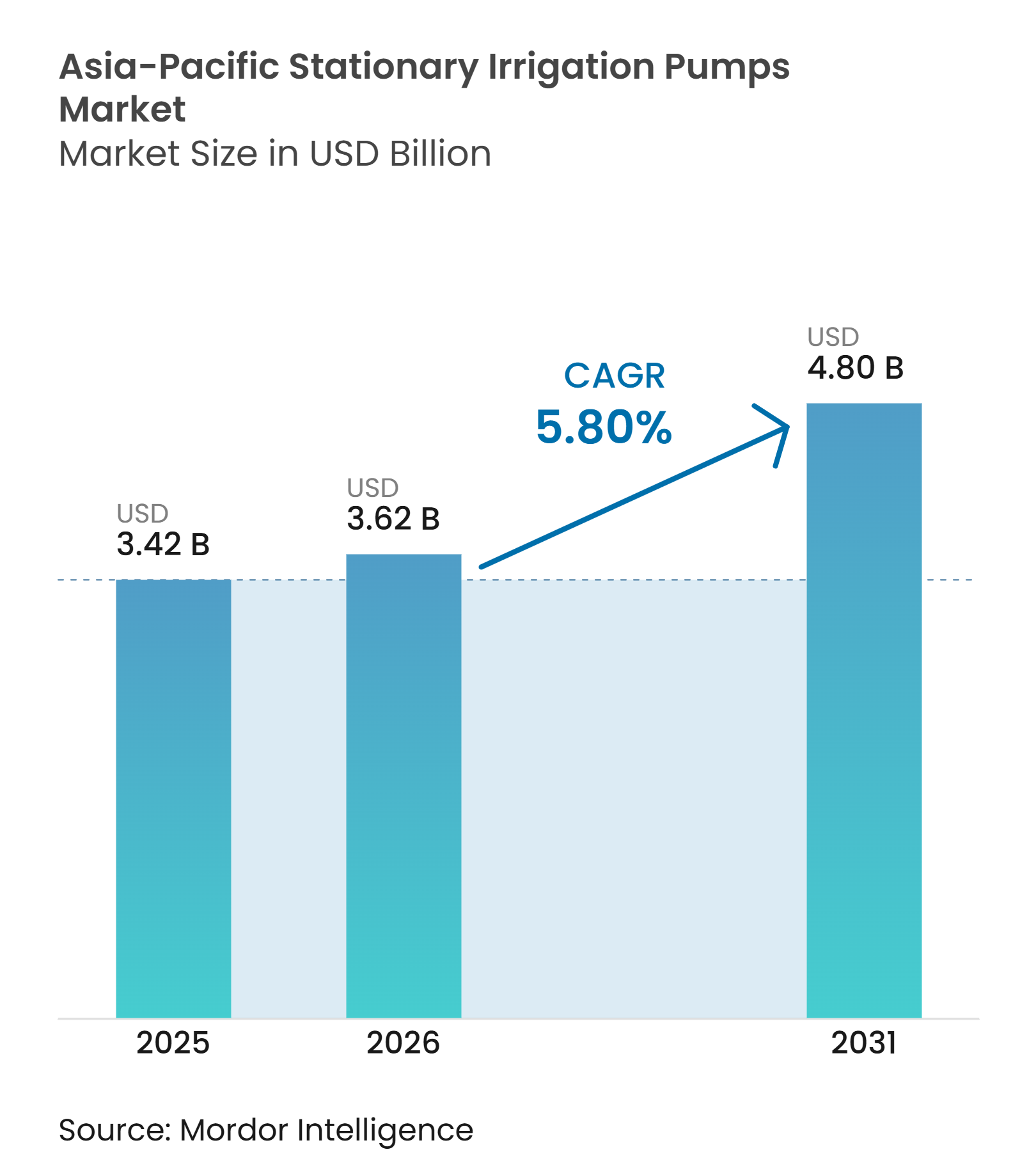
| Base Year Market Size (2025) | USD 3.42 Billion |
| Market Size (2026) | USD 3.62 Billion |
| Market Size (2031) | USD 4.80 Billion |
| Growth Rate (2026 - 2031) | 5.80 % |
| Market Concentration | Low |
Major Players *Disclaimer: Major Players sorted in no particular order Image © Mordor Intelligence. Reuse requires attribution under CC BY 4.0. | |
Asia-Pacific Stationary Irrigation Pumps Market Analysis by Mordor Intelligence
The Asia-Pacific stationary irrigation pumps market size was valued at USD 3.42 billion in 2025 and is projected to grow from USD 3.62 billion in 2026 to reach USD 4.8 billion by 2031, at a CAGR of 5.80% during the forecast period from 2026 to 2031. Demand across the market is supported by public irrigation programs, solar pump deployment, and the need for reliable dry-season water supply. Government procurement can provide suppliers with multi-year order visibility, though tender specifications and local-content requirements remain important considerations. Solar-connected systems are influencing buying decisions by reducing dependence on diesel and enabling monitoring capabilities. Fixed systems that support both irrigation and seasonal drainage may improve asset utilization in flood-prone farming areas. The market also faces cost pressure from local suppliers and increasing groundwater extraction depth requirements.
Key Report Takeaways
- By product type, centrifugal pumps are the largest segment and held 54.0% of the Asia-Pacific stationary irrigation pumps market share in 2025, while solar-compatible submersible pumps are the fastest-growing segment and are anticipated to grow at a 9.4% CAGR between 2026 and 2031.
- By power source, grid electricity is the largest segment and held 52.0% of the market share in 2025, while solar photovoltaic (PV) is the fastest-growing segment and is forecasted to grow at a 10.5% CAGR between 2026 and 2031.
- By application, field irrigation is the largest segment and held 44.0% of the market share in 2025, while protected cultivation is the fastest-growing segment and is forecasted to grow at an 8.8% CAGR between 2026 and 2031.
- By geography, China is the largest segment and held 39.0% of the market share in 2025, while Southeast Asia is the fastest-growing segment and is forecasted to grow at a 6.8% CAGR between 2026 and 2031.
Note: Market size and forecast figures in this report are generated using Mordor Intelligence’s proprietary estimation framework, updated with the latest available data and insights as of January 2026.
Market Trends and Insights
Drivers Impact Analysis of Asia-Pacific Stationary Irrigation Pumps Market*
| Driver | (~) % Impact on CAGR Forecast | Geographic Relevance | Impact Timeline |
|---|---|---|---|
| Government-backed agricultural modernization | +1.4% | Asia-Pacific, concentrated in India, China, Indonesia, and Vietnam | Short term (≤ 2 years) |
| Groundwater irrigation and water-security investment | +1.2% | Global, with the highest relevance in South and Southeast Asia | Medium term (2-4 years) |
| Solar and hybrid pumping adoption | +1.0% | India, Southeast Asia, and China | Medium term (2-4 years) |
| Expansion of high-value and protected cultivation | +0.7% | China, India, Southeast Asia, and Australia | Medium term (2-4 years) |
| Pump digitization and remote asset monitoring | +0.5% | Asia-Pacific, with expansion into rural Southeast Asia | Long term (≥ 4 years) |
| Rice-area electrification and flood-drainage dual use | +0.4% | Southeast Asia and South Asia | Medium term (2-4 years) |
| Source: Mordor Intelligence | |||
Government-Backed Agricultural Modernization
Public spending on irrigation infrastructure supports near-term equipment purchases in the Asia-Pacific stationary irrigation pumps market. Procurement programs typically cover pumps, canal upgrades, power connections, and related farm infrastructure. India had deployed more than 1 million standalone solar irrigation pumps and installed 12,164 MW of solar capacity under PM-KUSUM by February 2026[1]. According to the Asian Infrastructure Investment Bank (AIIB) report, Cambodia received USD 100 million in Asian Infrastructure Investment Bank (AIIB) financing in 2025 to rehabilitate priority irrigation systems and strengthen climate resilience. These programs can raise technical requirements for efficient motors and remote monitoring, and they tend to favor suppliers with project delivery capacity, local service teams, and compliant product documentation.
Groundwater Irrigation and Water-Security Investment
Groundwater dependence is supporting demand for fixed submersible and vertical turbine pumps in dry-season farming areas. The Asia-Pacific stationary irrigation pumps market benefits from investments in deeper wells and more reliable water-delivery systems. India has a large installed base of diesel-powered irrigation pumps, creating a substantial replacement opportunity as rising fuel costs and government electrification and solarization initiatives change farm economics. The Asian Development Bank also highlighted in 2025 the need for stronger financing mechanisms to address water insecurity and ecosystem degradation across Asia and the Pacific. Declining groundwater levels can increase the need for pumps capable of operating at greater depths and higher heads, supporting demand for more robust irrigation systems.
Solar and Hybrid Pumping Adoption
Solar pumping is expanding across India as farmers and irrigation programs shift toward lower-cost and more reliable alternatives to diesel-powered systems. Shakti Pumps installed 86,086 solar pumps during FY 2025–26, representing a 20% year-on-year increase, with government-led PM-KUSUM and state irrigation programs remaining important demand drivers[2]. Solar pumping can reduce exposure to diesel costs and provide an alternative where grid electricity is unreliable, while digitally enabled systems can support monitoring of pump performance, energy consumption, and irrigation operations. This strengthens demand for solar-compatible pumps, controllers, variable-frequency drives, and remote-monitoring solutions in the Asia-Pacific stationary irrigation pumps market.
Expansion of High-Value and Protected Cultivation
The expansion of protected cultivation is increasing demand for reliable irrigation systems that provide precise water delivery to greenhouses, orchards, and other high-value crop operations. In 2026, the Philippine Department of Agriculture allocated around PHP 300 million (USD 5.1 million) to support climate-resilient production of high-value vegetables, including greenhouse development, drip irrigation, and water-impounding systems. The program aims to expand greenhouse-covered farmland from around 500 hectares to 5,000 hectares by 2027, supporting greater adoption of controlled-environment production. Protected cultivation therefore creates opportunities for stationary irrigation pump suppliers offering variable-speed systems, pressure control, flow management, and compatibility with drip and greenhouse irrigation systems, supporting precision water delivery in the Asia-Pacific stationary irrigation pumps market.
Restraints Impact Analysis of Asia-Pacific Stationary Irrigation Pumps Market*
| Restraint | (~) % Impact on CAGR Forecast | Geographic Relevance | Impact Timeline |
|---|---|---|---|
| High installed cost for deep-well systems | -0.9% | Asia-Pacific, with the highest relevance in India and Southeast Asia | Short term (≤ 2 years) |
| Low-cost local pump competition | -0.7% | Asia-Pacific, concentrated in China and India | Medium term (2-4 years) |
| Grid unreliability and solar-storage mismatch | -0.5% | Rural Southeast Asia and archipelago settings | Medium term (2-4 years) |
| Groundwater regulation and subsidy uncertainty | -0.5% | Indonesia, Vietnam, Japan, and India | Long term (≥ 4 years) |
| Source: Mordor Intelligence | |||
High Installed Cost for Deep-Well Systems
Deep-well irrigation systems require investment in borewell drilling, pumps, motors, cabling, controllers, and installation, which can make adoption difficult for smallholders without financial support. A 2026 CEEW study on PM-KUSUM identified access to finance and high capital costs as key barriers to solar irrigation deployment, particularly for new entrants and small developers. Declining groundwater levels can further increase drilling depth and equipment requirements, raising the overall cost of installation. These upfront costs can limit self-funded purchases and slow the replacement or upgrading of stationary irrigation pump systems across the Asia-Pacific market.
Groundwater Regulation and Subsidy Uncertainty
Groundwater extraction regulations can affect the economics and timing of irrigation pump investments across Asia-Pacific. In India, the Central Ground Water Authority regulates groundwater development and extraction, while several states have their own groundwater authorities and regulations. According to the Central Ground Water Board in 2025, India's groundwater extraction reached 247.22 billion cubic meters, with agriculture accounting for the largest share of groundwater use, highlighting the importance of groundwater management for irrigation[3]. At the same time, government-supported irrigation and solar-pumping programs can influence the affordability and timing of pump purchases, making changes in funding and eligibility important to equipment demand. Consequently, tighter extraction controls, permitting requirements, or changes in subsidy availability can delay investment decisions and constrain growth in the Asia-Pacific stationary irrigation pumps market.
*Our forecasts treat driver/restraint impacts as directional, not additive. The impact forecasts reflect baseline growth, mix effects, and variable interactions.
Asia-Pacific Stationary Irrigation Pumps Market Segment Analysis
By Product Type:
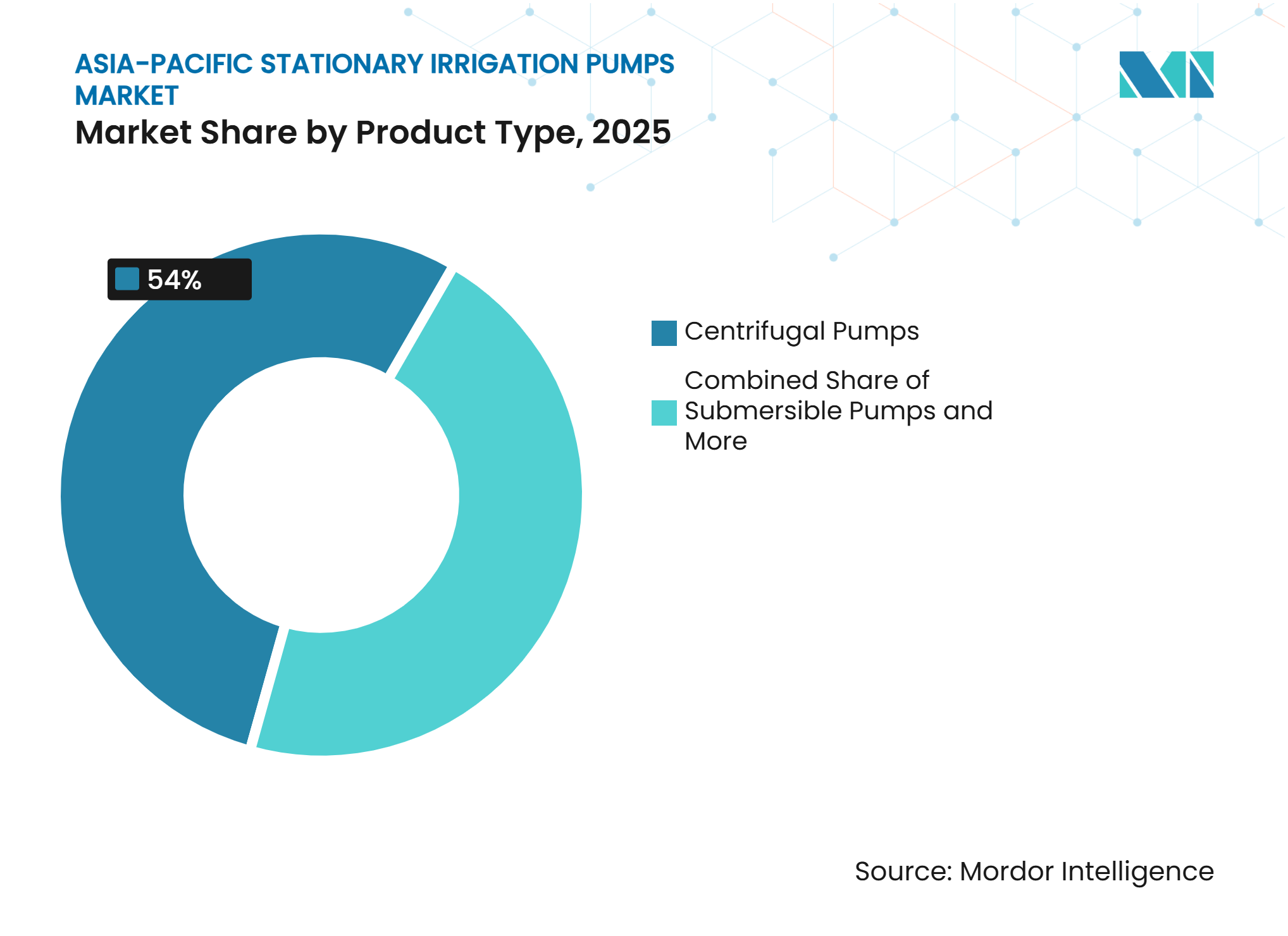
Centrifugal Pumps Lead While Solar-Compatible Submersibles GainCentrifugal pumps accounted for 54.0% of 2025 revenue, making them the largest product category in the Asia-Pacific stationary irrigation pumps market. Their widespread use in canal lifts, open channels, and surface-water intake drives demand across paddy-growing areas. China, India, Vietnam, and Thailand deploy these systems in large irrigation commands. Their simple configuration and local availability also support replacement demand. The Asia-Pacific stationary irrigation pumps market relies on centrifugal systems for volume, particularly where surface-water networks are already established.
Solar-compatible submersible pumps are forecast to grow at a 9.4% CAGR between 2026 and 2031. They are well suited to borewell and deep-well applications where grid access is limited. State solar programs in India, Indonesia, and the Philippines support bulk purchases of solar-ready units. Vertical turbine pumps remain important for large government lift-irrigation projects. Kirloskar Brothers reported in February 2026 that it had received orders for more than 100 vertical turbine pumps for irrigation projects in India. Mixed-flow and axial-flow systems serve high-flow drainage and irrigation stations, while positive-displacement pumps support drip and micro-irrigation systems.



By Power Source:
Grid Electricity Leads While Solar Photovoltaic AdvancesGrid electricity accounted for 52.0% of 2025 power-source revenue, supported by long-running rural electrification programs across China, India, and South Korea. Grid-connected fixed stations remain common in command-area irrigation projects. Diesel and petrol systems remain relevant where network extension is costly; however, higher fuel costs and electrification programs have reduced their growth outlook. Grid systems remain central to the Asia-Pacific stationary irrigation pumps market, as installed farm infrastructure continues to favor grid-connected equipment.
Solar PV is forecast to expand at a 10.5% CAGR between 2026 and 2031, the fastest rate among all power sources. Subsidy programs, lower module costs, and short payback periods for standard 5 horsepower (HP) systems support conversion from diesel equipment. Hybrid solar and grid systems can improve reliability where utility service is intermittent. Grid-connected solar also provides a financial incentive for farmers to sell surplus electricity rather than over-pump groundwater. Biogas and wind-powered systems remain a small part of the Asia-Pacific stationary irrigation pumps market.
By Application:
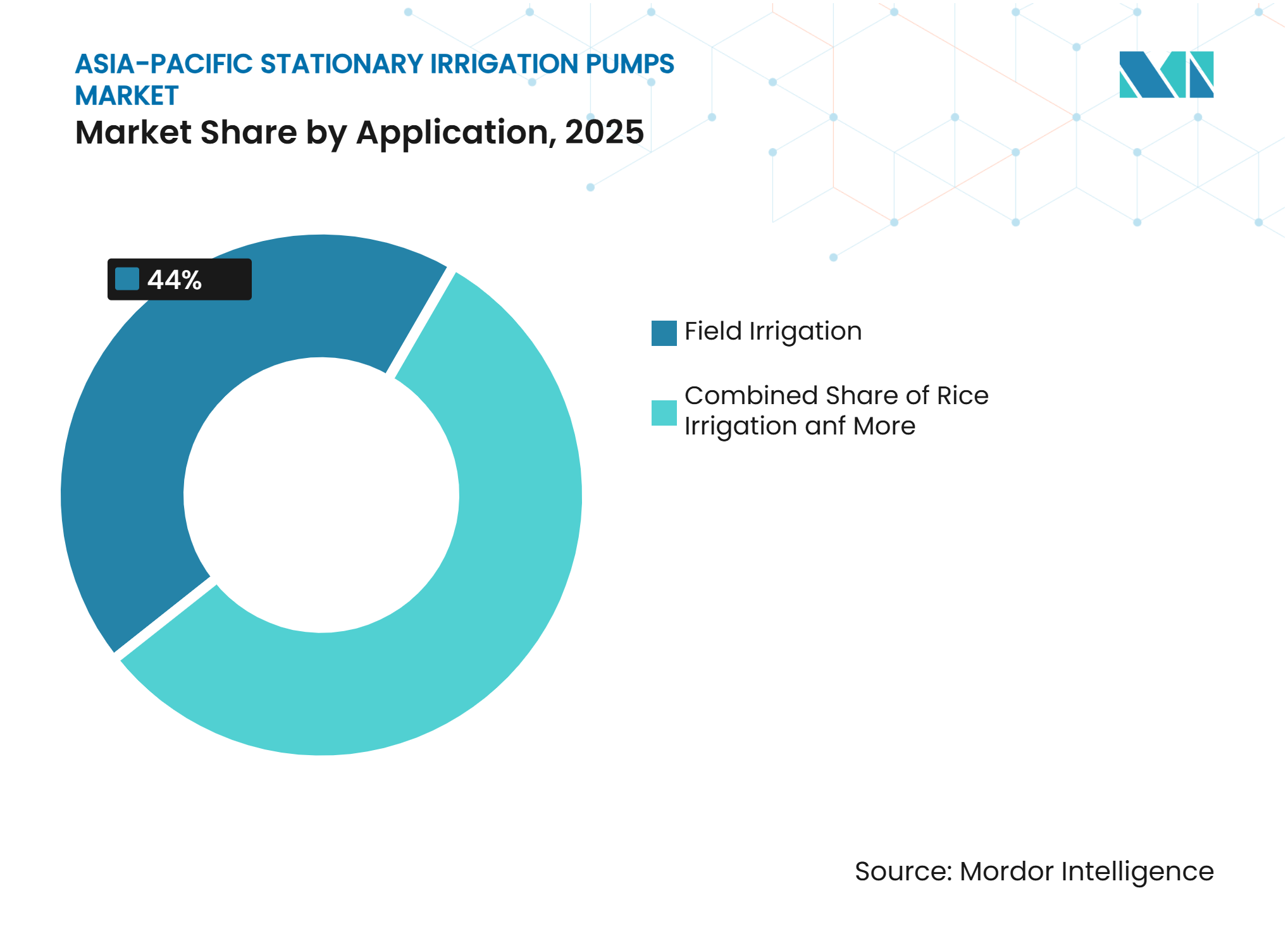
Field Irrigation Provides Volume While Protected Cultivation Grows FastestField irrigation accounted for 44.0% of the market share by application in 2025, driven by large paddy, wheat, and vegetable cultivation areas that require dependable water delivery. China's North China Plain, India's Indo-Gangetic Belt, and Indonesia's Java island rely on fixed pump systems across repeated annual cropping cycles. Rice irrigation was the second-largest application in 2025, as wet-paddy farming remains central to regional food production. These applications sustain demand for widely available surface and lift-irrigation pumps.
Protected cultivation is forecast to expand at an 8.8% CAGR between 2026 and 2031. Greenhouse operators require precision irrigation to manage water, nutrients, and crop quality. Orchards and plantations also support permanent drip and sprinkler infrastructure where high-value crops justify capital investment. Livestock watering remains a smaller but stable application. Drainage and flood control are gaining relevance in flood-prone deltas, where stations can serve two seasonal functions. This application mix broadens the Asia-Pacific stationary irrigation pumps market beyond conventional field irrigation.

Geography Analysis
China held the largest share in the Asia-Pacific stationary irrigation pumps market at 39.0% of the regional share in 2025. State investment in high-standard farmland, groundwater management, and water-saving irrigation supports demand. Domestic manufacturers supply much of the volume, especially for surface centrifugal pumps. International brands maintain a commercial presence through efficient equipment, service networks, and digital controls. China's National Smart Irrigation Action Plan for 2024 to 2030 links farmland upgrades with irrigation equipment modernization.
Southeast Asia is forecast to expand at a 6.8% CAGR between 2026 and 2031, the fastest growth rate across the region. Vietnam, Indonesia, Thailand, and the Philippines form the main demand base for new systems. Cambodia's 2025 AIIB-supported irrigation rehabilitation program supports modernization of priority irrigation systems. Solar adoption, paddy electrification, greenhouse growth, and flood management needs support procurement in this subregion. The region also requires systems that can operate reliably under inconsistent grid service conditions.
India remains a major national demand center due to the PM-KUSUM scheme and its large base of diesel pump sets. Solar feeder conversion and standalone pump deployment are shifting replacement demand toward efficient, monitoring-capable equipment. Japan, South Korea, and Australia are more replacement-driven markets with higher requirements for efficiency and monitoring. Grundfos introduced the CU 302 controller for bore and groundwater applications in Australia during 2025 and 2026. Bangladesh, Sri Lanka, Myanmar, and Pacific economies represent smaller emerging markets where rural electrification and development financing can support fixed pump adoption.
Competitive Landscape
Market Concentration
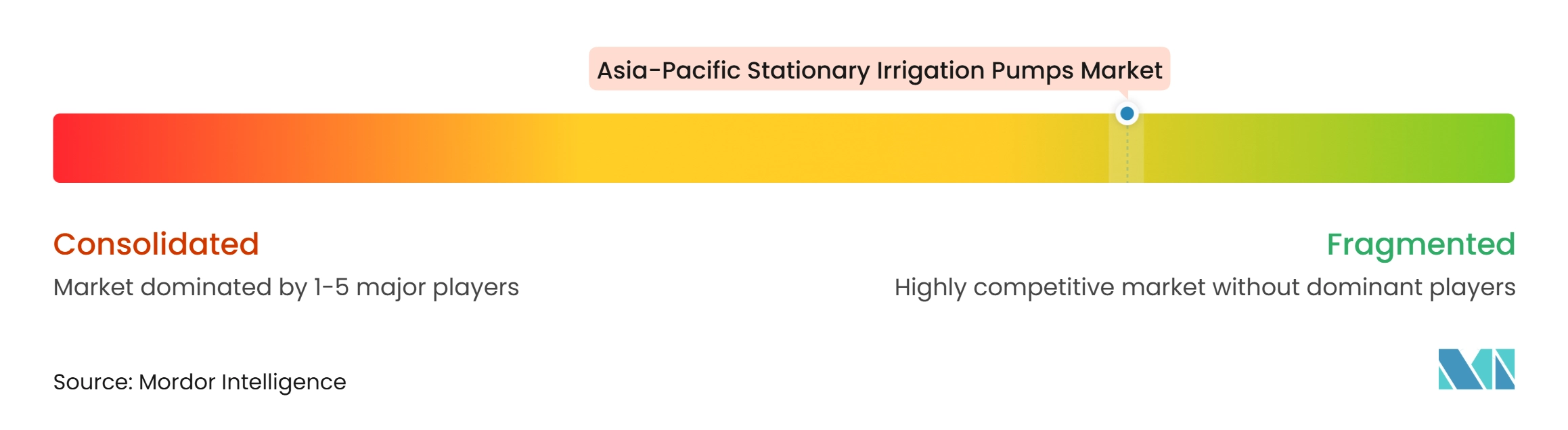
The Asia-Pacific stationary irrigation pumps market is fragmented, with the top five players — Grundfos, Kirloskar Brothers, Shakti Pumps, Xylem, and Jain Irrigation Systems — holding a small combined share in 2025. Ebara, KSB SE & Co. KGaA, Wilo, Franklin Electric, Torishima, Crompton Greaves, Texmo, WPIL, and Shimge Pump compete alongside a large number of local assemblers and contractors. International brands compete on energy efficiency, service access, and monitoring capability, while local suppliers compete primarily on price and distribution coverage.
Grundfos opened an SP submersible borehole pump sub-factory in Semarang, Indonesia, in June 2025 to reduce lead times and meet local content requirements. Shakti Pumps announced a capital expenditure plan of INR 17,000 million (USD 202.4 million), which includes additional pump and motor capacity and a 2.2 GW solar domestic content requirement (DCR) cell and PV module plant. This plan extends the company's position from pump supply into solar system components. Kirloskar Brothers continues to benefit from project orders for vertical turbine, split-case, and solar pump systems in India.
In protected cultivation, premium suppliers can build stronger market positions, as buyers place greater weight on reliability and after-sales support. These suppliers can also use controllers and remote monitoring to develop ongoing service relationships. Cost-sensitive buyers continue to favor products with a lower installed price. This divide makes direct competition less uniform across product tiers. As a result, the Asia-Pacific stationary irrigation pumps market provides regional suppliers room to compete in standard equipment, while international brands find greater opportunity in advanced applications.
Asia-Pacific Stationary Irrigation Pumps Industry Leaders
-
Grundfos (Grundfos Holding A/S)
-
Kirloskar Brothers Limited
-
Shakti Pumps (India) Ltd.
-
Xylem Inc.
-
Jain Irrigation Systems Limited
- *Disclaimer: Major Players sorted in no particular order
Asia-Pacific Stationary Irrigation Pumps Market Companies Covered in this Report
- Grundfos
- Xylem Inc.
- Shakti Pumps (India) Ltd.
- Jain Irrigation Systems Limited
- Kirloskar Brothers Limited
- Ebara Corporation
- KSB SE & Co. KGaA
- Wilo SE
- Flowserve Corporation
- Sulzer Ltd.
- Torishima Pump Mfg. Co., Ltd.
- Pentair plc
- Franklin Electric Co., Inc.
- Crompton Greaves Consumer Electricals Limited
- Havells India Limited
- Aquatex and Texmo
- WPIL Limited
- Shimge Pump Industry Group Co., Ltd.
- LEO Group Pump Co., Ltd.
- Valmont Industries, Inc.
- Lindsay Corporation
- The Toro Company
Recent Industry Developments in Asia-Pacific Stationary Irrigation Pumps Market
- April 2026: Indonesia expanded its pump-irrigation program with up to IDR 5 trillion (USD 291 million) in funding. The Ministry of Agriculture said the program would expand pump-based irrigation in upland areas, with nationwide replication planned to increase cropping intensity and agricultural output.
- February 2026: Kirloskar Brothers received major irrigation-pump orders across India. KBL reported orders for more than 100 vertical turbine pumps, 150 split-case pumps, and 400 solar pump sets for irrigation projects, demonstrating continued demand for stationary and solar-powered pumping equipment.
- January 2026: Shakti Pumps secured a INR 654.03 crore (USD 76.1 million) order from KREDL for 16,780 solar water-pumping systems. The PM-KUSUM order covers design, manufacturing, supply, installation, testing, and commissioning across Karnataka and marked Shakti Pumps' entry into the state.
Asia-Pacific Stationary Irrigation Pumps Market Report Scope
Stationary Irrigation Pumps are fixed pumping systems installed at a specific location to draw and distribute water from sources such as wells, rivers, reservoirs, and canals for agricultural irrigation. They typically include pumps, motors, and control systems designed for continuous or scheduled water delivery to fields, orchards, greenhouses, and other cultivated areas.
The Asia-Pacific Stationary Irrigation Pumps Market is Segmented by Product Type (Centrifugal Pumps, Submersible Pumps, and More), by Power Source (Grid Electricity, Diesel and Petrol, and More), and by Geography (Australia, China, India, and More). The Market Forecasts are Provided in Terms of Value (USD) and Volume (Metric Tons).
Segmentation Overview
| Centrifugal Pumps |
| Submersible Pumps |
| Vertical Turbine Pumps |
| Mixed-Flow and Axial-Flow Pumps |
| Positive-Displacement Pumps |
| Other Product Types |
| Grid Electricity |
| Diesel and Petrol |
| Solar Photovoltaic |
| Hybrid Solar and Grid |
| Other Power Sources |
| Field Irrigation |
| Rice Irrigation |
| Orchard and Plantation Irrigation |
| Protected Cultivation |
| Livestock Watering |
| Drainage and Flood Control |
| Asia-Pacific | Australia |
| China | |
| India | |
| Indonesia | |
| Japan | |
| Philippines | |
| South Korea | |
| Thailand | |
| Vietnam | |
| Rest of Asia-Pacific |
| Segmentation by Product Type | Centrifugal Pumps | |
| Submersible Pumps | ||
| Vertical Turbine Pumps | ||
| Mixed-Flow and Axial-Flow Pumps | ||
| Positive-Displacement Pumps | ||
| Other Product Types | ||
| Segmentation by Power Source | Grid Electricity | |
| Diesel and Petrol | ||
| Solar Photovoltaic | ||
| Hybrid Solar and Grid | ||
| Other Power Sources | ||
| Segmentation by Application | Field Irrigation | |
| Rice Irrigation | ||
| Orchard and Plantation Irrigation | ||
| Protected Cultivation | ||
| Livestock Watering | ||
| Drainage and Flood Control | ||
| Segmentation by Geography | Asia-Pacific | Australia |
| China | ||
| India | ||
| Indonesia | ||
| Japan | ||
| Philippines | ||
| South Korea | ||
| Thailand | ||
| Vietnam | ||
| Rest of Asia-Pacific | ||
Key Questions Answered in the Report
What is the size of the Asia-Pacific stationary irrigation pumps market?
The Asia-Pacific stationary irrigation pumps market is valued at USD 3.62 billion in 2026 and is forecasted to reach USD 4.80 billion by 2031.
Which product leads stationary irrigation pump sales in Asia-Pacific?
Centrifugal pumps led product sales with 54.0% of 2025 revenue because they are widely used in surface-water and canal-lift irrigation.
Which application is growing fastest for fixed irrigation pump systems?
Protected cultivation is forecasted to expand at an 8.8% CAGR between 2026 and 2031 because greenhouses require controlled water delivery.
What limits adoption of stationary irrigation pumps in Asia-Pacific?
High deep-well installation costs, low-cost local competition, grid limitations, and changing groundwater rules can delay purchases.