
Market Overview
| Study Period | 2021 - 2031 |
|---|---|
| Forecast Data Period | 2026 - 2031 |
| Historical Data Period | 2021 - 2024 |
| Growth Rate | 5.08 % |
Major Players *Disclaimer: Major Players sorted in no particular order Image © Mordor Intelligence. Reuse requires attribution under CC BY 4.0. | |
Asia-Pacific Nuclear Power Plant Equipment Market Analysis by Mordor Intelligence
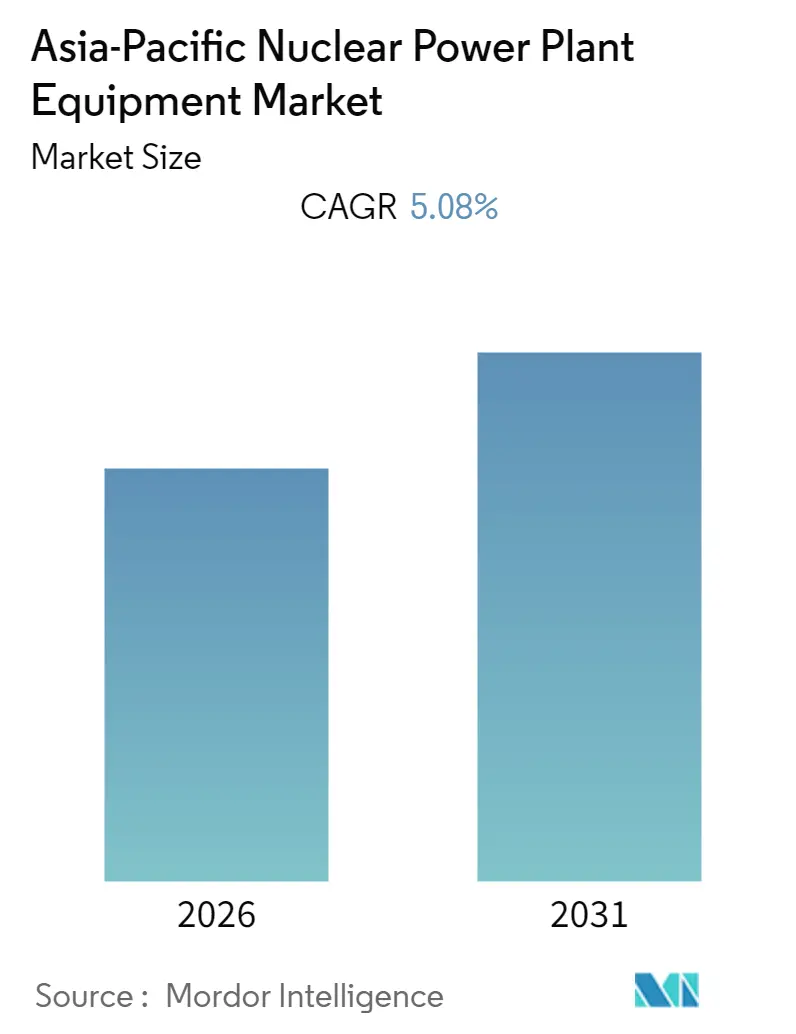
The Asia-Pacific Nuclear Power Plant Equipment Market size is expected to register a CAGR of 5.08% during the forecast period.
The market was negatively impacted by COVID-19 in 2020. Presently the market has now reached pre-pandemic levels.
- Over the long term, the significant contribution of nuclear energy in reducing GHG emissions while fulfilling the increasing energy demands of a growing population and supporting sustainable development in the country is expected to drive the market during the forecast period.
- On the other hand, increasing competition from natural gas and renewables in electricity generation is restraining market growth.
- Nevertheless, rising investments in small modular reactors are expected to be a significant growth opportunity for the market during the forecast period.
- Due to rising energy consumption, limited fossil fuel reserves, and efforts to reduce emissions, China is expected to be the largest market for nuclear power plant equipment during the forecast period.
Note: Market size and forecast figures in this report are generated using Mordor Intelligence’s proprietary estimation framework, updated with the latest available data and insights as of 2026.
Asia-Pacific Nuclear Power Plant Equipment Market Trends and Insights
Pressurized Water Reactors to Dominate the Market
- A typical design of a commercial PWR is such that the core inside the reactor vessel creates heat. The core of the reactor pressure vessel (RPV) contains nuclear fuel, moderator, control rods, and coolant that is cooled and moderated by high-pressure liquid water. PWR consists of a reactor vessel, steam generators, reactor coolant pumps, control roads, a pressurizer, and other elements.
- PWR is the most commercialized nuclear reactor design type, which dominates the Asia-pacific nuclear power plant equipment market. With supporting policies and upcoming projects in the forecast period, PWR nuclear power plants are expected to dominate the market in the coming years.
- Despite lower efficiency and high initial investments, PWR is a mature technology. It has relatively lower operational costs, so most countries with both adult and young nuclear energy sectors are investing in PWR technology. The reactor type is expected to dominate the market during the forecast period.
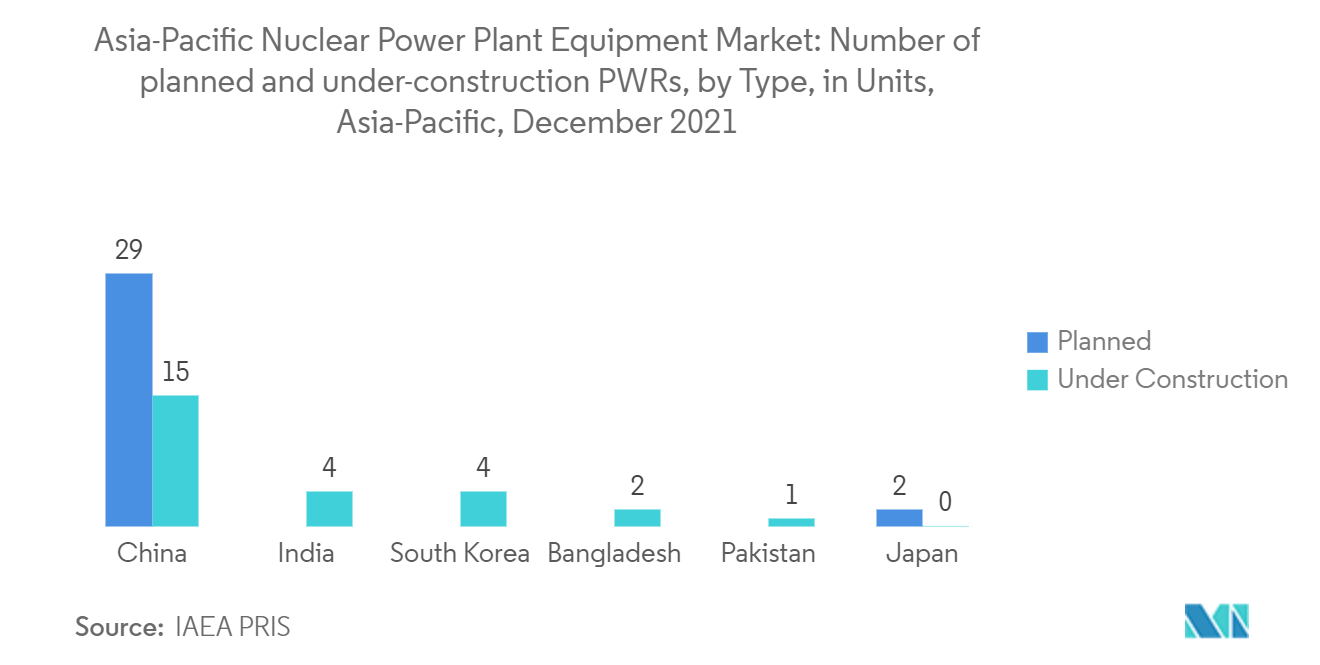
- As of December 2021, there are 26 under construction PWR in the Asia-Pacific region, and nearly 31 new PWRs are planned for construction. China is leading in terms of future pressurized water reactors and nuclear plants. China is the dominant country, with 15 under-construction PWR and 29 PWR reactors planned for construction.
- As PWR is a mature technology, most countries with a relatively underdeveloped nuclear energy industry focus on developing PWR-type nuclear reactors. Countries such as Bangladesh (2) and Pakistan (2) are building nuclear reactors exclusively of the PWR type. Additionally, due to the relatively lower operational costs, some countries with relatively mature nuclear sectors, such as India (4) and South Korea (4), are also building PWR-type nuclear reactors.
- Thus, such regional developments will support the Asia-Pacific nuclear power plant equipment market during the forecast period.


China to Dominate the Market
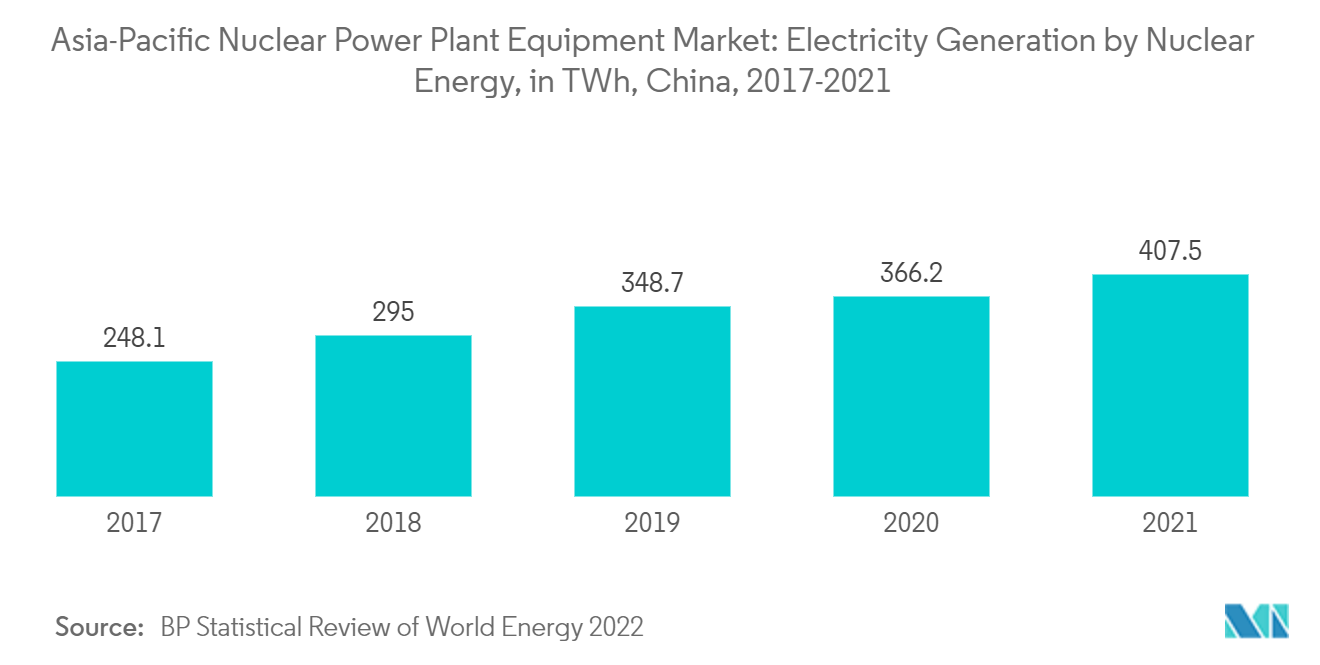
- China is the largest overall and nuclear energy consumer in Asia-Pacific region. As of December 2022, there are 16 nuclear power plants under construction in the country, and 31 are planned for construction. With a generation of 407.5 TWh of electricity from nuclear energy in 2021, China's nuclear power generation by nearly 65% during 2017-2021. With upcoming projects, dominance is expected to continue in the forecast period.
- China is projected to be one of the largest nuclear markets globally, by capacity during the forecast period. In March 2022, the National Energy Administration (NEA) set the target of increasing installed nuclear power capacity to 70 GW by 2025
- During 2021, China added 2 PWR reactors to the grid, and in January 2022, China added connected another PWR reactor to the grid, the Fuqing 6 reactor with a net capacity of 1000 MW. The Fuqing 5 nuclear reactor, which entered service in January 2021, was the first Hualong One reactor, a Chinese Generation III pressurized water nuclear reactor model, to enter commercial service. China also started construction on 6 new PWRs during 2021.
- Additionally, the country is also exporting technology and developing PWR nuclear reactors in many countries such as Pakistan, Romania, Iran, Turkey, Egypt and Argentina, and this is expected to the improve market prospects for PWR technology in these countries. Due to these factors, China is expected to be one of the largest markets for PWR reactors during the forecast period.
- China is expected to play a vital role in the future expansion of the global nuclear industry, despite some negative sentiment toward the Chinese nuclear companies, in the form of concerns over safety standards and illegal technology sharing.
Regulatory Landscape
Across Asia-Pacific, nuclear power plant equipment procurement is shaped by national licensing regimes that increasingly reference International Atomic Energy Agency (IAEA) safety expectations, with regulators tightening requirements for site selection, design, construction, and supply chain quality assurance. In Japan, the Nuclear Regulation Authority hosted an IAEA Integrated Regulatory Review Service (IRRS) mission (January 26 to February 6, 2026), reinforcing ongoing alignment of regulatory programs with international benchmarks relevant to reactor island and auxiliary equipment upgrades and life-extension activities.
Several markets are updating enabling laws and governance structures that affect project permitting and equipment qualification timelines. Vietnam brought a new Atomic Energy Law into effect on January 1, 2026, and followed with Ministry of Science and Technology Circular No. 07/2026/TT-BKHCN (effective March 31, 2026), covering nuclear safety-related technical regulations for site design and construction. The IAEA also handed over an Integrated Nuclear Infrastructure Review (INIR) report to Vietnam on April 22, 2026, tied to readiness steps for restarting the Ninh Thuan nuclear project. India advanced its framework with Presidential assent to the SHANTI Act on December 20, 2025, while Singapore's National Environment Agency commissioned studies in March 2026 on nuclear safety frameworks and environmental impacts, indicating a stronger regional focus on pre-deployment safety and governance preparation.
Value Chain Analysis
The nuclear power plant equipment value chain in Asia-Pacific spans nuclear-grade raw materials and heavy forgings (reactor pressure vessel and steam generator components), specialized fabrication and machining, nuclear QA and qualification (including documentation, traceability, and inspection), systems integration for island and auxiliary equipment, logistics for large components, and field installation with commissioning support and long-term services. Regional supply is influenced by concentrated capabilities in heavy forging and complex fabrication, particularly in Japan and South Korea, while EPC and OEM-led integration bundles core equipment with pumps, valves, instrumentation and control (I&C), and balance-of-plant packages.
Supply chain constraints are tied to workforce depth and supplier capability (including a reported 45% decline in skilled workers in Japan's nuclear industry post-2011), component obsolescence, and the challenge of modernizing plants with digital I&C under stringent qualification rules. Industry and government initiatives are also being used to reinforce supplier capacity and integrity, including Japan's METI and Japan Atomic Industrial Forum-led Nuclear Supply Chain Platform (NSCP) to support human resources and overseas business, along with wider adoption of nuclear supply chain management practices promoted by bodies such as the IAEA and OECD-NEA working groups. These dynamics raise the importance of commercial-grade dedication pathways for certain components, long-lead planning for heavy components, and multi-country partnerships to meet localization and compliance requirements in domestic and export projects.
Competitive Landscape
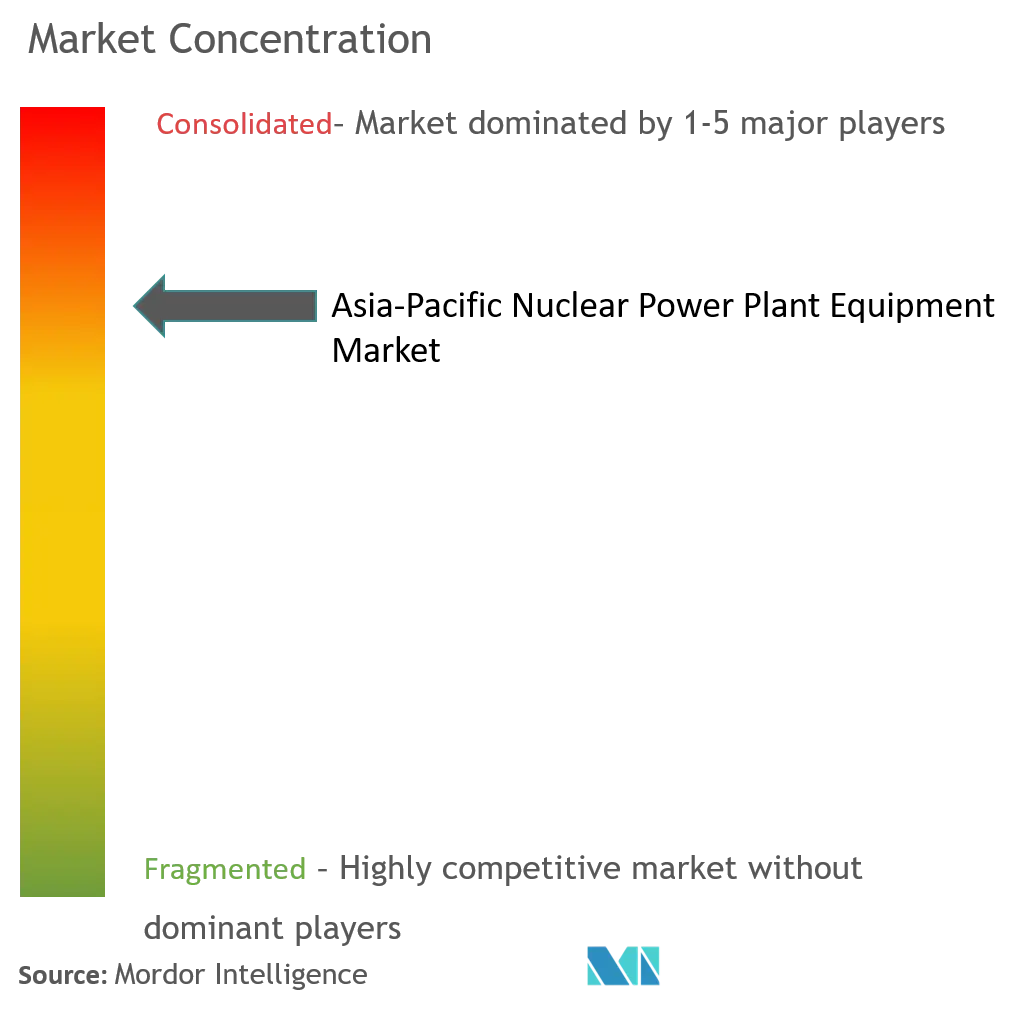
The Asia-Pacific nuclear power plant equipment market is moderately consolidated. Some of the major companies (in no particular order) include Korea Electric Power Corporation, Framatome, Dongfang Electric Corporation Limited, Doosan Corporation, and GE-Hitachi Nuclear Energy,
Asia-Pacific Nuclear Power Plant Equipment Industry Leaders
Korea Electric Power Corporation
Framatome
Doosan Corporation
Dongfang Electric Corporation Limited
GE-Hitachi Nuclear Energy
- *Disclaimer: Major Players sorted in no particular order

Market Opportunities and Future Outlook
A pipeline of new-build and restart activity continues to support demand for reactor island and auxiliary equipment in Asia-Pacific, with China acting as a key anchor market. As of June 2026, reporting citing EIA data indicated China had 60 operational reactors (58.7 GW) and 36 reactors under construction, supporting sustained requirements for long-lead components such as reactor vessels, steam generators, turbine islands, and nuclear-grade pumps and valves. Separately, policy signals in Japan emphasize replacement of decommissioned reactors with next-generation advanced reactors and continued R&D on SMRs and other advanced concepts under the 7th Strategic Energy Plan (February 2025), which expands the addressable scope for higher-specification materials, advanced safety systems, and modernization packages.
Opportunities are also being created by procurement models and industrial capacity additions tied to domestic manufacturing and export competitiveness. In India, the SHANTI Act (assented December 2025) has been followed by reported capacity expansion moves by equipment makers (including Tema India, Walchandnagar Industries, KSB Ltd, and Electronet Equipments, reported July 2026), as well as large package tenders such as the NPCIL-NTPC ASHVINI-led nuclear island mega EPC tender for the 4 x 700 MW Mahi Banswara Rajasthan Atomic Power Project (reported July 2026), which can draw demand across island equipment, auxiliaries, and qualified sub-suppliers. In South Korea, the Ministry of Science and ICT initiated the 7th Comprehensive Nuclear Energy Promotion Plan (2027-2031) in May 2026, with emphasis on SMRs and AI convergence, and a July 2026 trilateral memorandum of cooperation (South Korea, United States, Japan) focused on deploying SMRs in third countries, supporting vendor qualification, standardization, and export-oriented equipment supply chain development.
Recent Industry Developments
- May 2026: South Korea consolidated its nuclear export coordination under a unified "K-Nuclear One Team" approach, requiring Korea Electric Power Corporation (KEPCO) and Korea Hydro & Nuclear Power (KHNP) to jointly pursue overseas nuclear power plant projects. The move centralizes bid leadership and execution governance, tightening alignment across EPC, equipment sourcing, and export financing discussions. It also strengthens the platform for Korean equipment suppliers to access larger international tenders through a single national export channel.
- February 2026: Doosan Enerbility signed a KRW 320 billion contract with its Czech subsidiary, Doosan Skoda Power, to supply steam turbines and turbine control systems for Dukovany Nuclear Power Plant Units 5 and 6. The award underscores continued demand for conventional island equipment tied to nuclear new-build programs and highlights localization-linked teaming structures for export projects. It also reinforces Doosan's role in long-lead turbine island packages that influence upstream manufacturing schedules and qualified sub-supplier engagement.
- December 2024: Framatome signed a Design Cooperation Implementation Arrangement with the Japan Atomic Energy Agency (JAEA), Mitsubishi Heavy Industries (MHI), and Mitsubishi FBR Systems to support development of a sodium-cooled fast reactor demonstrator. The agreement expands advanced-reactor engineering collaboration in the region beyond large light-water reactor supply chains. It supports a longer-term equipment opportunity set around fast-reactor materials, component design, and qualification pathways.


Research Methodology Framework and Report Scope
Market Definition and Coverage
This market covers the revenue earned from equipment supplied for nuclear power plants in Asia-Pacific, including nuclear island and supporting plant systems that enable safe, stable electricity generation across operating and new-build sites.
Scope exclusions: We exclude nuclear fuel supply, spent fuel disposal services, and plant O&M labor-only services unless bundled as equipment-linked supply.
Segmentation Overview
- Reactor Type
- Pressurized Water Reactor
- Pressurized Heavy Water Reactor
- Other Reactor Types
- Carrier Type
- Island Equipment
- Auxiliary Equipment
- Research Reactor
- Geography
- China
- India
- Japan
- Rest of Asia-Pacific
Data Sources, Market Sizing, and Validation
Desk Research
We first build the demand context from public nuclear build and operating signals, and then align it with equipment categories used in this market. Common inputs include reactor and unit status data from sources such as the International Atomic Energy Agency, as well as electricity generation and capacity statistics from sources such as the International Energy Agency and national energy ministries in China, India, and Japan.
To make sure the model stays practical, we also track procurement and policy signals through sources such as government gazettes, nuclear regulator websites, and public tender portals, followed by customs and trade releases where available. Financial context is added using annual reports and investor presentations, supported by a paid subscription for company financials and news tracking when disclosures are scattered. The desk sources listed are illustrative, and many other public documents were referenced for cross-checks, clarification, and validation.
Primary Interviews and Surveys
We validate sizing assumptions through expert interviews and structured surveys with OEM and subsystem suppliers, EPC and project management professionals, utility procurement teams, and independent nuclear engineers. Because Asia-Pacific demand is project-led and timing sensitive, discussions focus on build schedules, typical equipment packages per reactor, localization levels, and price movement by major equipment groups across China, India, Japan, and the rest of the region.
Distribution of primary research fieldwork respondents
| Company type | Respondent position |
|---|---|
| Top tier: 35% | CXOs: 20% |
| Mid tier: 45% | Functional/Unit leaders: 30% |
| Smaller Players: 20% | Managers: 50% |
Market-Sizing & Forecasting
Sizing starts with a top-down rebuild of the equipment demand pool using Asia-Pacific reactor pipelines and operating fleet signals, which are then translated into equipment spend by mapping typical equipment packages to reactor-unit additions and major refurbishment cycles. The model is then checked through selective bottom-up approximations, where we roll up a sample of supplier revenues, validate typical order sizes, and pressure test implied pricing against recent contract and tender references.
A few practical inputs guide the math and keep it repeatable, such as the count of units under construction and planned, expected commissioning slippage, reactor type mix (for example PWR versus PHWR), the split between island equipment and auxiliary equipment, and the expected share of research reactor equipment spend. For countries with limited disclosure, gaps are handled using proxy assumptions from similar unit sizes and build patterns, and then corrected after primary feedback.
For forecasting, we rely on scenario analysis with a base case that follows announced build schedules and policy direction, and then adjust timing and pricing using expert consensus. When the main uncertainty sits in delivery dates, sensitivity is applied to project start and completion timing, thereby keeping forecast ranges grounded in what procurement teams say is feasible.
Data Validation & Update Cycle
We run cross-checks between the model outputs and independent signals, such as reactor status changes, grid generation trends, and major equipment tender activity, before finalizing totals. If a country-level value moves sharply versus the prior cycle, the assumptions are reviewed line by line and follow-up calls are triggered with relevant respondents to confirm whether the shift is real or timing related.
The work is reviewed in multiple steps, starting from calculation checks and ending with analyst sign-off after variance explanations are documented. Reports are refreshed annually, and interim updates are made when material events occur, such as new unit approvals, cancellations, or large equipment awards. Before delivery, a final pass is completed so clients receive the latest updated view.
Mordor Intelligence's Asia Pacific Nuclear Power Plant Equipment Market Size Versus Other Published Estimates
Published market numbers for Asia-Pacific nuclear power plant equipment can vary a lot, even when the topic sounds identical, because each publisher draws the line differently on what counts as equipment revenue and how project timing is treated. Differences also come from currency timing, whether refurbishment spend is included, and how prices are assumed to move across long project cycles.
In our view, the biggest gap driver in this market is whether the estimate mixes in broader nuclear plant services or stretches beyond plant equipment into fuel cycle and long-term O&M, which inflates the total for fast-growing countries. Another common difference is how new-build pipelines are converted into annual revenue, since some approaches pull forward multi-year orders into a single year, while others smooth them based on delivery milestones and commissioning delays.
Benchmark comparison
| Source | Market Size | Gaps in Research Methodology |
|---|---|---|
| Mordor Intelligence | USD 0.00 B (2026) | |
| Industry Data Portal A | USD 47.43 B (2025) | This figure appears to use a much broader spend perimeter and longer study window, and it likely counts plant-wide programs and adjacent nuclear services beyond equipment delivered to nuclear island, auxiliary, and research reactor packages. |
| Trade Publisher B | USD 9.50 B (2025) | This estimate reads closer to an Asia-only slice of a global equipment total, and it may be anchored to a narrower definition of equipment plus conservative project timing, which can undercount multi-country build programs and major retrofit cycles. |
The spread across published values mainly reflects scope and timing choices, rather than simple math differences, and the table makes that clear. When equipment is counted only at the point it is contracted and delivered into nuclear island, auxiliary, and research reactor packages, and when commissioning slippage is explicitly modeled, the result stays more traceable to real project flow, which is the approach applied by Mordor Intelligence.


Key Questions Answered in the Report
What is the current Asia-Pacific Nuclear Power Plant Equipment Market size?
The Asia-Pacific Nuclear Power Plant Equipment Market is projected to register a CAGR of 5.08% during the forecast period (2026-2031)
Who are the key players in Asia-Pacific Nuclear Power Plant Equipment Market?
Korea Electric Power Corporation, Framatome, Doosan Corporation, Dongfang Electric Corporation Limited and GE-Hitachi Nuclear Energy are the major companies operating in the Asia-Pacific Nuclear Power Plant Equipment Market.
What years does this Asia-Pacific Nuclear Power Plant Equipment Market cover?
The report covers the Asia-Pacific Nuclear Power Plant Equipment Market historical market size for years: 2020, 2021, 2022, 2023, 2024 and 2025. The report also forecasts the Asia-Pacific Nuclear Power Plant Equipment Market size for years: 2026, 2027, 2028, 2029, 2030 and 2031.
Page last updated on:


 Your data is secure and never sold or shared.


