
Asia - Pacific Modern Methods Of Construction (MMC) Market Size and Share
Market Overview
| Study Period | 2021 - 2032 |
|---|---|
| Forecast Data Period | 2027 - 2032 |
| Base Year Market Size (2026) | USD 137.67 Billion |
| Market Size (2027) | USD 149.58 Billion |
| Market Size (2032) | USD 226.47 Billion |
| Growth Rate (2027 - 2032) | 8.65 % |
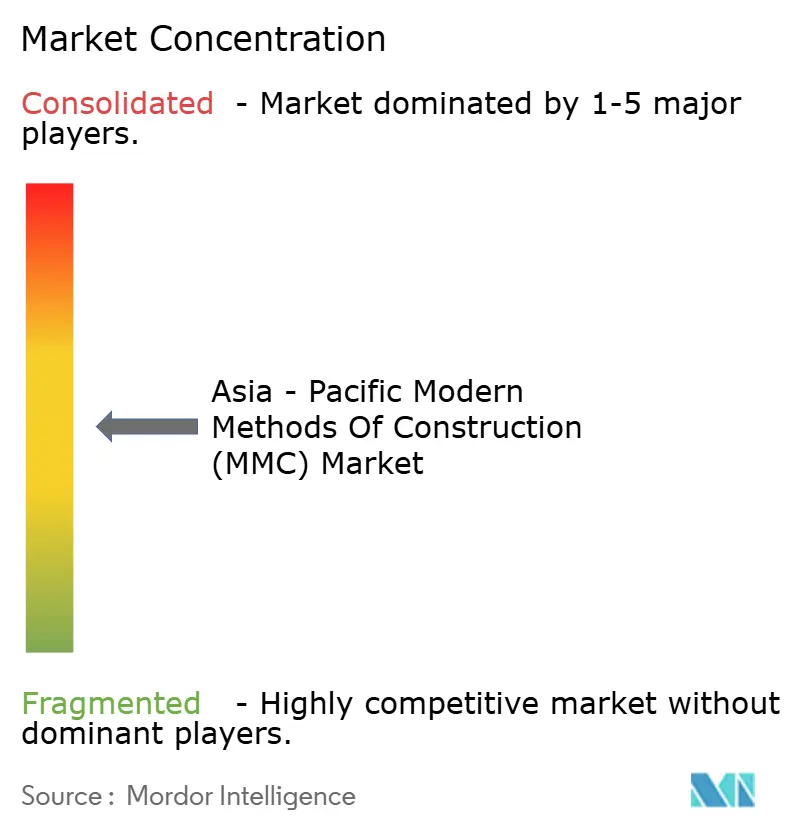
| Market Concentration | Medium |
Major Players *Disclaimer: Major Players sorted in no particular order Image © Mordor Intelligence. Reuse requires attribution under CC BY 4.0. | |
Asia - Pacific Modern Methods Of Construction (MMC) Market Analysis by Mordor Intelligence
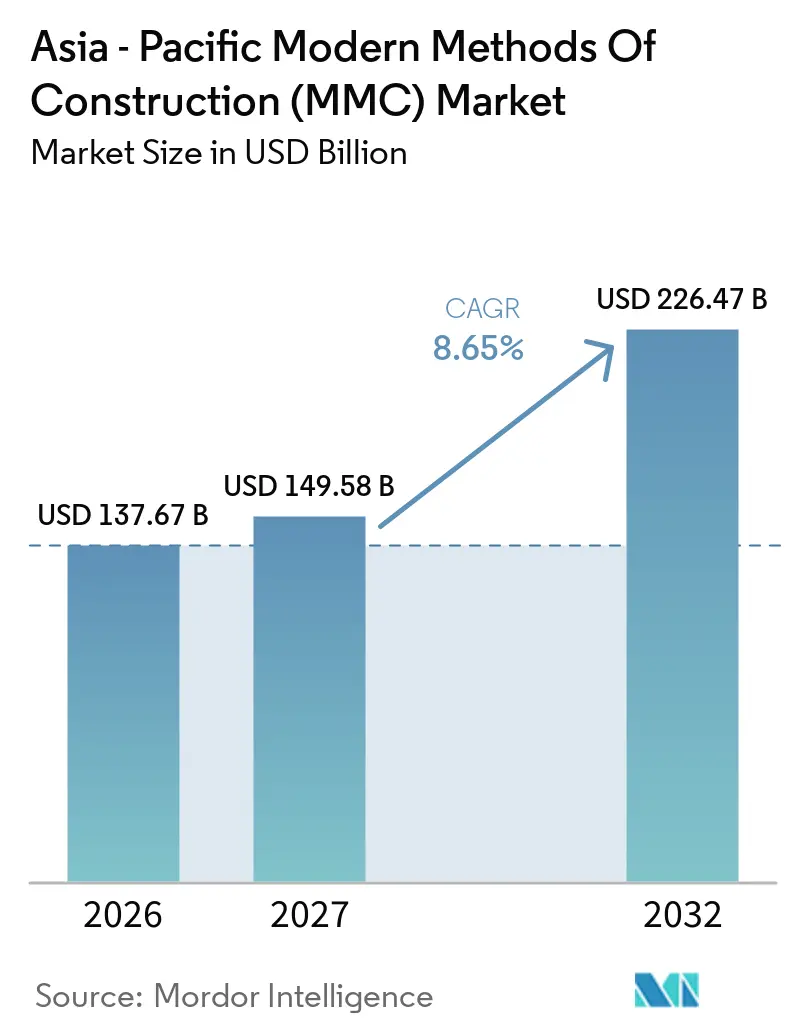
The Asia - Pacific Modern Methods Of Construction Market size was valued at USD 137.67 billion in 2026 and is estimated to grow from USD 149.58 billion in 2027 to reach USD 226.47 billion by 2032, at a CAGR of 8.65% during the forecast period (2027-2032).
The Asia-Pacific modern methods of construction market is shifting from limited project-based use toward broader procurement-led adoption, particularly as housing delivery and public infrastructure timelines face increasing pressure. Public agencies are increasingly establishing technical requirements for prefabricated building systems, providing manufacturers with greater visibility into demand and supporting investment in factory capacity. Several established construction markets across the region also face a declining supply of skilled on-site labor, increasing the value of predictable factory-based production.
Large contractors are responding by developing modular platforms, adopting digital design tools, and pursuing cross-border acquisitions to expand their manufacturing capabilities. However, the Asia-Pacific modern methods of construction market continues to face uneven standards, fragmented supplier networks, and challenging transport conditions across island markets, which can restrict the movement of fully completed modules.
Key Report Takeaways
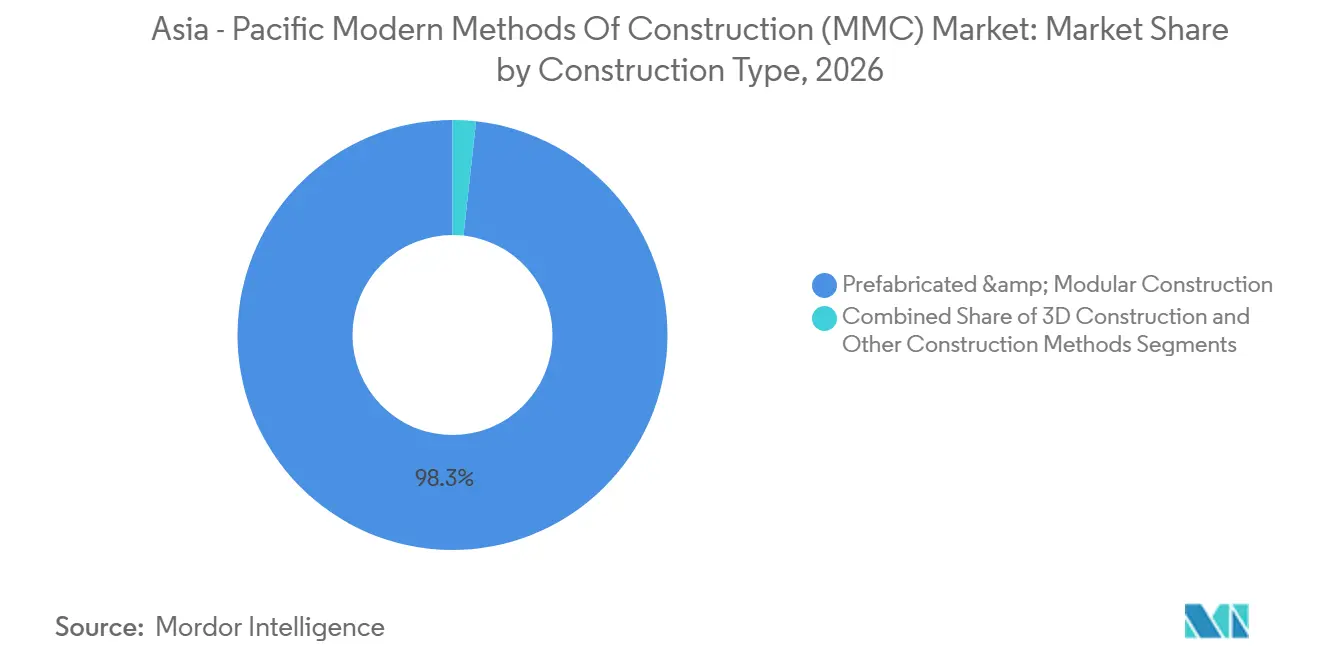
- By construction type, prefabricated and modular construction held 98.25% of the Asia-Pacific modern methods of construction market share in 2026, while 3D construction is forecast to grow at a 34.6% CAGR through 2032.
- By material type, concrete accounted for 54.15% of the Asia-Pacific modern methods of construction market size in 2026, while timber is forecast to grow at a 7.9% CAGR through 2032.
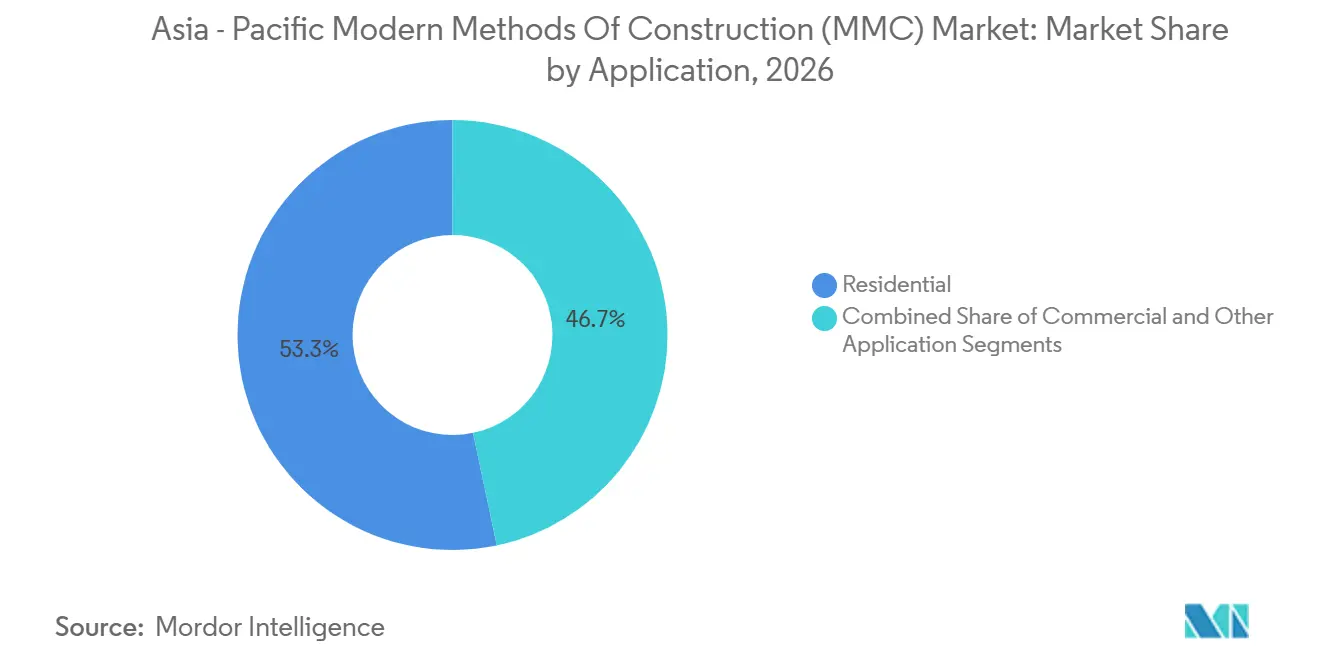
- By application, residential construction held 53.29% of the Asia-Pacific modern methods of construction market share in 2026, while commercial construction is forecast to grow at a 7.6% CAGR through 2032.
- By geography, China held 49.8% of the regional total in 2026, while India is forecast to grow at an 8.8% CAGR through 2032.
Note: Market numbers in this report are based on Mordor Intelligence's proprietary estimation framework, which combines nine months of actuals with Q4 projections for base year 2026.
Asia - Pacific Modern Methods Of Construction (MMC) Market Trends and Insights
Drivers Impact Analysis*
| Drivers | (~) % Impact on CAGR Forecast | Geographic Relevance | Impact Timeline |
|---|---|---|---|
| Rapid Urban Housing Demand | +2.5% | India, Indonesia, Vietnam, China | Short term (≤ 2 years) |
| Industrialized and Green Construction Policies | +2.0% | China, South Korea, Australia, India | Medium term (2-4 years) |
| Infrastructure and New-City Development | +1.5% | China, India, Southeast Asia | Medium term (2-4 years) |
| Labor Productivity and Schedule Pressures | +1.2% | Japan, South Korea, Australia | Short term (≤ 2 years) |
| High-Density Urban Development | +0.6% | China, Japan, Singapore, South Korea | Medium term (2-4 years) |
| Export-Oriented Modular Supply Chains | +0.5% | China, India, Vietnam | Long term (≥ 4 years) |
| Source: Mordor Intelligence | |||
Rapid Urban Housing Demand in Emerging Asian Economies
India’s Pradhan Mantri Awas Yojana-Gramin program aims to deliver an additional 2 crore rural homes between 2024-25 and 2028-29, creating substantial delivery requirements for the Asia-Pacific modern methods of construction market[1]. Prefabricated components can reduce reliance on scarce on-site labor, particularly where large-scale housing delivery is required. Vietnam’s social housing program and industrial park expansion are supporting demand for worker accommodation that can be delivered using repeatable building formats. Indonesia has also incorporated modular housing into its 3 Million Houses Development Program, indicating growing formal policy support for factory-built construction. These programs can generate orders that enable producers to plan capacity rather than depend solely on private residential construction cycles. They also strengthen the business case for suppliers capable of delivering standardized units across multiple housing locations.
Government Promotion of Industrialized and Green Construction
Government regulations are increasingly shaping the Asia-Pacific modern methods of construction market by establishing practical requirements for building design and delivery. China’s Ministry of Housing and Urban-Rural Development is expected to issue the first group of replicable prefabricated construction technology systems in March 2025. Shanghai is set to update its assembly-rate requirements in 2025, requiring eligible new buildings to achieve a 40% prefabrication rate or a 60% assembly rate from September 2025. South Korea plans to increase public modular rental orders to 3,000 units annually by 2026 and provide additional housing-fund support for modular projects. Australia is also developing a streamlined approval pathway and a national certification framework for prefabricated buildings. Clearer standards can reduce risks for developers, lenders, and manufacturers making long-term commitments.
Large-Scale Infrastructure and New-City Development
Infrastructure development and planned urban districts are expanding the range of projects served by the Asia-Pacific modern methods of construction market. India’s national freight, road, and port programs support the use of standardized steel and concrete components in bridges, stations, tunnels, and related infrastructure. Public plans for Beijing’s sub-center also recognize modular integrated construction for new-city infrastructure. China has directed local governments to establish long-term green and low-carbon construction systems that incorporate prefabricated and smart building technologies. Industrial parks can generate repeat orders for factories, warehouses, and worker housing, making factory investments easier to justify. These projects provide demand that is less dependent on the timing of private home sales.
Construction Labor Productivity and Schedule Pressures
Labor constraints are making production certainty an increasingly important purchasing factor in the Asia-Pacific modern methods of construction market. Japan recorded 740,667 housing starts in 2025, a 6.5% decline from the previous year, while contractors continued to face limited skilled trade capacity[2]. A 2025 peer-reviewed study found that prefabricated construction reduced on-site accident rates by 30–40% compared with traditional construction methods while maintaining component precision within ±2 millimeters. Korea Land and Housing Corporation is developing a 22-story modular residential tower in Uiwang Chopyeong, demonstrating the application of modular construction in taller buildings. Factory-based production helps contractors improve safety, manage schedules, and maintain consistency amid on-site labor constraints.
Restraints Impact Analysis*
| Restraints | (~) % Impact on CAGR Forecast | Geographic Relevance | Impact Timeline |
|---|---|---|---|
| Uneven Prefabrication Standards | -1.8% | Southeast Asia, South Asia, cross-border Asia-Pacific | Medium term (2-4 years) |
| Fragmented Contractor and Supplier Ecosystems | -1.5% | India, Southeast Asia, Rest of Asia-Pacific | Medium term (2-4 years) |
| Inter-Island and Cross-Border Logistics | -0.8% | Indonesia, Philippines, Pacific Islands | Long term (≥ 4 years) |
| Variable Quality Assurance and Installation Capacity | -0.7% | South Asia, Southeast Asia | Short term (≤ 2 years) |
| Source: Mordor Intelligence | |||
Uneven Adoption of National Prefabrication Standards
Different certification and inspection requirements remain a practical constraint on the Asia-Pacific modern methods of construction market. A 2025 comparative academic study identified distinct certification, design approval, and quality inspection systems in South Korea, Singapore, and the United Kingdom. These differences increase costs for suppliers seeking to serve multiple national markets. In December 2025, South Korea held a public hearing on a proposed act to establish unified certification criteria and a Modular Construction Review Committee. Australia’s Building Codes Board is also developing a national certification framework for prefabricated manufacturers[3]. Progress toward common structural and building code requirements could facilitate financing and cross-border transfer of factory-built systems.
Fragmented Contractor and Supplier Ecosystems
The Asia-Pacific modern methods of construction market comprises large industrial producers and numerous smaller fabricators and installers with varying capabilities. Smaller suppliers often face challenges in maintaining consistent tolerances, implementing digital quality checks, and ensuring reliable logistics for large-scale housing and infrastructure programs. Consequently, buyers may remain cautious when projects require consistent output at scale.
This challenge is particularly acute in markets where contractors receive irregular order volumes and cannot justify investments in automation. Public procurement can help mitigate this barrier by providing sufficient demand volume for suppliers to upgrade equipment and strengthen quality management systems. As a result, the market is gradually shifting toward deeper partnerships among developers, contractors, fabricators, and installation specialists.
*Our forecasts treat driver/restraint impacts as directional, not additive. The impact forecasts reflect baseline growth, mix effects, and variable interactions.
Segment Analysis
By Construction Type: Prefabrication Leads Regional Delivery While 3D Construction Gains Scale.
Prefabricated and modular construction is expected to account for 98.25% of the Asia-Pacific modern methods of construction market in 2026, supported by established factory networks in China, Japan, and other regional production centers. The segment includes panelized systems, volumetric modules, hybrid modular systems, and other factory-built approaches. Developers use structural insulated panels, light-gauge steel panels, and timber-frame panels in low- and mid-rise housing projects, where repeated layouts improve production efficiency. These methods allow manufacturers to produce core components before site preparation is complete. Volumetric modules are more commonly used in space-constrained markets, such as South Korea, Australia, and Hong Kong. Hybrid systems combine factory-built structural cores with on-site finishing work, providing developers with greater flexibility when project designs cannot be fully standardized. Tunnel formwork and other methods continue to support projects where transporting full modules is challenging. This segment remains central to the Asia-Pacific modern methods of construction industry because it aligns with existing construction codes and supply networks. Its scale also provides developers with a familiar pathway to industrialized project delivery.
3D construction is forecast to expand at a CAGR of 34.6% from 2027 to 2032, representing the fastest growth rate among construction types. In the Asia-Pacific modern methods of construction market, 3D construction methods are transitioning from demonstration structures to housing and infrastructure programs. Extrusion is the most established 3D construction approach for ground-level affordable housing projects in China, India, and Vietnam. It is well suited to projects where contractors can produce repeatable wall sections directly from digital plans. Power-bonding approaches remain primarily associated with research applications and complex geometries. Integrating 3D printing with prefabricated elements can provide contractors with greater design flexibility while maintaining factory-level quality control. This combination also reduces the amount of work required under variable site conditions. Wider adoption will depend on code acceptance, material testing, equipment availability, and project volumes. These requirements will keep near-term opportunities concentrated in projects with clearly defined technical specifications and may limit adoption where project teams cannot validate new construction methods.

By Material Type: Concrete Retains Volume While Timber Builds Momentum
Concrete is projected to account for 54.15% of the Asia-Pacific modern methods of construction market size in 2026, supported by mature precast supply chains and established structural codes. Developers, contractors, and public authorities widely understand concrete molds and precast workflows. The material is particularly suitable for recurring housing projects and infrastructure components that require high structural capacity, as well as public projects requiring standardized, durable building elements. China’s Yangtze Delta and Indonesia’s Java corridor have established production ecosystems that support the continued use of precast concrete. Metal, including light-gauge and structural steel, serves commercial and industrial modular buildings where frame weight and assembly speed are critical. India’s planned 2025 revision of the Domestically Manufactured Iron and Steel Products policy is expected to provide domestic steel with a 20% purchase preference in government procurement. Glass is primarily used in factory-produced façade and curtain-wall systems for commercial and mixed-use assets. Material selection depends on code requirements, project type, logistics, and local manufacturing capacity. These differences require suppliers to align their production lines with the materials used in their target projects.
Timber is projected to grow at a CAGR of 7.9% through 2032, driven by growing interest in cross-laminated timber as a lower-carbon structural alternative. Japan expects 429 cross-laminated timber projects to be completed in the year ending March 2027, compared with 357 projects in the preceding year. Residential projects account for 327 of these planned completions. In 2025, Australia’s Forest and Wood Products Australia is expected to issue a draft cross-laminated timber design standard that will provide a dedicated structural design framework. Red Stag Timber plans to open an off-site cross-laminated timber modular production line in Rotorua, New Zealand, in 2025, with an initial annual capacity of 800 modules. The material is particularly relevant in seismic markets, where engineered timber performance forms part of project specifications. Timber systems can also be manufactured as panels or modules for controlled off-site assembly. The Asia-Pacific modern methods of construction industry can therefore use timber to address building performance and environmental requirements simultaneously. However, adoption will depend on clear design standards, material availability, and confidence among project owners.
By Application: Residential Holds Demand While Commercial Construction Expands Faster
Residential construction is projected to account for 53.29% of the Asia-Pacific modern methods of construction market in 2026, supported by public housing programs and demand for repeatable building formats. India’s rural housing program represents a substantial public-sector pipeline and has shortlisted 54 technologies under the Global Housing Technology Challenge India. Korea Land and Housing Corporation operates 12 modular housing districts comprising 2,261 units and is advancing a 22-story modular residential tower. Japan’s Prefabricated Building Association is projected to record 105,111 prefabricated housing completions in fiscal year 2025-26, representing a 1.9% increase from the previous period. Multi-family rental completions are expected to rise by 6.6%, reflecting a shift toward projects with more stable delivery volumes. Residential demand provides manufacturers with a stable foundation for standardized designs and factory planning. It also supports the use of repeatable layouts and common components across multiple sites. Public housing programs can reduce uncertainty when private-sector demand is uneven and help public agencies meet delivery deadlines when conventional on-site construction is constrained by workforce availability. The segment will remain important in markets where governments require both high delivery volumes and consistent completion standards.
Commercial construction is forecast to grow at a 7.6% CAGR through 2032, driven by data centers, logistics facilities, hospitals, hotels, and mixed-use developments that prioritize reliable delivery schedules. Samsung C&T is expected to establish an off-site construction team in March 2025 and has entered into an agreement with Hyundai Elevator to develop third-generation modular elevator technology for high-rise buildings of up to 500 meters. CIMC Modular Building Systems is expected to complete its first concrete modular integrated construction project in Hong Kong in March 2026. These projects demonstrate how commercial buyers are adopting modular methods beyond conventional housing formats. Engineering-intensive assets can benefit from production processes that enable testing and assembly before equipment reaches the site. This approach can simplify construction sequencing where space and time constraints are significant. Larsen and Toubro is expected to deliver 110 modules, weighing 64,000 metric tonnes, for Project CERES in Australia during 2026. The Asia-Pacific modern methods of construction market can benefit from this demand, as industrial and commercial customers often require the consistency offered by factory-based systems. The expanding range of commercial applications also broadens the customer base beyond residential developers, making delivery performance and technical coordination central to competition in this segment.
Geography Analysis
China accounted for 49.8% of the regional total in 2026, making it the largest market in the Asia-Pacific modern methods of construction market. In September 2025, Sichuan issued a joint directive requiring assembly construction in 50% of new buildings and intelligent construction methods in 50% of large- and medium-sized projects. Shanghai's 2025 regulations require qualifying new buildings to achieve either a 40% prefabrication rate or a 60% assembly rate. Beijing has also promoted modular integrated construction and container buildings through its new-city infrastructure plans, supported by China's extensive precast production base and local mandates.
India is forecast to register a CAGR of 8.8% through 2032, making it the fastest-growing national market in the region. Housing programs, freight corridors, and infrastructure backlogs are driving demand for standardized construction systems. Domestic fabrication opportunities support the Asia-Pacific modern methods of construction market in India, as government policy favors local manufacturing and infrastructure delivery. India's iron and steel procurement policy improves the cost competitiveness of locally manufactured steel frames for public-sector projects. South Korea is also considering unified certification and planning measures for modular construction.
Australia, Indonesia, and Vietnam represent an important next-growth group within the Asia-Pacific modern methods of construction market. In 2025, New South Wales proposed an integrated approval pathway for prefabricated buildings to reduce duplicative regulatory reviews. Indonesia has incorporated modular construction into its 3 Million Houses Development Program, supporting its adoption in mainstream housing delivery. Vietnam's social housing program and industrial park expansion are generating demand for repeatable medium-density housing and related facilities. These markets require practical standards and efficient logistics systems to transition from project-level adoption to larger-scale production networks.
Competitive Landscape
The Asia-Pacific modern methods of construction market is moderately concentrated at the top and fragmented across smaller fabricators and installers. China State Construction Engineering Corporation, Larsen and Toubro, Kajima Corporation, Daiwa House Industry, and Samsung C&T combine engineering, manufacturing, and delivery capabilities. This integrated model gives large groups more control over design, production timing, procurement, and installation. Smaller companies often compete through local relationships, individual project expertise, or specialized components, while scale matters most where public contracts require predictable quality and high delivery volumes.
Technology remains a key source of competition in the Asia-Pacific modern methods of construction market. CIMC Modular Building Systems used an embedded self-bearing concrete modular integrated construction system and full building information modeling lifecycle management for Hong Kong’s Anderson Road Stone Quarry project in March 2026. Samsung C&T’s off-site construction team and elevator collaboration address the technical requirements of taller modular buildings. Larsen and Toubro’s Project CERES delivery shows how large engineering, procurement, and construction contractors can compete for process-industry modular work. Manufacturers that can provide proven performance data and dependable installation will be better placed to secure complex contracts.
Cross-border expansion is another competitive route in the Asia-Pacific modern methods of construction market. Obayashi Corporation agreed in June 2026 to acquire Multiplex, extending its global building construction platform. Sekisui Chemical acquired a 51% controlling interest in Ausbuild Group in September 2026 to apply industrialized housing expertise to Queensland townhouse and terrace projects. These transactions point to interest in markets where housing demand and regulatory changes support factory-built delivery. Growth opportunities also remain in cross-laminated timber modular buildings, disaster-resilient housing, and healthcare facilities.
Asia - Pacific Modern Methods Of Construction (MMC) Industry Leaders
-
CIMC Modular Building
-
China State Construction Engineering Corporation Limited
-
Broad Sustainable Building Co., Ltd.
-
China National Building Material Group Corporation
-
Sekisui House, Ltd.
- *Disclaimer: Major Players sorted in no particular order
Recent Industry Developments
- September 2026: Kapitol and ICD Property each invested AUD 5 million (combined AUD 10 million) in a volumetric modular construction partnership with CIMC Modular Building Systems, targeting large mid-rise and high-rise build-to-rent, student accommodation, hotels, and social housing; the partnership's first project is a AUD 50 million, 161-room purpose-built student accommodation development at Clayton, Victoria, scheduled to commence on site in early 2027.
- September 2026: Larsen and Toubro (L&T) completed fabrication and delivery of 110 modules weighing 64,000 metric tonnes for Project CERES, Australia’s largest urea manufacturing plant at 2.3 million tonnes per annum capacity, developed by Perdaman Chemicals and Fertilisers in Karratha, Western Australia, shipped in 23 marine consignments from L&T’s Kattupalli facility.
- August 2026: Modscape broke ground on its new purpose-built modular manufacturing facility at Stapylton within Frasers Property Industrial's Vantage Yatala estate between Brisbane and the Gold Coast, with approximately 20,000 square meters of covered manufacturing space on a 50,000 square-meter site under a 15-year lease, with planned operational output of approximately 2,000 modules per year and operations targeted from mid-2027.
Asia - Pacific Modern Methods Of Construction (MMC) Market Report Scope
| Prefabricated & Modular Construction | Panelized Systems | Structural Insulated Panels (SIPs) |
| Timber / Wood Frame Panels | ||
| Light Gauge Steel (LGS) Panels | ||
| Others | ||
| Volumetric Modules | Steel-Framed Volumetric Modules | |
| Timber-Framed Volumetric Modules | ||
| Concrete (Precast/Monolithic) Volumetric Modules | ||
| Others | ||
| Hybrid Modular Construction | ||
| 3D Construction | Extrusion Method | |
| Power Bonding Method | ||
| Others | ||
| Other Construction Methods | ||
| Concrete |
| Glass |
| Metal |
| Timber |
| Other Material Type |
| Residential |
| Commercial |
| Other Application (Industrial, Institutional, Energy and Utilities, Infrastructure) |
| China |
| India |
| Japan |
| South Korea |
| Australia |
| Indonesia |
| Vietnam |
| Rest of Asia-Pacific |
| By Construction Type | Prefabricated & Modular Construction | Panelized Systems | Structural Insulated Panels (SIPs) |
| Timber / Wood Frame Panels | |||
| Light Gauge Steel (LGS) Panels | |||
| Others | |||
| Volumetric Modules | Steel-Framed Volumetric Modules | ||
| Timber-Framed Volumetric Modules | |||
| Concrete (Precast/Monolithic) Volumetric Modules | |||
| Others | |||
| Hybrid Modular Construction | |||
| 3D Construction | Extrusion Method | ||
| Power Bonding Method | |||
| Others | |||
| Other Construction Methods | |||
| By Material Type | Concrete | ||
| Glass | |||
| Metal | |||
| Timber | |||
| Other Material Type | |||
| By Application | Residential | ||
| Commercial | |||
| Other Application (Industrial, Institutional, Energy and Utilities, Infrastructure) | |||
| By Geography | China | ||
| India | |||
| Japan | |||
| South Korea | |||
| Australia | |||
| Indonesia | |||
| Vietnam | |||
| Rest of Asia-Pacific | |||
Key Questions Answered in the Report
What is driving demand for modern methods of construction in Asia-Pacific?
Housing programs, infrastructure delivery schedules, labor constraints, and public rules for prefabricated systems are driving adoption across the region. These factors favor work that can be planned and produced before site assembly.
How large is the Asia-Pacific modern methods of construction market?
It is expected to reach USD 149.58 billion in 2027 and USD 226.47 billion by 2032, growing at an 8.65% CAGR. The forecast reflects wider use across housing, infrastructure, and commercial projects.
Which construction type is growing fastest in Asia-Pacific?
3D construction is the fastest-growing construction type, with a projected 34.6% CAGR through 2032. Adoption will depend on codes, validated materials, and suitable project volumes.
Which material has the largest role in factory-built construction?
Concrete held 54.15% of regional revenue in 2026 because precast supply chains and structural standards are well established. Metal and timber have roles that depend on building design and performance requirements.
Which application has the greatest regional demand?
Residential construction held 53.29% of regional revenue in 2026, supported by public housing programs and repeatable building formats. Commercial construction is growing faster as large assets require predictable delivery.
Which country is expected to grow fastest through 2032?
India is forecast to expand at a 9.10% CAGR through 2032, supported by housing programs and infrastructure development. Local fabrication can also benefit from policies that support domestic production.