
Asia-Pacific Mobile Homes Market Size and Share
Market Overview
| Study Period | 2020 - 2031 |
|---|---|
| Forecast Data Period | 2026 - 2031 |
| Base Year Market Size (2025) | USD 2.11 Billion |
| Market Size (2026) | USD 2.32 Billion |
| Market Size (2031) | USD 3.66 Billion |
| Growth Rate (2026 - 2031) | 9.55 % |
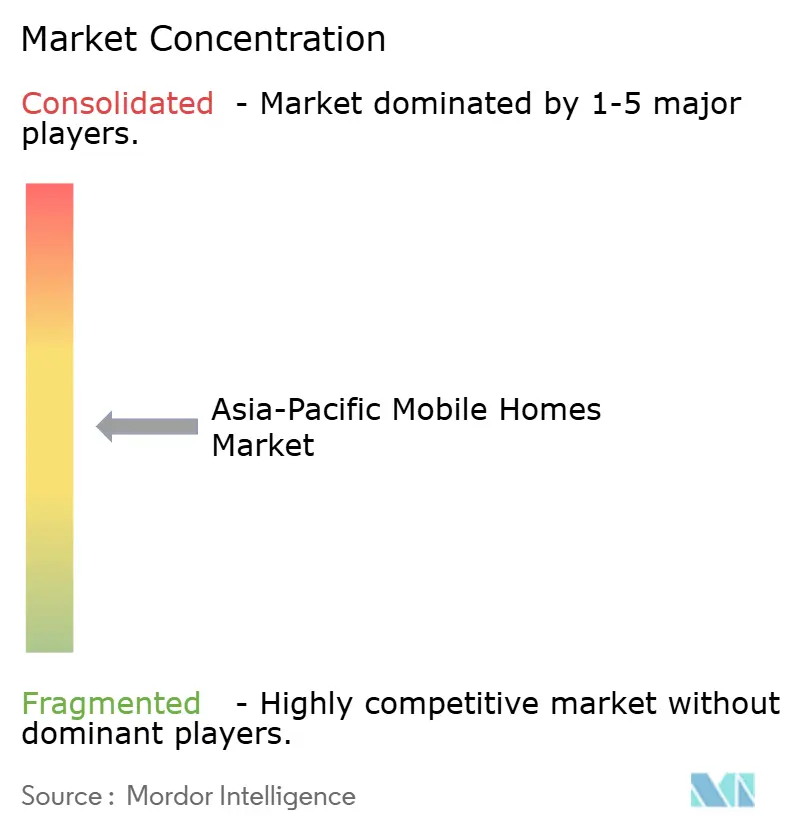
| Market Concentration | Medium |
Major Players *Disclaimer: Major Players sorted in no particular order Image © Mordor Intelligence. Reuse requires attribution under CC BY 4.0. | |
Asia-Pacific Mobile Homes Market Analysis by Mordor Intelligence
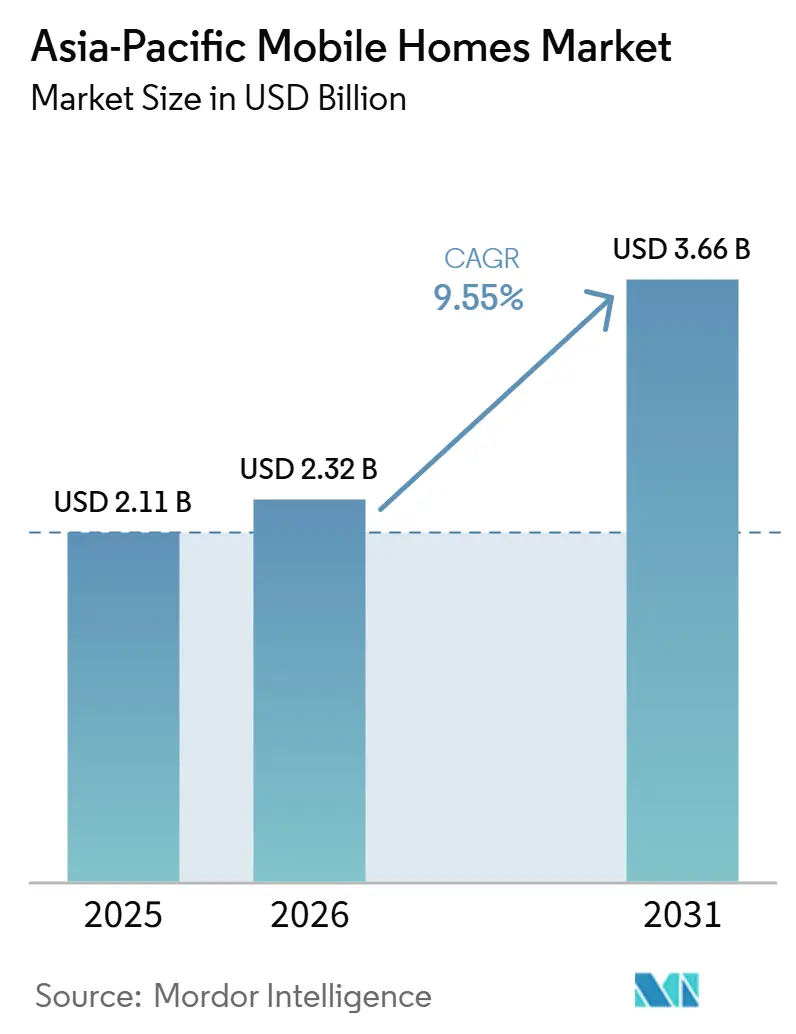
The Asia-Pacific Mobile Homes Market size is expected to increase from USD 2.11 billion in 2025 to USD 2.32 billion in 2026 and reach USD 3.66 billion by 2031, growing at a CAGR of 9.55% over 2026-2031.
Housing shortages, urban expansion, and rising land and labor costs are increasing interest in factory-built housing across the region. Public programs are positioning governments as key buyers of mobile and modular homes for permanent housing and emergency shelter. In the Philippines, for example, the Department of Human Settlements and Urban Development is deploying modular shelter units to disaster-stricken provinces through 2025, including under its “Bayanihan Villages” program launched after major earthquakes in Cebu and Davao Oriental. The initiative also includes financial assistance for more than 11,000 displaced families. Similarly, government-led mass housing tenders in markets such as Indonesia, Vietnam, and the Philippines mandate durability certification and rapid deployment capacity, directing volume toward factory-based suppliers.
This shift is encouraging manufacturers to invest in factory capacity, certification, and digital production systems. Demand is also expanding beyond standard homes to include disaster recovery, workforce accommodation, student housing, senior housing, and technology-enabled residences. However, regulatory differences, site logistics, and financing practices continue to limit how quickly the Asia-Pacific mobile homes market can scale.
Key Report Takeaways
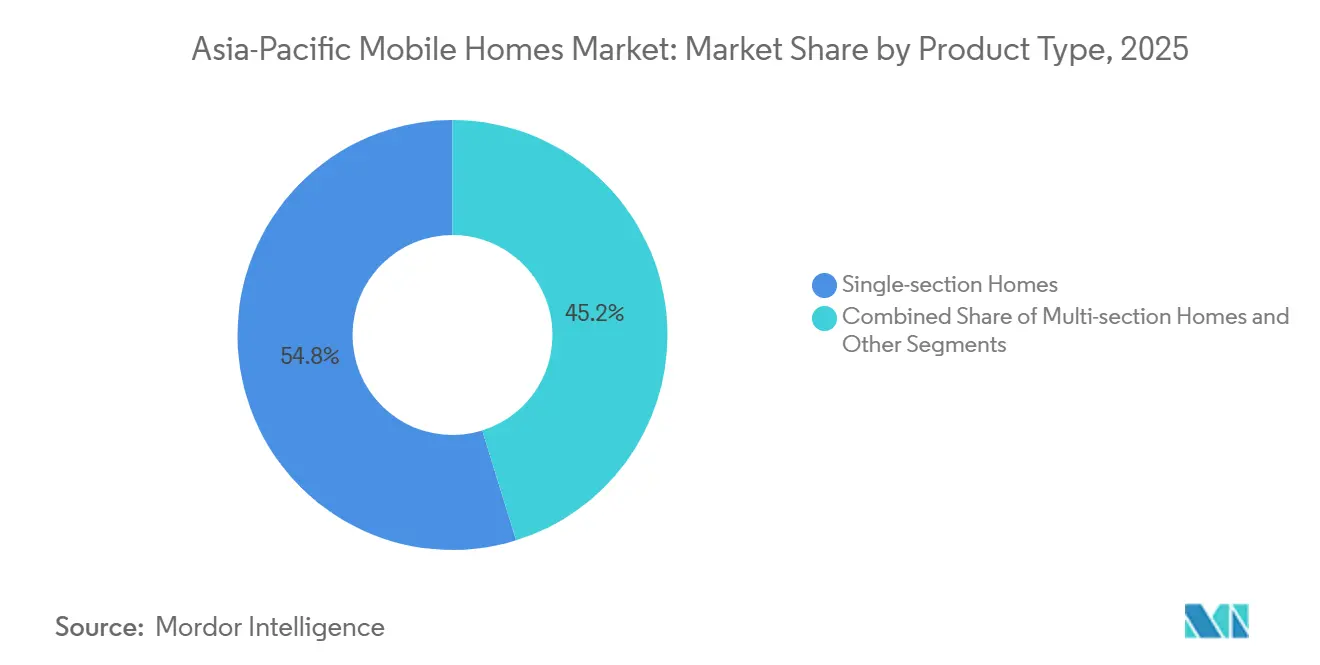
- By product type, single-section homes accounted for 54.8% of the Asia-Pacific mobile homes market share in 2025, while the Others segment is forecast to grow at a 11.78% CAGR through 2031.
- By material, steel-based construction accounted for 41.9% of the Asia-Pacific mobile homes market share in 2025, while composite and other materials are forecast to grow at a 11.21% CAGR through 2031.
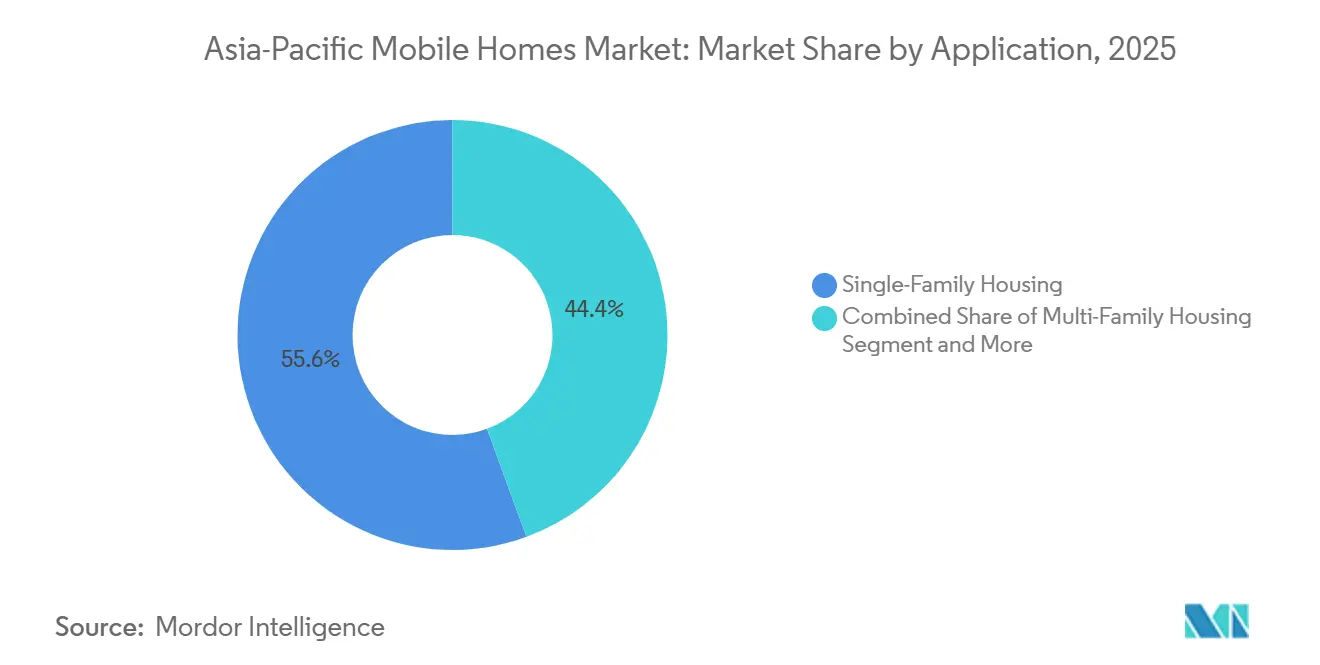
- By application, single-family housing accounted for 55.6% of the Asia-Pacific mobile homes market size in 2025, while the Others application segment is forecast to grow at 11.94% CAGR through 2031.
- By country, China held 38.4% of the Asia-Pacific mobile homes market share in 2025, while India is forecast to grow at 12.26% CAGR through 2031.
Note: Market size and forecast figures in this report are generated using Mordor Intelligence’s proprietary estimation framework, updated with the latest available data and insights as of January 2026.
Market Trends and Insights
Drivers Impact Analysis of Asia-Pacific Mobile Homes Market*
| Drivers | (~) % Impact on CAGR Forecast | Geographic Relevance | Impact Timeline |
|---|---|---|---|
| Government Support for Prefabricated and Affordable Housing | +2.4% | China, India, South Korea, Australia, with secondary effects in Vietnam and Indonesia | Medium term (2-4 years) |
| Housing Affordability Challenges and Supply Shortfalls | +2.1% | Asia-Pacific, with acute pressure in India, Australia, and Southeast Asian megacities | Short term (≤ 2 years) |
| Construction Labor Shortages | +1.5% | Japan, Australia, Singapore, South Korea, and Malaysia | Short term (≤ 2 years) |
| Disaster-Resilient and Emergency Housing Demand | +1.0% | Philippines, Indonesia, Bangladesh, Japan, and ASEAN markets | Short term (≤ 2 years) |
| Digital Design, Factory Automation, and Smart Home Integration | +1.0% | Japan, South Korea, Australia, and urban China | Medium term (2-4 years) |
| Urban Infill and Remote Area Development | +0.8% | Australia, India, and Indonesia | Long term (≥ 4 years) |
| Source: Mordor Intelligence | |||
Housing Affordability Challenges and Supply Shortfalls Drive Mobile Home Demand
Housing supply gaps are widening faster than conventional site construction can address in several locations across the Asia-Pacific. Australia’s National Housing Accord targets 1.2 million new homes by mid-2029, while a Curtin University report cited in the draft identified a 220,000-home shortfall under its central forecast[1]. The report recommended increasing the share of manufactured housing in new construction to 35% by 2036-37. Infill sites can support mobile home use where conventional concrete construction is harder to deliver. India’s NITI Aayog stated in January 2026 that PMAY-U 2.0 alone would not close the full housing deficit and that land reform and financing measures are also needed[2]. Higher land values and tighter affordable-housing finance are increasing the value of faster delivery and more predictable budgets for developers.
Construction Labor Shortages Increase Adoption of Factory-Built Homes
Labor availability is a central constraint on delivery in the Asia-Pacific mobile homes market. Factory production can move at least 80% of work away from the construction site and into controlled manufacturing settings. Hong Kong’s Construction Industry Council projected a shortage of 45,000 to 50,000 skilled and semi-skilled workers by 2030[3]. South Korean modular factories operated at 60% automation for supplied materials, and full-line automation was expected to reduce factory labor by 51% compared with conventional construction. Sekisui House has a major investment program for factory and information technology systems for FY2026 through FY2028. The program includes inspection robots, artificial intelligence design tools, and augmented reality accuracy systems, although manufacturers still need technically skilled factory employees.
Disaster-Resilient and Emergency Housing Demand Supports Market Expansion
Earthquake and cyclone exposure support recurring demand for rapid-deployment housing in the Asia-Pacific mobile homes market. Mobile homes can serve as temporary shelter and as permanent replacement housing after a disaster. The supplied draft described modular shelter deployments in Cebu and Davao Oriental after the September 2025 earthquake, with Mandaue City’s Bayanihan Village presented as a national model. It also described a foldable modular disaster house in South Korea that could be fully installed within 7 days. Guangdong Wellcamp delivered prefabricated emergency shelters to Myanmar after the March 2025 earthquake through Chinese humanitarian aid coordination. These deployments provide installation and durability experience that can inform later residential specifications. The same operating experience can raise quality expectations for mobile home products intended for regular residential use.
Digital Design, Factory Automation, and Smart Home Integration Enhance Product Appeal
Digital design and automation are becoming more relevant as producers seek consistent factory output. The supplied material stated that South Korean modular factories operated at 60% automation. It also stated that full-line automation could reduce factory labor by 51% compared with conventional construction. Sekisui House is investing in factory systems, artificial intelligence tools, inspection robots, and augmented reality processes. Smart home features can be installed during production rather than added after delivery. This approach can make factory-built housing more relevant to buyers seeking connected residential products.
Restraints Impact Analysis of Asia-Pacific Mobile Homes Market*
| Restraints | (~) % Impact on CAGR Forecast | Geographic Relevance | Impact Timeline |
|---|---|---|---|
| Fragmented Building Approvals and Zoning Regulations | -1.5% | Australia, India, Taiwan, and Vietnam | Medium term (2-4 years) |
| Transportation, Crane, and Site Access Constraints | -1.0% | Remote Australia, Indonesia, and mountainous Southeast Asia | Short term (≤ 2 years) |
| Limited Financing and Insurance Standardization | -0.8% | Australia and India | Medium term (2-4 years) |
| Consumer Perception and Resale Value Uncertainty | -0.5% | India, parts of Southeast Asia, and Japan | Long term (≥ 4 years) |
| Source: Mordor Intelligence | |||
Fragmented Building Approvals and Zoning Regulations Delay Market Expansion
Different building approvals and zoning rules limit producers' ability to use a single design across multiple markets. In Australia, a modular home certified in Victoria or Queensland may require reassessment before it is accepted in New South Wales. The New South Wales Government invested USD 1 million in a certification framework as part of its July 2026 program to address recognition issues. India had no dedicated modular construction standard in the supplied material, while prefabricated components faced an 18% goods and services tax rate in FY2026. A peer-reviewed 2025 study reported that fragmented regulation constrained prefabricated construction in Taiwan. China introduced Group standards T/COSOCC 045-2026 and T/COSOCC 063-2026 for prefabricated building design and green quality management, although regional alignment across ASEAN remains limited.
Transportation, Crane, and Site Access Constraints Increase Project Costs
Transporting oversized modules and arranging crane access can reduce the price advantage of mobile homes. The issue is especially relevant in remote locations and areas with difficult terrain. Indonesia’s IKN Nusantara project showed how inland sites and damaged infrastructure can add freight costs for specialized transport. Fleetwood closed its Smithfield facility in New South Wales in 2026 and consolidated output in Queensland and Victoria to reduce delivery distances. The company also entered a conditional USD 12.6 million agreement to acquire a 2,169-bed workforce accommodation asset in Western Australia’s Pilbara region. Remote mining accommodation uses a different logistics model from urban housing, which affects plant locations, module design, and delivery planning.
*Our forecasts treat driver/restraint impacts as directional, not additive. The impact forecasts reflect baseline growth, mix effects, and variable interactions.
Asia-Pacific Mobile Homes Market Segment Analysis
By Product Type:
Single-Section Homes Lead While Other Formats Grow FasterSingle-section homes accounted for 54.8% of the Asia-Pacific mobile homes market in 2025. Their position reflects their fit with suburban infill, rural housing programs, and disaster relief projects that have site limits or strict budgets. These homes have fewer assembly requirements than multi-section formats. That makes them appropriate where rapid installation and manageable transport are important. Multi-section homes serve buyers seeking layouts more similar to those of larger site-built homes. They are more relevant in Japan and Australia, where more households can support larger factory-built footprints. Multi-section formats also need sites that can accommodate transport, assembly, and related approvals. Their role, therefore, remains more focused than that of single-section units.
The Others segment, which includes volumetric modular homes, panelized mobile homes, and container-based homes, is forecast to grow at 11.78% CAGR from 2026 to 2031. This growth reflects demand from disaster relief, workforce accommodation, student housing, resort hospitality, and other uses identified in the draft. Factory testing and documentation can help volumetric systems meet government procurement requirements. Third-party certification is becoming more important for these procurement channels. The supplied material described Samsung Electronics' opening of an artificial intelligence modular home showroom in June 2026, with more than 80% factory completion and over 20 compatible devices installed during production. That model points to demand from buyers who value integrated technology with factory-built housing. The product category can therefore expand beyond basic temporary and budget-led housing. It also gives suppliers a way to differentiate through installed systems rather than only structural materials or delivery speed.

By Material:
Steel Holds the Largest Position While Composites Gain GroundSteel-based construction accounted for 41.9% of the Asia-Pacific mobile homes market in 2025. Steel supports structural flexibility in seismic areas and is widely used by China’s export-oriented producers. The material is also suitable for modular units supplied to Southeast Asia, Australia, and Pacific markets. Its established supply chain supports repeatable fabrication and standardized framing. Steel can remain practical where strength, transport, durability, and design flexibility are needed together. Export capacity gives Chinese producers a strong position in this material category. The use of steel also aligns with demand for units that can be produced at scale for government and commercial orders. These features explain why it remained the largest material base in the supplied market data.
Composite and other materials are forecast to grow at 11.21% CAGR from 2026 to 2031. The category includes fiber-reinforced polymers and insulated structural panels. The draft also cited Broad Group’s B-core slab technology in relation to a 12-story project completed in Mindanao in October 2024. It stated that the project claimed 80% to 90% lower carbon emissions and a lifespan 20 times longer than reinforced concrete. Lighter composite panels can reduce transport burdens for island locations and elevated sites. This is relevant where conventional steel-frame modules are expensive to move. Timber and concrete also retain roles in specific conditions, including Japanese seismic and energy-efficiency applications and areas exposed to typhoons or earthquakes.
By Application:
Single-Family Housing Anchors Demand While Other Uses AccelerateSingle-family housing accounted for 55.6% of the Asia-Pacific mobile homes market size in 2025. Affordable housing programs in India, China, and Australia support this demand. Owner-occupier preference for detached housing in suburban and peri-urban areas also supports the category. Japanese housing companies use direct consumer catalog models to sell manufactured single-family homes. The supplied material stated that factory-built methods account for 50% of new homes in Japan. This provides a useful benchmark for markets that are still building their manufactured housing base. Single-family projects also work well with standardized designs, controlled factory production, and phased community development. These characteristics keep the format central to regional demand.
The Others application segment, including disaster relief, student and senior housing, workforce housing, and container-based homes, is forecast to grow at 11.94% CAGR from 2026 to 2031. Its growth stems from several demand drivers rather than a single group of residential buyers. South Korea’s Uiwang Chopyeong project was described as a 22-story, 381-unit complex using precast concrete modular construction. The project received an Excellent Grade for long-life housing certification in the supplied material. Daiwa House announced modular prefabricated data centers in December 2025 that could be assembled on-site in 1 year. Commercial, hospitality, and institutional applications remain less developed than single-family housing. Their expansion would give manufacturers additional ways to use existing factory capacity. It would also reduce dependence on conventional residential cycles.
Geography Analysis
China and Japan Mobile Homes Market
China held 38.4% of the Asia-Pacific mobile homes market share in 2025, supported by the region’s largest manufacturing base and public adoption targets. The 15th Five-Year Plan places prefabricated and ultra-low-energy buildings within national construction priorities. Shanghai, Beijing, Guangdong, and Shanxi provide financial support for related activity. A 2025 Chinese notice directed city and district governments to establish long-term green and low-carbon construction mechanisms. China supplies domestic buyers and exports units across Southeast Asia, Australia, and the Pacific. Export revenue can support more factory investment and higher output. Japan remains the technology benchmark in the region. The supplied material identified Daiwa House, Sekisui House, Panasonic Homes, Toyota Housing, Misawa Homes, and Ichijo as major participants in its factory-built home base.
India Mobile Homes Market
India is forecast to grow at 12.26% CAGR through 2031, the fastest rate among the country segments in the supplied data. PMAY-U 2.0 runs from September 2024 to 2029 and uses prefabrication in core delivery routes. The program’s funding and approval pipeline support forward demand for factory-built housing. The absence of a dedicated modular code adds approval and design uncertainty. The 18% goods and services tax on prefabricated components adds further cost pressure in FY2026. These barriers can limit deployment speed even as housing demand remains strong. India’s opportunity depends on whether project finance, land access, and standards develop alongside public housing demand. The country’s growth outlook is therefore tied to both program execution and regulatory improvement.
APAC Mobile Homes Market
Australia’s National Housing Accord aims to deliver 1.2 million homes by mid-2029. The supplied analysis identified manufactured housing as a route to closing a 220,000-home supply gap. New South Wales launched its Modern Methods of Construction Industry Expansion Program in July 2026, with USD 2.5 million for certification reform. The rest of Asia-Pacific includes the Philippines, Indonesia, Vietnam, South Korea, and Pacific island nations. These markets add demand for disaster preparedness, remote workforce accommodation, new capital development, and technology-enabled modular housing pilots. South Korea’s public housing target provides a direct source of future demand for modular housing. Indonesia’s IKN Nusantara project highlights both infrastructure demand and freight challenges. These regional markets offer diverse applications but require designs and delivery models that align with local regulations and transport conditions.
Competitive Landscape
The Asia-Pacific mobile homes market is moderately concentrated, with Japanese and Australian listed companies active in premium tiers and Chinese manufacturers important in export and cost-focused segments. Daiwa House Industry, Sekisui House, and Panasonic Homes compete through manufacturing precision, seismic design, and integrated supply chains. Sekisui House has a substantial investment plan for FY2026 through FY2028, including investments in factories and information technology systems. The company’s program includes inspection robots, artificial intelligence design, and augmented reality tools. It also targets 14,300 homes ordered in FY2028. Japanese companies are pursuing overseas expansion, adopting advanced factory technologies, and developing new applications to strengthen their position. These actions support premium pricing and help them respond to labor shortages. Their focus on documented quality is also relevant to public procurement and seismic performance requirements.
Daiwa House completed the acquisition of the single-family housing business of JK Monarch Enterprises through Trumark Companies in March 2026. It also made Sumitomo Densetsu a wholly owned subsidiary in March 2026, strengthening domestic construction engineering capability. In February 2026, the company began a 414-unit multifamily development in Celina, Texas, with Alliance Residential Company. The supplied material described a February 2026 feasibility study for modular public housing in Ukraine using a Polish production base. It also stated that the program had a USD 63 million value and aimed for 100 public housing units by February 2029. These moves show the company’s use of acquisitions, engineering capability, and overseas projects to broaden its platform. They also show that strategic activity is not limited to the Asia-Pacific mobile homes market, even though it can support wider manufacturing and design capabilities.
Chinese producers compete through product range, export capacity, and compliance with developing standards. Group standards issued in June 2026 establish design and quality management frameworks that larger exporters may be better placed to meet. This can place more pressure on smaller regional producers. Guangdong Wellcamp has moved into medical and emergency solutions alongside residential and container-based offerings in the supplied material. Fleetwood sharpened its focus on government panel work after divesting its recreational vehicle segment and closing the Smithfield facility. Its H1 FY2026 order intake reached USD 135.5 million. The Asia-Pacific mobile homes market, therefore, contains a mix of premium integrated builders, government-oriented suppliers, and export-led manufacturers. No combined market share of the leading companies was provided, so the evidence does not support a more precise concentration assessment within the competitive narrative.
Asia-Pacific Mobile Homes Industry Leaders
-
Daiwa House Industry Co., Ltd.
-
Sekisui House, Ltd.
-
Panasonic Homes Co., Ltd.
-
Toyota Housing Corporation
-
Misawa Homes Co., Ltd.
- *Disclaimer: Major Players sorted in no particular order
Asia-Pacific Mobile Homes Market Companies Covered in this Report
- Daiwa House Industry Co., Ltd.
- Sekisui House, Ltd.
- Panasonic Homes Co., Ltd.
- Toyota Housing Corporation
- Misawa Homes Co., Ltd.
- Ichijo Co., Ltd.
- Fleetwood Australia Pty Ltd
- VanHomes Pty Ltd
- Eastcoast Homes and Park Cabins
- Austam Homes
- Goldbeer Homes Pty Ltd
- Wright Choice Homes
- Shanghai Star House Co., Ltd.
- GS Housing Group Co., Ltd.
- Chengdong Modular Housing
- Honkarakenne Oyj (active in Asia-Pacific export markets)
- Wuxi Xingbang Modular Housing Co., Ltd.
- Guangdong Wellcamp Building Materials Co., Ltd.
- Zhejiang Putian Integrated Housing Co., Ltd.
- Guangdong Cbox Co., Ltd.
Recent Industry Developments in Asia-Pacific Mobile Homes Market
- July 2026: NSW Government (Australia) launched the Modern Methods of Construction Industry Expansion Program Expression of Interest, backed by USD 2.5 million for a new MMC certification framework and USD 31.5 million in matched state funding, to formally integrate modular and prefabricated housing into NSW planning approvals and government procurement.
- March 2026: Daiwa House Industry Co., Ltd. completed the acquisition of Sumitomo Densetsu Co., Ltd. as a wholly-owned subsidiary following a tender offer launched in October 2025, strengthening the group’s domestic Japanese construction engineering services capability.
- March 2026: Daiwa House Industry Co., Ltd. (through Trumark Companies) acquired the single-family housing business of JK Monarch Enterprises, LLC in Washington State, marking the group’s eighth US homebuilder acquisition and extending its West Coast single-family platform.
Asia-Pacific Mobile Homes Market Report Scope
Segmentation Overview
| Single-section Homes |
| Multi-section Homes |
| Others (Volumetric Modular Homes, Panelized Mobile Homes, and Container-based Mobile Homes) |
| Timber-Based Construction |
| Steel-Based Construction |
| Concrete-Based Construction |
| Composite and Other Materials |
| Single-Family Housing |
| Multi-Family Housing |
| Commercial, Hospitality, and Institutional Buildings |
| Others (Disaster Relief and Temporary Housing, Student and Senior Housing, Student and Senior Housing, Workforce Housing, and Container-based Mobile Homes) |
| China |
| Japan |
| India |
| Australia |
| Rest of Asia-Pacific |
| By Product Type | Single-section Homes |
| Multi-section Homes | |
| Others (Volumetric Modular Homes, Panelized Mobile Homes, and Container-based Mobile Homes) | |
| By Material | Timber-Based Construction |
| Steel-Based Construction | |
| Concrete-Based Construction | |
| Composite and Other Materials | |
| By Application | Single-Family Housing |
| Multi-Family Housing | |
| Commercial, Hospitality, and Institutional Buildings | |
| Others (Disaster Relief and Temporary Housing, Student and Senior Housing, Student and Senior Housing, Workforce Housing, and Container-based Mobile Homes) | |
| By Country | China |
| Japan | |
| India | |
| Australia | |
| Rest of Asia-Pacific |
Key Questions Answered in the Report
What is the expected value of the Asia-Pacific mobile homes market by 2031?
The Asia-Pacific mobile homes market is forecast to reach USD 3.66 billion by 2031, growing at a 9.55% CAGR from 2026. The outlook reflects housing shortages, public procurement, factory investment, and wider use in both residential and emergency housing.
Which product type led Asia-Pacific mobile home demand in 2025?
Single-section homes led with a 54.8% share in 2025 because they fit suburban infill, rural housing, and disaster relief requirements. Their simpler assembly needs also make them suitable where budgets, site access, and delivery speed are important.
Which mobile home format is expected to grow the fastest through 2031?
The Others product segment, including volumetric modular, panelized, and container-based homes, is forecast to grow at 11.78% CAGR. Demand comes from disaster relief, workforce accommodation, student housing, resort uses, and buyers seeking factory-installed technology.
Which country has the largest regional position?
China held 38.4% of regional demand in 2025, supported by its manufacturing base, public targets, and export capacity. Its domestic scale and exports to Southeast Asia, Australia, and Pacific markets strengthen factory utilization and production capability.
Which country is forecast to grow the fastest through 2031?
India is forecast to grow at 12.26% CAGR, supported by PMAY-U 2.0 and demand for affordable urban housing. Progress depends on public delivery, project finance, land access, and the development of more consistent modular approvals.
What factors are limiting wider adoption of factory-built homes?
Different approvals, transport and crane costs, limited financing standards, and resale value concerns can slow adoption. These issues are particularly important when manufacturers must fund most production before site delivery or serve remote locations.