
Asia-Pacific Hydroponics Market Size and Share
Market Overview
| Study Period | 2022 - 2032 |
|---|---|
| Forecast Data Period | 2027 - 2032 |
| Base Year Market Size (2026) | USD 3.21 Billion |
| Market Size (2027) | USD 3.60 Billion |
| Market Size (2032) | USD 6.40 Billion |
| Growth Rate (2027 - 2032) | 12.20 % |
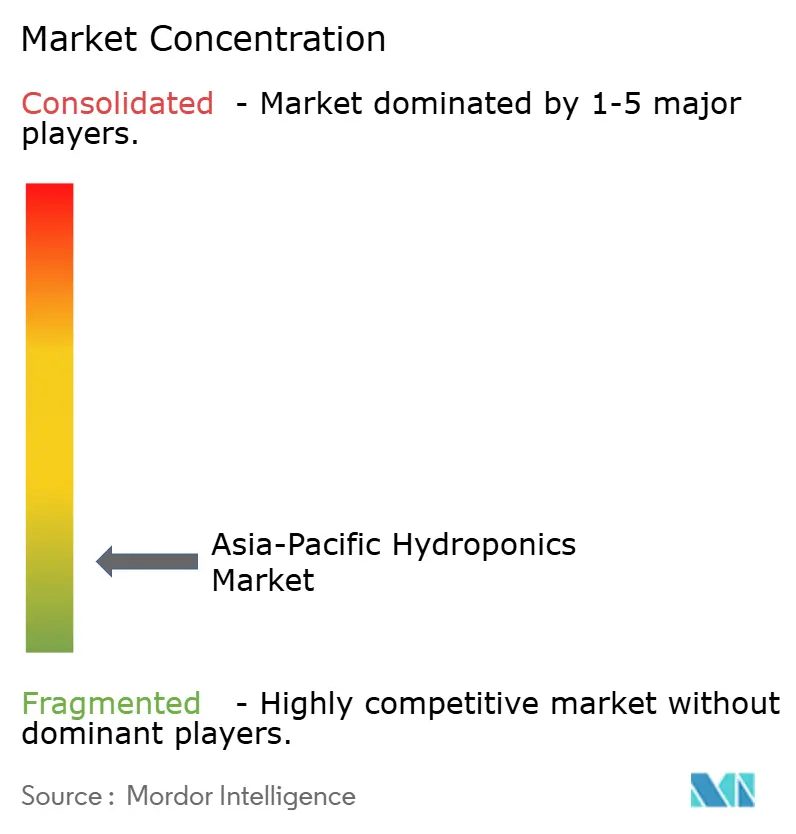
| Market Concentration | Low |
Major Players *Disclaimer: Major Players sorted in no particular order Image © Mordor Intelligence. Reuse requires attribution under CC BY 4.0. | |
Asia-Pacific Hydroponics Market Analysis by Mordor Intelligence
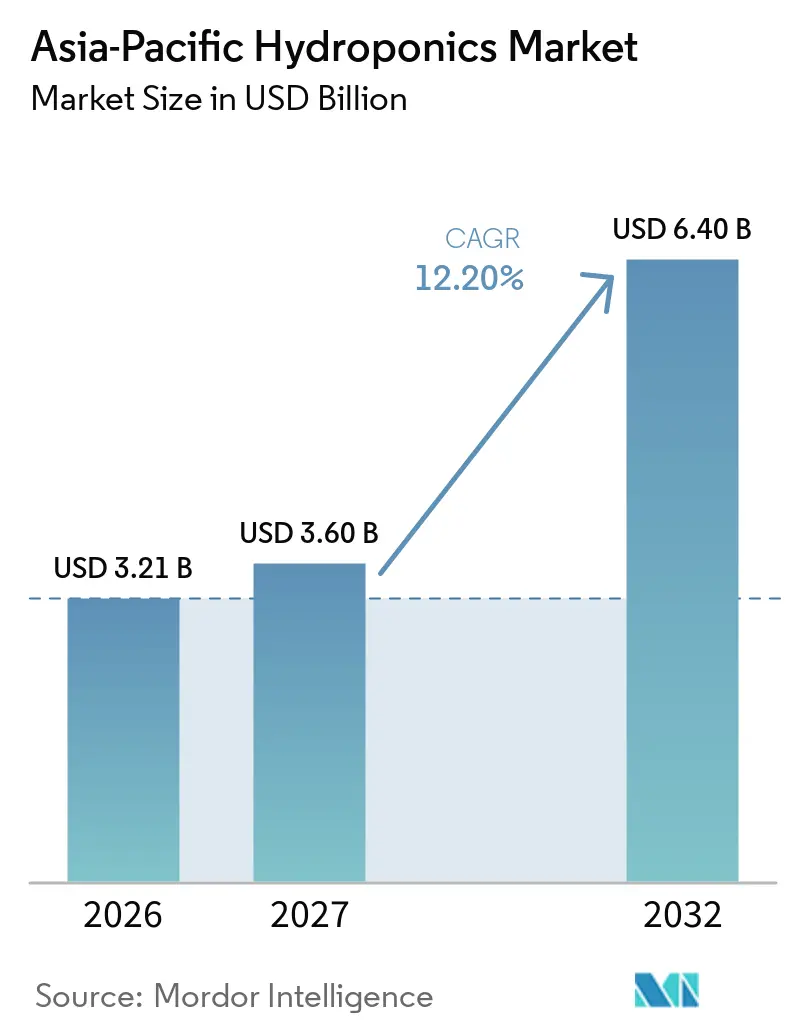
The Asia-Pacific hydroponics market size was valued at USD 3.21 billion in 2026 and is forecast to grow from USD 3.60 billion in 2027 to USD 6.40 billion by 2032, at a CAGR of 12.20% from 2027 to 2032. Limited agricultural land and water availability are directing food production investment toward systems that can deliver higher yields within a fixed footprint. The Food and Agriculture Organization (FAO) reported in 2025 that more than 60% of human-induced land degradation occurs on agricultural land. Asia also faces a limited scope to expand its arable land base [1]. Public programs in China, Japan, India, and Singapore are supporting controlled production systems as part of food security planning. Growth in the Asia-Pacific hydroponics market also depends on lower energy use, reliable demand from retailers, and farm designs suited to dense urban areas. Suppliers that combine efficient lighting with dependable service and retailer contracts have a clearer path to sustained demand.
Key Report Takeaways
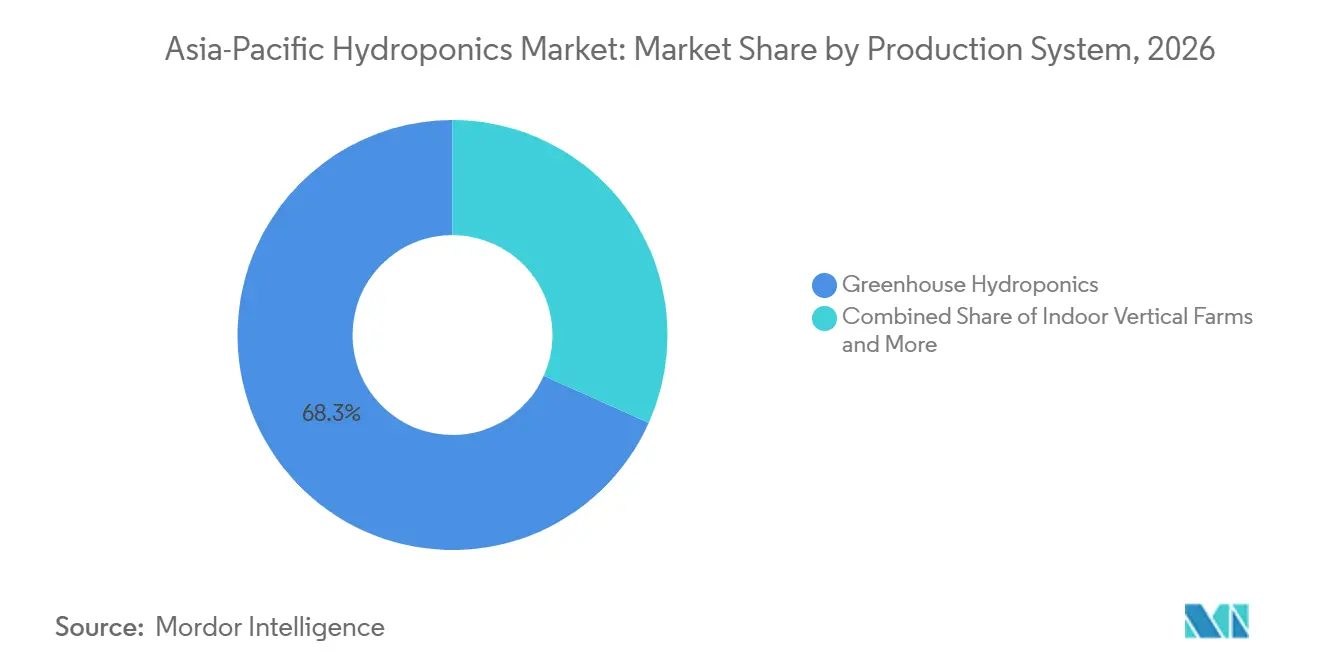
- By production system, greenhouse hydroponics accounted for 68.3% of the Asia-Pacific hydroponics market share in 2026, while indoor vertical farms are forecast to grow at a CAGR of 13.4% from 2027 to 2032.
- By crop type, leafy greens accounted for 47.2% of the Asia-Pacific hydroponics market size in 2026, while herbs and microgreens are forecast to grow at a CAGR of 12.6% from 2027 to 2032.
- By equipment, lighting systems accounted for 49.5% of the market share in 2026, while climate systems are forecast to grow at a CAGR of 12.8% from 2027 to 2032.
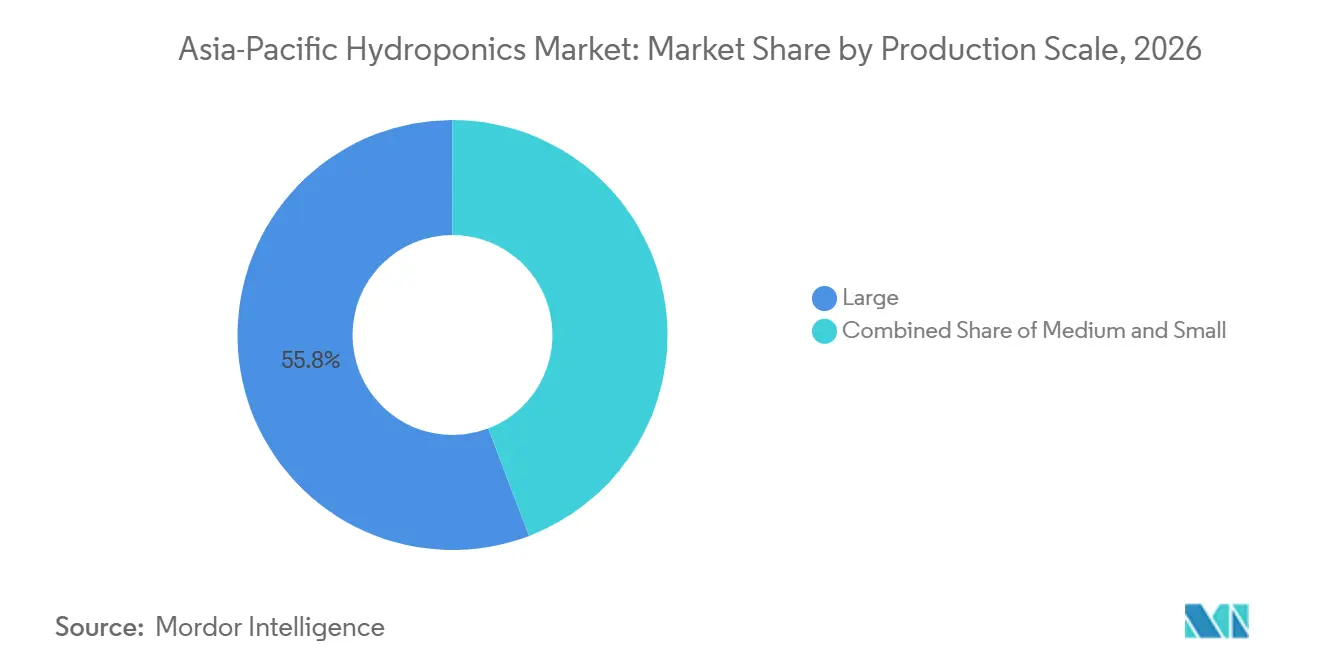
- By production scale, large-scale operations accounted for 55.8% of the market share in 2026, while small-scale operations are forecast to grow at a CAGR of 13.3% from 2027 to 2032.
- By geography, China accounted for 32% of the market share in 2026, while India is forecast to grow at a CAGR of 13.2% from 2027 to 2032.
Note: Market numbers in this report are based on Mordor Intelligence's proprietary estimation framework, which combines nine months of actuals with Q4 projections for base year 2026.
Market Trends and Insights
Drivers Impact Analysis of Asia-Pacific Hydroponics Market*
| Driver | (~) % Impact on CAGR Forecast | Geographic Relevance | Impact Timeline |
|---|---|---|---|
| Controlled-Environment Food Security Programs | +2.5% | China, India, Japan, Singapore, and South Korea | Short term (≤ 2 years) |
| Shrinking Arable Land and Water Availability | +2.8% | China, India, Southeast Asia, and the wider region | Long term (≥ 4 years) |
| Year-Round Premium Produce Supply | +1.8% | Japan, South Korea, Singapore, and Australia | Medium term (2-4 years) |
| Automation and Smart Agriculture Adoption | +2.2% | Japan, China, South Korea, and Singapore | Medium term (2-4 years) |
| Urban Micro-Farm Infrastructure for Import Resilience | +1.6% | Singapore, Japan, India, and China | Short term (≤ 2 years) |
| Retailer and Foodservice Traceability Requirements | +1.3% | Japan, Australia, South Korea, and Singapore | Medium term (2-4 years) |
| Source: Mordor Intelligence | |||
Controlled-Environment Food Security Programs
Government food security programs provide a direct source of demand for the Asia-Pacific hydroponics market. They can reduce early investment risk through grants, access to land, and planned sales arrangements. Singapore's 2026 Budget allocated a SGD 70 million (USD 52.6 million) fund over five years for local farm technology and shared supply infrastructure. Japan has set a JPY 4.6 trillion (USD 29.7 billion) public and private investment target for plant factories through fiscal 2040. These initiatives can support demand for controlled-environment farming technologies and improve investment conditions for commercial operators.
Shrinking Arable Land and Water Availability
Pressure on land and water strengthens the practical case for hydroponic production. According to the United Nations Economic and Social Commission for Asia and the Pacific (UN ESCAP), Asia and the Pacific were home to approximately 60% of the global population in 2022. The Food and Agriculture Organization of the United Nations (FAO) reported in October 2023 that agriculture accounted for approximately 90% of freshwater consumption in the region. According to a 2025 study published in the journal Nature Communications, India had unsustainable water demand in 61% of sub-basins for at least four months each year [2]. The FAO (Food and Agriculture Organization of the United Nations) has also documented constraints on agricultural land expansion and the ongoing degradation of land and water resources [3]. Closed-loop hydroponic systems can use 80–90% less water than conventional soil farming under the conditions described in the referenced research. This makes the Asia-Pacific hydroponics market relevant to farming districts and cities where water and land constraints occur together.
Year-Round Premium Produce Supply
Retail and foodservice buyers in Japan, South Korea, and Singapore require steady produce volumes through seasonal disruptions. Controlled farms can offer planned harvests, predictable quality, and lower exposure to weather events. Greenphyto Pte. Ltd. has supplied major Singapore supermarket chains through make-to-order arrangements since early 2025. East launched a Tokyo pilot project combining aquaponics and hydroponic cultivation, using AI and sensor technologies to control lighting and temperature in the indoor farming environment. Japan's agricultural workforce is shrinking, with the number of core agricultural workers declining from 2.05 million in 2010 to 986,600 in 2026, according to the Ministry of Agriculture, Forestry and Fisheries (MAFF). This decline strengthens the case for technologies that reduce labor requirements, including automated hydroponic systems.
Automation and Smart Agriculture Adoption
Automation is reducing the amount of specialist horticultural labor needed to operate large hydroponic facilities. Machine vision, environmental controls, and robotics turn sensor readings into recurring operating decisions. Daedong and Rainbow Robotics are developing the AGROID farm robot for a national AI greenhouse project in South Jeolla Province, with deployment targeted for 2028. A 2026 study published in the journal Frontiers in Plant Science found that dynamically reducing blue light improved light-energy use efficiency by up to 63% and reduced lighting costs by 40%. These capabilities can improve yield consistency and support broader adoption across the Asia-Pacific hydroponics market. They also make operating practices more repeatable across facilities with different staffing models.
Restraints Impact Analysis of Asia-Pacific Hydroponics Market*
| Restraint | (~) % Impact on CAGR Forecast | Geographic Relevance | Impact Timeline |
|---|---|---|---|
| High Capital Expenditure for Commercial Facilities | -2.1% | Wider region, especially India and Southeast Asia | Long term (≥ 4 years) |
| Energy-Cost Sensitivity of Artificial Lighting | -1.6% | Japan, South Korea, Singapore, and Australia | Medium term (2-4 years) |
| Limited Hydroponic Seed Genetics and Cultivar Data | -1.1% | India, China, and Southeast Asia | Long term (≥ 4 years) |
| Fragmented After-Sales Service and Interoperability | -0.8% | India, Indonesia, and Southeast Asia | Medium term (2-4 years) |
| Source: Mordor Intelligence | |||
High Capital Expenditure for Commercial Facilities
Commercial hydroponic farms require significant upfront investment in climate systems, lighting, automation, and structures before generating revenue from produce sales. This creates long payback periods and limits access to financing for new operators. Japan had approximately 440 operating plant factories in 2026, although high initial investment and electricity costs have contributed to business failures among some operators. In January 2026, Greenphyto Pte. Ltd. invested SGD 80 million (USD 60.2 million) in its Jurong West site and reached commercial delivery after 14 years of development. A 2026 techno-economic study published in Frontiers in Sustainable Food Systems found that improvements in light interception, intercepted light-use efficiency, and crop performance offer greater potential for reducing vertical farming production costs than improvements in LED system efficiency alone. Across Asia-Pacific markets, electricity costs, permitting requirements, and land availability also influence the economic feasibility of vertical farming projects.
Energy-Cost Sensitivity of Artificial Lighting
Electricity is the largest variable cost for many indoor hydroponic farms, and price changes can alter a facility's financial performance within a single fiscal year. A 2026 study published in Nature Communications found that controlled-environment agriculture systems need to operate at very low energy-use levels to meet low-carbon energy thresholds. A 2025 study published in the International Journal of Life Cycle Assessment found that controlled-environment hydroponic lettuce production had relatively high energy consumption, primarily due to artificial lighting. Smaller facilities are at a disadvantage when they cannot spread energy infrastructure costs across large output volumes. These energy-related cost pressures can constrain the profitability and scalability of indoor hydroponic operations, particularly in markets with high electricity prices.
*Our forecasts treat driver/restraint impacts as directional, not additive. The impact forecasts reflect baseline growth, mix effects, and variable interactions.
Asia-Pacific Hydroponics Market Segment Analysis
By Production System:
Greenhouse Hydroponics Leads Market Revenue, While Indoor Vertical Farms Grow FastestGreenhouse hydroponics accounted for 68.3% of the Asia-Pacific hydroponics market share in 2026. Lower capital cost per square meter and use of ambient sunlight make it a more accessible commercial model. Existing greenhouse operators can add nutrient management systems without replacing their entire production structures, thereby supporting adoption across China, Australia, and India. Container farms remain smaller in value but serve remote and island settings where food import costs are high. Fiji's August 2026 policy announcement reinforces the role of protected production in reducing import dependence.
Indoor vertical farms are forecast to grow at a CAGR of 13.4% from 2027 to 2032. Land scarcity in Singapore, South Korea, and Japanese cities supports this format, where greenhouse land is costly or unavailable. Japan's JPY 4.6 trillion (USD 29.7 billion) plant-factory target indicates continuing policy support through fiscal 2040. Lower-cost land in India and Indonesia will keep greenhouse systems important through the forecast period.

By Crop Type:
Leafy Greens Lead, While Herbs and Microgreens Grow FastestLeafy greens accounted for 47.2% of the Asia-Pacific hydroponics market share in 2026. Short growth cycles, efficient water use, and compatibility with common nutrient systems make them a practical entry crop. Tomatoes and cucumbers remain important in China's greenhouse production, while peppers retain a stable premium position in South Korea and Japan. Hydroponic production supports residue-control documentation, which is valuable to import and retail channels. These characteristics continue to anchor volume in the Asia-Pacific hydroponics market.
Herbs and microgreens are forecast to grow at a CAGR of 12.6% from 2027 to 2032. Their short cultivation cycles and suitability for space-efficient production meet the demand of foodservice operators and specialty retailers seeking fresh, high-value produce. Hydroponic systems enable controlled cultivation of crops such as basil, mint, coriander, and microgreens, supporting consistent supply for urban markets.
By Equipment:
Lighting Systems Lead, While Climate Systems Grow FastestLighting systems accounted for 49.5% of the market share in 2026. Lighting directly affects crop performance and is a major operating cost. Japan, South Korea, and Singapore have shifted strongly toward LED grow lights. Dynamic blue-light reduction can improve light-energy efficiency by up to 63%. This relationship between cost and yield keeps lighting central to equipment decisions in the Asia-Pacific hydroponics industry.
Climate systems are forecast to grow at a CAGR of 12.8% from 2027 to 2032. Temperature and humidity control can limit crop losses in tropical and subtropical conditions. Irrigation components and pumps remain essential for nutrient film, deep-water, and drip fertigation systems. Varying building and electrical standards across countries add certification requirements for multinational equipment suppliers.
By Production Scale:
Large-Scale Operations Lead Revenue, While Small-Scale Operations Grow FasterLarge-scale operations accounted for 55.8% of the market share in 2026. Commercial greenhouse and indoor operators in China and Australia have the capital and technical capacity for full environmental control, enabling economies of scale in nutrient purchasing, energy contracts, and distribution. These facilities also serve as practical sites for testing automation before wider deployment. Medium-scale farms serve regional distributors, institutional suppliers, and farming cooperatives, requiring dependable output without the cost of enterprise-level data and automation systems.
Small-scale operations are forecast to grow at a CAGR of 13.3% from 2027 to 2032. Modular units, Farm-as-a-Service models, and co-funding schemes reduce the capital burden for smaller entrants. UrbanKisaan in India illustrates a technology-enabled urban farming model serving local consumers, while Singapore's second tranche of the Agri-Food Cluster Transformation Fund provides support for shared supply-chain infrastructure. Similar programs in India, Indonesia, and Vietnam could support more distributed growth in the Asia-Pacific hydroponics market.
Geography Analysis
China accounted for 32% of the Asia-Pacific hydroponics market in 2026, supported by a broad commercial greenhouse base, large urban demand centers, and state investment in smart agriculture. Water shortages and land constraints in major agricultural areas support the adoption of controlled farming. Research published in Modern Agriculture in 2026 found that hybrid solar-grid systems reduced net present costs by 40.9%–65.7% compared with grid-only systems in vertical farms across major Chinese cities. Australia also provides advanced agrifood infrastructure and access to premium Northeast Asian export markets.
India is forecast to grow at a CAGR of 13.2% from 2027 to 2032, supported by urban demand, water stress, and an expanding organized retail base, which is driving commercial demand across several large cities. Panama Hydro-X announced an INR 214 crore (USD 25.5 million) investment in AI-enabled hydroponic farming infrastructure in Karnataka, using four patented AI technologies to cultivate saffron, ginger, and nine medicinal plants. The facility is planned for completion by the end of 2026, with the first commercial harvest expected in June 2027. The facility targets 3 annual crop cycles compared with 1 cycle for conventional outdoor farming. Vietnam's export-focused greenhouse vegetable activity also supports wider regional adoption.
Singapore serves as a technology reference point despite its limited land base. Greenphyto Pte. Ltd. opened its 23.3-meter-tall, 2-hectare Jurong West facility in January 2026 at a cost of SGD 80 million (USD 60.2 million). The site uses 69 patents and AI-based crop monitoring. Japan and South Korea remain high-value markets where food security policies and urban density support indoor farming output. Fiji, the Philippines, and Malaysia are beginning to advance import-substitution plans into funded controlled-environment projects.
Competitive Landscape
The Asia-Pacific hydroponics market is fragmented in 2026, with Signify N.V., ROCKWOOL Group, Netafim Ltd., Ridder Group, and Priva Holding B.V. forming the leading group of suppliers in the region. Buyers frequently source lighting, climate control, fertigation, and automation from separate providers. Service quality, system integration, and long-term support therefore influence purchasing decisions. European suppliers maintain recognized positions in lighting and substrate systems. Regional operators, including Sky Greens Pte. Ltd., Greenphyto Pte. Ltd., UrbanKisaan, and Barton Breeze, focus on solutions suited to local crops and operating conditions.
Data platforms and AI tools are becoming a source of differentiation. Greenphyto Pte. Ltd. has a 69-patent portfolio and plans to spin off Arber.ai, a technology focused on farm management software. Netafim Ltd.’s NetaFlex 5G integrates AI-enabled dosing and monitoring capabilities into fertigation management, while Ridder Group’s Fertimix provides automated control of irrigation and nutrient dosing for hydroponic and substrate-based cultivation. The market has open needs in tropical crop genetics, regional service networks, and hybrid energy management software.
Daedong and Rainbow Robotics are developing the AGROID robot for a South Korean AI greenhouse project. Greenphyto Pte. Ltd. has deployed AI monitoring and energy optimization at its Singapore facility. These developments indicate that participants in the Asia-Pacific hydroponics market are combining technology partnerships, automation, and locally adapted operations.
Asia-Pacific Hydroponics Industry Leaders
-
Signify N.V.
-
ROCKWOOL Group
-
Netafim Ltd. (Orbia Advance Corporation, S.A.B. de C.V.)
-
Ridder Group
-
Priva Holding B.V.
- *Disclaimer: Major Players sorted in no particular order
Asia-Pacific Hydroponics Market Companies Covered in this Report
- Signify N.V.
- ROCKWOOL Group
- Netafim Ltd. (Orbia Advance Corporation, S.A.B. de C.V.)
- Ridder Group
- Priva Holding B.V.
- Hoogendoorn Growth Management
- Argus Control Systems Limited
- Triton Foodworks
- Upgrown Farming Co.
- Stacked Farm
- ArianeTech Pte. Ltd.
- UrbanKisaan
- Barton Breeze
- Sky Greens Pte. Ltd.
- Greenphyto Pte. Ltd.
Recent Industry Developments in Asia-Pacific Hydroponics Market
- August 2026: Fiji’s Ministry of Agriculture and Waterways promoted hydroponics and protected agriculture to increase domestic vegetable production and reduce reliance on imports. The country imported approximately USD 1.1 billion in agricultural goods in 2025, highlighting the potential for controlled-environment farming to support domestic food supply and tourism-sector demand.
- April 2026: Singapore announced a second tranche of SGD 70 million (USD 52.6 million) for the Agri-Food Cluster Transformation (ACT) Fund 2, which was made available from April 2026 over five years. The co-funding scheme supported local farms in adopting advanced farming technologies, including LED grow lights, automated irrigation, and climate-controlled production systems. It also included support for shared infrastructure and industry-wide solutions.
- January 2026: Greenphyto Pte. Ltd. opened its five-story, 2-hectare vertical farm in Jurong West for SGD 80 million (USD 60.2 million). The facility incorporated 69 patents, AI-managed monitoring, and technology that reportedly reduced power consumption by 30%.
Asia-Pacific Hydroponics Market Report Scope
The hydroponics market refers to the cultivation of crops using soilless growing systems in which plants receive essential nutrients through water-based solutions. The market includes hydroponic systems used across various crop types and production environments in the region. We exclude aquaponics and soil-based greenhouse or open-field cultivation, even if similar crops are produced.
The Asia-Pacific Hydroponics Market report is segmented by Production System (Greenhouse Hydroponics, Indoor Vertical Farms, and Container Farms), by Crop Type (Leafy Greens, Tomatoes, Cucumbers, Peppers, and Herbs and Microgreens), by Equipment (Lighting Systems, Irrigation Components and Pumps, Climate Systems, Automation and Control Systems, and Structural Components), by Production Scale (Large, Medium, and Small), and by Geography (China, Japan, India, Australia, South Korea, Singapore, and Rest of Asia-Pacific). The market forecasts are provided in terms of value (USD).
Segmentation Overview
| Greenhouse Hydroponics |
| Indoor Vertical Farms |
| Container Farms |
| Leafy Greens |
| Tomatoes |
| Cucumbers |
| Peppers |
| Herbs and Microgreens |
| Lighting Systems |
| Irrigation Components and Pumps |
| Climate Systems |
| Automation and Control Systems |
| Structural Components |
| Large |
| Medium |
| Small |
| China |
| Japan |
| India |
| Australia |
| South Korea |
| Singapore |
| Rest of Asia-Pacific |
| By Production System | Greenhouse Hydroponics |
| Indoor Vertical Farms | |
| Container Farms | |
| By Crop Type | Leafy Greens |
| Tomatoes | |
| Cucumbers | |
| Peppers | |
| Herbs and Microgreens | |
| By Equipment | Lighting Systems |
| Irrigation Components and Pumps | |
| Climate Systems | |
| Automation and Control Systems | |
| Structural Components | |
| By Production Scale | Large |
| Medium | |
| Small | |
| By Geography | China |
| Japan | |
| India | |
| Australia | |
| South Korea | |
| Singapore | |
| Rest of Asia-Pacific |
Key Questions Answered in the Report
What is the size of the Asia-Pacific hydroponics market?
The Asia-Pacific hydroponics market size was valued at USD 3.21 billion in 2026 and is forecast to grow from USD 3.60 billion in 2027 to USD 6.40 billion by 2032, at a CAGR of 12.20% from 2027 to 2032.
Which production system is growing fastest in Asia-Pacific hydroponics?
Indoor vertical farms are forecast to grow at a CAGR of 13.4% from 2027 to 2032, supported by urban land scarcity and improved automation.
Which crop type leads hydroponic production in Asia-Pacific?
Leafy greens accounted for 47.2% of the market share in 2026 as they have short cycles and work well with common hydroponic systems.
What equipment is most important for controlled farms?
Lighting systems represented 49.5% of equipment value in 2026, while climate systems are forecast to grow at a 12.8% CAGR from 2027 to 2032.
What limits hydroponic farm profitability?
High initial investment, power costs, limited local seed data, and fragmented technical service networks can delay payback periods.