
Asia-Pacific Hydraulic Presses Market Size and Share
Market Overview
| Study Period | 2020 - 2031 |
|---|---|
| Forecast Data Period | 2026 - 2031 |
| Base Year Market Size (2025) | USD 1.49 Billion |
| Market Size (2026) | USD 1.59 Billion |
| Market Size (2031) | USD 2.21 Billion |
| Growth Rate (2026 - 2031) | 6.81 % |
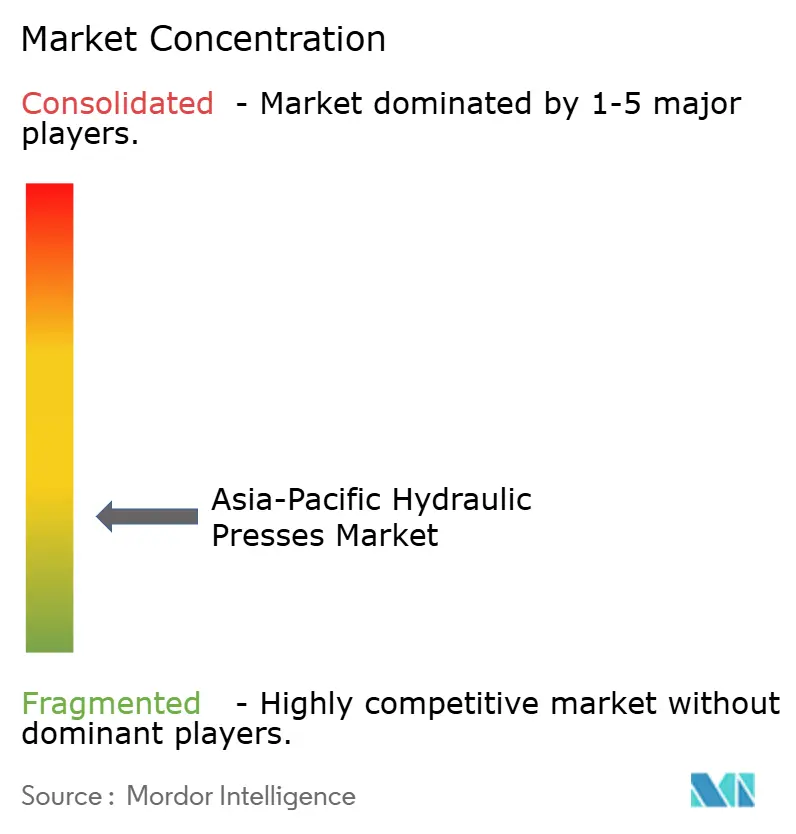
| Market Concentration | Low |
Major Players *Disclaimer: Major Players sorted in no particular order Image © Mordor Intelligence. Reuse requires attribution under CC BY 4.0. | |
Asia-Pacific Hydraulic Presses Market Analysis by Mordor Intelligence
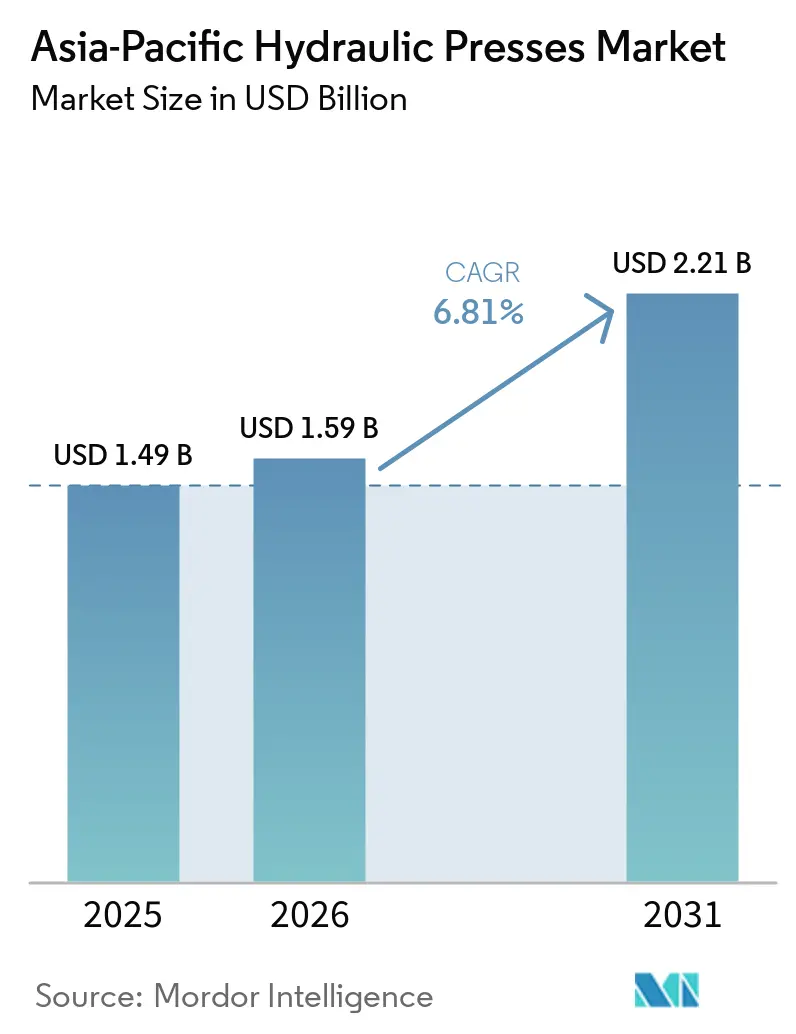
The Asia-Pacific Hydraulic Presses Market size is projected to be USD 1.49 billion in 2025, USD 1.59 billion in 2026, and reach USD 2.21 billion by 2031, growing at a CAGR of 6.81% from 2026 to 2031.
Vehicle, energy equipment, and general manufacturing capacity support demand for hydraulic forming equipment across the Asia-Pacific, particularly as industrial production expands and existing machinery is replaced or upgraded. Manufacturers are increasingly moving toward servo-hydraulic systems that provide improved position control, lower energy consumption, greater process consistency, and enhanced production monitoring. China, India, and ASEAN countries represent diverse sources of demand, ranging from the replacement of aging presses and the modernization of established production lines to new factory installations and capacity expansion. Suppliers are responding by offering connected press lines, automated material handling, integrated monitoring solutions, and retrofit services that help manufacturers improve productivity without fully replacing existing equipment. At the same time, the market faces competitive pressure from electric and mechanical presses in lighter and higher-speed applications; however, hydraulic presses continue to retain an advantage in heavy forming, deep drawing, and applications requiring high and controllable force, supporting their continued relevance across the region’s manufacturing base.
Key Report Takeaways
- By frame/structural configuration, C-frame/gap-frame hydraulic presses accounted for 34.00% of the Asia-Pacific hydraulic presses market share in 2025, while four-post/four-column hydraulic presses are projected to be the fastest-growing, with a 9.00% CAGR through 2031.
- By tonnage/press force, 101–500 tons accounted for 48.30% of the Asia-Pacific hydraulic presses market size in 2025, while above 2,000 tons presses are projected to be the fastest-growing, with an 8.70% CAGR through 2031.
- By application/forming process, sheet metal forming and deep drawing accounted for 42.00% of the Asia-Pacific hydraulic presses market share in 2025, while compression molding is projected to be the fastest-growing, with an 8.40% CAGR through 2031.
- By end-use industry, industrial machinery and general manufacturing accounted for 40.00% of the Asia-Pacific hydraulic presses market share in 2025, while the aerospace and defense industry is projected to be the fastest-growing, with an 8.00% CAGR through 2031.
- By geography, China accounted for 39.00% of the Asia-Pacific hydraulic presses market share in 2025, while India is projected to be the fastest-growing, with a 4.00% CAGR through 2031.
Note: Market size and forecast figures in this report are generated using Mordor Intelligence’s proprietary estimation framework, updated with the latest available data and insights as of January 2026.
Asia-Pacific Hydraulic Presses Market Trends and Insights
Drivers Impact Analysis*
| Driver | (~) % Impact on CAGR Forecast | Geographic Relevance | Impact Timeline |
|---|---|---|---|
| Electric-Vehicle Battery Enclosure and Lightweight Structural Forming | +2.0% | Asia-Pacific, led by China, South Korea, and Japan | Medium term (2-4 years) |
| China, India, and ASEAN Manufacturing-Capacity Expansion | +1.8% | China, India, Vietnam, Thailand, and Indonesia | Long term (≥ 4 years) |
| Automation, Robotics, and Connected Press Adoption | +1.2% | Japan, South Korea, China, and ASEAN | Medium term (2-4 years) |
| Aerospace, Defense, Shipbuilding, and Renewable-Equipment Investment | +0.8% | India, Japan, Australia, and China | Long term (≥ 4 years) |
| Brownfield Press Replacement for Energy, Safety, and Controls Obsolescence | +0.5% | China, Japan, South Korea, and ASEAN | Short term (≤ 2 years) |
| Regional Tooling, Die, and Process-Validation Ecosystems | +0.3% | China, India, and ASEAN | Medium term (2-4 years) |
| Source: Mordor Intelligence | |||
Electric-Vehicle Battery Enclosure and Lightweight Structural Forming
Asia-Pacific vehicle electrification is creating demand for precise, high-speed forming of thin, high-strength steel and aluminum battery parts. China produced 16.626 million new energy vehicles in 2025, an increase of 29% from 2024.[1]International Organization of Motor Vehicle Manufacturers, “Auto Industry Growth Shifted East in 2025 amid Global Repositioning,” OICA, oica.netBattery enclosures and structural trays require presses that can handle large panels with reliable force and position control. Cell-to-pack designs are increasing panel size, which supports demand for larger beds and four-post or H-frame layouts. Module assemblers and pack integrators are purchasing dedicated forming cells, which extends demand beyond final vehicle assembly plants. India’s advanced chemistry cell program is also supporting domestic battery-related manufacturing capacity that is scheduled to develop through 2027.
China, India, and ASEAN Manufacturing-Capacity Expansion
Manufacturing expansion in China, India, and ASEAN is creating a steady base of equipment orders across several end markets. China’s 2025-2026 machinery plan targeted CNY 10 trillion (USD 1.49 trillion) in industry operating revenue and linked equipment renewal with digital manufacturing. The Asia-Pacific hydraulic presses market benefits where replacement projects require new controls, higher efficiency, or custom forming capabilities. India’s National Manufacturing Mission aims to increase manufacturing’s contribution to GDP from 12.9% to 25% by 2035. Vietnam, Thailand, and Indonesia add greenfield demand as manufacturers diversify regional supply chains. Tooling, die, and process-validation ecosystems in China, India, and ASEAN also increase demand for presses with custom tonnage, bed dimensions, and stroke profiles.
Automation, Robotics, and Connected Press Adoption
Press lines are increasingly being purchased as part of integrated automation cells rather than as standalone machines. AIDA Engineering introduced its A-1Y Hand-in-Die Collaborative Robot in July 2025 for loading, pressing, and unloading work without a safety fence. The product includes workpiece-seating detection, which supports quality control during each cycle. Higher labor costs in Japan, South Korea, and urban China make unattended press cells more attractive over the forecast period. Connected machines can report force, vibration, and temperature data to factory systems for maintenance planning and traceability. This makes older, unmonitored equipment less suitable for plants that need a consistent digital quality record across the full production line.
Aerospace, Defense, Shipbuilding, and Renewable-Equipment Investment
Aerospace, defense, shipbuilding, and renewable-energy investment supports demand for high-tonnage hydraulic equipment. India approved an INR 69,725 crore (USD 8.1 billion) maritime package in September 2025, including measures to expand shipbuilding capacity to 4.5 million gross tonnes per year. Japan also announced plans for a JPY 1 trillion (USD 0.0065 trillion) public-private shipbuilding fund to support a capacity increase by 2035. These programs require structural plate forming and hydraulic assembly equipment over long project cycles. Offshore wind applications require large presses for tower flanges, and China’s wind manufacturing clusters are supporting heavy forming-line investment. The Asia-Pacific hydraulic presses market also gains from aerospace forging and shipbuilding work that requires force levels beyond the practical range of many alternative technologies.[2]Press Information Bureau, “The National Manufacturing Mission and PLI Schemes,” Government of India, pib.gov.in
Restraints Impact Analysis*
| Restraint | (~) % Impact on CAGR Forecast | Geographic Relevance | Impact Timeline |
|---|---|---|---|
| High Capital Cost and Limited SME Financing for Large Press Systems | -0.8% | ASEAN, India, and Rest of Asia-Pacific | Medium term (2-4 years) |
| Competition from Mechanical, Electric, and Alternative Forming Technologies | -0.6% | China, Japan, South Korea, and ASEAN | Short term (≤ 2 years) |
| Shortage of Hydraulic, Controls, and Press-Commissioning Specialists | -0.5% | ASEAN, India, and Rest of Asia-Pacific | Medium term (2-4 years) |
| Fragmented Standards, Imported Components, and Cross-Border Service Delays | -0.4% | ASEAN and Rest of Asia-Pacific | Long term (≥ 4 years) |
| Source: Mordor Intelligence | |||
High Capital Cost and Limited SME Financing for Large Press Systems
Small and medium-size manufacturers face financing limits when they consider large hydraulic press systems. The International Monetary Fund reported that collateral constraints for small businesses are more binding in Asia than in other regions. The Asian Development Bank also reported continuing financial barriers for small enterprises across twenty-six Asia-Pacific economies in 2025. Press systems above 500 tons are therefore more accessible to large manufacturers and state-linked enterprises. Safety and energy upgrades can also consume capital that might otherwise support a new capacity installation. Limited access to hydraulic, controls, and commissioning specialists, together with imported-component needs and cross-border service delays, can further raise the cost and timing risk for smaller buyers.
Competition from Mechanical, Electric, and Alternative Forming Technologies
Servo-electric and hybrid technologies are gaining ground in light- and medium-tonnage forming tasks. China’s machinery plan identifies digital transformation and electric servo-drive upgrades as key modernization paths for the country’s machinery base. Updated safety and energy requirements can raise the cost of keeping older hydraulic equipment in service. Hydraulic presses retain important technical advantages above 500 tons and in difficult forming work. However, servo-electric systems are increasingly competitive in the 100-500-ton range on repeatability and energy consumption. Chinese servo press suppliers are also expanding into Southeast Asian markets, which increases price pressure on established Japanese and European suppliers.
*Our forecasts treat driver/restraint impacts as directional, not additive. The impact forecasts reflect baseline growth, mix effects, and variable interactions.
Segment Analysis
By Frame / Structural Configuration: C-Frame Leads, Hybrid Architectures Are the Fastest-Growing
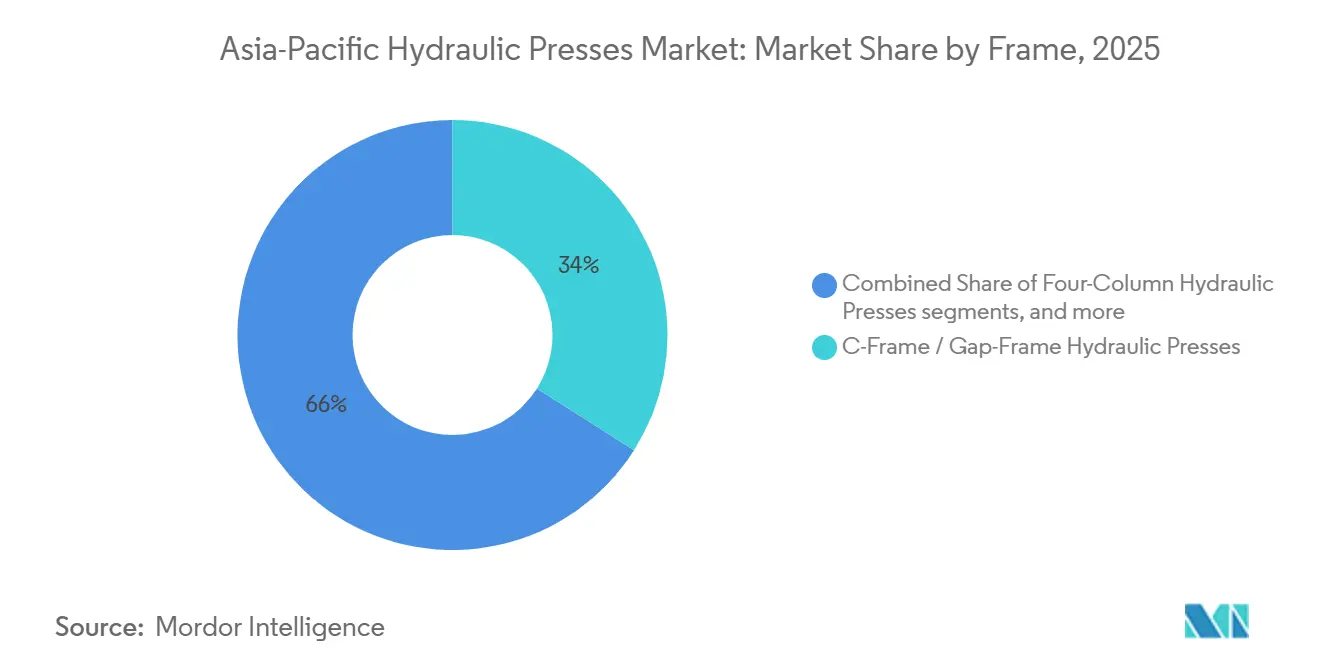
C-frame/gap-frame hydraulic presses accounted for 34.00% of the Asia-Pacific hydraulic presses market share in 2025. Their accessible bed design supports automotive stamping, electronics assembly, and general metal forming. Short tooling-change time makes these presses suitable for high-mix production at job shops and automotive suppliers. Robotic part loading can be integrated without changing the basic operating model. H-frame presses remain important for body-in-white stamping and aerospace panels that require accurate ram guidance.
Four-post/four-column hydraulic presses are projected to be the fastest-growing, with a 9.00% CAGR through 2031. Four-column presses are used for deep drawing and powder compaction because they distribute die pressure evenly. Two-post presses serve mid-range fabrication work, while benchtop units serve maintenance and price-sensitive tasks. Domestic producers in China and India commonly supply these lower-force configurations. The demand for hybrid hydraulic-electric presses is driven by buyers seeking hydraulic force with servo-electric control and lower energy use. ANDRITZ Schuler reported in January 2026 that its upgraded HFA presses can reach eighty-five strokes per minute with servo-controlled hydraulic pump drives. The company also reported double-digit energy-efficiency gains over conventional fixed-speed systems. Isostatic and multi-action presses serve ceramics, advanced composites, and powder metallurgy, where process requirements often make custom equipment necessary.



By Tonnage / Press Force: Mid-Range Anchors the Market, Heavy End Growth Is Structurally Differentiated
The 101–500 tons accounted for 48.30% of the Asia-Pacific hydraulic presses market size in 2025. The band supports automotive panels, brackets, appliance housings, and electronic enclosures. Its force range aligns with the capital budgets of many large and mid-size manufacturers. Presses up to 100 tons serve short-run work and face strong competition from servo-electric alternatives. The 501-1,000-ton range supports structural automotive forming and medium-scale forging. The 1,001-2,000-tons band is used for heavy automotive work, rail applications, and large machinery frames.
Above 2,000 tons presses are projected to be the fastest-growing, with a 8.70% CAGR through 2031. Wind turbine flange production, aerospace isothermal forging, and shipbuilding structural work support this demand. High-force applications preserve the role of hydraulic systems because the required tonnage is difficult to meet with commercially viable alternatives. India’s aerospace and defense manufacturing push is supporting investment in high-capacity forging capability. Aerolloy Technologies commissioned a 4,500/5,100-tons Intelligent Open Die Forging System in Lucknow in March 2026 for titanium and superalloy forgings. Heavy equipment orders give the Asia-Pacific hydraulic presses market a source of demand that is less exposed to lower-tonnage substitution.
By Application / Forming Process: Sheet Metal Forming Leads Revenue, Compression Molding Captures the Growth Edge
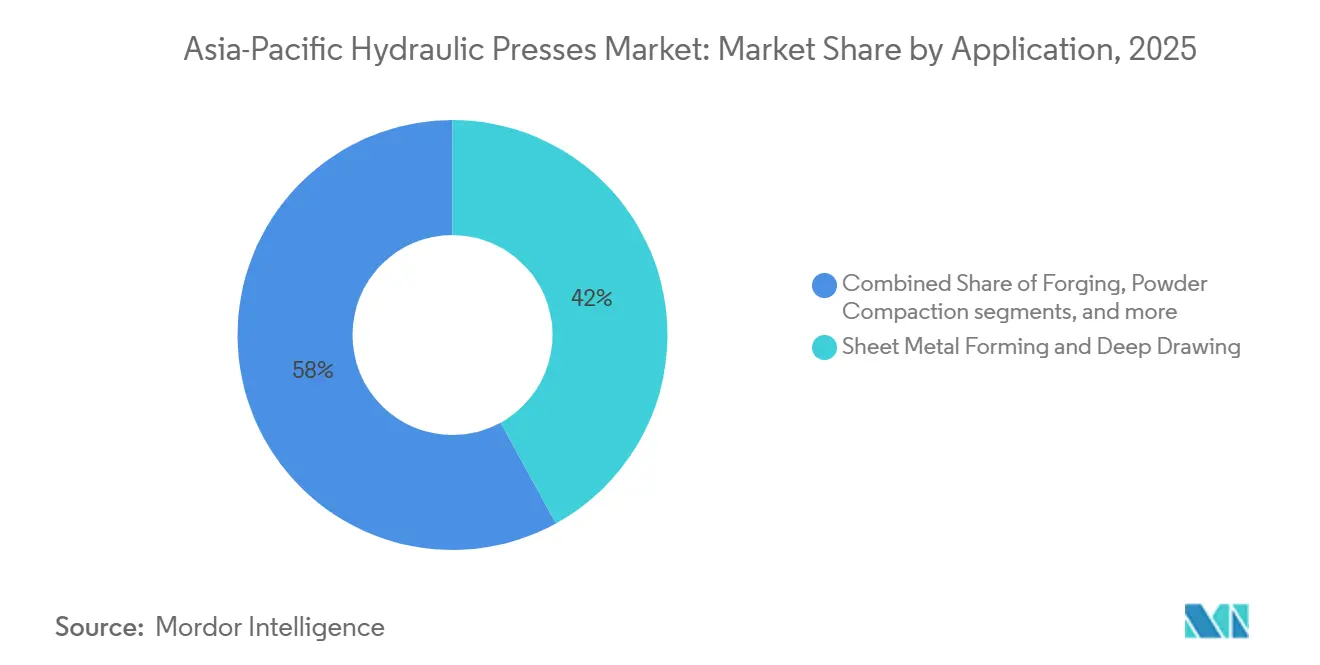
Sheet metal forming and deep drawing accounted for 42.00% of the Asia-Pacific hydraulic presses market share in 2025. Automotive body panels, appliances, and electronics all rely on this process. Advanced high-strength steel and aluminum increase the need for controlled forming profiles. Servo-hydraulic presses can deliver slower, controlled motion for difficult draw geometries. Forging has a substantial role in China and India through automotive drivetrain parts and defense components. Hydroforming supports tubular automotive structures, while bending, straightening, punching, and blanking serve construction, electronics, and assembly work.
Compression molding is projected to be the fastest-growing, with a 8.40% CAGR through 2031 as composite use expands in aerospace, lightweight vehicles, and wind blades. Fiber-reinforced polymer and carbon-fiber parts require stable pressure and temperature control. Dassault Aviation signed four production transfer agreements with Tata Advanced Systems in June 2025 for Rafale fuselage sections at a planned Hyderabad facility. The agreements covered lateral shells, central fuselage, and rear sections: assembly, press-fitting, powder compaction, and advanced-materials forming complete the application mix. Powder compaction also connects the Asia-Pacific hydraulic presses market with battery materials, ceramics, and metal-injection molding suppliers.
By End-Use Industry: Industrial Machinery Commands Revenue, Aerospace and Defense Leads Forward Demand
Industrial machinery and general manufacturing accounted for 40.00% of the Asia-Pacific hydraulic presses market share in 2025. Mid-tier fabricators use hydraulic presses for equipment ranging from agricultural machinery to construction machines. Electric vehicle investment is raising press-line requirements at automakers and first-tier suppliers. Electrical and electronics production requires smaller precision presses. Plastics, rubber, and composites support compression and transfer molding requirements. Rail, marine, construction, and energy applications provide additional demand and reduce reliance on one end-use.
The aerospace and defense industry is projected to be the fastest-growing, with a 8.00% CAGR through 2031. Aerolloy Technologies’ forging-system installation in 2026 supports titanium and superalloy production for defense and aerospace customers. Bharat Forge and Liebherr-Aerospace announced a Pune collaboration in February 2025 that included a ring mill and landing-gear machining. Australia’s commitment of AUD 12 billion (USD 8.55 billion) to the Henderson Defence Precinct adds a long-cycle requirement for structural forming and hydraulic assembly equipment.[3]PTC Industries Limited, “Completion of Installation and Commissioning of 4500/5100 Tonne Intelligent Open Die Forging System,” BSE India filing, bsmedia.business-standard.com
Geography Analysis
China accounted for 39.00% of the Asia-Pacific hydraulic presses market share in 2025. Its automotive, electronics, wind-energy, and industrial machinery supply chains support demand across several force ranges. The government’s 2025-2026 machinery plan supports equipment renewal and digital manufacturing transformation. This supports both replacement demand and purchases of newer connected equipment. Japan contributes premium demand from automotive suppliers, precision electronics, and shipbuilding. Japan’s proposed JPY 1 trillion (USD 0.0065 trillion) shipbuilding fund supports structural plate forming and assembly investment over a multiyear period. South Korea maintains demand through shipyards and semiconductor-equipment supply chains. Above-1,000-ton presses are needed for structural forming programs serving domestic and export customers.
India is projected to be the fastest-growing, with a 4.00% CAGR through 2031, supported by manufacturing policies and new defense, aerospace, and clean-energy capacity. The National Manufacturing Mission and production-linked incentive approvals are bringing forward capital-goods purchasing decisions. The Asia-Pacific hydraulic presses market share is also supported by ASEAN demand, where Vietnam, Thailand, and Indonesia are adding production capacity. Thailand’s automotive tooling base, Vietnam’s electronics stamping capacity, and Indonesia’s heavy-equipment base create distinct equipment needs.
Australia’s demand is centered on defense, resource-sector equipment, and naval shipbuilding rather than automotive or electronics. The Henderson Defence Precinct commitment creates a multiyear pipeline for heavy structural forming and precision assembly. Taiwan supports precision-stamping requirements from offshore wind and electronics manufacturing. Emerging markets, including Bangladesh, Sri Lanka, and other ASEAN economies, are developing entry-level press demand through consumer goods and auto-parts manufacturing. Aging production lines in export-oriented factories are also being replaced with digitally capable equipment. This broad geographic mix gives the Asia-Pacific hydraulic presses market demand from both mature industrial bases and new manufacturing locations.
Competitive Landscape
The Asia-Pacific hydraulic presses market is concentrated in high-tonnage specialty equipment and fragmented in the mid-range. Chinese suppliers lead by volume in the 101-500-ton category. ANDRITZ Schuler, SMS group, Siempelkamp, Komatsu, and Aida maintain positions in servo-hydraulic, connected, and high-precision applications. European and Japanese original equipment manufacturers remain important where process control and specialized engineering are required. Chinese hybrid-press builders are narrowing the technology gap in the 101-1,000-ton range. Their expansion in Southeast Asia increases competition on price-adjusted performance.
ANDRITZ Schuler restructured its arrangement with Feintool in January 2026 and assumed general-contractor responsibility for HFA fineblanking press turnkey systems. This shifts its role from supplying equipment to coordinating complete systems. AIDA’s July 2025 A-1Y collaborative robot launch shows how suppliers are competing around automated forming cells rather than only press hardware. AIDA also announced SAT-M and ARB high-speed robots for press-line automation, with an exhibition planned for May 2026. These moves support integrated offerings that combine material handling, safety, and process checks.
Patent activity in hybrid drives, connected sensors, and energy recovery reflects continued competition in press technology. The Asia-Pacific hydraulic presses market gives established suppliers an opportunity to modernize older machines with servo drives and sensors. Retrofit work can cost less than full replacement for plants with usable press structures. This creates service revenue for original equipment manufacturers and specialist retrofit providers. It also helps operators meet changing safety, energy, and traceability requirements without replacing every machine. Competitive success, therefore, depends on heavy-equipment capability, automation partnerships, local service, and modernization support.
Asia-Pacific Hydraulic Presses Industry Leaders
ANDRITZ Schuler Group
Tianjin Tianduan Press Co., Ltd. (GENERTEC Tianduan)
Yangli Group
Komatsu Ltd.
JIER Machine-Tool Group Co., Ltd.
- *Disclaimer: Major Players sorted in no particular order

Recent Industry Developments
- March 2026: Aerolloy Technologies Limited completed the installation and commissioning/trials of a 4,500/5,100-ton Intelligent Open Die Forging System at its Strategic Materials Technology Complex in Lucknow, Uttar Pradesh. The system is designed to process titanium, superalloys, and other high-performance alloys for aerospace and defense applications, strengthening India’s domestic high-value forging capabilities.
- January 2026: ANDRITZ Schuler expanded its fineblanking portfolio with the HFA plus+ series, establishing a new supply arrangement with Feintool under which ANDRITZ Schuler builds the presses and supplies turnkey fineblanking systems as general contractor, while Feintool continues to provide process and tooling expertise as required. The new hydraulic presses offer up to eighty-five strokes per minute, while their servo-controlled hydraulic pump drive delivers double-digit percentage improvements in energy efficiency over conventional systems.
- November 2025: Japan announced plans for a JPY 1 trillion (USD 0.0065 trillion) public-private investment framework to revitalize its shipbuilding industry, with the government targeting a doubling of annual domestic shipbuilding capacity to approximately 18 million gross tons by 2035 from around 9 million gross tons. The initiative is expected to drive investment in shipyard capacity, automation, productivity improvements, and associated manufacturing infrastructure, supporting longer-term demand for metal-forming and heavy industrial equipment.


Asia-Pacific Hydraulic Presses Market Report Scope
The Asia-Pacific Hydraulic Presses Market Report is Segmented by Frame (C-Frame, H-Frame, Four-Post, and More), by Tonnage (Up To 100 Tons, 101–500 Tons, and More), by Application (Forging, Powder Compaction, and More), by End-User Industry (Automotive and Transportation, and More), and by Geography (China, Japan, India, South Korea, and More). The Report Offers Market Size and Forecasts in Value (USD) for all the Above Segments.
| C-Frame / Gap-Frame Hydraulic Presses |
| H-Frame / Straight-Side / Gib-Guided Hydraulic Presses |
| Four-Post / Four-Column Hydraulic Presses |
| Two-Post / Column Hydraulic Presses |
| Benchtop / Workshop Hydraulic Presses |
| Other Specialized Hydraulic Press Configurations |
| Up to 100 Tons |
| 101-500 Tons |
| 501-1,000 Tons |
| 1,001-2,000 Tons |
| Above 2,000 Tons |
| Sheet Metal Forming and Deep Drawing |
| Forging |
| Bending and Straightening |
| Punching, Blanking and Coining |
| Compression Molding |
| Powder Compaction |
| Hydroforming |
| Assembly, Press-Fitting and General Pressing |
| Other Specialized Applications |
| Automotive and Transportation |
| Aerospace and Defense |
| Industrial Machinery and General Manufacturing |
| Electrical and Electronics |
| Plastics, Rubber and Composites |
| Construction and Heavy Equipment |
| Energy and Power Equipment |
| Rail and Marine |
| Powder Metallurgy, Ceramics and Advanced Materials |
| Other End-Use Industries |
| China |
| Japan |
| India |
| South Korea |
| ASEAN (Singapore, Malaysia, Indonesia, Thailand, Vietnam, Philippines, Myanmar, Cambodia, Laos, Brunei) |
| Australia |
| Rest of Asia-Pacific |
| By Frame / Structural Configuration | C-Frame / Gap-Frame Hydraulic Presses |
| H-Frame / Straight-Side / Gib-Guided Hydraulic Presses | |
| Four-Post / Four-Column Hydraulic Presses | |
| Two-Post / Column Hydraulic Presses | |
| Benchtop / Workshop Hydraulic Presses | |
| Other Specialized Hydraulic Press Configurations | |
| By Tonnage / Press Force | Up to 100 Tons |
| 101-500 Tons | |
| 501-1,000 Tons | |
| 1,001-2,000 Tons | |
| Above 2,000 Tons | |
| By Application / Forming Process | Sheet Metal Forming and Deep Drawing |
| Forging | |
| Bending and Straightening | |
| Punching, Blanking and Coining | |
| Compression Molding | |
| Powder Compaction | |
| Hydroforming | |
| Assembly, Press-Fitting and General Pressing | |
| Other Specialized Applications | |
| By End-Use Industry | Automotive and Transportation |
| Aerospace and Defense | |
| Industrial Machinery and General Manufacturing | |
| Electrical and Electronics | |
| Plastics, Rubber and Composites | |
| Construction and Heavy Equipment | |
| Energy and Power Equipment | |
| Rail and Marine | |
| Powder Metallurgy, Ceramics and Advanced Materials | |
| Other End-Use Industries | |
| By Geography | China |
| Japan | |
| India | |
| South Korea | |
| ASEAN (Singapore, Malaysia, Indonesia, Thailand, Vietnam, Philippines, Myanmar, Cambodia, Laos, Brunei) | |
| Australia | |
| Rest of Asia-Pacific |


Key Questions Answered in the Report
What is the projected value of the Asia-Pacific hydraulic presses market by 2031?
The Asia-Pacific hydraulic presses market is forecast to reach USD 2.21 billion by 2031, rising from USD 1.59 billion in 2026 at a 6.8% CAGR. The outlook reflects equipment requirements across manufacturing, mobility, energy, and defense supply chains. It also reflects demand for replacement machines with newer controls and lower energy use.
What is driving demand for hydraulic presses in Asia-Pacific?
Vehicle electrification, factory expansion, automated press cells, and aerospace, shipbuilding, and renewable-equipment investment support demand. These applications need reliable forming capacity, custom tooling compatibility, and stronger process control. Battery enclosures, structural panels, and large forged components are notable demand areas.
Which press-force category is growing fastest in Asia-Pacific?
Presses above 2,000 tons are forecast to grow fastest, registering an 8.70% CAGR through 2031, because wind flanges, aerospace forgings, and shipbuilding structures require high force. These jobs also have fewer practical alternatives to hydraulic forming equipment. Long equipment life and large project schedules can support purchasing in this category.
Which applications use hydraulic presses most widely in the region?
Sheet metal forming and deep drawing led application demand in 2025, accounting for 42.00% market share, while compression molding is expected to grow fastest, registering an 8.40% CAGR through 2031. Composite components for aerospace, lightweight vehicles, and wind equipment are supporting the latter application. Forging, hydroforming, bending, punching, and powder compaction provide other sources of demand
Which country has the greatest regional demand for hydraulic presses?
China accounted for 39.00% market share in 2025 and was the largest geography, supported by automotive, electronics, wind, and machinery supply chains. Equipment renewal and digital-manufacturing plans also support replacement and modernization demand. India is the fastest-growing economy, while ASEAN countries are adding new production capacity.
How are suppliers competing in hydraulic press equipment?
Suppliers are adding servo-hydraulic controls, connected monitoring, collaborative robots, retrofit services, and turnkey automation-cell capabilities. Buyers also value local service support, system integration, and the ability to meet changing safety and traceability needs. Heavy-tonnage engineering remains a key point of differentiation in aerospace, wind, and shipbuilding work.
Page last updated on:





