
Asia-Pacific Home and Furnishing Technical Textile Market Size and Share
Market Overview
| Study Period | 2021 - 2032 |
|---|---|
| Forecast Data Period | 2027 - 2032 |
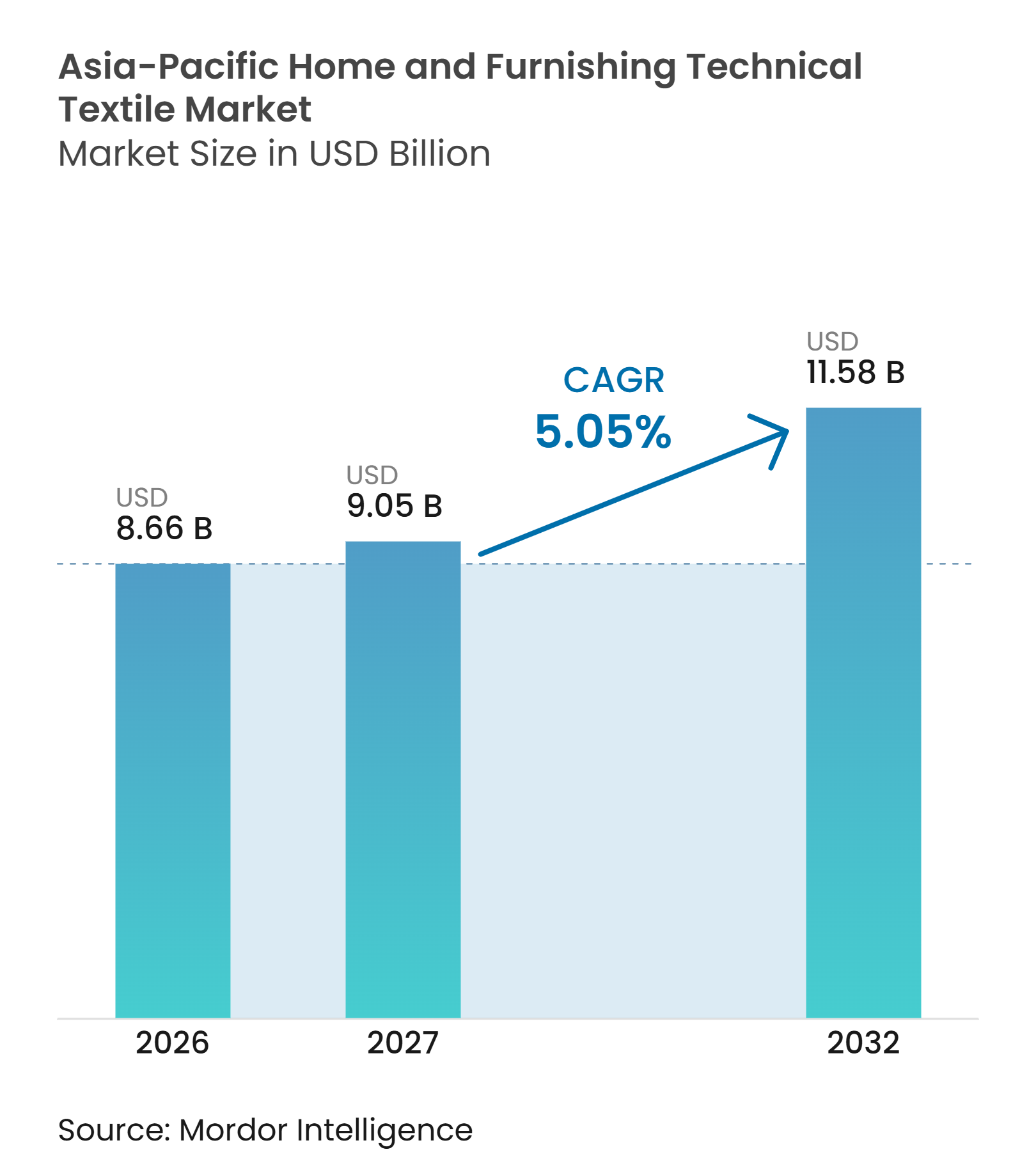
| Base Year Market Size (2026) | USD 8.66 Billion |
| Market Size (2027) | USD 9.05 Billion |
| Market Size (2032) | USD 11.58 Billion |
| Growth Rate (2027 - 2032) | 5.05 % |
| Market Concentration | Medium |
Major Players *Disclaimer: Major Players sorted in no particular order Image © Mordor Intelligence. Reuse requires attribution under CC BY 4.0. | |
Asia-Pacific Home and Furnishing Technical Textile Market Analysis by Mordor Intelligence
The Asia-Pacific Home And Furnishing Technical Textile Market size is projected to expand from USD 8.66 billion in 2026 and USD 9.05 billion in 2027 to USD 11.58 billion by 2032, registering a CAGR of 5.05% between 2027 and 2032.
The Asia-Pacific home and furnishing technical textile market is supported by urban household formation, which increases first-time purchases of bedding, upholstery, window coverings, and other functional furnishings. Demand is also moving toward materials with measurable hygiene, comfort, durability, and safety characteristics, rather than basic decorative fabrics. Hospitality construction, renovations, and institutional fit-outs increase the need for fabrics that meet stricter performance and qualification requirements. Producers with functional finishing, testing, recycled-fiber capability, and reliable regional supply relationships are better placed to serve these needs, although volatile fiber costs and compliance expenses remain material constraints.
Key Report Takeaways
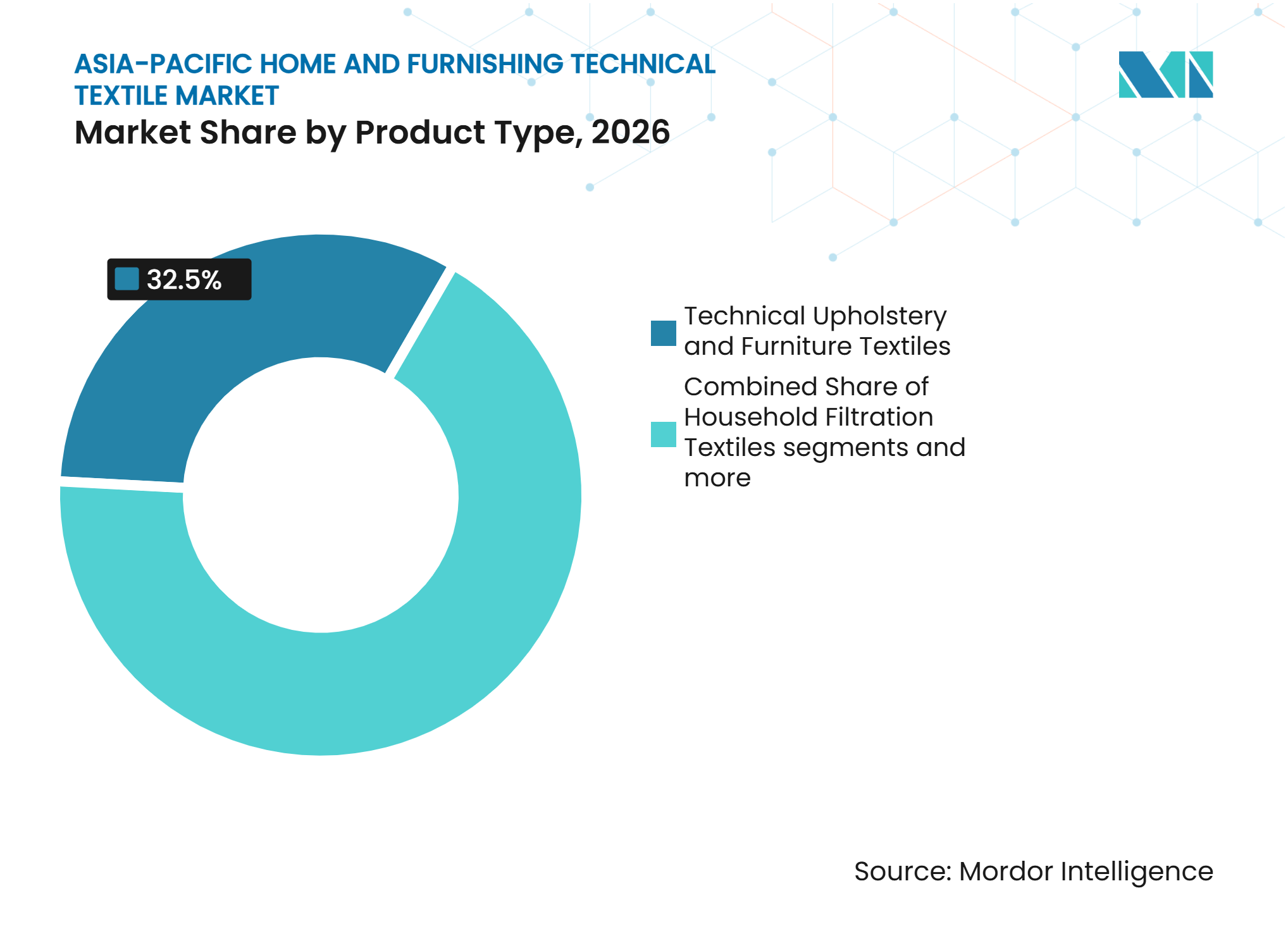
- By product type, technical upholstery and furniture textiles held 32.5% of the Asia-Pacific home and furnishing technical textile market share in 2026, while household filtration textiles are the fastest-growing product segment, registering a 7.4% CAGR through 2032.
- By material type, polyester held 42.0% of the Asia-Pacific home and furnishing technical textile market share in 2026, while regenerated cellulosic fibers are the fastest-growing material segment, registering a 7.8% CAGR through 2032.
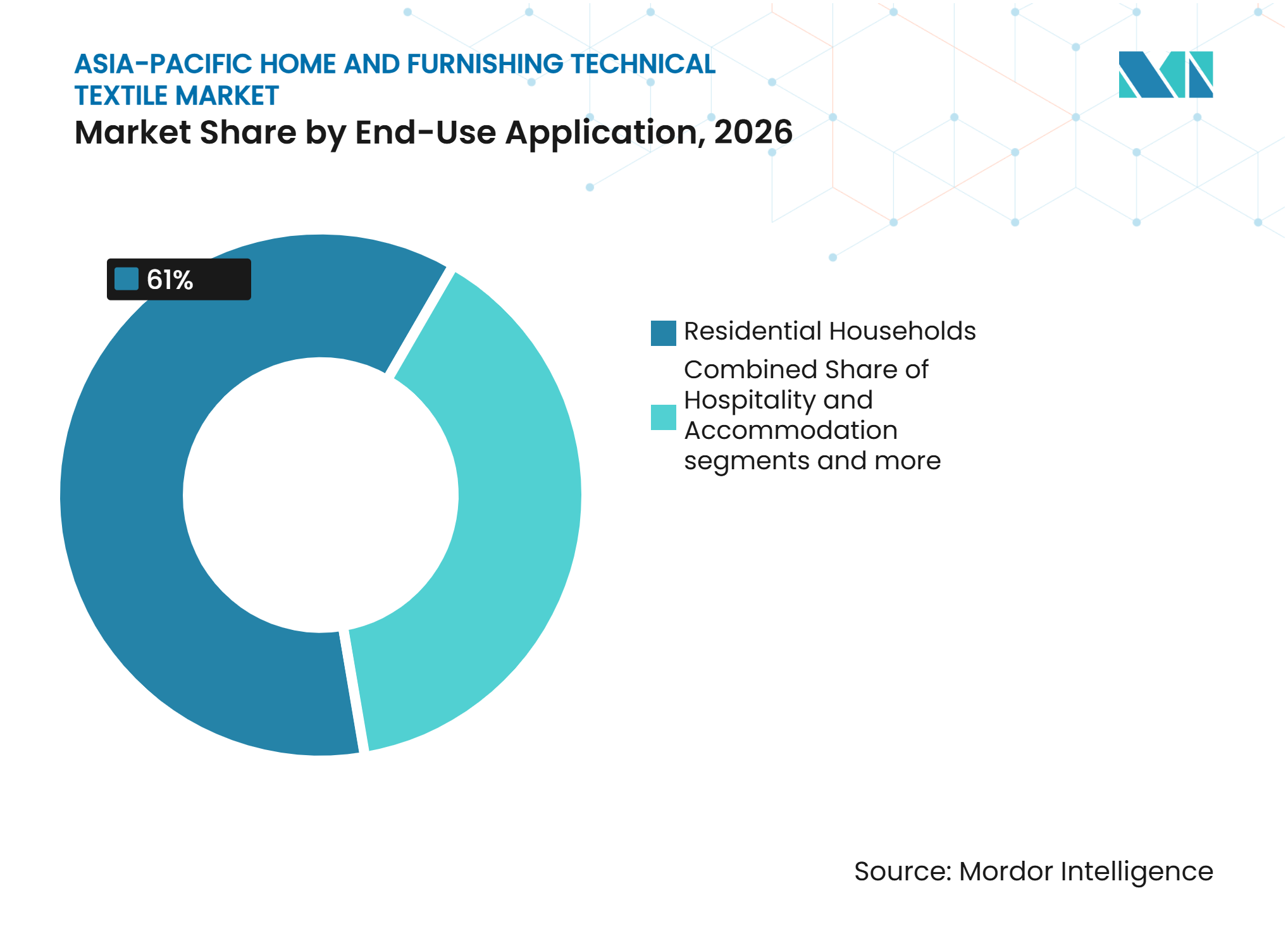
- By end-use application, residential households held 61.0% of the Asia-Pacific home and furnishing technical textile market share in 2026, while hospitality and accommodation is the fastest-growing end-use segment, registering a 6.8% CAGR through 2032.
- By geography, China held 34.0% of the Asia-Pacific home and furnishing technical textile market share in 2026, while India is projected to be the fastest-growing geography, registering a 7.6% CAGR through 2032.
Note: Market numbers in this report are based on Mordor Intelligence's proprietary estimation framework, which combines nine months of actuals with Q4 projections for base year 2026.
Market Trends and Insights
Drivers Impact Analysis of Asia-Pacific Home and Furnishing Technical Textile Market*
| Driver | (~) % Impact on CAGR Forecast | Geographic Relevance | Impact Timeline |
|---|---|---|---|
| Urbanization and Household Formation | +1.3% | ASEAN and South Asia, including India, Vietnam, Indonesia, and Bangladesh, with spillover to secondary cities | Long term (≥ 4 years) |
| Income Growth and Premiumization of Functional Home Furnishings | +1.1% | China, India, and Southeast Asia, including Indonesia, Vietnam, and the Philippines | Medium term (2-4 years) |
| Specification Pull from Hospitality, Healthcare, and Institutional Fit-Outs | +0.9% | India, Vietnam, Japan, Thailand, and Indonesia | Medium term (2-4 years) |
| Digital Retail and Cross-Border E-Commerce | +0.7% | China, India, Singapore, Malaysia, Taiwan, and Hong Kong | Medium term (2-4 years) |
| Sustainability and Recycled-Fiber Adoption | +0.5% | China, India, South Korea, Japan, and Australia | Long term (≥ 4 years) |
| Demand for Thermal and Acoustic Comfort in Dense Urban Housing | +0.4% | China, Japan, South Korea, and urban Southeast Asia | Long term (≥ 4 years) |
| Source: Mordor Intelligence | |||
Urbanization and Household Formation
Urbanization is increasing the number of households that need basic home furnishings for the first time. The United Nations reported that, in 2025, 19 of the 33 global megacities were in Asia, and cities in the region housed 45% of the world's population. The 2026 Asia-Pacific SDG Partnership Report projects 1.2 billion additional urban residents by 2050, especially in India, Vietnam, Indonesia, and Bangladesh. Smaller apartments favor products that address bedding comfort, allergen control, space efficiency, light management, and noise reduction. This supports purchases of mattress ticking, barrier covers, acoustic curtains, and durable upholstery rather than purely decorative products. The Asia-Pacific home and furnishing technical textile market therefore benefits from a long replacement and fit-out cycle as urban households mature.[1]
Income Growth and Premiumization of Functional Home Furnishings
Rising income supports purchases of higher-value home furnishing products with clear functional benefits. The Asian Development Bank expects developing Asia to expand by 5.1% in 2026, which supports consumer spending across the region. Buyers in China and Southeast Asia are placing greater value on certified safety, moisture management, stain resistance, and thermal comfort. This changes demand from plain sheets and untreated upholstery toward coated curtains, performance bedding fabrics, and cleaning substrates. It also increases the importance of testing and documented product claims. The Asia-Pacific home and furnishing technical textile market can benefit when suppliers combine performance finishing with traceable quality assurance.
Specification Pull from Hospitality, Healthcare, and Institutional Fit-Outs
Hospitality, healthcare, and institutional procurement favor fabrics with defined performance requirements. Hotels and resorts require durable upholstery, allergen-barrier bedding, and carpet backing that can withstand intensive use and cleaning. Healthcare and care facilities require antimicrobial substrates, wash-durable barriers, and nonwoven cleaning materials. These buyers usually purchase against written specifications, which increases the importance of fire resistance, chemical safety, and documented quality. The requirement is more demanding than a typical residential purchase and can support technically capable suppliers. The Asia-Pacific home and furnishing technical textile market has an opportunity to serve this demand through products designed for long service life and repeat procurement.
Digital Retail and Cross-Border E-Commerce
Digital sales channels are extending the reach of furnishing suppliers beyond their physical retail networks. IKEA launched an official flagship store on JD.com in August 2025, using JD Logistics to broaden access across Chinese cities. Online selling increases the need for accurate product descriptions, reliable delivery, and substantiated performance claims. It can help manufacturers present functional features such as anti-mite barriers, wash durability, and certified recycled content directly to buyers. Retailers that cannot match the product range and logistics of cross-border platforms may face more pressure. For the Asia-Pacific home and furnishing technical textile market, the channel favors suppliers that can communicate performance clearly and fulfill regional orders consistently.
Restraints Impact Analysis of Asia-Pacific Home and Furnishing Technical Textile Market*
| Restraint | (~) % Impact on CAGR Forecast | Geographic Relevance | Impact Timeline |
|---|---|---|---|
| Cotton, Polyester, and Specialty-Fiber Cost Volatility | -1.2% | Global, with strong exposure in China, India, Bangladesh, and Vietnam | Short term (≤ 2 years) |
| ESG, Chemical, Fire, and Retailer Qualification Costs | -0.8% | Global, with the highest compliance burden in Japan, South Korea, Australia, and export-oriented ASEAN markets | Medium term (2-4 years) |
| Inconsistent HomeTech Performance Testing Across Asia-Pacific | -0.5% | ASEAN and South Asia, with spillover to cross-border trade flows | Medium term (2-4 years) |
| Small-Batch Customization and Short-Run Economics | -0.4% | ASEAN manufacturing hubs and premium residential markets in China and Japan | Short term (≤ 2 years) |
| Source: Mordor Intelligence | |||
Cotton, Polyester, and Specialty-Fiber Cost Volatility
Fiber cost volatility remains a direct constraint on producer margins. The USDA reported higher domestic cotton prices in China in 2026, followed by additional import quota and reserve releases intended to support the textile sector. The same report showed that China’s cotton imports in the first six months of 2026 were twice the level seen in the same period of 2025, while cotton yarn imports were 55% higher. Cost pressure on cotton can occur at the same time as polyester feedstock costs rise, leaving converters exposed across both natural and synthetic materials. Mattress ticking, upholstery, and cushioning producers may find it difficult to pass higher costs through quickly under long-term supply contracts. The Asia-Pacific home and furnishing technical textile market therefore faces margin pressure when material costs move faster than contracted pricing.[2]
ESG, Chemical, Fire, and Retailer Qualification Costs
Chemical, fire-safety, and retailer qualification requirements can raise the cost of participating in higher-value supply chains. The European Chemicals Agency maintains REACH restrictions that affect chemical choices for textile articles placed on the European market. India’s Bureau of Indian Standards issued new and revised textile standards in December 2025, including IS 19441:2025 for fabric surface quality and smoothness characterization. Suppliers serving hospitality, healthcare, and export customers also face product-specific testing and documentation needs. Smaller converters without internal laboratories can carry a larger relative burden. The Asia-Pacific home and furnishing technical textile market may therefore favor firms that can spread testing, certification, and compliance costs across a broader product base.
*Our forecasts treat driver/restraint impacts as directional, not additive. The impact forecasts reflect baseline growth, mix effects, and variable interactions.
Asia-Pacific Home and Furnishing Technical Textile Market Segment Analysis
By Product Type:
Upholstery Holds the Largest PositionTechnical upholstery and furniture textiles accounted for 32.5% of the Asia-Pacific home and furnishing technical textile market size in 2026. The segment serves residential interiors, hospitality seating, healthcare furniture, and offices, giving it a broader demand base than individual furnishing categories. Demand for coated, laminated, stain-release, and fire-resistant fabrics is increasing where procurement specifications are more rigorous. Furniture construction and reinforcement textiles also benefit from regional furniture manufacturing activity. Mattress ticking, functional bedding components, and fiber-fill products provide additional volume through the premium bedding cycle in China, Japan, and South Korea. Window shading and functional curtains support steady demand in apartments and commercial interiors where solar control and acoustic performance matter.
Household filtration textiles are the fastest-growing product segment, registering a 7.4% CAGR through 2032. Air-purifier media and home HVAC filtration support demand where urban consumers focus on indoor air quality. Antimicrobial features can add value in Japan, South Korea, and Australia, where buyers often seek documented product performance. Household cleaning and nonwoven wipe textiles retain a stable base in China, Japan, and Southeast Asia through home, food-service, and institutional use. Mosquito nets and insect-screening materials remain relevant in India, Bangladesh, Vietnam, Indonesia, and Thailand because disease prevention is a public health priority. Other specialty products include acoustic fabrics and engineered household components that align with the broader move toward comfort and smart-home functions.



By Material Type:
Polyester Leads the Material MixPolyester held 42.0% of the Asia-Pacific home and furnishing technical textile market share in 2026. Its position reflects cost efficiency, processing flexibility, and the ability to support bedding fill, carpet backing, nonwoven upholstery substrates, and other functional products. Polypropylene remains important in carpet backing and floor coverings because of its low density, chemical resistance, and bonding properties. Polyamide serves higher-specification upholstery and filtration products where abrasion resistance and durability support a premium position. Cotton remains relevant for bedding and cleaning textiles, but price volatility encourages blends with polyester or modal. Acrylic and modacrylic fibers are used in flame-resistant furnishing materials, while wool and inorganic fibers remain relevant in premium and insulation applications.
Regenerated cellulosic fibers are the fastest-growing material segment, registering a 7.8% CAGR through 2032. Viscose, modal, lyocell, and cupro support bedding and upholstery uses where buyers prefer a natural hand feel and moisture management. The movement toward recycled and bio-based sourcing also supports interest in cellulosic materials. India’s National Technical Textiles Mission approved 16 new research projects in February 2026, including projects connected with advanced fibers and functional textiles. Updated standards can strengthen buyer confidence in documented fiber and fabric quality. Material suppliers that offer consistent performance and traceability can gain relevance as furnishing brands seek differentiated inputs.
By End-Use Application:
Residential Households Form the Core Demand BaseResidential households accounted for 61.0% of the Asia-Pacific home and furnishing technical textile market share in 2026. Furniture and interior furnishings, along with bedding and sleep products, form the largest value pools within household demand. Rising urbanization supports regular purchases of upholstery, mattress materials, window coverings, cleaning textiles, and filtration products. Flooring and window coverings also benefit from resale, renovation, and apartment fit-out cycles. Household cleaning, filtration, and mosquito screening add recurring demand linked to hygiene and indoor comfort. The size of the residential base means that even a modest move toward higher-performance products can create meaningful regional volume.
Hospitality and accommodation is the fastest-growing end-use segment, registering a 6.8% CAGR through 2032. Hotels and resorts use high-value furnishing materials, including allergen-barrier mattress ticking, certified fire-resistant upholstery, and commercial-grade carpet backing. Serviced apartments create a faster replacement cycle and support repeat purchases of durable textiles. Offices and commercial interiors can require acoustic materials as workspaces are renovated. Healthcare and care facilities need antimicrobial substrates, barrier fabrics, and institutional cleaning nonwovens. Education and public institutions form a steadier procurement category with longer contracts and more predictable purchasing schedules.

Geography Analysis
China
China held 34.0% of the Asia-Pacific home and furnishing technical textile market share in 2026. Its position rests on an integrated textile system that spans fiber supply, fabric conversion, nonwovens, and original equipment manufacturing. The USDA documented domestic cotton price pressure in 2026 and subsequent quota and reserve actions by the Chinese government. This has encouraged interest in recycled polyester and regenerated cellulosic inputs, which can provide a more sustainable product position for export buyers. Digital retail is changing how home furnishings reach consumers, illustrated by IKEA’s 2025 flagship launch on JD.com. Shanghai and Zhejiang remain important centers for polyester technical materials, while Shandong and Jiangsu support nonwovens and functional bedding output.
India
India is the fastest-growing geography in the Asia-Pacific home and furnishing technical textile market through 2032. The National Technical Textiles Mission had funded 168 projects by 2026 after approving 16 additional projects focused on advanced fibers and functional textile applications. The government also approved 17 new applicants under the Production Linked Incentive scheme in November 2025 for man-made fiber fabrics and technical textiles. The Tex-Eco Initiative adds support for recycling, waste management, and recycled-fiber development. These measures support a broader manufacturing base for functional furnishing materials. Updated BIS standards also strengthen the quality framework for domestic suppliers and export-oriented manufacturers.[3]
Southeast Asia and Other Markets
Japan and South Korea are mature markets for filtration materials, acoustic furnishing fabrics, and high-performance nonwovens. Demand is supported by dense housing, strong hygiene preferences, and more demanding chemical and quality requirements. South Korea has committed public funding to fiber-to-fiber recycling for polyester composite fibers, which supports its position in circular material development. Vietnam is expanding its role as a manufacturing base and is using digital routes to reach international buyers. The Vietnam News Agency reported that producers see digital platforms as an important route to global customers. Indonesia and Thailand have household demand supported by middle-class growth and hospitality activity. Bangladesh can serve lower-specification wipes and mosquito netting through its textile conversion base, while Australia and Taiwan remain premium markets where sustainability certification and provenance verification matter.
Competitive Landscape
Market Concentration
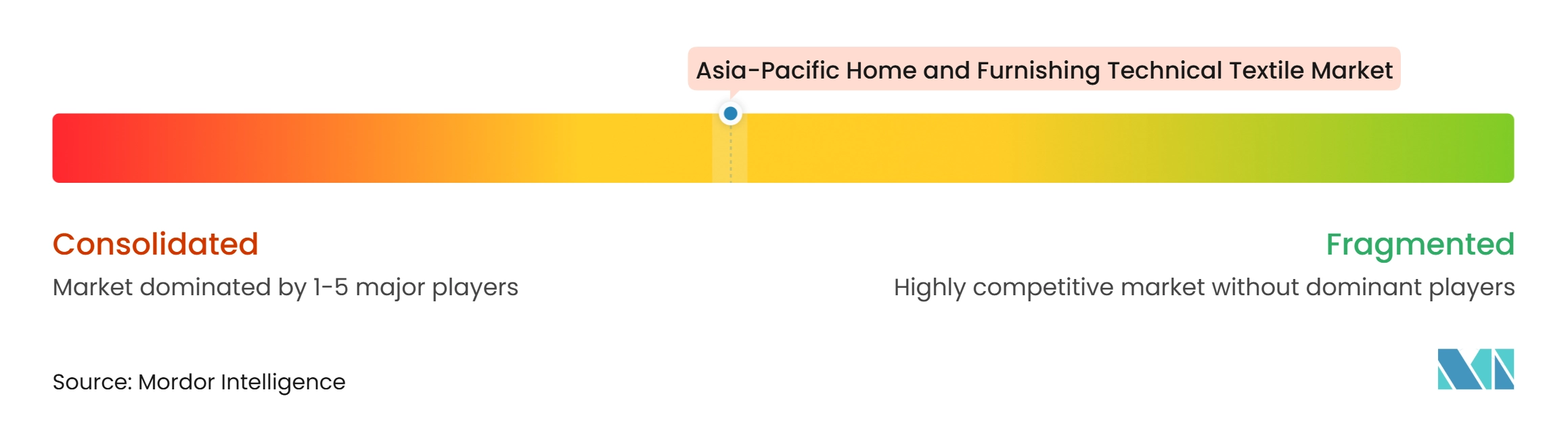
The Asia-Pacific home and furnishing technical textile market has moderate concentration because the top suppliers hold a minority of regional revenue. This leaves room for mid-sized domestic manufacturers that can compete through application expertise, faster product development, and regional compliance knowledge. Larger technical suppliers retain advantages in advanced nonwovens, specialty fibers, integrated operations, and testing capability. Toray is positioned in the higher-value part of the supply chain through its technical fiber and nonwoven activities. Its IGNITION 2028 plan identifies further investment in India, signaling a broader regional manufacturing and supply focus.
Strategic activity is also increasing in filtration and performance materials. Freudenberg became the sole owner of Japan Vilene Company after agreeing to acquire Toray’s remaining stake in November 2025. The transaction strengthens its access to nonwoven capabilities relevant to filtration and other technical applications. In January 2026, Freudenberg Performance Materials announced cooperation with KUKA Home for PureSkin mattresses using Evolon anti-mite textile technology. This illustrates how material producers can work with furnishing brands to package functional performance into a consumer product. Suppliers that can demonstrate allergy protection, hygiene benefits, or durability can differentiate themselves from commodity fabric producers.
Indian producers are using capacity development and material innovation to improve their technical positioning. Grasim Industries is expanding lyocell capacity, which may improve regional availability of cellulosic inputs for bedding and upholstery applications. Welspun Living is investing in modernization and advanced textile areas that can serve hospitality and healthcare specifications. Smaller suppliers in Vietnam and Indonesia can compete where they combine proximity to local customers with responsive production and logistics. Their main exposure is the volatility of cotton, polyester, and other fiber inputs. Competition remains dispersed among multinational specialists and domestic manufacturers.
Asia-Pacific Home and Furnishing Technical Textile Industry Leaders
-
Toray Industries, Inc.
-
Freudenberg SE
-
Ahlstrom Oyj
-
Asahi Kasei Corporation
-
Mitsui Chemicals, Inc.
- *Disclaimer: Major Players sorted in no particular order
Asia-Pacific Home and Furnishing Technical Textile Market Companies Covered in this Report
- Toray Industries, Inc.
- Freudenberg SE
- Ahlstrom Oyj
- Asahi Kasei Corporation
- Mitsui Chemicals, Inc.
- Teijin Limited
- Toyobo Co., Ltd.
- Kuraray Co., Ltd.
- Aditya Birla Management Corporation Pvt. Ltd.
- Welspun Living Limited
- Trident Limited
- Indo Count Industries Limited
- Himatsingka Seide Limited
- Pacific Textiles Holdings Limited
- Sunvim Group Co., Ltd.
- Luolai Lifestyle Technology Co., Ltd.
- Fuanna Bedding and Furnishing Co., Ltd.
- Nitori Holdings Co., Ltd.
- Everpia JSC
- Hanvico Corporation
- Hilon Indonesia
- TTN Nonwoven Solution Co., Ltd.
- Park Nonwoven Pvt. Ltd.
- Ginni Filaments Limited
Recent Industry Developments in Asia-Pacific Home and Furnishing Technical Textile Market
- March 2026: Toray Industries announced its IGNITION 2028 medium-term management plan, including a focus on fiber and textile investment in India. The plan links regional expansion with higher-value materials and broader supply capabilities.
- March 2026: India’s Ministry of Textiles reported that the National Technical Textiles Mission approved 16 new research projects in February 2026. The projects cover advanced fiber development and functional textile applications, adding to the mission’s earlier research support.
- January 2026: Freudenberg Performance Materials signed a cooperation agreement with KUKA Home for PureSkin mattresses using Evolon anti-mite textile technology. The cooperation combines a home furnishing product with microfilament barrier performance and product certification requirements.
Asia-Pacific Home and Furnishing Technical Textile Market Report Scope
The Asia-Pacific Home and Furnishing Technical Textile Market Report is Segmented by Product Type (Technical Upholstery and Furniture Textiles and More), by Material Type (Polyester, Polypropylene, and More), by End-Use Application (Residential Households, Hospitality and Accommodation, and More), and by Geography (China, India, Japan, and More). The Report Offers Market Size and Forecasts in Value (USD) for all the Above Segments.
Segmentation Overview
| Technical Upholstery and Furniture Textiles | Performance Upholstery Fabrics |
| Coated and Laminated Upholstery Fabrics | |
| Furniture Construction and Reinforcement Textiles | |
| Mattress Ticking and Functional Bedding Component Textiles | |
| Fibre Fill and Functional Cushioning Textiles | |
| Carpet Backing and Functional Floor Covering Textiles | |
| Interior Window Shading and Functional Curtain Textiles | |
| Household Filtration Textiles | |
| Household Cleaning and Nonwoven Wipe Textiles | |
| Household Mosquito Nets and Insect-Screening Textiles | |
| Other Specialty Home Technical Textiles (Plush and Stuffed Toy Fabrics, Specialty Acoustic Furnishing Textiles, Other Engineered Household Textile Components) |
| Polyester |
| Polypropylene |
| Polyamide |
| Acrylic and Modacrylic Fibers |
| Cotton |
| Wool and Other Animal Fibers |
| Regenerated Cellulosic Fibers |
| Glass and Other Inorganic Fibers |
| Other Materials |
| Residential Households | Furniture and Interior Furnishings |
| Bedding and Sleep Products | |
| Flooring and Window Coverings | |
| Household Cleaning, Filtration, and Other Applications | |
| Hospitality and Accommodation | Hotels and Resorts |
| Serviced Apartments and Other Accommodation | |
| Offices and Commercial Interiors | |
| Healthcare and Care Facilities | |
| Education and Public Institutions | |
| Other Contract and Institutional Interiors |
| China |
| India |
| Japan |
| South Korea |
| Taiwan |
| Vietnam |
| Indonesia |
| Thailand |
| Bangladesh |
| Australia |
| Rest of Asia-Pacific |
| By Product Type | Technical Upholstery and Furniture Textiles | Performance Upholstery Fabrics |
| Coated and Laminated Upholstery Fabrics | ||
| Furniture Construction and Reinforcement Textiles | ||
| Mattress Ticking and Functional Bedding Component Textiles | ||
| Fibre Fill and Functional Cushioning Textiles | ||
| Carpet Backing and Functional Floor Covering Textiles | ||
| Interior Window Shading and Functional Curtain Textiles | ||
| Household Filtration Textiles | ||
| Household Cleaning and Nonwoven Wipe Textiles | ||
| Household Mosquito Nets and Insect-Screening Textiles | ||
| Other Specialty Home Technical Textiles (Plush and Stuffed Toy Fabrics, Specialty Acoustic Furnishing Textiles, Other Engineered Household Textile Components) | ||
| By Material Type | Polyester | |
| Polypropylene | ||
| Polyamide | ||
| Acrylic and Modacrylic Fibers | ||
| Cotton | ||
| Wool and Other Animal Fibers | ||
| Regenerated Cellulosic Fibers | ||
| Glass and Other Inorganic Fibers | ||
| Other Materials | ||
| By End-Use Application | Residential Households | Furniture and Interior Furnishings |
| Bedding and Sleep Products | ||
| Flooring and Window Coverings | ||
| Household Cleaning, Filtration, and Other Applications | ||
| Hospitality and Accommodation | Hotels and Resorts | |
| Serviced Apartments and Other Accommodation | ||
| Offices and Commercial Interiors | ||
| Healthcare and Care Facilities | ||
| Education and Public Institutions | ||
| Other Contract and Institutional Interiors | ||
| By Geography | China | |
| India | ||
| Japan | ||
| South Korea | ||
| Taiwan | ||
| Vietnam | ||
| Indonesia | ||
| Thailand | ||
| Bangladesh | ||
| Australia | ||
| Rest of Asia-Pacific | ||
Key Questions Answered in the Report
What is the projected value of the Asia-Pacific home and furnishing technical textile market by 2032?
The Asia-Pacific home and furnishing technical textile market is projected to reach USD 11.58 billion by 2032, growing at a CAGR of 5.05% from 2027 to 2032. Urban household formation, higher demand for functional furnishings, and institutional specifications support this outlook. These forces also broaden the addressable base for bedding, upholstery, filtration, and window textile suppliers.
Which product category leads demand in Asia-Pacific home and furnishing technical textiles?
Technical upholstery and furniture textiles lead product demand, with a 32.5% share in 2026. Its wide use across residential, hospitality, healthcare, and office interiors gives it a larger demand base than other product categories. Demand for stain-release, coated, and fire-resistant upholstery materials reinforces the segment’s relevance.
What is the largest material used in home and furnishing technical textiles in Asia-Pacific?
Polyester is the largest material type, accounting for 42.0% of demand in 2026. It is widely used in bedding fill, carpet backing, nonwoven upholstery, and other applications because it combines processing flexibility with functional versatility. Cotton and cellulosic fibers remain important where comfort, hand feel, and sourcing requirements shape material selection.
Which end-use accounts for the greatest demand for these textiles?
Residential households are the largest end-use, accounting for 61.0% of demand in 2026. Bedding, interior furnishings, window coverings, cleaning products, and filtration materials create a broad set of household purchasing occasions. Apartment fit-outs and replacement buying create recurring demand beyond the first furnishing purchase. Suppliers that offer durable, easy-care, and health-oriented products can address multiple household needs within this large demand base.
Which Asia-Pacific country holds the largest share of demand?
China holds the largest national share, at 34.0% in 2026, supported by an integrated textile supply chain. Its production network covers material supply, fabric conversion, nonwovens, and finished furnishing products. Digital retail gives suppliers another route to reach consumers beyond a physical store footprint
What factors are limiting supplier growth in Asia-Pacific?
Cotton and polyester cost volatility, along with chemical, fire-safety, testing, and qualification requirements, can constrain supplier margins and raise market-entry costs. These pressures are most acute for smaller converters without internal testing, certification, or broad purchasing scale. Long-term contracts with hospitality and institutional customers can make rapid price adjustments particularly difficult. Inconsistent testing practices across markets can create further administrative work when suppliers pursue cross-border sales.