
Asia-Pacific Haying, Forage and Harvesting Machinery Market Size and Share
Market Overview
| Study Period | 2021 - 2031 |
|---|---|
| Forecast Data Period | 2026 - 2031 |
| Base Year Market Size (2025) | USD 1.69 Billion |
| Market Size (2026) | USD 1.8 Billion |
| Market Size (2031) | USD 2.49 Billion |
| Growth Rate (2026 - 2031) | 6.70 % |
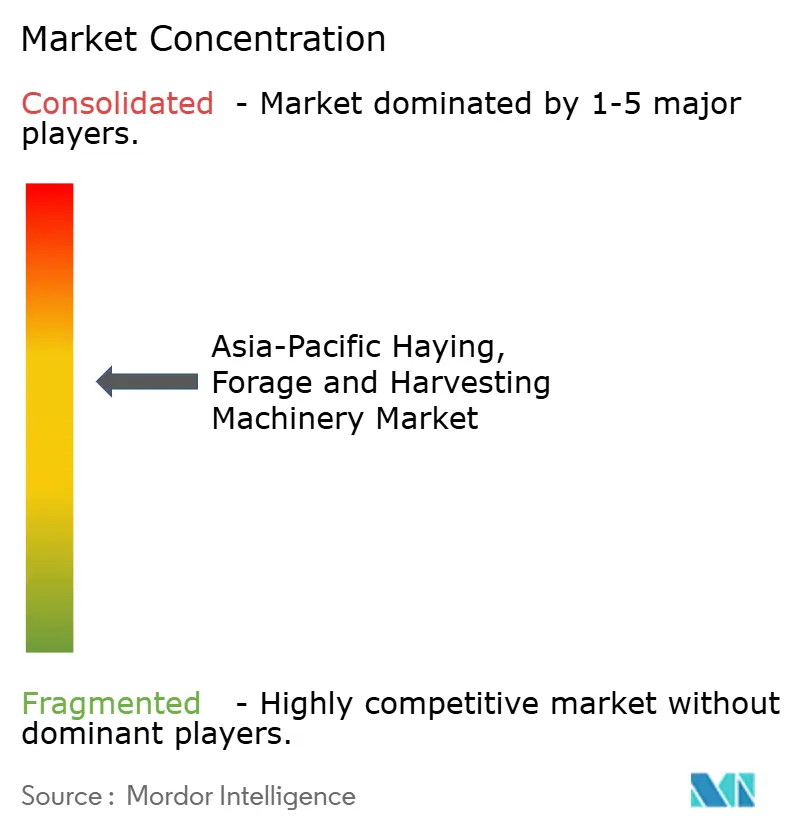
| Market Concentration | Medium |
Major Players *Disclaimer: Major Players sorted in no particular order Image © Mordor Intelligence. Reuse requires attribution under CC BY 4.0. | |
Asia-Pacific Haying, Forage and Harvesting Machinery Market Analysis by Mordor Intelligence
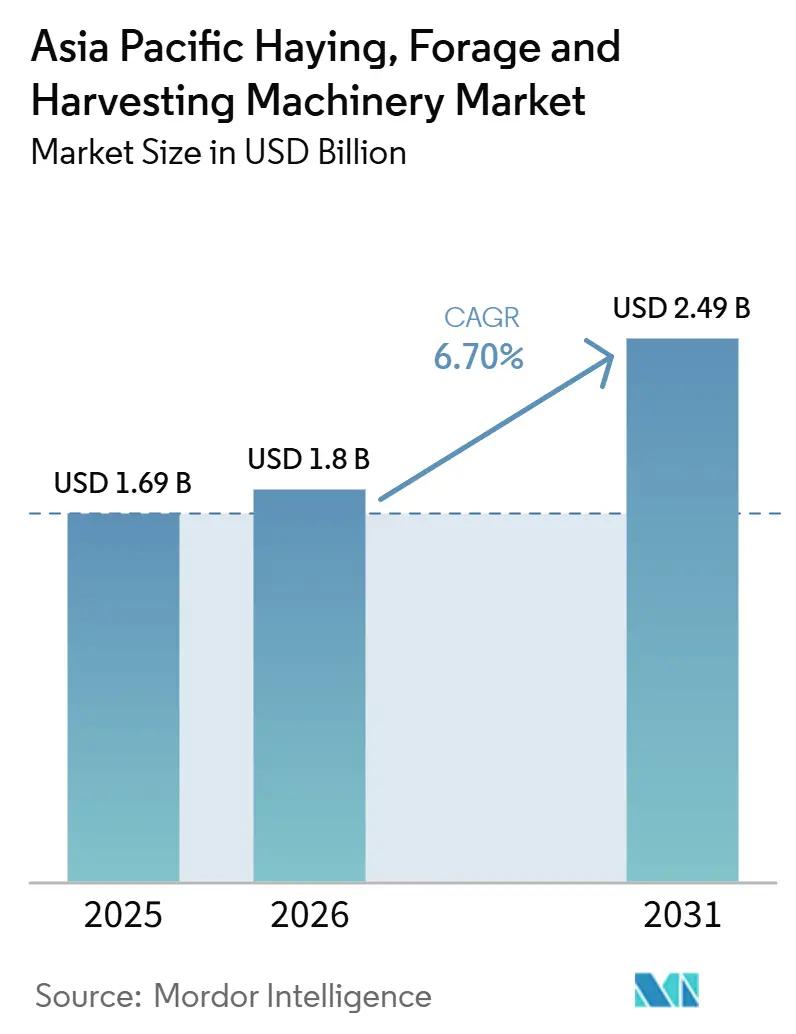
The Asia-Pacific haying, forage, and harvesting machinery market was valued at USD 1.69 billion in 2025 and is projected to grow from USD 1.80 billion in 2026 to USD 2.49 billion by 2031, registering a CAGR of 6.70% during the forecast period from 2026 to 2031. This market is experiencing growth due to a rapid shift toward mechanized forage handling, driven by the demand for consistent feed quality and tighter harvest schedules in commercial dairy and livestock systems. Subsidy-led fleet upgrades in countries such as China and India are further supporting market expansion, while increasing labor shortages are making self-propelled and automated machinery more viable for contractors and large-scale farms. Additionally, stricter feed safety standards and the need for precise quality control are encouraging buyers to invest in equipment capable of managing chop length, bale density, and moisture with greater accuracy. Competitive dynamics in the market are evolving, with factors such as telematics, predictive maintenance, and automation features increasingly influencing replacement decisions, particularly for higher-value fleets. However, price sensitivity remains a significant challenge in smaller farm markets. Fragmented landholdings, extended payback periods, and underdeveloped rural service networks continue to hinder the adoption of premium equipment in these regions.
Key Report Takeaways
- By product type, the Asia-Pacific haying, forage, and harvesting machinery market share for balers held the largest 31.0% in 2025, whereas forage harvesters are forecast to grow at the fastest 6.8% CAGR from 2026 to 2031.
- By operation type, self-propelled equipment accounted for the largest 42.0% share in 2025, and it is also projected to grow at the fastest 7.4% CAGR from 2026 to 2031.
- By power source, diesel-powered machinery held the largest 88.0% share in 2025, whereas the Asia-Pacific haying, forage, and harvesting machinery market size for hybrid systems is forecast to grow at the fastest 12.0% CAGR from 2026 to 2031.
- By application, hay production accounted for the largest 39.0% share in 2025, whereas silage making is projected to grow at the fastest 7.1% CAGR from 2026 to 2031.
- By geography, China held the largest 40.2% share in 2025, while Vietnam is forecast to grow at the fastest 8.6% CAGR from 2026 to 2031.
Note: Market size and forecast figures in this report are generated using Mordor Intelligence’s proprietary estimation framework, updated with the latest available data and insights as of January 2026.
Asia-Pacific Haying, Forage and Harvesting Machinery Market Trends and Insights
Drivers Impact Analysis*
| Driver | (~) % Impact on CAGR Forecast | Geographic Relevance | Impact Timeline |
|---|---|---|---|
| Rising labor costs and labor scarcity in farm operations | +1.2% | Asia-Pacific-wide, acute in Japan, South Korea, Australia, and coastal China | Short term (≤ 2 years) |
| Government mechanization subsidies and farm equipment financing | +1.0% | China, India, Vietnam, Indonesia, and Thailand | Medium term (2-4 years) |
| Expansion of dairy and forage intensive livestock systems | +0.9% | China, India, and Vietnam, with spillover to Indonesia and Thailand | Medium term (2-4 years) |
| Precision baling, telematics, and machine automation adoption | +0.8% | Australia, Japan, South Korea, and large-farm clusters in China | Long term (≥ 4 years) |
| Contractor fleet expansion and custom harvesting demand | +0.6% | India, China, Vietnam, and Thailand | Medium term (2-4 years) |
| Smallholder demand for compact electrified hay tools | +0.5% | India, Indonesia, Vietnam, and the Philippines | Long term (≥ 4 years) |
| Source: Mordor Intelligence | |||
Rising Labor Costs and Labor Scarcity in Farm Operations
Labor shortages and an aging agricultural workforce in the Asia-Pacific region are driving the adoption of mechanized forage harvesting solutions. According to the Food and Agriculture Organization of the United Nations (FAO) in its "The Status of Youth in Agrifood Systems" report (2025), rural youth account for only 5% of the population in industrial agrifood systems, indicating a declining future agricultural labor pool in areas such as East Asia[1]Source: Food and Agriculture Organization of the United Nations, “The Status of Youth in Agrifood Systems: New FAO Report Shines Light on Pitfalls and Prospects for 1.3 Billion Young People,” fao.org.. With younger workers increasingly shifting to urban employment, forage producers face significant challenges in securing labor during critical harvesting periods. As a result, farms are investing in balers, forage harvesters, and self-propelled haying equipment to enhance operational efficiency, reduce reliance on labor, and maintain forage quality. This trend is contributing to the growth of the Asia-Pacific haying, forage, and harvesting machinery market.
Government Mechanization Subsidies and Farm Equipment Financing
Government support programs are accelerating the adoption of haying, forage, and harvesting machinery across the Asia-Pacific region by reducing equipment acquisition costs. According to the National Development and Reform Commission (NDRC) of China (2025), the country expanded its agricultural machinery scrappage and renewal subsidy program and increased subsidy standards for selected equipment categories, with support reaching up to 50% of the sales price for certain eligible machinery under pilot implementation arrangements[2]Source: National Development and Reform Commission of the People's Republic of China, “Large-Scale Equipment Renewal and Consumer Goods Trade-In Policies 2025,” ndrc.gov.cn.. These incentives encourage farmers and contractors to invest in modern balers, forage harvesters, mowers, and related forage equipment, improving mechanization efficiency and supporting market growth.
Precision Baling, Telematics, and Machine Automation Adoption
The adoption of digital and automated farm machinery is growing rapidly across the Asia-Pacific region, driven by government initiatives promoting smart agriculture and precision farming practices. According to Japan's Ministry of Agriculture, Forestry and Fisheries (MAFF) in 2024, the country is expanding its Smart Agriculture Demonstration Projects to address labor shortages and enhance productivity. These projects integrate autonomous agricultural machinery, sensing technologies, and data-driven farm management systems. Such initiatives are increasing farmers' familiarity with automated and connected equipment, fostering favorable conditions for the adoption of advanced balers, forage harvesters, and telematics-enabled machinery. This trend is contributing to the growth of the Asia-Pacific haying, forage, and harvesting machinery market.
Contractor Fleet Expansion and Custom Harvesting Demand
The growth of contractor-based farming services is driving increased demand for high-capacity agricultural machinery in the Asia-Pacific region. According to the Department of Agriculture and Farmers Welfare, Government of India, as of February 28, 2025, over 52,000 Custom Hiring Centres (CHCs), Hi-tech Hubs, and Farm Machinery Banks (FMBs) had been established across Indian states under agricultural mechanization initiatives. These service centers enhance machinery utilization rates and enable farmers to access advanced equipment without significant upfront costs. As contractor fleets continue to expand, the demand for balers, forage harvesters, and self-propelled machinery is anticipated to grow, contributing to the development of the Asia-Pacific haying, forage, and harvesting machinery market.
Restraints Impact Analysis*
| Restraint | (~) % Impact on CAGR Forecast | Geographic Relevance | Impact Timeline |
|---|---|---|---|
| High upfront capital cost and long payback cycles | -0.9% | Indonesia, Vietnam, Thailand, rural India, and the Philippines | Short term (≤ 2 years) |
| Fragmented landholdings limiting machine utilization | -0.7% | India, Indonesia, Vietnam, and southern China | Medium term (2-4 years) |
| Technician and spare parts service gaps in rural markets | -0.5% | Indonesia, Vietnam, Thailand, and South Asia | Medium term (2-4 years) |
| Emissions compliance and certification complexity | -0.4% | Japan, South Korea, Australia, and increasingly China | Long term (≥ 4 years) |
| Source: Mordor Intelligence | |||
Fragmented Landholdings Limiting Machine Utilization
Fragmented landholdings continue to hinder the efficient use of advanced haying and forage machinery in the Asia-Pacific region. According to the National Institution for Transforming India (NITI) Aayog (2025), over 86% of Indian farmers are smallholders, managing relatively small and fragmented land parcels[3]Source: NITI Aayog, “Reimagining Agriculture: A Roadmap for Frontier Technology-Led Transformation,” niti.gov.in.. These land structures reduce field efficiency, increase maneuvering time, and lower the annual utilization rates of high-capacity balers, forage harvesters, and self-propelled equipment. Consequently, farmers experience weaker returns on machinery investments and longer payback periods, which limit the adoption of larger harvesting systems and constrain the growth of the haying, forage, and harvesting machinery market in the Asia-Pacific.
Emissions Compliance and Certification Complexity
Regulatory compliance and certification requirements are adding complexity to market entry for agricultural machinery manufacturers in the Asia-Pacific region. As stated by the Ministry of Agriculture and Rural Affairs of China (2024), machinery aiming to qualify under the 2024–2026 Agricultural Machinery Purchase and Application Subsidy Program must first secure approved agricultural machinery testing, appraisal, or certification credentials. These requirements encompass product verification, certification, and regulatory review processes, which can extend development timelines and increase compliance costs for manufacturers. As a result, these certification-related challenges may delay product commercialization and create higher market-entry barriers, thereby restraining growth in the Asia-Pacific haying, forage, and harvesting machinery market.
*Our forecasts treat driver/restraint impacts as directional, not additive. The impact forecasts reflect baseline growth, mix effects, and variable interactions.
Segment Analysis
By Product Type: Balers Lead, Forage Harvesters Accelerate on Silage Intensification
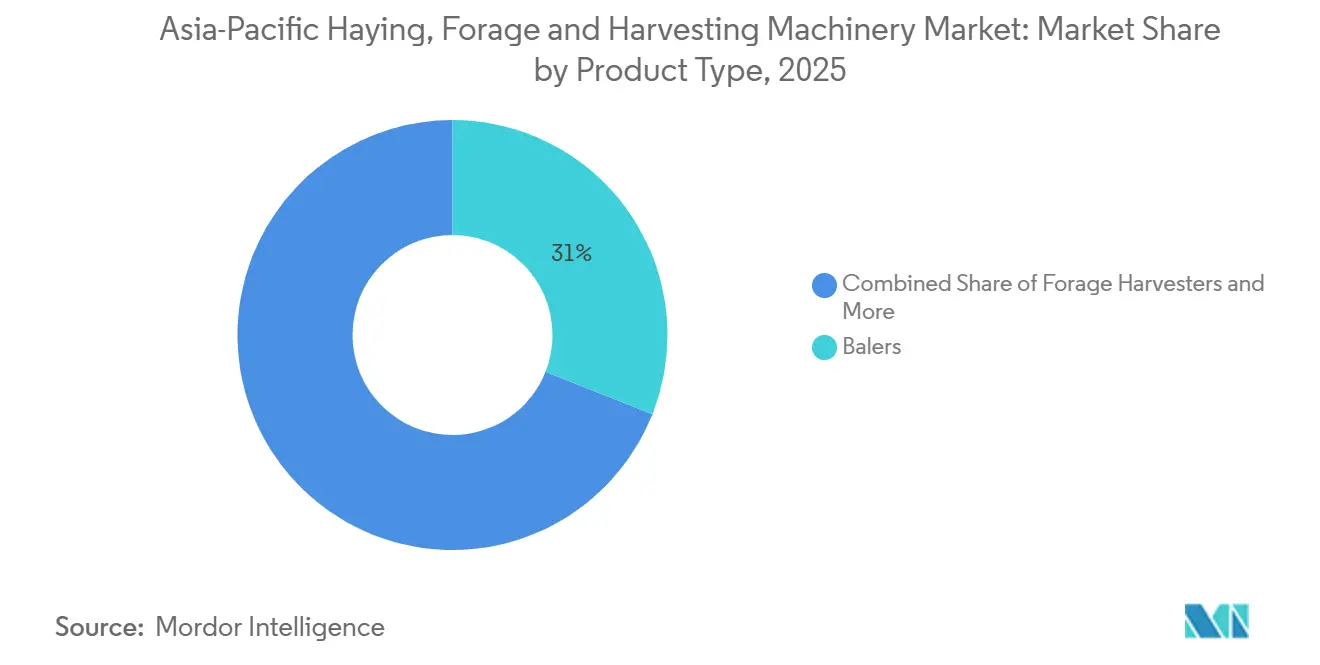
The Asia-Pacific haying, forage, and harvesting machinery market share for balers accounted for the largest 31.0% in 2025. Balers maintain their leading position due to their critical role in forage preservation, enhancing storage efficiency, and streamlining feed logistics in livestock production systems. Their adoption is driven by the increasing demand for compact and transportable forage products, which simplify handling and minimize storage losses. Large-scale dairy and beef operations continue to depend on baling equipment to optimize feed management efficiency. Additionally, the segment benefits from replacement demand and compatibility with various forage crops, establishing balers as a key machinery category in regional farming systems.
Forage harvesters are forecast to grow at the fastest 6.8% CAGR from 2026 to 2031. This growth is supported by the increasing adoption of silage-based feeding systems and the rising need for higher forage quality in commercial livestock operations. Modern forage production emphasizes rapid harvesting, precise crop processing, and improved feed consistency, all of which drive the deployment of forage harvesters. Expanding dairy intensification and the growing demand for year-round feed availability are further boosting equipment utilization rates. The segment also benefits from broader integration with mechanized forage management practices, fostering stronger demand for advanced harvesting solutions across the region.



By Operation Type: Self-Propelled Platforms Consolidate Around Commercial Scale
Self-propelled equipment held the largest 42.0% share in 2025. The segment's leadership reflects its suitability for commercial-scale operations requiring high field capacity, operational flexibility, and reduced dependence on multiple machines. Self-propelled platforms offer improved productivity through integrated harvesting systems and greater maneuverability in large forage production areas. Their ability to support advanced automation, operator-assistance functions, and precision agriculture technologies further enhances their appeal among professional operators. Growing labor constraints and increasing emphasis on operational efficiency continue to reinforce demand for self-propelled equipment throughout the regional forage harvesting sector.
Self-propelled equipment is also forecast to grow at the fastest 7.4% CAGR from 2026 to 2031. Expansion is being driven by increasing mechanization among commercial forage producers and agricultural contractors seeking greater harvesting efficiency. Larger operations are prioritizing equipment capable of delivering higher throughput while minimizing labor requirements and downtime. The growing adoption of digital monitoring systems, automated machine controls, and precision harvesting technologies is further supporting demand. Although tractor-mounted and trailed machinery remain important across smaller farming systems, investment trends increasingly favor self-propelled platforms where scale, productivity, and operational consistency are primary purchasing considerations.
By Power Source: Diesel Dominance Tested by Hybrid Momentum
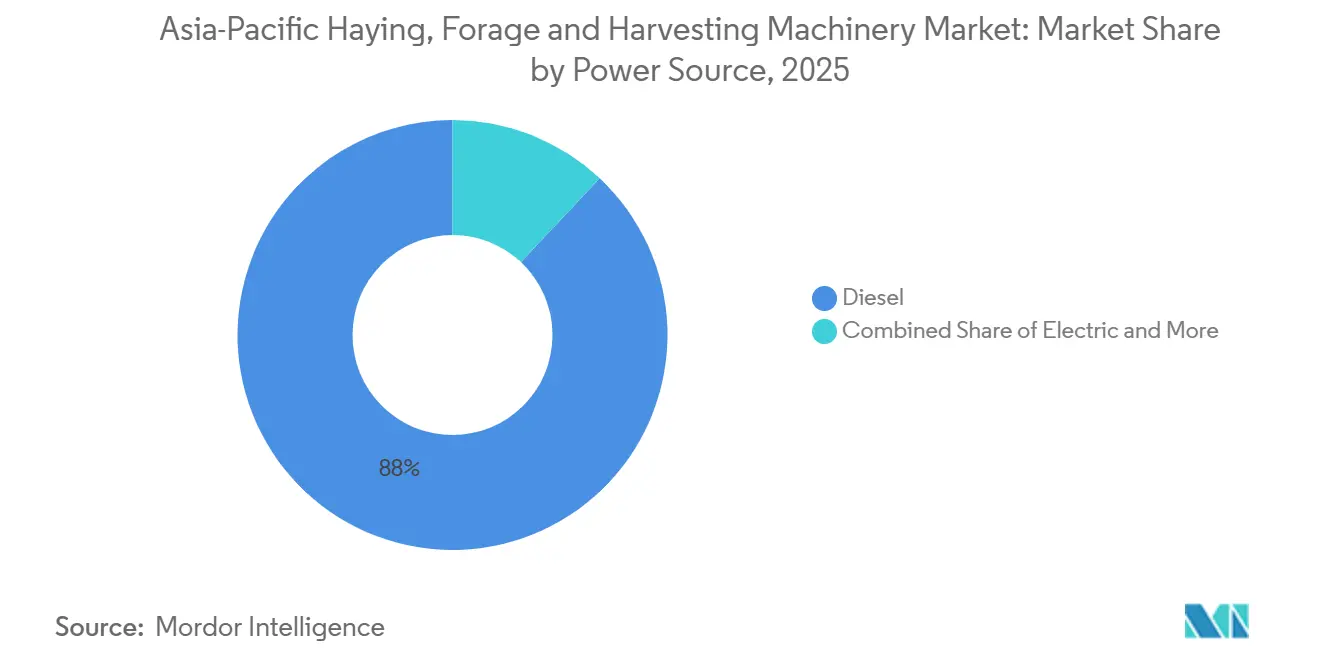
Diesel-powered machinery accounted for the largest 88.0% share in 2025. Diesel remains the preferred power source due to its ability to provide high torque, extended operating range, and reliability required for demanding forage harvesting applications. The existing service infrastructure, fuel availability, and operator familiarity continue to support its widespread adoption across both developed and emerging agricultural markets. Most high-capacity forage harvesters, balers, and windrowers rely on diesel engines to ensure consistent field performance during intensive harvesting periods. Additionally, the large installed base of diesel-powered equipment encourages replacement purchases within the same technology category.
The Asia-Pacific haying, forage, and harvesting machinery market size for hybrid systems is projected to grow at the fastest 12.0% CAGR from 2026 to 2031. Interest in hybrid technologies is increasing as manufacturers aim to enhance fuel efficiency and reduce emissions without compromising operational performance. Hybrid platforms provide a transitional solution between conventional diesel systems and future low-emission machinery. Regulatory developments, sustainability initiatives, and technological advancements are driving research and commercialization efforts in this segment. Although adoption is still in its early stages, hybrid machinery is gaining attention among operators seeking improved efficiency and long-term compliance with evolving environmental standards.
By Application: Hay Production Leads but Silage Making Gains Strategic Ground
Hay production accounted for the largest 39.0% share in 2025. This dominance is attributed to its critical role in livestock feeding systems across various agricultural regions. The production process involves a wide range of equipment, including mowers, conditioners, rakes, tedders, and balers, ensuring consistent machinery utilization. Additionally, well-established hay supply chains and strong demand from the dairy, beef, and equine sectors drive equipment purchases. The extensive installed base of machinery also contributes to recurring replacement demand, solidifying hay production as the leading application segment in regional forage management activities.
Silage making is projected to grow at the fastest 7.1% CAGR from 2026 to 2031. This growth is driven by livestock producers' increasing focus on feed quality, nutrient retention, and year-round feed availability. Silage systems offer significant advantages in regions where weather conditions hinder traditional forage drying processes. The growing commercialization of dairy and livestock operations is further encouraging investments in harvesting and forage-processing equipment tailored for silage production. As producers aim to enhance feed efficiency and herd performance, demand for machinery supporting silage preparation and storage is projected to rise across the region.
Geography Analysis
China held the largest 40.2% share in 2025. This leadership is attributed to its extensive livestock production base, well-established agricultural mechanization ecosystem, and robust manufacturing capabilities for agricultural equipment. The widespread adoption of mechanized forage production practices and a significant installed base of harvesting machinery further bolster its position. Continuous modernization of agricultural operations and the replacement demand for existing equipment sustain market activity. Additionally, the presence of domestic manufacturers alongside international brands enhances equipment availability and distribution networks, solidifying China's status as the largest market in the regional industry.
Vietnam is forecast to grow at the fastest 8.6% CAGR from 2026 to 2031. This growth is driven by the increasing adoption of mechanized forage production practices, the expansion of commercial livestock operations, and rising investments in feed supply chains. The country is transitioning toward more structured forage management systems, necessitating improved harvesting efficiency and feed preservation capabilities. Growing awareness of forage quality, operational productivity, and labor efficiency is fueling demand for modern haying and forage equipment. Meanwhile, Indonesia and Thailand are advancing in agricultural mechanization, and other emerging regional markets continue to offer opportunities for first-time equipment adoption.
Australia, Japan, and South Korea represent the mature segment of the Asia-Pacific haying, forage, and harvesting machinery market. These countries are characterized by high mechanization levels, strong replacement demand, and greater adoption of technologically advanced harvesting equipment. Producers increasingly prioritize productivity, automation, operator convenience, and precision farming capabilities when making purchasing decisions. For instance, Japan's Ministry of Agriculture, Forestry and Fisheries (MAFF) reported that Smart Agriculture Demonstration Projects had been implemented across 217 regions, supporting the adoption of advanced agricultural machinery and labor-saving technologies. Well-established livestock industries, advanced agricultural infrastructure, and widespread use of mechanized forage production systems sustain equipment demand. As a result, market growth in these countries is primarily driven by technology upgrades, fleet modernization, and operational efficiency improvements rather than first-time machinery adoption.
Competitive Landscape
The Asia-Pacific haying, forage, and harvesting machinery market is moderately consolidated, with key players including Deere and Company, Kubota Corporation, CNH Industrial N.V., AGCO Corporation, and CLAAS KGaA mbH. These companies compete alongside regional and domestic equipment suppliers. The level of competition varies depending on factors such as country, farm size, and mechanization levels. Global manufacturers dominate the premium and high-capacity machinery segments, while local producers are more active in value-oriented categories. This competitive structure creates distinct market tiers catering to both technologically advanced operations and cost-conscious agricultural users.
Leading manufacturers are enhancing their competitive positions through product innovation, automation, and the integration of precision agriculture technologies. Advanced harvesting technologies, improved machine intelligence, and enhanced operator-assistance systems are becoming critical factors influencing purchasing decisions. Companies are focusing on machinery platforms that boost productivity, minimize downtime, and optimize forage quality, addressing challenges such as labor shortages. Additionally, digital connectivity, telematics, and data-driven decision-making tools are increasingly integral to equipment offerings. As customer demands grow more sophisticated, technology-driven product development remains a key strategy for maintaining competitiveness in the regional market.
Competition is further intensifying through investments in automation, dealer network expansion, strategic partnerships, and acquisitions aimed at strengthening regional market presence. For instance, in January 2025, Yanmar Holdings Co., Ltd. acquired the remaining equity stake held by CLAAS KGaA mbH in its Indian agricultural machinery joint venture, making it a wholly owned subsidiary of Yanmar Holdings Co., Ltd. This development underscores the increasing importance of regional production capabilities and localized market strategies. Manufacturers are focusing on differentiation through operational efficiency, technology integration, and robust service support. Over time, competitive positioning is projected to rely not only on machinery performance but also on integrated technology ecosystems and comprehensive customer support infrastructure.
Asia-Pacific Haying, Forage and Harvesting Machinery Industry Leaders
Deere and Company
Kubota Corporation
CNH Industrial N.V.
AGCO Corporation
CLAAS KGaA mbH
- *Disclaimer: Major Players sorted in no particular order

Recent Industry Developments
- February 2026: CNH Industrial N.V. announced an investment of INR 1,800 crore (USD 206 million) in India to expand agricultural machinery manufacturing, including localized harvesting equipment production, to strengthen its haying, forage, and harvesting machinery portfolio across the Asia-Pacific region.
- July 2025: AGCO Corporation and Tractors and Farm Equipment Limited finalized a settlement on brand rights and commercial arrangements in India, strengthening AGCO's agricultural machinery business and supporting the long-term growth of its haying, forage, and harvesting equipment operations across Asia-Pacific.
- January 2025: Yanmar Holdings Co., Ltd. acquired CLAAS India Private Limited and renamed it Yanmar Agricultural Machinery India Private Limited, expanding its regional manufacturing capabilities and strengthening production of haying, forage, and harvesting machinery for the Asia-Pacific agricultural market.


Asia-Pacific Haying, Forage and Harvesting Machinery Market Report Scope
Haying, forage, and harvesting machinery includes equipment designed for cutting, conditioning, raking, baling, collecting, and processing forage crops and hay. These machines enhance harvesting efficiency, improve feed quality, and increase labor productivity in livestock farming operations. The Asia-Pacific Haying, Forage and Harvesting Machinery Market Report is Segmented by Product Type (Mowers and Conditioners, Balers, Forage Harvesters, and More), by Operation Type (Tractor Mounted and More), by Power Source (Diesel and Hybrid), by Application (Hay Production and More), and by Geography (China, India, Japan, South Korea, Australia, and More). The Market Forecasts are Provided in Terms of Value (USD).
| Mowers and Conditioners |
| Balers |
| Forage Harvesters |
| Tedders and Rakes |
| Self-Propelled Windrowers |
| Other Haying and Forage Machinery |
| Tractor Mounted |
| Self-Propelled |
| Trailed and Pull-Type |
| Diesel |
| Electric |
| Hybrid |
| Hay Production |
| Silage Making |
| Forage Harvesting |
| Pasture Management |
| China |
| India |
| Japan |
| South Korea |
| Australia |
| Indonesia |
| Vietnam |
| Thailand |
| Rest of Asia-Pacific |
| By Product Type | Mowers and Conditioners |
| Balers | |
| Forage Harvesters | |
| Tedders and Rakes | |
| Self-Propelled Windrowers | |
| Other Haying and Forage Machinery | |
| By Operation Type | Tractor Mounted |
| Self-Propelled | |
| Trailed and Pull-Type | |
| By Power Source | Diesel |
| Electric | |
| Hybrid | |
| By Application | Hay Production |
| Silage Making | |
| Forage Harvesting | |
| Pasture Management | |
| By Geography | China |
| India | |
| Japan | |
| South Korea | |
| Australia | |
| Indonesia | |
| Vietnam | |
| Thailand | |
| Rest of Asia-Pacific |


Key Questions Answered in the Report
What is the 2026 value of the Asia-Pacific haying, forage and harvesting machinery market?
The Asia-Pacific haying, forage and harvesting machinery market stands at USD 1.80 billion in 2026.
Which product type leads revenue in this space?
Balers led revenue with the largest 31.0% share in 2025.
Why is self-propelled equipment growing faster than other operation types?
Self-propelled equipment combines high throughput, easier maneuverability, and stronger precision integration, which fits contractor and large-farm economics. It held the largest 42.0% share in 2025 and is projected to grow at the fastest 7.4% from 2026 to 2031.
What is driving hybrid machinery demand across the region?
Hybrid systems are projected to grow at the fastest 12.0% CAGR from 2026 to 2031.
Page last updated on:





