
Asia-Pacific Grapes Harvesters Market Size and Share
Market Overview
| Study Period | 2021 - 2031 |
|---|---|
| Forecast Data Period | 2026 - 2031 |
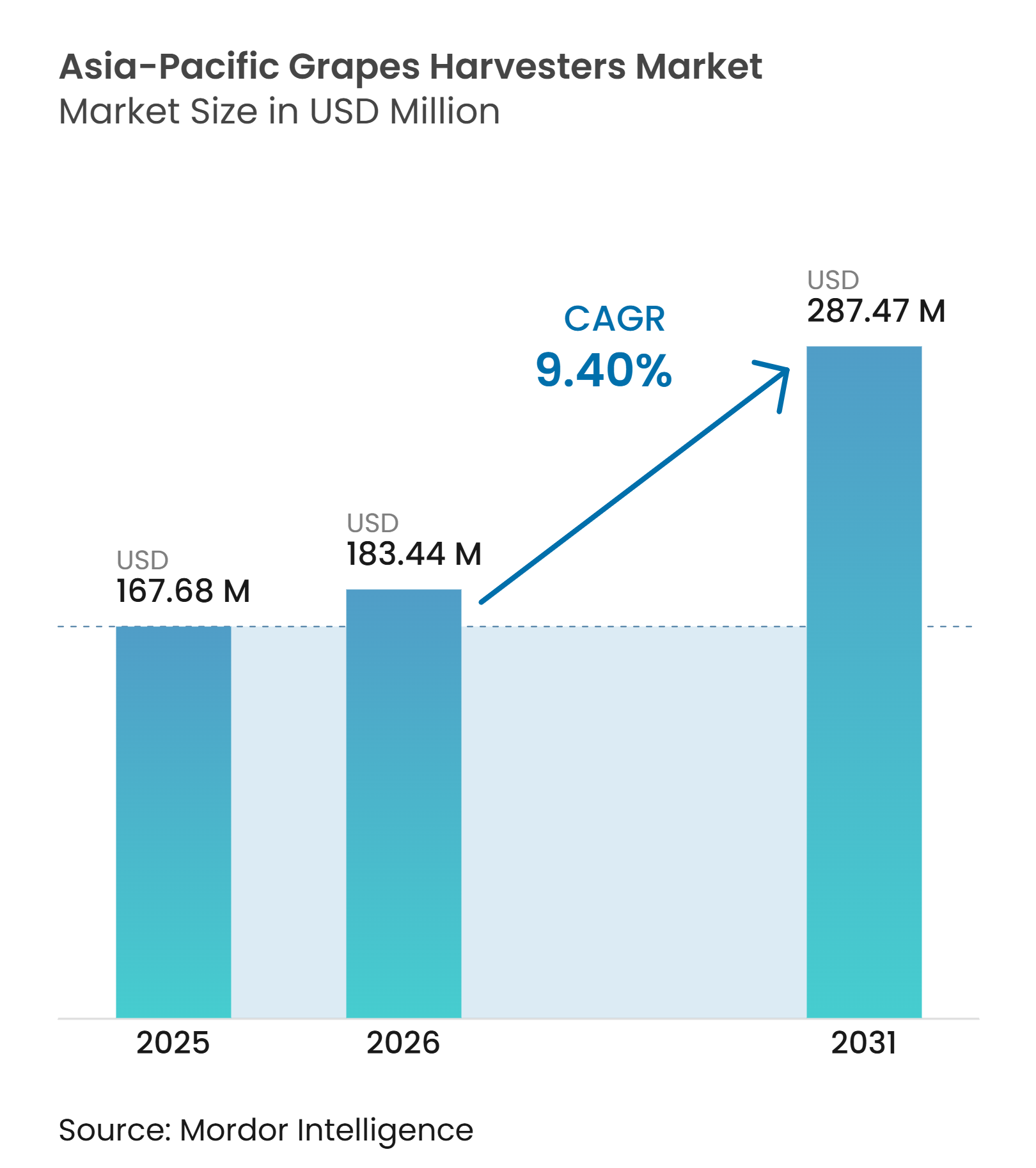
| Base Year Market Size (2025) | USD 167.68 Million |
| Market Size (2026) | USD 183.44 Million |
| Market Size (2031) | USD 287.47 Million |
| Growth Rate (2026 - 2031) | 9.40 % |
| Market Concentration | Medium |
Major Players *Disclaimer: Major Players sorted in no particular order Image © Mordor Intelligence. Reuse requires attribution under CC BY 4.0. | |
Asia-Pacific Grapes Harvesters Market Analysis by Mordor Intelligence
The Asia-Pacific grape harvesters market size was valued at USD 167.68 million in 2025 and is forecast to grow from USD 183.44 million in 2026 to USD 287.47 million by 2031, at a CAGR of 9.40% during the forecast period from 2026 to 2031. The market is influenced by the cost and availability of seasonal harvest labor, particularly in Australia and China. Vineyard modernization programs in China and India are reducing some of the financial barriers that have delayed equipment purchases. Commercial vineyards are also becoming more receptive to machine configurations that can operate in narrow rows, on uneven ground, and across different trellis designs. Suppliers are responding with precision controls, electric platforms, and more specialized service support. The market presents its strongest opportunities where vineyard scale, labor pressure, and local maintenance capacity develop together.
Key Report Takeaways
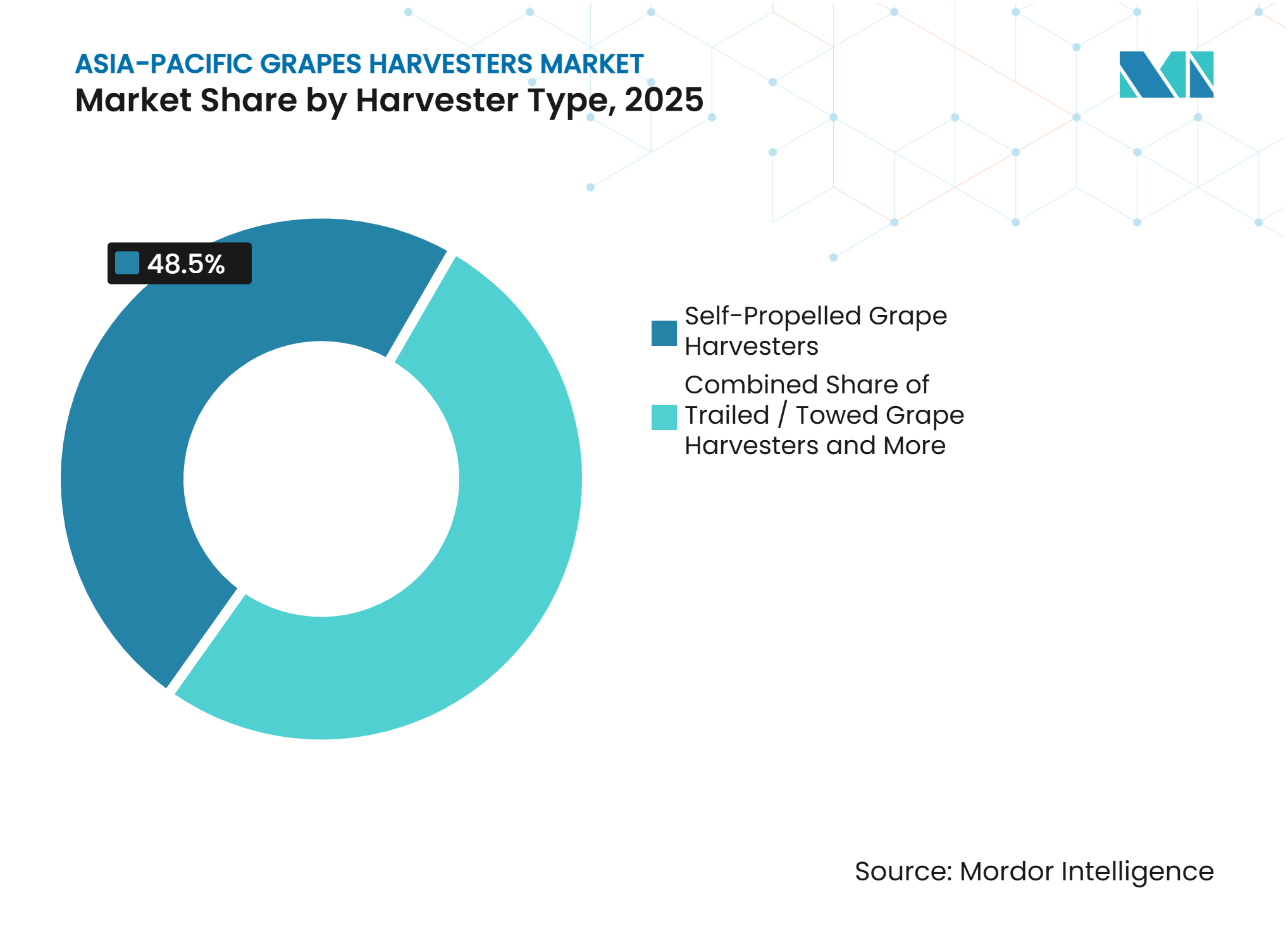
- By harvester type, self-propelled grape harvesters accounted for the largest Asia-Pacific grapes harvesters market share in 2025, at 48.5%, while tractor-mounted grape harvesters are forecast to be the fastest-growing segment, with a CAGR of 11.8% from 2026 to 2031.
- By mode of operation, assisted/precision-guided systems accounted for 54.2% of the Asia-Pacific grapes harvesters market size, while autonomous and semi-autonomous operations are forecast to be the fastest-growing segment, with a CAGR of 13.2% from 2026 to 2031.
- By power source, diesel-powered harvesters accounted for the largest share in 2025, at 66.8%, while electric harvesters are forecast to be the fastest-growing segment, with a CAGR of 14.0% from 2026 to 2031.
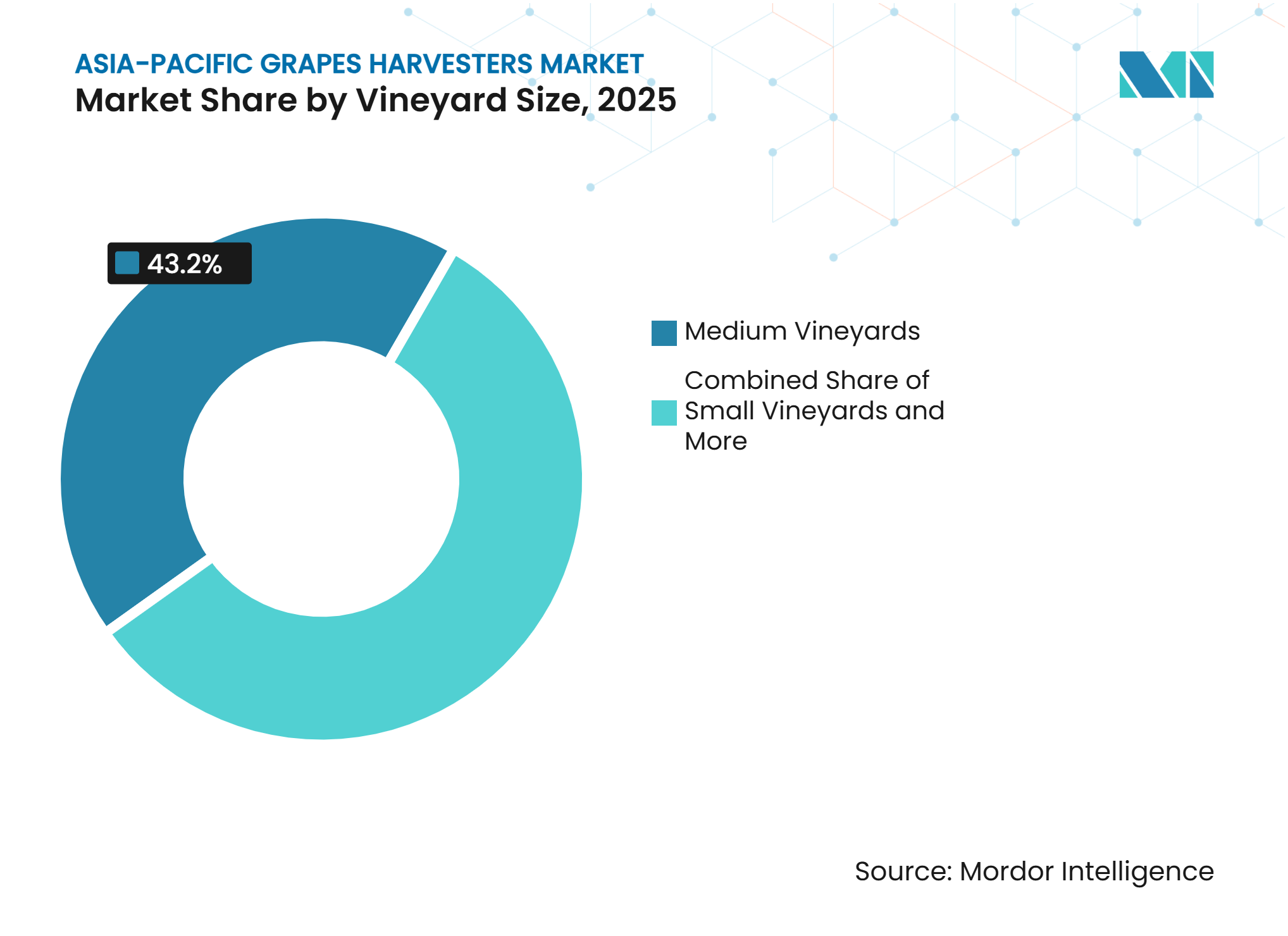
- By vineyard size, medium vineyards from 51 to 200 hectares accounted for the largest share in 2025, at 43.2%, while vineyards above 200 hectares are forecast to be the fastest-growing segment, with a CAGR of 12.4% from 2026 to 2031.
Note: Market size and forecast figures in this report are generated using Mordor Intelligence’s proprietary estimation framework, updated with the latest available data and insights as of January 2026.
Market Trends and Insights
Drivers Impact Analysis of Asia-Pacific Grapes Harvesters Market*
| Driver | (~) % Impact on CAGR Forecast | Geographic Relevance | Impact Timeline |
|---|---|---|---|
| Acute seasonal labor shortages in Australia and China | +1.8% | Australia, China, Japan | Short term (≤ 2 years) |
| Vineyard modernization subsidies in China and India | +1.5% | China, India | Medium term (2-4 years) |
| Expansion of commercial vineyards in China and India | +1.2% | China, India | Long term (≥ 4 years) |
| Rising harvest-service and wage costs in Australia | +1% | Australia, New Zealand | Short term (≤ 2 years) |
| Narrow-row and slope-adaptive machine demand in Asia-Pacific vineyards | +0.8% | Japan, India, Australia | Medium term (2-4 years) |
| Local development of electric and autonomous viticulture equipment | +1% | Australia, China, Japan | Long term (≥ 4 years) |
| Source: Mordor Intelligence | |||
Acute Seasonal Labor Shortages in Australia and China
Labor availability during the harvest window remains a direct purchasing consideration for vineyard operators in the Asia-Pacific grapes harvesters market. According to the Australian Bureau of Agricultural and Resource Economics and Sciences (ABARES), Australia’s agricultural sector employed an average of 247,000 people over the four quarters to November 2025, 11.6% below its level a decade earlier, while horticultural farms tend to use relatively large amounts of casual and contract labor at key times of the year, including harvest[1]. These workforce dynamics increase the value of mechanized harvesting where operators face short harvest windows and variable labor availability. In 2026, DEEP Robotics deployed Lynx M20S wheeled-legged robots in commercial vineyards in Turpan, China, where the machines were reported to reduce manual carrying labor during harvest by more than 70%. The robots transport harvested grape baskets to collection points rather than harvesting grapes directly, indicating that labor substitution and harvest-logistics automation are moving beyond trials in some Chinese specialty-crop vineyards.
Vineyard Modernization Subsidies in China and India
Public agricultural machinery-support programs can improve the affordability of mechanization for vineyard operators in the Asia-Pacific grapes harvesters market. In China, the Ministry of Agriculture and Rural Affairs and Ministry of Finance established the 2024–2026 Agricultural Machinery Purchase and Application Subsidy framework, which supports farmers and agricultural production organizations in purchasing and using advanced and appropriate agricultural machinery, with provinces able to determine eligible machinery categories according to local agricultural needs. China also expanded its agricultural machinery scrappage and replacement subsidy program in February 2025, supporting the replacement of older equipment with newer machinery. In India, Maharashtra's Sub-Mission on Agricultural Mechanization (SMAM) provides financial assistance for agricultural machinery and equipment, with support levels varying by beneficiary category. These programs can strengthen the economic case for vineyard mechanization by reducing equipment acquisition costs. Subsidy support therefore complements adoption alongside labor availability, vineyard scale, terrain, financing, and machine suitability.
Expansion of Commercial Vineyards in China and India
A large and increasingly commercialized vineyard base broadens the potential customer base for grape-harvesting equipment in the Asia-Pacific market. According to the International Organisation of Vine and Wine (OIV), India’s vineyard area reached an estimated 197 thousand hectares in 2025 and has expanded at an average annual rate of 4.6% since 2019, making India the world’s seventh-largest vineyard area. China’s vineyard area was estimated at 733 thousand hectares in 2025 and has remained broadly stable in recent years. In India, Maharashtra remains the country’s main wine-producing region, with 70 of India’s 95 wineries located in the state and 40 in Nashik, while the state accounts for nearly 85% of national grape-wine production. In China, vineyard development is increasingly linked with standardized planting and mechanization. Ningxia's Helan Mountain wine region had 60.2mu of wine-grape cultivation in 2025 (40,800 hectares), while Xinjiang is developing standardized vineyards with GPS-based row and trellis layouts designed to accommodate mechanical operations[2]. Larger and more standardized vineyard blocks can improve machine access and utilization, helping spread equipment ownership costs across greater harvested acreage. However, fragmented holdings, uneven terrain, narrow rows, and incompatible vineyard layouts can still constrain adoption. Vineyard expansion therefore supports grape-harvester demand most strongly where commercial scale is accompanied by standardized trellis systems, adequate field access, and layouts compatible with mechanized harvesting.
Rising Harvest-Service and Wage Costs in Australia
Rising labor and harvesting-service costs strengthen the economic case for mechanization among Australian vineyard operators. Australia’s horticultural sector relies on casual and contract labor during labor-intensive periods such as harvest, creating exposure to seasonal workforce availability and wage costs. These conditions can increase the value of grape-harvesting equipment, as operators need to complete harvesting within short seasonal windows and improve scheduling certainty. The effect is particularly relevant for larger vineyards that can evaluate the economics of owned machinery against external harvesting services. Wine Australia reported that the 2025 national winegrape crush reached 1.57 million metric tons, an 11% increase from 2024, with South Australia accounting for 48% of the national crush[3]. The higher volume of grapes requiring harvesting increases the value of reliable harvesting capacity during the vintage period and can support investment in machinery where vineyard scale and utilization rates justify ownership.
Restraints Impact Analysis of Asia-Pacific Grapes Harvesters Market*
| Restraint | (~) % Impact on CAGR Forecast | Geographic Relevance | Impact Timeline |
|---|---|---|---|
| High imported-machine cost and financing friction | -1.5% | India, China, Japan | Short term (≤ 2 years) |
| Fragmented smallholder and terraced vineyard structure | -1.2% | India, Japan, South Korea | Long term (≥ 4 years) |
| Limited regional service and spare-parts coverage | -0.8% | India, Rest of Asia-Pacific | Medium term (2-4 years) |
| Varietal and terrain constraints on mechanical harvesting | -0.7% | Japan, India, Australia | Long term (≥ 4 years) |
| Source: Mordor Intelligence | |||
High Imported-Machine Cost and Financing Friction
Imported equipment costs remain a material restraint on the Asia-Pacific grape harvesters market, particularly for smaller vineyard operators. Performance-grade grape harvesters are predominantly manufactured by European original equipment manufacturers (OEM), requiring buyers in markets such as India and Japan to absorb additional freight, import, currency, distribution, and after-sales service costs alongside the equipment purchase price. The resulting capital requirement can make ownership difficult to justify for vineyards with limited acreage or low machine utilization, increasing reliance on harvesting contractors or manual labor. In India, financing constraints can further limit machinery adoption among smaller producers with restricted collateral and borrowing capacity, while Japan presents a different challenge because major grape-growing regions such as Yamanashi use specialized trellis systems and vineyards across sloping terrain, creating equipment-fit requirements that may not align with standard imported harvester configurations. These cost, financing, and site-compatibility constraints can slow adoption among smaller operators and increase the need for compact, localized, or shared-equipment solutions across the Asia-Pacific grape harvesters market.
Fragmented Smallholder and Terraced Vineyard Structure
Fragmented vineyards and terraced production areas restrict the practical use of full-scale over-the-row grape harvesters across parts of Japan, South Korea, India, and other Asia-Pacific markets. Small and dispersed plots can reduce annual machine utilization and weaken the economics of equipment ownership, while sloping or terraced sites can limit the safe operation of conventional self-propelled harvesters. Tractor-mounted and trailed equipment can provide alternatives in some terrain conditions, although harvesting methods may still need to accommodate crop and quality requirements that favor selective manual harvesting. Japan presents a specific equipment-fit challenge because some grape-growing systems use horizontal or covered trellises and narrow vineyard configurations that are not readily compatible with standard over-the-row designs. These physical constraints, combined with limited machine utilization and potentially longer access to specialized parts and service in smaller markets, can slow adoption of conventional grape harvesters even where agricultural mechanization incentives are available.
*Our forecasts treat driver/restraint impacts as directional, not additive. The impact forecasts reflect baseline growth, mix effects, and variable interactions.
Asia-Pacific Grapes Harvesters Market Segment Analysis
By Harvester Type:
Self-Propelled Machines Lead, While Tractor-Mounted Units Gain GroundSelf-propelled grape harvesters held 48.5% of the Asia-Pacific grape harvesters market share in 2025. Their adoption is strongest on larger commercial estates in Australia and in China's Ningxia and Xinjiang regions. Onboard crop-cleaning systems support growers that require high daily harvesting throughput. High-capacity hoppers are suited to vineyards handling more than 200 metric tons per season. These machines are most viable where row geometry is uniform and operating hours are sufficient. They also require skilled operators and reliable service support. New Holland Agriculture launched the Braud 9.50L, 9.70L, and 9.70M models at SITEVI 2025. The models introduced the Vari-Control System, which the company stated could improve productivity by at least 10% at working speeds of up to 13 kilometers per hour. This product direction reflects demand for more productive machinery. The self-propelled category remains dependent on field scale and dealer capability.
Tractor-mounted grape harvesters are forecast to expand at an 11.8% CAGR between 2026 and 2031. Their lower initial cost makes them more accessible to mid-scale operators, supporting their relevance in Maharashtra and China's inland provinces. Growers in these regions may not yet have the harvest volumes needed to justify a self-propelled unit. Tractor-mounted units can also utilize farm tractors already present on the vineyard. Their performance depends on terrain, tractor power, and crop-handling requirements. The ISO (International Organization for Standardization) 11684 series provides an agricultural machinery safety-marking framework applicable to harvester types entering the region. Established European manufacturers can benefit from familiarity with this certification. The tractor-mounted category offers a means to extend mechanization in the Asia-Pacific grape harvesters market beyond the largest estates.



By Mode of Operation:
Precision-Guided Control Leads, While Autonomy AdvancesAssisted or precision-guided operation accounted for 54.2% of the market share in 2025. This category reflects the widespread use of GPS-linked auto-steering and row-sensing functions, which can reduce operator fatigue during extended harvest shifts and limit vine damage during nighttime work. Night harvesting is practiced in Australia's Riverland and Murray-Darling areas to protect grape quality in high temperatures. This equipment combines machine control with continued operator oversight, making it more immediately practical than fully autonomous operation. In July 2026, Pellenc Australia promoted its Pellenc Connect platform for real-time fleet visibility, yield mapping, and remote performance monitoring. Such digital fleet tools connect harvesting activity to equipment management but do not eliminate the need for trained field personnel.
Autonomous and semi-autonomous operation is forecast to expand at a 13.2% CAGR between 2026 and 2031, supported by field deployments and research activity across the region. The September 2026 deployment of DEEP Robotics' Lynx M20S equipment in commercial vineyards in Turpan, Xinjiang, demonstrated the use of robotic support technology for grape-harvest logistics, including the transport of harvested grape baskets, rather than direct grape picking. Japan is participating in international research on adaptive vineyard robotics, including pruning technologies developed through the Japan Science and Technology Agency (JST) Strategic International Collaborative Research Program with partners in France and Germany. These developments indicate growing automation activity across China, Australia, and Japan primarily in harvest support, vineyard management, and pruning.
By Power Source:
Diesel Retains Its Lead, While Electric Platforms ExpandDiesel-powered harvesters accounted for 66.8% of revenue in 2025. They remain well-suited for long harvest days and vineyards without charging infrastructure. Their refueling speed supports continued use in remote vineyard areas, which is relevant across Australia, China, and India. Diesel machines are also compatible with established farm service practices. ERO GmbH's Grapeliner 8000, launched in October 2025, used a Tier V 4-cylinder AGCO Power engine and Poclain TwinLock MSE18 rear motors. The manufacturer presented this configuration as capable of all-day harvesting without refueling. Such designs indicate that fuel efficiency remains an important product criterion. The transition away from diesel is likely to depend on charging access, duty cycle, and buyer confidence.
Electric harvesters are forecast to expand at a 14.0% CAGR between 2026 and 2031, the fastest growth rate among power-source categories in the Asia-Pacific grape harvesters market. Pellenc S.A.S. offers a lithium-ion platform covering harvesters, inter-row crawlers, and hand tools, with Pellenc Australia providing an active route to market for these equipment families. Provincial emissions initiatives in China and agricultural sustainability programs in Australia are favorable to electric equipment adoption. However, charging infrastructure remains a prerequisite for broader field adoption. Hybrid harvesters offer an intermediate option for vineyards located near grid access. The Asia-Pacific grape harvesters market is therefore likely to retain more than one power source throughout the forecast period, as electric growth does not eliminate the need for diesel capability in remote operations.
By Vineyard Size:
Medium Vineyards Set the Revenue Base, While Small Vineyards Lead GrowthMedium vineyards of 51 to 200 hectares accounted for 43.2% of the Asia-Pacific grape harvesters market share in 2025. This size range aligns with the ownership threshold for many self-propelled and precision-guided machines. Commercial estates in South Australia and New South Wales often fall within this operating profile, as do commercial blocks in Ningxia. Operators at this scale can distribute purchase and maintenance costs across greater production volumes, and machine scheduling tends to be more consistent than on fragmented small plots. Large vineyards above 200 hectares are already testing advanced automated equipment. Duxton Vineyards' 900-hectare Euston site partnered with Smart Machine and Wine Australia to trial the OXIN fully autonomous multi-task vineyard tractor in 2024, representing the first deployment of that technology in Australia. Larger sites provide the controlled conditions needed to test more complex machinery.
Small vineyards below 50 hectares are forecast to expand at a 12.4% CAGR between 2026 and 2031. These operators represent an early mechanization group in Nashik and China's inland provinces, many of which have historically relied entirely on seasonal manual labor. Their machinery needs differ from those of large estates, requiring lower-cost equipment, financing access, and localized maintenance. Smaller, more adaptable units are often more appropriate than high-capacity platforms. Vineyard modernization efforts can also prepare rows and irrigation systems for future machine use. The Nashik cluster program identifies this group for upgrades that can support eventual mechanization. The Asia-Pacific grape harvesters market will require service models that make equipment ownership practical at a smaller scale, with suppliers also needing to account for small plot geometry and uneven access conditions.

Geography Analysis
China accounted for 41.0% of the Asia-Pacific grape harvesters market share in 2025. Its wide acerage of vine area and commercial estates in Ningxia and Xinjiang support a large regional equipment base. Provincial mechanization subsidies can reduce acquisition costs for commercial vineyard operators. The country's subsidy framework for 2024 to 2026 also provides a policy setting for standard and specialty-crop machinery. The September 2026 Turpan robot deployment illustrates commercial interest in labor-support automation. China has a wider range of vineyard conditions than a single harvester configuration can address, requiring suppliers to adapt for plot size, field access, and regional service requirements.
India is the fastest-growing geography and is forecast to expand at an 11.5% CAGR between 2026 and 2031. The Nashik modernization program adds support for vineyard upgrades in 2026. Australia remains a significant equipment market due to high labor costs and the recovery in its winegrape crush. Autonomous trials in Orange and at Duxton Vineyards provide a practical testing base for new vineyard technology, though local field support will remain essential for converting trials into equipment purchases.
Japan's premium Shine Muscat production is supporting research into compact robotic solutions for vineyard operations. However, terraced vineyards, narrow rows, and specialized trellis systems limit the use of standard over-the-row harvesters. New Zealand and other Oceania markets primarily access European grape-harvesting platforms through distribution networks that also serve Australia. South Korea and other Asia-Pacific markets have relatively low grape-harvester penetration despite the development of commercial viticulture. These markets require equipment capable of operating across slopes and smaller vineyard plots, along with stronger access to specialized spare parts, maintenance services, and trained technicians.
Competitive Landscape
Market Concentration
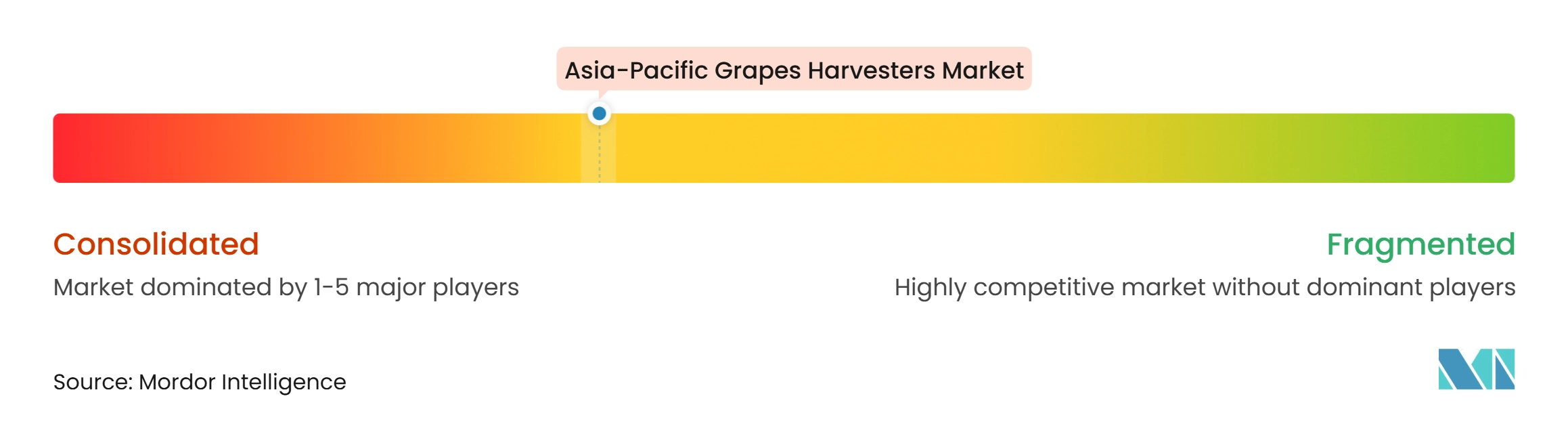
The Asia-Pacific grapes harvesters market is moderately concentrated, with established players including CNH Industrial N.V., PELLENC S.A.S., GRÉGOIRE SAS, ERO GmbH, and Oxbo International Corporation serving key markets in the region. CNH Industrial supplies Braud grape harvesters through its New Holland Agriculture platform in Australia and New Zealand, while Grégoire has documented sales in China and an established presence in Australia. ERO supports the Grapeliner range through regional distribution and technical-service networks, and Pellenc and Oxbo offer grape-harvesting platforms for different vineyard configurations. These established suppliers form the core of the region's mechanized grape-harvesting equipment base.
Competition is primarily based on vineyard compatibility, harvesting performance, machine productivity, and after-sales support. New Holland's model-year 2026 Braud 9.80N incorporates an upgraded front axle for narrow-vineyard applications, while ERO GmbH's Grapeliner range emphasizes cleaning performance, terrain capability, and operational efficiency. Pellenc S.A.S's GRAPES'LINE and Oxbo's 6030 and 620 provide alternative configurations, including towed and multifunction harvesting platforms. In the Asia-Pacific context, spare-parts availability, technician access, commissioning, and harvest-season response are important differentiators because equipment downtime during the relatively short vintage period can directly affect vineyard operations. As a result, established distribution and service infrastructure can be as important to supplier selection as machine specifications.
Opportunities remain in markets where vineyard mechanization is developing but farm structures and field conditions limit the economics of conventional self-propelled harvesters. India and China offer scope for lower-capacity and cost-conscious equipment suited to smaller commercial blocks, while Japan and South Korea present opportunities for machines adapted to narrow rows, specialized trellis systems, and sloping terrain. Trailed, compact, and specialized harvesting platforms can address applications where full-scale over-the-row machines are less suitable. Emerging Chinese vineyard-automation technologies may further support mechanization by addressing harvesting logistics and other labor-intensive tasks, although they currently complement rather than directly replace conventional high-throughput grape harvesters. This creates room for smaller original equipment manufacturers (OEM's) to compete through localized engineering, specialized machine configurations, and solutions targeted at specific vineyard structures.
Asia-Pacific Grapes Harvesters Industry Leaders
-
CNH Industrial N.V.
-
PELLENC S.A.S.
-
GRÉGOIRE SAS (SDF S.p.A.)
-
ERO GmbH
-
Oxbo International Corporation (Ploeger Oxbo Group B.V.)
- *Disclaimer: Major Players sorted in no particular order
Asia-Pacific Grapes Harvesters Market Companies Covered in this Report
- CNH Industrial N.V.
- PELLENC S.A.S.
- ERO GmbH
- GRÉGOIRE SAS (SDF S.p.A.)
- Oxbo International Corporation (Ploeger Oxbo Group B.V.)
- BTL Industries (SA) Pty Ltd
- Shihezi Kaifaqu Dario Extension Machinery Equipment Co., Ltd.
- CRF Costruzioni S.r.l.
- Arnaud Frères SAS (ALMA)
Recent Industry Developments in Asia-Pacific Grapes Harvesters Market
- September 2026: DEEP Robotics commercially deployed Lynx M20S wheeled-legged robots in vineyards in Turpan, Xinjiang, where the robots were reported to reduce manual grape-basket carrying labor by more than 70%. The robots do not harvest grapes themselves. They transport harvested grape baskets from vineyard rows to collection points and perform other harvest-support tasks.
- July 2026: PELLENC Australia promoted PELLENC CONNECT for Australian viticulture, highlighting real-time fleet visibility, remote machine-performance adjustment, diagnostics, harvested-mass and yield data, and vineyard-management information.
- June 2025: MEINONG ROBOT launched a new-generation grape-picking robot designed for large-scale vineyard operations, with the company stating that the system had reached a commercially deployable stage. The robot was developed to improve grape-recognition accuracy, picking efficiency, and operational stability during peak harvest periods while reducing labor dependence and post-harvest losses.
Asia-Pacific Grapes Harvesters Market Report Scope
A grape harvesting machine is a mechanized device used in vineyards to detach grapes from vines and collect them efficiently during harvest, reducing manual labor and increasing harvesting speed. The Asia-Pacific grapes harvesters market report is segmented by harvester type (self-propelled, trailed or towed, and tractor-mounted), by mode of operation (manual steering, assisted or precision-guided, and autonomous or semi-autonomous), by power source (diesel, hybrid, and electric), by vineyard size (small vineyards (below 50 hectares), medium vineyards (51-200 hectares), and large vineyards (above 200 hectares)), and by geography (China, Australia, and More). The market forecasts are provided in USD (value).
Segmentation Overview
| Self-Propelled Grape Harvesters |
| Trailed/ Towed Grape Harvesters |
| Tractor-Mounted Grape Harvesters |
| Manual Steering and Operation |
| Assisted/ Precision-Guided Operation |
| Autonomous and Semi-Autonomous Operation |
| Diesel-Powered Harvesters |
| Hybrid Harvesters |
| Electric Harvesters |
| Small Vineyards Below 50 Hectares |
| Medium Vineyards 51 to 200 Hectares |
| Large Vineyards Above 200 Hectares |
| China |
| Australia |
| India |
| Japan |
| South Korea |
| New Zealand |
| Rest of Asia-Pacific |
| By Harvester Type | Self-Propelled Grape Harvesters |
| Trailed/ Towed Grape Harvesters | |
| Tractor-Mounted Grape Harvesters | |
| By Mode of Operation | Manual Steering and Operation |
| Assisted/ Precision-Guided Operation | |
| Autonomous and Semi-Autonomous Operation | |
| By Power Source | Diesel-Powered Harvesters |
| Hybrid Harvesters | |
| Electric Harvesters | |
| By Vineyard Size | Small Vineyards Below 50 Hectares |
| Medium Vineyards 51 to 200 Hectares | |
| Large Vineyards Above 200 Hectares | |
| By Geography | China |
| Australia | |
| India | |
| Japan | |
| South Korea | |
| New Zealand | |
| Rest of Asia-Pacific |
Key Questions Answered in the Report
What is the size of the Asia-Pacific grapes harvesters market?
The market was valued at USD 167.68 million in 2025 and is forecasted to reach USD 287.5 million by 2031 at a 9.40% CAGR.
Which harvester type leads regional sales?
Self-propelled grape harvesters led with 48.5% share in 2025, supported by large commercial estates and high-throughput operating requirements.
Which power source is growing most quickly?
Electric harvesters are forecasted to expand at a 14.0% CAGR between 2026 and 2031, supported by electric equipment development and sustainability programs.
What limits equipment adoption in smaller vineyards?
Imported-machine costs, limited financing, fragmented holdings, terraced terrain, and thin service coverage can limit adoption.