
Asia-Pacific Data Center Testing, Inspection, and Certification Market Size and Share
Market Overview
| Study Period | 2021 - 2032 |
|---|---|
| Forecast Data Period | 2027 - 2032 |
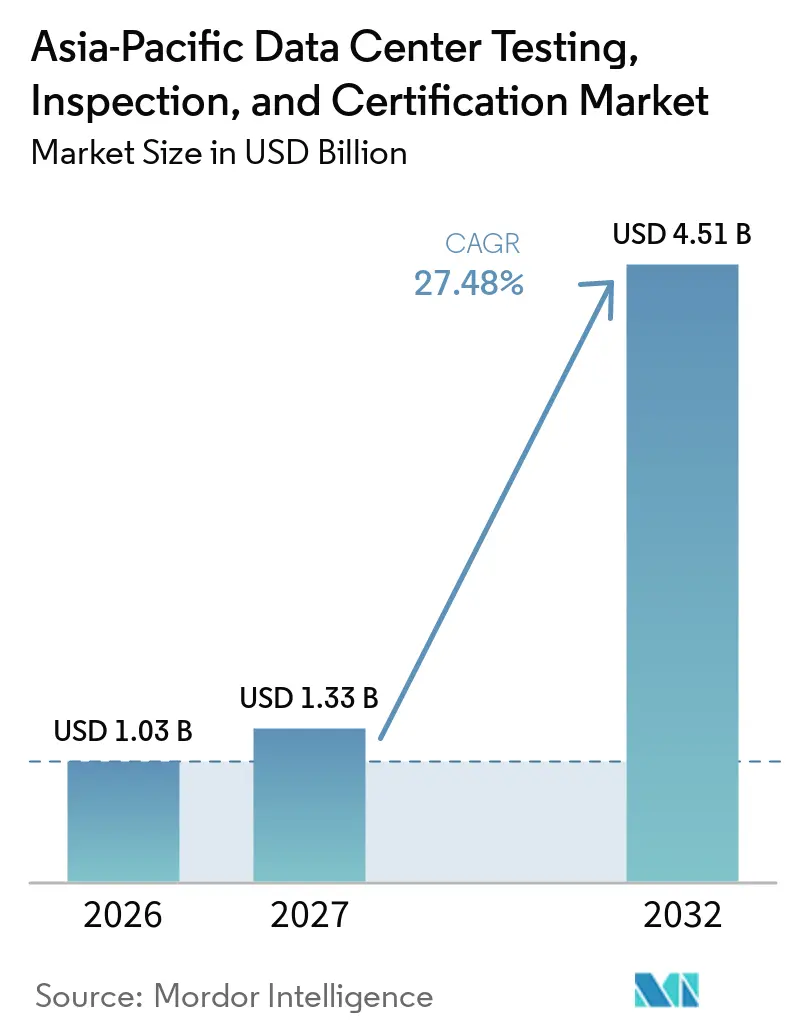
| Base Year Market Size (2026) | USD 1.03 Billion |
| Market Size (2027) | USD 1.33 Billion |
| Market Size (2032) | USD 4.51 Billion |
| Growth Rate (2027 - 2032) | 27.48 % |
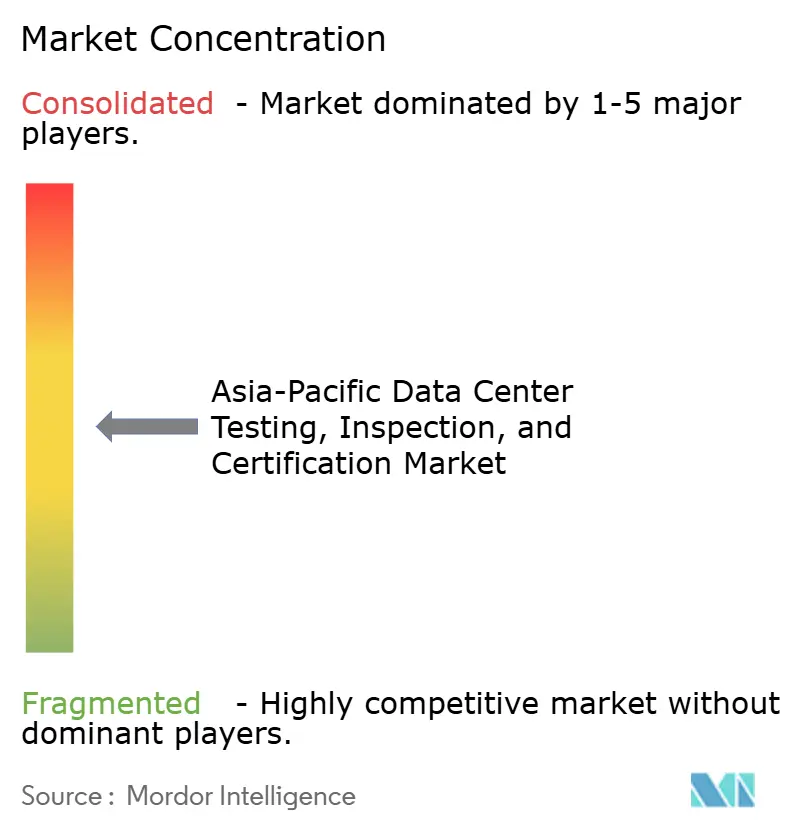
| Market Concentration | Medium |
Major Players *Disclaimer: Major Players sorted in no particular order Image © Mordor Intelligence. Reuse requires attribution under CC BY 4.0. | |
Asia-Pacific Data Center Testing, Inspection, and Certification Market Analysis by Mordor Intelligence
The Asia-Pacific data center testing, inspection, and certification market size was valued at USD 1.03 billion in 2026 and is estimated to expand from USD 1.33 billion in 2027 to reach USD 4.51 billion by 2032, at a CAGR of 27.48% during the forecast period from 2027 to 2032. The region is entering a concentrated phase of AI-ready data center construction, with hyperscalers and cloud providers committing capacity within shorter delivery schedules. This creates demand for independent testing, inspection, certification, and assurance work throughout design, construction, commissioning, and operations. Data localization rules, energy-efficiency requirements, and high-density AI rack standards are widening the scope of individual engagements. Providers with regional accreditations and specialist teams can address complex assignments across several jurisdictions, while power constraints and shortages of qualified engineers may delay project delivery.
Key Report Takeaways
- By service type, Testing held 39.22% of the Asia-Pacific data center Testing, Inspection, and Certification market share in 2026 in the Asia-Pacific data center testing, inspection, and certification market, while Compliance and Assurance Services is projected to expand at a CAGR of 27.82% through 2032.
- By data center lifecycle, Construction, Installation, and Commissioning accounted for 59.24% of the market size in 2026, while Operations, Maintenance, and Recertification is projected to expand at a CAGR of 28.16% through 2032.
- By infrastructure system, Electrical Infrastructure held 36.47% share in 2026, while IT, Network, and Cybersecurity Infrastructure are projected to expand at a CAGR of 28.44% through 2032.
- By data center type, Hyperscale and Cloud Service Provider Data Centers held 39.12% share in 2026 and are projected to expand at a CAGR of 28.17% through 2032.
- By tier type, Tier 3 held 58.11% share in 2026, while Tier 4 is projected to expand at a CAGR of 28.46% through 2032 in the Asia-Pacific data center testing, inspection, and certification market.
- By geography, China held 30.24% share in 2026, while Malaysia is projected to expand at a CAGR of 27.91% through 2032.
Note: Market numbers in this report are based on Mordor Intelligence's proprietary estimation framework, which combines nine months of actuals with Q4 projections for base year 2026.
Asia-Pacific Data Center Testing, Inspection, and Certification Market Trends and Insights
Drivers Impact Analysis*
| Driver | (~) % Impact on CAGR Forecast | Geographic Relevance | Impact Timeline |
|---|---|---|---|
| AI-Ready Hyperscale Capacity Expansion | +5.2% | Global, with primary demand concentration in China, India, Malaysia, Japan, and Australia | Medium term (2-4 years) |
| Accelerating Colocation Development in Power-Advantaged Markets | +4.3% | Malaysia, Indonesia, Vietnam, Thailand, with spillover to India and the Philippines | Medium term (2-4 years) |
| Rising Sustainability and Energy-Efficiency Certification Requirements | +3.8% | Australia, Singapore, South Korea, India, with regulatory influence across Asia-Pacific | Long term (≥ 4 years) |
| Increasing Cybersecurity and Digital-Trust Assurance Requirements | +3.4% | Asia-Pacific-wide, with concentration in Singapore, Japan, South Korea, and Taiwan | Medium term (2-4 years) |
| Liquid-Cooling Validation for High-Density AI Racks | +2.9% | China, Japan, Singapore, and India | Short term (≤ 2 years) |
| Power-Quality Assurance for Grid-Constrained Campuses | +2.1% | Japan, Singapore, India, South Korea, Malaysia, and Indonesia | Medium term (2-4 years) |
| Source: Mordor Intelligence | |||
AI-Ready Hyperscale Capacity Expansion
The Asia-Pacific data center Testing, Inspection, and Certification market is supported by a large pipeline of AI-ready capacity that requires validation before facilities accept live workloads. New sites require defined checks for power systems, cooling equipment, fire safety, and IT infrastructure. High-density AI racks operate at 50-120 kW per rack, compared with 5-15 kW in conventional designs. This changes the requirements for factory acceptance testing, integrated system tests, and load-bank validation. TCS HyperVault announced a 264-acre AI data center campus in Hyderabad with a capacity of up to 1 GW and direct-to-chip liquid cooling in September 2026.[1] The project scale increases the value of providers that have AI-specific validation methods and experienced commissioning teams.
Accelerating Colocation Development in Power-Advantaged Markets
Power availability and public digital economy programs are directing colocation construction toward Malaysia, Vietnam, Thailand, and Indonesia. These locations can absorb demand that is more difficult to place in power-constrained hubs such as Singapore and Tokyo. AirTrunk committed MYR 12 billion (USD 2.8 billion) to develop the JHB3 and JHB4 campuses in Johor Bahru during 2025.[2] The company stated that its existing JHB1 and JHB2 campuses, totaling more than 420 MW of IT load, were almost fully contracted. New colocation campuses need design verification, factory acceptance testing, site acceptance testing, and integrated system testing before handover. The Asia-Pacific data center TIC market, therefore, has an opportunity in projects where operators use independent certification to support customer confidence.
Rising Sustainability and Energy-Efficiency Certification Requirements
Energy performance is becoming a contractual and regulatory matter for data center operators in several Asia-Pacific markets. This shift expands recurring work because annual surveillance audits and periodic recertification follow initial certification. Singapore has introduced a Digital Infrastructure Act for data centers with critical IT loads of 3 MW and above, strengthening the role of licensing, energy-efficiency compliance, and resilience standards. TÜV SÜD opened an SGD 100 million (USD 74.0 million) regional hub in Singapore in March 2026, including a Digital Center of Excellence for sustainability and digital trust work.[3] The facility shows the specialist investment required to serve environmental and digital assurance needs across Southeast Asia. The Asia-Pacific data center TIC market benefits when certification is tied to continued operational monitoring rather than a one-time construction milestone.
Increasing Cybersecurity and Digital-Trust Assurance Requirements
Data sovereignty obligations and cyber risk are increasing the demand for third-party security assurance in data center procurement. Operators are incorporating frameworks such as ISO/IEC 27001:2022, SOC 2 Type II, PCI DSS v4.0, and Singapore's Data Protection Trustmark into customer and government requirements. NTT Com Asia reported five concurrent ISO and ISO/IEC certifications for its data center services in 2025, including ISO/IEC 27001, ISO 50001, and ISO 45001. BSI launched its Data Center Mark of Trust in January 2026 as a modular framework covering availability, protection, energy efficiency, water management, and IT service management. Chunghwa Telecom became one of the first Asian organizations certified under the framework that month. These requirements create a specialized demand channel for accredited providers in the Asia-Pacific data center TIC market.
Restraints Impact Analysis*
| Restraint | (~) % Impact on CAGR Forecast | Geographic Relevance | Impact Timeline |
|---|---|---|---|
| Shortage of Qualified Data Center Commissioning and Cybersecurity Specialists | -3.2% | Asia-Pacific-wide, most acute in Malaysia, Indonesia, India, and South Korea | Short term (≤ 2 years) |
| Fragmented National Accreditation and Compliance Regimes | -2.4% | ASEAN-wide, with Vietnam, Indonesia, the Philippines, and India most affected | Long term (≥ 4 years) |
| Limited Standardization for Liquid Cooling and AI Infrastructure Testing | -1.8% | Global, with core impact on China, Japan, Singapore, and India | Medium term (2-4 years) |
| Delays in Power, Permitting and Construction Readiness | -1.5% | Malaysia, Indonesia, India, and Australia | Short term (≤ 2 years) |
| Source: Mordor Intelligence | |||
Shortage of Qualified Data Center Commissioning and Cybersecurity Specialists
The supply of engineers qualified to validate mission-critical systems is not keeping pace with the data center construction schedule. Commissioning managers, high-voltage electrical engineers, and cybersecurity specialists are required across design, installation, testing, and operations. This shortage is more acute in markets with compressed construction timelines and limited local training capacity. The result can be longer commissioning backlogs and delayed third-party validation. Operators may also proceed with insufficient external verification, which can increase operational defect risk. The Asia-Pacific data center TIC market favors providers that can retain certified specialists and deploy them quickly across multiple countries.
Fragmented National Accreditation and Compliance Regimes
Asia-Pacific does not have a unified accreditation framework for data center testing and certification. Providers must maintain separate laboratory accreditations, auditor qualifications, documentation, and local operating procedures for each jurisdiction. National requirements include CQC 8302 in China, NABERS in Australia, DPTM and Green Mark in Singapore, SIRIM and Green RE in Malaysia, JC-STAR in Japan, and PUE verification in South Korea. This arrangement creates duplicated compliance costs for operators that build in several countries. Providers without local accreditation can lose work to smaller domestic specialists with established regulatory relationships. The Asia-Pacific data center TIC market faces slower cross-border scaling until closer recognition of data center certifications is established.
*Our forecasts treat driver/restraint impacts as directional, not additive. The impact forecasts reflect baseline growth, mix effects, and variable interactions.
Segment Analysis
By Service Type: Testing Anchors Demand While Compliance Expands
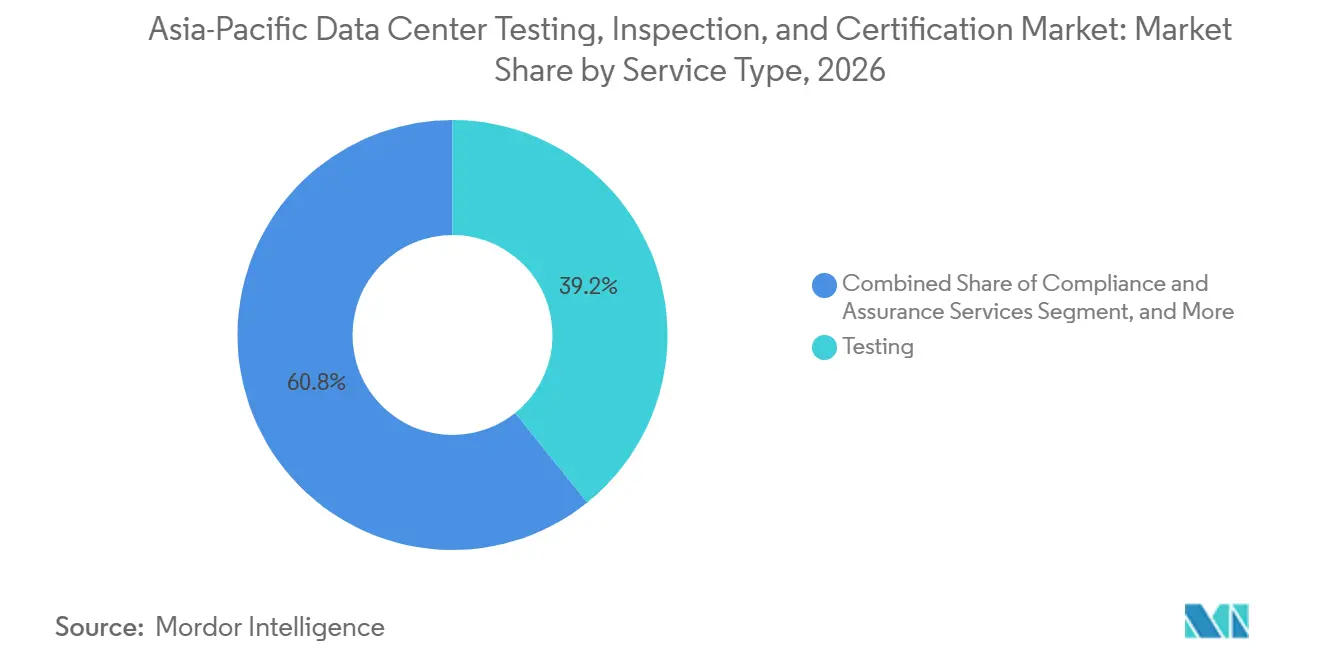
Testing held 39.22% of the Asia-Pacific data center Testing, Inspection, and Certification market in 2026. It remains necessary because each new facility must verify electrical, mechanical, cooling, and fire-safety systems before receiving live workloads. Factory acceptance testing and site acceptance testing are recurring requirements for power distribution units, UPS systems, and cooling equipment. Integrated system testing and load-bank validation add further work during commissioning. Testing demand is particularly strong where AI-ready designs increase system density and operating complexity. The Asia-Pacific data center TIC industry relies on these services as the basic assurance layer across new capacity additions.
Compliance and Assurance Services is projected to expand at a CAGR of 27.82% from 2027 to 2032. The service benefits from expanding obligations related to energy performance, data localization, cybersecurity, and operational governance. Australia, Singapore, India, and Indonesia apply different requirements, but each adds recurring assurance needs for operators. Bureau Veritas reported 30% organic growth in data center commissioning globally in 2025 and identified sustainability and cybersecurity assurance as important activity areas. Inspection supports construction quality verification and independent design review. Certification also creates multi-year revenue through TIA-942, ISO 50001, ISO/IEC 27001, and Uptime Institute programs.

By Data Center Lifecycle: Construction Leads While Operations Gain Weight
Construction, Installation and Commissioning held 59.24% of the Asia-Pacific data center Testing, Inspection, and Certification market size in 2026. The segment includes factory acceptance testing, site acceptance testing, integrated systems tests, and load-bank validation. Each activity represents a distinct engagement before a facility enters service. High-density AI racks increase the need for liquid-cooling and power-system validation. This concentration reflects the amount of greenfield capacity under development across the region. The Asia-Pacific data center TIC market is, therefore, closely connected to project mobilization and commissioning schedules.
Operations, Maintenance and Recertification is projected to expand at a CAGR of 28.16% from 2027 to 2032. Demand rises as sites move from initial commissioning into regular operating cycles. Operational programs include CQC 8302 L3 certification in China, ISO 41001:2018 facility management accreditation in Singapore, and recertification activities in Japan. Surveillance audits can be required in the third and fourth operational years. This work is less dependent on the start of new construction than initial commissioning assignments. Pre-construction design review and modernization also remain relevant when operators assess power readiness, retrofit cooling systems, or upgrade cybersecurity controls.
By Infrastructure System: Electrical Systems Lead While Cybersecurity Advances
Electrical Infrastructure held 36.47% of the Asia-Pacific data center TIC market in 2026. Commissioning starts with verification of UPS systems, generators, switchgear, power distribution equipment, and power quality. These systems are essential at every data center type and tier level. GPU-dense AI deployments are increasing interest in higher-voltage DC architectures. China's CAICT Tel Lab started construction of an 800V HVDC co-verification platform in April 2026 for energy-efficiency and safety testing. Electrical testing remains the required baseline for the Asia-Pacific data center TIC industry.
IT, Network, and Cybersecurity Infrastructure is projected to expand at a CAGR of 28.44% from 2027 to 2032. The segment is supported by ISO/IEC 27001:2022, SOC 2, PCI DSS v4.0, and other customer assurance requirements. Security testing is important to colocation agreements and government cloud contracts. Mechanical, Cooling, and Fire-Safety Infrastructure provides stable assurance work alongside structural and physical security systems. Liquid cooling is becoming a differentiated service area as AI rack density rises. UL Solutions launched testing and certification for immersion cooling fluids under UL 2417 in June 2025.
By Data Center Type: Hyperscale Combines Scale and Speed
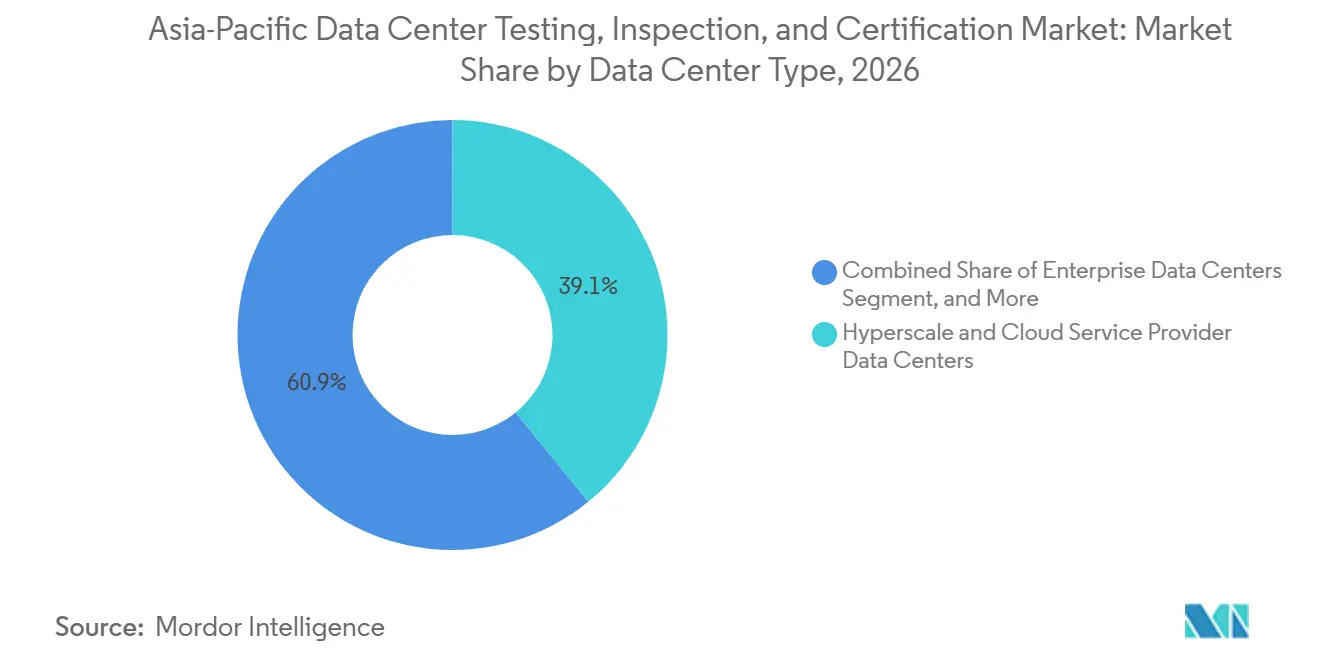
Hyperscale and Cloud Service Provider Data Centers held 39.12% of the Asia-Pacific data center TIC market in 2026. The segment is also projected to expand at a CAGR of 28.17% from 2027 to 2032. A large campus can need multiple assignments across design review, construction inspection, commissioning, and operating recertification. Vantage Data Centers secured USD 1.6 billion for its Asia-Pacific platform from GIC and ADIA in September 2025. Such commitments extend the pipeline for providers that can work across several project stages.
Colocation is the second-largest data center type and is expanding as ASEAN markets advance projects with own-source power and green certification credentials. Operators often use third-party certification to give customers confidence in their facilities. Enterprise sites continue to serve banking, insurance, and government users who require formal security and operational assurance. Edge and modular sites form an emerging area for the Asia-Pacific data center TIC market because distributed facilities need remote monitoring, periodic inspection, and modular certification. Their smaller and less staffed locations change how assurance work is delivered. The segment, therefore, broadens the addressable project base beyond large centralized campuses.
By Tier Type: Tier 3 Leads While Tier 4 Raises Complexity
Tier 3 held 58.11% of the Asia-Pacific data center TIC market size in 2026. The tier is widely used by colocation operators and enterprise-oriented developers because it supports concurrently maintainable infrastructure. TIA-942-B is an important reference framework for Tier 3 projects in the region. NTT Global Data Centers completed a second TIA-942-B Rated-3 surveillance audit for Cyberjaya 5 in Malaysia in June 2026. STT Seoul 1 received Uptime Institute Tier III Certification of Design Documents in May 2026. These certifications show the ongoing need for a detailed independent review.
Tier 4 is projected to expand at a CAGR of 28.46% from 2027 to 2032. Government, financial services, and AI inference applications are increasing the demand for fault-tolerant infrastructure. Irix became Malaysia's first data center to receive Uptime Institute Tier IV Certification of Constructed Facility in 2025. Johor's limits on new Tier 1 and Tier 2 data center approvals direct new applications toward higher tiers. Tier 4 work carries greater technical complexity and more demanding compliance requirements. This creates a premium opportunity for specialized certification teams.
Geography Analysis
China held 30.24% of the Asia-Pacific data center Testing, Inspection, and Certification market share in 2026. The country has a large installed base of certified data center infrastructure and a developed domestic certification system. CQC 8302 and GB 50174-2017 create operational and construction-related compliance requirements. The CAICT Tel Lab's 800V HVDC verification initiative also reflects investment in testing infrastructure for AI data center equipment. India is another active market, supported by planned hyperscale and AI campus investments. TCS HyperVault's Hyderabad project illustrates the scale of commissioning activity entering the country.
Malaysia is projected to expand at a CAGR of 27.91% from 2027 to 2032. Johor Bahru is attracting hyperscale development because of its location, capacity opportunity, and developing compliance framework. AirTrunk's MYR 12 billion (USD 2.8 billion) commitment for two Johor campuses demonstrates the scale of activity. Own-source power requirements, Green RE Platinum, and restrictions on new Tier 1 and Tier 2 facilities create structured assurance work. Singapore applies licensing and energy-efficiency requirements to facilities with critical IT loads of 3 MW and above.
Australia, Taiwan, and Vietnam contribute to regional demand through established certification needs and new development. Australia's NABERS Data Centre rating requirements create recurring energy-efficiency obligations for operators. South Korea has Tier III and Tier IV certification demand, including STT Seoul 1's Tier III design certification. Taiwan is adopting digital trust frameworks, with Chunghwa Telecom receiving BSI Data Centre Mark of Trust certification in January 2026. Vietnam has volume potential as its facilities move toward internationally recognized standards. CMC Data Center Tan Thuan received TCOS Tier III Gold certification in October 2026, supporting the country's appeal to hyperscale tenants.
Competitive Landscape
The Asia-Pacific data center testing, inspection, and certification market is moderately consolidated among global providers serving full-lifecycle assignments at hyperscale and Tier 3-plus facilities. SGS SA, Bureau Veritas SA, Intertek Group plc, TÜV SÜD AG, TÜV Rheinland AG, and DNV AS are active across physical, operational, and digital assurance work. Bureau Veritas signed an agreement to acquire Lotusworks in April 2026 for EUR 375 million (USD 406.9 million). Lotusworks recorded EUR 131 million (USD 141.9 million) in revenue in 2025, and the transaction strengthened Bureau Veritas's mission-critical commissioning capability. TÜV NORD GROUP acquired Singapore-based EPI Group in October 2025, adding specialized audit, certification, and training capabilities for data centers. SGS completed the acquisition of Granite River Labs Services in March 2026 to expand digital trust and high-speed connectivity testing.
Competition increasingly depends on multi-jurisdictional accreditation, digital commissioning tools, and access to engineers qualified in liquid cooling and high-voltage DC systems. Broad accreditation can reduce retesting for operators with projects in several countries. Digital evidence capture can shorten project handover and improve documentation quality. BSI's Data Center Mark of Trust provides a modular format that operators can use across different assurance topics. TÜV SÜD's regional hub in Singapore adds laboratory and digital trust capacity for the wider region. These moves show why providers are combining specialist acquisitions with targeted regional investment.
Regional specialists retain strong positions where domestic accreditation, language, and public-sector relationships are essential. China Certification and Inspection Group, Centre Testing International, and Japan Quality Assurance Organization can compete effectively for national government and state-owned enterprise work. National laboratory accreditation and compliance with local rules remain baseline conditions for many mandates. Providers also need technical capability across electrical systems, sustainability, cybersecurity, and facility operations. This limits direct competition from firms without data center-specific credentials. The Asia-Pacific data center TIC market remains open to regional specialists, but large cross-border assignments favor providers with broad accreditation portfolios.
Asia-Pacific Data Center Testing, Inspection, and Certification Industry Leaders
-
SGS SA
-
Bureau Veritas SA
-
Intertek Group plc
-
TÜV SÜD AG
-
TÜV Rheinland AG
- *Disclaimer: Major Players sorted in no particular order
Recent Industry Developments
- October 2026: CMC Data Center Tan Thuan (Vietnam) achieved the TCOS Tier III Gold certification from Uptime Institute as of October 9, 2026, marking a milestone in Vietnam's transition toward internationally recognized data center infrastructure standards and expanding the pool of Tier-certified facilities available to hyperscale tenants in Southeast Asia.
- September 2026: TÜV SÜD launched its Global Decarbonisation Centre of Excellence (CoE) in Singapore on September 9, focusing on carbon market integrity, digital measurement, reporting and verification (dMRV), and cross-border carbon assurance under Article 6 of the Paris Agreement. The CoE positions Singapore as a regional anchor for climate-related TIC services across Southeast Asia and broadens TÜV SÜD's addressable market beyond physical infrastructure into carbon and sustainability verification for data center operators with net-zero commitments.
- September 2026: TCS HyperVault, a subsidiary of Tata Consultancy Services, secured 264 acres in Hyderabad, India, for an AI data center campus of up to 1 GW capacity on September 5. The campus, designed for direct-to-chip liquid cooling and high-density GPU workloads, represents one of India's largest single-site AI infrastructure commitments and will generate a multi-phase TIC pipeline spanning design verification, liquid-cooling validation, and operational certification across its build-out phases.
- August 2026: ST Telemedia Global Data Centres Japan announced on August 21 that STT Tokyo 1, its Inzai City (Chiba Prefecture) data center, achieved LEED Gold certification under the U.S. Green Building Council's rating system. The facility targets an annualized PUE of below 1.25 and will deliver up to 32 MW of IT capacity at full build. The certification reinforces the growing trend of international institutional investors requiring LEED or equivalent third-party environmental performance validation as a condition of project financing.
Asia-Pacific Data Center Testing, Inspection, and Certification Market Report Scope
The Asia-Pacific Data Center Testing, Inspection, and Certification Market comprises third-party services that verify the safety, performance, reliability, and compliance of data center infrastructure across APAC countries from design review and commissioning through ongoing operations and modernization.
The Asia-Pacific Data Center Testing, Inspection, and Certification Market Report is Segmented by Service Type (Testing, Inspection, Certification, and Compliance), Data Center Lifecycle (Pre-Construction and Design, Construction, Installation and Commissioning, Operations, Maintenance and Recertification, and Retrofit and Modernization), Infrastructure System (Electrical Infrastructure, Mechanical, Cooling and Fire-Safety Infrastructure, Structural, Building and Physical Security Systems, and IT, Network and Cybersecurity Infrastructure), Data Center Type (Hyperscale and Cloud Service Provider Data Centers, Colocation, Enterprise, Edge and Modular), Tier (1 and 2, 3, 4), and Geography (China, India, Japan, Australia, Singapore, Malaysia, and Rest of Asia-Pacific). The Market Forecasts are Provided in Terms of Value (USD).
| Testing |
| Inspection |
| Certification |
| Compliance and Assurance Services |
| Pre-Construction and Design |
| Construction, Installation and Commissioning |
| Operations, Maintenance and Recertification |
| Retrofit and Modernization |
| Electrical Infrastructure |
| Mechanical, Cooling and Fire-Safety Infrastructure |
| Structural, Building and Physical Security Systems |
| IT, Network and Cybersecurity Infrastructure |
| Hyperscale and Cloud Service Provider Data Centers |
| Colocation Data Centers |
| Enterprise Data Centers |
| Edge and Modular Data Centers |
| Tier 1 and Tier 2 |
| Tier 3 |
| Tier 4 |
| China |
| India |
| Japan |
| Australia |
| Singapore |
| Malaysia |
| Thailand |
| Vietnam |
| Taiwan |
| Hong Kong |
| Philippines |
| Rest of Asia-Pacific |
| By Service Type | Testing |
| Inspection | |
| Certification | |
| Compliance and Assurance Services | |
| By Data Center Lifecycle | Pre-Construction and Design |
| Construction, Installation and Commissioning | |
| Operations, Maintenance and Recertification | |
| Retrofit and Modernization | |
| By Infrastructure System | Electrical Infrastructure |
| Mechanical, Cooling and Fire-Safety Infrastructure | |
| Structural, Building and Physical Security Systems | |
| IT, Network and Cybersecurity Infrastructure | |
| By Data Center Type | Hyperscale and Cloud Service Provider Data Centers |
| Colocation Data Centers | |
| Enterprise Data Centers | |
| Edge and Modular Data Centers | |
| By Tier Type | Tier 1 and Tier 2 |
| Tier 3 | |
| Tier 4 | |
| By Asia-Pacific | China |
| India | |
| Japan | |
| Australia | |
| Singapore | |
| Malaysia | |
| Thailand | |
| Vietnam | |
| Taiwan | |
| Hong Kong | |
| Philippines | |
| Rest of Asia-Pacific |
Key Questions Answered in the Report
What is the size of the Asia-Pacific data center TIC market?
The 2027 value is USD 1.33 billion, and it is projected to reach USD 4.51 billion by 2032 at a CAGR of 27.48%.
Which service has the largest role in data center TIC work?
Testing leads by service type with a 39.22% share in 2026 because new facilities require electrical, mechanical, cooling, and fire-safety validation before operation.
What is driving demand for compliance and assurance services?
Data localization, cybersecurity, energy-efficiency, and digital trust obligations are expanding recurring assurance needs. Compliance and Assurance Services is projected to record a CAGR of 27.82% through 2032.
Why are hyperscale data centers important to TIC providers?
Hyperscale and cloud service provider facilities held 39.12% share in 2026 and need multiple engagements across design, construction, commissioning, and recertification.
Which Asia-Pacific country is projected to expand the fastest?
Malaysia is projected to record a CAGR of 27.91% through 2032, supported by hyperscale construction in Johor Bahru and expanding compliance requirements.
What limits the expansion of data center assurance services?
A shortage of commissioning and cybersecurity specialists, fragmented accreditation requirements, and delays in power and permits can slow engagement schedules.