
Asia-Pacific Automotive Smart Key Market Size and Share
Market Overview
| Study Period | 2019 - 2030 |
|---|---|
| Forecast Data Period | 2025 - 2030 |
| Historical Data Period | 2019 - 2023 |
| Market Size (2025) | USD 5.42 Billion |
| Market Size (2030) | USD 7.52 Billion |
| Growth Rate (2025 - 2030) | 6.77 % |
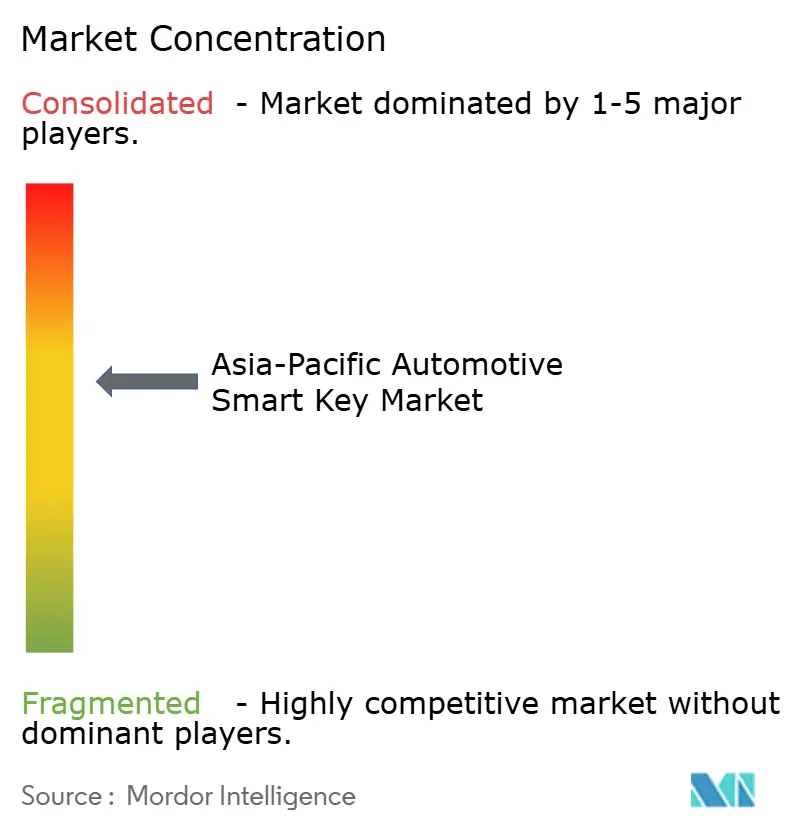
| Market Concentration | Medium |
Major Players *Disclaimer: Major Players sorted in no particular order Image © Mordor Intelligence. Reuse requires attribution under CC BY 4.0. | |

Asia-Pacific Automotive Smart Key Market Analysis by Mordor Intelligence
The Asia-Pacific Automotive Smart Key Market size is estimated at USD 5.42 billion in 2025, and is expected to reach USD 7.52 billion by 2030, at a CAGR of 6.77% during the forecast period (2025-2030).
Asia-Pacific remains the primary demand center for automotive smart key systems, supported by the region’s dominant vehicle production base and the steady increase in convenience and security feature penetration across mid-segment vehicles. Vehicle manufacturing volume is structurally led by China, followed by Japan, India, and South Korea, which together account for a significant share of global vehicle output. This scale expands the installed base for OEM-fitted smart key systems and sustains demand for replacement and duplicate keys across the regional vehicle parc.
Within Asia-Pacific, market evolution follows two parallel technology paths. Conventional remote keyless entry systems continue to account for the majority of installations, owing to their cost efficiency, maturity, and broad platform standardization. In parallel, passive keyless entry and smartphone-enabled digital key solutions are gaining traction. Adoption is driven by consumer expectations for hands-free access and by OEM initiatives to strengthen vehicle security, including improved protection against relay attacks through enhanced ranging accuracy, secure elements, and modern wireless architectures combining BLE, UWB, and NFC fallback.
From a segmentation perspective, single-function smart keys have historically accounted for the largest share of demand, reflecting widespread deployment in high-volume vehicle platforms. However, multi-function smart keys are positioned as the fastest-growing application category as OEMs bundle additional features into standard offerings. Similarly, while remote keyless entry systems dominate current volumes, passive keyless entry is expected to grow at a faster pace as comfort and security features continue to cascade from premium vehicles into mass-market segments[1]“Production Statistics (2024),” International Organization of Motor Vehicle Manufacturers, oica.net.
Key Report Takeaways
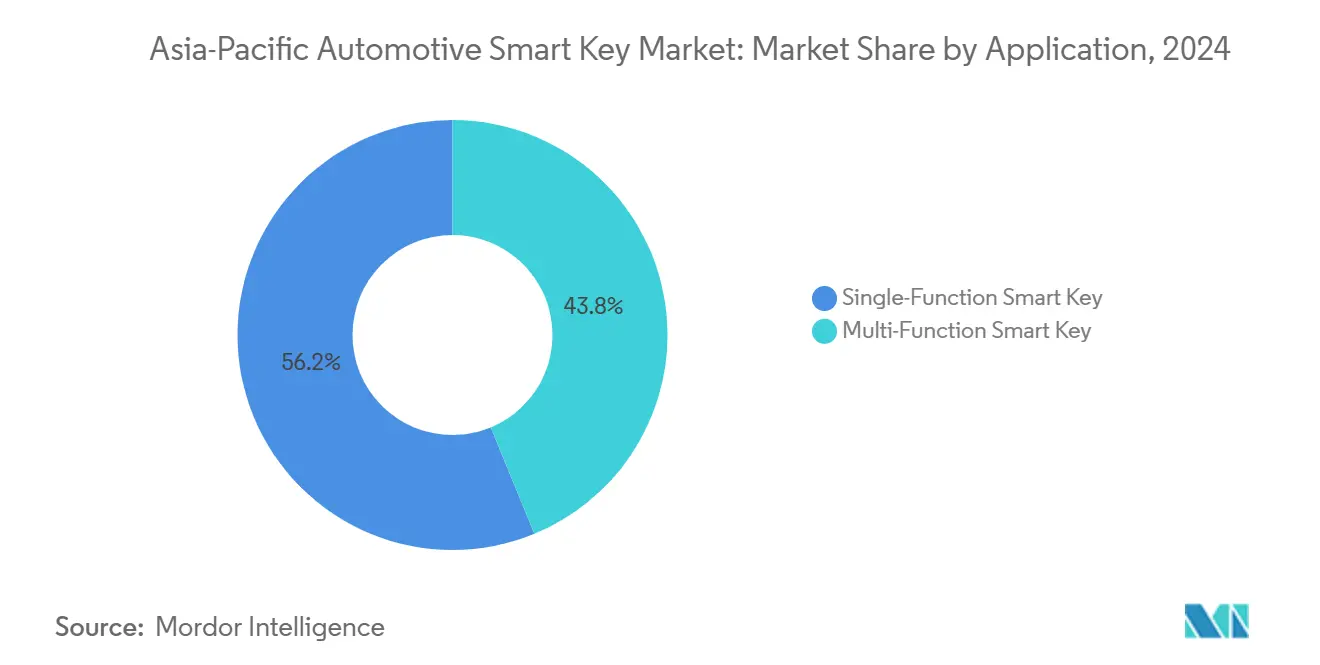
- By application, single-function smart keys accounted for 56.23% of the market in 2024, while multi-function smart keys are expected to grow fastest at an 8.45% CAGR during 2025–2030.
- By technology, remote keyless entry represented 54.36% share in 2024, whereas passive keyless entry is projected to expand at a higher 9.10% CAGR through 2030.
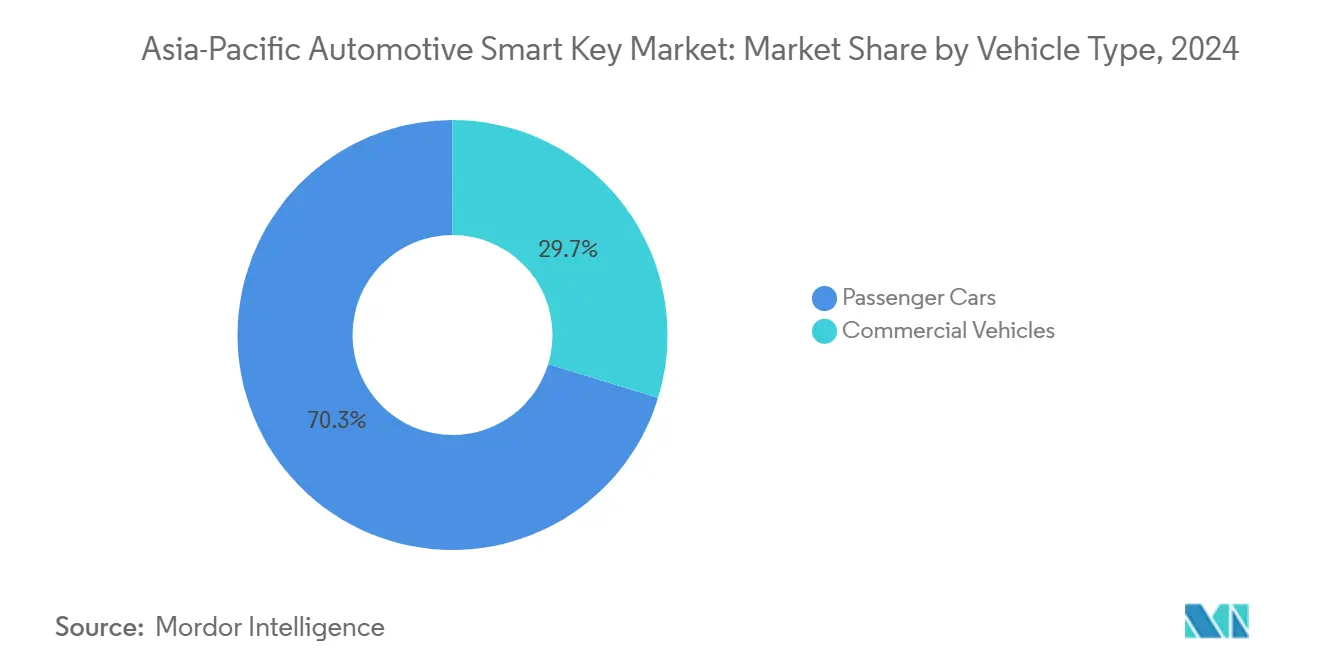
- By vehicle type, passenger cars dominated the market with a 70.28% share in 2024 and are also forecast to grow at a 6.85% CAGR over the forecast period.
- By sales channel, OEMs accounted for 87.15% of the total market in 2024, while the aftermarket segment is expected to register the fastest growth at a 9.25% CAGR through 2030.
- By geography, China held a 42.18% share of the Asia-Pacific market in 2024, while the rest of Asia-Pacific is projected to grow fastest at an 8.95% CAGR through 2030.
Note: Market size and forecast figures in this report are generated using Mordor Intelligence’s proprietary estimation framework, updated with the latest available data and insights as of January 2026.
Market Trends and Insights
Drivers Impact Analysis of Asia-Pacific Automotive Smart Key Market*
| Drivers | (~) % Impact on CAGR Forecast | Geographic Relevance | Impact Timeline |
|---|---|---|---|
| Feature Cascade Into Mid-Segment Passenger Cars | +1.0% | Broad-based; strongest in China/India high-volume segments | Medium term (2–4 years) |
| Growth in Passive Entry/Passive Start Fitments | +0.9% | Higher in Japan/Korea and premium-heavy urban markets | Medium term (2–4 years) |
| Digital Key Ecosystem Momentum | +0.8% | Stronger in China/Japan/Korea smartphone-led ecosystems | Long term (≥ 4 years) |
| Rising Security Spend Against Keyless Theft | +0.6% | Broad; higher where theft risk is elevated | Short term (≤ 2 years) |
| Higher Vehicle Production Base in Asia-Pacific | +0.5% | China/India/Japan/Korea production hubs | Medium term (2–4 years) |
| Aftermarket Replacement and Duplication Demand | +0.3% | Higher in large parc markets and dense metros | Short term (≤ 2 years) |
| Source: Mordor Intelligence | |||
Feature Cascade Into Mid-Segment Passenger Cars
Smart key functionality, once limited to premium trims, is increasingly integrated into mid-segment passenger vehicles. OEMs use visible convenience features to differentiate offerings while leveraging common electronic architectures across trims to control costs. This dynamic is particularly pronounced in Asia-Pacific, where high model refresh cycles and intense competitive pressure accelerate the inclusion of comfort and security features in high-volume platforms.
Growth in Passive Entry and Passive Start Fitments
Remote keyless entry systems have historically dominated installations; however, passive entry and passive start systems are expanding at a faster rate. Passive systems increase per-vehicle content through additional antennas, authentication logic, and deeper vehicle integration. As OEM electrical and electronic architectures become more standardized, the marginal cost of adding passive entry declines, supporting wider adoption across vehicle segments.
Digital Key Ecosystem Momentum (Phone and Wearables)
The evolution of standardized digital key frameworks, including solutions combining UWB, BLE, and NFC fallback, reduces interoperability risk and enables broader OEM adoption beyond early premium launches. Asia-Pacific benefits from a strong smartphone ecosystem and close collaboration between automotive OEMs and consumer technology providers, which accelerates the rollout of phone- and wearable-based access credentials across vehicle portfolios.
Rising Security Spend Against Keyless Theft Methods
Security enhancement has become a central driver of smart key system upgrades. OEMs and suppliers are investing in stronger cryptography, secure elements, and distance-bounding technologies such as UWB to address relay-style theft risks. These security upgrades are increasingly bundled into next-generation smart key architectures, linking higher security standards with broader system adoption.
Restraints Impact Analysis of Asia-Pacific Automotive Smart Key Market*
| Restraints | (~) % Impact on CAGR Forecast | Geographic Relevance | Impact Timeline |
|---|---|---|---|
| Cybersecurity and Data-Security Concerns | -0.7% | Broad; highest where digital keys scale fastest | Medium term (2–4 years) |
| Cost Sensitivity in Entry Segments | -0.6% | Higher impact in price-sensitive markets | Short term (≤ 2 years) |
| Interoperability and Standard Fragmentation Risks | -0.4% | Cross-region; affects phone-based credentials | Long term (≥ 4 years) |
| Semiconductor and RF Component Supply Volatility | -0.3% | Broad; higher impact in tight supply cycles | Short term (≤ 2 years) |
| Source: Mordor Intelligence | |||
Cybersecurity and Data-Security Concerns
As smart key systems become more connected, particularly through digital key implementations, the potential attack surface expands. This increases requirements for validation, certification, and lifecycle cybersecurity management. Heightened concern around data security and cybercrime adds complexity and cost to OEM and supplier development programs, acting as a restraint on rapid deployment[2]“Car Connectivity Consortium Publishes Digital Key Release 3.0,” Car Connectivity Consortium, carconnectivity.org.
Cost Sensitivity in Entry Vehicle Segments
In price-sensitive entry-level vehicle categories, OEMs often restrict smart key functionality to higher trims. Passive entry systems and multi-function smart keys add both hardware and software cost, which limits penetration in high-volume, cost-optimized models. As a result, adoption progresses faster in mid- and premium segments than in entry-level vehicles, moderating overall market expansion.
*Our forecasts treat driver/restraint impacts as directional, not additive. The impact forecasts reflect baseline growth, mix effects, and variable interactions.
Asia-Pacific Automotive Smart Key Market Segment Analysis
By Application:
Single-Function vs. Multi-Function Smart KeySingle-function smart keys, limited to core lock/unlock and basic authorization, remain the volume anchor in Asia-Pacific. These systems deliver strong perceived value at controlled cost and are widely deployed across mainstream passenger vehicles. OEMs typically standardize the underlying electronics while selectively offering smart access features across trims to balance feature appeal with margin discipline.
Multi-function smart keys, which support passive start, trunk or boot access, personalized user settings, and deeper integration with body control modules, are positioned for faster growth. OEMs increasingly rely on feature bundling to enhance user experience and differentiate offerings. Regional research consistently identifies multi-function smart keys as the fastest-growing application class, reflecting ongoing upgrades in convenience and security content.


By Technology:
Remote Keyless Entry vs. Passive Keyless EntryRemote keyless entry (RKE) dominates the current installed base owing to its long maturity, proven reliability, and relatively simple vehicle integration. Strong standardization across Tier-1 suppliers enables cost-optimized deployment, supporting high penetration in volume vehicle platforms.
Passive keyless entry (PKE) is expected to expand at a faster pace as hands-free access becomes a baseline expectation in mid- to premium-segment vehicles. PKE systems carry higher content value, driven by additional antennas, authentication logic, and tighter integration. Security enhancements, including improved proximity validation in advanced implementations, further support market value expansion even if unit penetration rises more gradually.
By Vehicle Type:
Passenger Cars vs. Commercial VehiclesPassenger cars represent the largest demand pool, as comfort and convenience features are central to purchase decisions and OEMs regularly refresh electronic architectures. Asia-Pacific’s large passenger vehicle production base, led by China, Japan, India, and South Korea, supports steady increases in smart key penetration across successive model platforms.
Commercial vehicle adoption remains more selective and is typically justified by fleet security, driver access management, and operational convenience. However, as light commercial vehicles increasingly share passenger-car platforms and electronics, smart key features are gradually propagating into urban logistics and service fleets.
By Sales Channel:
OEMs vs. AftermarketOEMs account for the majority of market value, as smart key systems are deeply integrated with body control modules, immobilizers, and vehicle security stacks. Factory fitment offers the most seamless integration path and benefits from platform-level electronics standardization.
Aftermarket demand is supported by replacement and duplication needs, as well as by fleet and used-vehicle owners seeking convenience upgrades. However, rising security hardening and cryptographic protections increase technical barriers for non-OEM provisioning, shifting higher-value opportunities toward authorized service channels and certified solutions.
Geography Analysis
China Automotive Smart Key Market
China is structurally the largest contributor, supported by its scale of vehicle production, dense competitive environment, and rapid feature adoption across domestic and joint-venture brands. This production footprint sustains both OEM smart key fitment volumes and downstream replacement demand.
APAC Automotive Smart Key Market
Japan and South Korea contribute high penetration rates, supported by strong domestic OEM platforms and mature Tier-1 supplier ecosystems. India and the rest of Asia-Pacific represent incremental growth markets, driven by rising adoption in mid-segment vehicles and the gradual expansion of convenience and security features across broader price bands.
Competitive Landscape
The Asia-Pacific automotive smart key market shows medium concentration, with a mix of global Tier-1s and strong regional specialists/OEM-linked suppliers. Competitive differentiation is driven by system security, interoperability readiness (digital key standards), RF architecture performance in dense environments, and cost-down execution for high-volume platforms.
Asia-Pacific Automotive Smart Key Industry Leaders
Denso Corporation
Tokai Rika Co., Ltd.
Continental AG
ZF Friedrichshafen AG
Valeo SA
- *Disclaimer: Major Players sorted in no particular order
Asia-Pacific Automotive Smart Key Market Companies Covered in this Report
- Denso Corporation
- Tokai Rika Co., Ltd.
- Mitsubishi Electric Corporation
- ALPS Alpine Co., Ltd.
- Continental AG
- ZF Friedrichshafen AG
- Valeo SA
- Hyundai Mobis Co., Ltd.
- Hella GmbH & Co. KGaA
- Robert Bosch GmbH
- Aisin Corporation
- Omron Corporation
- Panasonic Corporation
- Samsung Electro-Mechanics
- LG Innotek
- Fujitsu Limited
- NXP Semiconductors
- Infineon Technologies AG
- STMicroelectronics
- Texas Instruments Incorporated

Recent Industry Developments in Asia-Pacific Automotive Smart Key Market
- April 2025: the Car Connectivity Consortium (CCC) announced it is expanding its Asia-Pacific presence—particularly in China—to support CCC Digital Key adoption, emphasizing deeper member collaboration and localized enablement/certification to drive secure, interoperable digital-key deployments across OEMs and suppliers in the region.
- February 2024: Samsung expanded Samsung Wallet “Digital Key” compatibility to select Volvo Cars and Polestar vehicles, enabling Galaxy users to lock/unlock and start supported vehicles via smartphone—supporting wider phone-as-key adoption in APAC ecosystems.


Asia-Pacific Automotive Smart Key Market Report Scope
Automotive smart key systems are electronic access and authorization solutions that enable secure vehicle entry and (in many configurations) engine start using encrypted credential exchange between the vehicle and an electronic key fob or compatible mobile device.
The scope includes segmentation by Application (Single-Function Smart Key and Multi-Function Smart Key), Technology (Remote Keyless Entry and Passive Keyless Entry), Vehicle Type (Passenger Cars and Commercial Vehicles), Sales Channel (OEMs and Aftermarket), and Geography (China, India, Japan, South Korea, Australia, and Rest of Asia-Pacific). The market forecasts are provided in terms of value (USD).
| Single-Function Smart Key |
| Remote Keyless Entry |
| Passive Keyless Entry |
| Passenger Cars |
| Commercial Vehicles |
| OEMs |
| Aftermarket |
| China |
| India |
| Japan |
| South Korea |
| Australia |
| Thailand |
| Indonesia |
| Rest of Asia-Pacific |
| Segmentation by Application (Value, USD) | Single-Function Smart Key |
| Segmentation by Technology (Value, USD) | Remote Keyless Entry |
| Passive Keyless Entry | |
| Segmentation by Vehicle Type (Value, USD) | Passenger Cars |
| Commercial Vehicles | |
| Segmentation by Sales Channel (Value, USD) | OEMs |
| Aftermarket | |
| Segmentation by Country/Cluster (Value, USD) | China |
| India | |
| Japan | |
| South Korea | |
| Australia | |
| Thailand | |
| Indonesia | |
| Rest of Asia-Pacific |


Key Questions Answered in the Report
What is the current value of the Asia-Pacific automotive smart key market?
It is estimated at USD 5,423.06 million in 2025 and is projected to reach USD 7,524.29 million by 2030.
Which technology leads adoption today in Asia-Pacific?
Remote keyless entry leads current adoption, supported by cost-optimized, widely deployed architectures.
Which application category is growing fastest through the forecast horizon?
Multi-function smart keys are positioned as the fastest-growing application segment as feature bundling expands.
Why is passive keyless entry growing faster than remote keyless entry?
Consumer preference for hands-free convenience and stronger security design evolution drives faster PKE adoption.
Which country anchors Asia-Pacific demand?
China anchors demand due to the region’s largest vehicle production scale (31.28 million vehicles in 2024).
Page last updated on:





