
ASEAN ITSM Market Size and Share
Market Overview
| Study Period | 2024 - 2035 |
|---|---|
| Forecast Data Period | 2026 - 2035 |
| Base Year Market Size (2025) | USD 0.4 Billion |
| Market Size (2026) | USD 0.48 Billion |
| Market Size (2035) | USD 13.35 Billion |
| Growth Rate (2026 - 2035) | 22.60 % |
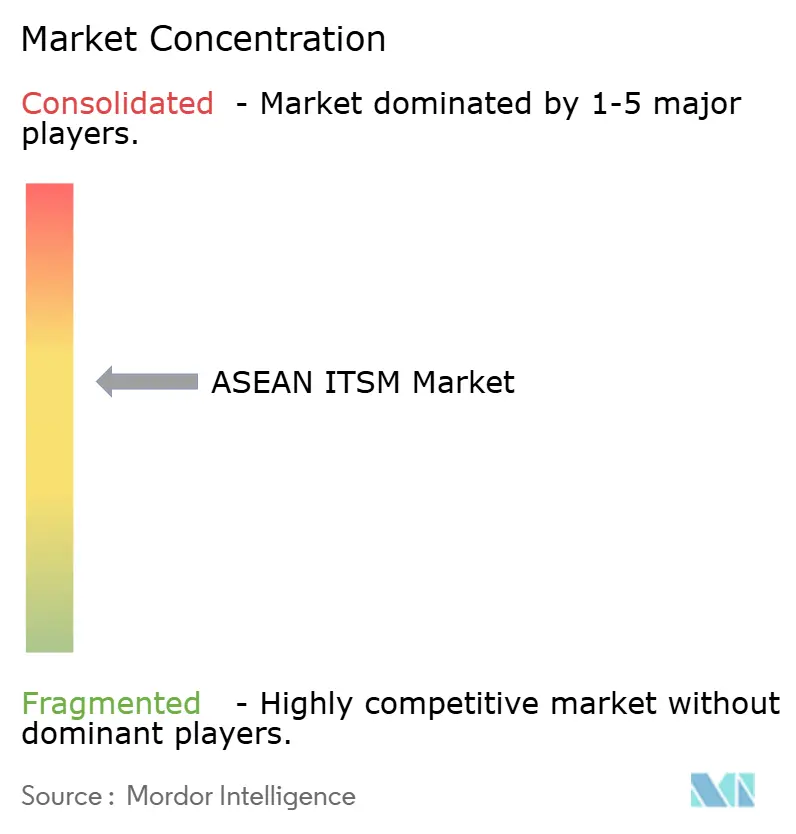
| Market Concentration | Medium |
Major Players *Disclaimer: Major Players sorted in no particular order Image © Mordor Intelligence. Reuse requires attribution under CC BY 4.0. | |
ASEAN ITSM Market Analysis by Mordor Intelligence
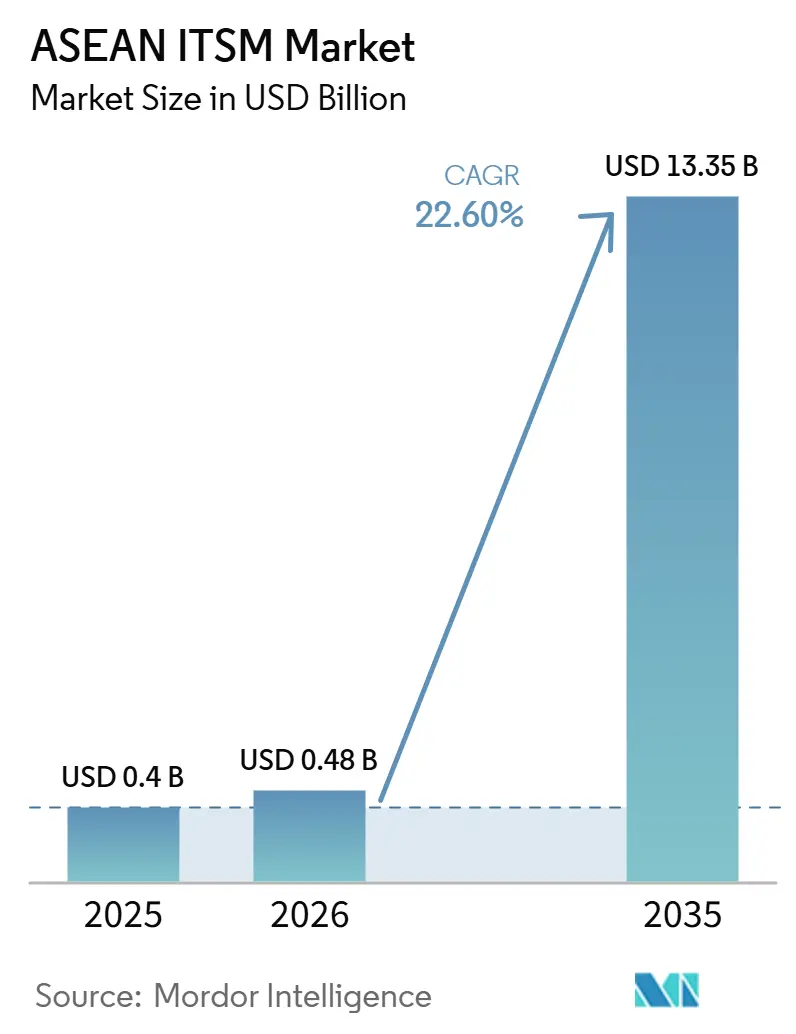
The ASEAN ITSM Market size is expected to increase from USD 0.4 billion in 2025 to USD 0.48 billion in 2026 and reach USD 13.35 billion by 2035, growing at a CAGR of 22.60% over 2026-2035.
Growth is being supported by wider digital modernization programs across Southeast Asia, where service management is moving closer to core operating priorities instead of remaining a support activity. Cloud-based rollouts are also gaining traction because many buyers are adopting formal ITSM platforms for the first time and are choosing faster deployment models with lower infrastructure burden. Demand is also being shaped by stronger interest in AI-enabled self-service, workflow automation, and knowledge tools that reduce ticket pressure and improve user response quality. At the same time, regulatory obligations across financial services, government, and data-sensitive sectors are pushing organizations toward more auditable operating models and increasing the role of managed service partners. This combination is widening the commercial opportunity for vendors that can pair platform capabilities with implementation support, governance features, and cross-functional service workflows across the ASEAN ITSM market.
Key Report Takeaways
- By component, Solutions held 65.22% of the ASEAN ITSM market in 2025, while Services is projected to expand at a 23.01% CAGR through 2031.
- By deployment, Cloud accounted for 69.32% of the market in 2025 and is also projected to grow at a 24.42% CAGR through 2031.
- By application, Service Desk and Incident Management captured 30.42% share in 2025, while Knowledge Management is projected to expand at a 22.99% CAGR through 2031.
- By end-user industry, IT and Telecom held 20.34% of the market in 2025, while Healthcare is projected to grow at a 23.22% CAGR through 2031.
- By enterprise size, Large Enterprises accounted for 63.00% share in 2025, while SMEs are projected to advance at a 23.02% CAGR through 2031.
By geography, Singapore held 30.51% share in 2025, while Vietnam is projected to record the highest CAGR at 24.11% through 2031.
Note: Market size and forecast figures in this report are generated using Mordor Intelligence’s proprietary estimation framework, updated with the latest available data and insights as of January 2026.
ASEAN ITSM Market Trends and Insights
Drivers Impact Analysis*
| Driver | (~) % Impact on CAGR Forecast | Geographic Relevance | Impact Timeline |
|---|---|---|---|
| Rising Cloud-First IT Operations Modernization | +5.8% | ASEAN-wide, with core adoption in Singapore, Vietnam, and Indonesia | Short term (≤ 2 years) |
| Escalating Demand for AI-Assisted Self-Service and Knowledge Deflection | +4.6% | Global, concentrated in Singapore, Malaysia, and Thailand | Short term (≤ 2 years) |
| Expanding Digital Service Desk Standardization Across Enterprises | +3.2% | APAC core, spill-over to Philippines and Vietnam | Medium term (2-4 years) |
| Growing Need for Cross-Functional Enterprise Service Management | +2.8% | APAC core, Singapore, Malaysia, Indonesia | Medium term (2-4 years) |
| Rapid Tool Sprawl Requiring Unified Workflow Orchestration | +2.1% | Global, concentrated in Singapore, Malaysia, and Thailand | Medium term (2-4 years) |
| Increasing Regulatory Pressure for Auditable IT Change Control | +1.4% | Regional, Indonesia, Singapore, Vietnam | Long term (≥ 4 years) |
| Source: Mordor Intelligence | |||
Rising Cloud-First IT Operations Modernization
Many organizations across the ASEAN ITSM market are choosing cloud deployment as the starting point for formal service management programs instead of upgrading older on-premises tools. VietinBank moved its Jira and Confluence environments to cloud in 2025 for nearly 4,000 personnel, showing that even regulated institutions are prioritizing scalability and continuity in new service environments. Government-led digital modernization is also reinforcing this shift because national service platforms need more responsive and standardized support systems. Singapore Government Technology Agency has also used Jira Service Management within its Government Commercial Cloud environment, which shows how cloud-aligned service operations are being embedded into public digital infrastructure[1]Singapore Government Technology Agency, “SGTS Product Updates, GCC,” Government Technology Agency, docs.developer.tech.gov.sg. The broader digital transformation backdrop remains supportive, as the ASEAN digital transformation market was estimated at USD 102.07 billion in 2025 and was projected to grow at a 23.68% CAGR, creating a favorable base for ITSM platform adoption.
Escalating Demand For AI-Assisted Self-Service And Knowledge Deflection
AI-assisted self-service is gaining importance across the ASEAN ITSM market because support teams are under pressure to manage more requests without matching staff growth. Freshworks stated in 2026 that 47% of IT tickets are submitted after business hours, which highlights why enterprises are investing in automated support and always-on service experiences. A leading Thai bank used an AI-native ITSM platform and automated 65% of service requests, improved customer satisfaction by 60%, and cut resolution times by 50% across subsidiaries. That operating model supports the strong outlook for Knowledge Management, which is the fastest-growing application segment in the ASEAN ITSM market at a 22.99% CAGR through 2031. Freshworks also launched AI Agent Studio in Freshservice in May 2026, giving enterprises a no-code way to extend service automation into tools such as Microsoft Teams, Slack, Workday, and Rippling.
Expanding Digital Service Desk Standardization Across Enterprises
Standardized service desk models are becoming more important in the ASEAN ITSM market because many regional groups still operate with uneven support processes across business units. Cognizant was selected by JG Summit Holdings in May 2026 to deploy ServiceNow ITSM Professional, IT Asset Management, and other modules across a diversified operating portfolio, with a clear goal of creating governed and consistent workflows. This aligns with the current shape of demand because Service Desk and Incident Management held 30.42% of the 2025 application mix in the ASEAN ITSM market. The ASEAN Innovation Business Platform found that 54.4% of organizations identified integration with existing systems as their main implementation barrier, which means standardization programs are closely tied to integration planning rather than software purchase alone. As a result, many enterprises are relying more heavily on service partners to sequence rollout, align legacy systems, and shorten the time needed to stabilize formal service operations across the ASEAN ITSM market.
Growing Need For Cross-Functional Enterprise Service Management
Cross-functional enterprise service management is expanding the addressable scope of the ASEAN ITSM market beyond core technology support. Singapore Government Technology Agency has used Jira Service Management within the Government Commercial Cloud for incident ticketing, service requests, and shared support handling, which shows how a single platform can support multiple operating needs across institutions. Zuellig Pharma adopted Jira Service Management Cloud to unify IT help desk, HR data collection, and clinical CRM workflows, demonstrating how service management logic is being extended into business functions outside central IT. Freshworks also reported in 2025 that its enterprise service management business teams segment more than doubled annual recurring revenue over the previous twelve months, which points to rising commercial demand for non-IT workflow adoption. This matters most in large organizations, where shared platforms can coordinate workflows across departments and raise the long-term value captured from the ASEAN ITSM market.
Restraints Impact Analysis*
| Restraint | (~) % Impact on CAGR Forecast | Geographic Relevance | Impact Timeline |
|---|---|---|---|
| Legacy System Integration Complexity In Brownfield IT Environments | -3.1% | ASEAN-wide, concentrated in Indonesia, Thailand, and Vietnam | Medium term (2-4 years) |
| Data Residency And Sovereignty Concerns For Cloud Deployments | -2.4% | Regional, Indonesia, Vietnam, Thailand, Malaysia | Long term (≥ 4 years) |
| Skilled ITSM Administration Gap Across Mid-Market Buyers | -1.8% | ASEAN-wide, concentrated in Philippines and Vietnam | Medium term (2-4 years) |
| Low Process Maturity In Smaller Organizations Slowing Standardization | -1.2% | ASEAN-wide, concentrated in Indonesia and Philippines | Long term (≥ 4 years) |
| Source: Mordor Intelligence | |||
Legacy System Integration Complexity In Brownfield IT Environments
Legacy integration remains the strongest operational barrier for the ASEAN ITSM market, especially in large organizations that depend on older core systems. The ASEAN Innovation Business Platform found that 54.4% of organizations identified integration with existing systems as the main implementation barrier, which shows how often modernization programs slow before full workflow adoption begins. The same issue is visible in smaller buyers, where EasyVista and OTRS Group reported that 66% of Malaysian SMBs still relied on manual work or spreadsheets to bridge ITSM and IT asset management gaps. Bank Central Asia also described modernization as a coordination challenge between technology and business stakeholders who rely on long-running systems for daily continuity. This keeps implementation cycles longer, raises upgrade complexity, and makes phased migration support a central part of vendor positioning across the ASEAN ITSM market.
Data Residency And Sovereignty Concerns For Cloud Deployments
Data residency rules are slowing parts of the ASEAN ITSM market because cloud architecture choices now need closer alignment with country-specific compliance rules. Indonesia’s UU PDP became effective in October 2024 and introduced broader data protection obligations, with penalties of up to 6% of annual revenue or IDR 60 billion, whichever is greater, for relevant violations. Vietnam’s Personal Data Protection Law also added localization requirements that affect vendor selection when platforms process citizen or employee information. This fragmented compliance structure means vendors cannot rely on a single operating template across all major ASEAN countries and must localize deployment, hosting, and governance choices more carefully. ServiceNow’s investment in a Singapore Regulated Market Cloud hosted on Microsoft Azure shows that leading suppliers are spending more to address sovereign and regulated-sector demand in the ASEAN ITSM market.
*Our forecasts treat driver/restraint impacts as directional, not additive. The impact forecasts reflect baseline growth, mix effects, and variable interactions.
Segment Analysis
By Component: Solutions Anchor Revenue While Services Scale Faster
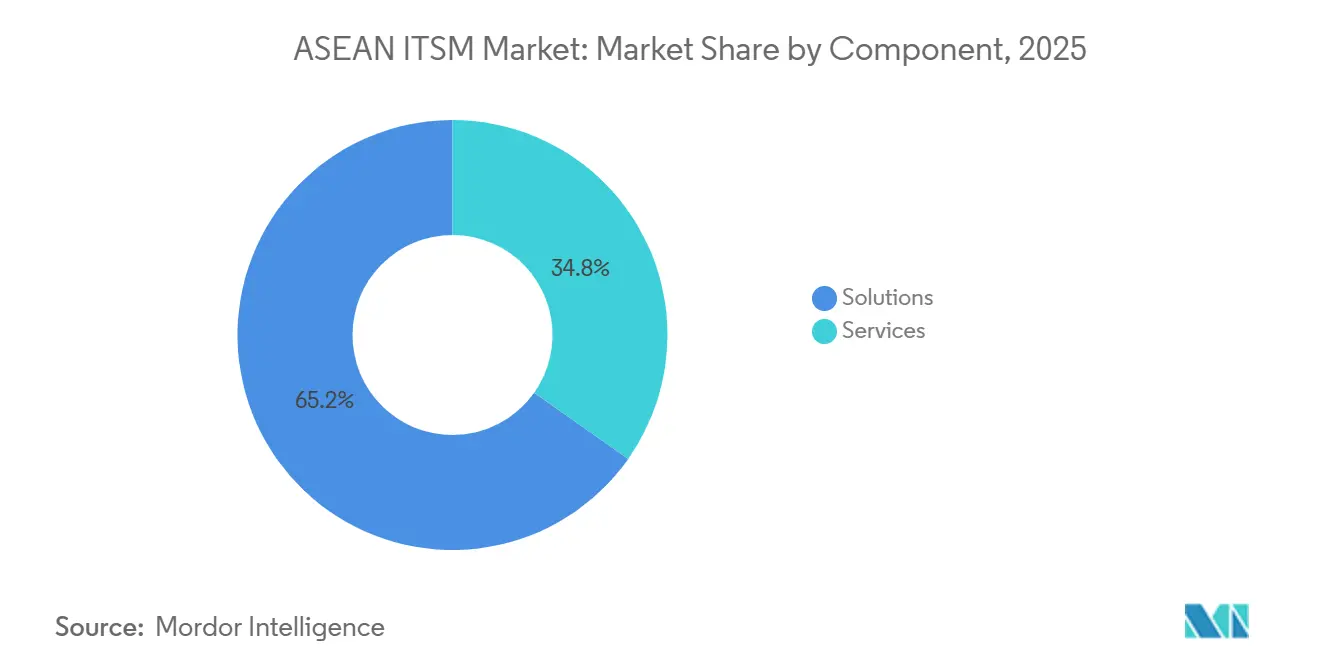
Solutions accounted for 65.22% of the ASEAN ITSM market size in 2025, while Services is projected to grow at a 23.01% CAGR through 2031. That mix reflects a platform-first buying pattern, in which enterprises begin with core modules and then add partner support once workflows become more formalized. In the ASEAN ITSM market, larger buyers in Singapore and Malaysia have tended to start with multi-module purchases that cover incidents, assets, and change processes in the same rollout cycle. This behavior has helped software platforms capture the larger initial spend, especially where governance and reporting requirements are already well established. Even so, the growth profile shows that service revenue is becoming more important as implementation depth increases across the ASEAN ITSM market.
Services are expanding faster because many organizations still need outside support for configuration, training, upgrade planning, and daily administration. HPT Vietnam signed a memorandum of understanding with SMOne and ManageEngine in April 2026 to expand the delivery of ITSM and IT operations management solutions, underscoring how service ecosystems are being built around platform adoption. Cognizant’s May 2026 ServiceNow engagement with JG Summit also illustrates how implementation and managed services are increasingly bundled with platform modernization programs. In practice, buyers in the ASEAN ITSM market are learning that license cost is only one part of the spending profile once workflow design, integrations, and operating governance are considered. That is why the Services segment is moving from a supporting role toward a more recurring commercial layer within the ASEAN ITSM market.


By Deployment: Cloud Leads The Installed Base And The Growth Curve
Cloud held 69.32% of the ASEAN ITSM market size in 2025 and is projected to advance at a 24.42% CAGR through 2031. This dual position as both the largest and fastest-growing deployment model shows that many first-time buyers are skipping on-premises evaluation and moving directly to cloud environments. The ASEAN ITSM market has been especially receptive to this model because greenfield adoption remains common across several industries and national markets. Singapore’s government cloud environment has already embedded Jira Service Management into shared digital support operations, which reinforces confidence in cloud-based service models for regulated use cases. VietinBank’s migration of Jira and Confluence for nearly 4,000 employees also supports the view that scale and regulation do not automatically prevent cloud adoption in the ASEAN ITSM market.
On-premises and hybrid models still remain relevant where local infrastructure control is treated as a compliance requirement rather than a technical preference. Indonesia, Vietnam, and parts of government and financial services continue to keep localized or mixed environments because data handling rules can narrow deployment flexibility. Hybrid models are also practical for large groups that want a common service layer while keeping certain subsidiary systems on separate upgrade cycles. This is creating a more divided demand profile inside the ASEAN ITSM market, where smaller cloud-first buyers and larger regulated enterprises do not follow the same deployment path. Vendors that support both rapid cloud rollout and controlled hybrid governance are therefore in a stronger position across the ASEAN ITSM market.
By Application: Service Desk Remains Foundational While Knowledge Tools Gain Value
Service Desk and Incident Management held 30.42% of the 2025 application mix in the ASEAN ITSM market, making it the largest application segment. This lead reflects the fact that formal ticketing and incident handling are usually the first visible step in service management maturity. Many organizations in Vietnam and the Philippines are still consolidating fragmented support processes that were previously spread across departments or handled through informal channels. That keeps service desk demand central because a unified intake model is often needed before asset, change, and release workflows can scale cleanly. As a result, the ASEAN ITSM market still treats incident handling as the operational anchor for broader platform adoption.
Knowledge Management is projected to grow at a 22.99% CAGR through 2031, which shows that the next phase of adoption is moving toward smarter deflection and faster agent support. Freshworks stated in 2026 that AI Insights reduced ticket trend analysis time from one hour to three minutes for Amerisure, illustrating how knowledge tools are shifting from static storage to active support intelligence. The same change is visible in AI agent rollouts, where self-service and retrieval models are helping enterprises reduce repeat tickets before they reach human teams. Change and Release Management is also gaining importance as organizations align DevOps speed with formal governance. Together, these shifts are increasing the value of application depth inside the ASEAN ITSM market rather than limiting buyers to basic ticket management alone.
By End-User Industry: IT And Telecom Leads While Healthcare Expands Fastest
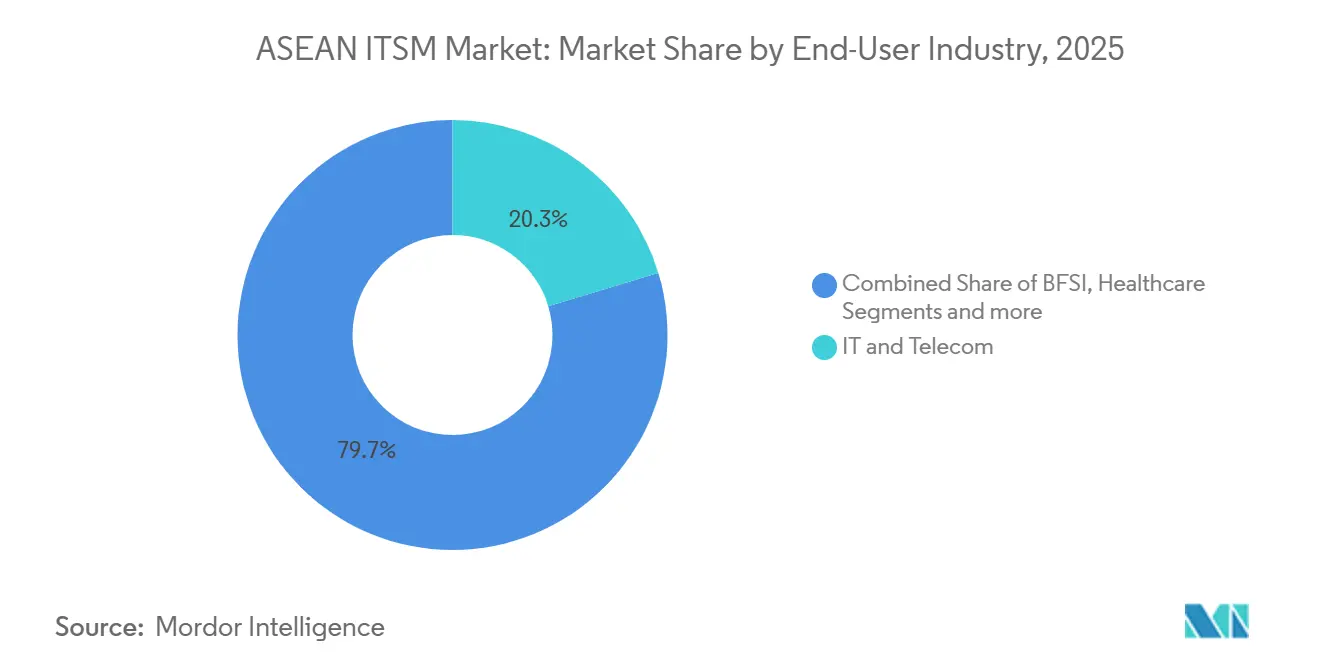
IT and Telecom held 20.34% of the ASEAN ITSM market in 2025, giving it the largest end-user position among tracked industries. This leadership is consistent with the sector’s heavier service complexity, faster application change cycles, and greater need for formal incident and change governance. BFSI also remains a major buyer group because auditability, uptime discipline, and system interdependence push banks and financial institutions toward structured service processes. In the ASEAN ITSM market, manufacturing, public sector, retail, e-commerce, and travel segments are also expanding adoption, but many of them are still in earlier maturity stages. That means service-heavy rollout models remain common outside the most digitally mature sectors in the ASEAN ITSM market.
Healthcare is projected to grow at a 23.22% CAGR through 2031, making it the fastest-expanding end-user segment. Zuellig Pharma used Jira Service Management Cloud to connect IT help desk, HR data collection, and clinical CRM workflows, showing how service management is moving deeper into operational healthcare environments. That case matters because healthcare support needs are no longer limited to internal technology tickets and now extend into patient data systems, clinical applications, and regulated workflow controls. Vendors that can deliver modular, compliance-aware deployment models are likely to find stronger traction as these use cases broaden. This keeps healthcare positioned as one of the most commercially attractive demand pockets within the ASEAN ITSM market.

By Enterprise Size: Large Enterprises Drive Revenue While SMEs Shape Future Adoption
Large Enterprises held 63.00% of ASEAN ITSM market share in 2025, while SMEs are projected to grow at a 23.02% CAGR through 2031. Large organizations still account for most spending because they face stronger regulatory oversight, broader application estates, and a higher need for formal service governance. Singapore and Malaysia have a deeper base of mature enterprise buyers, and many of them are already extending beyond core IT support into wider enterprise service workflows. This keeps large accounts central to near-term revenue, especially for multi-module suites and managed services programs. At the same time, the growth rate shows that the future trajectory of the ASEAN ITSM market depends heavily on the next wave of smaller and mid-sized adopters.
The SME opportunity is being opened by easier deployment, lower upfront infrastructure needs, and more channel-led distribution. EasyVista and OTRS Group found that 62% of Malaysian SMBs recognized ITSM as a strategic opportunity, yet 35% still relied on basic ticketing, spreadsheets, or manual workarounds, which points to a usability gap rather than a demand gap. Freshworks partnered with Unisys in February 2025 to expand Freshservice and Device42 access through a managed services channel aimed at mid-market and smaller enterprise buyers. ManageEngine has also continued to strengthen its Southeast Asia partner footprint, which supports the channel-heavy sales motion that SMEs often prefer in the ASEAN ITSM market. These patterns suggest that simpler rollout models, local support, and packaged service bundles will be important to how the ASEAN ITSM market widens beyond its large enterprise base.
Geography Analysis
Singapore held 30.51% of ASEAN ITSM market share in 2025, which kept it as the largest country market in the region. Its lead reflects strong institutional maturity, high enterprise digitization, and a policy environment that has treated digital service delivery as a national priority. Singapore Government Technology Agency has embedded Jira Service Management into its Government Commercial Cloud service environment, showing how ITSM discipline supports public digital operations at scale. Singapore also ranked 2nd in the 2025 IMD World Digital Competitiveness Index and 3rd in the 2024 UN E-Government Development Index, which strengthens its position as a reference market for regulated service deployments[2]Singapore Government Technology Agency, “SGTS Product Updates, GCC,” Government Technology Agency, docs.developer.tech.gov.sg. Indonesia and Malaysia form the next important demand layer in the ASEAN ITSM market, though their growth patterns are shaped by different commercial and regulatory conditions.
Indonesia’s demand is influenced by tighter compliance requirements across finance, government, and digital operations, which raises the need for more auditable service processes. Malaysia is showing strong commercial momentum through partner-led expansion and direct vendor investment. ManageEngine reported 25% revenue growth in Malaysia in 2025 and opened its first dedicated office in the country in 2026, which points to deeper local commitment in the ASEAN ITSM market. These two markets are important because they combine large enterprise opportunity with rising mid-market adoption. Their performance also shows that the ASEAN ITSM market is not being shaped by one single route to scale, since compliance-led buying and partner-led expansion are both active growth models.
Vietnam is the fastest-growing geography in the ASEAN ITSM market and is projected to expand at a 24.11% CAGR through 2031. The Vietnamese government allocated VND 95 trillion, equivalent to USD 3.6 billion, from the 2026 state budget for digital transformation, up from nearly USD 950 million in 2025, which is creating a stronger public-sector technology pipeline[3]Ministry of Information and Communications, “Viet Nam to Allocate US$3.6 Billion for Development of Science, Technology, Innovation in 2026, Prime Minister,” Vietnam Ministry of Information and Communications, beta-en.mic.gov.vn. VietinBank’s 2025 cloud migration and HPT Vietnam’s 2026 partnership with SMOne and ManageEngine both suggest that enterprise deployment is moving beyond pilot use cases into broader execution. Thailand is building demand through strong BFSI adoption, while the Philippines is benefiting from large group contracts and a more investable mid-market layer. The rest of ASEAN remains earlier in maturity and still relies more on regional service partners than on deep local platform ecosystems.
Competitive Landscape
The ASEAN ITSM market remains moderately concentrated at the platform layer, with ServiceNow and Atlassian holding strong positions in large enterprise environments and a broader mid-tier of Freshworks, ManageEngine, Ivanti, SysAid, TOPdesk, and other vendors competing for expansion. Competition is also shaped by the delivery layer because implementation partners and managed service providers have a direct influence on buying confidence, rollout speed, and ongoing platform adoption. HCLTech, TCS, Wipro, DXC Technology, Fujitsu, and Cognizant are among the firms expanding platform-aligned service capabilities to support enterprise transformation programs across the ASEAN ITSM market. This structure keeps the market from becoming highly concentrated because software choice and service choice are often evaluated together. It also gives enterprises more room to mix platform vendors with different implementation partners based on sector and deployment needs.
Several recent strategic moves show how vendors are trying to widen their position in the ASEAN ITSM market. Freshworks introduced AI Agent Studio in May 2026 to let enterprises build no-code AI agents inside Freshservice and connect them with collaboration and business applications[4]Freshworks Inc., “Freshworks Unveils AI Agent Studio in Freshservice to Unlock Service Transformation That Drives Compounding Business Growth,” GlobeNewswire, globenewswire.com. Freshworks also added continuous infrastructure discovery and dependency mapping into Freshservice in April 2026 through its Device42 integration, strengthening its position in asset and configuration intelligence. Cognizant’s ServiceNow engagement with JG Summit further shows that large implementation programs remain an important route to vendor visibility in the region [5]Cognizant, “JG Summit Selects Cognizant for ServiceNow Implementation and Managed Services Engagement,” PR Newswire, prnewswire.com. HCLTech’s long-term AI-led partnership with Neste also reinforces how service modernization capabilities are being used to strengthen enterprise relationships beyond pure software resale.
Competitive pressure is also increasing because buyers in the ASEAN ITSM market are paying closer attention to implementation simplicity, AI readiness, and long-term operating cost. Atlassian’s broader service collection growth and expansion of service management use cases outside central IT show that challengers are pushing harder into workflows once dominated by established enterprise platforms. At the same time, channel-based vendors such as ManageEngine continue to build traction through local partner ecosystems and more modular product packaging. Healthcare and SMEs remain open areas where no single vendor has yet built an uncontested reference position across the region. That leaves the ASEAN ITSM market competitive enough for new wins, even though the leading platforms still hold clear advantages in large and highly governed accounts.
ASEAN ITSM Industry Leaders
ServiceNow, Inc.
Atlassian Corporation Plc
BMC Software, Inc.
Freshworks Inc.
Zoho Corporation Pvt. Ltd.
- *Disclaimer: Major Players sorted in no particular order

Recent Industry Developments
- June 2026: Inspira Enterprise, a global cybersecurity and AI services provider with offices in Singapore and Sydney, announced a strategic partnership with ServiceNow covering the full platform portfolio, including AICT, Veza identity governance, and Armis asset intelligence. The agreement positioned Inspira as a unified delivery partner for integrated IT, security, and AI governance outcomes across the Asia Pacific region.
- June 2026: HCLTech announced a long-term AI-led efficiency transformation partnership with Neste, the world’s leading producer of sustainable aviation fuel. Under the engagement, HCLTech is driving IT service consolidation and building an agile technology capability aligned with Neste’s core renewables operations, a contract that underscores HCLTech’s growing mandate in IT service management modernization for industrial enterprises.
- May 2026: Freshworks unveiled its AI Agent Studio within Freshservice at the Refresh 2026 conference, introducing a no-code platform for deploying custom and pre-built AI agents integrated with enterprise tools including Microsoft Teams, Slack, Workday, and Rippling. The launch also included a Model Context Protocol Gateway and Experience Level Agreements, targeting enterprises seeking agentic ITSM automation without deep AI engineering resources.
- May 2026: Cognizant was selected by JG Summit Holdings, one of the Philippines’ largest and most diversified conglomerates, for a ServiceNow implementation and managed services engagement. Cognizant is deploying ServiceNow ITSM Professional, IT Asset Management, Hardware Asset Management, and Software Asset Management Pro to establish a unified, AI-ready IT governance platform across JG Summit’s multi-industry portfolio.
- April 2026: Freshworks introduced a reimagined IT Asset Management capability within Freshservice, integrating continuous infrastructure discovery and dependency mapping, capabilities acquired through its Device42 purchase, directly into the ITSM platform. The expansion enables organizations to unify ITSM, ITAM, and ITOM data layers, providing AI agents with accurate infrastructure context for faster, more reliable incident resolution.
- April 2026: HPT Vietnam Corporation signed a memorandum of understanding with SMOne and ManageEngine to expand the ManageEngine partner ecosystem and strengthen ITSM and IT operations management solution delivery across Vietnam. The collaboration covers the full ManageEngine portfolio including ServiceDesk Plus, ITOM, AD360, and over 120 related products.


ASEAN ITSM Market Report Scope
The ASEAN IT Service Management (ITSM) Market Report is Segmented by Component (Solutions, Services), Deployment (Cloud, On-Premises, Hybrid), Application (Service Desk and Incident Management, Asset and Configuration Management, and More), End-User Industry (BFSI, Manufacturing, and More), and Enterprise Size (Large Enterprises, Small and Medium Enterprises). The Market Forecasts are Provided in Terms of Value (USD).
| Solutions |
| Services |
| Cloud |
| On-Premises |
| Hybrid |
| Service Desk |
| Asset and Configuration Management |
| Change and Release Management |
| Service Request Management |
| Knowledge Management |
| Other ITSM Applications |
| BFSI |
| Manufacturing |
| Government and Public Sector |
| IT and Telecom |
| Retail and E-Commerce |
| Healthcare |
| Travel and Hospitality |
| Other End-User Industries |
| Large Enterprises |
| Small and Medium Enterprises |
| Singapore |
| Indonesia |
| Malaysia |
| Thailand |
| Vietnam |
| Philippines |
| Rest of ASEAN |
| By Component | Solutions |
| Services | |
| By Deployment | Cloud |
| On-Premises | |
| Hybrid | |
| By Application | Service Desk |
| Asset and Configuration Management | |
| Change and Release Management | |
| Service Request Management | |
| Knowledge Management | |
| Other ITSM Applications | |
| By End-User Industry | BFSI |
| Manufacturing | |
| Government and Public Sector | |
| IT and Telecom | |
| Retail and E-Commerce | |
| Healthcare | |
| Travel and Hospitality | |
| Other End-User Industries | |
| By Enterprise Size | Large Enterprises |
| Small and Medium Enterprises | |
| By Geography | Singapore |
| Indonesia | |
| Malaysia | |
| Thailand | |
| Vietnam | |
| Philippines | |
| Rest of ASEAN |


Key Questions Answered in the Report
What is the current and forecast size of the ASEAN ITSM market?
The ASEAN ITSM market stood at USD 396.03 million in 2025, rises to USD 481.89 million in 2026, and is forecast to reach USD 1,334.63 million by 2031 at a 22.60% CAGR.
Which deployment model is leading demand across Southeast Asia?
Cloud is the leading deployment model, with 69.32% share in 2025, and it is also the fastest-growing mode with a 24.42% CAGR through 2031.
Which application area is the main entry point for ITSM adoption in ASEAN?
Service Desk and Incident Management remains the main starting point, holding 30.42% of the 2025 application mix because many organizations begin with unified ticketing and incident control.
Why are managed services becoming more important in ASEAN ITSM adoption?
Services are growing at a 23.01% CAGR because many organizations still need outside help for integration, rollout, training, governance, and daily administration.
Which country is growing fastest in ASEAN for ITSM adoption?
Vietnam is the fastest-growing country market, with a projected 24.11% CAGR through 2031, supported by public digital spending and rising enterprise deployment activity.
Which end-user segment is creating the strongest new opportunity?
Healthcare is the fastest-growing end-user segment at a 23.22% CAGR, driven by rising demand for service governance across clinical systems, HR workflows, and regulated operational support.
Page last updated on:





