
Market Overview
| Study Period | 2021 - 2031 |
|---|---|
| Forecast Data Period | 2026 - 2031 |
| Historical Data Period | 2021 - 2024 |
| Growth Rate | 3.18 % |
| Market Concentration | Low |
Major Players *Disclaimer: Major Players sorted in no particular order Image © Mordor Intelligence. Reuse requires attribution under CC BY 4.0. | |
ASEAN Heat Exchanger Market Analysis by Mordor Intelligence
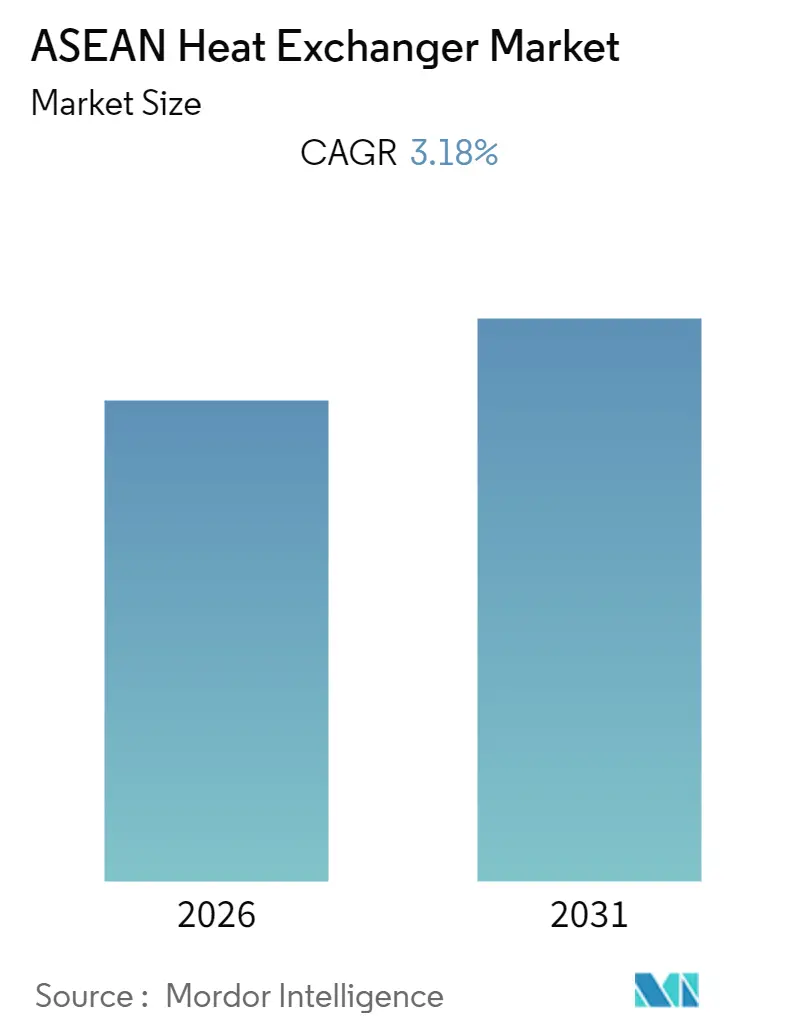
The ASEAN Heat Exchanger Market size is expected to register a CAGR of 3.18% during the forecast period (2026-2031).
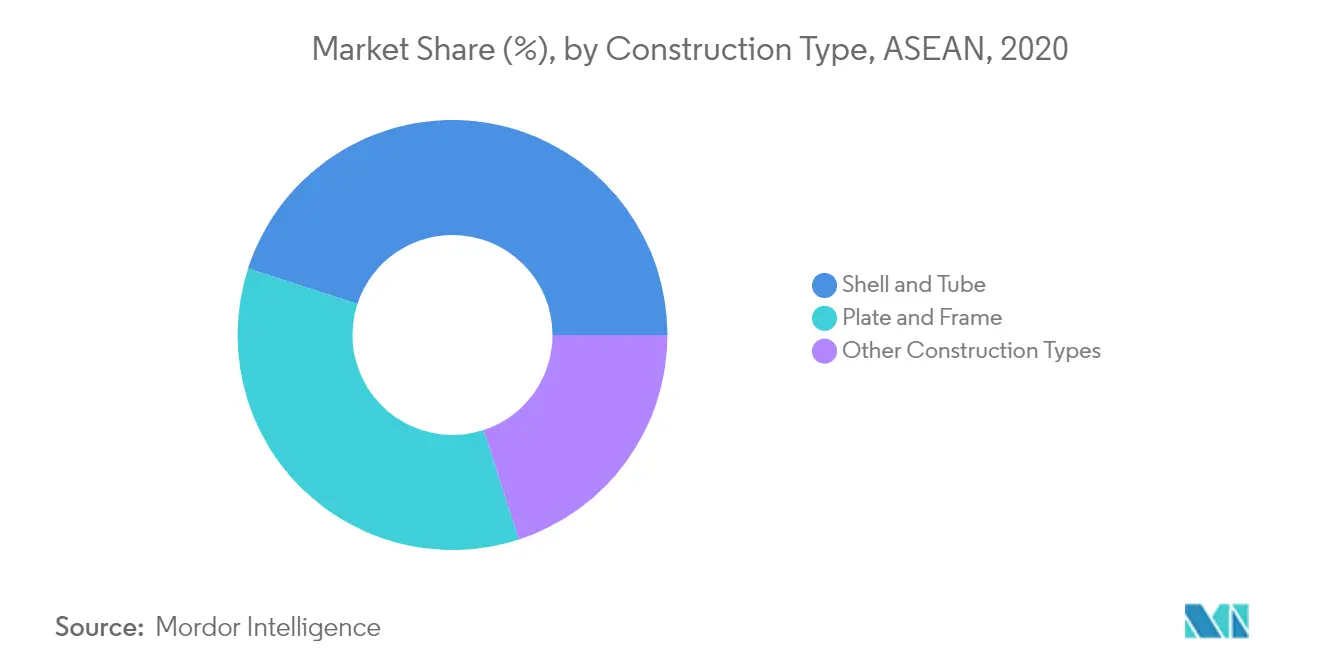
- Shell and Tube heat exchangers are expected to witness significant growth during the forecast period, owing to the multiple associated benefits when compared to other construction types. They are most commonly used heat exchangers for industrial applications.
- Technological advancements and upgradations are likely to create immense opportunities for the heat exchanger market in ASEAN region soon.
- Indonesia is expected to witness significant demand during the forecast period, owing to the plans of increasing power generation capacity in the coming years.
Note: Market size and forecast figures in this report are generated using Mordor Intelligence’s proprietary estimation framework, updated with the latest available data and insights as of 2026.
Market Trends and Insights
Shell and Tube Heat Exchangers Expected to Witness Significant Growth
- Shell and tube heat exchangers consists of a shell and many tubes placed inside it, where one fluid runs through the shell and another fluid runs through the tube to transfer heat. These type of heat exchangers are most commonly used in oil refineries and other large scale pharmaceutical & chemical industries.
- Their ability to transfer heat at very high temperature, less servicing requirement and, low maintenance features make it more preferable over other counterparts. In addition, they are also capable of operating in wide range of fluids.
- These heat exchangers are manufactured at very low costs and offer effective & robust construction. They are ideal and flexible for wide range of applications where constant maintenance and servicing is required. Also, they are resistant to thermal shocks and have no dimensional limits, thus, creating positive business outlook for shell and tube heat exchangers.
- Some common types of shell and tube heat exchangers used in different industries, are direct contact heat exchangers, co-current (Parallel) flow heat exchangers, and recuperators and regenerative heat exchangers.
- The high pressure and temperature along with long-distance heat transfer causes significant wear and tear, which results in regular maintenance and periodic replacement of shell and tube heat exchangers. Therefore, replacement of shell and tube heat exchangers is likely to play a key role in growing the ASEAN heat exchangers market during the forecast period.
- Therefore, based on the above-mentioned factors, shell and tube heat exchangers are expected to witness significant growth in ASEAN heat exchangers market during the forecast period.
Indonesia is Expected to Witness Significant Demand
- Mounting energy demand across Indonesia is expected to increase the power generation installed capacity, in turn, driving the deployment of heat exchangers over the forecast timeframe. Thermal power is mostly generated from various sources such as natural gas, coal, oil, and others, which requires a heat exchanger to transfer the heat between two systems.
- According to the International Energy Agency (IEA), ASEAN is one of the few regions of the world where coal-fired generation has been expanding, with close to 20 GW of new coal-fired generating capacity under construction, mostly in Indonesia (a major coal producer), Vietnam and the Philippines. Significantly more capacity is at the pre-construction stage, but some plans are being reconsidered and greater emphasis is being placed on natural gas as well as the expansion of renewables.
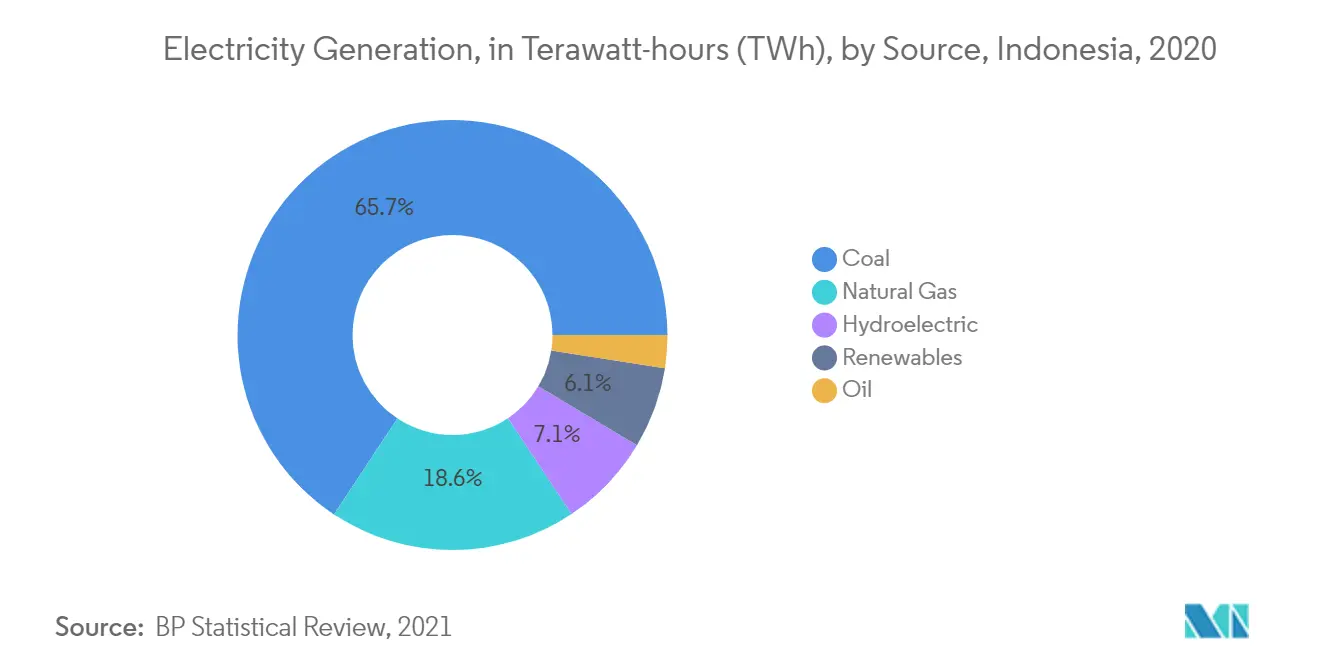
- Indonesia is expected to become the fourth-largest economy in the world by 2040. Coal dominates the Indonesian power mix, supplying around 65% of its electricity in 2020, with natural gas and oil together accounting for around 20% of the supply, with the remainder from renewables, mostly hydro and geothermal. Moreover, ongoing shift towards cleaner energy fuels coupled with boom in the natural gas production across the country institutes a favorable business scenario for the heat exchanger market.
- Furthermore, projects such as withering and drying of Indonesian tea leaves using heat pipe heat exchanger (HPHE) by utilizing low-temperature geothermal energy (in R&D stage, as of 2021) is expected to create immense opportunities in the ASEAN heat exchanger market during the forecast period.
- Therefore, based on the above-mentioned factors, Indonesia is expected to witness significant demand in ASEAN heat exchanger market during the forecast period.
Regulatory Landscape
Regulation affecting heat exchanger selection in ASEAN increasingly reflects regional energy-efficiency and decarbonization programs, alongside national compliance regimes for industrial facilities. The ASEAN Plan of Action for Energy Cooperation (APAEC) 2016-2025 (Phase II: 2021-2025) provides a coordinated anchor for energy efficiency and standards coordination across member states, while ASEAN-led harmonization initiatives and sectoral mutual recognition frameworks (such as the ASEAN EEE MRA guidance) support cross-border acceptance of test methods and conformity assessment for equipment used in industrial energy systems.
At the country level, energy-efficiency requirements for cooling and thermal systems shape specification choices and verification practices, particularly in large industrial and commercial installations. For example, Singapore's National Environment Agency (NEA) requirements and guidelines on measurement and verification for Minimum Energy Efficiency Standards (MEES) in water-cooled chilled water systems include compliance deadlines set for December 1, 2025 for in-scope systems, reinforcing demand for higher-efficiency heat transfer equipment and documentation aligned to regulated M&V practices.
Value Chain Analysis
The ASEAN heat exchanger value chain spans raw materials (stainless steel, copper, nickel alloys, and titanium), fabrication and component manufacturing (plates, tubes, gaskets, brazing and welding consumables), OEM design and assembly (including regional manufacturers such as HISAKAWORKS S.E.A. in Malaysia), and downstream channels through EPC contractors, system integrators, and industrial service providers that handle installation, maintenance, cleaning, and performance optimization. Demand pull comes primarily from oil and gas, power generation, and chemical sites, where exchanger selection is tied to uptime requirements and life-cycle cost, supporting a recurring aftermarket for inspection and replacement in high-temperature and high-pressure duty cycles.
Key constraints in the regional chain include reliance on imported high-grade alloys and specialized parts, varying customs and local compliance needs, and additional time for engineering documentation and certification workflows (commonly referenced standards include ASME/PED in project specifications). Trade and standards harmonization efforts under ASEAN mechanisms reduce friction for compliant equipment moving across borders, but lead times remain sensitive to material availability and project-specific qualification requirements, keeping local assembly, stocking, and service networks important differentiators for suppliers.
Competitive Landscape
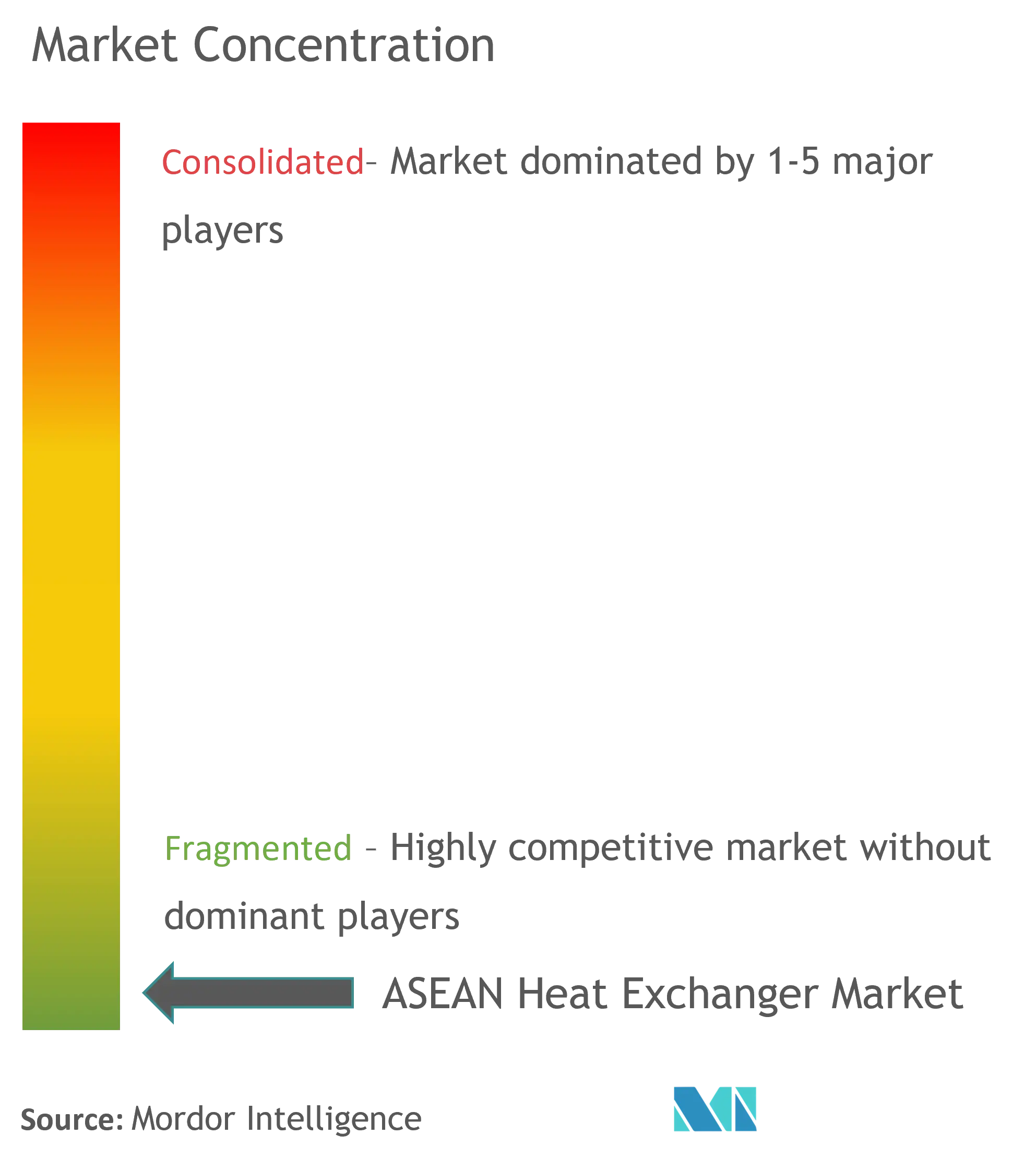
The ASEAN heat exchanger market is fragmented. Some of the major players include Alfa Laval AB, General Electric Company, Danfoss AB, Xylem Inc., and Kelvion Holding GmbH.
ASEAN Heat Exchanger Industry Leaders
-
Alfa Laval AB
-
General Electric Company
-
Danfoss AB
-
Xylem Inc.
-
Kelvion Holding GmbH
- *Disclaimer: Major Players sorted in no particular order
ASEAN Heat Exchanger Market Companies Covered in this Report
- Alfa Laval AB
- General Electric Company
- Danfoss AB
- Kelvion Holding GmbH
- Xylem Inc.
- Hisaka Works, Ltd.
- SPX FLOW, Inc.
- Thermax Limited
- Chart Industries, Inc.
- Barriquand Technologies Thermiques SAS
Market Opportunities and Future Outlook
Industrial decarbonization and efficiency programs across Southeast Asia are translating into procurement needs for waste heat recovery, electrified heat, and higher-efficiency cooling, which increases the role of heat exchangers in brownfield retrofits and new-build projects. Under the APAEC 2016-2025 policy backdrop and broader national focus on energy performance in large cooling systems, including Singapore NEA's MEES-related measurement and verification requirements with a December 1, 2025 compliance deadline for in-scope chilled water systems, industrial sites are pushed toward documented efficiency improvements. This is translating into demand for engineered heat transfer equipment, as well as testing and monitoring services.
Named, near-term project activity also points to gaps in advanced designs and localized supply. In March 2026, Econotherm was awarded a contract to supply a 6.6 MW heat pipe-based fired-heater air preheater to a refinery in Thailand, highlighting refinery-side interest in higher-effectiveness heat recovery solutions. In June 2026, InnoTek Limited announced an approximately SD 7.5 million investment in a liquid-cooling components manufacturing facility in Chonburi, Thailand, reflecting growing regional capability build-out for high-performance thermal management hardware that uses plate- and liquid-cooling architectures. In parallel, localized engineering and service providers in Indonesia (for example, PT Rekuvindo Perdana) indicate a route to scale through retrofit-focused supply, maintenance, and performance-upgrade engagements in energy-intensive plants.
Recent Industry Developments in ASEAN Heat Exchanger Market
- June 2026: GE Vernova secured an order for two 9HA.02 gas turbines and associated equipment for Vietnam Electricity (EVN) at the 1.6 GW Quang Trach II LNG power plant in Vietnam. The scope includes combined-cycle-related equipment where heat recovery and balance-of-plant thermal systems are central, supporting demand for high-performance heat transfer equipment in large power projects. The award also reinforces an active pipeline of LNG-to-power builds that drive exchanger requirements across HRSG, cooling, and auxiliary systems.
- May 2026: Alfa Laval launched the TS45 semi-welded plate heat exchanger aimed at high-capacity, high-pressure duties, including industrial heat pumps and carbon capture applications. The product targets operating envelopes where leakage control and robustness are critical, expanding options for customers shifting toward higher-efficiency thermal processes. This adds competitive pressure in premium plate heat exchanger segments used in energy-transition-linked industrial retrofits.
- October 2024: GE Vernova announced an order for a 9HA.01 gas turbine and a heat recovery steam generator (HRSG) for YTL PowerSeraya's 600 MW hydrogen-capable power plant in Singapore. The HRSG component directly ties to heat transfer equipment demand within combined-cycle configurations and sets performance benchmarks for suppliers supporting high-efficiency generation assets. The hydrogen-capable framing also steers thermal system specifications toward materials and designs suited to flexible operation.
ASEAN Heat Exchanger Market Report Scope and Research Methodology
Market Definition and Coverage
For this study, the market covers heat exchangers sold and installed across ASEAN for industrial and commercial heat transfer duties, valued at manufacturer and channel selling prices, and counted when equipment is supplied for new projects or as replacement units.
Scope exclusions: We exclude on-site fabrication labor, standalone piping and valves, insulation, and aftermarket services such as cleaning-only and inspection-only work.
Segments Covered in This Report
- Construction Type
- Shell and Tube
- Plate and Frame
- Other Construction Types
- End-User
- Oil and Gas
- Power Generation
- Chemical
- Others End-Users
- Geography
- Singapore
- Malaysia
- Thailand
- Indonesia
- Rest of ASEAN Countries
Data Sources, Market Sizing, and Validation
Desk Research
Desk research was used to build the core demand map by country and end-use, and to understand how project cycles flow into equipment orders. We mainly pulled public energy, industry, and trade signals, and then aligned them with typical heat exchanger placement in refineries, power plants, and chemical units.
Common references included ASEANstats and country statistical offices for industrial output, UN Comtrade for trade flows under relevant product headings, International Energy Agency publications for capacity additions and fuel trends, and World Bank indicators for manufacturing and construction momentum. We also reviewed environmental and energy efficiency requirements released by national regulators, along with association and conference materials that describe project pipelines in oil and gas and power. To tighten the player and pricing view, we complemented public information with paid subscriptions for company financials and intelligence, news and financials tracking, and an import-export shipment-level database where available. These sources are illustrative and not exhaustive, and other public and paid references were also used for data collection, validation, and clarification.
Primary Interviews and Surveys
Primary work focused on verifying what portion of project spending actually converts into exchanger orders, and how buying decisions differ across countries and end users. We spoke with a mix of OEM-side teams, distributors, EPC-facing participants, and plant maintenance stakeholders across ASEAN to cross-check capacity additions, replacement cycles, and realized pricing in recent bids. Where desk inputs conflicted, assumptions were re-tested with respondents from multiple countries so the final model matched on-the-ground deal patterns.
Distribution of primary research fieldwork respondents
| Company type | Respondent position |
|---|---|
| Top tier: 29% | CXOs: 17% |
| Mid tier: 51% | Functional/Unit leaders: 38% |
| Smaller Players: 20% | Managers: 45% |
Market-Sizing & Forecasting
Sizing was built by reconstructing the demand pool from end-use activity in ASEAN, and then converting that activity into equipment spend using practical placement ratios. The top-down and bottom-up approach was run through country-level project signals such as refinery and petrochemical capacity additions, thermal power and process plant upgrades, and manufacturing output changes, which were then translated into expected exchanger procurement.
To keep totals realistic, selective bottom-up checks were added, including sampled price-per-unit ranges for shell and tube versus plate designs, channel markups where distributors are active, and a supplier roll-up for a limited set of visible projects. Key inputs that mattered in this market included the share of exchanger demand tied to new builds versus turnarounds, typical replacement intervals in continuous-process plants, metal intensity effects on average selling prices, and the timing of large EPC awards that shift deliveries across years. When direct country data was missing, gaps were handled using proxy indicators like nearby-country project mix and trade flow directionality, followed by an interview-based sanity check.
Forecasting leaned on scenario analysis because project starts can move with oil prices, power demand, and permitting timelines. Variables were projected with simple trend smoothing and known project schedules, and then adjusted using expert consensus on lead times, utilization levels, and expected pricing progression.
Data Validation & Update Cycle
We validated outputs by comparing implied equipment volumes and spend against independent signals like industrial capex direction, major project announcements, and trade movements for exchanger-related categories. Outliers were flagged when country shares or end-use splits shifted too sharply year over year, and the drivers were rechecked before final sign-off.
A multi-step internal review is followed so assumptions, arithmetic, and currency conversions are consistent across the workbook and written analysis. Reports are refreshed annually, with interim updates triggered by material events such as large project cancellations, major capacity approvals, or sharp commodity-driven pricing changes. Before delivery, the latest news and data points are re-screened so clients receive an up-to-date view.
Mordor Intelligence's Asean Heat Exchanger Market Size Compared Against Other Published Estimates
Published market sizes for ASEAN heat exchangers can look far apart because firms do not count the same thing, and because base years, pricing points, and country coverage are not always aligned. Differences also come from whether the number is tied to equipment shipments, installed value, or broader heat-transfer systems spending.
By tracking project-level capacity additions and turnaround cycles and then refreshing ASP assumptions with country-specific validation checks, Mordor Intelligence keeps the total focused on exchanger equipment value inside ASEAN rather than adjacent mechanical packages. Some estimates expand scope into full cooling systems, installation labor, or include wider Asia-Pacific countries, which increases the stated value even when the underlying demand pool is similar.
Benchmark comparison
| Source | Market Size | Gaps in Research Methodology |
|---|---|---|
| Mordor Intelligence | USD 0.69 B (2024) | |
| Industry Publisher A | USD 0.47 B (2023) | Uses a country subset approach and reports a narrower product boundary that appears closer to import-only equipment, which can undercount domestically produced or intra-ASEAN supplied units. |
| Industry Publisher B | USD 1.10 B (2023) | Likely bundles heat exchangers into broader cooling and process equipment packages and applies faster ASP growth across years, which can inflate value versus exchanger-only equipment sales. |
The spread mostly comes down to what is included in the spend line and how ASEAN demand is rebuilt from real project activity. When the scope is kept to exchanger equipment and checked against country project timing and pricing, the resulting number is easier to trace and repeat year to year.
Key Questions Answered in the Report
What is the current ASEAN Heat Exchanger Market size?
The ASEAN Heat Exchanger Market is projected to register a CAGR of 3.18% during the forecast period (2026-2031)
Who are the key players in ASEAN Heat Exchanger Market?
Alfa Laval AB, General Electric Company, Danfoss AB, Xylem Inc. and Kelvion Holding GmbH are the major companies operating in the ASEAN Heat Exchanger Market.
What years does this ASEAN Heat Exchanger Market cover?
The report covers the ASEAN Heat Exchanger Market historical market size for years: 2020, 2021, 2022, 2023 and 2024. The report also forecasts the ASEAN Heat Exchanger Market size for years: 2026, 2027, 2028, 2029, 2030 and 2031.