
ASEAN Cosmetics Products Market Size and Share
Market Overview
| Study Period | 2021 - 2031 |
|---|---|
| Forecast Data Period | 2026 - 2031 |
| Base Year Market Size (2025) | USD 7.29 Billion |
| Market Size (2026) | USD 7.71 Billion |
| Market Size (2031) | USD 10.51 Billion |
| Growth Rate (2026 - 2031) | 6.39 % |
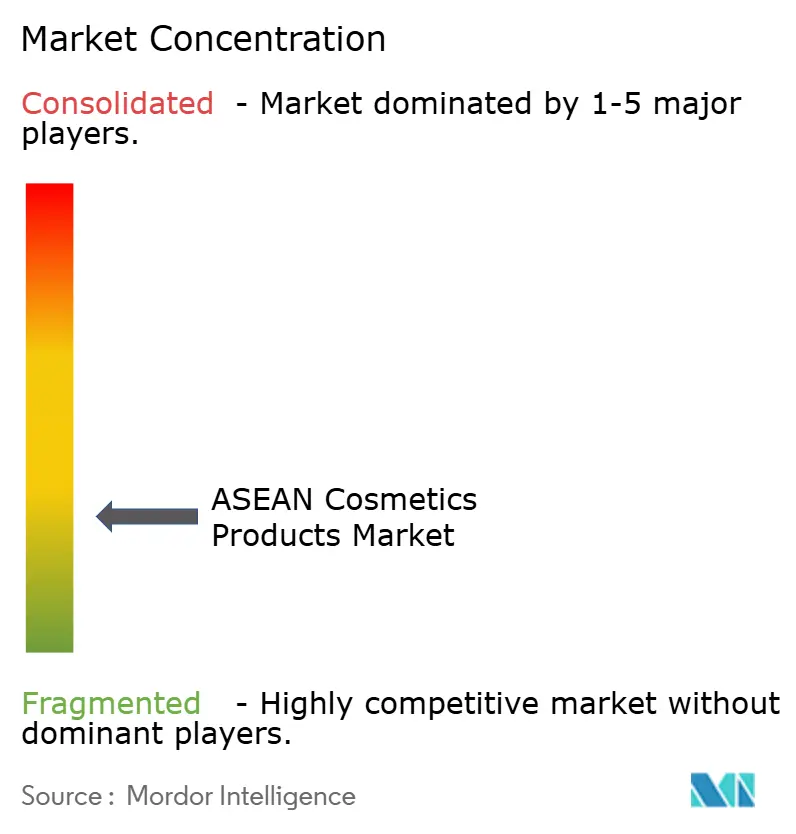
| Market Concentration | Low |
Major Players *Disclaimer: Major Players sorted in no particular order Image © Mordor Intelligence. Reuse requires attribution under CC BY 4.0. | |
ASEAN Cosmetics Products Market Analysis by Mordor Intelligence
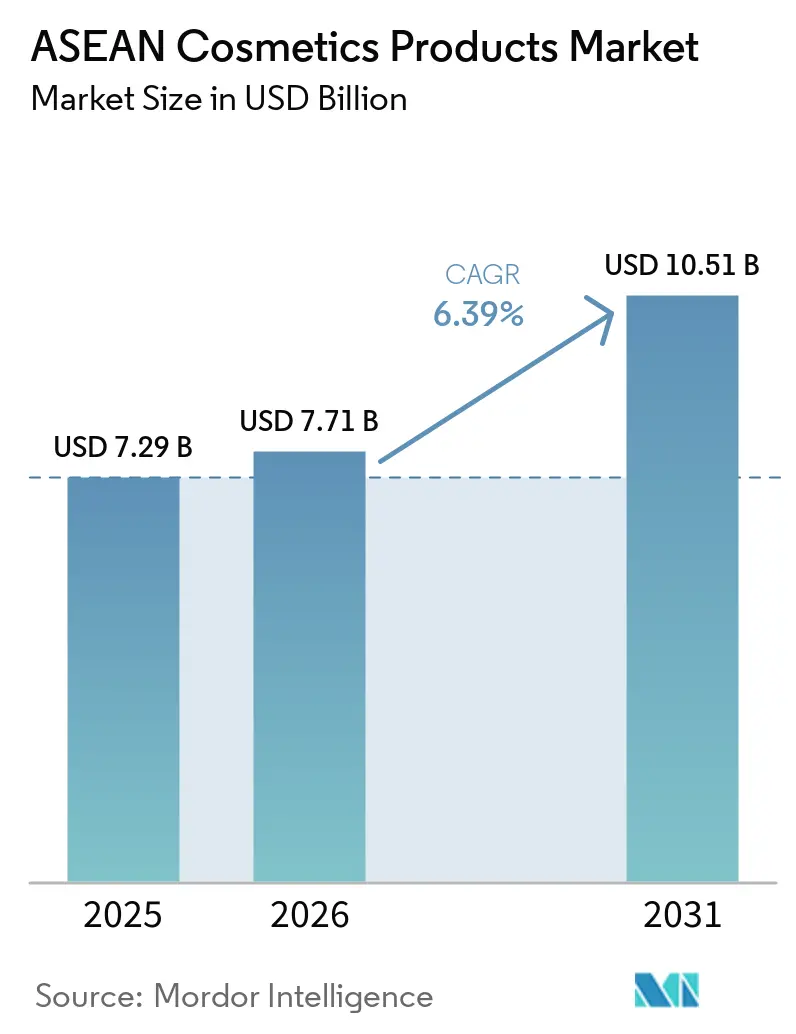
The ASEAN cosmetics products market size is expected to grow from USD 7.29 billion in 2025 to USD 7.71 billion in 2026 and is forecast to reach USD 10.51 billion by 2031 at a 6.39% CAGR over 2026-2031. The market is experiencing sustained growth, driven by rising urbanization, improving disposable incomes, growing beauty awareness, and increasing demand across both mass-market and premium consumer segments. The market is also benefiting from the growing popularity of clean, halal, natural, and multifunctional beauty products, reflecting evolving consumer preferences for ingredient transparency, product safety, and sustainability. Rapid growth in e-commerce, social commerce, and digital beauty platforms has further improved product accessibility and consumer engagement across the region. Manufacturers are increasingly focusing on localized product development, climate-appropriate formulations, and continuous product innovation to address diverse consumer needs.
Key Report Takeaways
- By product type, facial make-up products held 38.20% of the ASEAN cosmetics products market share in 2025, while eye make-up products are projected to grow at 7.25% CAGR through 2031, with faster demand formation visible across Vietnam, Thailand, and the Philippines.
- By category, mass products accounted for 72.80% of the ASEAN cosmetics products market share in 2025, while premium products are forecast to expand at 8.08% CAGR through 2031, led by stronger premium uptake in Malaysia, Singapore, and urban Thailand.
- By nature, conventional/synthetic products represented 81.60% share in 2025, while natural/organic products are expected to advance at 9.58% CAGR through 2031, with the strongest relevance in Indonesia, Malaysia, Thailand, and Singapore.
- By distribution channel, offline retail stores held 68.40% share in 2025, while online retail stores are projected to rise at 9.74% CAGR through 2031, with the clearest digital acceleration in Indonesia and Vietnam.
- By geography, Indonesia captured 34.80% of regional revenue in 2025, while Vietnam is forecast to post the fastest 2026-2031 CAGR at 8.22%, supported by stronger social commerce-led beauty spending.
Note: Market size and forecast figures in this report are generated using Mordor Intelligence’s proprietary estimation framework, updated with the latest available data and insights as of January 2026.
Market Trends and Insights
Drivers Impact Analysis of ASEAN Cosmetics Products Market*
| Driver | (~) % Impact on CAGR Forecast | Geographic Relevance | Impact Timeline |
|---|---|---|---|
| Rising urbanization, premiumization, and masstige beauty demand | +1.4% | ASEAN-wide; concentrated uplift in Indonesia, Vietnam, Philippines | Medium term (2-4 years) |
| Expansion of social commerce and influencer-driven beauty sales | +1.6% | Indonesia, Vietnam, Thailand; cross-border TikTok Shop and Shopee ecosystem | Short term (≤ 2 years) |
| Growing demand for halal, clean, and science-backed cosmetics | +1.1% | Indonesia, Malaysia; spill-over to Singapore, Philippines | Medium term (2-4 years) |
| Growing influence of K-Beauty and J-Beauty trends across ASEAN | +0.8% | Thailand, Vietnam, Singapore; expanding to Philippines, Indonesia | Medium term (2-4 years) |
| Growing adoption of multifunctional and hybrid beauty products | +0.5% | ASEAN-wide; urban consumers in Indonesia and Thailand lead adoption | Medium term (2-4 years) |
| Increasing male grooming and gender-neutral beauty adoption | +0.4% | Indonesia, Thailand, Vietnam, Malaysia, Philippines | Long term (≥ 4 years) |
| Source: Mordor Intelligence | |||
Rising urbanization, premiumization, and masstige beauty demand
Rapid urbanization across ASEAN is expanding the consumer base for cosmetics products by increasing access to modern retail, organized beauty stores, and digital commerce. According to the ASEAN Socio-Cultural Community (2025), ASEAN became predominantly urban in 2020, and 55.7% of the region's population (around 405 million people) is projected to live in urban areas by 2030 [1]. Alongside urbanization, rising disposable incomes are accelerating premiumization and strengthening demand for masstige beauty products that combine premium-quality features with accessible pricing. Consumers are increasingly seeking cosmetics with skincare benefits, natural ingredients, long-wear performance, and attractive packaging outside the luxury price segment. In response, both international and regional brands are expanding their premium and masstige portfolios and introducing products tailored to evolving consumer preferences, supporting sustained growth across the ASEAN cosmetics products market.
Expansion of social commerce and influencer-driven beauty sales
The rapid expansion of digital commerce infrastructure across ASEAN is strengthening social commerce and creating new growth opportunities for cosmetics brands. According to the Digital and Sustainable Trade Facilitation in ASEAN 2025 report, ASEAN achieved an 83% implementation rate for digital trade facilitation measures in 2025, up from 79% in 2023[2]. The report also notes that wider adoption of digital trade facilitation measures could reduce trade costs across ASEAN by nearly 7.5%, supporting more efficient cross-border e-commerce and improving market access for beauty brands [3]. These developments are enabling cosmetics companies to leverage social media platforms, influencer marketing, livestream shopping, and creator-led product launches to reach consumers more effectively. Improved digital connectivity and streamlined online purchasing experiences are driving higher consumer engagement, particularly among younger consumers who increasingly discover and purchase beauty products through social commerce channels. As ASEAN's digital trade ecosystem continues to develop, influencer-driven marketing and social commerce are expected to remain key drivers of cosmetics products market growth.
Growing demand for halal, clean, and science-backed cosmetics
Consumer preferences across ASEAN are shifting toward cosmetics that combine ingredient transparency, product safety, and proven efficacy with ethical and halal standards. Growing awareness of clean beauty, naturally derived ingredients, and dermatologically tested formulations is prompting manufacturers to develop products that meet both performance and regulatory expectations. This is particularly evident in Muslim-majority markets, where halal certification is becoming an important purchasing consideration alongside scientific validation and sustainable ingredient sourcing. Recent product launches and industry initiatives reflect this shift toward science-backed and halal cosmetics. In 2025, the Philippine Department of Science and Technology–Industrial Technology Development Institute (DOST-ITDI) introduced a portfolio of halal-compliant cosmetics and personal care products, including moisturizing lipstick, lip balm, anti-aging serum, gel cleanser, and skincare formulations developed using locally sourced natural ingredients and tested to meet ASEAN safety standards. Similarly, Indonesia continues to strengthen its halal cosmetics ecosystem ahead of mandatory halal certification requirements, encouraging manufacturers to expand certified product portfolios and invest in transparent, research-driven formulations.
Growing influence of K-Beauty and J-Beauty trends across ASEAN
The growing influence of K-Beauty and J-Beauty continues to reshape consumer preferences in the ASEAN cosmetics market, driving demand for innovative formulations, minimalist aesthetics, and skincare-infused makeup products. Consumers are increasingly seeking cosmetics that deliver multifunctional benefits, such as hydration, sun protection, long-lasting wear, and skin-friendly ingredients. This has encouraged manufacturers to introduce products inspired by Korean and Japanese beauty philosophies. The widespread availability of these brands through retail stores and cross-border e-commerce has further accelerated their adoption across the region. Social media platforms, beauty influencers, and digital content have increased awareness of Korean and Japanese beauty routines, product innovations, and seasonal trends among younger consumers. This has prompted both international and regional cosmetics companies to develop products featuring lightweight textures, natural finishes, clean formulations, and advanced skincare benefits. As consumer preferences continue to shift toward high-performance and hybrid beauty products, the influence of K-Beauty and J-Beauty is expected to remain a key growth driver in the ASEAN cosmetics products market.
Restraints Impact Analysis of ASEAN Cosmetics Products Market*
| Restraint | (~) % Impact on CAGR Forecast | Geographic Relevance | Impact Timeline |
|---|---|---|---|
| Fragmented ASEAN cosmetic registration and enforcement | -0.5% | All ASEAN member states; most acute for cross-border brands | Long term (≥ 4 years) |
| Counterfeit products and unregulated online sales | -0.7% | Indonesia, Vietnam, Malaysia, Thailand | Short term (≤ 2 years) |
| Growing consumer concerns regarding ingredient safety | -0.4% | Singapore, Malaysia, Thailand (high ingredient-literacy markets) | Medium term (2-4 years) |
| Challenges in achieving sustainable and ethical ingredient sourcing | -0.4% | Indonesia, Thailand; sourcing communities in Sumatra, Kalimantan | Long term (≥ 4 years) |
| Source: Mordor Intelligence | |||
Fragmented ASEAN cosmetic registration and enforcement
Although the ASEAN Cosmetic Directive provides a common regulatory framework, individual member states maintain country-specific requirements for product notification, labeling, ingredient restrictions, language, documentation, and post-market surveillance. As a result, cosmetics manufacturers must adapt products and compliance processes across multiple jurisdictions, increasing the time and resources required to introduce products across the region. Differences in regulatory implementation and enforcement create operational complexities for both multinational and regional cosmetics companies. Frequent updates to national regulations, varying compliance timelines, and differing interpretations of safety and labeling requirements can delay product launches and increase compliance costs. These regulatory inconsistencies present a particular challenge for smaller manufacturers with limited regulatory resources, restraining the pace of regional market expansion.
Counterfeit products and unregulated online sales
The widespread availability of counterfeit cosmetics and unregulated online sales remains a significant challenge for the ASEAN cosmetics market. The rapid expansion of e-commerce, social commerce, and cross-border marketplaces has increased consumer access to beauty products, but has also made it easier for counterfeit and non-compliant products to enter the market. These products often bypass regulatory oversight, raising concerns about product authenticity, safety, and ingredient quality. Counterfeit cosmetics can erode consumer trust, damage brand reputation, and intensify price competition for legitimate manufacturers. Inconsistent enforcement across digital marketplaces and cross-border supply chains also makes it difficult for regulatory authorities to monitor and remove unauthorized products effectively. As a result, established brands continue to invest in product authentication technologies, consumer awareness initiatives, and stronger distribution controls to reduce the impact of counterfeit and unregulated cosmetics sales.
*Our forecasts treat driver/restraint impacts as directional, not additive. The impact forecasts reflect baseline growth, mix effects, and variable interactions.
ASEAN Cosmetics Products Market Segment Analysis
By Product Type:
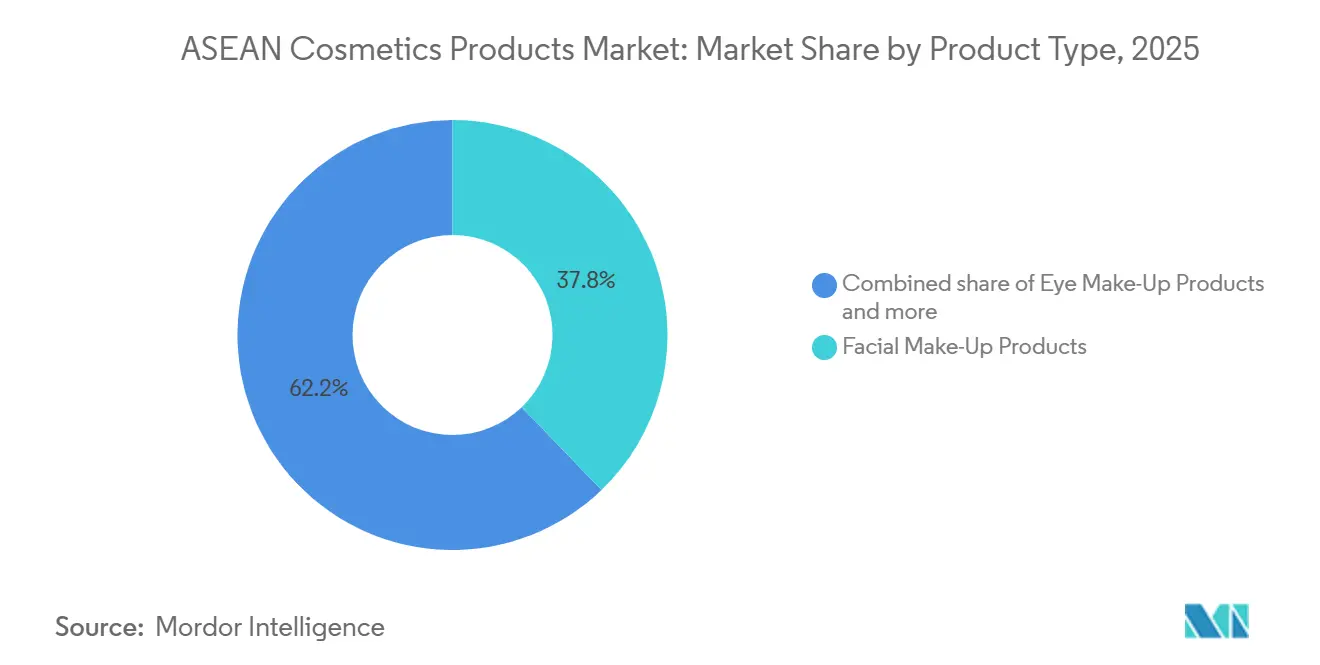
Eye Make-up Acceleration Reshaping the Category MixFacial make-up products accounted for the largest share of the ASEAN cosmetics products market, capturing 38.20% of revenue in 2025. The segment's dominance is supported by consistent demand for foundation, compact powder, concealer, and blush, which form the core of everyday beauty routines across the region. Growing consumer preference for long-wear, lightweight, and skincare-infused base makeup products, along with broad availability through offline and online retail channels, continues to reinforce the segment's position. Manufacturers are also introducing formulations suited to tropical climates, further supporting sustained demand.
Eye make-up products are projected to register the fastest growth, expanding at a CAGR of 7.25% during 2026–2031. Growth is driven by increasing consumer interest in expressive eye makeup, supported by the widespread influence of K-beauty trends, beauty influencers, and short-form video content on digital platforms. Rising demand for products such as mascara, eyeliner, and eye shadow, along with continuous product innovation featuring smudge-proof, waterproof, and long-lasting formulations, is encouraging higher product adoption across ASEAN. The expanding availability of premium and mass-market eye makeup products is expected to further accelerate segment growth over the forecast period.

By Category:
Mass Dominance Entrenched, Premium Acceleration IntensifyingMass products accounted for the largest share of the ASEAN cosmetics market, capturing 72.80% of revenue in 2025. The segment's dominance is driven by strong demand for affordable cosmetics across a broad consumer base, particularly in developing ASEAN economies where value for money remains a key purchasing factor. Manufacturers continue to strengthen this segment by offering products with enhanced formulations, including skincare ingredients and long-lasting performance, making mass-market cosmetics increasingly appealing to quality-conscious consumers.
The premium products segment is projected to record the fastest growth, expanding at a CAGR of 8.08% during 2026–2031. Rising disposable incomes, increasing beauty awareness, and growing consumer preference for high-performance and multifunctional cosmetics are driving demand for premium offerings across the region. The expansion of the masstige segment, which combines premium product attributes with relatively accessible pricing, is further encouraging consumers to trade up from conventional mass-market products. Continuous product innovation, premium packaging, and the growing popularity of clean and science-backed formulations are expected to support sustained growth in the premium category.
By Nature:
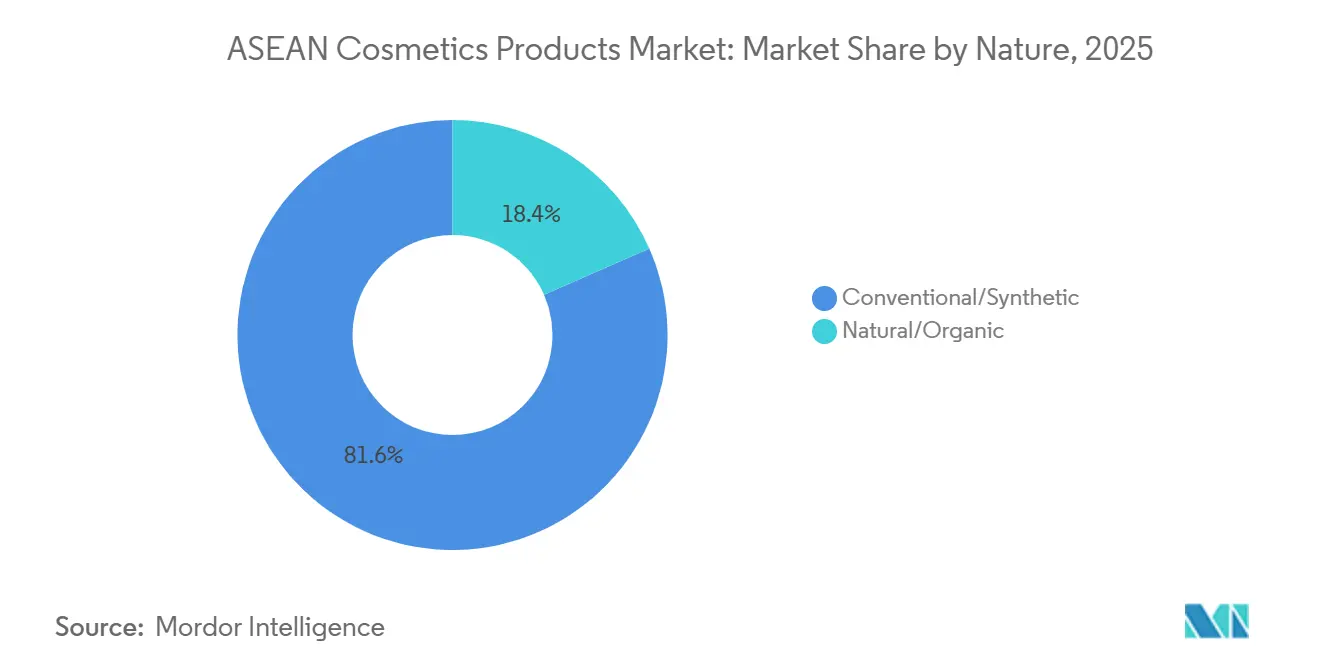
Conventional Segment Dominant, Natural/Organic Defines the Growth HorizonConventional/synthetic products accounted for the largest share of the ASEAN cosmetics market, capturing 81.60% of revenue in 2025. The segment's dominance is supported by widespread availability, cost-effectiveness, and established manufacturing processes, which enable manufacturers to offer a broad range of cosmetics at competitive price points. Synthetic ingredients also provide consistent quality, stability, and product performance, making them the preferred choice across mass-market cosmetics.
Natural/organic products are projected to register the fastest growth, expanding at a CAGR of 9.58% during 2026–2031. Rising consumer awareness of ingredient transparency, sustainability, and product safety is driving demand for cosmetics formulated with naturally derived and plant-based ingredients. Growing interest in clean beauty, halal-certified products, and environmentally responsible formulations is further supporting segment growth. Manufacturers are responding by expanding their portfolios with botanical extracts, naturally sourced ingredients, and clean-label formulations to meet evolving consumer preferences across ASEAN.
By Distribution Channel:
Offline Holds Value; Online Rewrites Rules of DiscoveryOffline retail stores accounted for the largest share of the ASEAN cosmetics products market, capturing 68.40% of revenue in 2025. This dominance is supported by consumers' preference for in-store product testing, shade matching, and personalized beauty consultations before purchase. The extensive presence of supermarkets, hypermarkets, pharmacies, specialty beauty stores, and department stores across the region further strengthens offline sales by offering a wide selection of cosmetics and immediate product availability.
Online retail stores are projected to register the fastest growth, expanding at a CAGR of 9.74% during 2026–2031. Growth is driven by the increasing popularity of e-commerce platforms, social commerce, livestream shopping, and influencer-led product promotions, which have changed how consumers discover and purchase cosmetics. Greater smartphone penetration, improved digital payment infrastructure, and the convenience of home delivery are further accelerating online beauty purchases. In response, cosmetics brands are expanding their digital presence and adopting omnichannel strategies to enhance consumer engagement and support long-term market growth.
Geography Analysis
Indonesia Cosmetics Products Market
Indonesia accounted for the largest share of the ASEAN cosmetics products market, contributing 34.80% of regional revenue in 2025. The country's dominance is supported by its large population, expanding middle class, and well-established cosmetics manufacturing base. Rising urbanization, increasing beauty awareness, and strong demand for both mass-market and halal-certified cosmetics continue to drive market expansion. The rapid growth of modern retail formats and e-commerce platforms has further improved product accessibility across urban and secondary cities, reinforcing Indonesia's position as the region's largest cosmetics market.
Vietnam Cosmetics Products Market
Vietnam is projected to register the fastest growth in the ASEAN cosmetics products market, expanding at a CAGR of 8.22% during 2026–2031. Growth is driven by rising disposable incomes, a young digitally connected population, and increasing adoption of online shopping and social commerce. Consumers are demonstrating growing interest in premium, skincare-infused, and international beauty products, while the country's expanding retail infrastructure and favorable digital ecosystem continue to support cosmetics market development. These factors are expected to sustain Vietnam's strong growth momentum throughout the forecast period.
ASEAN Cosmetics Products Market
Thailand, Malaysia, the Philippines, Singapore, and the Rest of ASEAN continue to present significant growth opportunities for cosmetics manufacturers. Thailand remains a key market for premium and innovative beauty products, while Malaysia benefits from strong demand for halal-certified and clean-label cosmetics. The Philippines is witnessing increasing cosmetics consumption supported by its young consumer base and expanding digital retail channels, whereas Singapore serves as an important regional hub for premium beauty brands and product innovation. Meanwhile, emerging markets including Cambodia, Laos, Myanmar, and Brunei are gradually benefiting from rising urbanization, improving retail infrastructure, and increasing availability of international and regional cosmetics brands, creating new opportunities for long-term market expansion.
Competitive Landscape
The ASEAN cosmetics products market is highly fragmented, with numerous international, regional, and domestic manufacturers competing across mass-market and premium segments. Companies such as Shiseido Co., Ltd., L'Oréal S.A., The Estée Lauder Companies Inc., Unilever PLC, and PT Paragon Technology and Innovation maintain strong market positions through broad product portfolios, extensive distribution networks, continuous product innovation, and significant investments in brand building. Local brands continue to strengthen their presence by offering products tailored to regional consumer preferences, including halal-certified, clean-label, and naturally derived cosmetics.
Companies are increasingly focusing on product innovation, digital transformation, and omnichannel retail strategies to strengthen their competitive positions across ASEAN. Hybrid makeup-skincare formulations, AI-enabled beauty technologies, personalized product recommendations, and sustainable packaging have become key areas of differentiation. Many manufacturers are also expanding their direct-to-consumer channels, strengthening partnerships with e-commerce platforms, and leveraging social media and influencer marketing to enhance consumer engagement and brand visibility.
The market is also witnessing the emergence of regional and independent beauty brands capitalizing on changing consumer preferences for clean beauty, vegan formulations, botanical ingredients, and locally inspired products. These companies are increasingly utilizing digital-first business models, social commerce, and influencer collaborations to build brand awareness while targeting niche consumer segments. As consumer demand for personalized, sustainable, and science-backed cosmetics continues to grow, emerging brands are expected to intensify competition and contribute to the continued evolution of the ASEAN cosmetics products market.
ASEAN Cosmetics Products Industry Leaders
-
Shiseido Co., Ltd.
-
L'Oréal S.A.
-
The Estée Lauder Companies Inc.
-
Unilever PLC
-
PT Paragon Technology and Innovation
- *Disclaimer: Major Players sorted in no particular order
ASEAN Cosmetics Products Market Companies Covered in this Report
- Shiseido Co., Ltd.
- L'Oréal S.A.
- The Estée Lauder Companies Inc.
- LVMH
- Amorepacific Corporation
- LG H&H Co., Ltd.
- Unilever PLC
- Beiersdorf AG
- Kao Corporation
- Naruko
- Dr. Wu Skincare Co., Ltd.
- AS Watson Group
- COSMED
- Poya International Co., Ltd.
- Heme Cosmetics
- Solone
- YCY Cosmetics Co., Ltd.
- Topwell Cosmetics Co., Ltd.
- Tair Jiuh Enterprise Co., Ltd.
- PT Paragon Technology and Innovation
- Polaroisin Biotech Cosmetics Co., Ltd.
Recent Industry Developments in ASEAN Cosmetics Products Market
- May 2026: L'Oréal launched the 2026 Big Bang Beauty Tech Innovation Program in Singapore to support startups across the SAPMENA region. The initiative focuses on AI-powered commerce, creator ecosystems, beauty science, and sustainability, with winning startups receiving opportunities to pilot solutions with L'Oréal brands and scale them across 35 regional markets, including ASEAN.
- January 2026: SEPHORA partnered with CJ OLIVE YOUNG to introduce a curated selection of Korean beauty brands across Southeast Asia, including Singapore, Malaysia, and Thailand, expanding consumers' access to trend-driven cosmetics through its omnichannel retail network.
- November 2025: InNature Berhad completed the acquisition of The Body Shop Singapore from The Body Shop International Ltd., expanding its regional retail footprint. The acquisition added 27 stores in Singapore to InNature's existing network across Malaysia, Vietnam, and Cambodia, strengthening its presence in the Southeast Asian beauty and personal care market.
- April 2025: L'Oréal inaugurated its first Livestream Studio in Vietnam to strengthen digital engagement and social commerce across the country's beauty market. The facility enables real-time product demonstrations, expert consultations, and livestream shopping, supporting all 14 L'Oréal brands while enhancing the consumer shopping experience and expanding the company's omnichannel capabilities in Vietnam.
ASEAN Cosmetics Products Market Report Scope
Color cosmetics products are cosmetic formulations used to enhance facial appearance through products for the face, eyes, lips, and nails. They are available in a variety of formulations and price segments to meet evolving consumer beauty preferences. The ASEAN cosmetics products market is segmented by product type, category, nature, distribution channel, and country. Product types include facial make-up products, eye make-up products, lip make-up products, and nail make-up products, with facial products covering foundation, powders, blush, highlighters, and concealers, eye products including eyeliners, mascaras, and eye shadows, and lip products comprising lipsticks, lip glosses, and other lip cosmetics. The market is further segmented into premium products and mass products, as well as conventional/synthetic and natural/organic products. Distribution channels include online retail stores and offline retail stores, with the latter comprising supermarkets/hypermarkets, specialty stores, and other retail channels. The market forecasts are provided in terms of value (USD).
Segmentation Overview
| Facial Make-Up Products | Foundation |
| Compact and Pressed Powders | |
| Blush /Highlighter | |
| Concealer | |
| Others | |
| Eye Make-Up Products | Eyeliners |
| Mascara | |
| Eye Shadow | |
| Others | |
| Lip Make-Up Products | Lipsticks |
| Lip Gloss | |
| Others | |
| Nail Make-Up Products |
| Premium Products |
| Mass Products |
| Conventional/Synthetic |
| Natural/Organic |
| Online Retail Stores | |
| Offline Retail Stores | Supermarkets/Hypermarkets |
| Specialty Stores | |
| Other Distribution Channels |
| Indonesia |
| Thailand |
| Vietnam |
| Malaysia |
| Philippines |
| Singapore |
| Rest of ASEAN |
| By Product Type | Facial Make-Up Products | Foundation |
| Compact and Pressed Powders | ||
| Blush /Highlighter | ||
| Concealer | ||
| Others | ||
| Eye Make-Up Products | Eyeliners | |
| Mascara | ||
| Eye Shadow | ||
| Others | ||
| Lip Make-Up Products | Lipsticks | |
| Lip Gloss | ||
| Others | ||
| Nail Make-Up Products | ||
| By Category | Premium Products | |
| Mass Products | ||
| By Nature | Conventional/Synthetic | |
| Natural/Organic | ||
| By Distribution Channel | Online Retail Stores | |
| Offline Retail Stores | Supermarkets/Hypermarkets | |
| Specialty Stores | ||
| Other Distribution Channels | ||
| By Country | Indonesia | |
| Thailand | ||
| Vietnam | ||
| Malaysia | ||
| Philippines | ||
| Singapore | ||
| Rest of ASEAN | ||
Key Questions Answered in the Report
What is the 2026 size of the ASEAN cosmetics products market?
The ASEAN cosmetics products market stands at USD 7.71 billion in 2026 and is forecast to reach USD 10.51 billion by 2031 at a 6.39% CAGR.
Which country leads cosmetics sales in Southeast Asia?
Indonesia leads regional revenue with a 34.80% share in 2025, making it the largest national base for cosmetics demand in ASEAN.
Which distribution channel is expanding the fastest?
Online Retail Stores are forecast to grow at 9.74% CAGR through 2031, although Offline Retail Stores still held the larger 68.40% share in 2025.
What product group is growing the fastest in makeup?
Eye Make-Up Products are projected to post the fastest product-type growth at 7.25% CAGR through 2031, while Facial Make-Up Products remained the largest segment in 2025.