
Artificial Intelligence Recommendation Software Market Size and Share
Market Overview
| Study Period | 2020 - 2031 |
|---|---|
| Market Size (2026) | USD 5.04 Billion |
| Market Size (2031) | USD 11.94 Billion |
| Growth Rate (2026 - 2031) | 18.83 % |
| Fastest Growing Market | Asia-Pacific |
| Largest Market | North America |
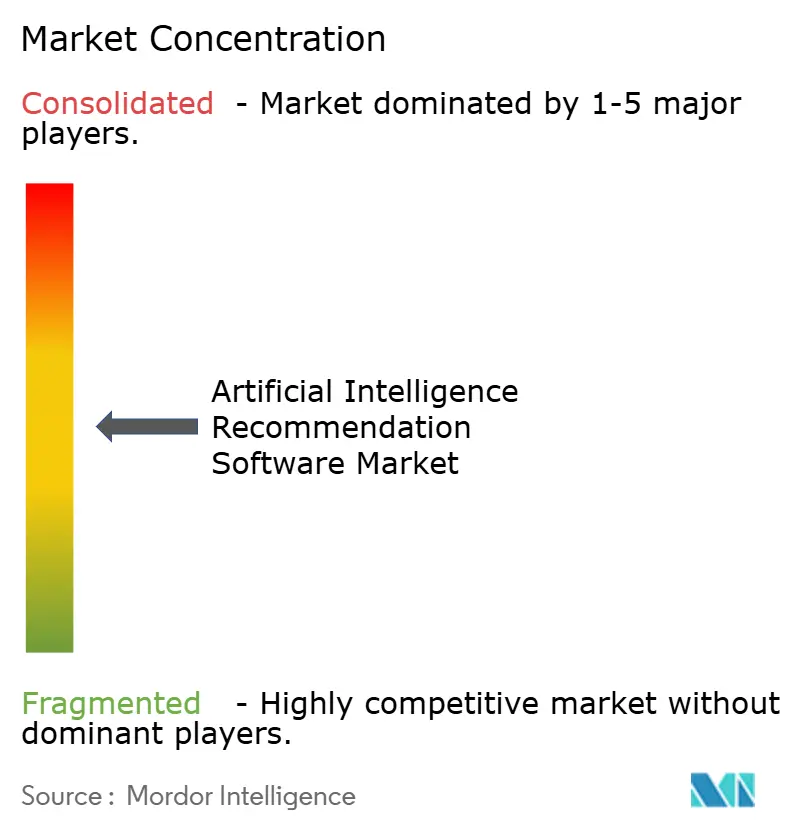
| Market Concentration | Medium |
Major Players *Disclaimer: Major Players sorted in no particular order Image © Mordor Intelligence. Reuse requires attribution under CC BY 4.0. | |
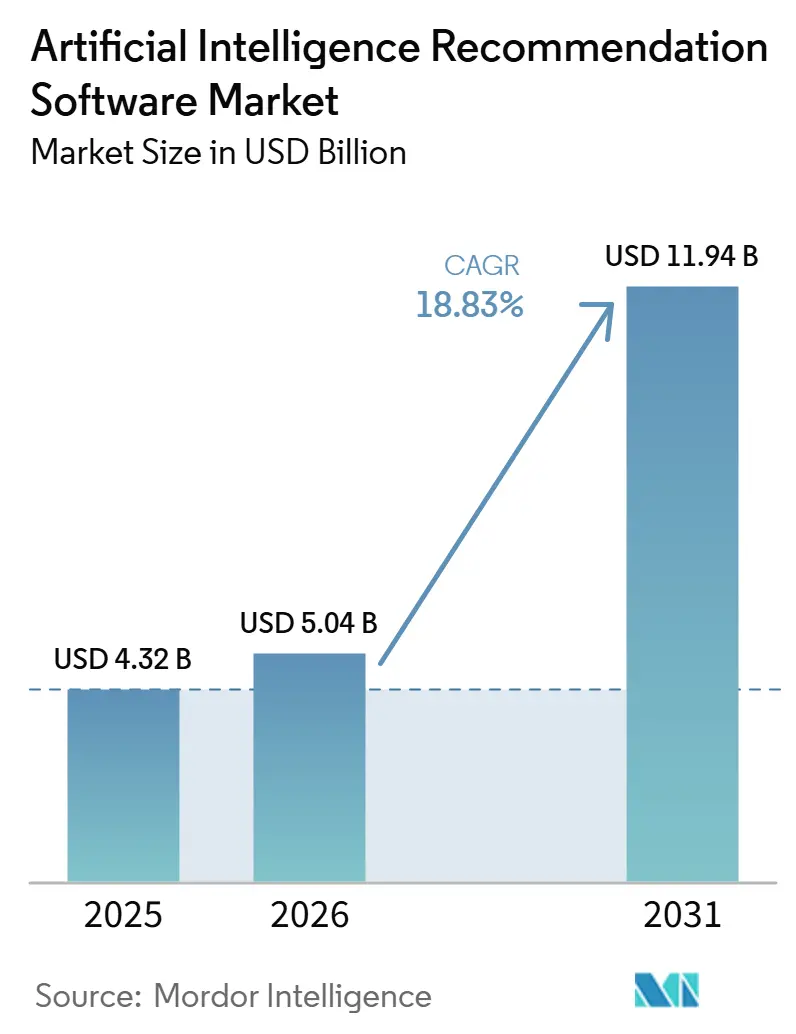
Artificial Intelligence Recommendation Software Market Analysis by Mordor Intelligence
The artificial intelligence recommendation software market size is expected to grow from USD 4.32 billion in 2025 to USD 5.04 billion in 2026 and is forecast to reach USD 11.94 billion by 2031 at 18.83% CAGR over 2026-2031. Growth is being supported by a broad move from basic personalization toward recommendation systems that shape customer journeys, content discovery, and revenue management across enterprise workflows. Demand is no longer limited to digital retail, because healthcare, financial services, and B2B selling are also using recommendation software to improve guidance, matching, and engagement. Generative AI is changing vendor positioning because it can infer user intent from limited behavioral signals and can handle more complex requests than older collaborative filtering models. The shift away from third-party cookies is increasing the value of consented first-party data, which is making data maturity a stronger competitive advantage for enterprises and software vendors. The market is also opening new room for cloud-native providers and service partners as buyers need integration, model tuning, governance support, and explainability features alongside core recommendation capabilities.
Key Report Takeaways
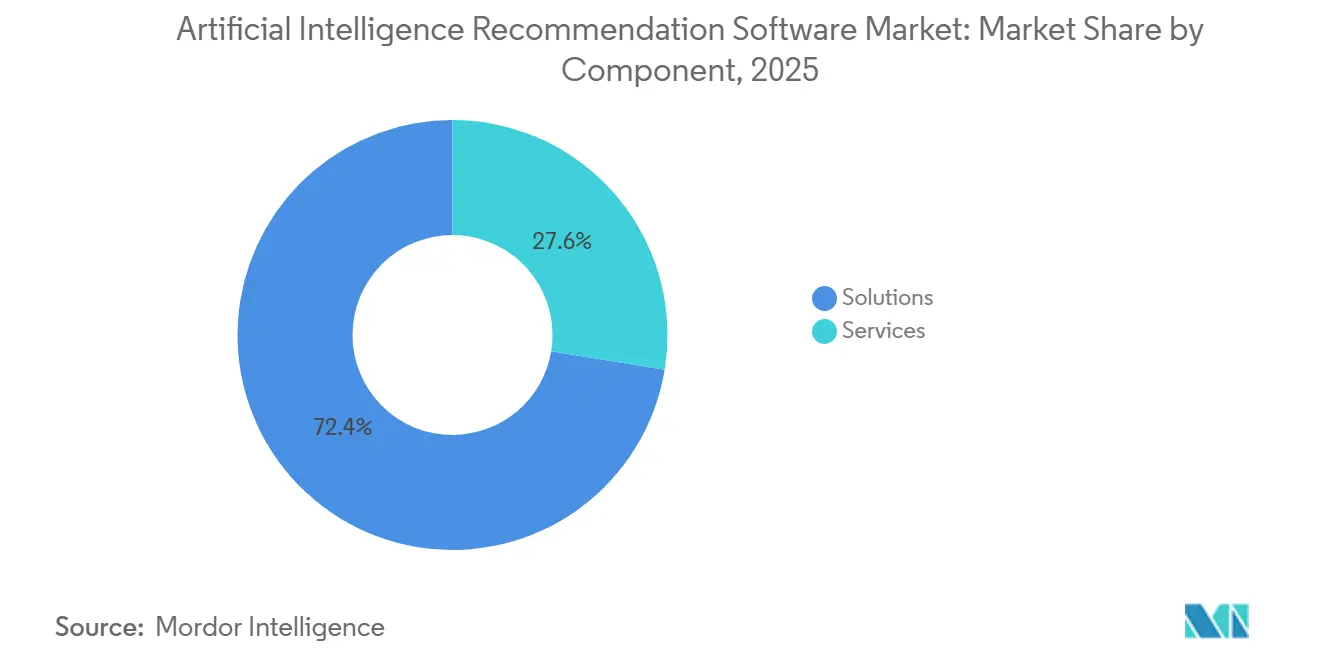
- By component, solutions held 72.41% of revenue in 2025, while services are projected to expand at a 21.84% CAGR through 2031 in the artificial intelligence recommendation software market.
- By recommendation type, product recommendations accounted for 38.62% share in 2025, while search and discovery recommendations are projected to grow at a 22.19% CAGR through 2031.
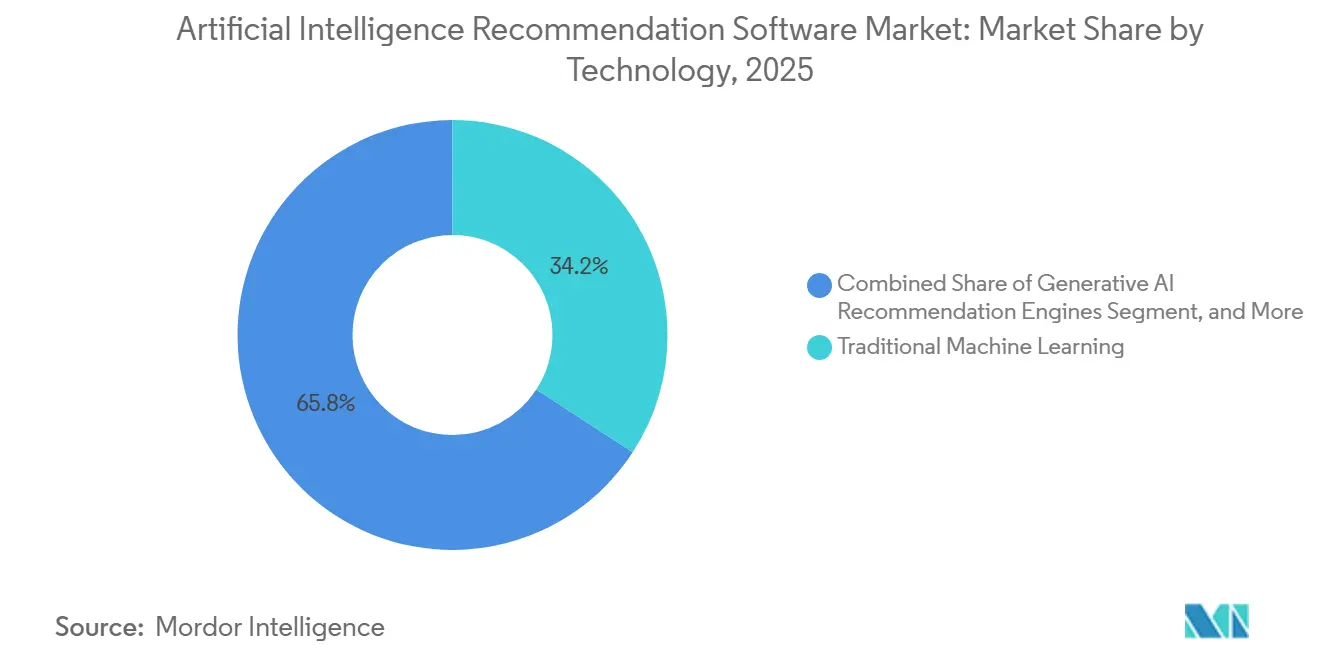
- By technology, traditional machine learning led with a 34.18% share in the artificial intelligence recommendation software market in 2025, while generative AI recommendation engines are expected to advance at a 26.73% CAGR through 2031.
- By business function, customer personalization captured 31.24% share in 2025, while marketing campaign optimization is projected to expand at a 21.46% CAGR through 2031.
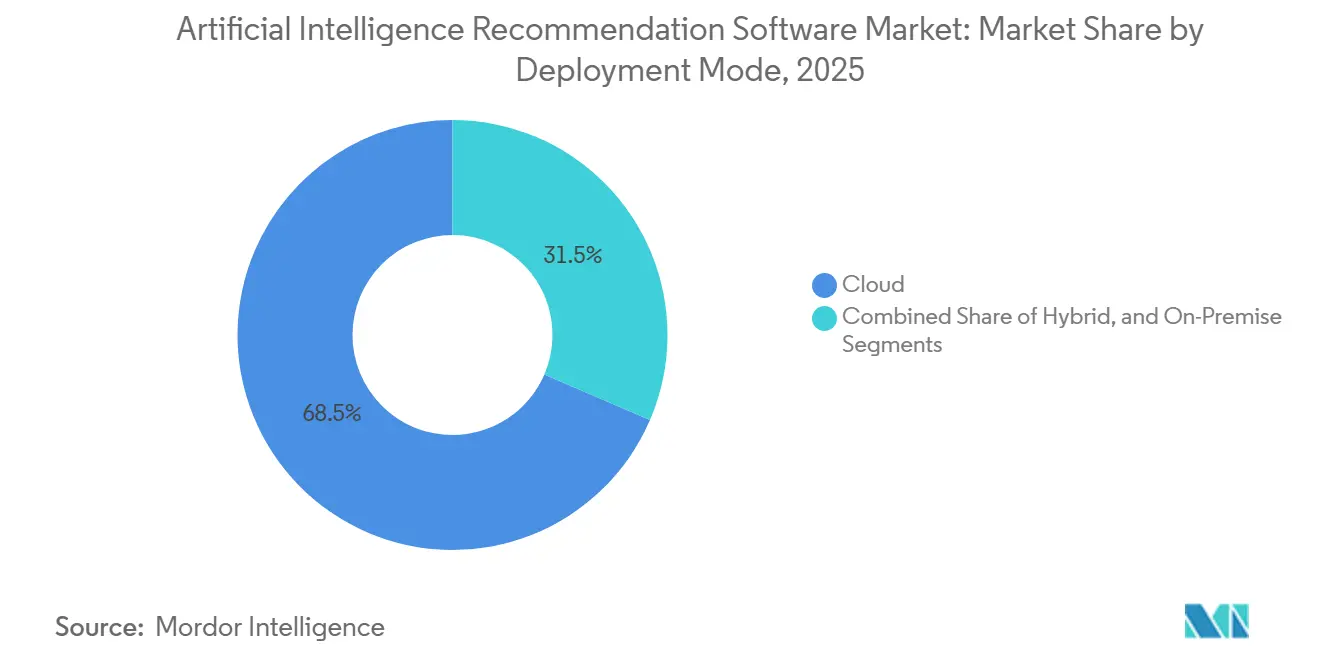
- By deployment mode, cloud accounted for 68.53% of the market in 2025, while hybrid deployment is expected to record a 20.82% CAGR through 2031.
- By enterprise size, large enterprises held 64.79% share in 2025, while small and medium enterprises are projected to grow at a 22.41% CAGR through 2031.
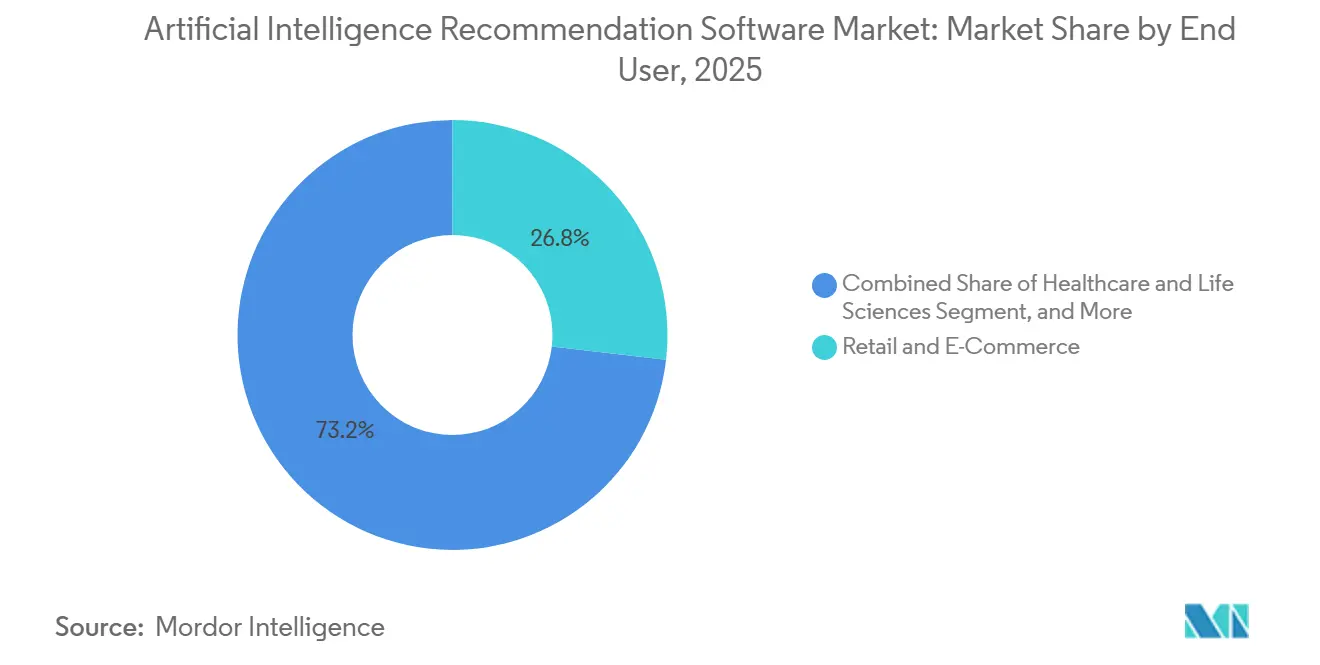
- By end user, retail and e-commerce retained 26.84% share in 2025, while healthcare and life sciences are expected to expand at a 21.37% CAGR through 2031.
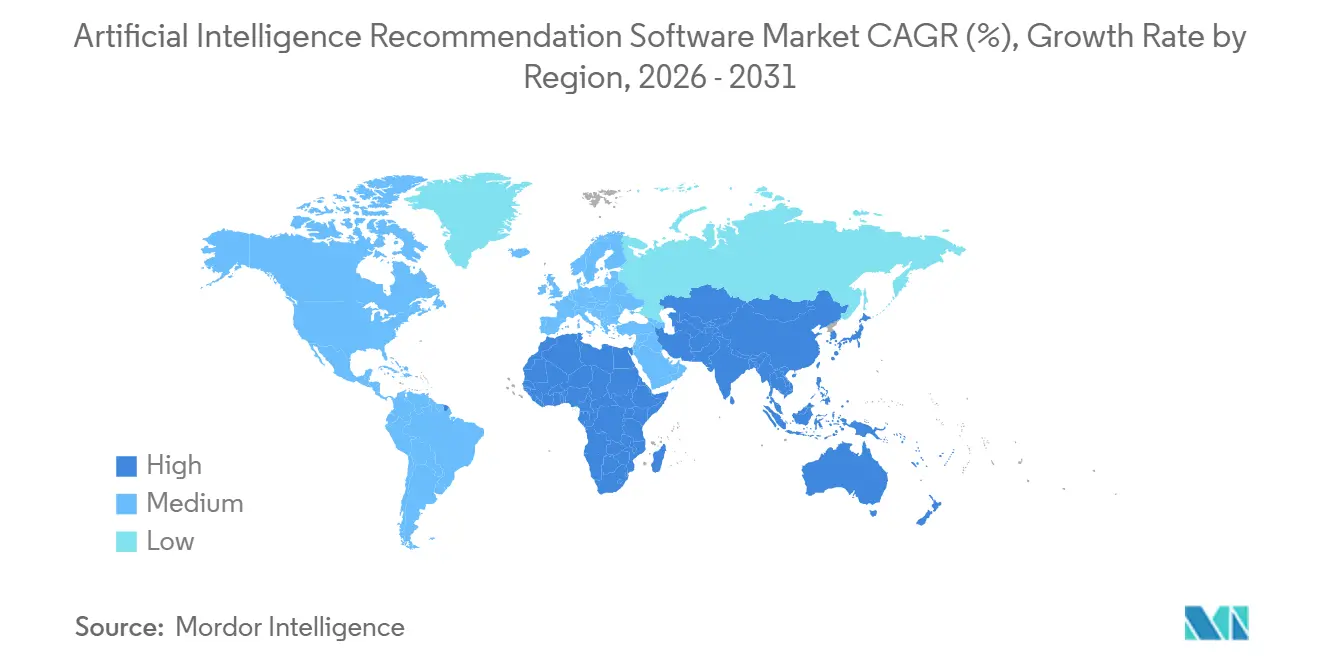
- By geography, North America held 36.42% share in the artificial intelligence recommendation software market in 2025, while Asia-Pacific is projected to grow at a 23.68% CAGR through 2031.
Note: Market size and forecast figures in this report are generated using Mordor Intelligence’s proprietary estimation framework, updated with the latest available data and insights as of January 2026.
Market Trends and Insights
Drivers Impact Analysis of Artificial Intelligence Recommendation Software Market*
| Driver | (~) % Impact on CAGR Forecast | Geographic Relevance | Impact Timeline |
|---|---|---|---|
| Hyper-Personalization Demand in Digital Commerce | +4.2% | Global, with highest intensity in North America and Asia-Pacific | Medium term (2-4 years) |
| Generative AI-Led Intent Understanding | +3.8% | Global, early adoption concentrated in North America and East Asia | Short term (≤ 2 years) |
| Real-Time Ranking for Omnichannel Discovery | +2.9% | Global, particularly North America, Western Europe, and Asia-Pacific | Medium term (2-4 years) |
| First-Party Data Activation Across Walled Gardens | +2.4% | North America and the EU, expanding to Asia-Pacific | Short term (≤ 2 years) |
| Edge Recommendation for Low-Latency Experiences | +1.8% | Asia-Pacific core, with spillover to North America and the Middle East and Africa | Long term (≥ 4 years) |
| Retail Media Monetization Through On-Site Recommendation Placements | +1.6% | North America and the EU, with early gains in Asia-Pacific | Medium term (2-4 years) |
| Source: Mordor Intelligence | |||
Hyper-Personalization Demand in Digital Commerce
The artificial intelligence recommendation software market is being driven by a clear shift from broad audience targeting to real-time recommendations tailored to individual users. Enterprises now treat declared preferences, browsing behavior, purchase history, and loyalty activity as a combined signal set that can support far more precise recommendation decisions. This has moved recommendation software from a campaign-support tool to a core layer of the digital commerce architecture, shaping discovery, retention, and basket expansion. The commercial value of strong personalization remains visible in revenue growth and customer outcomes, even though the artificial intelligence recommendation software market is now judged on broader business impact than click lift alone. Buyers increasingly expect recommendation tools to simultaneously improve conversion, retention, and experience quality, which raises the value of platforms that can connect data, ranking logic, and execution in a single flow. This pattern keeps demand firm across the artificial intelligence recommendation software market because the benefit now extends to product discovery, repeat purchase, and lifetime value management rather than a single isolated channel.
Generative AI-Led Intent Understanding
The artificial intelligence recommendation software market is also being shaped by generative AI models that interpret intent rather than simply retrieving similar items from past activity. Shopify reported that its generative recommender treated buyer sessions as sequential prediction problems and lifted shop orders by 0.94%, high-quality click-through rates by 5%, and conversion by 0.71% in live A/B testing.[1]Shopify Engineering, “The Generative Recommender Behind Shopify's Commerce Engine,” Shopify Engineering, shopify.engineering This matters because enterprises can use a single architecture to read natural language queries, handle sparse behavioral signals, and explain recommendations more directly. Research on JD.com's GenRec framework showed that preference-oriented generative models can support large-scale production recommendation by using denser training signals and by addressing one-to-many recommendation ambiguity.[2]Y. Ma et al., “GenRec: A Preference-Oriented Generative Framework for Large-Scale Recommendation,” arXiv, doi.org The same shift also reduces one of the oldest barriers in the artificial intelligence recommendation software market, because new users and new products no longer need long interaction histories before recommendations become useful. Vendors that can pair these models with reliable retraining, ranking, and governance workflows are gaining ground as buyers look for systems that can scale beyond simple product suggestion engines.
Real-Time Ranking for Omnichannel Discovery
The artificial intelligence recommendation software market is moving toward recommendation systems that can refresh context across web, mobile, store, and conversational touchpoints in near real time. This change matters because a single customer action now needs to update recommendation surfaces across several channels without delay if the experience is to stay consistent. Recommendation quality, therefore, depends not only on model design but also on event streaming, feature freshness, and the ability to preserve context across interactions. Company launches across the commerce software stack in 2026 showed that vendors are building discovery tools around natural language interaction and faster response loops, which reflects the broader move from static search to conversational discovery.[3]Bloomreach Team, “Bloomreach Unveils the Features Ushering in the Agentic Era of Marketing and Ecommerce,” Bloomreach News, bloomreach.com The European Parliament noted that the EU AI Act sits alongside other digital rules and underscores the need for traceability and documentation in automated systems, making real-time logging and audit trails more important in recommendation environments. As a result, the artificial intelligence recommendation software market is rewarding vendors that can combine ranking speed with explainability records and operational monitoring within a single workflow.
First-Party Data Activation Across Walled Gardens
The artificial intelligence recommendation software market is also benefiting from the growing importance of first-party data following the decline of third-party cookie-based tracking. Enterprises are rebuilding recommendation signal flows around consented customer interactions, server-side collection, and tighter control of their own data assets. This shift is not affecting all sectors equally, because companies with rich transaction histories and direct customer relationships have a clearer base for model training. Organizations that invested early in customer data platforms and consent-aware data design are now better positioned to maintain stable recommendation quality across channels. Those that moved later are dealing with both technical catch-up and internal process changes, which slow deployment and keep service demand high in the artificial intelligence recommendation software market. The result is a wider performance gap between data-mature and data-nascent organizations, which supports demand for vendors that can simplify activation, identity resolution, and governance within a single product stack.
Restraints Impact Analysis of Artificial Intelligence Recommendation Software Market*
| Restraint | (~) % Impact on CAGR Forecast | Geographic Relevance | Impact Timeline |
|---|---|---|---|
| Data Privacy and Consent Fragmentation | -2.1% | The EU and North America primarily, expanding globally through Asia-Pacific national regulations | Short term (≤ 2 years) |
| Model Explainability and Bias Governance Gaps | -1.5% | The EU, North America, and global regulated enterprise environments | Medium term (2-4 years) |
| Legacy Stack Integration and Feature Store Complexity | -1.2% | Global, with the heaviest pressure in North American large enterprises and European banking and retail | Long term (≥ 4 years) |
| High Cost of High-Quality Behavioral Data Pipelines | -0.9% | Global, with disproportionate impact on SMEs and emerging market enterprises | Medium term (2-4 years) |
| Source: Mordor Intelligence | |||
Data Privacy and Consent Fragmentation
The artificial intelligence recommendation software market faces growing friction due to fragmented privacy rules and uneven consent practices across regions. Research in the International Journal of Computer Science and Engineering found that only 23% of users provided comprehensive consent for advertising, while 36% refused non-essential processing, leaving recommendation systems working with uneven data depth across cohorts.[4]Goldbach et al., “Impact of GDPR Compliance on Advertising Recommendation Systems, Algorithmic Challenges, Privacy-Preserving Solutions, and Performance Trade Offs,” International Journal of Computer Science and Engineering, doi.org That fragmentation weakens model consistency because some user groups can be profiled with a rich history while others cannot. The same research also noted that compliance controls add latency to recommendation requests, which matters in environments that target very fast response times. The European Parliament stated that the overlap between the EU AI Act and other digital rules creates additional documentation and assessment requirements for automated systems, especially when profiling or decision support is involved. This keeps compliance costs high in the artificial intelligence recommendation software market, favoring vendors that already support consent tracking, auditability, and regional policy management.
Model Explainability and Bias Governance Gaps
The artificial intelligence recommendation software market is also constrained by the gap between model accuracy and model explainability in regulated settings. The Bank for International Settlements noted that regulators are revising model risk guidance to address AI-specific explainability expectations as institutions expand AI use in decision support and recommendation tasks. This creates a problem for deep learning and large language model systems that perform well but remain hard to explain at the output level. In sectors such as healthcare, finance, and government, buyers are extending evaluation cycles until vendors can demonstrate stronger logging, stronger fairness controls, and stronger documentation. The issue is broader than compliance alone, as popularity bias and opaque ranking practices can erode trust in recommendation results when buyers cannot trace why some options are promoted over others. The artificial intelligence recommendation software market, therefore, continues to reward providers that can balance semantic accuracy, transparency, and governance readiness rather than competing solely on model novelty.
*Our forecasts treat driver/restraint impacts as directional, not additive. The impact forecasts reflect baseline growth, mix effects, and variable interactions.
Artificial Intelligence Recommendation Software Market Segment Analysis
By Component:
Solutions Anchor Revenue While Services AccelerateSolutions accounted for 72.41% of the artificial intelligence recommendation software market share in 2025, which reflected the scale of software licensing, API-based platforms, and embedded analytics across enterprise stacks. Enterprises still spend first on the core engine because recommendation logic sits inside search, commerce, content, and customer engagement workflows. That gives solutions a clear revenue lead within the artificial intelligence recommendation software market, especially where buyers want a direct platform layer that can be connected across channels. Bloomreach introduced Recommendations+ in May 2025, featuring transformer-based real-time behavioral analysis, demonstrating how vendors are adding more intelligence directly into packaged software offerings. The dominance of solutions also reflects the fact that many enterprises prefer to secure the engine first and then build services around it over time.
Services are projected to grow at 21.84% through 2031, the fastest pace among the components in the artificial intelligence recommendation software market. Buyers often need help with data pipeline design, integration, model tuning, and governance controls before they can produce stable results in production. This is especially true when enterprises connect customer data platforms, feature stores, consent frameworks, and multiple cloud environments into a single operating setup. Regulatory pressure is adding another layer of service demand, as recommendation deployments now require more work on explainability, documentation, and process controls. The result is a tighter link between software sales and ongoing advisory, integration, and managed optimization work in the artificial intelligence recommendation software market.


By Recommendation Type:
Conversational Discovery Reshapes The Demand CurveProduct recommendations accounted for 38.62% of revenue in 2025, making them the largest recommendation type in the artificial intelligence recommendation software market. Their lead came from broad use in product detail pages, checkout flows, cart expansion, and post-purchase communication. These use cases remain mature, repeatable, and easy to connect with conversion metrics, so they continue to anchor demand across commerce environments. The long deployment history of product recommendation widgets also gives vendors a large installed base that is difficult to displace quickly. This keeps the category central even as newer discovery models gain momentum.
Search and discovery recommendations are projected to grow by 22.19% through 2031, making them the fastest-rising type in the artificial intelligence recommendation software market. Growth is tied to the shift from structured keyword search to conversational discovery, where users describe their needs in natural language and expect immediate, relevant guidance. Vendors are responding by linking search, recommendation, and relevance analytics more closely, so merchandising teams can see the commercial impact with greater clarity. Content recommendations continue to matter in media, entertainment, and publishing, indicating that recommendation demand is spreading across product, content, and search contexts rather than remaining confined to one format. Buyers are increasingly favoring vendors that can support all 3 modes through a single architecture, as this reduces operational complexity and makes cross-channel optimization easier.
By Technology:
Generative AI Disrupts Traditional Model HierarchiesTraditional machine learning held a 34.18% share in 2025, making it the largest technology base in the artificial intelligence recommendation software market. Its lead came from deep production use, lower inference cost, and stronger interpretability in environments where auditability still matters. Many enterprises continue to rely on these models for established recommendation tasks because they are well understood and easier to govern. This gives traditional machine learning a stable installed base even as new generative approaches gain attention. The segment, therefore, remains important to buyers who prioritize operational control and predictable deployment behavior.
Generative AI recommendation engines are projected to grow at 26.73% through 2031, which makes them the fastest-growing technology segment in the artificial intelligence recommendation software market. Shopify reported that its production generative recommender improved high-quality click-through rate by 5% and conversion by 0.71%, which supports the case for sequential and intent-aware architectures in live commerce settings. Research on GenRec also showed that preference-oriented generative frameworks can handle large-scale industrial recommendation by using denser gradient signals and by reducing one-to-many ambiguity. Deep learning and neural networks still hold a practical middle position because they can deliver better accuracy than older models without the full operating weight of frontier generative stacks. Over time, the artificial intelligence recommendation software market is moving toward systems that can combine text, image, and behavioral signals into a single representation space, which improves cold-start performance and reduces the limitations of interaction-history-based methods.

By Business Function:
Agentic AI Elevates Campaign OptimizationCustomer personalization accounted for 31.24% of the market in 2025, making it the largest business function in the artificial intelligence recommendation software market. This lead reflects the continued importance of offering the right product, content, or message to each user across the customer lifecycle. Personalization is still the first use case many buyers pursue because it can be connected directly to conversion, retention, and engagement outcomes. It also gives enterprises a base on which they can later add search, campaign, and merchandising use cases. That keeps customer personalization at the center of spending even as the scope of recommendation software widens.
Marketing campaign optimization is projected to grow at 21.46% through 2031, which makes it the fastest-growing business function in the artificial intelligence recommendation software market. Salesforce expanded its agentic commerce and content capabilities in 2026, including the acquisition of Contentful, which aligned recommendation logic more closely with automated content orchestration and campaign execution. This reflects a broader move toward systems that can sequence offers, creative assets, and channel actions with less manual intervention. Sales and revenue optimization continues to cover next-best-action, cross-sell, upsell, and dynamic offer use cases, while merchandising and inventory optimization bring demand signals into supply-side decisions. The recommendation stack is therefore extending beyond front-end experience design into commercial execution, increasing the strategic weight of the artificial intelligence recommendation software market within broader enterprise workflows.
By Deployment Mode:
Hybrid Architectures Reflect Compliance RealitiesCloud deployment accounted for 68.53% of the artificial intelligence recommendation software market in 2025, confirming it as the dominant deployment model. Cloud led because it supports elastic inference scaling, vendor-managed updates, and lower infrastructure burden for enterprises without deep AI operations teams. It also aligns with subscription- and API-based delivery models that have become common across recommendation platforms. This makes the cloud the easiest entry point for many buyers who want faster rollout and lower operating friction. As a result, cloud continues to set the baseline for mainstream deployment in the artificial intelligence recommendation software market.
Hybrid deployment is projected to grow at 20.82% through 2031, which makes it the fastest-growing mode in the artificial intelligence recommendation software market. The rise of hybrid reflects the needs of financial services, healthcare, and government organizations that want local control over sensitive data but still value cloud-based training and orchestration. Research published in IEEE proceedings reported that edge-deployed recommendation models using federated learning reduced latency by 30%, improved contextual accuracy by 20%, and delivered 95% data privacy efficiency compared with hybrid and cloud alternatives in the study design. On-premise deployments remain relevant where legacy architecture, intellectual property controls, or data sovereignty concerns still shape technology choices. This means the artificial intelligence recommendation software market is not moving toward a single universal deployment pattern, but toward a mix in which compliance and latency requirements determine the architecture.
By Enterprise Size:
SaaS Democratization Drives SME AdoptionLarge enterprises held a 64.79% share in 2025, making them the largest customer group in the artificial intelligence recommendation software market. Their lead reflects deeper data, dedicated AI teams, and the ability to support multi-year software contracts and complex deployment programs. Large organizations also benefit more quickly from recommendation systems because they operate at higher transaction volume and can train models on richer interaction histories. This gives them a natural advantage in accuracy, experimentation, and readiness for governance. The spending base from large enterprises, therefore, remains a major anchor for the artificial intelligence recommendation software market.
Small and medium enterprises are projected to grow at 22.41% through 2031, making them the fastest-growing segment in the artificial intelligence recommendation software market. The OECD noted in December 2025 that skills shortages and financial constraints remain major barriers to AI adoption among SMEs, but cloud-based AI-as-a-service models are helping reduce both pressures. Bloomreach launched Loomi AI for Shopify in April 2026 with no-code activation, which showed how vendors are lowering the technical threshold for smaller merchants. Outcome-based pricing and simplified implementation models are also making recommendation software easier to justify for firms with tighter budgets. This is widening the addressable market for artificial intelligence recommendation software and shifting part of future growth toward more accessible software formats.
By End User:
Retail Leads But Healthcare's Growth Trajectory Is SteeperRetail and e-commerce accounted for 26.84% of the market in 2025, maintaining their position as the largest end-user segment in the artificial intelligence recommendation software market. This lead reflects retail's long history with product ranking, basket expansion, search relevance, and personalized promotion. Retail also remains the sector where recommendation performance can be measured most directly against revenue and conversion outcomes. That clear return path has helped it stay the most established deployment environment. As a result, the artificial intelligence recommendation software market still takes many of its commercial and technical signals from retail practice.
Healthcare and life sciences are projected to grow at 21.37% through 2031, which makes them the fastest-growing end-user group in the artificial intelligence recommendation software market. A study in Nature npj Digital Medicine reported that an agentic AI system for generating pharmacogenomic recommendations achieved 91.9% entity-extraction accuracy and outperformed frontier general-purpose language models on clinical clarity and guideline concordance. This supports the view that recommendation systems are moving beyond consumer use and into clinical decision support, pharmacogenomics, and patient-to-trial matching. BFSI continues to use recommendation tools for product matching and portfolio guidance, while IT and telecommunications apply them to churn management and upsell, and media and entertainment use them for content curation and audience retention. Healthcare drives stronger growth, but it also raises stricter expectations for explainability and bias control, which will continue to shape vendor requirements across the artificial intelligence recommendation software market.
Geography Analysis
North America Artificial Intelligence Recommendation Software Market
North America held 36.42% of the artificial intelligence recommendation software market share in 2025, making it the largest regional contributor. The region benefits from dense enterprise software supply, mature cloud infrastructure, and early investment in first-party data systems. The United States remained the main demand center, while Canada continued to build adoption in financial services and retail. Mexico also added relevance as nearshore operations in retail and financial services supported cost-effective deployment programs. North American buyers increasingly moved from stand-alone personalization tools toward more integrated agentic commerce systems, which tied recommendation logic more closely to search, content, and customer service workflows.
APAC Artificial Intelligence Recommendation Software Market
Asia-Pacific is projected to grow at 23.68% through 2031, which makes it the fastest-growing geography in the artificial intelligence recommendation software market. Growth in China, India, South Korea, and Southeast Asia is being supported by high digital commerce volume and by platform businesses that already manage large streams of behavioral data. Rakuten Group launched Discovery Recommendations on the Rakuten Ichiba app in November 2025, using proprietary AI to surface personalized product images, videos, and content pages from nearly 500 million items across more than 50,000 stores. This showed how platform operators in the region are pushing recommendation delivery beyond traditional product carousels and into richer content-led discovery. Super-app ecosystems across Southeast Asia are also increasing demand for recommendation layers that can work across commerce, food, logistics, and financial products within one user session.
EMEA and South America Artificial Intelligence Recommendation Software Market
Europe remained the third-largest regional market for artificial intelligence recommendation software in 2025. Germany, the United Kingdom, and France continued to lead enterprise adoption because they combine strong software demand with active investment in compliance. GDPR and the EU AI Act are raising deployment complexity for recommendation systems, especially in healthcare and financial services, but they also favor providers with stronger documentation, auditability, and governance design. The Middle East and Africa remained at an earlier stage, with adoption centered in Gulf Cooperation Council states and South Africa, where sovereign AI programs and retail media activity are creating initial demand. South America, led by Brazil and Argentina, continued to expand from a smaller installed base, leaving room for SaaS-based vendors, even though integration costs and regulatory maturity still moderate deployment speed.

Competitive Landscape
The artificial intelligence recommendation software market remains moderately consolidated at the platform layer, but remains fragmented across specialist recommendation, search, and discovery vendors. Large enterprise vendors compete from a position of existing customer relationships, cloud reach, and access to operating data already residing in transaction systems. Specialist providers compete by offering faster implementation, clearer transparency, and stronger flexibility for recommendation-specific use cases. SAP launched its Business AI Platform and Autonomous Suite in May 2026, which showed how incumbents are embedding AI agents and recommendation-adjacent logic directly into broader enterprise data and workflow environments. Oracle made a similar move in March 2026 with Fusion Agentic Applications, which placed coordinated AI agents inside Fusion Cloud business processes rather than treating them as separate add-ons.
These moves show that major vendors are competing less on one isolated model feature and more on data proximity, workflow control, and the ability to raise switching costs. The artificial intelligence recommendation software market, therefore, rewards platforms that can keep recommendation logic close to ERP, CRM, commerce, and content systems where proprietary enterprise data already resides. Salesforce also pushed this direction in 2026 through agentic commerce and content orchestration moves, which more tightly linked recommendation decisioning with execution across marketing and customer journeys. Adobe expanded on this broader pattern with CX Enterprise Coworker, built to orchestrate customer experience workflows across Adobe Experience Platform and connect with other AI ecosystems. IBM added another layer in July 2026 by introducing multi-agent capabilities and enterprise modernization workflows, thereby strengthening the roles of orchestration and interoperability in how buyers assess AI software stacks.
Smaller and mid-sized vendors continue to compete by promising quicker deployment cycles and more focused relevance improvement. Bloomreach's 2026 product moves, including Loomi Connect and Loomi AI for Shopify, showed how challengers are extending recommendation intelligence into conversational channels and enabling easier merchant activation. This matters because some buyers prefer specialized recommendations with deeper depth and faster time to value over a broad software suite. Compliance readiness is also becoming a stronger differentiator, since vendors that can document decisions, monitor bias, and support audit trails can shorten enterprise procurement cycles in regulated sectors. That dynamic is likely to put pressure on smaller providers that lack dedicated compliance engineering resources, even while the artificial intelligence recommendation software market remains open to focused challengers with strong interoperability and clear commercial outcomes.
Artificial Intelligence Recommendation Software Industry Leaders
Amazon Web Services, Inc.
Microsoft Corporation
Alphabet Inc.
Adobe Inc.
Salesforce, Inc.
- *Disclaimer: Major Players sorted in no particular order
Artificial Intelligence Recommendation Software Market Companies Covered in this Report
- Amazon Web Services, Inc.
- Alphabet Inc.
- Microsoft Corporation
- Adobe Inc.
- Salesforce, Inc.
- Oracle Corporation
- SAP SE
- IBM Corporation
- Coveo Solutions Inc.
- Bloomreach, Inc.
- Algolia SAS
- Constructor.io, Inc.
- Dynamic Yield, Inc.
- Nosto Solutions Ltd.
- Recombee s.r.o.
- Kibo Commerce, Inc.
- Unbxd Software India Private Limited
- Clerk, Inc.
- Barilliance Ltd.
- Algonomy Software Private Limited
- Sitecore Holding II A/S
- Insider Teknoloji A.S.
- Klevu Oy
- Moloco Inc

Recent Industry Developments in Artificial Intelligence Recommendation Software Market
- July 2026: IBM announced major updates to IBM Bob, its agentic software development platform, introducing multi-agent capabilities, built-in AI cost analytics, and specialized enterprise modernization workflows. IBM and SAP simultaneously deepened their AI collaboration, with IBM Consulting Advantage gaining the ability to manage SAP Joule Agents alongside IBM watsonx Orchestrate agents under an expanded Agent2Agent interoperability standard, enabling multi-agent orchestration across enterprise ERP and AI systems.
- June 2026: Bloomreach announced enhancements to its Loomi conversational agent, incorporating an advanced agentic architecture with multi-step reasoning, third-party tool connectivity, and the ability to fetch live customer reviews, guiding shoppers from initial search query through checkout. Bloomreach also launched the Sidekick extension for Loomi for Shopify in June 2026, giving merchants real-time conversational visibility into product search ranking logic within the Shopify admin interface.
- June 2026: Salesforce signed a definitive agreement to acquire Fin, an AI-powered customer agent platform with a proprietary model called Apex optimized for customer support. The acquisition, upon close, is designed to extend Salesforce Agentforce to faster time-to-value deployments specifically suited for small and medium enterprise organizations.
- June 2026: Salesforce announced the acquisition of Contentful, a composable content management platform used by more than 4,800 enterprises, to add a unified content orchestration layer to its Headless 360 product. The acquisition enables AI agents to create content once and distribute it dynamically across every channel and language, directly advancing agentic marketing campaign optimization capabilities within Agentforce.


Global Artificial Intelligence Recommendation Software Market Report Scope
The artificial intelligence recommendation software market refers to the ecosystem of software solutions and associated services that utilize advanced algorithms, including traditional machine learning, deep learning, neural networks, and generative AI, to analyze user behavior, historical data, and contextual inputs to deliver highly personalized suggestions. These recommendations encompass products, digital content, and search discovery results tailored to individual user preferences and intent. Deployed across cloud, on-premise, and hybrid environments, these solutions cater to organizations of all sizes across diverse industries such as retail, media, BFSI, and healthcare. The software supports critical business functions, including customer personalization, sales and revenue optimization, merchandising and inventory management, and marketing campaign optimization. By dynamically adapting to real-time user interactions, AI recommendation software enables businesses to enhance user engagement, significantly improve conversion rates, drive average order values, and build long-term customer loyalty through hyper-personalized digital experiences.
The Artificial Intelligence Recommendation Software Market Report is Segmented by Component (Solutions, and Services), Recommendation Type (Product Recommendations, Content Recommendations, and Search and Discovery Recommendations), Technology (Traditional Machine Learning, Deep Learning and Neural Networks, and Generative AI Recommendation Engines), Business Function (Customer Personalization, Sales and Revenue Optimization, Merchandising and Inventory Optimization, and Marketing Campaign Optimization), Deployment Mode (Cloud, On-Premise, and Hybrid), Enterprise Size (Large Enterprises, and Small and Medium Enterprises), End User (IT and Telecommunication, BFSI, Healthcare and Life Sciences, Retail and E-Commerce, Industrial Manufacturing, Education and Research Institutions, Media and Entertainment, Government and Administration, Energy and Utilities, and Other End-User Industries), and Geography (North America, South America, Europe, Asia-Pacific, and Middle East and Africa). The Market Forecasts are Provided in Terms of Value (USD).
| Solutions |
| Services |
| Product Recommendations |
| Content Recommendations |
| Search and Discovery Recommendations |
| Traditional Machine Learning |
| Deep Learning and Neural Networks |
| Generative AI Recommendation Engines |
| Customer Personalization |
| Sales and Revenue Optimization |
| Merchandising and Inventory Optimization |
| Marketing Campaign Optimization |
| Cloud |
| On-Premise |
| Hybrid |
| Large Enterprises |
| Small and Medium Enterprises |
| IT and Telecommunication |
| BFSI |
| Healthcare and Life Sciences |
| Retail and E-Commerce |
| Industrial Manufacturing |
| Education and Research Institutions |
| Media and Entertainment |
| Government and Administration |
| Energy and Utilities |
| Other End User Industries |
| North America | United States | |
| Canada | ||
| Mexico | ||
| South America | Brazil | |
| Argentina | ||
| Rest of South America | ||
| Europe | Germany | |
| United Kingdom | ||
| France | ||
| Russia | ||
| Spain | ||
| Rest of Europe | ||
| Asia-Pacific | China | |
| Japan | ||
| India | ||
| South Korea | ||
| Southeast Asia | ||
| Rest of Asia-Pacific | ||
| Middle East and Africa | Middle East | Saudi Arabia |
| United Arab Emirates | ||
| Rest of Middle East | ||
| Africa | South Africa | |
| Nigeria | ||
| Rest of Africa | ||
| By Component | Solutions | ||
| Services | |||
| By Recommendation Type | Product Recommendations | ||
| Content Recommendations | |||
| Search and Discovery Recommendations | |||
| By Technology | Traditional Machine Learning | ||
| Deep Learning and Neural Networks | |||
| Generative AI Recommendation Engines | |||
| By Business Function | Customer Personalization | ||
| Sales and Revenue Optimization | |||
| Merchandising and Inventory Optimization | |||
| Marketing Campaign Optimization | |||
| By Deployment Mode | Cloud | ||
| On-Premise | |||
| Hybrid | |||
| By Enterprise Size | Large Enterprises | ||
| Small and Medium Enterprises | |||
| By End User Industry | IT and Telecommunication | ||
| BFSI | |||
| Healthcare and Life Sciences | |||
| Retail and E-Commerce | |||
| Industrial Manufacturing | |||
| Education and Research Institutions | |||
| Media and Entertainment | |||
| Government and Administration | |||
| Energy and Utilities | |||
| Other End User Industries | |||
| By Geography | North America | United States | |
| Canada | |||
| Mexico | |||
| South America | Brazil | ||
| Argentina | |||
| Rest of South America | |||
| Europe | Germany | ||
| United Kingdom | |||
| France | |||
| Russia | |||
| Spain | |||
| Rest of Europe | |||
| Asia-Pacific | China | ||
| Japan | |||
| India | |||
| South Korea | |||
| Southeast Asia | |||
| Rest of Asia-Pacific | |||
| Middle East and Africa | Middle East | Saudi Arabia | |
| United Arab Emirates | |||
| Rest of Middle East | |||
| Africa | South Africa | ||
| Nigeria | |||
| Rest of Africa | |||


Key Questions Answered in the Report
What is the current and forecast value of the Artificial Intelligence Recommendation Software Market?
The artificial intelligence recommendation software market was valued at USD 4.32 billion in 2025, stood at USD 5.04 billion in 2026, and is forecast to reach USD 11.94 billion by 2031 at an 18.83% CAGR.
Which region leads demand for artificial intelligence recommendation software?
North America led with 36.42% share in 2025, supported by mature cloud infrastructure, enterprise software depth, and stronger first-party data readiness.
Which region is growing the fastest through 2031?
Asia-Pacific is projected to expand at a 23.68% CAGR through 2031 because of high digital commerce scale and strong platform-led recommendation deployment.
Which technology trend is reshaping recommendation platforms the most?
Generative AI recommendation engines are the fastest-growing technology segment at 26.73% CAGR, because they can interpret intent and work better with sparse signals.
Which customer group is creating the next growth wave for vendors?
Small and medium enterprises are projected to grow at 22.41% CAGR as SaaS delivery, no-code tools, and lower implementation barriers widen adoption.
Which end-user segment shows the strongest future opportunity?
Healthcare and life sciences is the fastest-growing end-user vertical at 21.37% CAGR, driven by decision support, pharmacogenomics, and patient-matching use cases.
Page last updated on:


 Your data is secure and never sold or shared.


