
Aromatherapy Carrier Oil Market Size and Share
Market Overview
| Study Period | 2020 - 2031 |
|---|---|
| Market Size (2026) | USD 2.16 Billion |
| Market Size (2031) | USD 3.45 Billion |
| Growth Rate (2026 - 2031) | 9.83 % |
| Fastest Growing Market | Asia Pacific |
| Largest Market | North America |
| Market Concentration | Low |
Major Players *Disclaimer: Major Players sorted in no particular order Image © Mordor Intelligence. Reuse requires attribution under CC BY 4.0. | |
Aromatherapy Carrier Oil Market Analysis by Mordor Intelligence
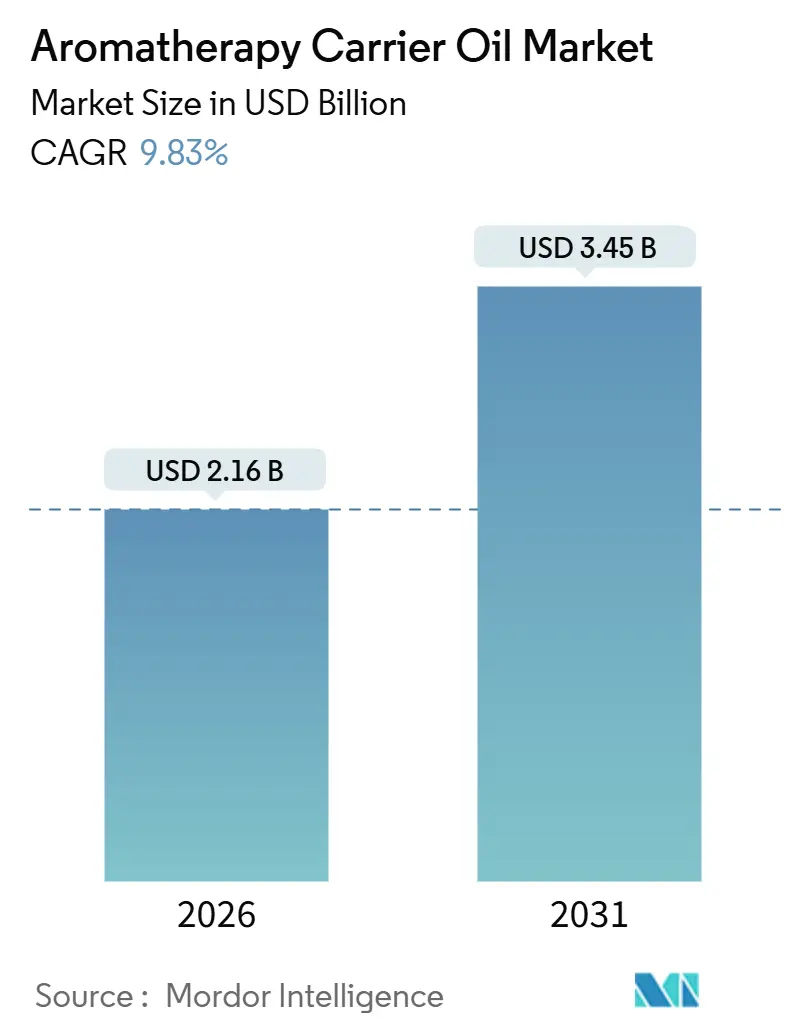
The Aromatherapy Carrier Oil Market size is estimated at USD 2.16 billion in 2026, and is expected to reach USD 3.45 billion by 2031, at a CAGR of 9.83% during the forecast period (2026-2031).
Demand is rising because formulators are replacing synthetic emollients with plant-derived lipids to meet clean-label expectations, and because spa operators want massage bases that feel light yet remain stable at elevated temperatures. Raw-material volatility—coconut oil jumped 64.9% year on year to USD 2,505 per metric ton in 2025—has increased the strategic value of secure, traceable supply chains, although procurement teams continue to favor coconut for its lauric-acid profile and microbial resilience. Nut oils such as argan and macadamia are gaining ground thanks to their antioxidant content and premium positioning, while fractionated extraction technologies are improving the shelf life of liquid MCT variants. Regulatory pressure is simultaneously tightening and clarifying: the FDA’s MoCRA in the United States requires facility registration and adverse-event reporting, and the European Union now obliges labels to list 26 fragrance allergens, prompting brands to choose hypoallergenic carrier oils that satisfy both regimes.
Key Report Takeaways
- By carrier oil type, vegetable oils led with 64.14% of the aromatherapy carrier oil market share in 2025, while nut oils are forecast to expand at an 11.57% CAGR through 2031.
- By source, plant-based variants held 88.26% of revenue in 2025; animal-based oils are projected to advance at a 13.32% CAGR.
- By application, cosmetics and personal care commanded 56.76% of revenue in 2025, whereas medical use is expected to rise at a 12.43% CAGR.
- By distribution channel, offline outlets retained 61.68% of sales in 2025, yet online platforms are set to grow at 13.87% a year.
- By end user, individual consumers generated 56.27% of demand in 2025; salons and spas are poised to expand at an 11.52% CAGR.
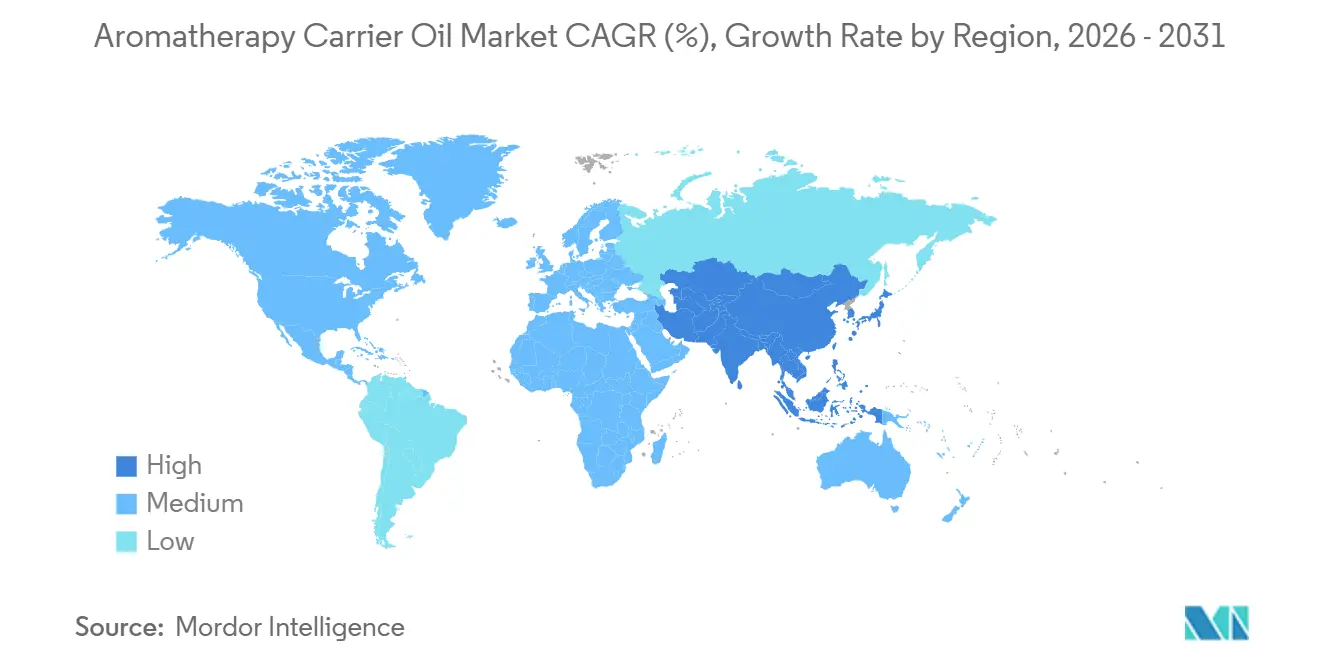
- By geography, North America dominated with 37.87% of global revenue in 2025, and Asia-Pacific is on track for an 11.46% CAGR through 2031.
Note: Market size and forecast figures in this report are generated using Mordor Intelligence’s proprietary estimation framework, updated with the latest available data and insights as of January 2026.
Market Trends and Insights
Drivers Impact Analysis of Aromatherapy Carrier Oil Market*
| Driver | (~) % Impact on CAGR Forecast | Geographic Relevance | Impact Timeline |
|---|---|---|---|
| Rising Preference for Natural & Organic Personal-Care Products | +2.1% | North America, Europe, global spillover | Medium term (2-4 years) |
| Expansion of Spa & Wellness Tourism and Home-Aromatherapy Adoption | +1.8% | United States, Thailand, India, China, GCC | Medium term (2-4 years) |
| Rapid Growth of E-Commerce & D2C Sales Channels for Oils | +1.6% | Urban North America and Europe, Asia-Pacific metros | Short term (≤ 2 years) |
| Increasing Disposable Incomes in Emerging Economies | +1.5% | India, Southeast Asia, Brazil, Mexico | Long term (≥ 4 years) |
| Advances in Cold-Pressed & Fractionated Extraction Technologies | +1.3% | United States, Europe, Japan | Long term (≥ 4 years) |
| Blockchain-Enabled Traceability & Clean-Label Certifications | +1.0% | Premium tiers in North America, Europe, Asia-Pacific | Medium term (2-4 years) |
| Source: Mordor Intelligence | |||
Rising Preference for Natural & Organic Personal-Care Products
MoCRA’s phased enforcement lifts compliance costs for synthetic emollients, nudging formulators toward USDA-certified organic carriers that already comply with purity standards.[1]U.S. Food and Drug Administration, “FDA Modernization of Cosmetics Regulation Act (MoCRA),” U.S. FDA, fda.gov Europe’s requirement to list 26 fragrance allergens further drives substitution of synthetics with essential oils diluted in hypoallergenic grapeseed or fractionated coconut.[2]European Commission, “Scientific Committee on Consumer Safety Opinions on Allergens,” European Commission, ec.europa.eu The USDA National Organic Program bans pesticides and GMOs, a rule set that aligns with shoppers who scan ingredient lists against third-party databases. Young Living responded in 2025 with Wyld Notes, a certified-organic carrier-plus-aroma bundle that trades at a 20% price premium. Industry convergence around organic definitions is giving global brands a single SKU that satisfies major authorities, lowering formulation complexity.
Expansion of Spa & Wellness Tourism and Home-Aromatherapy Adoption
The United States spa sector earned USD 22.5 billion in 2024 and recorded 187 million visits, reopening a channel that supplies carrier-oil blends at checkout and lifts per-visit revenue 12-15%.[3]International Spa Association, “2024 U.S. Spa Industry Study,” ISPA, ispastaff.com Thailand, India and China registered double-digit spa growth as travel restrictions eased, spurring carrier-oil demand from resort chains. At home, diffuser bundles and DIY kits blossomed during hybrid-work conditions, with doTERRA’s Wellness Made Simple campaign guiding novices through first purchases. Spa operators standardize cold-pressed jojoba and sweet almond for massages because these oils stay stable under heat lamps and wash out of linens easily. Upselling from treatment room to retail shelf is deepening repeat-purchase behavior.
Rapid Growth of E-Commerce & D2C Sales Channels for Oils
Online volume is on course to rise 13.87% a year, easily outpacing brick-and-mortar. Direct-to-consumer brands save 30-40% distributor margin and use subscription models to anchor lifetime value. Amazon’s “Climate Pledge Friendly” badge now covers USDA-organic and Fair Trade carriers, helping niche mills place products in front of mainstream shoppers. Shopify’s 2025 blockchain widgets let sellers post farm-to-bottle ledgers, addressing traceability concerns. Mountain Rose Herbs and Plant Therapy report conversion rates up to 25% when educational content appears alongside buy buttons. Faster cycles also mean fresher batches, which reduces oxidation complaints.
Increasing Disposable Incomes in Emerging Economies
IMF forecasts show South Asia expanding 6.2% annually and East Asia 4.4% through 2026, creating capacity for premium personal care. India’s 400 million middle-class households spend 8-10% of discretionary income on skincare that often includes DIY carrier-oil serums. Southeast Asian cities such as Jakarta and Manila add millions of first-time beauty shoppers every year, and Latin American salons in Brazil and Mexico are layering argan and macadamia oils into high-ticket facials. China’s post-pandemic rebound channels spending into home wellness kits that offer stress relief without prescriptions. Rising wages, urban lifestyles and social-media beauty culture work together to widen the addressable base.
Restraints Impact Analysis of Aromatherapy Carrier Oil Market*
| Restraint | (~) % Impact on CAGR Forecast | Geographic Relevance | Impact Timeline |
|---|---|---|---|
| Volatile Raw-Material Prices & Supply Disruptions | -1.4% | Coconut and palm in Southeast Asia, argan in North Africa | Short term (≤ 2 years) |
| Quality-Adulteration Risks and Lack of Global Standards | -0.9% | Unregulated markets in South Asia, Middle East, Africa | Medium term (2-4 years) |
| Dermatological Allergen Scrutiny Tightening | -0.7% | Europe, North America, premium Asia-Pacific | Medium term (2-4 years) |
| Tariff Swings / Trade Protectionism on Key Oil Crops | -0.6% | Thailand, India, parts of Latin America | Short term (≤ 2 years) |
| Source: Mordor Intelligence | |||
Volatile Raw-Material Prices & Supply Disruptions
Coconut’s 64.9% price leap compressed producer margins by up to 12 percentage points. OECD-FAO outlooks warn that yield growth for palm and coconut will slow to 0.7% annually as plantations age and labor shortages persist. Weather volatility such as La Niña cut Philippine coconut harvests 10-15% in 2024-2025. Morocco’s 2024 drought trimmed argan output 18%, yet facial-serum demand climbed 22%, lifting wholesale prices and tempting adulteration. Australian macadamia exporters faced port congestion and container shortages, forcing formulators to switch inputs, sometimes at the expense of product feel.
Quality-Adulteration Risks and Lack of Global Standards
Laboratory audits uncovered argan diluted with sunflower at ratios above 30%, exploiting the absence of a universally enforced carrier-oil purity code. MoCRA mandates adverse-event reporting but skips pre-market safety checks, leaving gaps that unethical suppliers exploit. GC-MS testing can spot fatty-acid fingerprints yet costs USD 150-250 per batch, an overhead many startups avoid. Jojoba adulteration with soybean rose 12% in 2024-2025 as organic premiums widened. Blockchain adoption remains under 15% of global volume, meaning most chains still rely on paperwork that can be forged.
*Our forecasts treat driver/restraint impacts as directional, not additive. The impact forecasts reflect baseline growth, mix effects, and variable interactions.
Aromatherapy Carrier Oil Market Segment Analysis
By Carrier Oil Type:
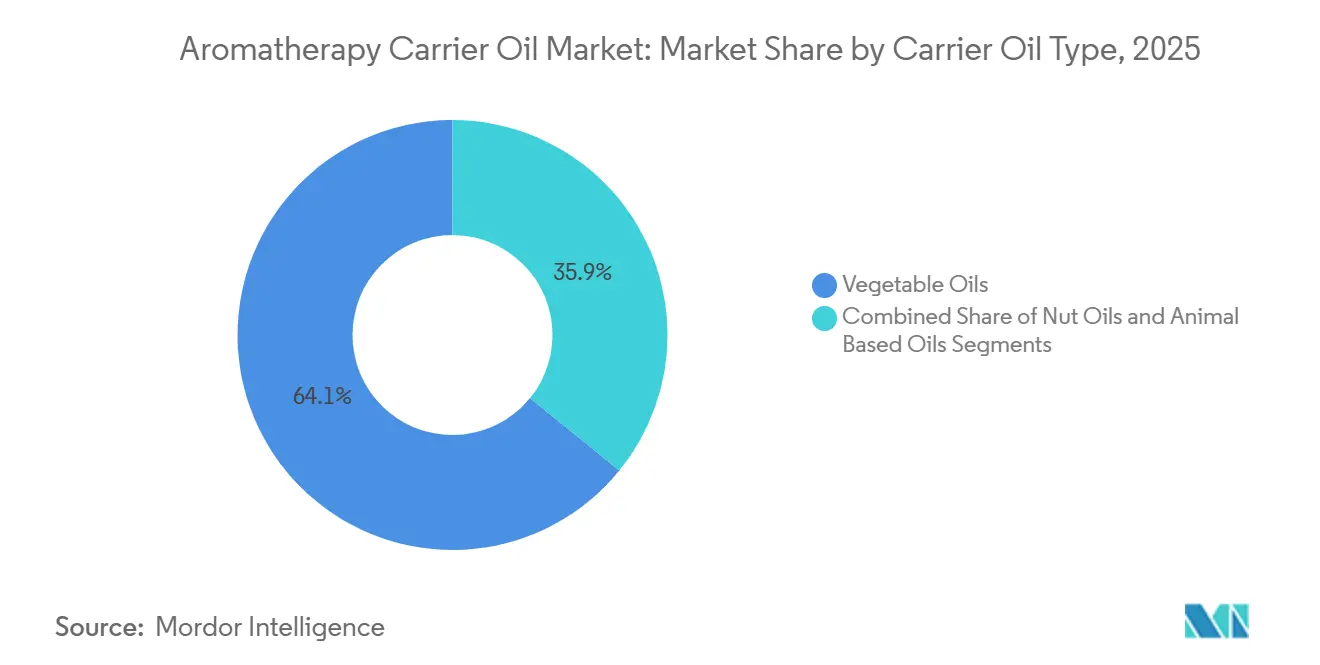
Nut Oils Gain Premium PositioningVegetable oils accounted for 64.14% of aromatherapy carrier oil market share in 2025, upheld by the affordability and versatility of coconut, sweet almond, jojoba and grapeseed. Coconut remains the universal massage base because lauric acid delivers antimicrobial benefits without a greasy after-feel, while jojoba’s wax-ester structure mirrors human sebum, making it a staple for acne-prone facial serums. Grapeseed absorbs quickly yet spoils sooner, limiting its export potential.
Nut oils are forecast to grow at 11.57% a year, led by argan and macadamia. Argan retails for USD 30-40 per 50 ml after cold pressing at temperatures below 60 °C, preserving tocopherols that appeal to mature-skin shoppers. Macadamia’s palmitoleic acid supports barrier repair, and 2024 dermatology trials verified its efficacy, prompting European brands to launch anti-aging ranges. Animal-based oils formed a 2-3% sliver in 2025 but are set for a 13.32% run rate as hospitals test omega-3-rich fish-oil balms for post-surgery inflammation.



By Source:
Plant Dominance, Animal NichePlant sources generated 88.26% of revenue in 2025, reflecting consumer alignment with vegan ethics and the clear pathway to USDA-organic certification. Fair Trade argan and Rainforest Alliance palm-kernel help brands tell stories of social impact. Reliable supply from Indonesia, Malaysia and Morocco keeps prices competitive.
Animal oils will nonetheless post a 13.32% CAGR. Emu and ostrich offer omega-7 fractions valuable in wound care, and fish oils carry EPA that dermatologists use for psoriasis creams. Traceability obligations for plant oils under the EU Deforestation Regulation are leveling compliance costs, leaving room for animal variants to compete on functionality rather than price.
By Application:
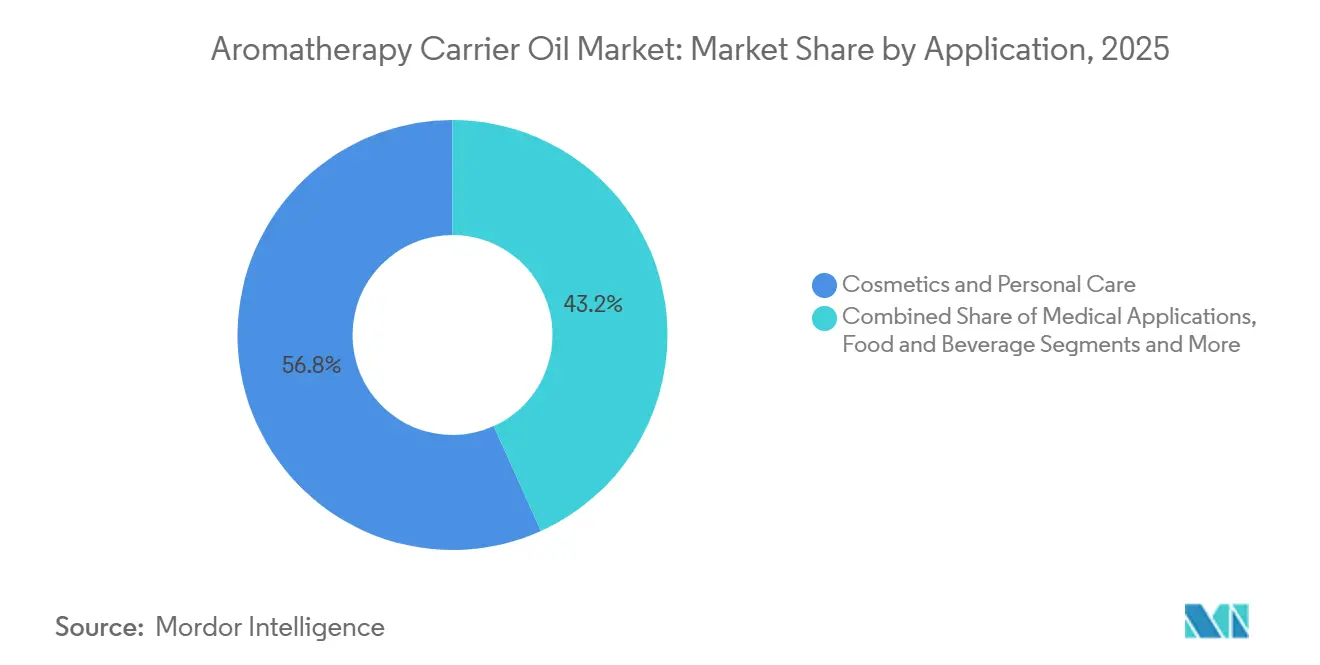
Medical MomentumCosmetics and personal care held 56.76% of value in 2025, with facial oils and serums expanding shelf space at prestige retailers. Hair-care brands cite peer-reviewed data showing coconut oil penetrates the shaft and reduces protein loss. Facial serums blending argan with vitamin C represent 30-35% of cosmetics revenue.
Medical use is projected to rise 12.43% yearly. A 2024 trial revealed lavender in sweet almond cut post-operative opioid usage 18%. Pediatric clinics deploy eucalyptus in fractionated coconut for cough relief. Wellness centers offer macadamia carriers infused with valerian to improve sleep, and subscription services deliver ready-to-diffuse therapeutic blends to chronic-pain patients.
By Distribution Channel:
Online UpshiftBrick-and-mortar still captured 61.68% of sales in 2025 because shoppers like to smell and feel oils before buying. Whole Foods and Target added natural-beauty bays, while spa therapists convert service users into retail customers.
Digital sales, however, will rise 13.87% each year. Brands using Shopify manage data, personalize tips and upsell droppers or recipe cards, lifting basket value 20-25%. Amazon funnels discovery but its ad costs thin margins. Subscription boxes deliver curated assortments, solving oxidation risk by moving small batches quickly from mill to shelf.
By End User:
Salon & Spa RecoveryIndividuals made up 56.27% of demand in 2025, buoyed by online tutorials that teach safe dilution ratios. Kits offering pre-measured carrier oils and recipe cards reduce experimentation anxiety and encourage brand loyalty.
Salons and spas are forecast to advance 11.52% yearly, riding a wellness-tourism rebound. U.S. spas logged USD 22.5 billion revenue in 2024 and increasingly specify cold-pressed jojoba to minimize linen residue. Physiotherapists and occupational-therapy clinics integrate fish-oil balms into recovery routines, expanding institutional usage.
Geography Analysis
The Americas Aromatherapy Carrier Oil Market
North America generated 37.87% of 2025 revenue. The FDA’s MoCRA supplies regulatory certainty, and 68% of U.S. consumers are willing to pay more for USDA-organic certification. Canada’s natural-health-product licensing pushes therapeutic carriers into premium price tiers, and Mexican resort spas order bulk coconut and jojoba for tourist treatments. Proximity to South American raw materials shortens lead times and buffers supply shocks.
APAC Aromatherapy Carrier Oil Market
Asia-Pacific is on pace for an 11.46% CAGR to 2031. China’s urbanites are buying diffuser kits as stress relievers, and India’s middle class budgets almost a tenth of discretionary income for skincare. Japan’s aging society values macadamia’s barrier-repair properties, while Korea’s K-beauty labs merge traditional botanicals with Western carriers to shape export trends. Australia functions as a macadamia hub despite modest local consumption, and Indonesia’s coconut surplus underpins competitive pricing even as extreme weather threatens harvests.
Europe, APAC and Africa Aromatherapy Carrier Oil Market
Europe benefits from strict allergen rules that favor hypoallergenic carriers. German spa towns demand certified-organic oils, French perfumers blend argan with proprietary accords, and U.K. retailers have widened natural-oil assortments despite post-Brexit paperwork. Italy and Spain leverage native olive and almond supply, but Moroccan argan still dominates anti-aging niches. Mandatory geolocation under the Deforestation Regulation is forcing Asian suppliers to invest in monitoring tools, raising switching costs.
MEA Aromatherapy Carrier Oil Market
The Middle East and Africa remain fragmented. GCC resorts import premium argan and macadamia for luxury packages. South Africa ships ostrich oil, while Moroccan cooperatives face drought-induced yield drops. Regulatory patchwork and limited cold-press infrastructure restrain broader uptake, yet urban wellness awareness is climbing in Dubai and Johannesburg.
South America Aromatherapy Carrier Oil Market
South America relies on Brazil and Argentina, where salons embrace natural-product narratives. Amazonian oils such as buriti and babassu bolster local lines, although traceability gaps hinder export certification. Currency volatility and limited consolidation of cold-press networks temper growth, but rising regional middle-class spending offers incremental upside.

Competitive Landscape
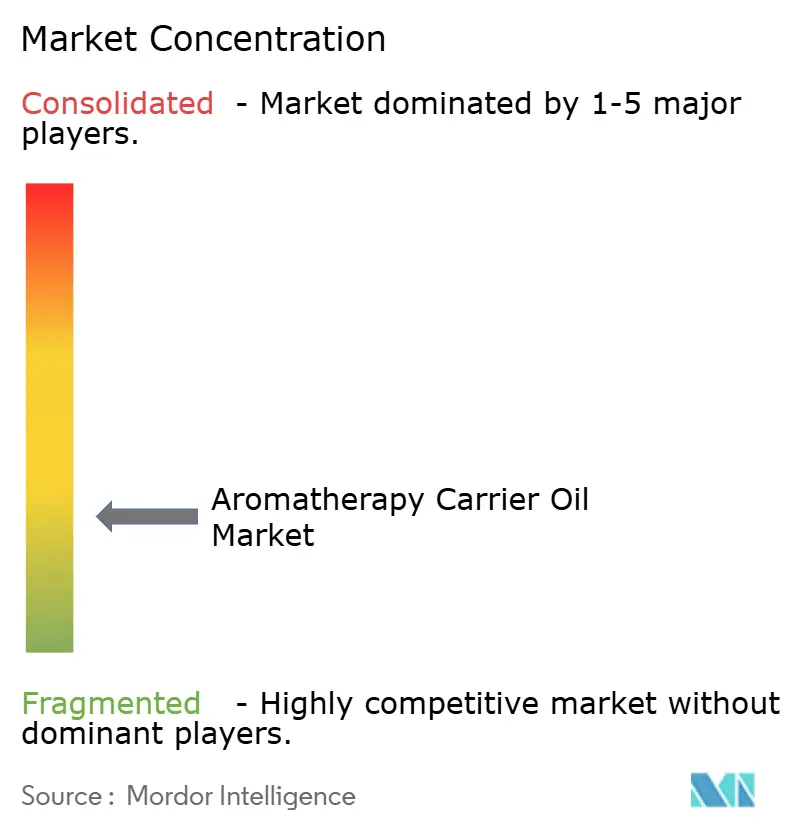
The aromatherapy carrier oil market shows moderate fragmentation. Young Living’s Wyld Notes launch bundled certified-organic carriers with mood-based aromas to raise basket size. doTERRA trimmed its SKU count under the Wellness Made Simple program, easing choice-overload for new users and safeguarding gross margin through tiered pricing.
Patent filings reveal that rivals are racing to improve extraction efficiency. Nitrogen-blanketed cold-press lines and super-critical CO₂ equipment widen shelf life and lower cost per liter. Smaller firms including Mountain Rose Herbs and Rocky Mountain Oils focus on educational e-commerce and subscription models that elevate repeat sales. Compliance costs tied to MoCRA are likely to trigger exits or mergers among under-capitalized blenders, tightening the field. Blockchain implementation and GC-MS purity testing are becoming differentiators for premium players, while budget labels still rely on supplier affidavits.
Aromatherapy Carrier Oil Industry Leaders
doTERRA International LLC
Edens Garden Inc.
Plant Therapy Inc.
Young Living Essential Oils
NOW Health Group Inc. (NOW Foods)
- *Disclaimer: Major Players sorted in no particular order
Aromatherapy Carrier Oil Market Companies Covered in this Report
- AAK Natural Oils
- AG Industries
- AOS Products Pvt. Ltd.
- Aura Cacia / Frontier Co-op
- Blue Diamond Growers
- Caloy Quality Natural Oils
- ConnOils
- doTERRA International LLC
- Edens Garden Inc.
- Falcon Essential Oils
- Floracopeia Inc.
- Florihana Distillerie
- Gustav Heess GmbH
- Moksha Lifestyle Products
- Mountain Rose Herbs
- NOW Health Group Inc. (NOW Foods)
- Plant Therapy Inc.
- Proteco Oils
- Rocky Mountain Oils LLC
- Young Living Essential Oils

Recent Industry Developments in Aromatherapy Carrier Oil Market
- October 2025: Kohler introduced Sprig Essential Oils, adding aromatherapy to its wellness portfolio and reinforcing its strategy to integrate sensory features into bathroom fixtures.
- August 2025: Saje Natural Wellness appointed Ulta Beauty as its first national retail partner, placing best-selling carrier-oil blends in more than 200 U.S. stores and on ulta.com.
- August 2025: IXOM acquired Essential Oils of Tasmania, strengthening the Australian Botanical Products line with niche Tasmanian extracts for global distribution.


Global Aromatherapy Carrier Oil Market Report Scope
Carrier oil, also called base oil, is a substance used to dilute active ingredients in pharmaceuticals, essential oils in aromatherapy, and compounds in food for easier incorporation.
The Aromatherapy Carrier Oil Market Report is segmented by Carrier Oil Type, Source, Application, Distribution Channel, End User, and Geography. By Carrier Oil Type, the market is segmented into Vegetable Oils, Nut Oils, Animal-Based Oils, and Others. By Source, the market is segmented into Plant-Based and Animal-Based. By Application, the market is segmented into Cosmetics & Personal Care, Medical, Food & Beverages, and Others. By Distribution Channel, the market is segmented into Offline and Online. By End User, the market is segmented into Individual Consumers, Salons & Spas, Wellness Centers, Healthcare Professionals, and Manufacturers. By Geography, the market is segmented into North America, Europe, Asia-Pacific, Middle East & Africa, and South America. The market report also covers the estimated market sizes and trends for 17 countries across major regions globally. Market Forecasts are Provided in Terms of Value (USD).
| Vegetable Oils | Coconut Oil |
| Sweet Almond Oil | |
| Jojoba Oil | |
| Grapeseed Oil | |
| Others (Sunflower, Olive, Avocado, etc.) | |
| Nut Oils | Argan Oil |
| Macadamia Oil | |
| Animal-Based Oils | Fish Oil |
| Emu Oil | |
| Ostrich Oil | |
| Others |
| Plant-Based Oils |
| Animal-Based Oils |
| Cosmetics & Personal Care | Skin-Care Products |
| Hair-Care Products | |
| Serums & Facial Oils | |
| Medical Applications | Pain Management |
| Cold & Cough Relief | |
| Other Therapeutic Uses | |
| Food & Beverages | |
| Others |
| Offline |
| Online |
| Individual Consumers |
| Beauty Salons & Spas |
| Wellness & Alternative-Therapy Centers |
| Healthcare Professionals |
| Cosmetic & Personal-Care Manufacturers |
| North America | United States |
| Canada | |
| Mexico | |
| Europe | Germany |
| France | |
| United Kingdom | |
| Italy | |
| Spain | |
| Rest of Europe | |
| Asia-Pacific | China |
| Japan | |
| India | |
| South Korea | |
| Australia | |
| Rest of Asia-Pacific | |
| Middle East & Africa | GCC |
| South Africa | |
| Rest of Middle East & Africa | |
| South America | Brazil |
| Argentina | |
| Rest of South America |
| By Carrier Oil Type | Vegetable Oils | Coconut Oil |
| Sweet Almond Oil | ||
| Jojoba Oil | ||
| Grapeseed Oil | ||
| Others (Sunflower, Olive, Avocado, etc.) | ||
| Nut Oils | Argan Oil | |
| Macadamia Oil | ||
| Animal-Based Oils | Fish Oil | |
| Emu Oil | ||
| Ostrich Oil | ||
| Others | ||
| By Source | Plant-Based Oils | |
| Animal-Based Oils | ||
| By Application | Cosmetics & Personal Care | Skin-Care Products |
| Hair-Care Products | ||
| Serums & Facial Oils | ||
| Medical Applications | Pain Management | |
| Cold & Cough Relief | ||
| Other Therapeutic Uses | ||
| Food & Beverages | ||
| Others | ||
| By Distribution Channel | Offline | |
| Online | ||
| By End User | Individual Consumers | |
| Beauty Salons & Spas | ||
| Wellness & Alternative-Therapy Centers | ||
| Healthcare Professionals | ||
| Cosmetic & Personal-Care Manufacturers | ||
| By Geography | North America | United States |
| Canada | ||
| Mexico | ||
| Europe | Germany | |
| France | ||
| United Kingdom | ||
| Italy | ||
| Spain | ||
| Rest of Europe | ||
| Asia-Pacific | China | |
| Japan | ||
| India | ||
| South Korea | ||
| Australia | ||
| Rest of Asia-Pacific | ||
| Middle East & Africa | GCC | |
| South Africa | ||
| Rest of Middle East & Africa | ||
| South America | Brazil | |
| Argentina | ||
| Rest of South America | ||


Key Questions Answered in the Report
How large is the aromatherapy carrier oil market in 2026 and where is it heading by 2031?
It is valued at USD 2.16 billion in 2026 and is forecast to reach USD 3.45 billion by 2031, growing at a 9.83% CAGR.
Which carrier-oil category is expanding fastest?
Nut oils, powered by argan and macadamia, are projected to post an 11.57% CAGR through 2031.
Why are online sales growing so quickly for carrier oils?
Direct-to-consumer brands save 30-40% distributor margin, use subscriptions, and leverage Amazon’s “Climate Pledge Friendly” badge, supporting a 13.87% annual rise in e-commerce volume.
What new regulations are shaping product formulation?
The FDA’s MoCRA mandates facility registration and adverse-event reporting, and the EU now requires labels to list 26 fragrance allergens, steering formulators toward hypoallergenic, certified-organic carriers.
How are spas influencing demand?
U.S. spas booked USD 22.5 billion revenue in 2024 and retail carrier-oil blends at checkout, lifting per-visit spend by 12-15% and driving steady re-orders.
Which geographic region is expected to grow fastest to 2031?
Asia-Pacific, supported by 6.2% disposable-income growth in South Asia and 4.4% in East Asia, is set for an 11.46% CAGR.
Page last updated on:





