
Argentina Grapes Harvesters Market Size and Share
Market Overview
| Study Period | 2021 - 2031 |
|---|---|
| Forecast Data Period | 2026 - 2031 |
| Base Year Market Size (2025) | USD 12.40 Million |
| Market Size (2026) | USD 13.31 Million |
| Market Size (2031) | USD 18.98 Million |
| Growth Rate (2026 - 2031) | 7.35 % |
| Market Concentration | Medium |
Major Players *Disclaimer: Major Players sorted in no particular order Image © Mordor Intelligence. Reuse requires attribution under CC BY 4.0. | |
Argentina Grapes Harvesters Market Analysis by Mordor Intelligence
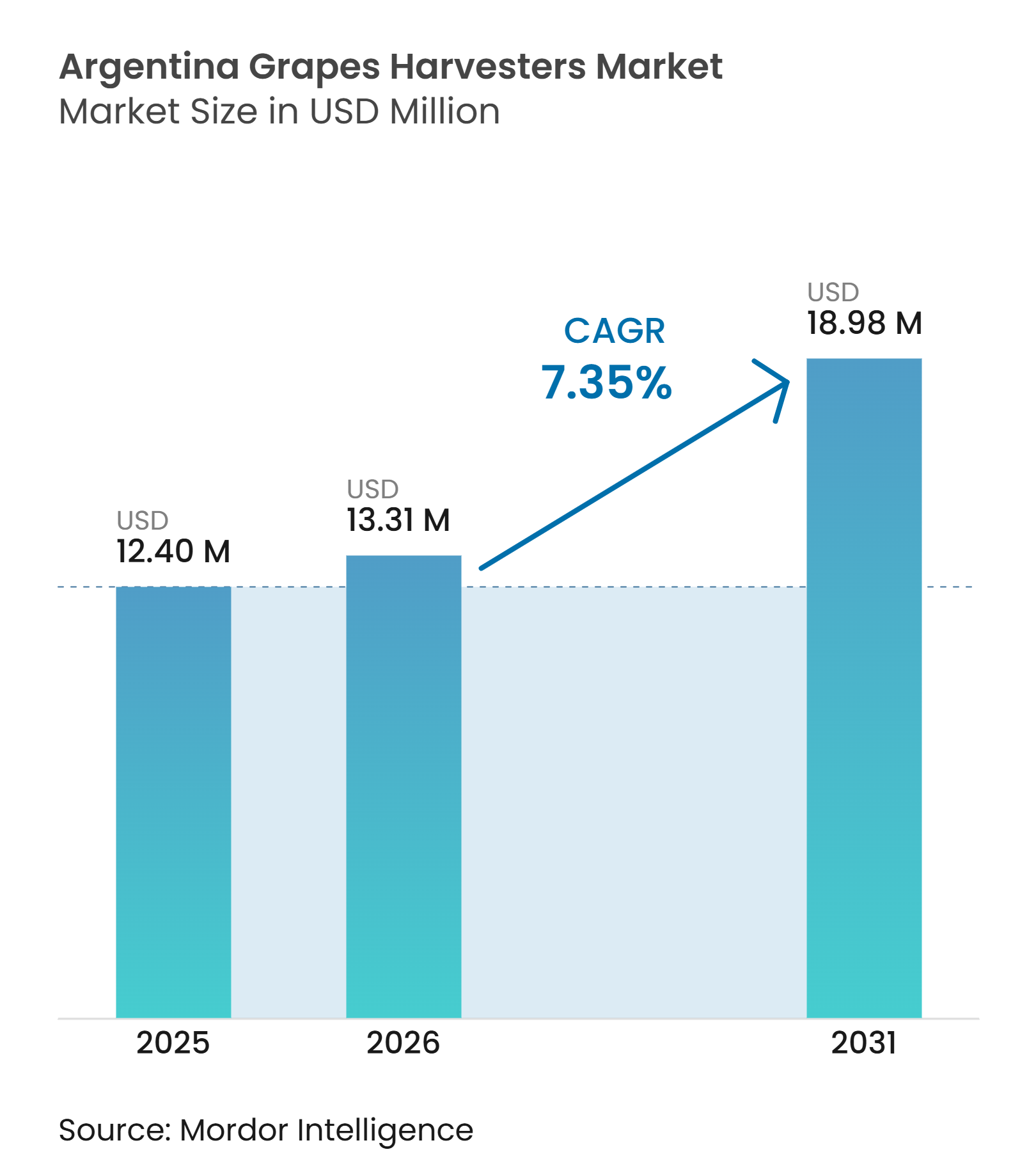
The Argentina grapes harvesters market size was valued at USD 12.40 million in 2025 and is forecast to grow from USD 13.31 million in 2026 to USD 18.98 million by 2031, at a CAGR of 7.35% from 2026 to 2031. The market is supported by labor constraints during the February to April harvest period and winery requirements for timely grape collection at the intended ripeness level. Argentina had 196,220 hectares of vineyards and produced 19.9 million quintals of grapes in 2025, indicating a substantial vineyard base for mechanization, according to the English version of the National Institute of Viticulture (INV)[1]. Lower-cost trailed equipment can widen access for growers that cannot support a self-propelled machine, while imported machinery costs, foreign-exchange exposure, financing requirements, and limited after-sales service remain constraints. The Argentina grapes harvesters market therefore presents a moderate-growth mechanization opportunity, with adoption increasingly influenced by labor availability, vineyard scale, equipment economics, and localized access to machinery and services.
Key Report Takeaways
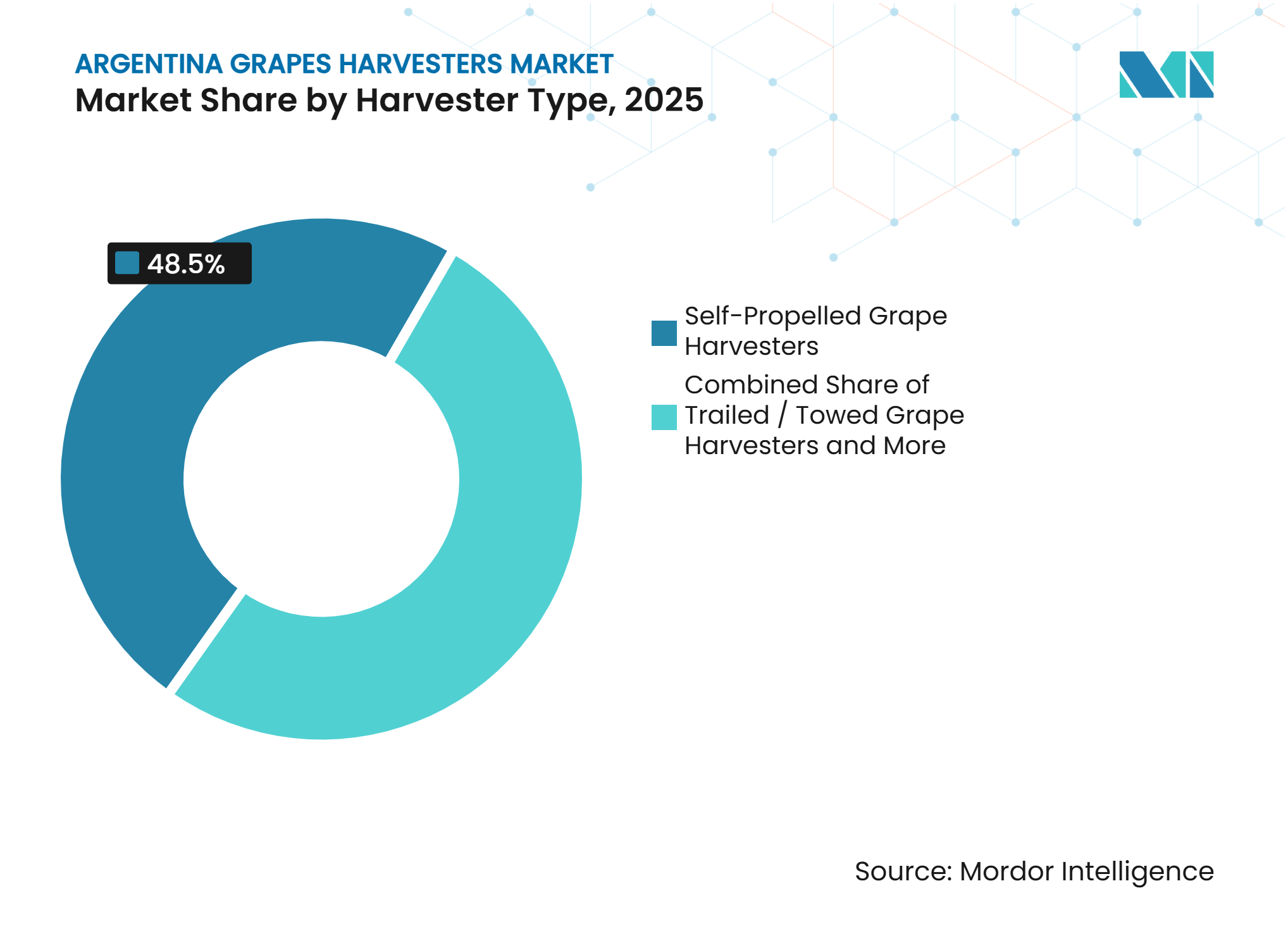
- By harvester type, self-propelled grape harvesters accounted for the largest Argentina grapes harvesters market share in 2025, at 48.5%, while trailed/towed grape harvesters are forecast to be the fastest-growing segment, with a CAGR of 10.5% from 2026 to 2031.
- By mode of operation, assisted/precision-guided systems accounted for the largest share in 2025, at 54.2%, while autonomous and semi-autonomous operation is forecast to be the fastest-growing segment, with a CAGR of 13.2% from 2026 to 2031.
- By power source, diesel-powered harvesters accounted for 66.8% of the Argentina grapes harvesters market size in 2025, while electric harvesters are forecast to be the fastest-growing segment, with a CAGR of 12.0% between 2026 and 2031.
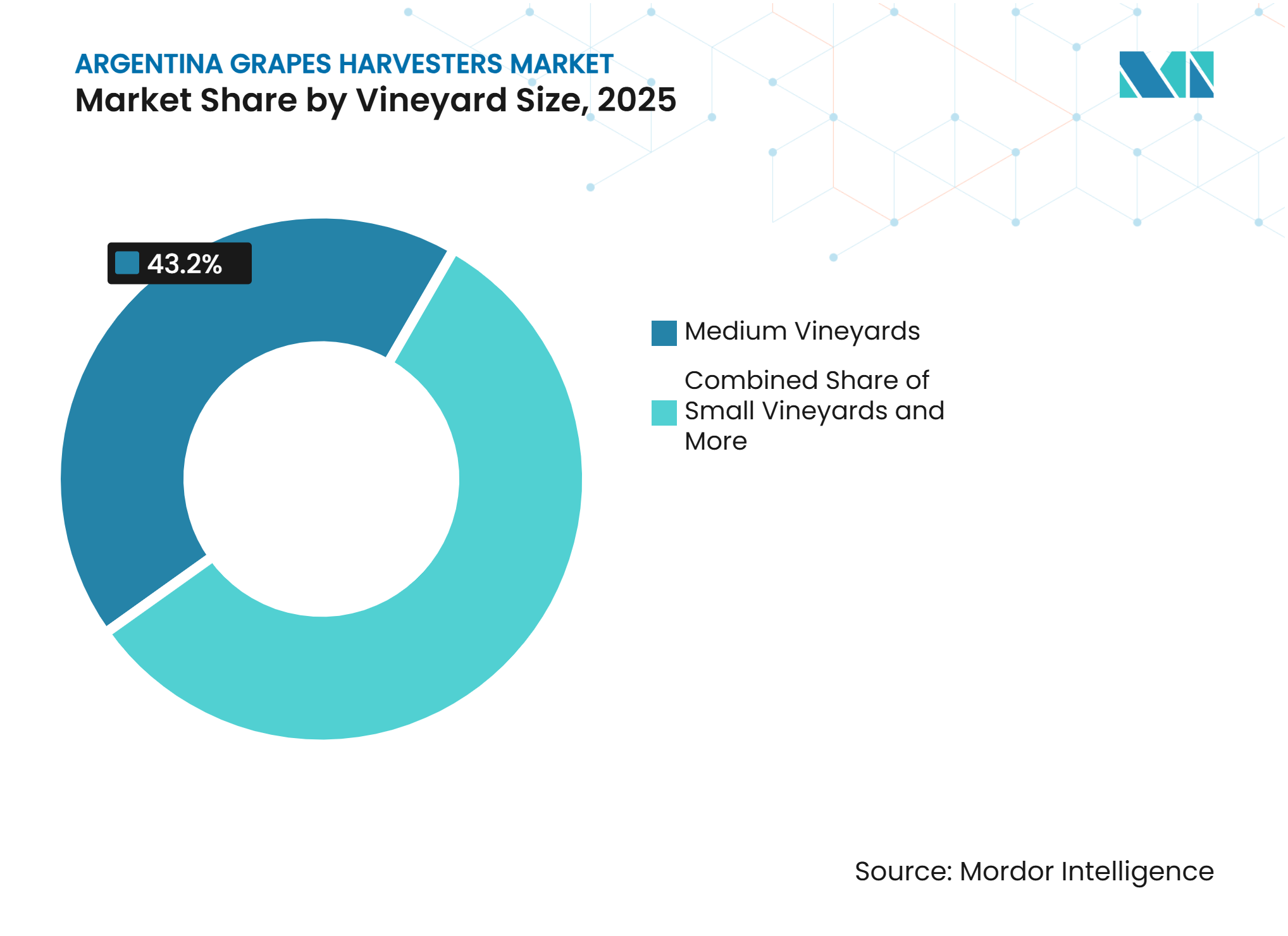
- By vineyard size, medium vineyards from 51 to 200 hectares accounted for the largest share in 2025, at 43.2%, while small vineyards below 50 hectares are forecast to be the fastest-growing segment, with a CAGR of 10.0% between 2026 and 2031.
Note: Market size and forecast figures in this report are generated using Mordor Intelligence’s proprietary estimation framework, updated with the latest available data and insights as of January 2026.
Market Trends and Insights
Drivers Impact Analysis of Argentina Grapes Harvesters Market*
| Driver | (~) % Impact on CAGR Forecast | Geographic Relevance | Impact Timeline |
|---|---|---|---|
| Rising labor and harvest-timing pressure in Mendoza and San Juan | +1.8% | Mendoza, San Juan | Short term (≤ 2 years) |
| Expansion of mechanized harvesting in wine-grape Espaldera vineyards | +1.4% | Mendoza, San Juan, Neuquén | Medium term (2-4 years) |
| Contractor and shared-machinery models lowering access barriers | +1.2% | Mendoza, San Juan, La Rioja | Medium term (2-4 years) |
| Export-oriented wineries seeking consistent harvest windows | +1.0% | Mendoza, San Juan, Salta | Medium term (2-4 years) |
| Low-capex trailed harvesters expanding addressable vineyard base | +0.9% | Mendoza, San Juan, Rest of Argentina | Short term (≤ 2 years) |
| Mechanization potential in high-adoption, small-base provinces | +0.8% | Neuquén, La Pampa | Long term (≥ 4 years) |
| Source: Mordor Intelligence | |||
Rising Labor and Harvest-Timing Pressure in Mendoza and San Juan
Seasonal labor constraints during Argentina's February to April grape harvest are supporting the adoption of mechanical harvesting, particularly in major producing regions such as Mendoza and San Juan. The National Viticulture Institute (INV) recorded 20,939 vineyards and 893 wineries and processing establishments involved in the 2025 crop, reflecting the scale of the harvesting and processing network and the potential for competing labor requirements during narrow harvest windows. Mechanical harvesting enables producers to collect grapes more rapidly than manual crews, helping wineries manage harvest timing and collect grapes within targeted ripeness windows. In 2025, mechanically harvested grapes represented 18.0% of San Juan's total provincial grape production, indicating an established level of mechanization and continued scope for adoption.
Expansion of Mechanized Harvesting in Wine-Grape Espaldera Vineyards
Espaldera is one of the principal vineyard training systems in Argentina and provides a machine-compatible configuration that can support further adoption of mechanical harvesting. Its vertically trained rows can accommodate conventional straddle harvesters, allowing growers to integrate mechanization more readily when establishing or replanting vineyards. New vineyard developments in major wine-producing provinces such as Mendoza and Neuquén can incorporate machine-compatible row and trellis configurations from the outset, reducing the need for costly structural modifications when growers transition from manual to mechanical harvesting. The replacement of older vineyard structures with espaldera systems can therefore gradually expand the technically accessible vineyard area for mechanized harvesting and support demand for grape harvesters in Argentina.
Contractor and Shared-Machinery Models Lowering Access Barriers
Argentina's fragmented vineyard structure can make investment in dedicated grape harvesters economically challenging for individual growers. The National Viticulture Institute (INV) recorded 20,939 vineyards covering 196,220 hectares in 2025, equivalent to an average vineyard area of approximately 9.4 hectares. The access challenge is particularly pronounced in San Juan, where 86% of vineyards are smaller than 15 hectares, while the traditional parral training system is used by nearly 90% of establishments and limits the use of integral mechanical harvesting equipment[2]. Contractors, cooperatives, and shared-machinery arrangements can therefore distribute equipment costs across multiple growers, allowing producers to purchase harvesting services rather than invest in individual machines. The INV also formally recognizes mechanized and outsourced harvesting within its harvest-control procedures, requiring producers using these services to register the service provider and affected vineyard area. This service-based model can improve harvester utilization across multiple vineyard blocks and lower the upfront capital barrier to mechanization, supporting equipment adoption among Argentina's small and medium-sized grape growers.
Export-Oriented Wineries Seeking Consistent Harvest Windows
Export-oriented wineries have a direct incentive to improve harvest efficiency and maintain consistent grape quality, particularly as Argentina's wine industry remains strongly connected to international markets. Bodegas de Argentina reported that bottled still-wine export value increased 8.0% year on year in December 2025, while bottled sparkling-wine export value increased 16.0%, indicating continued demand for higher-value packaged wine exports[3]. Export-focused wineries therefore have an incentive to collect grapes within targeted ripeness windows and deliver them to wineries rapidly, particularly when multiple vineyard blocks reach harvest maturity over a limited period. Mechanical harvesting can support this requirement by increasing harvesting speed and allowing wineries to coordinate grape intake more closely with processing capacity. The Argentina Grapes Harvesters Market consequently benefits from demand among larger and export-oriented wineries seeking to improve harvest timing, operational consistency, and the efficient movement of grapes from vineyards to wineries.
Restraints Impact Analysis of Argentina Grapes Harvesters Market*
| Restraint | (~) % Impact on CAGR Forecast | Geographic Relevance | Impact Timeline |
|---|---|---|---|
| High imported-equipment cost and foreign-exchange exposure | -1.8% | All Argentina, especially small growers | Short term (≤ 2 years) |
| Parral vineyard structures limiting harvester compatibility | -1.3% | Mendoza, San Juan, La Rioja | Long term (≥ 4 years) |
| Premium and fresh-grape quality requirements favoring hand harvest | -1.0% | Mendoza, Salta, San Juan | Medium term (2-4 years) |
| Sparse local parts and specialist-operator coverage outside Cuyo | -0.7% | Outside Cuyo, La Rioja, Salta, Río Negro | Medium term (2-4 years) |
| Source: Mordor Intelligence | |||
High Imported-Equipment Cost and Foreign-Exchange Exposure
Commercial grape harvesters available in Argentina are largely sourced from international manufacturers, making equipment and spare-parts costs sensitive to foreign-currency movements, import costs, and customs procedures. Machines typically involve high upfront capital requirements, while replacement parts and specialized maintenance can add to the total cost of ownership. These factors raise the investment hurdle for small and medium-sized vineyards, particularly those that cannot spread equipment costs across multiple growers through contractor, cooperative, or shared-machinery arrangements. Foreign-exchange volatility can further affect purchasing decisions by increasing the peso-denominated cost of imported machinery and components. As a result, adoption can be delayed even where mechanical harvesting offers productivity and harvest-timing advantages, keeping the Argentina Grapes Harvesters Market sensitive to equipment financing conditions, import costs, and foreign-currency availability.
Premium and Fresh-Grape Quality Requirements Favoring Hand Harvest
Premium and high-altitude wine programs in Argentina can favor hand harvesting for selected parcels where selective picking and careful grape handling are prioritized. High-altitude Malbec and Torrontés production in Cafayate, for example, includes manually harvested grapes collected in small containers to support careful handling. This preference is particularly relevant for premium and small-lot wines, where producers may prioritize parcel-level selection and grape quality over the speed and throughput of mechanical harvesting. The September 2025 study published by the Institute of Electrical and Electronics Engineers (IEEE) on robotic grape harvesting also identifies selective harvesting as an important application for high-value vineyard production. As these quality-sensitive parcels are less suitable for conventional high-throughput mechanical harvesting, they reduce the proportion of vineyard area that can be economically targeted for mechanization. Although premium production represents a relatively limited share of Argentina's total grape output, the continued use of hand harvesting on high-value parcels can reduce machine utilization potential and lengthen the payback period for growers investing in harvesters. Consequently, quality-driven harvesting practices can limit the addressable equipment base and moderate the pace of grape harvester adoption in Argentina.
*Our forecasts treat driver/restraint impacts as directional, not additive. The impact forecasts reflect baseline growth, mix effects, and variable interactions.
Argentina Grapes Harvesters Market Segment Analysis
By Harvester Type:
Trailed Platforms Broaden the Mechanizable Grower BaseSelf-propelled grape harvesters accounted for 48.5% of the Argentina grapes harvesters market share in 2025, making them the dominant harvester type. These machines are suited to larger commercial vineyards with machine-compatible row configurations and sufficient harvest volumes to justify higher capital costs and maximize seasonal utilization. Trailed and towed harvesters remain relevant for small and medium-sized vineyards and contractor operations, as growers can use existing tractors and avoid the higher investment required for a dedicated self-propelled harvesting platform.
The trailed and towed grape harvesters are forecast to grow at a CAGR of 10.5% between 2026 and 2031. Their lower upfront investment and compatibility with existing tractors can make mechanical harvesting more accessible to Argentina's fragmented vineyard base, particularly where individual growers cannot justify purchasing self-propelled equipment. The format can also support contractor and shared-machinery models, allowing a single machine to serve multiple vineyard blocks and improve utilization. However, adoption remains dependent on suitable row spacing and vineyard configurations, limiting the use of trailed equipment in traditional parral vineyards.



By Mode of Operation:
Automation Functions Gain Commercial MomentumAssisted/precision-guided operation held 54.2% of the Argentina Grapes Harvesters Market share in 2025, reflecting operators' preference for systems that retain direct control while improving harvesting consistency. This operating mode is suited to vineyards transitioning from manual harvesting but still requiring operator intervention to manage variations in row conditions and vineyard layouts. It is particularly relevant to Argentina's fragmented vineyard base, where differences in vineyard size, row configuration, and terrain can make fully autonomous harvesting less practical. Precision-guided functions can reduce operator workload while allowing intervention when field conditions change, supporting adoption among growers and contractors that want greater operating consistency without moving immediately to fully autonomous equipment. Conventional manual operation remains relevant for small or quality-sensitive vineyards, but its use is constrained by seasonal labor availability.
The Argentina grapes harvesters market for semi-autonomous and automated operation is anticipated to expand at a 13.2% CAGR between 2026 and 2031. Increasing automation can reduce dependence on operator inputs and improve machine consistency during Argentina's concentrated February to April harvest window, when producers face pressure to collect grapes at targeted maturity levels. New Holland's R4 autonomous robot series, introduced for vineyard and specialty-crop applications in 2025, indicates continued development of automated solutions for specialty agriculture. Adoption in Argentina is likely to initially concentrate among larger vineyards and professional contractors with suitable vineyard configurations and technical capabilities. As automation becomes more integrated into conventional harvesting platforms, lower operator requirements could support wider adoption across the country's mechanizing vineyard base.
By Power Source:
Diesel Holds Dominance While Electric Builds a Credible BaseDiesel-powered harvesters accounted for 66.8% of the market in 2025, reflecting the established use of diesel equipment across the country's commercial agricultural sector. Diesel machines benefit from existing fuel distribution, established maintenance practices, and operator familiarity, while avoiding the need for dedicated charging infrastructure in vineyard areas. These advantages are particularly relevant in Argentina's major grape-producing provinces, where growers and contractors prioritize equipment availability and straightforward servicing during the concentrated harvest season. Diesel harvesters are therefore likely to remain the preferred power source for most commercial harvesting operations in the near term.
The Argentina grapes harvesters market for electric harvesters is forecast to grow at a CAGR of 12.0% between 2026 and 2031, albeit from a relatively small installed base. Manufacturers are developing battery-electric and autonomous agricultural platforms that could support future electrification of specialty-crop operations. Electric harvesting equipment could offer lower direct fuel consumption and reduced emissions, but adoption in Argentina will depend on equipment cost, battery capacity, charging access, and the availability of local technical support. Initial uptake is therefore likely to remain concentrated among larger commercial operators and early adopters before broader deployment becomes economically and operationally practical.
By Vineyard Size:
Small Vineyard Demand Accelerates Through Service ModelsMedium vineyards of 51 to 200 hectares accounted for the largest Argentina grapes harvesters market share in 2025, at 43.2%.. This scale can generate sufficient seasonal harvesting volume to justify mechanization while providing flexibility to use either self-propelled or trailed equipment depending on capital availability and vineyard configuration. Trailed harvesters can be particularly relevant where growers already operate suitable tractors, reducing the investment required to transition from manual harvesting. Equipment selection within this segment is therefore influenced by expected machine utilization, access to financing, vineyard layout, and availability of local harvesting services.
The Argentina grapes harvesters market size for small vineyards below 50 hectares is forecast to grow at a CAGR of 10.0% between 2026 and 2031. Individual ownership of a dedicated harvester can be difficult to justify at smaller vineyard sizes because annual utilization may be insufficient to support the capital investment. Contractor, cooperative, and shared-machinery services can therefore provide a more economical route to mechanization by allowing equipment to serve multiple vineyard blocks during the concentrated harvest period. Large vineyards above 200 hectares remain important customers for high-capacity self-propelled harvesters and advanced precision functions, while their greater harvesting volumes can support higher equipment utilization and provide a pathway for early adoption of newer technologies.

Geography Analysis
Mendoza held 71.7% of Argentina's vineyard area in 2025 and remained the leading region for the Argentina grapes harvesters market. The province produced 14.8 million quintals of grapes, equivalent to 74.3% of national grape output, during 2025. Its large vineyard base and concentration of wineries create the strongest addressable demand for mechanical harvesting equipment, including self-propelled and trailed harvesters. The combination of commercial vineyard scale, concentrated grape production, and established harvesting activity supports equipment sales, contractor fleets, maintenance requirements, and replacement demand.
Neuquén is the fastest-growing provincial market and is forecast to expand at a 10.5% CAGR between 2026 and 2031. Its relatively younger vineyard base provides opportunities for machine-compatible vineyard development without the same degree of conversion constraints associated with older traditional vineyard structures. San Juan remained the second-largest vineyard geography in 2025, but its extensive use of the traditional parral training system limits the suitability of conventional mechanical harvesting equipment. Salta remains relevant for premium and high-altitude Malbec and Torrontés production, where mechanical harvesting can be considered for suitable volume parcels while hand harvesting continues for selected premium lots.
La Rioja and Río Negro also contribute to the addressable market for grape harvesters, with demand influenced by vineyard scale, mechanization suitability, and access to harvesting services. La Pampa has an established vineyard base but represents a smaller incremental opportunity than Mendoza and San Juan. Emerging vineyards in Patagonia, including Río Negro and Chubut, provide longer-term potential for mechanization where new plantings can incorporate machine-compatible configurations from the outset. Overall, provincial demand is shaped by vineyard area and grape production, but also by trellis systems, vineyard age, harvest volumes, and access to equipment and contractor services.
Competitive Landscape
Market Concentration
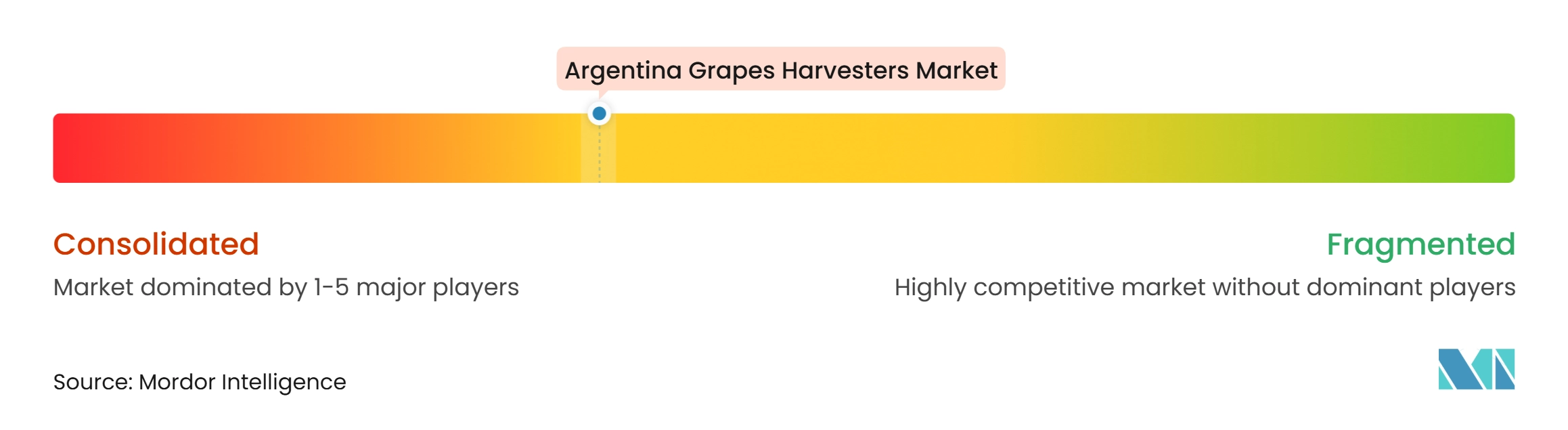
The Argentina grapes harvesters market remained moderately consolidated in 2025, with international vineyard-equipment manufacturers and specialized distributors serving a market concentrated heavily in Mendoza and the broader Cuyo region. CNH Industrial N.V. (CNH), through New Holland Braud, Pellenc S.A.S., and SDF S.p.A., through its Grégoire portfolio, and ARNAUD FRÈRES CONSTRUCTION ALMA S.A. compete primarily in mechanized vineyard equipment, while local distributors and service providers influence access to imported machines. The competitive divide is shaped by Argentina's vineyard structure. Self-propelled harvesters target larger commercial vineyards with sufficient harvesting volumes, while trailed equipment provides a lower-investment option for smaller growers and contractors. Vineyard configuration is also important, as machine-compatible espaldera systems offer greater mechanization potential than traditional parral vineyards, particularly in San Juan. Consequently, supplier competitiveness depends on machine suitability, acquisition cost, parts availability, and service coverage across the major producing provinces.
Grégoire and New Holland Braud maintain strong positioning in higher-capacity and technology-enabled harvesting equipment, while Pellenc has strengthened its position by offering both self-propelled and trailed solutions. Pellenc's GRAPES'LINE is particularly relevant to Argentina's fragmented grower base because its tow-behind configuration can be operated with an existing tractor, reducing the capital requirement for mechanization. This positioning complements contractor and shared-machinery models, which can improve equipment utilization across multiple vineyard blocks. New Holland Braud, in contrast, is better positioned toward larger commercial operations where higher machine utilization can support the investment in self-propelled equipment. The result is a market in which suppliers compete not only on harvesting performance but also on the ability to match equipment economics with Argentina's highly varied vineyard sizes and configurations.
Strategic activity in the market is increasingly focused on improving productivity, reducing operator requirements, and lowering the barriers to mechanization. In 2025, New Holland expanded its Braud range with Vari-Control proportional leveling and introduced a two-year factory warranty for Braud grape harvesters and straddle tractors, strengthening its proposition for commercial operators concerned with machine reliability and ownership support. Pellenc's GRAPES'LINE offers Active Guidance and a trailed configuration, supporting its positioning toward growers and contractors seeking a lower-investment harvesting solution. These developments are particularly relevant in Argentina because imported-equipment costs, foreign-exchange exposure, and limited specialized service coverage can influence purchasing decisions. Suppliers that combine suitable machine configurations with reliable parts, technician coverage, and contractor access are therefore better positioned to expand adoption beyond the largest vineyards and into Argentina's fragmented grower base.
Argentina Grapes Harvesters Industry Leaders
-
Pellenc (Pellenc S.A.S.)
-
New Holland Agriculture / Braud (CNH Industrial N.V.)
-
Grégoire (SDF S.p.A.)
-
Arnaud Frères SAS (ALMA)
-
Oxbo International Corporation (Oxbo)
- *Disclaimer: Major Players sorted in no particular order
Argentina Grapes Harvesters Market Companies Covered in this Report
- Pellenc S.A.S.
- CNH Industrial N.V.
- Grégoire S.A.S. (SDF S.p.A.)
- ERO GmbH
- Oxbo International Corporation (Ploeger Oxbo Group B.V.)
- Établissements Bobard Jeune
- Préciculture (Exel Industries S.A.)
- SARL Grosjean René Viticole
- ARNAUD FRÈRES CONSTRUCTION ALMA S.A.
Recent Industry Developments in Argentina Grapes Harvesters Market
- May 2026: New Holland participated in Sitevinitech 2026 alongside its official Mendoza dealer, Agromaq Virdó, and presented the updated Braud 9070L grape harvester. The machine incorporates improvements to engine capacity, transmission, guidance, and telemetry, including the IntelliView IV monitor and FieldOps connectivity. The development strengthens New Holland's positioning in Argentina's core viticultural market by combining harvesting equipment with digital monitoring and dealer-based support.
- January 2026: New Holland reported that Catena Zapata has used Braud grape harvesters since 2011 after initially relying on specialized harvesting contractors. The winery's continued use of mechanized harvesting demonstrates the role of contractor-to-equipment ownership progression among established Argentine wineries and provides a local reference for mechanized harvesting adoption.
- February 2025: Agrocosecha introduced the Pellenc GRAPES'LINE range in Mendoza for the 2025 harvest. The trailed machines were positioned as a lower-investment alternative to self-propelled harvesters, with Pellenc stating that the platform can provide up to 3,600 liters of harvesting capacity and incorporates features such as row guidance and selective sorting.
Argentina Grapes Harvesters Market Report Scope
A grape harvesting machine is a mechanized device used in vineyards to detach grapes from vines and collect them efficiently during harvest, reducing manual labor and increasing harvesting speed. The Argentina grapes harvesters market report is segmented by harvester type (self-propelled, trailed or towed, and tractor mounted), by mode of operation (manual steering, assisted or precision-guided, and autonomous or semi autonomous), by power source (diesel, hybrid, and electric), and by vineyard size (small vineyards (below 50 hectares), medium vineyards (51-200 hectares) and large vineyards (above 200 hectares)). The market forecasts are provided in USD (value).
Segmentation Overview
| Self-Propelled Grape Harvesters |
| Trailed/ Towed Grape Harvesters |
| Tractor-Mounted Grape Harvesters |
| Manual Steering and Operation |
| Assisted/ Precision-Guided Operation |
| Autonomous and Semi-Autonomous Operation |
| Diesel-Powered Harvesters |
| Hybrid Harvesters |
| Electric Harvesters |
| Small Vineyards Below 50 Hectares |
| Medium Vineyards 51 to 200 Hectares |
| Large Vineyards Above 200 Hectares |
| By Harvester Type | Self-Propelled Grape Harvesters |
| Trailed/ Towed Grape Harvesters | |
| Tractor-Mounted Grape Harvesters | |
| By Mode of Operation | Manual Steering and Operation |
| Assisted/ Precision-Guided Operation | |
| Autonomous and Semi-Autonomous Operation | |
| By Power Source | Diesel-Powered Harvesters |
| Hybrid Harvesters | |
| Electric Harvesters | |
| By Vineyard Size | Small Vineyards Below 50 Hectares |
| Medium Vineyards 51 to 200 Hectares | |
| Large Vineyards Above 200 Hectares |
Key Questions Answered in the Report
What is the 2026 value of Argentina grape harvester market size?
The market value is USD 13.31 million in 2026 and is forecast to reach USD 18.98 million by 2031, at a CAGR of 7.35% between 2026 and 2031.
Which grape harvester type is growing fastest in Argentina?
Trailed and towed grape harvesters are forecast to grow at a CAGR of 10.5% between 2026 and 2031.
Which province is the main demand center for grape harvesters?
Mendoza led demand, accounting for 71.7% of Argentina’s vineyard area in 2025 and supported by the country’s strongest dealer and service network.
Why are trailed grape harvesters gaining use among Argentine vineyards?
They lower the ownership threshold and can be deployed by contractors and cooperatives across multiple vineyards.