
Argentina Commercial Greenhouse Market Size and Share
Market Overview
| Study Period | 2021 - 2031 |
|---|---|
| Forecast Data Period | 2026 - 2031 |
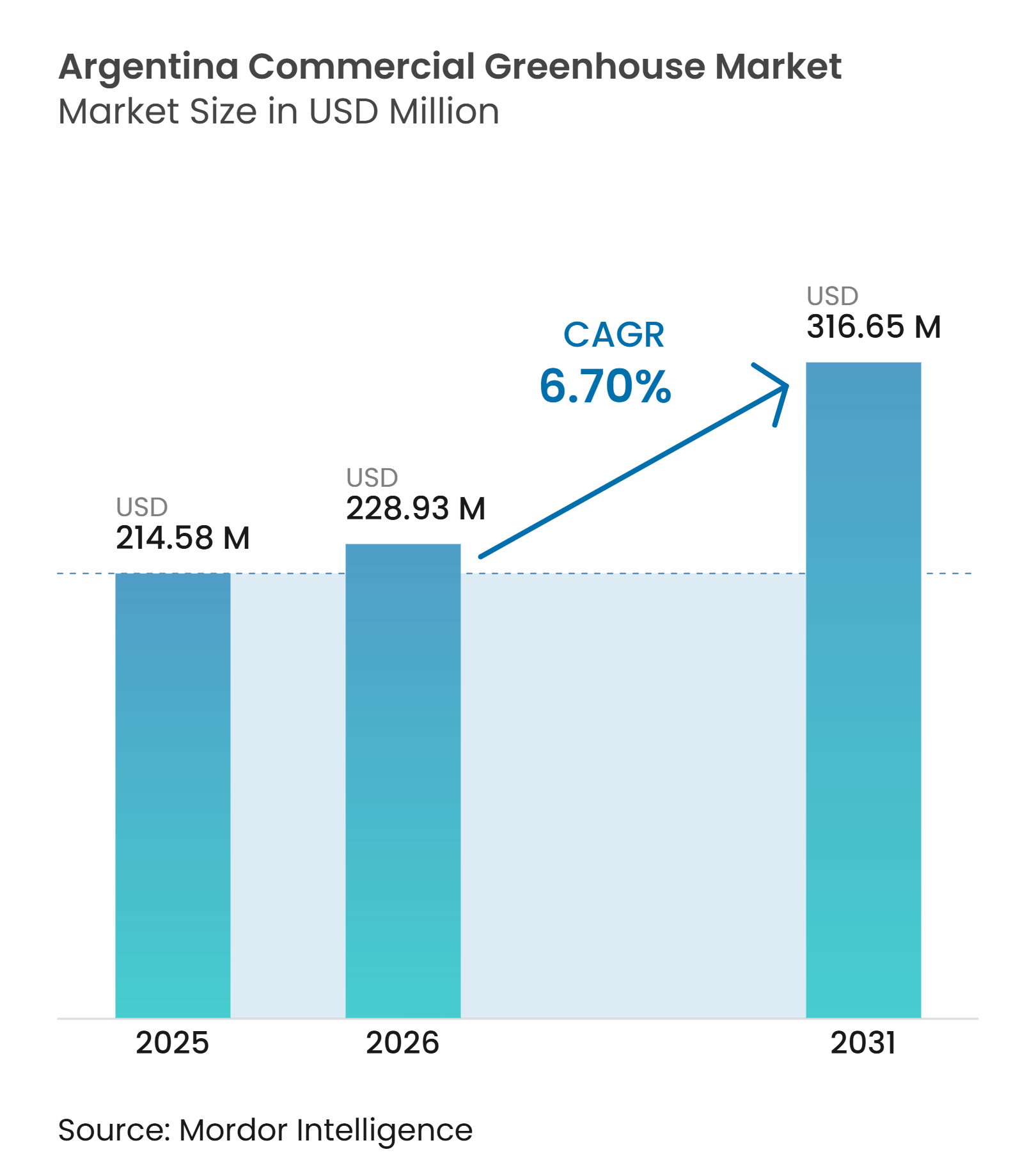
| Base Year Market Size (2025) | USD 214.58 Million |
| Market Size (2026) | USD 228.93 Million |
| Market Size (2031) | USD 316.65 Million |
| Growth Rate (2026 - 2031) | 6.70 % |
| Market Concentration | Medium |
Major Players *Disclaimer: Major Players sorted in no particular order Image © Mordor Intelligence. Reuse requires attribution under CC BY 4.0. | |
Argentina Commercial Greenhouse Market Analysis by Mordor Intelligence
The Argentina commercial greenhouse market was USD 214.58 million in 2025 and is forecast to grow from USD 228.93 million in 2026 to USD 316.65 million by 2031, at a CAGR of 6.70% during the forecast period 2026-2031. The market is supported by buyers seeking dependable availability, uniform produce, documented production practices, and low-residue supply. Retail chains, food processors, and export-oriented buyers increasingly prefer greenhouse-grown produce due to its consistency and traceability. In April 2025, Argentina removed foreign-exchange purchase restrictions, improving the ability of businesses to make import payments and plan equipment purchases in foreign currency. This policy change is anticipated to support investment in greenhouse infrastructure and equipment over the near term. However, the market faces challenges including uneven energy costs, costly financing, and continued reliance on imported components. Domestic equipment manufacturers and suppliers of irrigation systems, structures, and hydroponic systems can address some of these constraints with locally supported products. Local sourcing of key inputs also reduces exposure to currency fluctuations and import delays. Research activity led by national institutions helps growers evaluate protected cultivation and automated production methods, supporting gradual adoption of more efficient growing practices across the country.
Key Report Takeaways
- By equipment type, heating systems were the largest segment and held 31.0% of the Argentina commercial greenhouse market share in 2025, while climate control and automation software is the fastest-growing segment and is anticipated to expand at a 10.5% CAGR between 2026 and 2031.
- By crop type, fruits and vegetables were the largest segment and held 62.0% of the Argentina commercial greenhouse market size in 2025, while herbs and microgreens are the fastest-growing segment and are anticipated to expand at a 10.2% CAGR between 2026 and 2031.
- By greenhouse type, plastic-film greenhouses were the largest segment and held 78.0% of the market share in 2025, while glass greenhouses are the fastest-growing segment and are anticipated to expand at an 8.2% CAGR between 2026 and 2031.
- By cultivation technology, non-hydroponic soil and substrate was the largest segment and held 82.0% of the market share in 2025, while hydroponic is the fastest-growing segment and is anticipated to expand at a 9.5% CAGR between 2026 and 2031.
- By end user, commercial growers were the largest segment and held 82.0% of the market share in 2025, while research and educational institutes are the fastest growing segment and is anticipated to expand at an 8.0% CAGR between 2026 and 2031.
Note: Market size and forecast figures in this report are generated using Mordor Intelligence’s proprietary estimation framework, updated with the latest available data and insights as of January 2026.
Market Trends and Insights
Drivers Impact Analysis of Argentina Commercial Greenhouse Market*
| Driver | (~) % Impact on CAGR Forecast | Geographic Relevance | Impact Timeline |
|---|---|---|---|
| Year-round demand for fresh and premium produce | +1.5% | Greater Buenos Aires and Cuyo supply chains | Medium term (2-4 years) |
| Expansion of hydroponic production in high-value horticulture | +1.3% | Buenos Aires, CABA, Córdoba, and Santa Fe urban supply corridors | Long term (≥ 4 years) |
| Retailer demand for consistent quality, traceability and low residue | +0.9% | National, with early gains in Buenos Aires retail and food-service hubs | Medium term (2-4 years) |
| Public and technical support for protected cultivation | +0.8% | Buenos Aires, Patagonia, Northwest, and Cuyo | Long term (≥ 4 years) |
| Inverse-season strawberry production for export windows | +0.7% | Northwest Argentina and Buenos Aires Province coastal belt | Short term (≤ 2 years) |
| Local manufacturing of NFT channels and modular automation | +0.6% | Buenos Aires Province manufacturing corridor and national distributor network | Long term (≥ 4 years) |
| Source: Mordor Intelligence | |||
Year-Round Demand for Fresh and Premium Produce
Demand for consistent-quality fresh vegetables is supporting the adoption of protected cultivation in Argentina, particularly for crops such as tomatoes, peppers, and leafy vegetables. In February 2025, the National Institute of Agricultural Technology (INTA), in collaboration with the Regional Center for Technological Education (CERET), reported results from trials covering more than 30 horticultural crops during the 2023–24 campaign. The trials were conducted across seven tunnels and two greenhouses covering 3,000 m² and assessed parameters including yield per square meter, fruit quality, size, and sugar content[1]. These trials demonstrate the continued use of protected cultivation to improve productivity and quality under controlled growing conditions. As commercial growers seek to maintain more consistent output and quality across production cycles, the need for greenhouse structures, ventilation, irrigation, and other climate-management systems is anticipated to support the growth of Argentina's commercial greenhouse market.
Expansion of Hydroponic Production in High-Value Horticulture
Hydroponic cultivation is gaining relevance within Argentina's protected horticulture sector as growers seek to improve the efficiency of land and water use while maintaining controlled growing conditions. Recent horticultural initiatives and trials in Argentina have included hydroponic systems for vegetable production, demonstrating continued interest in soilless cultivation under greenhouse environments. Hydroponic systems can support intensive production of high-value crops while enabling greater control over water, nutrients, and growing conditions. Their adoption creates demand for greenhouse infrastructure and complementary technologies such as fertigation systems, irrigation controls, climate sensors, ventilation, and environmental-monitoring equipment. As commercial growers increasingly combine protected cultivation with soilless production methods, the expansion of hydroponics can contribute to demand across multiple equipment categories within Argentina's commercial greenhouse market.
Retailer Demand for Consistent Quality, Traceability and Low Residue
Food-safety and phytosanitary requirements are increasing the importance of controlled production and record keeping within Argentina's fresh-produce supply chain. In June 2025, Argentina's Joint Resolution 29/2025 established requirements for fruits and vegetables used as raw materials, including compliance with applicable pesticide-residue limits. Such requirements increase the importance of monitoring crop inputs, pest-management practices, and harvesting conditions, particularly for commercial growers supplying formal distribution and processing channels. Greenhouse production can provide greater control over growing conditions and facilitate the integration of irrigation, fertigation, pest-management, and production-monitoring systems. As compliance and quality requirements become increasingly relevant to commercial horticulture, demand for greenhouse infrastructure and associated fertigation, irrigation, monitoring, and climate-control technologies is anticipated to support the Argentina commercial greenhouse market.
Public and Technical Support for Protected Cultivation
Public-sector research, technical assistance, and knowledge-transfer programs are supporting the development of protected horticulture in Argentina. The National Institute of Agricultural Technology (INTA) conducts applied research and provides technical support covering horticultural production systems, including greenhouse and hydroponic cultivation. Its collaboration with universities, technical institutions, and producer organizations helps transfer locally relevant knowledge on crop management, varieties, irrigation, fertigation, and environmental control to growers. Recent technical activities have also included hydroponic and protected-production systems, providing producers with practical information for evaluating alternative cultivation methods. These initiatives can reduce technical barriers to technology adoption and support investment in greenhouse structures and complementary irrigation, fertigation, climate-control, and monitoring systems, contributing to the development of Argentina's commercial greenhouse market.
Restraints Impact Analysis of Argentina Commercial Greenhouse Market*
| Restraint | (~) % Impact on CAGR Forecast | Geographic Relevance | Impact Timeline |
|---|---|---|---|
| High upfront capital and restricted financing access | -1.3% | National, with greater pressure in Northwest Argentina and Patagonia | Long term (≥ 4 years) |
| Energy-cost volatility for heating, cooling, and supplemental lighting | -1.1% | Patagonia, Cuyo, and the Northwest | Medium term (2-4 years) |
| Foreign-exchange exposure for imported greenhouse equipment and spare parts | -0.9% | National | Medium term (2-4 years) |
| Fragmented farm data and limited interoperability across control systems | -0.5% | National, especially soil-based operations adopting partial automation | Long term (≥ 4 years) |
| Source: Mordor Intelligence | |||
High Upfront Capital and Restricted Financing Access
Greenhouse structures, climate-control equipment, irrigation, and hydroponic systems require significant upfront investment, which can constrain adoption among small and medium-sized horticultural producers. In April 2026, the National Institute of Agricultural Technology (INTA) reported that buried drip-irrigation systems in Argentina were being quoted at USD 2,800–3,300 per hectare, illustrating the capital required even for individual components of intensive production systems[2]. Financing conditions can further limit investment capacity. The Organisation for Economic Co-operation and Development (OECD) reported in 2025 that FONDAGRO, a fund established in 2017 to finance agricultural investment at preferential interest rates for specific groups, was closed by decree in 2024. Although the 2026 RIMI framework introduced tax and financial incentives for investment in irrigation, access to capital remains an important consideration for growers evaluating greenhouse projects with long payback periods. These investment requirements can favor established operators with stronger balance sheets and limit the pace of greenhouse technology adoption among smaller and first-time commercial growers.
Energy-Cost Volatility for Heating, Cooling and Supplemental Lighting
Energy-intensive greenhouse systems can increase operating-cost exposure because heating, cooling, ventilation, irrigation pumping, and supplemental lighting add recurring electricity requirements. In April 2026, Córdoba Province reduced the value-added tax on electricity used for agricultural irrigation from 27% to 10.5%, reflecting efforts to reduce the energy burden on agricultural producers[3]. While the measure applies specifically to irrigation rather than greenhouse operations, it illustrates the importance of electricity costs to intensive agricultural production. For greenhouse growers, fluctuations in electricity prices can affect the operating economics of climate-control and irrigation systems and increase uncertainty around project payback periods. This can discourage smaller growers from adopting energy-intensive technologies and favor greenhouse configurations that rely more heavily on passive ventilation, natural light, and energy-efficient equipment.
*Our forecasts treat driver/restraint impacts as directional, not additive. The impact forecasts reflect baseline growth, mix effects, and variable interactions.
Argentina Commercial Greenhouse Market Segment Analysis
By Equipment Type:
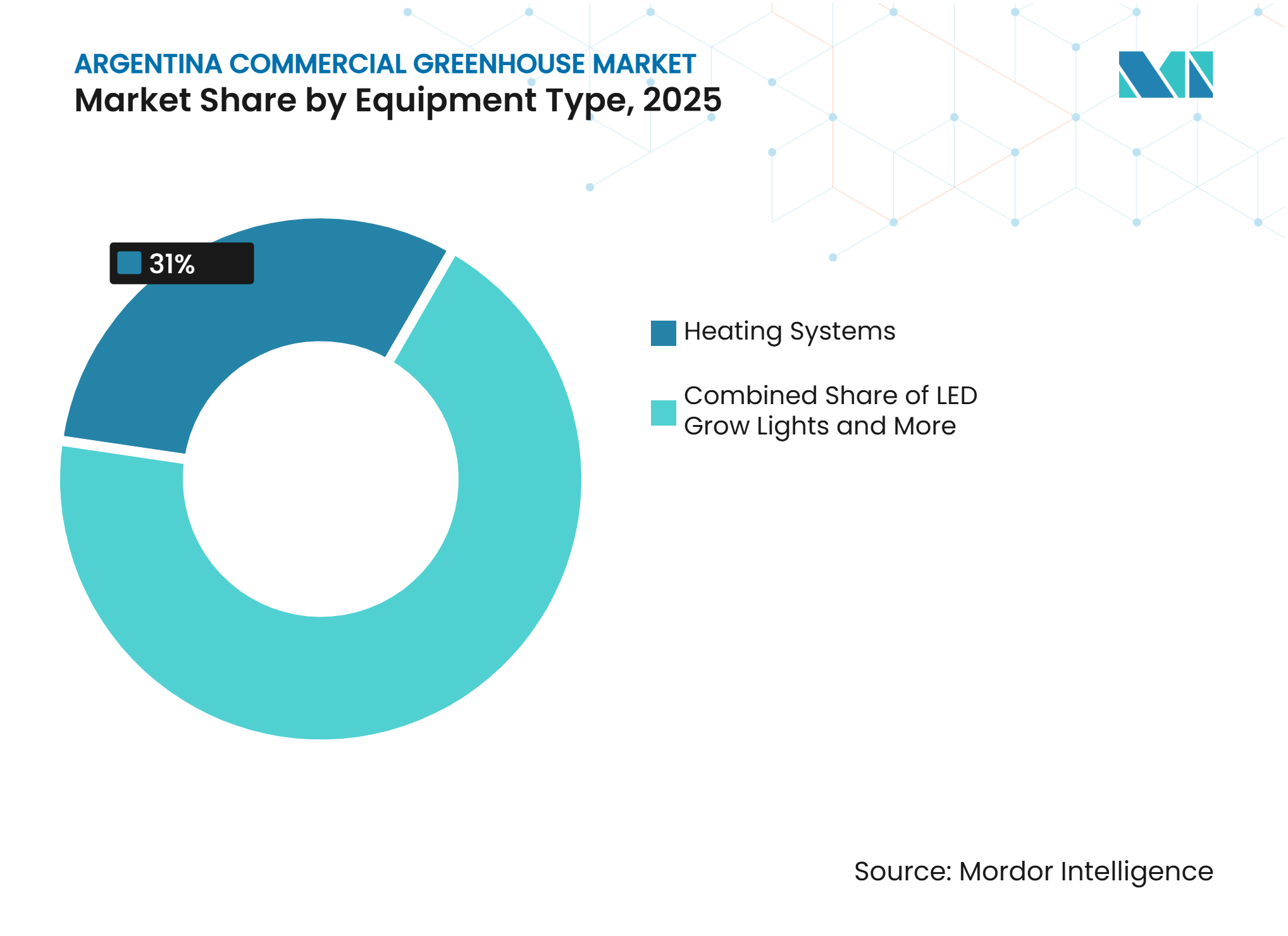
Heating Leads While Automation Software AdvancesHeating systems held 31.0% of the Argentina commercial greenhouse market in 2025, making them the largest equipment type. Their leading position reflects the importance of maintaining suitable temperatures during colder periods and extending production windows across Argentina's diverse climatic conditions. Heating systems are particularly relevant for commercial growers seeking to maintain stable growing conditions when outdoor temperatures fall below crop requirements. Cooling and Ventilation Systems, Irrigation and Fertigation Systems, Screening and Shading Systems, and Structural Components complement heating equipment by addressing temperature regulation, water and nutrient delivery, light management, and greenhouse construction requirements. As commercial greenhouse cultivation expands across different climatic regions, demand for reliable environmental-control and production infrastructure is anticipated to remain a major contributor to the Argentina commercial greenhouse market.
Climate control and automation software is forecast to expand at a 10.5% CAGR between 2026 and 2031, making it the fastest-growing equipment type. Growth is supported by increasing adoption of sensors, automated irrigation, remote monitoring, and data-driven crop management. In May 2025, the National Institute of Agricultural Technology (INTA) reported an intelligent irrigation system developed for greenhouse cultivation that uses sensors to monitor soil moisture, temperature, and ambient humidity, while artificial intelligence determines irrigation timing. The system can be configured for 170 different crops and provides producers with real-time information through connected mobile and web applications. This development illustrates the increasing integration of sensing, connectivity, and automation into Argentine protected cultivation. As growers seek to improve resource efficiency and reduce manual intervention, demand for automation software and connected control systems is anticipated to expand alongside conventional greenhouse equipment.



By Crop Type:
Fruits and Vegetables Retain Scale While Herbs and Microgreens Grow FasterFruits and vegetables held 62.0% of the Argentina commercial greenhouse market in 2025, making them the largest crop type. Their leading position reflects the established scale of vegetable production and the broad consumption base for crops such as tomatoes, peppers, cucumbers, and leafy vegetables. In August 2025, the National Institute of Agricultural Technology (INTA) reported that Argentina's tomato production averages approximately 1.1 million tons annually across 17,000 hectares, with around 60–70% directed toward the fresh-consumption market. The large domestic market for fresh vegetables supports continued investment in protected cultivation, where greenhouse systems can provide greater control over production conditions and crop quality. Flowers and Ornamentals represent another established application, supported by demand for cut flowers, potted plants, and bedding plants, while Cannabis and Specialty Crops remain smaller applications subject to specific regulatory requirements. As commercial horticulture continues to adopt protected-production systems, fruits and vegetables are anticipated to remain the primary source of greenhouse market revenue in Argentina.
Herbs and microgreens are forecast to expand at a 10.2% CAGR between 2026 and 2031, making them the fastest-growing crop type. Their growth is supported by the suitability of short-cycle, high-value crops for intensive production systems, including hydroponic and controlled-environment cultivation. Greenhouse and soilless systems can allow growers to optimize growing conditions, water and nutrient delivery, and production density for crops such as herbs and microgreens. Demand for locally produced, fresh products can further support cultivation near urban consumption centers, where shorter supply chains can benefit highly perishable crops. Strawberries and Berries represent another specialized application, with protected cultivation providing opportunities to manage production conditions and extend market windows. As growers diversify beyond conventional greenhouse vegetables, higher-value specialty crops are anticipated to create additional opportunities within the Argentina commercial greenhouse market.
By Greenhouse Type:
Plastic Film Holds the Broadest Base While Glass Serves Advanced ProjectsPlastic-Film Greenhouses held 78.0% of the Argentina commercial greenhouse market in 2025, making them the largest greenhouse type. Their leading position reflects the relatively accessible construction and replacement requirements of polyethylene-covered structures and their suitability for Argentina's established protected-horticulture operations. Plastic-film structures can be adapted with ventilation, irrigation, fertigation, shading, and other climate-management systems without requiring the higher structural investment associated with rigid glazing. The continued relevance of plastic-covered production is also evident in Corrientes, where INTA published a 2026 update specifically assessing the construction costs of wood-frame greenhouses, noting that greenhouse investment has a significant impact on horticultural operating margins. Rigid Polycarbonate Greenhouses provide greater durability and light-diffusion characteristics and can serve applications requiring longer-lasting structures or more controlled growing environments. As growers remain sensitive to initial investment, plastic-film structures are anticipated to retain the broadest installed base in Argentina's commercial greenhouse market.
Glass Greenhouses are forecast to expand at an 8.2% CAGR between 2026 and 2031, making them the fastest-growing greenhouse type. Their expansion is associated with projects requiring higher levels of environmental control, durability, and integration of advanced production technologies rather than broad replacement of plastic-film structures. Glass systems can accommodate sophisticated climate-management, irrigation, fertigation, and automation equipment and are therefore suited to technology-intensive commercial and research applications. Hybrid and Semi-Closed Greenhouses provide additional options for growers seeking greater control over air movement, temperature, humidity, and nutrient management. As investment in protected cultivation becomes more technology-oriented, demand for higher-specification greenhouse configurations is anticipated to increase alongside the continued dominance of lower-cost plastic-film structures.
By Cultivation Technology:
Soil and Substrate Systems Lead While Hydroponics ExpandsNon-Hydroponic Soil and Substrate Systems held 82.0% of the Argentina commercial greenhouse market in 2025, making them the largest cultivation-technology segment. Their leading position reflects the established use of soil-based and substrate cultivation across Argentina's protected horticulture industry, supported by growers' familiarity with conventional production practices and existing greenhouse infrastructure. Substrate systems can also provide greater control over the root zone while retaining cultivation methods that are less complex than fully recirculating hydroponic systems. INTA's recent technical work on substrate management highlights the importance of substrate properties for irrigation and fertilization decisions, reinforcing the role of substrate-based cultivation in controlled horticultural production. As growers continue to prioritize familiar production systems and manage investment requirements, soil and substrate cultivation are anticipated to retain the largest share of Argentina's commercial greenhouse market.
Hydroponic Systems are forecast to expand at a 9.5% CAGR between 2026 and 2031, making them the fastest-growing cultivation-technology segment. Growth is supported by increasing interest in soilless production for intensive horticulture and the ability to control water and nutrient delivery more precisely. In May 2025, INTA researchers reported a six-month trial of two lettuce varieties grown using a recirculating Nutrient Film Technique (NFT) system under greenhouse conditions in Bella Vista, Corrientes. The study noted that hydroponic systems remained relatively underdeveloped in the region but that commercial ventures were already present in several locations. The continued development of local NFT systems and greenhouse-based hydroponic production is creating demand for specialized irrigation, fertigation, nutrient-monitoring, and environmental-control equipment. As commercial growers increasingly evaluate soilless cultivation and automation, hydroponics is anticipated to gain share while conventional soil and substrate systems remain the dominant production base.
By End User:
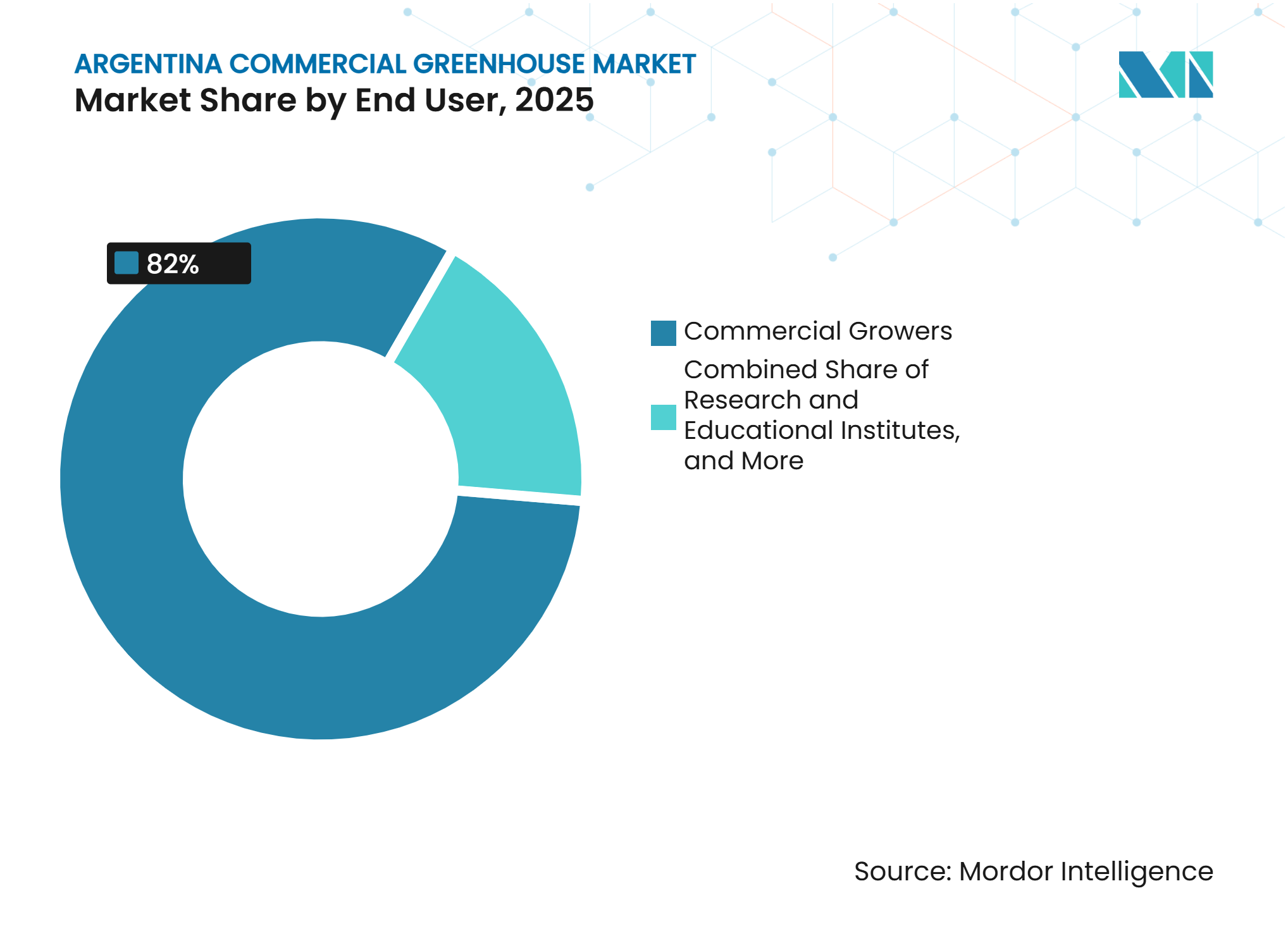
Commercial Growers Lead While Research and Educational Institutes Add Technical DemandCommercial Growers held 82.0% of the Argentina commercial greenhouse market in 2025, making them the largest end-user segment. Their leading position reflects the primary use of commercial greenhouses for market-oriented horticultural production and the established base of growers investing in protected cultivation to improve production consistency and resource management. Commercial operations range from relatively simple structures using passive ventilation and manual irrigation to more advanced facilities incorporating climate control, fertigation, and automation. This variation creates demand across both conventional greenhouse infrastructure and technology upgrades, while capital requirements can limit the pace at which smaller growers adopt higher-specification systems. As commercial producers seek to improve productivity, crop quality, and resource efficiency, they are anticipated to remain the principal source of demand for greenhouse structures and associated equipment in Argentina.
Research and Educational Institutes are forecast to expand at an 8.0% CAGR between 2026 and 2031, making them the fastest-growing end-user segment. Research institutions and universities use protected cultivation facilities to evaluate crop varieties, cultivation methods, irrigation strategies, and soilless production systems, creating demand for specialized greenhouse and environmental-control equipment. In May 2025, researchers from INTA's Bella Vista Experimental Station and the National University of the Northeast reported a greenhouse trial evaluating two lettuce varieties using a recirculating Nutrient Film Technique (NFT) hydroponic system in Corrientes. The study was presented at the 2nd Argentine Hydroponics Congress and demonstrates the continued use of greenhouse facilities for evaluating hydroponic production under local conditions. Retail Garden Centers and Nurseries form another end-user group, requiring propagation, irrigation, substrate, environmental-control, and greenhouse equipment. For example, Argentine supplier Argenplugs reports 31 production greenhouses, three germination chambers, more than 15 million plantlets per year, and more than 500 customers, while its product portfolio includes propagation trays, substrates, irrigation, dosing, humidification, and greenhouse systems. As research and nursery operations adopt more controlled cultivation and propagation technologies, they can contribute to incremental demand for specialized greenhouse equipment alongside the much larger commercial-grower base.

Geography Analysis
Buenos Aires and CABA held the largest share of the Argentina commercial greenhouse market at 45.0% in 2025, supported by the concentration of protected horticultural production around major consumption centers and the established commercial greenhouse base in Buenos Aires Province. The La Plata horticultural belt is an important production area for vegetables under protected cultivation, with growers increasingly evaluating hydroponic and automated production technologies alongside conventional systems. Buenos Aires has an established supplier base for greenhouse infrastructure and cultivation equipment, including ADC Invernaderos, which operates from Abasto and supplies greenhouse solutions to producers. Cuyo remains an important protected-cultivation market, supported by its irrigated agricultural base and established horticultural and fruit-production activities. Northeast Argentina, particularly Corrientes, also has a significant protected-horticulture base, with recent INTA research continuing to address greenhouse production, irrigation, and cultivation practices.
Patagonia is the fastest-growing geography in the Argentina commercial greenhouse market, registering a CAGR of 8.4% between 2026 and 2031. Growth is supported by the need to extend production periods and manage low temperatures and other climatic constraints that limit open-field cultivation. A 2025 study by researchers associated with the National University of Comahue identified 31 greenhouse producers operating 94 greenhouse modules across approximately 20 hectares in the Lower Valley of Río Negro, demonstrating an established but developing protected-cultivation base in the region. The study also highlighted differences in technology adoption and access to technical support among producers. INTA's Patagonia activities are increasingly incorporating automation and environmental monitoring; in 2025, researchers reported work on greenhouse irrigation automation using sensors for soil moisture, temperature, and ambient humidity. These developments are supporting demand for irrigation automation, climate-control, environmental monitoring, and other greenhouse technologies as producers seek to improve production reliability under challenging climatic conditions.
The remainder of Argentina provides additional opportunities through specialized horticultural production and regional adaptation of protected-cultivation technologies. Northwest Argentina supports greenhouse production of strawberries and other specialty crops, with recent research evaluating protected cultivation under local environmental conditions. In Santiago del Estero, a 2026 study evaluated strawberry production under protected cultivation, reflecting continued experimentation with greenhouse systems for higher-value crops. Cuyo's combination of intensive irrigated agriculture and high-value horticulture creates opportunities for greenhouse fertigation and water-management technologies, while Corrientes and other Northeast provinces maintain established greenhouse production for vegetables, nurseries, and ornamental crops. Across these regions, greenhouse investment is increasingly differentiated by climatic conditions, crop specialization, water availability, and the degree of automation adopted, creating opportunities for both conventional protected structures and higher-technology cultivation systems.
Competitive Landscape
Market Concentration
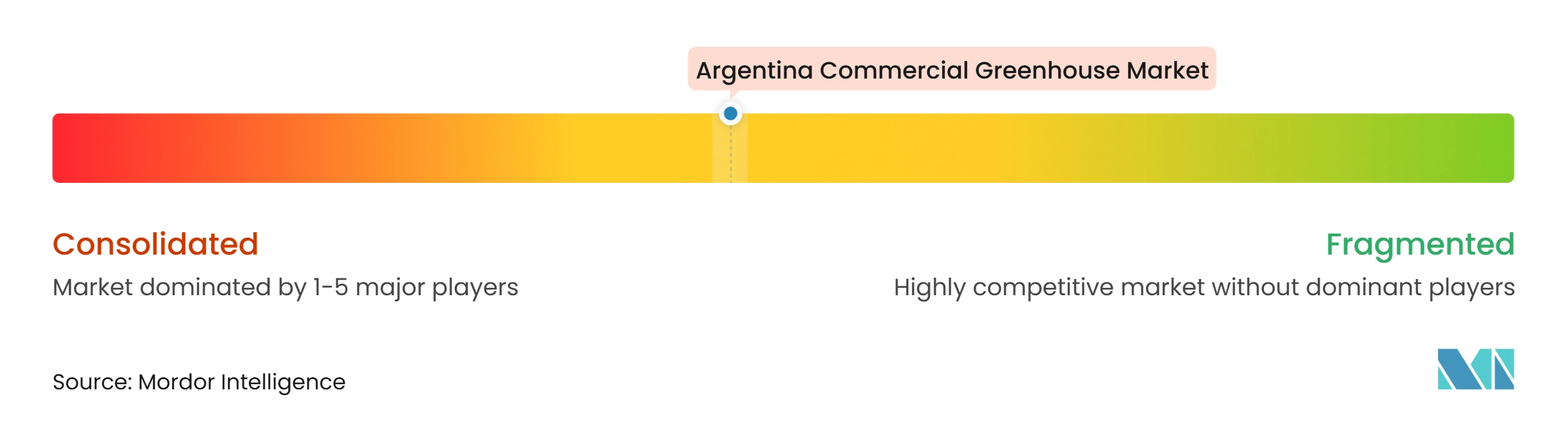
The Argentina commercial greenhouse market is moderately concentrated, with ADC Invernaderos SRL, ACQUA GARDEN S.A.S., IRIE Hnos. S.R.L., Richel Group, and Netafim Argentina S.A. representing major players in the market in 2025. Competition is centered on greenhouse design and manufacturing, climate control, irrigation and fertigation, automation, and turnkey project execution. ADC Invernaderos SRL combines locally manufactured galvanized-steel structures with polyethene and polycarbonate coverings, research-oriented greenhouse systems, and automation technologies including heating, thermal screens, evaporative cooling, extraction, irrigation, and sensor-based environmental control. Alvatec S.R.L. provides Richel Group greenhouse technologies in Argentina and Uruguay and focuses on commercial and industrial projects, with its portfolio extending across greenhouse structures, climate-control equipment, and customized project execution. Netafim Argentina S.A. competes primarily through precision irrigation, fertigation, climate-management, and digital monitoring solutions for protected cultivation. Other domestic players, including IRIE Hnos. S.R.L., compete through locally manufactured galvanized-steel greenhouse structures, multiple tunnel configurations, and ventilation options.
Competitive differentiation is increasingly shifting from greenhouse structures alone toward integrated cultivation systems. Suppliers are combining structural solutions with irrigation, fertigation, climate control, environmental monitoring, and automation to provide growers with greater control over production conditions. ADC Invernaderos SRL's automated greenhouse configurations can integrate ventilation, heating, shading, cooling, and environmental sensors, while Alvatec S.R.L. offers greenhouse projects together with climate-control equipment and customized project execution. Netafim Argentina S.A. similarly combines precision irrigation and fertigation with climate-management and digital monitoring technologies for protected crops. This integration trend is particularly relevant as Argentine growers evaluate hydroponic production, resource-efficiency technologies, and automation while balancing the investment requirements of higher-specification greenhouse systems.
The market also provides opportunities for suppliers that can adapt technology to different farm scales and regional production conditions. Smaller commercial growers represent an opportunity for modular greenhouse structures, affordable irrigation automation, and scalable environmental-monitoring systems, while larger projects can support demand for integrated climate-control and turnkey solutions. Regional requirements also create opportunities for energy-efficient greenhouse technologies in colder areas such as Patagonia and water-efficient irrigation and fertigation systems in Cuyo and other water-constrained production zones. Alvatec S.R.L.'s positioning around projects above 500 m² illustrates the market segmentation between larger commercial installations and smaller local greenhouse projects. Consequently, competitive advantage is increasingly determined by a supplier's ability to combine structural engineering with irrigation, climate management, automation, technical support, and customized project execution rather than by the supply of individual greenhouse components alone.
Argentina Commercial Greenhouse Industry Leaders
-
ADC Invernaderos SRL
-
Netafim Argentina S.A. (Orbia Advance Corporation)
-
IRIE Hnos. S.R.L.
-
Richel Group
-
ACQUA GARDEN S.A.S.
- *Disclaimer: Major Players sorted in no particular order
Argentina Commercial Greenhouse Market Companies Covered in this Report
- IRIE Hnos. S.R.L.
- Alvatec S.R.L.
- Richel Group (GREENBEES)
- Netafim Argentina S.A. (Orbia Advance Corporation)
- Signify Argentina S.A. (Signify N.V.)
- ACQUA GARDEN S.A.S.
- VERDEAGUA HIDROPONIA S.R.L.
- ARGENPLUGS S.A.
- LC Empresas
Recent Industry Developments in Argentina Commercial Greenhouse Market
- September 2026: The Argentine government reported on September 3, 2026 that researchers from the National University of San Luis, INTA, and local producers were developing an intelligent greenhouse system combining sensors and AI to anticipate climatic conditions affecting horticultural crops. The project is financed through the European Union's CIN-UNIEAR program and is being developed for agricultural-family production. This represents a recent move toward sensor-based environmental monitoring and predictive greenhouse management in Argentina.
- June 2026: GrowDirector announced its Latin American expansion in June 2026, identifying Verdeagua and Crear Hydroponia in Argentina among its local distributors. Its GrowDirector 4 PRO platform combines IoT hardware, cloud monitoring, and AI-driven agronomic functionality for greenhouse and other controlled-environment applications, including climate control, irrigation, fertigation, lighting, environmental monitoring, and energy management.
- May 2025: At the 2nd Argentine Hydroponics Congress on May 22–23, 2025, INTA Bella Vista and the National University of the Northeast presented research on two lettuce varieties cultivated using a recirculating NFT system under greenhouse conditions in Corrientes. The study provides evidence of continued technical development of greenhouse hydroponics in a region with an established protected-horticulture base.
Argentina Commercial Greenhouse Market Report Scope
A commercial greenhouse is a greenhouse that is used for the cultivation of commercial crops that will be sold in the market.
The Argentina Commercial Greenhouse Market Report is Segmented by Equipment Type (Heating Systems, and More), by Crop Type (Fruits and Vegetables, and More), by Greenhouse Type (Glass Greenhouse, and More), by Cultivation Technology (Hydroponic, and More), and by End User (Commercial Growers, and More). The Market Forecasts are Provided in Terms of Value (USD).
Segmentation Overview
| Heating Systems | |
| Cooling and Ventilation Systems | |
| LED Grow Lighting | |
| Irrigation and Fertigation Systems | |
| Climate-Control and Automation Software | |
| Screening and Shading | |
| Structural Components | Glazing Systems |
| Frames and Trusses |
| Fruits and Vegetables | Tomatoes |
| Cucumbers | |
| Lettuce and Leafy Greens | |
| Peppers | |
| Strawberries and Berries | |
| Flowers and Ornamentals | Cut Flowers |
| Potted and Bedding Plants | |
| Herbs and Microgreens | |
| Cannabis and Specialty Crops | Medical Cannabis |
| Seedlings and Propagation Crops |
| Glass Greenhouses |
| Plastic-Film Greenhouses |
| Rigid Polycarbonate Greenhouses |
| Hybrid and Semi-Closed Greenhouses |
| Hydroponic | Nutrient Film Technique |
| Deep Water Culture | |
| Drip Hydroponics | |
| Non-Hydroponic Soil and Substrate | Soil-Based |
| Coco Coir and Rockwool Substrate | |
| Hybrid and Vertical Integration |
| Commercial Growers |
| Research and Educational Institutes |
| Retail Garden Centers and Nurseries |
| By Equipment Type | Heating Systems | |
| Cooling and Ventilation Systems | ||
| LED Grow Lighting | ||
| Irrigation and Fertigation Systems | ||
| Climate-Control and Automation Software | ||
| Screening and Shading | ||
| Structural Components | Glazing Systems | |
| Frames and Trusses | ||
| By Crops | Fruits and Vegetables | Tomatoes |
| Cucumbers | ||
| Lettuce and Leafy Greens | ||
| Peppers | ||
| Strawberries and Berries | ||
| Flowers and Ornamentals | Cut Flowers | |
| Potted and Bedding Plants | ||
| Herbs and Microgreens | ||
| Cannabis and Specialty Crops | Medical Cannabis | |
| Seedlings and Propagation Crops | ||
| By Greenhouse Type | Glass Greenhouses | |
| Plastic-Film Greenhouses | ||
| Rigid Polycarbonate Greenhouses | ||
| Hybrid and Semi-Closed Greenhouses | ||
| By Cultivation Technology | Hydroponic | Nutrient Film Technique |
| Deep Water Culture | ||
| Drip Hydroponics | ||
| Non-Hydroponic Soil and Substrate | Soil-Based | |
| Coco Coir and Rockwool Substrate | ||
| Hybrid and Vertical Integration | ||
| By End User | Commercial Growers | |
| Research and Educational Institutes | ||
| Retail Garden Centers and Nurseries | ||
Key Questions Answered in the Report
What is the Argentina commercial greenhouse market size in 2026?
The market is valued at USD 228.93 million in 2026 and is forecast to reach USD 316.65 million by 2031, at a 6.70% CAGR.
Which crop type has the largest role?
Fruits and Vegetables held 62.0% of crop-type revenue in 2025, led by established greenhouse production of tomatoes, cucumbers, lettuce, and peppers.
Why are hydroponic systems gaining use?
Hydroponics enables greater control over water, nutrients, and growing conditions, while NFT and automation systems support more efficient intensive production.
What constrains investment in protected cultivation?
High upfront costs, financing constraints, energy-price volatility, imported-equipment exposure, and limited system integration remain key investment barriers.