
Market Overview
| Study Period | 2019 - 2031 |
|---|---|
| Forecast Data Period | 2026 - 2031 |
| Base Year Market Size (2025) | USD 4.28 Million |
| Market Size (2026) | USD 4.53 Million |
| Market Size (2031) | USD 5.98 Million |
| Growth Rate (2026 - 2031) | 5.73 % |
| Market Concentration | Medium |
Major Players *Disclaimer: Major Players sorted in no particular order Image © Mordor Intelligence. Reuse requires attribution under CC BY 4.0. | |
Argentina Automotive Reed Sensors Switches Market Analysis by Mordor Intelligence
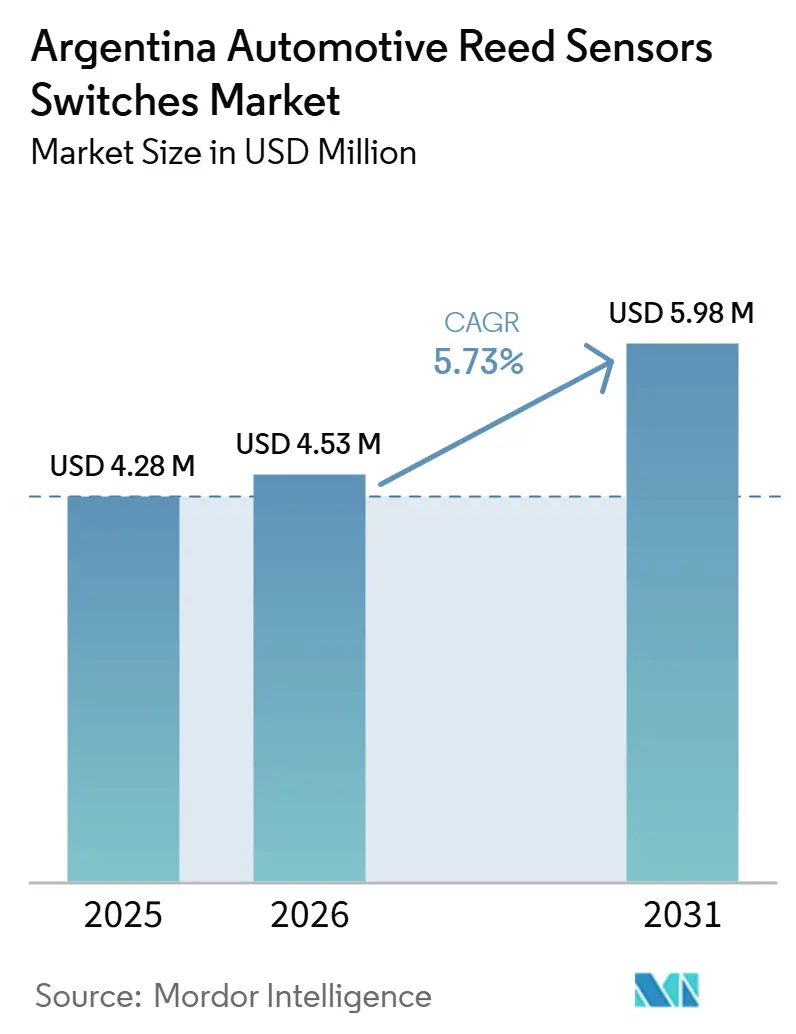
The Argentine automotive reed sensor switches market size is expected to grow from USD 4.28 million in 2025 to USD 4.53 million in 2026, and is forecast to reach USD 6.0 million by 2031, at a 5.73% CAGR over 2026-2031. The automotive reed sensors and reed switches market in Argentina is supported primarily by replacement demand from a large and aging vehicle fleet, keeping wear-driven component demand active across installed vehicles. The market is also shaped by an import-heavy new-vehicle mix, as the majority of new-vehicle sales are imported, tying many fitment specifications to foreign OEM programs rather than to local engineering decisions. Domestic production remains relevant to supply continuity and dealer activity; however, a recent decline in vehicle output underscores the greater role of imports in shaping product configurations.
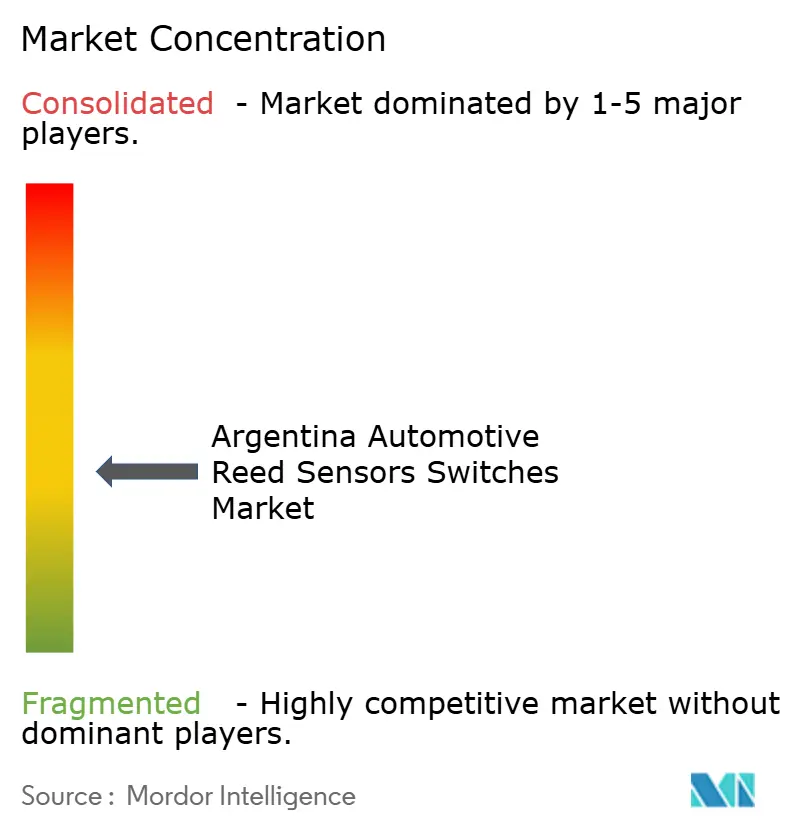
The operating backdrop remains uneven because inflation stayed high, yet the OECD expects Argentina’s real GDP to grow, which supports a measured recovery in vehicle-related spending [1]“OECD Economic Outlook, Volume 2026 Issue 1, Argentina,” OECD, oecd.org. Competition in the automotive reed sensors and reed switches market in Argentina remains moderately fragmented, with a few global suppliers holding the widest automotive-grade portfolios while local execution depends heavily on distribution reach, aftermarket access, and alignment with imported vehicle platforms.
Key Report Takeaways
- By product type, reed switches accounted for 54.28% of the Argentine automotive reed sensor switches market share in 2025, while reed sensors are projected to expand at a 7.13% CAGR through 2031.
- By application, body electronics accounted for 24.78% share of the Argentine automotive reed sensor switches market in 2025, while battery and charging systems are forecast to grow at a 9.63% CAGR through 2031.
- By vehicle type, passenger cars held 78.64% share in 2025 and also recorded the highest projected CAGR at 5.83% through 2031.
- By sales channel, OEMs accounted for 75.15% share in 2025, while the aftermarket is projected to grow fastest at a 6.33% CAGR through 2031.
- By propulsion type, internal combustion engine vehicles represented 63.34% share in 2025, while battery electric vehicles are expected to advance at a 12.63% CAGR through 2031.
Note: Market size and forecast figures in this report are generated using Mordor Intelligence’s proprietary estimation framework, updated with the latest available data and insights as of January 2026.
Argentina Automotive Reed Sensors Switches Market Trends and Insights
Drivers Impact Analysis*
| Driver | (~) % Impact on CAGR Forecast | Geographic Relevance | Impact Timeline |
|---|---|---|---|
| Aftermarket Replacement Demand | +1.8% | National (Older Parc) | Medium term (2-4 years) |
| Gradual EV Adoption Uptick | +1.0% | Major Cities | Medium term (2-4 years) |
| Charging Ecosystem Build-Out | +0.8% | Urban Corridors | Medium term (2-4 years) |
| Body Electronics Content Growth | +0.7% | National | Short term (≤ 2 years) |
| Import-Led Model Refresh | +0.6% | National | Short term (≤ 2 years) |
| Service Network Expansion | +0.5% | Major Provinces | Medium term (2-4 years) |
| Source: Mordor Intelligence | |||
Large and Aging Vehicle Fleet Sustaining Replacement Demand
The automotive reed sensors and reed switches market in Argentina continues to draw its clearest support from the country’s old vehicle base and the slow pace of fleet renewal. Argentina’s vehicle fleet reached 15,784,385 units at the end of 2025, and the average vehicle age rose to 14.8 years from 14.3 years in 2024[2]“Flota Vehicular Circulante en Argentina 2025,” AUTO X Arg, autoxarg.com.ar.
A significant share of vehicles on the road is over two decades old, sustaining replacement demand for door latches, trunk-release mechanisms, and other reed-supported body components that wear out with repeated use. The gap between required fleet renewal and actual registrations remained wide, as Argentina needed substantially more new vehicle registrations per year to stabilize the average fleet age. Yet, actual registrations fell well short of that threshold. This imbalance extends the replacement cycle and shifts a meaningful share of demand toward independent repair channels and parts distributors serving mid-age and older vehicles. E-Parts operated as a national franchise network with plans to scale its outlet count, reflecting how distribution networks are positioning around recurring service demand rather than new vehicle growth alone.
Policy Support Improving Availability of EVs and Hybrids
Government initiatives aimed at improving access to electric and hybrid vehicles are gradually expanding the electrified vehicle parc in Argentina. Policy mechanisms that reduce import barriers and support the introduction of new EV and hybrid models are increasing vehicle availability, particularly in urban markets. While overall penetration remains limited, these measures are widening the addressable base for electrified platforms.
Electrified vehicles require additional sensing components compared to conventional vehicles, particularly in battery packs, charging interfaces, and safety interlock systems. As the number of EVs and hybrids in circulation increases, demand for reed sensors and switches used in these subsystems is expected to rise, supporting higher-growth application segments over the forecast period.
Expansion of Charging Infrastructure Enabling EV Usability
The gradual expansion of public and utility-led charging infrastructure is improving the practical usability of electric vehicles, particularly in major metropolitan areas and along key transport corridors. Improved charging access reduces range-related concerns and supports more frequent EV usage, which in turn strengthens adoption prospects over time.
Charging infrastructure expansion also directly supports demand for sensing components used within charging systems. Reed sensors and switches are used for connector engagement detection, access panel monitoring, and safety-related switching in charging equipment and vehicle-side interfaces. As charging networks expand, demand for associated sensing increases, reinforcing growth in battery- and charging-related applications.
Continued OEM Production and Dealer Sales Supporting Factory-Fit Demand
The automotive reed sensors and reed switches market in Argentina depends on OEM fitment volumes, even though the local production base is no longer the primary source of new vehicle configurations. A significant share of new vehicle sales in Argentina comprises imported vehicles, which creates a steady stream of vehicles entering service with factory-installed sensing assemblies. Domestic production reached 490,876 vehicles in 2025, representing a 3.1% annual decline, though local manufacturing continued to provide a meaningful volume base for dealer-linked parts and service activity[3]“Informe Industria Diciembre 2025,” ADEFA, adefa.org.ar.
The OEM channel holds a strong position in the automotive reed sensors and reed switches market in Argentina, supported by the steady flow of fitments and the role of authorized dealer networks in early-life service. Dealer expansion also supports parts availability beyond the point of first sale; Stellantis continued to extend its Norauto autocentro footprint in Argentina during 2025. This keeps OEM-specification components visible in the service market and reduces the gap between imported vehicle content and local access to replacements.
Restraints Impact Analysis*
| Restraint | (~) % Impact on CAGR Forecast | Geographic Relevance | Impact Timeline |
|---|---|---|---|
| FX Volatility and Import Curbs | -1.2% | National | Short term (≤ 2 years) |
| Limited EV Charging Coverage | -0.8% | Outside Major Cities | Medium term (2-4 years) |
| Lower OEM Production Scale | -0.6% | National | Medium term (2-4 years) |
| Price Sensitivity in Aftermarket | -0.4% | National | Medium term (2-4 years) |
| Source: Mordor Intelligence | |||
Low Electric Vehicle Penetration Limits Near-Term Scale
Electric vehicle penetration in Argentina remains in its early stages, constraining near-term demand for BEV-linked reed sensors and switches. Although electric vehicle growth rates are high relative to a small base, absolute volumes remain limited compared to internal combustion engine vehicles. As a result, applications tied to battery and charging systems contribute a smaller share to total market demand in the near term.
This limits the realization of short-term growth opportunities associated with electrified platforms. While EV adoption is expected to increase over the forecast period, the dominance of conventional vehicles limits the short-term impact of EV-driven sensing demand, particularly outside major urban markets where adoption remains concentrated.
Macroeconomic Volatility Affecting Vehicle Production and Imports
Macroeconomic volatility in Argentina continues to influence vehicle production levels, sales cycles, and component import dynamics. Fluctuations in production output and dealer inventory levels can affect near-term sourcing decisions by OEMs and Tier-1 suppliers, leading to variability in factory-fit demand for electronic components, including reed sensors and switches.
In addition, import-related constraints and planning uncertainty can disrupt supply chains and delay module sourcing or replacement cycles. These factors reduce demand visibility over the short to medium term and can soften market momentum, particularly in periods of economic adjustment or policy transition.
*Our forecasts treat driver/restraint impacts as directional, not additive. The impact forecasts reflect baseline growth, mix effects, and variable interactions.
Segment Analysis
By Product Type: Reed Switches Lead Today; Reed Sensors Expand Faster
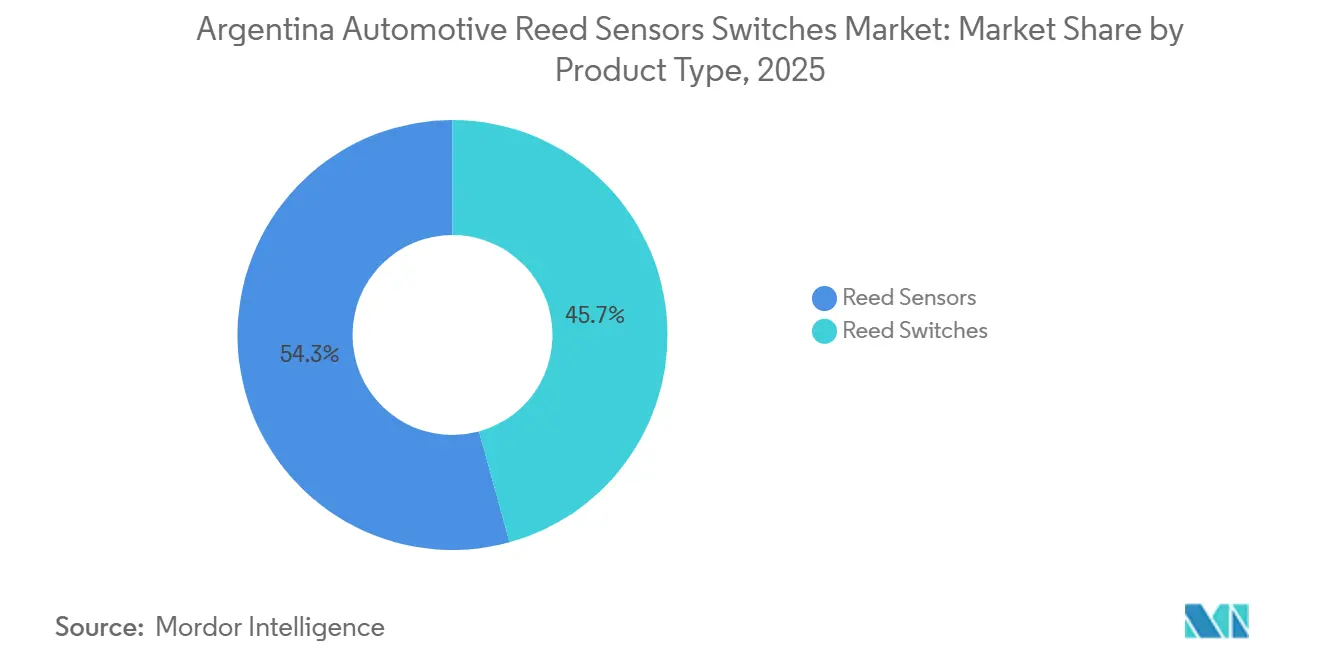
Reed switches accounted for 54.3% of automotive reed sensors in Argentina in 2025, keeping them the largest product format entering the forecast period. Reed sensors, however, are projected to grow at a 7.1% CAGR through 2031, which makes them the fastest-moving format within the product mix. This split reflects two separate demand bases, since switches remain deeply embedded in conventional body and utility functions, while sensors are gaining ground where packaging, integration, and module density matter more. The automotive reed sensors and reed switches market in Argentina still relies heavily on established switch applications in door-ajar systems, trunk sensing, power window interlocks, and HVAC actuator feedback. Those use cases remain durable because they are present in both older vehicles and newer imported models, allowing switches to preserve their larger base even as sensors gain share in newer assemblies.
As imported and electrified platforms place greater emphasis on compact electronic modules, reed sensors are gaining a stronger position in future design choices. Standex Detect notes that a typical automobile can carry a significant number of distinct reed switch and sensor applications, indicating that even modest product-format shifts can affect total content per vehicle. Within the automotive reed sensors and reed switches market, switches continue to anchor current scale while sensors capture a larger share of future model refresh activity.


By Application: Body Electronics Anchor Demand; Battery and Charging Systems Lead Growth
Body electronics accounted for 24.78% of the automotive reed sensors and reed switches market in Argentina in 2025, making it the largest application area. Battery and charging systems are expected to grow at a 9.63% CAGR through 2031, making them the fastest-growing application within the forecast period. Body electronics leads the market because functions such as door-latch state, hood and trunk position, seatbelt sensing, mirror adjustment, and cabin light actuation are common across the broad installed fleet. That installed base is particularly relevant in Argentina, where the high average fleet age sustains demand for service of repetitive-use components beyond newly produced vehicles. As these functions wear on switching cycles and exist across vehicle classes, body electronics remain less sensitive to short-term changes in local production or EV penetration.
Battery and charging growth stems from a different base, tied more closely to the rise of electrified platforms and the greater sensing density these systems require. Reed devices offer an advantage in passive-state power draw, making them useful in battery management interlock circuits where unnecessary auxiliary load affects range and system efficiency. Safety and security systems, infotainment and comfort systems, and transmission and braking systems continue to generate steady baseline demand, supported by the large conventional fleet already in operation. The engine and powertrain segment faces a slower growth path because Argentina still has a predominantly internal combustion installed base, though new electrified content is gradually shifting future value toward battery-centered functions. Within the automotive reed sensors and reed switches market in Argentina, this creates a stable present structure alongside a growth path that increasingly favors higher-content electrical subsystems.
By Vehicle Type: Passenger Cars Dominate and Also Grow Fastest
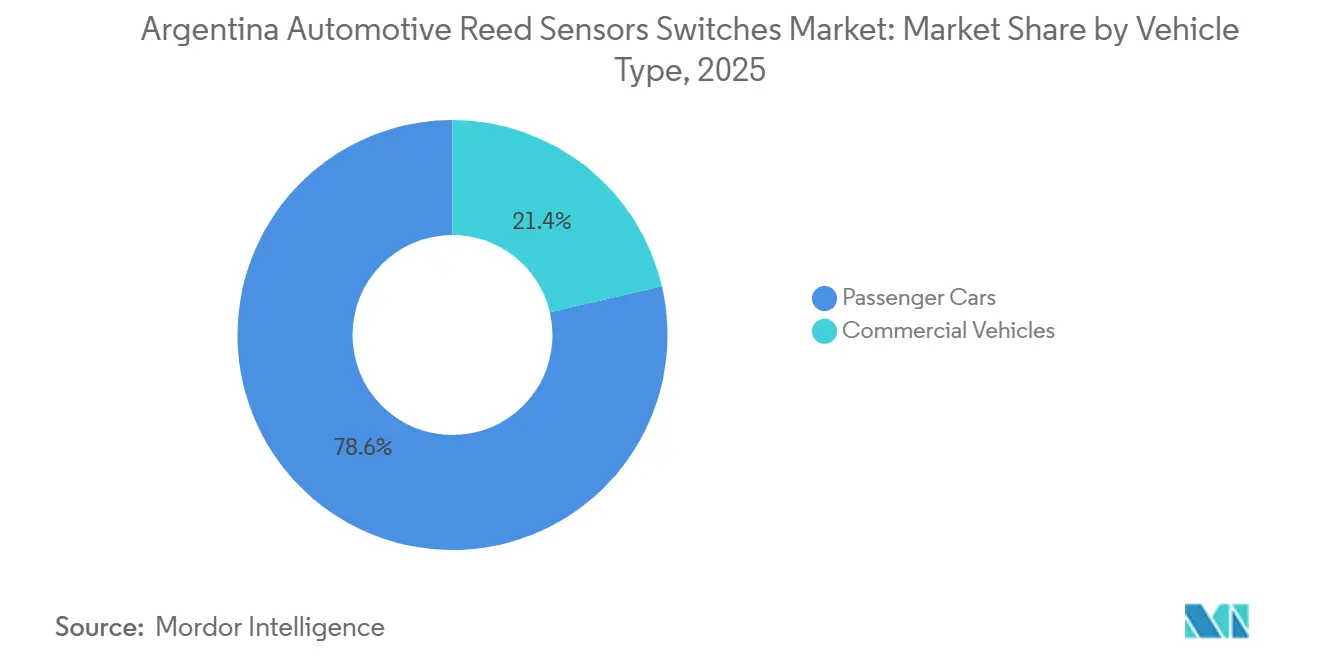
Passenger cars represented 78.64% of the automotive reed sensors and reed switches market in Argentina in 2025 and are projected to grow at a 5.83% CAGR through 2031. This trend reflects Argentina's fleet composition, where passenger automobiles accounted for the majority of the country's vehicle parc. Passenger cars, therefore, set the baseline for both OEM fitment and aftermarket replacement demand across door systems, comfort features, basic safety functions, and utility sensing points. Their higher growth rate also reflects that the largest share of imported new vehicles entering Argentina continues to be oriented toward passenger use rather than specialized fleet applications. In Argentina's automotive reed sensors and reed switches market, passenger vehicles represent the clearest link between old-fleet replacement cycles and new-model fitment demand.
Commercial vehicles remain important, but their demand structure is more stable and more tied to fleet maintenance practices, uptime requirements, and scheduled service. Argentina's commercial vehicle production recorded stronger year-on-year growth compared to passenger cars, indicating a more pronounced local production trend. Even so, demand for reed in commercial vehicles is spread across a smaller installed base, which limits its share relative to passenger cars despite healthy after-sales needs. The difference between passenger and commercial dynamics also illustrates how imports and domestic production influence the market differently: imported passenger models shape fitment breadth, while locally active fleets support service continuity. As the vehicle mix evolves, the passenger car base is likely to remain the main volume driver for the automotive reed sensors and reed switches market in Argentina in the near future.
By Sales Channel: OEMs Lead Today; Aftermarket Grows Faster
OEMs accounted for 75.15% of the automotive reed sensors and reed switches market in Argentina in 2025, keeping factory-installed components the largest sales channel today. The aftermarket is projected to grow at a 6.3% CAGR through 2031, which shows that replacement activity is increasing faster than new fitment over the forecast period. OEM strength is sustained by the continuous flow of new vehicles entering service with pre-installed assemblies, particularly in a year when imports represented a significant share of new sales. This means factory specifications continue to define the market's starting point, even when those specifications are developed outside Argentina. The channel balance in Argentina's automotive reed sensors and reed switches market is therefore not a straightforward shift away from OEMs, but a gradual strengthening of replacement-led demand around an already large installed base.
Aftermarket growth is being reinforced by the age structure of the vehicle parc and by organized network expansion across service and parts distribution. The country's high average vehicle age naturally increases the number of systems entering replacement cycles, particularly for frequently actuated sensing points. E-Parts planned to expand its outlet network, and Norauto continued extending its autocentro presence, supporting broader access to service channels beyond traditional dealer formats. As more imported vehicles age into independent repair cycles, availability and specification matching become more important than fitment volume alone. This pattern keeps the aftermarket on a faster growth path in the automotive reed sensors and reed switches market without displacing the central role that OEM programs continue to play in shaping product design.
By Propulsion Type: ICE Leads Current Volume; BEVs Expand the Fastest
Internal combustion engine (ICE) vehicles accounted for 63.34% of the automotive reed sensors and reed switches market in Argentina in 2025, making them the dominant propulsion segment for current demand. Battery electric vehicles (BEVs) are expected to grow at a 12.63% CAGR through 2031, representing the strongest propulsion-linked growth in the forecast period. ICE dominance reflects Argentina's existing fleet composition, where gasoline vehicles held the largest share, followed by diesel vehicles and CNG conversions. This installed base supports ongoing demand for fuel-level sensing, transmission-state detection, throttle-related functions, and a broad range of standard body electronics. As a result, current revenue in the automotive reed sensors and reed switches market in Argentina remains anchored in conventional propulsion, even as the fastest future growth shifts elsewhere.
Hybrid vehicles added an intermediate layer of demand, with the fleet recording strong year-over-year growth. These platforms carry more electrical monitoring content than standard ICE vehicles. BEVs, however, started from a relatively small base, which limits their present scale despite having the strongest growth rate in the market. Reed devices remain relevant in electrified vehicles due to their passive-state zero power draw, which is useful in energy-sensitive systems and high-voltage interlock functions. FCEVs remain negligible in Argentina and do not currently contribute measurable demand, even though they are included in the propulsion framework used in the market. The automotive reed sensors and reed switches market in Argentina, therefore, reflects a propulsion mix where established ICE volume supports current scale. At the same time, electrified platforms shape the long-term content direction.
Geography Analysis
Geographic demand in Argentina's automotive reed sensors and reed switches market remains national. Still, replacement activity is concentrated in Buenos Aires province, CABA, and Córdoba, where large vehicle populations and dense repair networks support demand. Córdoba and Buenos Aires also anchor domestic vehicle production and OEM-linked activity, causing replacement-led and fitment-led demand to overlap across the country’s main automotive corridors.
Imports add another geographic layer, as Buenos Aires and Rosario serve as key entry points for imported models that dominate new vehicle sales. These vehicles use foreign component standards that local distributor and workshop networks must support. Buenos Aires, Córdoba, and Mendoza are likely to see early gains from the availability of electrified vehicles. However, the EV base remains very small, so EV-linked geographic differences remain secondary to the national replacement cycle for conventional vehicles.
The service footprint is the final geographic factor. E-Parts planned to expand its national reach, while Norauto continued to expand its presence, indicating better-organized parts access beyond the largest metropolitan areas. This matters for interior provinces, where limited formal coverage can slow replacement activity despite demand within the aging fleet. Therefore, geographic performance depends on where fleet age, import exposure, service density, and industrial activity intersect most strongly.
Competitive Landscape
The automotive reed sensors and reed switches market in Argentina has a moderately fragmented competitive structure. A small group of global suppliers offers the broadest automotive-grade portfolios, while local performance largely depends on distribution execution. Standex Detect remains one of the more clearly defined specialists in this space, having consolidated the Meder, KOFU, and Kent portfolios under a unified sensing brand. This consolidation simplified how the company presents its reed switches, reed sensors, reed relays, and related product families to automotive customers. It also reinforced its position in custom configurations and assembly support, which is relevant when OEM programs require specialized packaging or fitment adaptation. In the Argentine automotive reed sensors and reed switches market, this portfolio depth carries practical value, as imported vehicle platforms often need close alignment with pre-existing foreign specifications.
Littelfuse competes from a broader sensing and protection base and has been extending its magnetic and vehicle-electronics portfolio through recent product launches. Its Transportation segment reported net sales growth, with passenger vehicle organic sales also rising, reflecting continued automotive demand across its broader offering. Sensata is approaching the market from high-voltage switching and adjacent electrification hardware, with its Automotive segment accounting for a significant share of total revenue. The company's recent STEV and FaultBreak launches indicate how suppliers are working to secure stronger positions in future battery and protection architectures, rather than focusing solely on legacy vehicle sensing points.
In Argentina specifically, competitive advantage depends less on local manufacturing presence and more on product breadth, imported platform compatibility, and route-to-market coverage. Suppliers that can support both OEM-linked fitment standards and independent workshop replacement needs are better positioned than those relying on a single sales route. Standex Detect's brand consolidation, Littelfuse's magnetic portfolio expansion, and Sensata's high-voltage launches reflect this competitive dynamic. As a result, the automotive reed sensors and reed switches market in Argentina remains open to multiple global suppliers, with local channel quality and specification support serving as the primary competitive differentiators.
Argentina Automotive Reed Sensors Switches Industry Leaders
Standex Electronics
Coto Technology
Littelfuse (Hamlin)
Comus International
Honeywell International Inc.
- *Disclaimer: Major Players sorted in no particular order

Recent Industry Developments
- October 2025: BYD launched EV and PHEV models in Argentina, leveraging the policy environment that enables larger EV/hybrid import volumes—supporting a broader electrified parc over time.
- January 2025: Argentina implemented a tariff-exempt import mechanism for EVs and hybrids (quota-based), supporting greater model availability and indirect expansion of EV-associated sensing points over the forecast horizon.


Argentina Automotive Reed Sensors Switches Market Report Scope
Automotive reed sensors switches are magnetically actuated switching components used to detect position/state changes (open/close, proximity/position, safety-state) across vehicle systems. They are commonly deployed in body electronics (doors, trunk/hood sensing, seat and window mechanisms), safety-state interlocks, and selected electrified-vehicle/charging-adjacent modules where compact, sealed switching is preferred.
The scope includes segmentation by Product Type (Reed Switches, Reed Sensors), Application (Body Electronics, Battery and Charging Systems, and Others), Vehicle Type (Passenger Cars, Commercial Vehicles), Sales Channel (OEMs, Aftermarket), Propulsion Type (Internal Combustion Engine Vehicles, Battery Electric Vehicles, and Others), and Geography (Argentina). The market forecasts are provided in terms of value (USD).
Segmentation by Product Type (Value, USD)
| Reed Sensors |
| Reed Switches |
Segmentation by Application (Value, USD)
| Engine and Powertrain Systems |
| Body Electronics |
| Safety and Security Systems |
| Infotainment and Comfort Systems |
| Transmission and Braking Systems |
| Battery and Charging Systems |
| Other Applications |
Segmentation by Vehicle Type (Value, USD)
| Passenger Cars |
| Commercial Vehicles |
Segmentation by Sales Channel (Value, USD)
| OEMs |
| Aftermarket |
Segmentation by Propulsion Type (Value, USD)
| Internal Combustion Engine (ICE) Vehicles |
| Hybrid Electric Vehicles (HEV) |
| Plug-in Hybrid Electric Vehicle (PHEV) |
| Battery Electric Vehicles (BEV) |
| Fuel Cell Electric Vehicles (FCEV) |
| Segmentation by Product Type (Value, USD) | Reed Sensors |
| Reed Switches | |
| Segmentation by Application (Value, USD) | Engine and Powertrain Systems |
| Body Electronics | |
| Safety and Security Systems | |
| Infotainment and Comfort Systems | |
| Transmission and Braking Systems | |
| Battery and Charging Systems | |
| Other Applications | |
| Segmentation by Vehicle Type (Value, USD) | Passenger Cars |
| Commercial Vehicles | |
| Segmentation by Sales Channel (Value, USD) | OEMs |
| Aftermarket | |
| Segmentation by Propulsion Type (Value, USD) | Internal Combustion Engine (ICE) Vehicles |
| Hybrid Electric Vehicles (HEV) | |
| Plug-in Hybrid Electric Vehicle (PHEV) | |
| Battery Electric Vehicles (BEV) | |
| Fuel Cell Electric Vehicles (FCEV) |


Key Questions Answered in the Report
What is the current size of the automotive reed sensors and reed switches space in Argentina?
The automotive reed sensors and reed switches market in Argentina stands at USD 4.53 million in 2026 and is forecast to reach USD 5.98 million by 2031 at a 5.73% CAGR.
What is driving demand most strongly in Argentina?
The primary driver is replacement demand, as the aging national fleet continues to grow, with vehicles reaching an advanced average age.
Which product format is growing faster?
Reed switches remained larger with 54.28% share in 2025, but reed sensors are growing faster at a 7.13% CAGR through 2031.
Which application area leads and which one is expanding fastest?
Body electronics led with 24.78% share in 2025, while battery and charging systems are forecast to grow fastest at a 9.6% CAGR.
Why does the aftermarket matter so much here?
The old fleet profile is pushing more vehicles into replacement cycles, which is why the aftermarket is set to grow at a 6.33% CAGR through 2031.
Page last updated on:





