
Antibacterial Washcloth Market Size and Share
Market Overview
| Study Period | 2020 - 2031 |
|---|---|
| Market Size (2026) | USD 262.49 Million |
| Market Size (2031) | USD 370.38 Million |
| Growth Rate (2026 - 2031) | 7.13 % |
| Fastest Growing Market | Asia Pacific |
| Largest Market | North America |
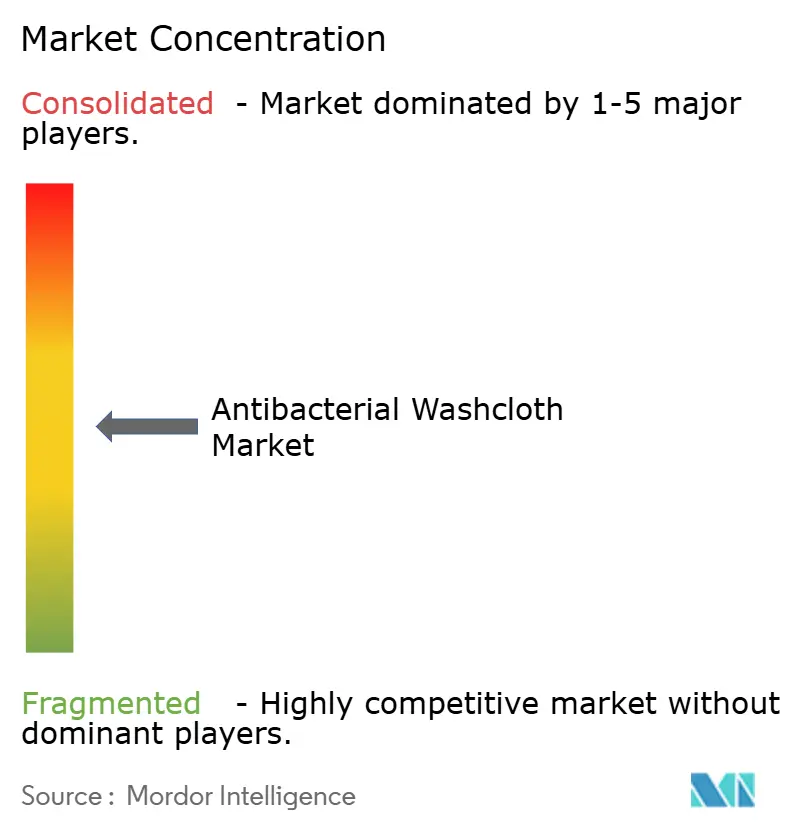
| Market Concentration | Medium |
Major Players *Disclaimer: Major Players sorted in no particular order Image © Mordor Intelligence. Reuse requires attribution under CC BY 4.0. | |
Antibacterial Washcloth Market Analysis by Mordor Intelligence
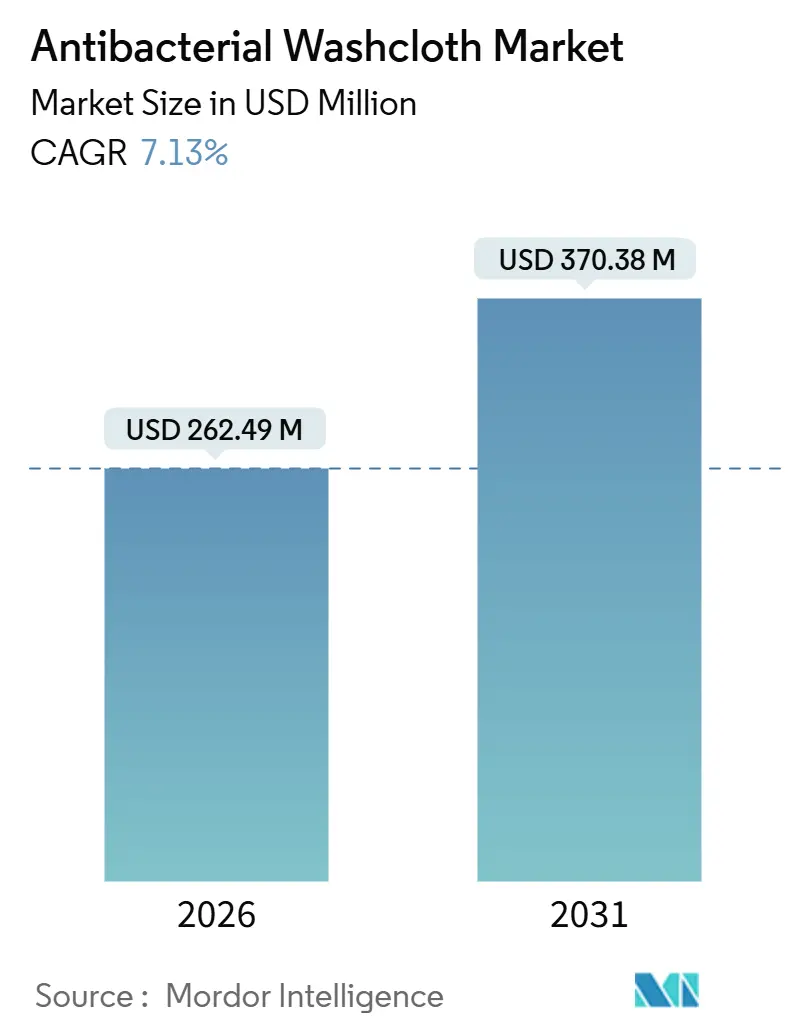
The Antibacterial Washcloth Market size is estimated at USD 262.49 million in 2026, and is expected to reach USD 370.38 million by 2031, at a CAGR of 7.13% during the forecast period (2026-2031).
Clinical protocols that emphasize infection prevention, expand geriatric care, and mandate sustainability underpin this growth as hospitals, long-term care centers, and home-based caregivers replace water-based bathing with rinse-free antimicrobial cloths. Disposable formats dominate because they eliminate cross-contamination risk, yet demand for reusable cloths is rising in markets that prioritize carbon reduction and cost savings. Regional momentum is shifting toward Asia-Pacific as hospital construction, universal health coverage programs, and an aging population accelerate the adoption of bacteriostatic wipes. Competitive dynamics remain moderate, with diversified manufacturers defending formulary positions while niche entrants differentiate through novel antimicrobial blends.
Key Report Takeaways
- By product type, disposable antibacterial washcloths captured 71.81% of 2025 revenue, while reusable variants are advancing at a 7.41% CAGR through 2031.
- By material, cotton and cotton blends accounted for 42.97% of the 2025 volume; bamboo and other cellulosic fibers are forecast to expand at an 8.14% CAGR through 2031.
- By end user, hospitals and surgical centers accounted for 67.32% of 2025 demand, while home care settings are on track for a 10.13% CAGR over the same period.
- By geography, North America accounted for 37.17% of 2025 sales, whereas Asia-Pacific is projected to grow at a 10.74% CAGR through 2031.
Note: Market size and forecast figures in this report are generated using Mordor Intelligence’s proprietary estimation framework, updated with the latest available data and insights as of January 2026.
Market Trends and Insights
Drivers Impact Analysis of Antibacterial Washcloth Market*
| Driver | (~) % Impact on CAGR Forecast | Geographic Relevance | Impact Timeline |
|---|---|---|---|
| Rising Incidence of Hospital-Acquired Infections | +1.8% | North America, Europe, Global tertiary centers | Medium term (2-4 years) |
| Growing Elderly Population and Incontinence Care | +1.5% | Japan, South Korea, Western Europe | Long term (≥ 4 years) |
| Expansion of Pre-Operative Skin-Prep Protocols | +1.2% | North America, EU, Tier-1 APAC hospitals | Short term (≤ 2 years) |
| Shift Toward CHG-Impregnated Cloths | +1.0% | Global tertiary care and trauma units | Medium term (2-4 years) |
| Carbon-Reduction Targets | +0.9% | EU, North America, early APAC adopters | Long term (≥ 4 years) |
| Defence & Disaster-Relief Procurement | +0.7% | U.S., NATO, APAC disaster-prone zones | Medium term (2-4 years) |
| Source: Mordor Intelligence | |||
Rising Incidence of Hospital-Acquired Infections (HAIs)
HAIs still affect roughly 1 in 31 U.S. inpatients, despite a notable 13% decline in central line infections and an 11% fall in catheter-related infections during 2023. Surgical centers that substituted povidone-iodine with chlorhexidine bathing reported a 41% drop in surgical site infections.[1] Facilities in low- and middle-income countries, where 40% lack basic water and sanitation services, adopt rinse-free cloths to bridge infrastructure gaps. These converging realities expand the antibacterial washcloth market as administrators seek adjunctive hygiene that works without plumbing upgrades.
Growing Elderly Population and Incontinence Care Demand
Japan’s 65+ cohort exceeded 29% of its population in 2024, and South Korea will surpass 20% in 2025.[2] In the U.S., 76.5% of residents in care communities experience urinary incontinence, creating a strong pull for bacteriostatic cloths that reduce the risk of urinary tract infections and reduce nurse workload. Medicare’s expansion of home-health reimbursements allows caregivers to source antimicrobial wipes through e-commerce, propelling home-care volumes at double-digit rates.[3]
Expansion of Pre-Operative Skin-Prep Protocols in Surgical Centers
Ambulatory surgery centers conducted 28 million procedures in 2023, and most now mandate two nights of 4% chlorhexidine bathing, consuming six to eight wipes per patient. Accreditation bodies tie reimbursement to infection-prevention compliance, anchoring the antibacterial washcloth market within surgical supply budgets. Evidence that each doubling of skin-level chlorhexidine reduces the odds of gram-positive colonization by 16% further cements the case for cloth adoption.
Shift Toward CHG-Impregnated Cloths for Superior Biofilm Penetration
Biofilm-embedded pathogens are resistant to antimicrobials up to 1,000-fold more than planktonic cells. CHG’s cationic chemistry disrupts these matrices, achieving 84% reductions in Staphylococcus aureus skin colonization at concentrations ≥ 2 µg/cm². Intensive care units implement daily CHG bathing, while regulatory Class II device status concentrates production among firms with robust quality systems.
Restraints Impact Analysis of Antibacterial Washcloth Market*
| Restraint | (~) % Impact on CAGR Forecast | Geographic Relevance | Impact Timeline |
|---|---|---|---|
| Price Premium Versus Conventional Washcloths | −0.8% | APAC, MEA, global cost-sensitive facilities | Short term (≤ 2 years) |
| Regulatory Scrutiny on Silver & QAC Leaching | −0.6% | North America, EU, export-dependent producers | Medium term (2-4 years) |
| Emerging Microbial Resistance to Chlorhexidine | −0.5% | Global tertiary centers | Long term (≥ 4 years) |
| Supply-Chain Dependence on Melt-Blown Capacity | −0.4% | Global, bottlenecks in APAC resin supply | Short term (≤ 2 years) |
| Source: Mordor Intelligence | |||
Price Premium Versus Conventional Washcloths
Antibacterial wipes cost three to five times as much as cotton cloths, constraining their uptake in public hospitals and Medicaid-funded homes. A 2024 cost-effectiveness analysis placed daily CHG bathing at USD 8-USD 12 per patient versus USD 2-USD 3 for soap-and-water, though every avoided surgical infection saves USD 15,000-USD 30,000. Value-based purchasing incentives partly offset cost, but smaller facilities still ration use to high-risk patients.
Regulatory Scrutiny on Silver & QAC Leaching
EPA pesticide rules cap quaternary ammonium leaching, while the FDA urged caution in neonatal CHG exposure after burn reports in 2024. The EU Medical Device Regulation 2017/745 requires exhaustive biocompatibility testing, delaying launches of silver-infused fabrics. Environmental advocates lobby for tighter limits on nanoparticle discharges, complicating compliance for small producers.
*Our forecasts treat driver/restraint impacts as directional, not additive. The impact forecasts reflect baseline growth, mix effects, and variable interactions.
Antibacterial Washcloth Market Segment Analysis
By Product Type:
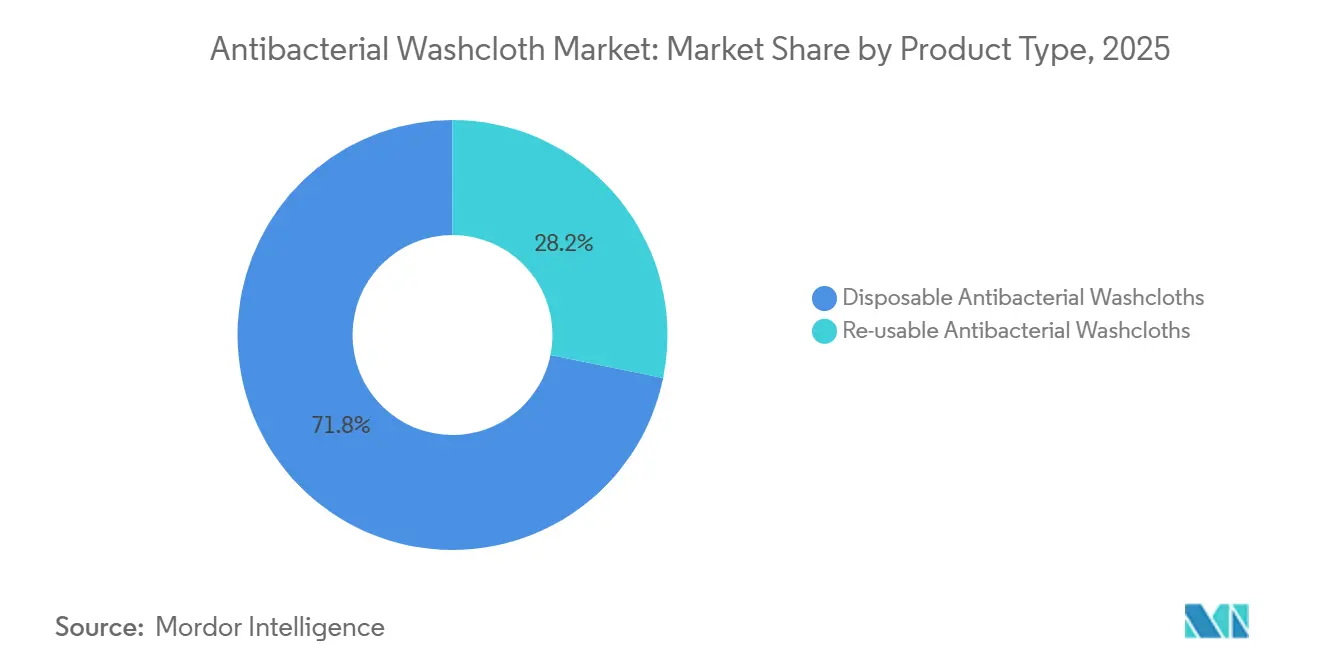
Disposable Leads, Re-Usable AdvancesDisposable wipes accounted for 71.81% of 2025 volume, reflecting strict infection-control audits and the zero-touch convenience they offer in operating rooms and intensive care units. This dominance supports predictable hospital reorder cycles that anchor the antibacterial washcloth market, although carbon-reduction targets elevate scrutiny of single-use plastics. Reusable cloths are forecast to grow at 7.41% annually through 2031 as post-acute facilities seek lower per-patient costs and reduced waste; a European life-cycle study showed 30% lower emissions when reusables were laundered 50 times.
Disposable products enjoy simpler U.S. FDA 510(k) validation because a single-use design eliminates longevity testing. Reusable formats must demonstrate antimicrobial durability across the claimed wash cycles, deterring some entrants but appealing to long-term care chains. Defense agencies and disaster-relief stockpiles favor disposable kits for logistical ease, reinforcing baseline demand even as sustainability debates intensify.
By Material:
Cellulosic Fibers Accelerate on Sustainability PledgesCotton and cotton blends represented 42.97% of 2025 sales, benefiting from historical clinical use and mature supply chains. Polyester and microfiber deliver superior liquid retention but face headwinds from decarbonization targets. Bamboo and other cellulosic substrates are projected to expand 8.14% annually, as procurement teams embrace biodegradable options that support Scope 3 emission cuts and align with 100% renewable fiber pledges from leading manufacturers.
Regulatory familiarity favors cotton in 510(k) filings, while novel cellulosic blends must document equivalence. Melt-blown capacity in Asia-Pacific underpins polyester volumes, yet polypropylene price volatility narrows cost advantages. Metal-ion-infused nonwovens remain a niche amid concerns about leaching and cytotoxicity, but they offer synergistic antimicrobial activity when combined with chlorhexidine.
By End User:
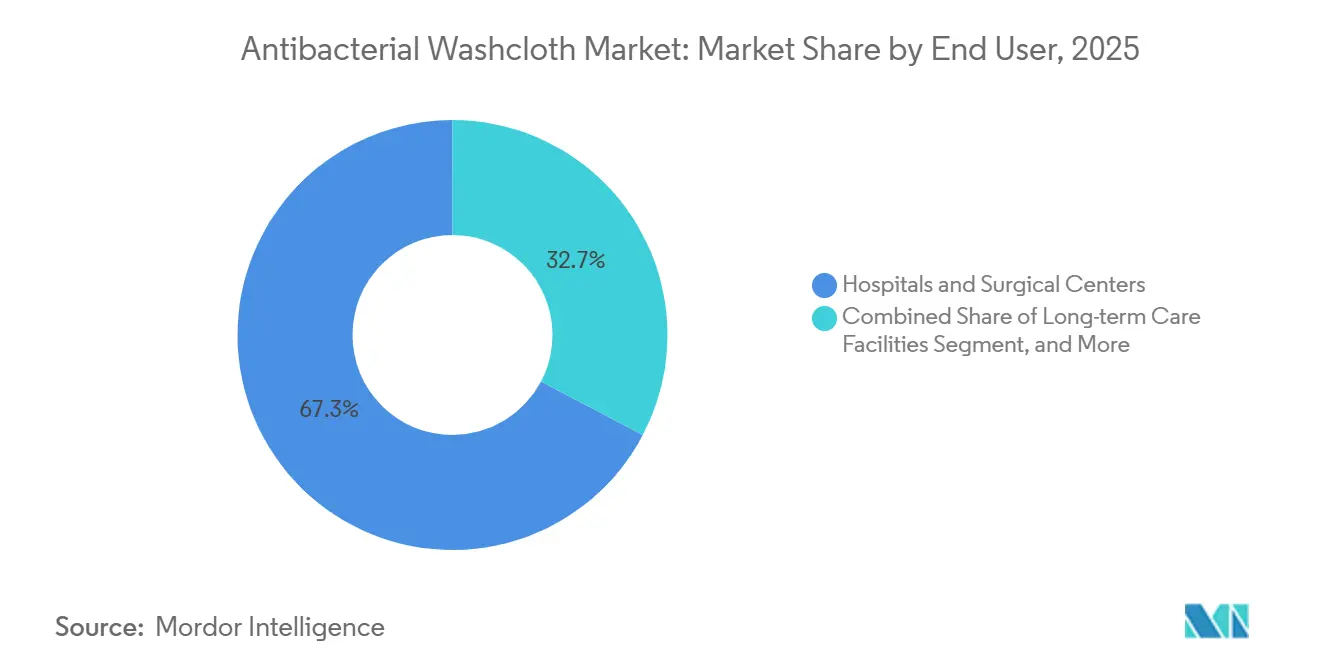
Home Care Emerges as Fastest-Growing ChannelHospitals and surgical centers retained 67.32% of 2025 demand thanks to mandatory CHG skin-prep protocols and value-based purchasing penalties for HAIs. Nevertheless, home care settings are forecast to grow at a 10.13% CAGR through 2031, spurred by Medicare’s expanded home-health benefit and e-commerce distribution that empowers family caregivers.
Long-term care facilities, facing a 76.5% prevalence of resident incontinence, use antibacterial wipes to reduce urinary tract infections and laundry labor. Fixed Medicaid reimbursement hampers universal adoption, but quality incentive programs drive incremental uptake. The U.S. Department of Veterans Affairs now serves 50,000 veterans in home-based primary care, adding a high-comorbidity user base.

Geography Analysis
North America Antibacterial Washcloth Market
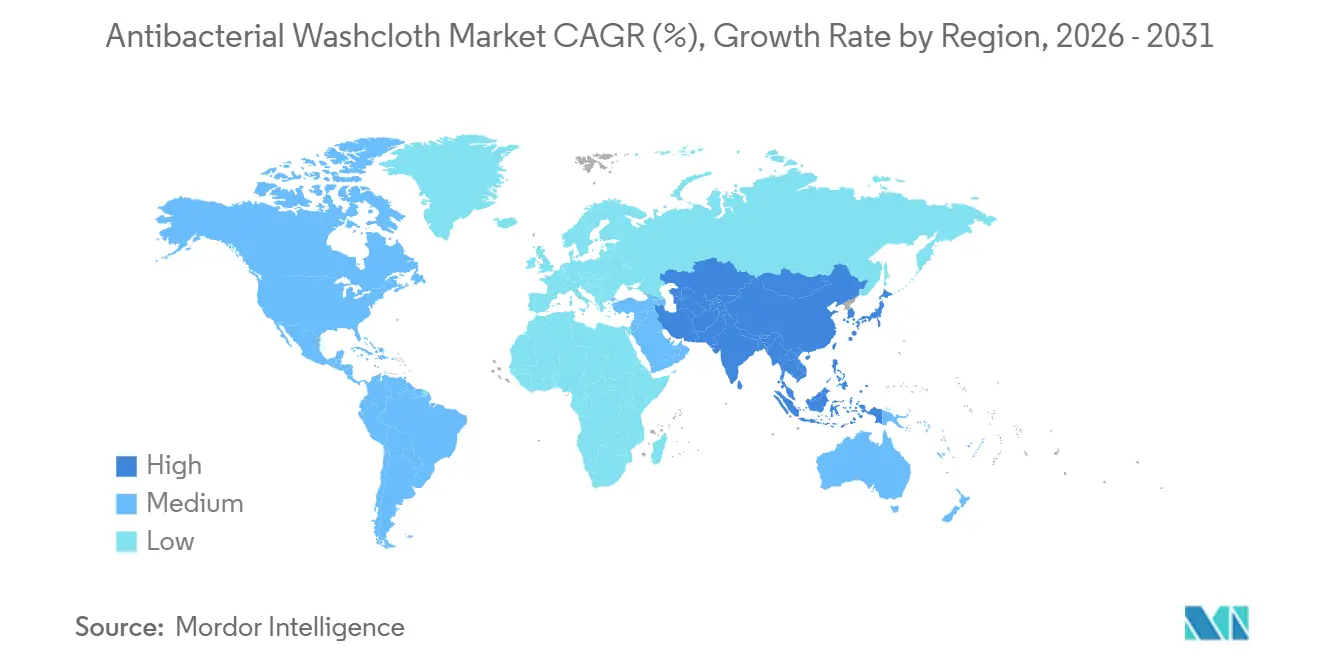
North America accounted for 37.17% of 2025 revenue as value-based care and robust per-capita spending lock antibacterial cloths into infection-prevention bundles. Procurement favors disposable CHG wipes that align with Joint Commission accreditation requirements, and regional manufacturers leverage established distribution to maintain formulary share.
APAC Antibacterial Washcloth Market
Asia-Pacific is the fastest-growing region at a 10.74% CAGR to 2031, propelled by China’s USD 140 billion hospital build-out and super-aged populations in Japan and South Korea. Expansion of universal health coverage in Southeast Asia elevates baseline hygiene standards, positioning rinse-free wipes as a practical stopgap where plumbing upgrades are incomplete. India’s Ayushman Bharat program further enlarges the antibacterial washcloth market through standardized surgical protocols and rising inpatient volumes.
EMEA and South America Antibacterial Washcloth Market
Europe’s trajectory reflects both rigorous infection control and net-zero mandates. The NHS pledge to halve water use per patient day encourages rinse-free bathing, while EU MDR compliance reshapes supplier portfolios toward biocompatible materials. Germany, the United Kingdom, France, Italy, and Spain drive regional demand, whereas the Middle East, Africa, and South America grow from varied baselines, balancing premium private hospital adoption with public-sector budget constraints.
Competitive Landscape
The top five suppliers, Solventum (ex-3M), Medline Industries, Kimberly-Clark, Cardinal Health, and Mölnlycke, reflect scale in non-woven manufacturing and group purchasing organization contracts. Solventum’s 2024 spin-off sharpened its focus on infection prevention and accelerated regional partnerships. Kimberly-Clark invested in Southeast Asian melt-blown lines and partnered with a European bamboo-viscose producer to secure renewable fibers.
Niche players such as PDI Healthcare and Winner Medical target biofilm-resistant pathogens with customized quaternary ammonium and silver nanoparticle blends. Becton, Dickinson & Co. patents extended-release CHG coatings that maintain 24-hour activity, while Coloplast emphasizes skin-pH-balanced formulations for fragile geriatric skin. GPOs like Premier and Vizient favor incumbents, yet sustainability credentials open doors for smaller suppliers offering biodegradable substrates and lower Scope 3 impact.
Strategic moves include Essity’s backward integration into pulp to secure cellulosic supply and Smith & Nephew’s silver-nanoparticle cloth aimed at diabetic foot ulcer clinics. Regulatory hurdles under FDA 510(k) and EU MDR continue to shape competitive timing, with strong quality systems and sterilization validation emerging as decisive capabilities.
Antibacterial Washcloth Industry Leaders
-
Becton, Dickinson & Company
-
Cardinal Health
-
Medline Industries
-
Smith & Nephew
-
Coloplast
- *Disclaimer: Major Players sorted in no particular order
Antibacterial Washcloth Market Companies Covered in this Report
- 3M
- Beckton Dickinson
- Cardinal Health
- Colgate-Palmolive Company
- Coloplast
- Dynarex
- Ecolab
- Essity
- Kimberly-Clark Worldwide
- Medline Industries
- Mölnlycke Health Care
- Ontex Group
- Hartmann Group
- PDI Healthcare
- Reckitt Benckiser Group
- Smiths Group
- Tranquility (PBE)
- Unicharm
- Winner Medical
Recent Industry Developments in Antibacterial Washcloth Market
- September 2024: Kimberly-Clark partnered with a bamboo-viscose specialist to develop biodegradable substrates, advancing its 2030 renewable-fiber goal at KIMBERLY.
- April 2024: 3M completed the spin-off of Solventum, a USD 8.2 billion infection-prevention pure-play.
Global Antibacterial Washcloth Market Report Scope
The antibacterial washcloth market refers to the global industry focused on the production, distribution, and sale of antibacterial washcloths, specialized cloths (often disposable or reusable, made from materials like cotton, bamboo extract, or linen) infused or treated with antimicrobial agents to kill or inhibit bacteria, germs, and sometimes viruses during use.
The antibacterial washcloth market is segmented by product type into disposable and reusable washcloths; by material into cotton & cotton blends, polyester & microfiber, bamboo & cellulosic fibers, and metal-ion infused non-wovens; by end user into hospitals & surgical centers, long-term care facilities, and home care settings; and by geography into North America, Europe, Asia-Pacific, Middle East & Africa, and South America. Market forecasts are provided in terms of value (USD).
Segmentation Overview
| Disposable Antibacterial Washcloths |
| Re-usable Antibacterial Washcloths |
| Cotton & Cotton Blends |
| Polyester & Microfiber |
| Bamboo & Cellulosic Fibers |
| Metal-ion Infused Non-wovens |
| Hospitals & Surgical Centers |
| Long-term Care Facilities |
| Home Care Settings |
| North America | United States |
| Canada | |
| Mexico | |
| Europe | Germany |
| United Kingdom | |
| France | |
| Italy | |
| Spain | |
| Rest of Europe | |
| Asia-Pacific | China |
| Japan | |
| India | |
| Australia | |
| South Korea | |
| Rest of Asia-Pacific | |
| Middle East & Africa | GCC |
| South Africa | |
| Rest of Middle East & Africa | |
| South America | Brazil |
| Argentina | |
| Rest of South America |
| By Product Type | Disposable Antibacterial Washcloths | |
| Re-usable Antibacterial Washcloths | ||
| By Material | Cotton & Cotton Blends | |
| Polyester & Microfiber | ||
| Bamboo & Cellulosic Fibers | ||
| Metal-ion Infused Non-wovens | ||
| By End User | Hospitals & Surgical Centers | |
| Long-term Care Facilities | ||
| Home Care Settings | ||
| By Geography | North America | United States |
| Canada | ||
| Mexico | ||
| Europe | Germany | |
| United Kingdom | ||
| France | ||
| Italy | ||
| Spain | ||
| Rest of Europe | ||
| Asia-Pacific | China | |
| Japan | ||
| India | ||
| Australia | ||
| South Korea | ||
| Rest of Asia-Pacific | ||
| Middle East & Africa | GCC | |
| South Africa | ||
| Rest of Middle East & Africa | ||
| South America | Brazil | |
| Argentina | ||
| Rest of South America | ||
Key Questions Answered in the Report
What is the projected value of the antibacterial washcloth market in 2031?
The market is forecast to reach USD 370.38 million by 2031 at a 7.13% CAGR.
Which region is expected to grow fastest for antibacterial washcloths through 2031?
Asia-Pacific is projected to expand at a 10.74% CAGR, driven by hospital construction and aging demographics.
Why are disposable antibacterial washcloths prevalent in hospitals?
They eliminate cross-contamination and align with infection-control audits, giving them 71.81% market share in 2025.
How are sustainability goals influencing material choices?
Procurement teams are shifting toward bamboo and other cellulosic fibers, which are projected to grow 8.14% annually as health systems target carbon reductions.
What factors drive home care demand for antibacterial washcloths?
Medicare’s expanded home-health benefits and e-commerce distribution enable family caregivers to adopt rinse-free antimicrobial wipes, supporting a 10.13% CAGR in home settings.