
American Epoxy Adhesives Market Size and Share
Market Overview
| Study Period | 2019 - 2030 |
|---|---|
| Forecast Data Period | 2025 - 2030 |
| Historical Data Period | 2019 - 2023 |
| Market Size (2025) | USD 1.24 Billion |
| Market Size (2030) | USD 1.62 Billion |
| Growth Rate (2025 - 2030) | 5.43 % |
| Market Concentration | Medium |
Major Players *Disclaimer: Major Players sorted in no particular order Image © Mordor Intelligence. Reuse requires attribution under CC BY 4.0. | |

American Epoxy Adhesives Market Analysis by Mordor Intelligence
The American Epoxy Adhesives Market size is estimated at USD 1.24 billion in 2025, and is expected to reach USD 1.62 billion by 2030, at a CAGR of 5.43% during the forecast period (2025-2030). Growing cross-border trade with Mexico, rapidly expanding EV battery production lines, and multi-year public‐infrastructure programs in the United States and Brazil are widening the application base for high-performance formulations. Construction continues to anchor volume, yet electrical and electronics lines are scaling fastest as semiconductor encapsulation, LED packaging, and power-module potting demand flame-retardant, thermally conductive grades. Automotive Tier-1 suppliers in Mexico favor alumina-filled systems that dissipate heat while preserving electrical insulation, while U.S. wind-blade OEMs specify low-viscosity resins for 100-meter blades produced by vacuum infusion. Balanced against these growth vectors are feedstock-price swings tied to bisphenol-A intermediates, regulatory pressure to cut VOC emissions, and rising use of structural tapes in auto body-in-white assembly.
Key Report Takeaways
- By product type, two-component systems held 63.47% of the American epoxy adhesives market share in 2024, while one-component grades are projected to expand at a 6.12% CAGR through 2030.
- By end-user industry, construction generated 30.51% of revenue in 2024; electrical and electronics are advancing at the fastest 6.32% CAGR to 2030.
- By geography, North America captured 70.15% share of the American epoxy adhesives market size in 2024 and is set to grow at a 5.77% CAGR during the forecast horizon.
Note: Market size and forecast figures in this report are generated using Mordor Intelligence’s proprietary estimation framework, updated with the latest available data and insights as of January 2026.
Market Trends and Insights
Drivers Impact Analysis of American Epoxy Adhesives Market*
| Drivers | (~) % Impact on CAGR Forecast | Geographic Relevance | Impact Timeline |
|---|---|---|---|
| Surging demand for mini- and lightweight consumer electronics | +0.8% | United States assembly hubs, Mexico contract manufacturing zones | Short term (≤ 2 years) |
| Proliferation of EV battery assembly lines in Mexico | +1.2% | Mexico Bajío and northern industrial corridors, spillover to U.S. suppliers | Medium term (2-4 years) |
| Infrastructure-linked reconstruction programs (US IIJA, Brazil PAC) | +1.0% | United States, Brazil, secondary gains in Argentina and Chile | Long term (≥ 4 years) |
| Wind-blade length growth demanding high-strength bonding | +0.7% | U.S. Great Plains, Atlantic offshore, Brazil Northeast, Chile | Medium term (2-4 years) |
| Decentralized solar-plus-storage installations in rural Latin America | +0.5% | Brazil Amazon, rural Chile, Northwest Argentina | Long term (≥ 4 years) |
| Source: Mordor Intelligence | |||
Surging Demand for Mini- and Lightweight Consumer Electronics
As thinner designs eliminate the need for mechanical fasteners, manufacturers of smartphones, wearables, and augmented-reality headsets are turning to increased epoxy usage. Single-component heat-cure resins can gel quickly at elevated temperatures, trimming assembly time compared to their two-part counterparts. In Guadalajara and Tijuana, contract manufacturers in Mexico are prioritizing UL94 V-0 compliance to adhere to lithium-ion safety standards. To ensure optical clarity in camera arrays, formulators are gravitating towards alicyclic backbones, which cure with minimal shrinkage and maintain transparency. With rapid product cycles in play, suppliers with application labs situated close to U.S. and Mexican OEM design hubs gain a significant competitive advantage, bolstering the position of multinational players. Additionally, regional wage benefits empower contract manufacturers to dedicate more labor hours to precise adhesive applications, all while staying within budgetary constraints.
Proliferation of EV Battery Assembly Lines in Mexico
In 2023, foreign direct investment in the automotive sector increased significantly, with a substantial portion of new capital expenditures now centered on battery-module production. Epoxies must achieve shear strengths above 20 MPa on aluminum after a seven-day cure and retain more than 80% of room-temperature performance at 80 °C, narrowing supplier qualification lists[1]Springer, “Adhesive Bonding in EV Battery Packs,” link.springer.com. Tier-1 sites, situated within proximity to final assembly, not only minimize logistics delays but also necessitate pot lives suitable for timely deliveries. Specifications are dominated by alumina-filled grades that offer superior thermal conductivity while maintaining high volume resistivity. Labor costs in Mexico enhance landed economics compared to China. This significant cost advantage ensures that throughput expansions remain on course, even in the face of rising raw material prices. As light-vehicle production is set to increase, the demand for both structural and gap-filling grades is poised to rise correspondingly.
Infrastructure-Linked Reconstruction Programs (U.S. IIJA and Brazil PAC)
Adhesive vendors now face heightened entry barriers due to the "Build America, Buy America" rules, which mandate North American sourcing documentation. This shift not only favors domestic resin producers but also poses challenges for offshore blenders. In Brazil, the "Novo PAC" initiative has allocated significant funding for rail corridors, including Fiol and Transnordestina, with support extending through 2026. This investment is set to drive multi-year orders for sleeper bonding and adhesives used in rolling-stock interiors. Rail freight volumes have shown growth, and federal ambitions to elevate the rail's modal share by 2035 signal a robust and steady demand. In Argentina and Chile, early-stage integration routes are poised to benefit from substantial financing from development banks. This influx not only underscores the significance of these routes but also opens doors for specialized applications like crack injection and composite strengthening in infrastructure elements such as bridges and culverts. Given the extended procurement cycles, it's anticipated that adhesive volumes will peak around 2028-2030, aligning with the zenith of civil works.
Wind-Blade Length Growth Demanding High-Strength Bonding
As onshore turbine blades grow larger, fatigue stresses on spar-cap bonds intensify. Epoxy systems are challenged to cure in bondlines while ensuring a long lifespan over millions of load cycles. For vacuum-assisted resin infusion, maintaining appropriate viscosities at the processing temperature is crucial for achieving complete fiber wet-out. Facilities in the U.S. The Great Plains and Brazil's Northeast are turning to rapid-cure grades. These grades can achieve desired strength quickly, allowing for quicker mold turnarounds and boosting annual throughput. The industry is progressively moving away from polyester systems, driven by the need for moisture resistance and enhanced interlaminar shear strength. Offshore operations, facing unique challenges, demand salt-spray durability. Epoxy matrices meet this requirement, eliminating the need for additional barrier coatings.
Restraints Impact Analysis of American Epoxy Adhesives Market*
| Restraints | (~) % Impact on CAGR Forecast | Geographic Relevance | Impact Timeline |
|---|---|---|---|
| Volatility in BPA-based epoxy resin feedstock prices | -0.9% | United States Gulf Coast suppliers, import-dependent South American markets | Short term (≤ 2 years) |
| Stringent VOC and indoor-air-quality norms in California and Canada | -0.6% | California, Canada, and U.S. states preparing to mirror CARB thresholds | Medium term (2-4 years) |
| OEM shift toward one-shot structural tapes for auto body-in-white | -0.7% | U.S. and Mexican automotive assembly plants | Medium term (2-4 years) |
| Source: Mordor Intelligence | |||
Volatility in BPA-Based Epoxy Resin Feedstock Prices
In early 2025, spot quotes for epichlorohydrin in India fluctuated within a range that tightens gross margins for formulators without long-term contracts. Cost shifts driven by propylene reverberate through the bisphenol-A supply chain, revealing the complexities of the commodity chain to manufacturers. With Mexico importing most of its petrochemical inputs, freight congestion and currency fluctuations significantly impact domestic delivered prices. While vertically integrated players can adjust internal transfer prices to manage risk, independent blenders experience margin compression during price spikes. Furthermore, the process of passing costs forward can take time, a delay that jeopardizes competitiveness in sensitive construction tenders.
Stringent VOC and Indoor-Air-Quality Norms in California and Canada
California's Air Resources Board has reduced caps for various interior adhesive classes. This move is pushing manufacturers to reformulate their products, leaning towards waterborne or 100%-solids profiles[2]California Air Resources Board, “Volatile Organic Compound Regulations,” arb.ca.gov. Meanwhile, Canada's formaldehyde regulations are tightening, mandating third-party certification. Waterborne epoxies, while offering an extended open time, may underperform on metals. This limitation restricts their application in sensitive areas like electronics or power-train assembly. On the other hand, fully solvent-free chemistries come with their own set of challenges. They necessitate heated dispensers and meticulous worker training. Such investments can be a tough sell for smaller fabricators. In a broader regulatory push, states like New York, Massachusetts, and New Jersey are set to adopt CARB's limits. This move not only expands the regulatory landscape but also hastens the retirement of older, solvent-rich product lines.
*Our forecasts treat driver/restraint impacts as directional, not additive. The impact forecasts reflect baseline growth, mix effects, and variable interactions.
American Epoxy Adhesives Market Segment Analysis
By Product Type:
Two-Component Dominance Meets One-Component ConvenienceTwo-component grades commanded 63.47% share of the American epoxy adhesives market in 2024, supported by strength, working-life flexibility, and filler compatibility. Their dominance spans wind-blade lay-ups, marine hull assembly, and aerospace structures, where mixing rigs ensure precise stoichiometry and quality control. Yet application overheads—equipment, pot-life management, and training—add to installed cost, curbing uptake in small-batch repairs. One-component systems are forecast to grow at a 6.12% CAGR to 2030 as electronics manufacturers automate heat-cure cycles, trimming labor and improving consistency. UV-LED initiatives blur boundaries further, with single-component resins curing in roughly eight minutes under 365 nm light while attaining near-thermoset strength. These technologies penetrate high-volume surface-mount lines and medical-device bonding where solvent-free, low-outgassing traits outweigh equipment retrofits.



By End-User Industry:
Construction Anchors Share, Electronics Drives GrowthConstruction delivered 30.51% revenue in 2024, led by crack repair, rebar anchoring, and composite strengthening on bridges and rail corridors. Industry specifications demand high compressive strengths and bond strengths to concrete. Two-part commodity mixes achieve these benchmarks. While infrastructure investments, bolstered by the IIJA and Novo PAC, maintain robust volumes, competitive bidding has led to tighter margins. Additionally, the rise of polyurethane and acrylic substitutes has further narrowed some market opportunities. Electrical and electronics applications are expanding at a 6.32% CAGR. This growth is largely attributed to the adoption of LEDs, semiconductor die encapsulation, and power-module potting. These applications necessitate stringent standards, including UL94 V-0 ratings, high thermal conductivity, and a low coefficient of thermal expansion (CTE). The market for American epoxy adhesives in the electronics segment is anticipated to grow steadily. In aerospace and defense, there's a clear demand for low-outgassing grades compliant with MIL-PRF-23377 standards. Meanwhile, marine OEMs are gearing up for the implementation of DIN 2304-2, which tightens quality-control measures and emphasizes the importance of qualified suppliers. While there's a decline in automotive body-in-white volumes, the rising popularity of tapes is noteworthy. Furthermore, the demand for high-strength gap-fillers in EV battery bonding, which require high shear strength on aluminum post-aging, is helping to mitigate this decline.


Geography Analysis
North America American Epoxy Adhesives Market
North America accounted for 70.15% of 2024 revenue and is on track for a 5.77% CAGR through 2030. The U.S. boasts a robust aerospace, automotive, and wind-energy production landscape, while Mexico reaps benefits from nearshoring. U.S. government data reveals substantial bilateral trade in 2023. In San Luis Potosí and Nuevo León, Tier-1 suppliers are increasingly relying on adhesives, specifically those qualified for a decade-long durability on thermal-cycled joints. Furthermore, the "Build America, Buy America" content rules are steering orders towards domestic formulators, especially those adept at documenting resin traceability.
South America American Epoxy Adhesives Market
While South America may be smaller in revenue, it's poised for growth, largely driven by Brazil's rail initiative. This endeavor amplifies the demand for sleeper bonding, track fastening, and rolling-stock interiors. With aspirations to achieve a higher rail modal share by 2035, the demand is set to persist well past the 2026 budget allocations. Meanwhile, in Chile, the Atacama solar-storage projects are generating niche demands for UV-stable, moisture-curing epoxies. These specialized epoxies are crucial for maintaining bond integrity amidst the region's diurnal temperature fluctuations. In Argentina, road and bridge rehabilitation projects, co-financed by BNDES and regional development banks, are turning to fast-cure two-part systems. These systems meet the stringent specification of crack-injection grades that require a swift return-to-service time.
LATAM American Epoxy Adhesives Market
Latin America grapples with a structural challenge: import dependence. Seaborne routes deliver epichlorohydrin and specialty hardeners, leaving local blenders vulnerable to freight-rate fluctuations. Additionally, episodes of currency depreciation can erode margins unless firms adopt aggressive hedging strategies. However, a public-sector focus on railway expansion, renewable energy, and rural electrification is cultivating a stable, multi-year project pipeline. This development aids suppliers in navigating cyclical market fluctuations.
Competitive Landscape
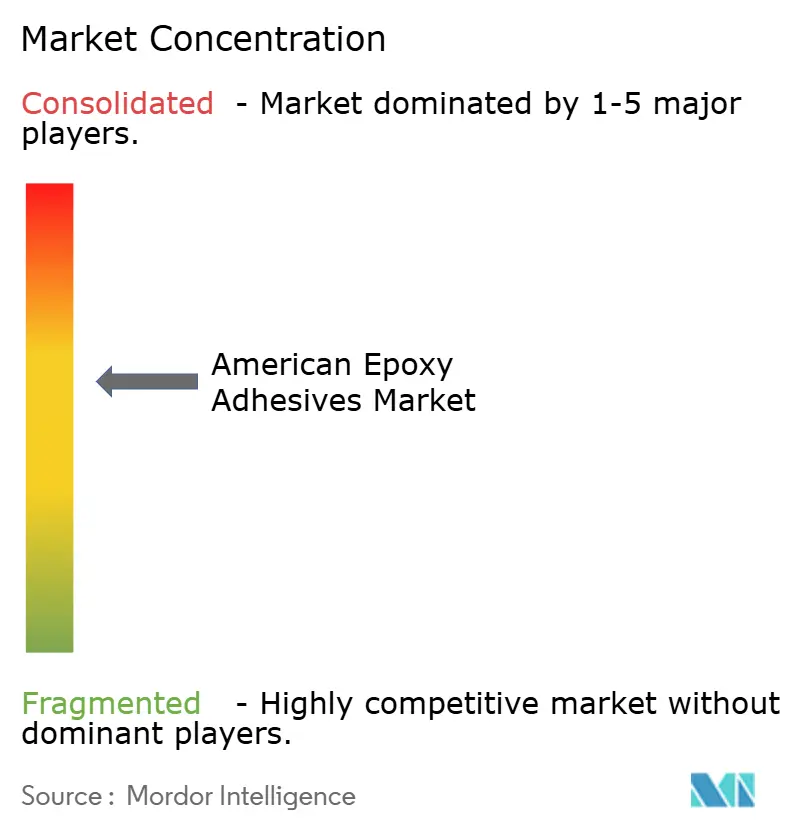
The American epoxy adhesives market is moderately consolidated. Technology differentiation is accelerating. UV-LED-curable grades that reach handling strength in fewer than ten minutes are winning share in electronics, where throughput trumps raw-material cost. Bio-based resins formulated with epoxidized vegetable oils are emerging in marine laminating and wind-energy lay-ups, reducing carbon footprints, albeit at a price premium and a 5–10 °C lower glass-transition temperature. Competition in flame-retardant and thermally conductive fillers remains intense, with dozens of patent filings targeting UL94 V-0 compliance and 1.0 W/m·K targets without the viscosity penalties that hamper automated dispensing. Pricing power is mixed. Top-tier suppliers defend margins through value-added technical service and multi-year qualification barriers in aerospace and EV battery lines. Mid-tier providers compete on price in construction and general industry, but volatile bisphenol-A costs and regulatory overheads erode spreads. As VOC limits tighten, vendors with waterborne or 100%-solids portfolios gain an edge, yet capital cost for heated dispensers can temper adoption among smaller fabricators.
American Epoxy Adhesives Industry Leaders
Henkel AG & Co. KGaA
3M
Sika AG
Dow
Huntsman International LLC
- *Disclaimer: Major Players sorted in no particular order
American Epoxy Adhesives Market Companies Covered in this Report
- 3M
- Arkema Group
- Ashland
- Dow
- Dymax Corporation
- H.B. Fuller Company
- Henkel AG & Co. KGaA
- Hexcel Corporation
- Hexion
- Huntsman International LLC
- ITW Performance Polymers
- Jowat SE
- MAPEI S.p.A.
- Parker Hannifin Corp
- Permabond
- RPM International Inc.
- Sika AG
- Wacker Chemie AG

Recent Industry Developments in American Epoxy Adhesives Market
- May 2025: H.B. Fuller opened a new manufacturing facility in Cairo and expanded its United Arab Emirates site to serve more than 30 market segments. The Vice President mentions that the facility ensures efficient and seamless distribution to customers across North America.
- May 2024: H.B. Fuller Company announced the acquisition of ND Industries Inc., a leading provider of specialty adhesives and fastener locking and sealing solutions. H.B. Fuller aims to fast-track its key growth objectives through a strategic acquisition. This move aligns with the company's approach of channeling capital towards the most lucrative segments in the functional coatings, adhesives, sealants, and elastomers (CASE) sector. With this acquisition, H.B. Fuller is set to enhance its portfolio by incorporating ND Industries’ Vibra-Tite brand products, complementing its current offerings of epoxy products.


American Epoxy Adhesives Market Report Scope
Epoxy adhesives are two-part thermosetting adhesives made by mixing a resin with a hardener. When cured, they create a strong and durable bond. This process forms a rigid, cross-linked polymer, making the adhesive highly resistant to chemicals, moisture, and high temperatures. The American epoxy adhesives market is segmented by product type, end-user industry, and geography. By product type, the market is segmented into single-component and dual-component. By end-user industry, the market is segmented into aerospace and defense, automotive and transport, marine sector, electrical and electronics, construction, energy and power, and others (e.g., packaging, sporting goods). The report also covers the market size and forecasts for the epoxy adhesives market in 6 countries across the American region. For each segment, the market sizing and forecasts have been done based on revenue (USD).
| One-component |
| Two-component |
| Aerospace and Defense |
| Automotive and Transportation |
| Marine |
| Electrical and Electronics |
| Construction |
| Energy and Power |
| Others (Packaging, Sporting Goods) |
| North America | United States |
| Canada | |
| Mexico | |
| South America | Brazil |
| Argentina | |
| Chile | |
| Rest of South America |
| By Product Type | One-component | |
| Two-component | ||
| By End-user Industry | Aerospace and Defense | |
| Automotive and Transportation | ||
| Marine | ||
| Electrical and Electronics | ||
| Construction | ||
| Energy and Power | ||
| Others (Packaging, Sporting Goods) | ||
| By Geography | North America | United States |
| Canada | ||
| Mexico | ||
| South America | Brazil | |
| Argentina | ||
| Chile | ||
| Rest of South America | ||


Key Questions Answered in the Report
What is the current size and projected growth rate for American epoxy-adhesive demand?
The segment stood at USD 1.24 billion in 2025 and is forecast to reach USD 1.62 billion by 2030, implying a 5.43% CAGR over the period.
Which application area is expanding at the quickest pace through 2030?
Electrical and electronics lines—covering semiconductor encapsulation, LED packaging, and power-module potting—are advancing at a 6.32% CAGR, the fastest among all tracked verticals.
How are tightening VOC and indoor-air-quality rules shaping product preferences in North America?
California CARB limits and similar Canadian rules are pushing buyers toward waterborne and 100% solids formulations, favoring suppliers that can offer low-emission grades without sacrificing bond strength or cure speed.
What production advantages do one-component epoxies bring to electronics assembly lines?
Single-component heat-cure systems remove mixing errors, integrate easily with automated dispensers, and cut assembly time compared with two-part mixes, making them ideal for high-volume smartphone and wearable outputs.
Page last updated on:





