
Size and Share of Alternate Fuel and Raw Materials (AFR) Market For New Energy Generation Industry
Market Overview
| Study Period | 2021 - 2031 |
|---|---|
| Market Size (2026) | USD 0.96 Billion |
| Market Size (2031) | USD 1.52 Billion |
| Growth Rate (2026 - 2031) | 9.63 % |
| Fastest Growing Market | Asia-Pacific |
| Largest Market | Europe |
| Market Concentration | Medium |
Major Players *Disclaimer: Major Players sorted in no particular order Image © Mordor Intelligence. Reuse requires attribution under CC BY 4.0. | |
Analysis of Alternate Fuel and Raw Materials (AFR) Market For New Energy Generation Industry by Mordor Intelligence
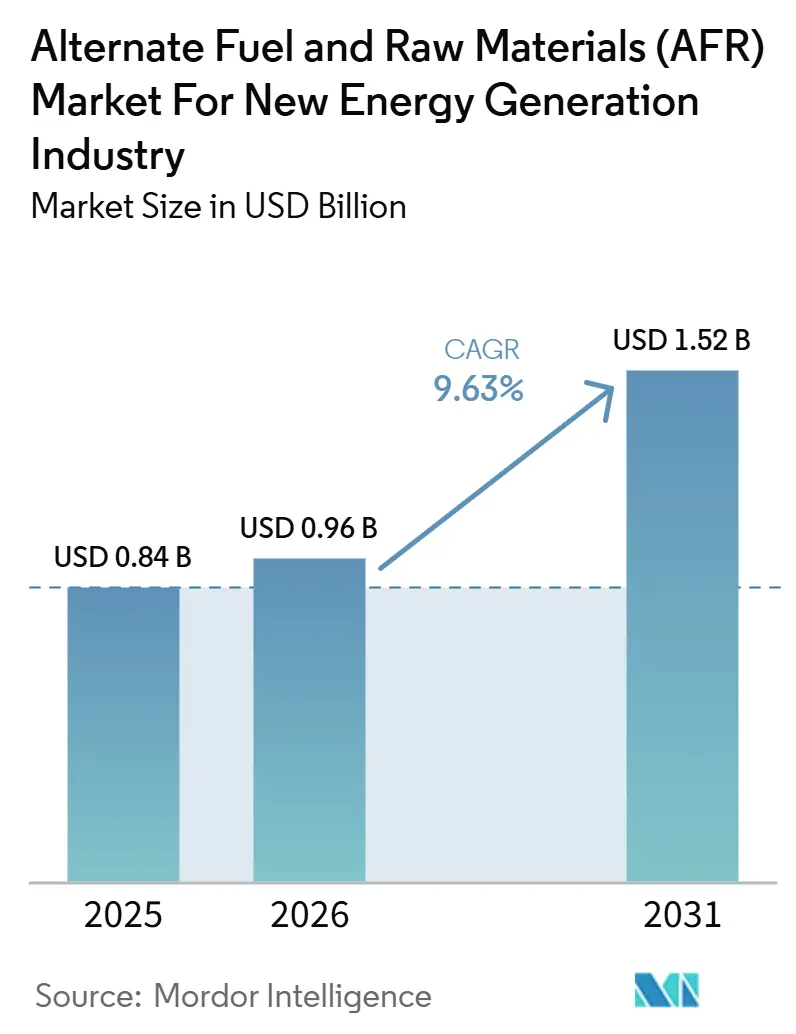
The Alternate Fuel and Raw Materials Market for New Energy Generation Industry size is projected to expand from USD 0.84 billion in 2025 and USD 0.96 billion in 2026 to USD 1.52 billion by 2031, registering a CAGR of 9.63% between 2026 and 2031. Carbon pricing, landfill diversion rules, and the move toward waste-derived inputs in cement and energy generation support demand for the alternate fuel and raw materials market. Europe remains the established center of activity because its waste sorting systems, co-processing capacity, and emissions rules support industrial use of recovered materials. The alternate fuel and raw materials market also benefits when coal phase-outs reduce the availability of fly ash and increase interest in steel slag and other substitutes. Competition centers on access to consistent feedstock, processing capability, certification, and long-term supply agreements that can provide buyers with predictable volumes and documented material quality. The alternate fuel and raw materials market faces limits from variable fuel quality, competing recycling uses for residual waste, and slow permitting for new facilities.
Key Report Takeaways
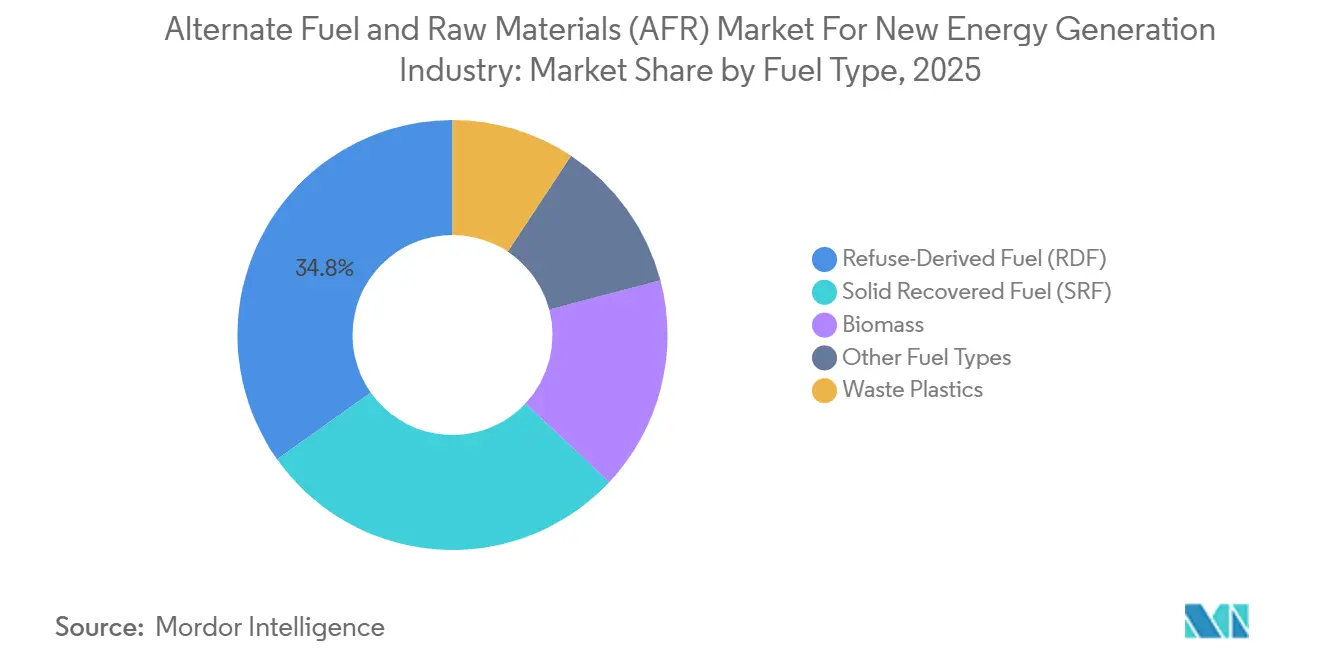
- By fuel type, RDF led with 34.8% revenue share in 2025, while SRF is forecast to expand at a 10.9% CAGR through 2031.
- By raw material type, Fly Ash led with 38.9% revenue share in 2025, while Steel Slag is forecast to expand at a 10.2% CAGR through 2031.
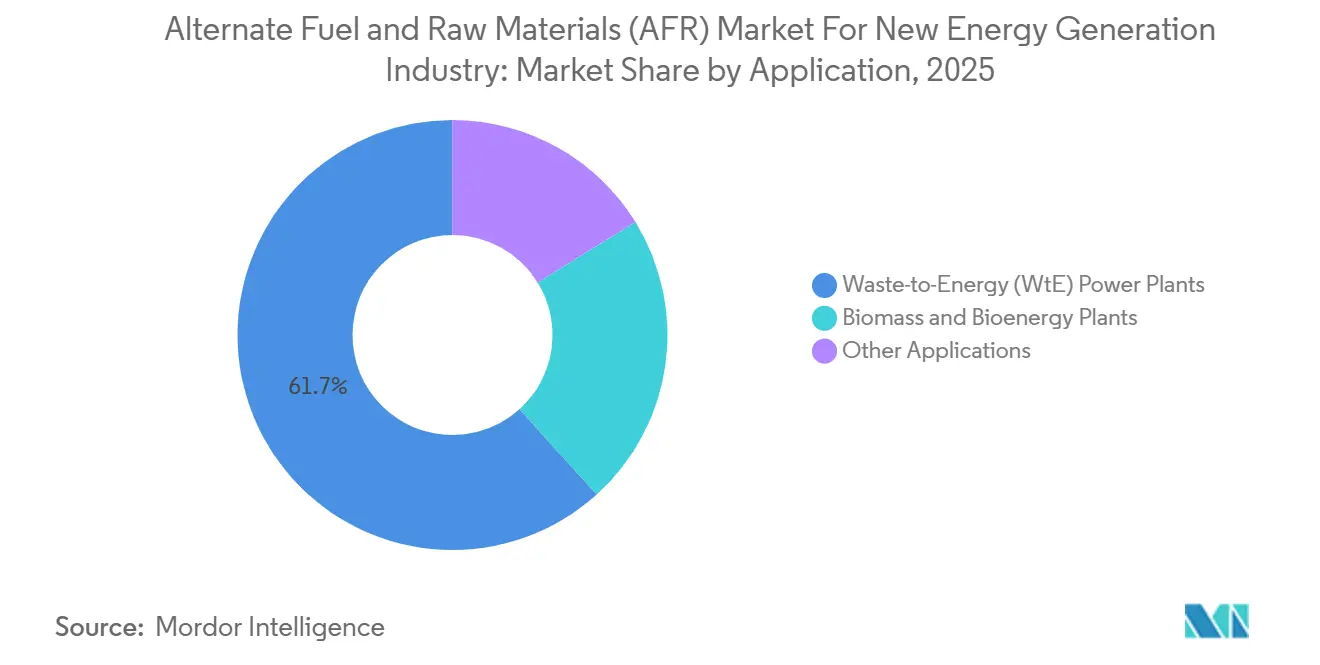
- By application, WtE Power Plants accounted for 61.7% revenue share in 2025, while Biomass and Bioenergy Plants are forecast to expand at a 10.5% CAGR through 2031.
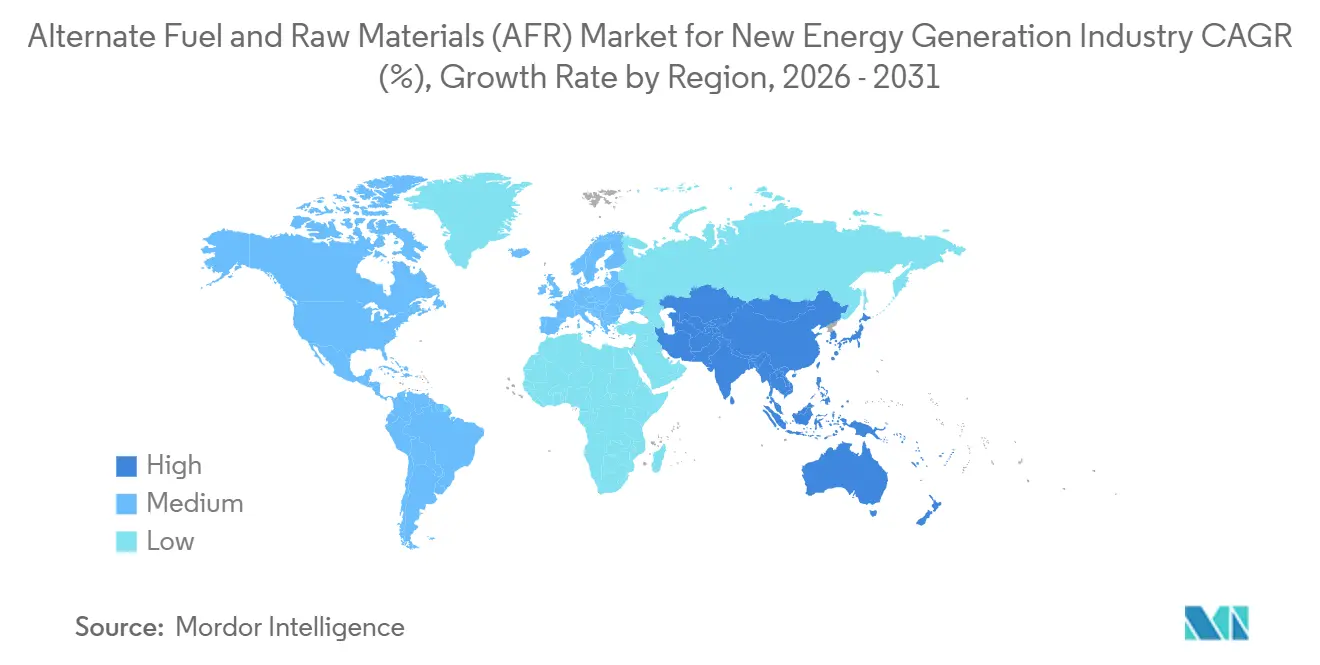
- By geography, Europe accounted for 39.6% revenue share in 2025, while Asia-Pacific is forecast to expand at a 11.1% CAGR through 2031.
Note: Market size and forecast figures in this report are generated using Mordor Intelligence’s proprietary estimation framework, updated with the latest available data and insights as of January 2026.
Market Trends and Insights
Drivers Impact Analysis of Alternate Fuel and Raw Materials (AFR) Market For New Energy Generation Industry*
| Driver | (~) % Impact on CAGR Forecast | Geographic Relevance | Impact Timeline |
|---|---|---|---|
| Carbon Pricing and Industrial Decarbonization | +2.80% | Global, with the strongest immediate effect in the EU, UK, and carbon-priced markets | Short term (≤ 2 years) |
| Landfill Diversion and Circular Economy Mandates | +1.90% | Europe, including EU member states and the UK, with policy influence in Asia-Pacific | Medium term (2-4 years) |
| Cement Kiln Fuel Substitution Economics | +1.50% | Global, with immediate relevance in the EU and developed Asia-Pacific markets | Short term (≤ 2 years) |
| Expansion of Waste Sorting and Pre-Processing Infrastructure | +1.10% | Indonesia, India, Vietnam, Thailand, the Middle East and Africa, and South America | Medium term (2-4 years) |
| Localized Industrial Symbiosis and Waste-to-Resource Platforms | +0.70% | Benelux, Scandinavia, Germany, and emerging Asia-Pacific industrial parks | Long term (≥ 4 years) |
| Digital Fuel-Quality Certification and Traceability | +0.50% | Global, led by the EU, UK, and Japan | Medium term (2-4 years) |
| Source: Mordor Intelligence | |||
Carbon Pricing and Industrial Decarbonization
The alternate fuel and raw materials market gains support from the cost of carbon-intensive fuel use in cement and other heavy industries. Carbon pricing and related import requirements have increased attention to the emissions cost of cement, steel, and aluminum production. The Global Cement and Concrete Association reported that waste supplied less than 10% of cement kiln energy worldwide in 2025, leaving room for broader substitution where operational conditions allow [1]Source: Global Cement and Concrete Association, “Cement and Concrete Industry Net Zero Action and Progress Report,” Global Cement and Concrete Association, gccassociation.org. A peer-reviewed 2026 review found that RDF substitution can reduce the global warming potential of clinker production, with the outcome depending on the substitution rate and avoided landfill effects. The planned phase-out of free emissions allowances for cement increases the operating relevance of reduced fossil fuel use. This setting supports longer fuel supply agreements for certified recovered fuels, especially where buyers must document emissions reductions across their operations.
Landfill Diversion and Circular-Economy Mandates
Landfill diversion requirements support the alternate fuel and raw materials market by directing residual waste away from disposal. The revised EU Waste Framework Directive strengthened requirements related to separate collection and food waste reduction in 2025. EU waste policy links higher recycling expectations with lower landfill use by 2035. Material that remains after appropriate sorting can become feedstock for RDF and SRF processing, although processors must maintain quality controls before the material reaches industrial users. The Clean Industrial Deal presented in February 2025 places industrial decarbonization and circularity within the EU competitiveness agenda. Better source separation can increase the supply of suitable residual material without requiring higher total waste volumes, while maintaining the priority given to recycling under waste policy.
Cement-Kiln Fuel Substitution Economics
Cement kilns provide a large and established outlet for recovered fuel in the alternate fuel and raw materials market, especially where coal replacement aligns with emissions and waste policy. The GCCA reported that some European cement plants exceeded 80% thermal substitution with alternative fuels, while global use remained below 10% of kiln energy in 2025. India operated at a 4-8% thermal substitution rate and China at 10-20%, leaving a substantial gap between current practice and higher-use markets with mature pre-processing and kiln acceptance systems. Fuel quality remains central because kilns require a stable calorific value and low chlorine content. Research published in 2026 identified fuel composition and process conditions as important determinants of RDF performance in thermal treatment systems. Cimento Itambé commissioned a kiln in Brazil in 2025 that was designed for 50% alternative fuel thermal substitution and reached 67% in trials.
Expansion of Waste Sorting and Pre-Processing Infrastructure
Sorting and pre-processing determine whether available waste can meet industrial fuel specifications, which directly affects the reliability of contracted deliveries. Continuous measurement of moisture and calorific value can improve consistency compared with periodic manual sampling. Indonesia attracted public and private investment in waste-to-energy projects during 2026, including the Legok Nangka project in West Java. Indonesia's alternate fuel and raw materials market received support from public and private investment in waste-to-energy infrastructure during 2026. Italian guidance for larger SRF plants has supported in-line monitoring and stronger production controls, providing a reference for facilities that need to demonstrate consistent specifications to industrial buyers. Wider use of near-infrared sorting can reduce variation in recovered fuel quality and improve acceptance by industrial buyers.
Restraints Impact Analysis of Alternate Fuel and Raw Materials (AFR) Market For New Energy Generation Industry*
| Restraint | (~) % Impact on CAGR Forecast | Geographic Relevance | Impact Timeline |
|---|---|---|---|
| Feedstock Quality Variability and Contamination | -0.90% | Global, with greater pressure in mixed-collection systems and developing Asian markets | Medium term (2-4 years) |
| High Retrofit, Storage, and Permitting Costs | -0.70% | North America, developing Asia-Pacific, the Middle East and Africa, and the EU | Medium term (2-4 years) |
| Competition for Premium Waste Streams | -0.50% | Europe and North America | Medium term (2-4 years) |
| Declining Availability of Traditional Secondary Raw Materials | -0.60% | Europe and North America | Long term (≥ 4 years) |
| Source: Mordor Intelligence | |||
Feedstock Quality Variability and Contamination
Feedstock variability remains a restraint on the alternate fuel and raw materials market because industrial users need predictable material properties. A 2026 study found that RDF quality results cannot be applied across feedstocks without testing each material composition. Chlorine is particularly important because higher concentrations can increase the risk of undesirable emissions during cement kiln co-processing. Storage also requires controls for fire prevention, moisture, and contamination. These requirements increase operating costs for smaller processors in the alternate fuel and raw materials market. Stronger chemical controls in Europe and the UK can further raise the specification burden for suppliers.
High Retrofit, Storage, and Permitting Costs
Existing cement and energy plants need burner modifications, handling systems, and safety measures before they can use larger volumes of alternative fuel. These capital needs are harder to fund where carbon pricing or blended finance is limited, which can slow investment by smaller plant operators. North American state-level approaches to waste diversion create uneven conditions for retrofit decisions. Large processing plants can face permitting periods of 3-5 years under industrial pollution control rules. Regulatory uncertainty in Southeast Asia and the Middle East and Africa can affect whether a processed material is treated as a product or as waste. Competition for premium residual streams and the falling availability of fly ash add further pressure to project economics.
*Our forecasts treat driver/restraint impacts as directional, not additive. The impact forecasts reflect baseline growth, mix effects, and variable interactions.
Alternate Fuel and Raw Materials (AFR) Market For New Energy Generation Industry Segment Analysis
By Fuel Type:
Standardized SRF Supports Higher-Value OfftakeRDF held 34.8% of the alternate fuel and raw materials market share in 2025, supported by co-processing agreements with cement manufacturers in Germany, Italy, and Poland. SRF is forecast to grow at a 10.9% CAGR through 2031, the highest rate among fuel types. Its EN ISO 21644 biomass-content certification can support procurement decisions that require auditable renewable content. The alternate fuel and raw materials market rewards SRF suppliers that can provide stable specifications and traceable material, because industrial buyers need clear evidence of fuel composition and renewable content. Higher biogenic content can help cement producers separate renewable and fossil carbon in emissions reporting.
Within the alternate fuel and raw materials market, waste plastics provide high calorific value in co-firing blends, but recycling policy can restrict their use for energy recovery. Tire-derived fuel remains important in parts of South America. Brazil used tire-derived fuel in cement kilns under Ibama monitoring in 2024. Tire-derived fuel also remains relevant to the cement sector in Mexico. Process-derived fuels and agricultural residues retain smaller roles where segregated waste collection is less developed.



By Raw Material Type:
Fly Ash Leads While Steel Slag Gains ImportanceFly Ash held 38.9% of the alternate fuel and raw materials market share in 2025 because it is a well-established supplementary cementitious material. Its supply is expected to tighten as coal generation declines. A 2025 scenario analysis projected that EU fly ash supply could fall from 8.5 million metric tons in 2025 to 1.9-2.7 million metric tons by 2035 [2]Source: R. Snellings et al., “Concrete Change: Exploring Future Scenarios for the Supply of Supplementary Cementitious Materials in the EU,” Developments in the Built Environment, doi.org. The alternate fuel and raw materials market can use legacy stockpiles while fresh ash production declines.
Steel Slag is forecast to grow at a 10.2% CAGR through 2031, making it the fastest-growing raw material type. Research published in Nature Communications found that a binder made from 70% washed steel slag and 30% fly ash delivered a 133.7% improvement in compressive strength and showed a potential global emissions reduction of 2.2-3.0 gigatonnes. Blast furnace slag and foundry sand remain relevant but can face supply changes as steel and foundry operations decarbonize. Other material types include municipal solid waste incineration bottom ash and calcined clay, which are being assessed as processors seek to reduce dependence on inputs affected by coal phase-outs. The alternate fuel and raw materials industry is therefore broadening its input base as traditional supplementary cementitious materials become less available, increasing the value of processing systems that can manage different mineral inputs.
By Application:
WtE Plants Provide the Largest OutletWithin the alternate fuel and raw materials market, WtE Power Plants represented 61.7% of the alternate fuel and raw materials market size for applications in 2025, reflecting the installed base in Europe and Northeast Asia. These plants can provide high-volume demand for standardized fuels and recovered materials, allowing processors to support predictable operating schedules and improve the use of residual waste. SUEZ secured a 10-year operating contract in March 2026 for the Valserhône energy-from-waste facility in France, beginning in September 2027. Long operating contracts can improve confidence for upstream sorting and processing investment. This application base provides an important route to market for material that cannot be recycled, provided that operators meet environmental controls and local permitting conditions.
Biomass and Bioenergy Plants are forecast to grow at a 10.5% CAGR through 2031. India expanded bioenergy and waste-to-energy capacity through 2025, supporting the use of biomass-origin recovered fuels. Indonesia announced several waste-to-energy projects in 2026 under Presidential Regulation No. 109 of 2025. Biomass applications also require sustainability certification and compliance with greenhouse gas saving requirements, creating a clear preference for suppliers that can document feedstock origin and handling conditions. Industrial co-firing in glass, chemicals, and ceramics remains a smaller outlet for high-calorific-value material.
Geography Analysis
Europe Alternate Fuel and Raw Materials (AFR) Market for New Energy Generation Industry
The alternate fuel and raw materials market in Europe held 39.6% of the alternate fuel and raw materials market share in 2025, supported by mature sorting systems, landfill rules, and cement kiln co-processing capacity. Germany, Italy, Poland, France, and the United Kingdom accounted for much of the region's SRF and RDF demand. Poland and Germany have substantial SRF co-firing capacity as cement producers replace coal. Indaver opened the Rivenhall Integrated Waste Management Facility in Essex in June 2026, a USD 798.88 million project that processes up to 595,000 metric tons of residual waste each year and produces 55 MW of electricity [3]Source: Indaver, “Rivenhall Integrated Waste Management Facility Officially Opens,” Rivenhall IWMF, rivenhall-iwmf.co.uk. EU waste and industrial policy continue to support demand for recovered fuels and materials in the region, while harmonized classifications and emissions thresholds influence how operators structure processing investments.
APAC Alternate Fuel and Raw Materials (AFR) Market for New Energy Generation Industry
Asia-Pacific is forecast to grow at an 11.1% CAGR through 2031, the fastest geographic rate in the alternate fuel and raw materials market. India and China have lower cement kiln thermal substitution rates than leading European facilities. Indonesia, India, Vietnam, and Thailand are developing processing and waste-to-energy capacity. Indonesia launched more than USD 600 million in waste-to-energy investment during 2026. India has a substantial agricultural biomass resource that can support biomass-origin recovered fuels. Japan and South Korea, with 50-65% thermal substitution rates in cement kilns, provide regional reference points as policy frameworks develop and neighboring markets work to improve waste access and fuel preparation.
The Americas and MEA Alternate Fuel and Raw Materials (AFR) Market for New Energy Generation Industry
North America, South America, and the Middle East and Africa have different demand patterns. In North America, landfill gas conversion to renewable natural gas is an important energy-recovery route. Republic Services and Archaea Energy opened their first joint renewable natural gas facility in Fort Wayne, Indiana, in June 2026. South America continues to use tire-derived fuel within cement co-processing. South Africa, Morocco, and Saudi Arabia are emerging locations for specification-controlled alternative fuel activity.

Competitive Landscape
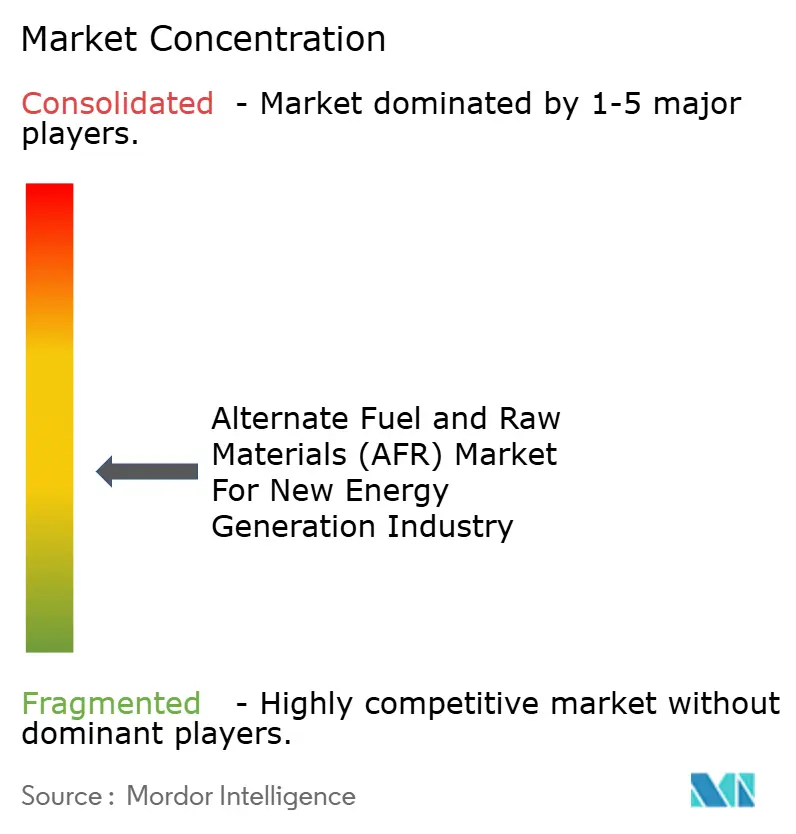
The alternate fuel and raw materials market is moderately fragmented, with Veolia, SUEZ, REMONDIS, and Indaver operating across collection, processing, and energy recovery. These companies benefit from municipal concessions, feedstock access, and long-term supply arrangements, which can protect volumes when high-quality waste streams are scarce. Certification distinguishes suppliers that can meet high-value industrial requirements. EN ISO 21644 testing helps establish biomass content in SRF. Strong knowledge of end-of-waste classification can also affect whether a processed fuel can be traded as a product, which influences logistics options, contracting terms, and access to cross-border customers.
In the alternate fuel and raw materials market, digital traceability is becoming more relevant to suppliers seeking premium offtake contracts. Xpansiv's Digital Fuels Registry records and retires environmental attributes for low-carbon fuels with chain-of-custody controls [4]Source: Xpansiv, “Digital Fuels Registry,” Xpansiv, xpansiv.com. A 2026 study evaluated a digital monitoring framework that handled 1,960 transactions per second with sub-second finality. These tools can help document fuel origin, composition, and environmental attributes, which can reduce disputes when multiple parties handle a material before final industrial use. They also respond to the need for consistent information across processors, buyers, and regulators, although implementation depends on the willingness of firms to adopt common operating and reporting practices.
Industrial symbiosis platforms link waste generators with processors and can reduce the cost of localized material exchange. International Synergies provides a resource-matching platform for industrial waste streams. Indaver announced plans in March 2026 to build 10 Plastics2Chemicals plants in European chemical clusters, including Rotterdam, Le Havre, and Germany. This move can divert plastic waste toward chemical recycling rather than SRF production, increasing competition for feedstocks that have both material recovery and energy recovery value. Modular co-located processing units may also help regional operators work around limited collection infrastructure in developing markets, where centralized systems may take longer to develop.
Leaders of Alternate Fuel and Raw Materials (AFR) Market For New Energy Generation Industry
Biffa Limited
Averda International Limited
Renewi plc
SUEZ S.A.
Veolia Environnement S.A.
- *Disclaimer: Major Players sorted in no particular order
Alternate Fuel and Raw Materials (AFR) Market For New Energy Generation Industry Companies Covered in this Report
- Averda International Limited
- Biffa Limited
- Enva Group Limited
- FCC Servicios Medio Ambiente Holding, S.A.U.
- Fomento de Construcciones y Contratas, S.A.
- Indaver NV
- PreZero International GmbH
- Ragn-Sells AB
- REMONDIS SE & Co. KG
- Renewi plc
- Republic Services, Inc.
- SARIA SE & Co. KG
- Sembcorp Industries Ltd.
- SUEZ S.A.
- Tradebe Environmental Services, LLC
- Veolia Environnement S.A.
- Viridor Limited
- Waste Management, Inc.

Recent Industry Developments in Alternate Fuel and Raw Materials (AFR) Market For New Energy Generation Industry
- July 2026: PT Pertamina announced a 30 MW waste-to-energy plant for the Yogyakarta, Sleman, and Bantul region to process over 1,000 metric tons of daily waste, targeting PLN grid integration as part of Indonesia's national program to accelerate waste-to-electricity across hundreds of untapped districts.
- June 2026: Indaver NV officially opened the USD 798.88 million Rivenhall Integrated Waste Management Facility in Essex, UK, processing up to 595,000 metric tons of residual waste annually and generating 55 MW of electricity, Indaver's largest-ever energy-from-waste investment.
- June 2026: Republic Services, Inc. broke ground on the San Bernardino Sustainability Park in California, scalable to 600,000 metric tons per year of food and yard waste, to meet California's SB 1383 landfill diversion requirements.
- March 2026: SUEZ secured a 10-year operating contract from September 2027 for the Valserhône energy-from-waste plant in France, committing to convert it into a European benchmark for environmental and energy performance.


Scope of Report on Alternate Fuel and Raw Materials (AFR) Market For New Energy Generation Industry
The Global Alternate Fuel and Raw Materials (AFR) Market for the New Energy Generation Industry covers the production, processing, supply, and utilization of waste-derived fuels and secondary raw materials used as alternative energy sources or feedstocks in new energy generation facilities. These materials replace conventional fossil fuels and virgin raw materials in processes such as waste-to-energy (WtE), biomass power generation, bioenergy plants, combined heat and power (CHP) systems, gasification, pyrolysis, and other advanced energy recovery technologies. The market includes the collection, treatment, upgrading, logistics, and commercialization of alternative fuels, including refuse-derived fuel (RDF), solid recovered fuel (SRF), biomass, waste plastics, and industrial residues as well as recovered raw materials such as fly ash, blast furnace slag, foundry sand, bottom ash, and other industrial by-products that improve resource efficiency and support circular economy objectives.
The Alternative Fuel and Raw Material (AFR) market for new energy generation industry is segmented by fuel type, raw material type, application, and geography. By fuel type, the market is segmented into refuse-derived fuel (RDF), solid recovered fuel (SRF), biomass, waste plastics, and other fuel types. By raw material type, the market is segmented into fly ash, blast furnace (bf) slag, foundry sand, steel slag, and other raw materials. By application, the market is segmented into waste-to-energy (WtE) power plants, biomass and bioenergy plants and other applications. The report also covers the market size and forecasts for the global alternative fuel and raw material (AFR) market for new energy generation industry across 26 countries in key regions. For each segment, the market sizing and forecasts have been provided on the basis of value (USD).
| Refuse-Derived Fuel (RDF) |
| Solid Recovered Fuel (SRF) |
| Biomass |
| Waste Plastics |
| Other Fuel Types |
| Fly Ash |
| Blast Furnace Slag |
| Foundry Sand |
| Steel Slag |
| Other Raw Material Types |
| Waste-to-Energy (WtE) Power Plants |
| Biomass and Bioenergy Plants |
| Other Applications |
| North America | United States |
| Canada | |
| Mexico | |
| Europe | Germany |
| France | |
| Italy | |
| Spain | |
| United Kingdom | |
| Poland | |
| Russia | |
| Rest of Europe | |
| Asia-Pacific | China |
| India | |
| Japan | |
| South Korea | |
| Australia | |
| Indonesia | |
| Vietnam | |
| Thailand | |
| Rest of Asia-Pacific | |
| South America | Brazil |
| Argentina | |
| Chile | |
| Rest of South America | |
| Middle East and Africa | Saudi Arabia |
| United Arab Emirates | |
| Egypt | |
| South Africa | |
| Morocco | |
| Rest of Middle East and Africa |
| By Fuel Type | Refuse-Derived Fuel (RDF) | |
| Solid Recovered Fuel (SRF) | ||
| Biomass | ||
| Waste Plastics | ||
| Other Fuel Types | ||
| By Raw Material Type | Fly Ash | |
| Blast Furnace Slag | ||
| Foundry Sand | ||
| Steel Slag | ||
| Other Raw Material Types | ||
| By Application | Waste-to-Energy (WtE) Power Plants | |
| Biomass and Bioenergy Plants | ||
| Other Applications | ||
| By Geography | North America | United States |
| Canada | ||
| Mexico | ||
| Europe | Germany | |
| France | ||
| Italy | ||
| Spain | ||
| United Kingdom | ||
| Poland | ||
| Russia | ||
| Rest of Europe | ||
| Asia-Pacific | China | |
| India | ||
| Japan | ||
| South Korea | ||
| Australia | ||
| Indonesia | ||
| Vietnam | ||
| Thailand | ||
| Rest of Asia-Pacific | ||
| South America | Brazil | |
| Argentina | ||
| Chile | ||
| Rest of South America | ||
| Middle East and Africa | Saudi Arabia | |
| United Arab Emirates | ||
| Egypt | ||
| South Africa | ||
| Morocco | ||
| Rest of Middle East and Africa | ||


Key Questions Answered in the Report
How large is the alternate fuel and raw materials market?
The sector is valued at USD 0.96 billion in 2026 and is forecast to reach USD 1.52 billion by 2031 at a 9.63% CAGR. The outlook reflects demand for waste-derived fuel and substitutes for declining traditional mineral inputs, particularly as coal retirements change the availability of fly ash used in cement and construction materials.
What is driving alternate fuel and raw materials demand?
Carbon pricing, landfill diversion, cement kiln substitution, and growing sorting capacity support demand through 2031. These factors matter most where processors can supply consistent material to cement plants and energy facilities, and where permitting and logistics allow material to move reliably from collection points to users.
Which fuel type is growing fastest?
SRF is forecast to grow at a 10.9% CAGR through 2031 because standardized quality and certification support industrial offtake. Buyers value its documented composition, which helps address kiln acceptance and emissions-reporting requirements, while stronger quality assurance can support long-term contracts between processors and industrial offtakers.
Why is steel slag becoming more important?
Steel Slag is forecast to grow at a 10.2% CAGR as fly ash availability declines with coal generation. Its use broadens the pool of mineral materials available to lower-carbon construction applications, and it becomes more relevant where steel sector by-products can be processed consistently for construction use.
Which application has the largest demand?
WtE Power Plants held 61.7% of application demand in 2025, supported by installed capacity in Europe and Northeast Asia. Their long operating lives make them important buyers of standardized recovered fuel and material streams, which can justify investment in sorting, drying, storage, and pre-processing capacity upstream.
Page last updated on:





