
Almond Oil Market Size and Share
Market Overview
| Study Period | 2021 - 2031 |
|---|---|
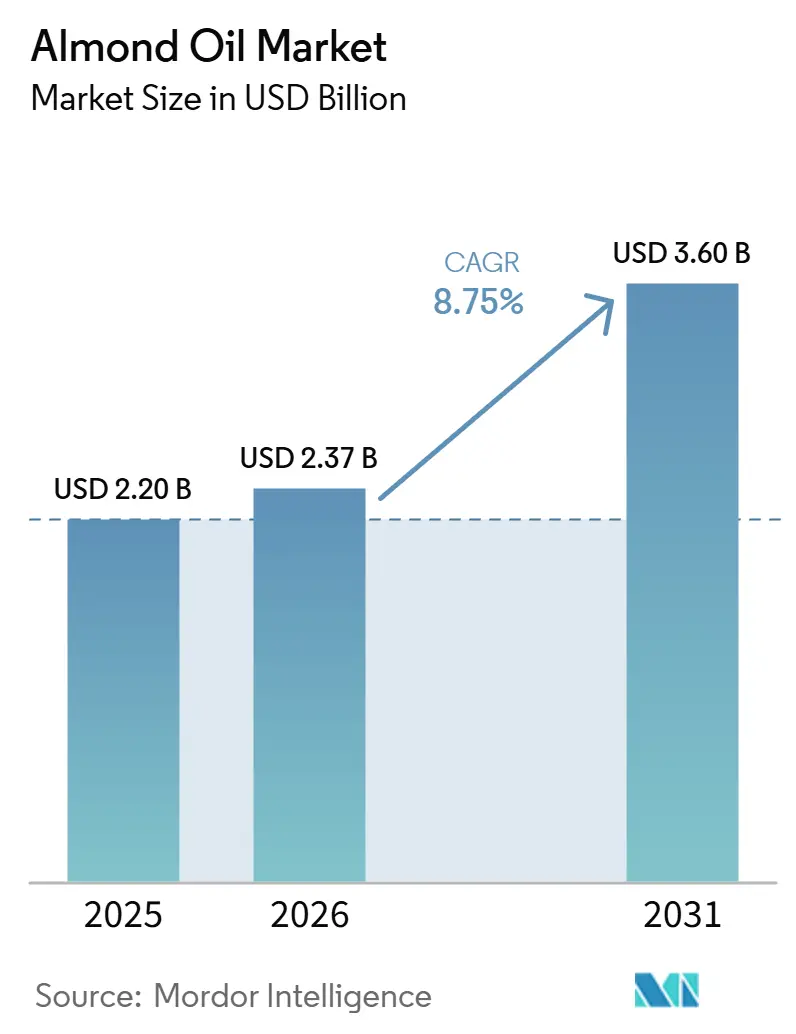
| Market Size (2026) | USD 2.37 Billion |
| Market Size (2031) | USD 3.60 Billion |
| Growth Rate (2026 - 2031) | 8.75 % |
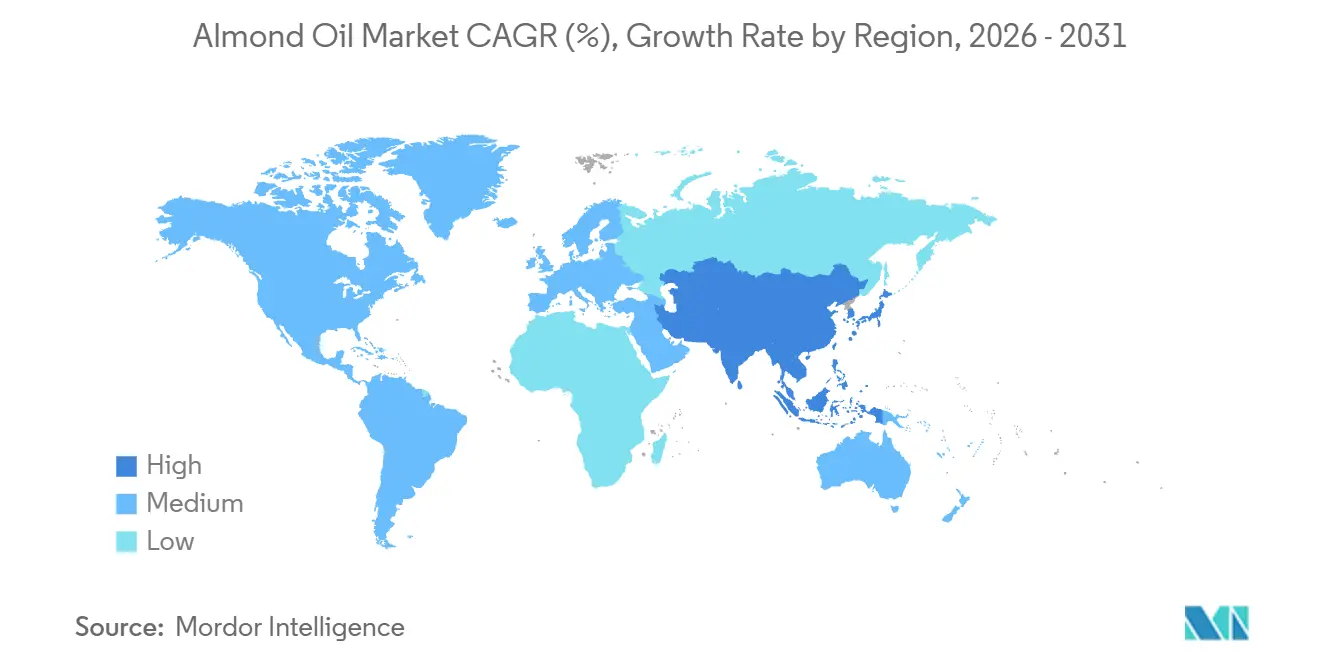
| Fastest Growing Market | Asia-Pacific |
| Largest Market | North America |
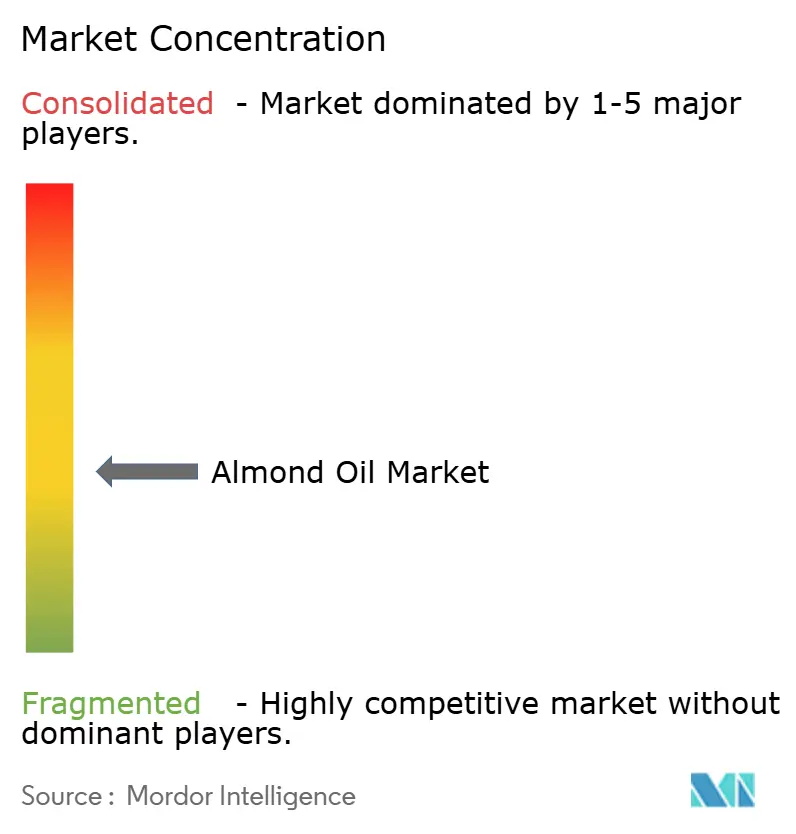
| Market Concentration | Medium |
Major Players *Disclaimer: Major Players sorted in no particular order Image © Mordor Intelligence. Reuse requires attribution under CC BY 4.0. | |
Almond Oil Market Analysis by Mordor Intelligence
The almond oil market size was USD 2.2 billion in 2025 and is forecast to reach USD 3.6 billion by 2031, growing at an 8.75% CAGR from 2026 to 2031. Demand is supported by use in personal care, food, and pharmaceutical formulations, which gives suppliers several routes to market. Supply conditions remain important because California acreage declined for a fourth consecutive year in 2025, while growers continued to face water and operating-cost pressures. These conditions favor processors that can offer consistent specifications, traceability, and refined or specialty-grade formats. The almond oil market also benefits when manufacturers replace less documented ingredients with plant-derived oils that have established quality standards. At the same time, higher raw-material, testing, and compliance costs make low-price, undifferentiated supply less attractive.
Key Report Takeaways
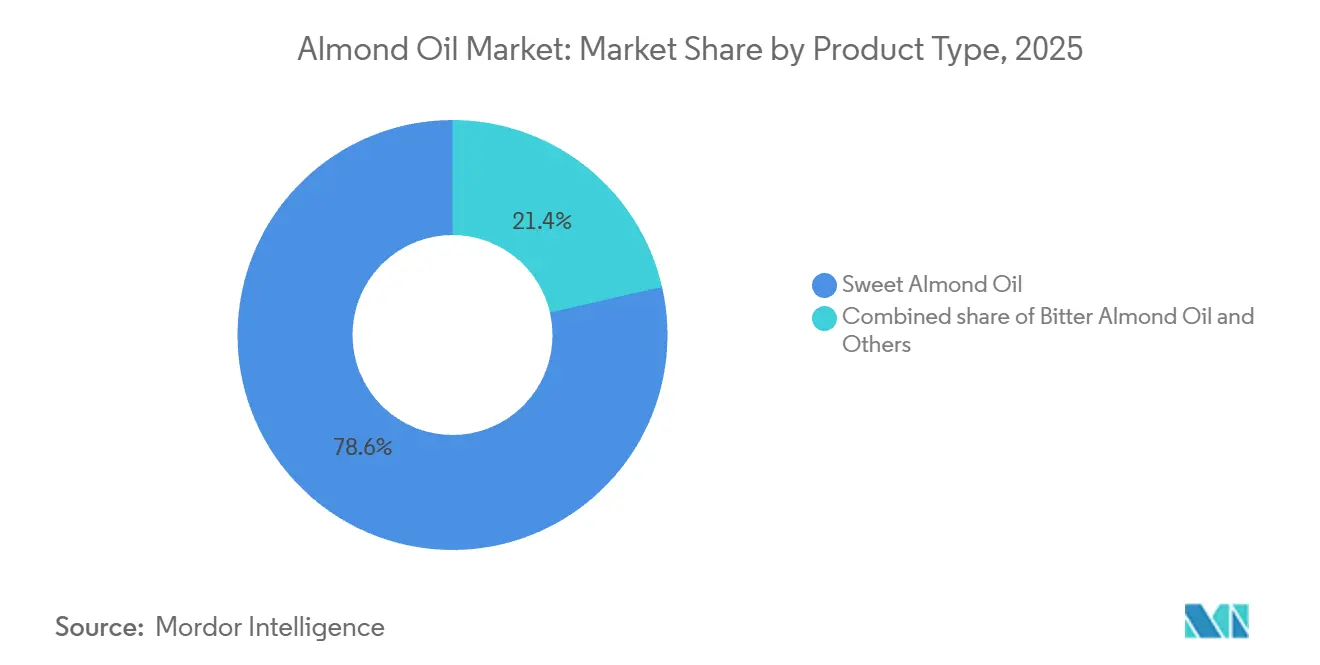
- By product type, Sweet Almond Oil held a 78.6% share in 2025, while Bitter Almond Oil is forecast to grow at a 10.1% CAGR through 2031.
- By extraction method, Cold Pressing accounted for a 56.7% share in 2025, while Expeller-Pressing is forecast to expand at a 9.2% CAGR through 2031.
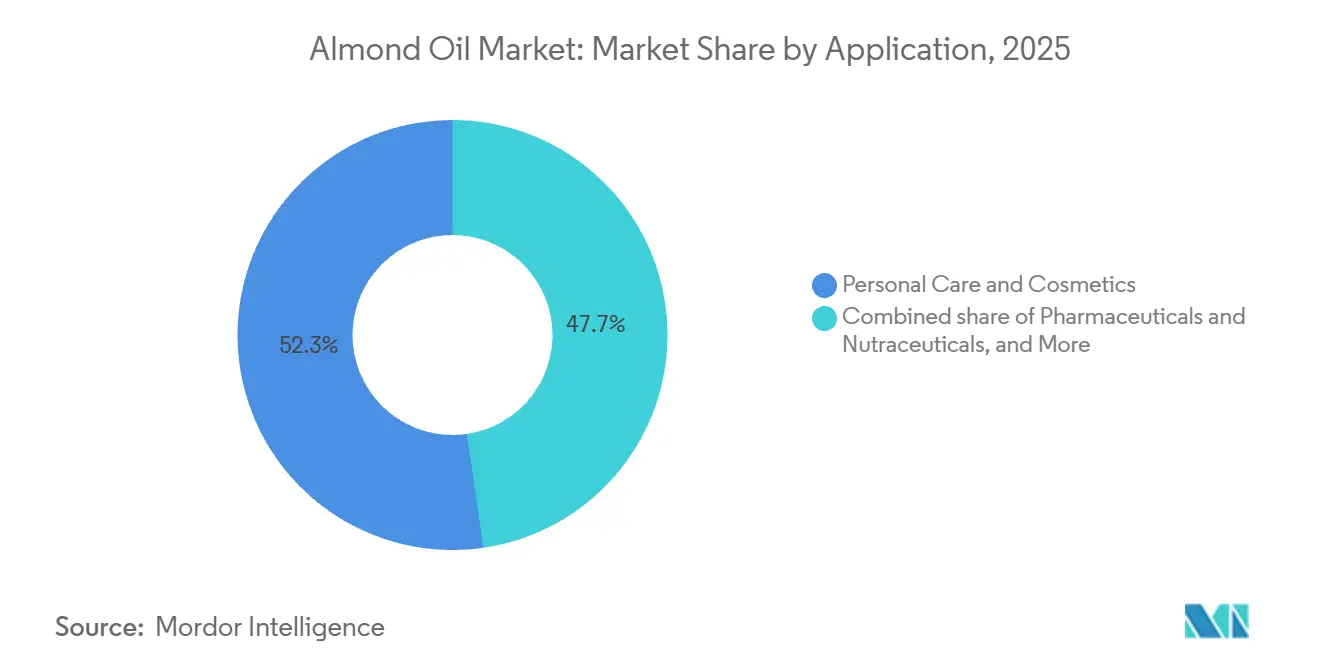
- By application, Personal Care and Cosmetics held 52.3% of the almond oil market size in 2025, while Pharmaceuticals and Nutraceuticals are forecast to advance at a 9.6% CAGR through 2031.
- By geography, North America held 33.7% of the almond oil market size in 2025, while Asia-Pacific is forecast to advance at a 10.3% CAGR through 2031.
Note: Market size and forecast figures in this report are generated using Mordor Intelligence’s proprietary estimation framework, updated with the latest available data and insights as of January 2026.
Market Trends and Insights
Drivers Impact Analysis of Almond Oil Market*
| Drivers | (~) % Impact on CAGR Forecast | Geographic Relevance | Impact Timeline |
|---|---|---|---|
| Rising preference for natural and plant-based ingredients | +2.0% | Global | Long term (≥ 4 years) |
| Strong demand in natural personal care formulations | +1.8% | North America & Europe | Long term (≥ 4 years) |
| Anti-inflammatory and skin-soothing positioning | +1.2% | Global | Medium term (2–4 years) |
| Expansion of nutraceutical and dietary supplement use | +0.9% | APAC, North America | Medium term (2–4 years) |
| Rising clean-label demand in food applications | +0.7% | North America & EU | Medium term (2–4 years) |
| Popularity of cold-pressed and premium oil formats | +0.6% | North America, Europe, APAC | Short term (≤ 2 years) |
| Source: Mordor Intelligence | |||
Rising Preference for Natural and Plant-Based Ingredients
Consumer demand for plant-derived, minimally processed ingredients is now embedded in purchasing behavior across income segments rather than confined to premium channels. Almond oil sits at the intersection of this shift, it is simultaneously a cosmetic emollient, a dietary fat, and a pharmaceutical excipient, giving it cross-sector reach that few botanical oils can match. The Almond Board of California confirmed that almonds appeared in over 9,000 new products in 2024/25 alone, a figure that includes food, beverage, and personal care formulations. This breadth signals a demand structure resilient to category slowdowns; even as healthy snacking softened in the United States, ingredient-level use sustained volume[1]Source: Almond Board of California, “Brightseed Partnership Identifies Health-Promoting Compounds in Almonds”, almonds.org.. The compounding effect of plant-based positioning and multi-application versatility makes this driver the single largest contributor to the market's forecasted CAGR.
Strong Demand in Natural Personal Care Formulations
Cosmetics Europe reported that the European personal care market exceeded EUR 96 billion (approximately USD 105 billion) in retail sales in 2024, sustaining ingredient demand for botanical oils across mass and luxury segments. Almond oil benefits disproportionately because its light texture, non-comedogenic profile, and vitamin E content satisfy formulation requirements across an unusually wide product range, from baby care to anti-aging serums. A critical second-order dynamic is that tightening EU Cosmetics Regulation updates, including Commission Regulation (EU) 2024/996 restricting synthetic endocrine-active substances and Regulation (EU) 2024/858 banning certain nanomaterials from February 2025, are effectively narrowing the pool of permitted synthetic alternatives. This regulatory influence accelerates reformulation toward natural actives, positioning almond oil as a compliant, well-documented substitute across multiple functional categories[2]Source: European Commission, “Commission Regulation (EU) 2024/858”, eur-lex.europa.eu..
Anti-Inflammatory and Skin-Soothing Positioning
Almond oil's phytochemical profile, approximately 70% oleic acid, 20% linoleic acid, plus tocopherols and phytosterols, supports clinical positioning in dermatological applications targeting barrier restoration and inflammation control. The European Pharmacopoeia monograph for almond oil sets purity and composition standards that pharmaceutical manufacturers rely on for topical excipient sourcing, reducing qualification timelines and regulatory uncertainty. Demand is growing particularly in prescription and over-the-counter products targeting eczema and psoriasis, conditions with rising global prevalence. Manufacturers in India, China, and the EU have intensified almond oil sourcing for therapeutic formulations, including massage oils, liniments, and dermatological preparations, leveraging both the anti-inflammatory mechanism and favorable regulatory status across major jurisdictions.
Expansion of Nutraceutical and Dietary Supplement Use
The nutraceutical sector is using almond oil both as an active ingredient and as a carrier oil in soft-gel capsules and oral health products, enabled by FDA GRAS recognition in the United States. BrightSeed's partnership with the Almond Board of California identified 530 health-promoting bioactive compounds in almonds in 2025, a finding that is actively reshaping ingredient positioning across functional food and supplement brands. The growing preference for traceable, clean-label carrier oils in capsule formulations, as opposed to conventional refined vegetable oils, directly benefits cold-pressed almond oil, which carries a superior phytonutrient profile and identifiable geographic provenance. Pharmaceutical and nutraceutical companies are increasingly willing to absorb the premium for specification-grade almond oil because documentation, allergen declaration compliance, and lot traceability reduce downstream liability rather than merely adding cost.
Restraints Impact Analysis of Almond Oil Market*
| Restraint | (~) % Impact on CAGR Forecast | Geographic Relevance | Impact Timeline |
|---|---|---|---|
| Raw material supply volatility | -1.5% | Global (supply risk concentrated in California, Spain) | Short term (≤ 2 years) |
| Risk of adulteration and counterfeit products | -1.0% | APAC, MEA | Medium term (2–4 years) |
| Regulatory complexity | -0.7% | EU, North America | Long term (≥ 4 years) |
| Competition from substitute oils | -0.9% | Global | Medium term (2–4 years) |
| Source: Mordor Intelligence | |||
Raw Material Supply Volatility
California accounts for approximately 80% of global almond supply, and water access constraints under the SGMA are creating structural, rather than cyclical, supply risk. California's total almond acreage declined for the fourth consecutive year in 2025, with new plantings also falling; orchards without access to surface water are experiencing yield declines and potential abandonment, as documented by Tridge's market intelligence and confirmed by the International Nut and Dried Fruit Council's 2024/25 position report. Even a near-record harvest forecast for 2025, with USDA estimating approximately 3 billion meat pounds, did not remove volatility risk; almond prices dropped nearly 20% after the USDA Objective Measurement Report was released, only to be questioned for accuracy by industry operators. For almond oil buyers, this environment translates into procurement planning challenges, margin pressure during tight-supply years, and growing interest in multi-origin sourcing that includes Australian and Mediterranean supply lanes.
Risk of Adulteration and Counterfeit Products
Adulteration of almond oil, typically through blending with lower-cost apricot kernel oil, mineral fractions, or non-nut vegetable oils, is a persistent commercial and food safety challenge, particularly in high-volume markets across South and Southeast Asia. The Canada Food Inspection Agency's 2023/24 Food Fraud Annual Report identified adulteration of expensive botanical oils as a continuing enforcement priority. Detection methodologies are advancing; hyperspectral imaging combined with machine learning algorithms demonstrated 100% validation accuracy in classifying pure versus adulterated oils in a study published in PMC, but laboratory infrastructure to deploy these methods at scale remains uneven across developing markets. For branded manufacturers, adulteration risk creates a margin paradox: premium-grade assurance costs money to certify, yet the market price spread between authentic and substituted oils is insufficient to deter fraudulent blending across informal trade channels. This restraint is most acute in MEA and APAC markets where regulatory oversight of botanical oil supply chains is still maturing.
*Our forecasts treat driver/restraint impacts as directional, not additive. The impact forecasts reflect baseline growth, mix effects, and variable interactions.
Almond Oil Market Segment Analysis
By Product Type:
Sweet Almond Oil Has Broad Application UseSweet Almond Oil held 78.6% of the almond oil market share in 2025. Its leading position reflects use across skincare, hair care, baby care, massage products, and essential-oil blends. The oil’s vitamin E content and formulation flexibility support this broad role. Blue Diamond Growers introduced Virgin Almond Oil in 2024 as a cold-pressed, minimally processed ingredient for food and cosmetic uses. The launch shows that suppliers are addressing premium demand within the sweet almond category. Other variants include organic, Californian, and Nonpareil almond oils that serve smaller certified-organic and origin-specific channels.
Bitter Almond Oil is projected to grow at a 10.1% CAGR from 2026 to 2031. Its uses differ from those of sweet almond oil because benzaldehyde requires stricter handling and regulatory controls. The oil is used mainly in flavoring applications, including confectionery and macarons, and in selected pharmaceutical intermediates. These requirements limit broader cosmetic use. Producers that meet flavoring-grade purity standards and European food-safety requirements can serve a more specialized customer base. Confectionery demand in China, Turkey, and Morocco, along with pharmaceutical synthesis, supports the segment’s growth outlook.



By Extraction Method:
Cold Pressing Leads While Expeller-Pressing ExpandsCold Pressing accounted for 56.7% of the almond oil market size in 2025. It is used in premium personal care, organic, and pharmaceutical-grade supply chains. The supplied draft stated that cold-pressed oil contains 24 to 40 mg of vitamin E per 100 g, compared with 5 to 10 mg in refined alternatives. This composition supports use in functional skincare and nutraceutical products. Gustav Heess’s Caloy unit in Modesto operates dedicated equipment for almond oil and other nut oils to reduce cross-contamination risk. The supplied draft also stated that the format commands a 20% to 40% per-kilogram premium over refined alternatives.
Expeller-Pressing is forecast to grow at a 9.2% CAGR through 2031. This method sits between cold pressing and solvent extraction in yield efficiency and nutrient retention. High-throughput expeller lines help mid-sized manufacturers make hexane-free and Non-GMO-verified oil without the full unit-cost profile of artisanal cold pressing. NOW Health Group describes its sweet almond oil as expeller-pressed and hexane-free. This positioning shows that expeller extraction can meet clean-label expectations in specialty retail. Solvent extraction remains in the other category and faces weaker relative demand as North American and European buyers tighten clean-label requirements.
By Application:
Personal Care Leads While Pharmaceuticals and Nutraceuticals ExpandPersonal Care and Cosmetics held 52.3% of the almond oil market size in 2025. The application includes skincare, hair care, baby care, massage, and sun-care products. In India, the supplied draft reported that Bajaj Consumer Care’s Almond Drops Hair Oil exceeded 63% value share in the light hair oil category in Q3 FY26. The brand’s reported growth reflected low-unit packs and wider rural distribution. Croda markets Cropure™ Almond for body creams, shower oils, conditioning sprays, and body serums. Food and beverage applications remain smaller but benefit from culinary and confectionery demand in Mediterranean and emerging markets.
Pharmaceuticals and Nutraceuticals is projected to grow at a 9.6% CAGR from 2026 to 2031. The segment is supported by FDA GRAS recognition and European Pharmacopoeia documentation. Manufacturers use the oil as an excipient and in topical dermatological preparations. The 2025 work identifying 530 almond bioactive compounds gives formulators evidence for product-development work. Encapsulation can improve bioavailability and oxidative stability in oral soft-gel formats. This creates a closer link between pharmaceutical and nutraceutical demand in the almond oil market.
Geography Analysis
North America Almond Oil Market
North America held 33.7% of the almond oil market share in 2025. California’s cultivation, pressing, refining, and branded-product activities provide an integrated supply base. This structure can reduce logistics steps and speed product specification changes. Blue Diamond Growers reported expanding distribution in Canada and new beverage partnerships in Japan during 2025. The cooperative also reported growth activity in India, Turkey, and the UAE. U.S. clean-label expectations and California transparency requirements raise the importance of supplier documentation and chain-of-custody systems.
APAC Almond Oil Market
Asia-Pacific is forecast to grow at a 10.3% CAGR through 2031. The supplied draft stated that India received 423 million pounds, or 192,000 MT, of almonds in 2024/25, up 6% from the prior year. Ayurvedic wellness practices support hair and skin oil use in India. Dabur and Bajaj Consumer Care have developed almond-oil product franchises in this setting. South Korean formulators use almond oil in mild products for sensitive skin. China’s cross-border e-commerce channels give consumers access to premium cold-pressed variants, while Australia combines almond production with traceability standards.
EMEA and South America Almond Oil Market
Europe was the second-largest geographic segment in the supplied draft and relies on established cosmetic formulation activity. France, Germany, and Italy are major demand centers for premium emollient applications. The cosmetic rules on nanomaterials and listed endocrine-disrupting substances support demand for documented natural ingredients. South America, the Middle East, and Africa remain smaller but developing areas for the almond oil market. Brazil’s personal care sector and organized retail in South Africa and the UAE support demand. Adulteration concerns remain more severe in informal supply channels across parts of the Middle East and Africa.

Competitive Landscape
The supplied material gives the almond oil market a concentration score of 4 out of 10, indicating a moderately fragmented structure. No company controls pricing or formulation across all regions and applications. Gustav Heess, through Caloy in Modesto, uses dedicated nut-oil processing capacity to strengthen quality and supply reliability. The supplied draft describes the facility as the world’s largest almond oil production unit. This vertical integration helps processors manage handling, purity, and delivery consistency, supporting sales to pharmaceutical- and cosmetic-grade customers.
AAK operates across specialty fats, oils, formulation, and distribution, not only almond oil extraction. The supplied material cites a January 2026 Nordmann announcement on an expanded AAK partnership for food-industry distribution in Germany, France, the Netherlands, and Austria, extending an earlier cosmetics-focused relationship. Croda follows a formulation-led strategy through its Cropure™ Almond range, serving hair, skin, and body care applications. These examples show that suppliers can build commercial strength through distribution networks, technical support, and application knowledge, not only orchard ownership.
Blue Diamond Growers’ 2024 Virgin Almond Oil launch added a minimally processed option to its refined, bleached, and deodorized portfolio for food and cosmetic customers seeking premium oil. The supplied material identifies Proteco Oils and Liberty Vegetable Oil Company as suppliers that support geographic diversification beyond California. Suppliers also compete through organic, halal, Non-GMO Project Verified, traceability, and ISO 16128 natural-origin credentials. Hyperspectral authentication may strengthen quality control for larger suppliers with laboratory resources. These practices raise barriers for undocumented supply chains, leaving room for regional and mid-sized suppliers that can prove origin, quality, and consistent specifications.
Almond Oil Industry Leaders
AOS Products Private Limited
Gustav Heess GmbH
Blue Diamond Growers, Inc.
Jiangxi Baicao Pharmaceutical Co., Ltd.
AAK AB
- *Disclaimer: Major Players sorted in no particular order
Almond Oil Market Companies Covered in this Report
- AAK AB
- AOS Products Private Limited
- Ashwin Fine Chemicals and Pharmaceuticals
- Bajaj Consumer Care Ltd.
- Blue Diamond Growers, Inc.
- Caloy Company, LP
- Croda International Plc
- Dabur India Ltd.
- Eden Botanicals
- ESI S.p.A.
- Flora Manufacturing and Distributing Ltd.
- Frontier Co-op
- Gustav Heess GmbH
- Henry Lamotte Oils GmbH
- Jiangxi Baicao Pharmaceutical Co., Ltd.
- Jiangxi Xuesong Natural Medicinal Oil Co., Ltd.
- Liberty Vegetable Oil Company
- Mountain Ocean Ltd.
- NOW Health Group, Inc.
- Proteco Oils

Recent Industry Developments in Almond Oil Market
- January 2026: AAK AB expanded its long-standing distribution partnership with Nordmann, extending coverage of AAK’s plant-based oils and fats into the food industry across Germany, France, the Netherlands, and Austria. The collaboration, previously concentrated in cosmetics, now covers food-grade botanical oils and reflects AAK’s strategy to cross-sell plant-based oil expertise across adjacent end-use sectors in core European markets.
- November 2025: Blue Diamond Growers, at its 115th Annual Meeting, reported expansion of international distribution across multiple regions. Canada grew at a pace exceeding category and private-label growth, strategic beverage partnerships were established in Japan, and in-shell almond growth accelerated in India, Turkey, and the UAE.


Global Almond Oil Market Report Scope
| Sweet Almond Oil |
| Bitter Almond Oil |
| Others |
| Cold Pressing |
| Expeller-Pressing |
| Others |
| Personal Care and Cosmetics |
| Pharmaceuticals and Nutraceuticals |
| Food and Beverages |
| Others |
| North America | United States |
| Canada | |
| Mexico | |
| Rest of North America | |
| Europe | Germany |
| United Kingdom | |
| Italy | |
| France | |
| Spain | |
| Netherlands | |
| Poland | |
| Belgium | |
| Sweden | |
| Rest of Europe | |
| Asia-Pacific | China |
| India | |
| Japan | |
| Australia | |
| Indonesia | |
| South Korea | |
| Thailand | |
| Singapore | |
| Rest of Asia-Pacific | |
| South America | Brazil |
| Argentina | |
| Colombia | |
| Chile | |
| Peru | |
| Rest of South America | |
| Middle East and Africa | South Africa |
| Saudi Arabia | |
| United Arab Emirates | |
| Nigeria | |
| Egypt | |
| Morocco | |
| Turkey | |
| Rest of Middle East and Africa |
| By Product Type | Sweet Almond Oil | |
| Bitter Almond Oil | ||
| Others | ||
| By Extraction Method | Cold Pressing | |
| Expeller-Pressing | ||
| Others | ||
| By Application | Personal Care and Cosmetics | |
| Pharmaceuticals and Nutraceuticals | ||
| Food and Beverages | ||
| Others | ||
| By Geography | North America | United States |
| Canada | ||
| Mexico | ||
| Rest of North America | ||
| Europe | Germany | |
| United Kingdom | ||
| Italy | ||
| France | ||
| Spain | ||
| Netherlands | ||
| Poland | ||
| Belgium | ||
| Sweden | ||
| Rest of Europe | ||
| Asia-Pacific | China | |
| India | ||
| Japan | ||
| Australia | ||
| Indonesia | ||
| South Korea | ||
| Thailand | ||
| Singapore | ||
| Rest of Asia-Pacific | ||
| South America | Brazil | |
| Argentina | ||
| Colombia | ||
| Chile | ||
| Peru | ||
| Rest of South America | ||
| Middle East and Africa | South Africa | |
| Saudi Arabia | ||
| United Arab Emirates | ||
| Nigeria | ||
| Egypt | ||
| Morocco | ||
| Turkey | ||
| Rest of Middle East and Africa | ||


Key Questions Answered in the Report
What is the forecast for the almond oil market?
The almond oil market is forecast to grow from USD 2.2 billion in 2025 to USD 3.6 billion by 2031, at an 8.75% CAGR from 2026 to 2031.
Which almond oil product type leads demand?
Sweet Almond Oil led with 78.6% share in 2025 because it is used across skincare, hair care, baby care, massage, and other consumer products.
Which extraction method is growing fastest?
Expeller-Pressing is forecast to grow at a 9.2% CAGR through 2031, supported by demand for scalable, hexane-free, clean-label oil .
Which region is growing fastest for almond oil?
Asia-Pacific is forecast to grow at a 10.3% CAGR through 2031, with demand supported by Indian wellness uses, South Korean formulation activity, and Chinese cross-border e-commerce.
Page last updated on:


 Your data is secure and never sold or shared.


