
Algae Biofuel Market Size and Share
Market Overview
| Study Period | 2022 - 2032 |
|---|---|
| Market Size (2027) | USD 13.25 Billion |
| Market Size (2032) | USD 20.56 Billion |
| Growth Rate (2027 - 2032) | 9.18 % |
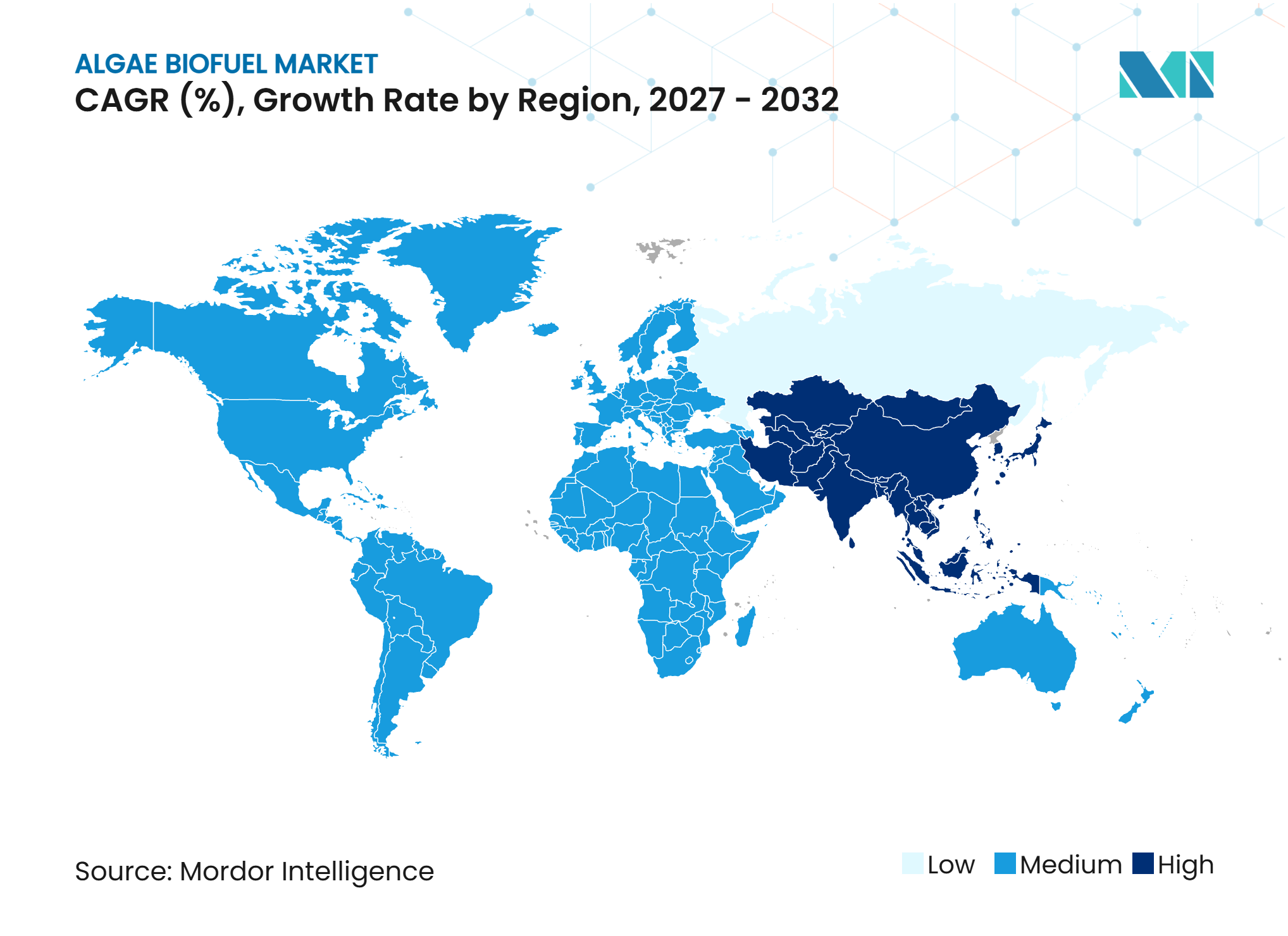
| Fastest Growing Market | Asia-Pacific |
| Largest Market | North America |
| Market Concentration | Low |
Major Players *Disclaimer: Major Players sorted in no particular order Image © Mordor Intelligence. Reuse requires attribution under CC BY 4.0. | |
Algae Biofuel Market Analysis by Mordor Intelligence
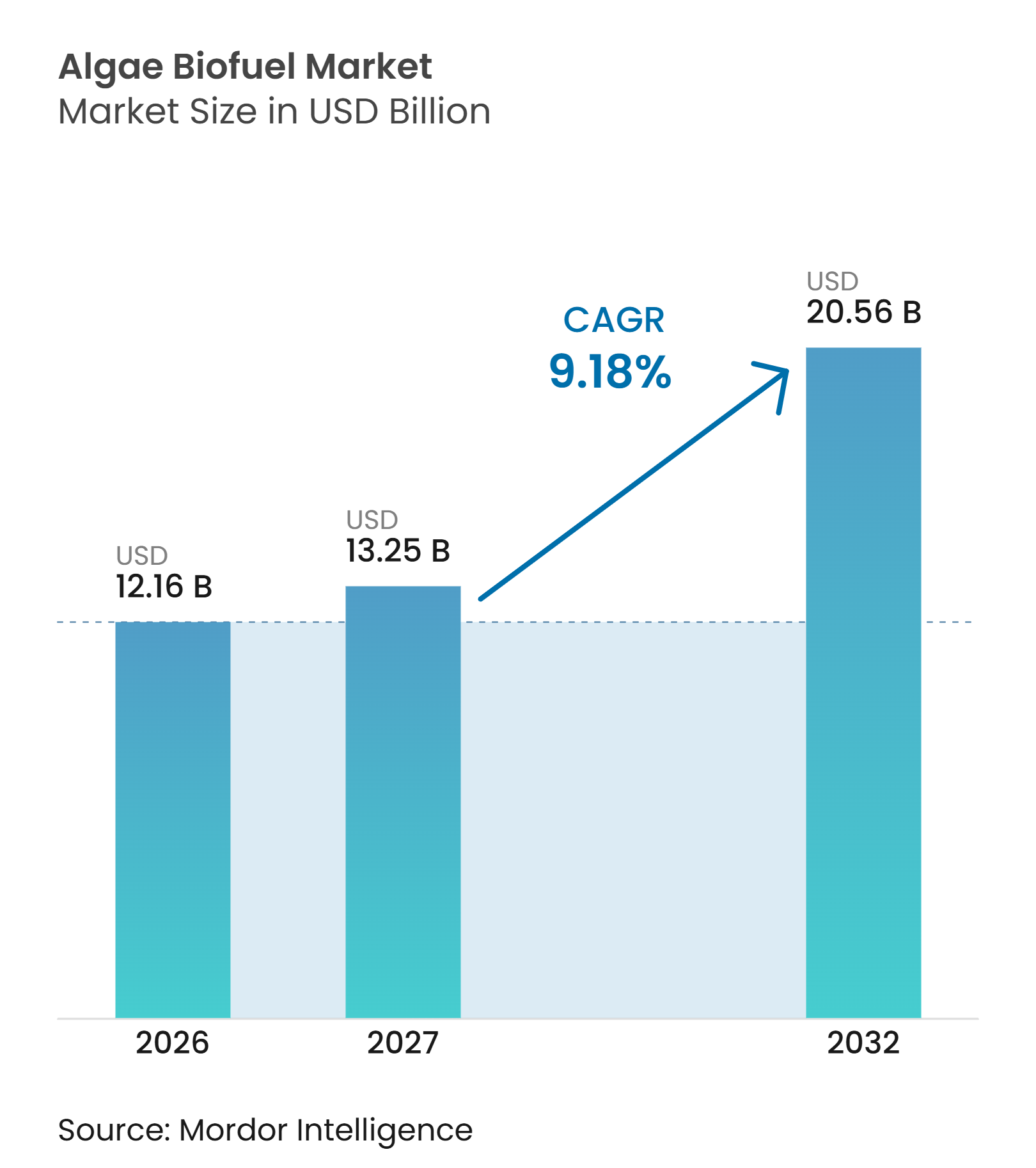
The algae biofuel market size is expected to grow from USD 12.16 billion in 2026 to USD 13.25 billion in 2027 and is forecast to reach USD 20.56 billion by 2032 at a 9.18% CAGR over 2027-2032. The algae biofuel market is being shaped by fuel mandates that turn low-carbon fuel supply into a compliance requirement for airlines and shipping operators. Demand is moving toward uses where electrification is difficult, particularly aviation and marine transport. Developers are also seeking lower-cost models that use wastewater, industrial carbon dioxide, saline water, and non-arable land. This favors integrated facilities, although scale-up performance and extraction costs remain important limits on commercial returns. The algae biofuel market remains fragmented, so technology ownership, certification capability, and secured offtake agreements can carry more weight than production scale alone.
Key Report Takeaways
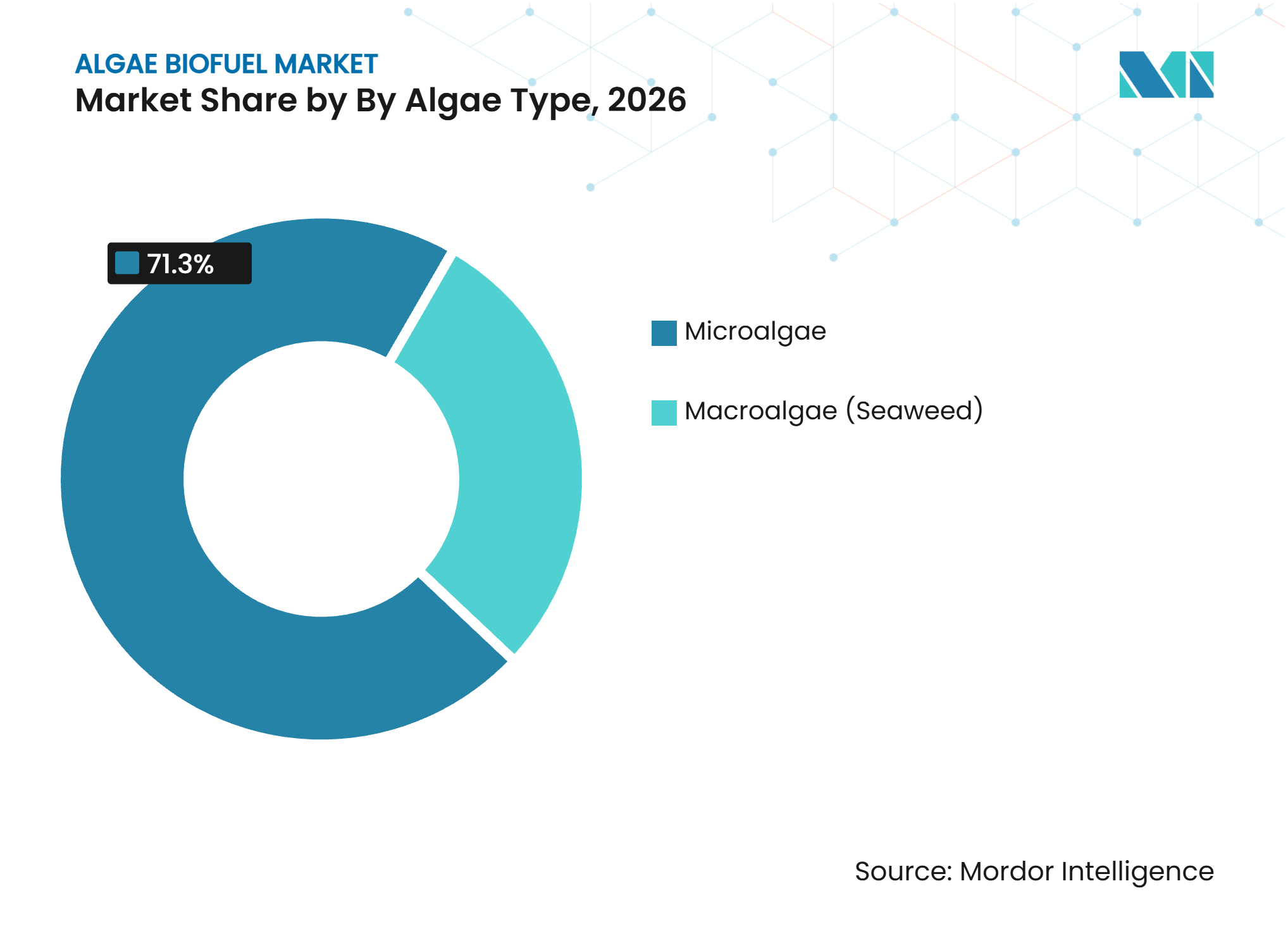
- By algae type, microalgae held a 71.3% revenue share in 2026, while macroalgae is expected to record the highest growth, with a CAGR of 9.8% through 2032.
- By fuel type, biodiesel held a 29.5% revenue share in 2026, while sustainable aviation fuel and biojet fuel are expected to record the highest projected CAGR at 10.3% through 2032.
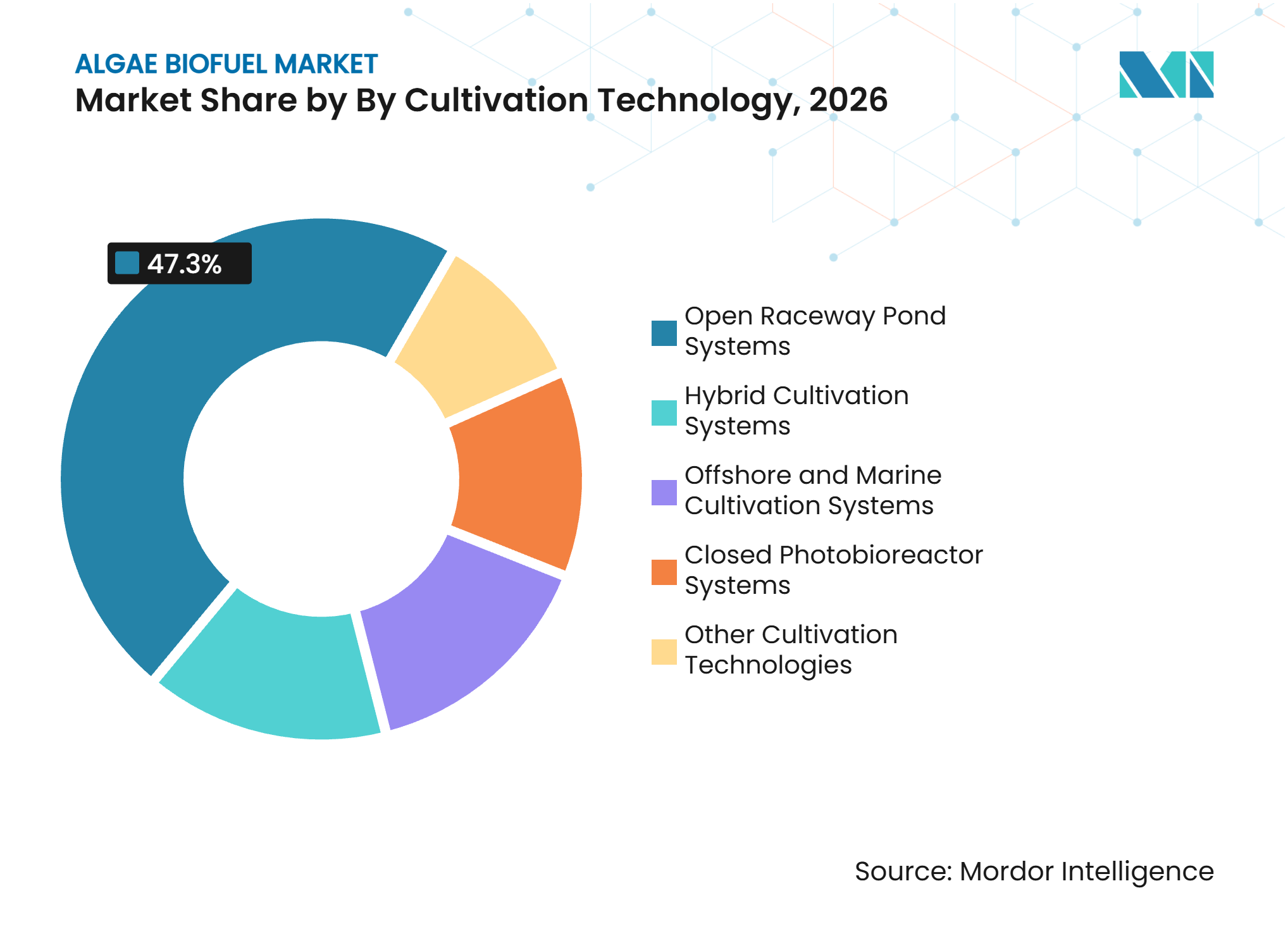
- By cultivation technology, open raceway ponds held 47.3% algae biofuel market share in 2026, while closed photobioreactors are expected to record the highest projected CAGR at 9.6% through 2032.
- By application, road transportation held 42.4% revenue share in 2026, while aviation is expected to record the highest projected CAGR at 10.2% through 2032.
- By geography, North America held a 37.7% to the algae biofuel market size in 2026, while Asia-Pacific is expected to record the highest projected CAGR at 9.9% through 2032.
Note: Market numbers in this report are based on Mordor Intelligence's proprietary estimation framework, which combines nine months of actuals with Q4 projections for base year 2026.
Market Trends and Insights
Drivers Impact Analysis of Algae Biofuel Market*
| Driver | (~) % Impact on CAGR Forecast | Geographic Relevance | Impact Timeline |
|---|---|---|---|
| Renewable Fuel Mandates and Low-Carbon Fuel Standards | +2.4% | Global (North America & EU core) | Short term (≤ 2 years) |
| Sustainable Aviation Fuel and Maritime Decarbonization Demand | +2.1% | Global | Medium term (2–4 years) |
| High Productivity on Non-Arable Land and Saline Water | +1.0% | APAC, MEA, South America | Medium term (2–4 years) |
| Carbon Capture and Wastewater Nutrient-Recovery Integration | +0.9% | North America, Europe | Medium term (2–4 years) |
| Strain Engineering and Higher-Lipid Productivity | +0.8% | Global | Long term (≥ 4 years) |
| Algal Fuel and Protein Coproduction Economics | +0.6% | North America, Europe | Long term (≥ 4 years) |
| Source: Mordor Intelligence | |||
Renewable Fuel Mandates and Low-Carbon Fuel Standards
The algae biofuel market benefits when fuel rules create clear obligations for low-carbon supply. ReFuelEU Aviation requires 2% sustainable aviation fuel in 2025, with the requirement rising to 34% in 2040 and 70% in 2050, while the framework recognizes microalgae as an advanced feedstock under the Renewable Energy Directive III (RED III).[1] The classification can improve the position of algae-based fuels because advanced-biofuel sub-targets and double-counting provisions support certified pathways. The United States also supports certified advanced fuels through Inflation Reduction Act tax credits, which can improve project economics where production meets eligibility requirements. ICAO’s Carbon Offsetting and Reduction Scheme for International Aviation (CORSIA) framework becomes mandatory for most member states from 2027 and increases the importance of fuel pathways that satisfy environmental and social criteria. The OECD and FAO reported that the Renewable Energy Directive III (RED III) advanced biofuel targets increased from 3.5% to 5.5% by 2030, tightening competition for eligible nonfood feedstocks.
Sustainable Aviation Fuel and Maritime Decarbonization Demand
The algae biofuel market has a growing opportunity in aviation because technology rollout, rather than feedstock availability, is identified as the main limit to long-term sustainable aviation fuel supply. Global sustainable aviation fuel production doubled in 2024 and was expected to double again in 2025, yet it would cover only 0.7% of aviation fuel demand. This gap gives the algae biofuel market a reason to pursue aviation fuel even where road-fuel applications are already established. The International Maritime Organisation (IMO) approved the Net-Zero Framework in April 2025, and the framework is scheduled to enter into force in 2027 for vessels above 5,000 gross tonnage. These vessels account for 85% of international shipping carbon dioxide emissions, which creates a broad compliance setting for fuels with lower lifecycle emissions. HutanBio reports that its algae oil achieved lifecycle greenhouse gas intensity of negative 20.96 gCO2e/MJ, indicating why producers are evaluating algae-derived oil for marine fuel applications.
Carbon Capture and Wastewater Nutrient-Recovery Integration
The algae biofuel market can reduce input costs when cultivation is linked to wastewater treatment and industrial carbon dioxide streams. A Department of Energy technical report found wastewater-derived algal biomass could support drop-in fuel at USD 3.32 per gasoline gallon equivalent, compared with USD 5.54 per gasoline gallon equivalent for pond-cultivated microalgae under comparable scale assumptions.[2] This approach reduces dependence on purchased nutrients and can make waste handling part of the facility’s operating model. The SusAlgaeFuel project is targeting a reduction in hydroprocessed esters and fatty acids cost from USD 12.3 per kg to USD 6.3 per kg by combining anaerobic-digestion flue gas and digestate. A 2025 life-cycle study reported that wastewater-grown microalgae could achieve negative 6,799 kg of CO2 equivalent per tonne of biodiesel produced. Wastewater-based cultivation still requires controls for pathogens, effluent quality, and discharge requirements, so the benefit depends on local operating conditions.
Strain Engineering and Higher-Lipid Productivity
The algae biofuel market depends on improving biomass productivity without losing lipid content. A 2026 study in Trends in Biotechnology reported that a prokaryotic acyl-acyl carrier protein pathway in Chlamydomonas reinhardtii produced 385 mg of lipid per g of dry cell weight, which was 185% above the wild-type result while maintaining growth under nitrogen stress. This work addresses the historical trade-off between rapid algal growth and lipid accumulation that has limited the algae biofuel market. The Department of Energy offered up to USD 10 million through its Maximizing Algal System Yield program to address cultivation and preprocessing barriers. HutanBio also reported that a redesign of its photobioreactor bag system halved production costs through better light distribution and gas exchange. The algae biofuel industry therefore has scope to lower costs through biological advances, reactor design, and coproduct revenue, rather than relying on a single technology improvement.
Restraints Impact Analysis of Algae Biofuel Market*
| Restraint | (~) % Impact on CAGR Forecast | Geographic Relevance | Impact Timeline |
|---|---|---|---|
| High Cultivation, Dewatering, and Extraction Cost | −1.8% | Global | Short term (≤ 2 years) |
| Scale-Up Risk from Pilot to Commercial Farms | −1.4% | Global | Medium term (2–4 years) |
| Contamination, Light-Management, and Climate Variability | −0.6% | APAC, MEA (open pond systems) | Short term (≤ 2 years) |
| Certification, Feedstock Traceability, and Lifecycle-Carbon Uncertainty | −0.5% | Global (EU & ICAO certification intensive) | Medium term (2–4 years) |
| Source: Mordor Intelligence | |||
High Cultivation, Dewatering, and Extraction Cost
Production cost remains the largest restraint on the algae biofuel market. Concawe reported harmonized minimum fuel selling prices of EUR 2.2 per L for lipid extraction and EUR 3.4 per L for hydrothermal liquefaction. Low biomass concentration in open ponds creates high energy needs for harvesting and dewatering before fuel conversion can begin. A 2025 techno-economic study found that a high-lipid pathway reached USD 3.68 per gasoline gallon equivalent only when revenue from non-isocyanate polyurethane coproducts was fully credited.[3] Wastewater systems may lower algae biofuel market production cost, but pathogen control and discharge compliance can add their own operating burden. Closed photobioreactors offer cleaner production conditions but retain a large capital premium over open ponds, limiting their use in price-sensitive fuel markets.
Scale-Up Risk from Pilot to Commercial Farms
The algae biofuel market faces a difficult transition from laboratory and pilot performance to large commercial farms. Concawe identified 18.6 g/m²/day (or fully written out: 18.6 grams per square meter per day) as the highest reported outdoor productivity, which is 26% below the National Renewable Energy Laboratory benchmark used in optimistic techno-economic models. A 2026 review described the algae biofuel market as constrained by fragmented development pathways, inconsistent techno-economic evidence, and unresolved scalability barriers. Large facilities must also manage contamination, changing sunlight, temperature variation, and consistent nutrient supply. Certification and feedstock traceability add a further requirement where developers seek aviation or marine fuel markets. The Circular Bio-based Europe Joint Undertaking has invested EUR 1.4 billion across 250 projects, but grant support does not by itself close the financing gap for commercial-scale plants.
*Our forecasts treat driver/restraint impacts as directional, not additive. The impact forecasts reflect baseline growth, mix effects, and variable interactions.
Algae Biofuel Market Segment Analysis
By Algae Type:
Microalgae Leads Current Production While Macroalgae Gains InterestMicroalgae held 71.3% of the algae biofuel market share in 2026. Its position reflects the higher lipid content of species such as Nannochloropsis, Chlorella, and Chlamydomonas, along with established routes for hydroprocessing. Concawe notes that microalgal lipid content commonly ranges from 20% to 45% of dry weight. These qualities have made microalgae the near-term choice within the algae biofuel market for producers seeking sustainable aviation fuel and renewable diesel feedstocks.
Macroalgae is forecast to grow at 9.8% through 2032, the fastest rate in this segmentation. The European Ocean Pact, launched in 2025, includes a Blue Bioeconomy Innovation initiative intended to scale European algae production by 2027. Mexico is examining a multinational approach to convert sargassum into aviation biofuel under the Carbon Offsetting and Reduction Scheme for International Aviation (CORSIA) criteria. Its long-term position, therefore, depends on solving conversion efficiency and logistics challenges.



By Fuel Type:
Sustainable Aviation Fuel Draws Higher-Value InvestmentBiodiesel held 29.5% of algae biofuel industry share in 2026. It has a longer commercial history and serves a wide base of compatible diesel vehicles and marine equipment. Bioethanol, biogas or methane, renewable diesel, biogasoline, and biobutanol made up the remaining fuel mix. Biodiesel nonetheless faces greater competition for capital as certified aviation fuels command higher prices.
Sustainable aviation fuel and biojet fuel are forecast to grow at 10.3% through 2032. A 2025 US study found that microalgae-based sustainable aviation fuel through hydroprocessed esters and fatty acids could reach USD 1.73 to USD 4.48 per liter of gasoline equivalent under favorable future assumptions. This can improve algae biofuel market returns compared with conventional aviation fuel feedstocks. The premium aviation pathway still depends on stringent fuel certification and dependable feedstock quality.
By Cultivation Technology:
Open Ponds Retain a Cost EdgeOpen raceway ponds accounted for 47.3% of the algae biofuel market size in 2026. Their lead comes from lower capital requirements, straightforward construction, and use on marginal or saline land. The systems fit biodiesel and biogas projects where fuel cost is the main purchasing factor. Their main limitations are contamination, weather exposure, and lower control over growing conditions.
Closed photobioreactors are forecast to grow at 9.6% through 2032, the highest rate among cultivation technologies. HutanBio AS reported a 50% reduction in algae oil production costs after redesigning its photobioreactor bag system. A 2025 study found that membrane-integrated raceway ponds at 100 hectares could reach USD 7.5 per kg of biomass with a 5.3-year payback period. Algae biofuel market technology choice will remain tied to local fuel prices, land conditions, certification needs, and access to capital.

By Application:
Aviation Expands Faster Than Road TransportationRoad transportation held 42.4% revenue share in 2026. Marine transportation, power generation, and industrial energy form the rest of the application base. Marine demand is gaining support from the International Maritime Organisation (IMO) fuel-intensity framework that takes effect in 2027. These applications are more viable where carbon-credit income or co-location with industrial emissions improves the economics.
Aviation is forecast to grow at 10.2% through 2032, faster than other application segments. Its growth reflects Carbon Offsetting and Reduction Scheme for International Aviation (CORSIA) participation, ReFuelEU Aviation obligations, and airline purchasing agreements that exceeded 170 globally. The COCPIT project is developing a circular pathway that uses algal biomass for aviation and marine fuels. A 2025 assessment found that hydrothermal liquefaction of wastewater-grown algae could meet conventional jet-fuel requirements for density, viscosity, surface tension, and freeze point. Cost competitiveness remains the key requirement before this technical eligibility becomes sustained commercial demand.
Geography Analysis
North America held 37.7% revenue share in 2026. Federal support includes the Renewable Fuel Standard, Inflation Reduction Act tax credits, and Department of Energy research programs. The Department of Energy’s MASY program offers up to USD 10 million to address algae cultivation scale-up. The algae biofuel market also benefits from university and national laboratory partnerships that support strain development, fuel conversion research, and lifecycle analysis. Mexico offers coastline access for macroalgae harvesting and has considered sargassum conversion for aviation fuel.
Asia-Pacific is forecast to grow at 9.9% through 2032, the fastest regional rate. Japan’s investors committed USD 50 million to Chitose in March 2025 to expand algae production in Sarawak, Malaysia. This model gives the algae biofuel market access to Japanese capital and Southeast Asian cultivation conditions. The algae biofuel market in the region can therefore benefit from lower cultivation costs, although commercial execution and fuel certification remain necessary.
The algae biofuel market in Europe has a substantial revenue base because ReFuelEU Aviation and the EU Emissions Trading System support low-carbon fuel demand. European algae production currently serves food, feed, and cosmetics more than biofuel, while fuel activity remains largely at demonstration scale. The Middle East and Africa offer sunlight, non-arable land, and saline water for open ponds. Gulf Cooperation Council countries also combine carbon-reduction plans with energy diversification priorities that could support algae projects using desalination brine and industrial carbon dioxide. HutanBio and Utopia World Investment have an Oman partnership targeting 6,000 to 8,000 metric tons of production annually by 2029.
Competitive Landscape
Market Concentration
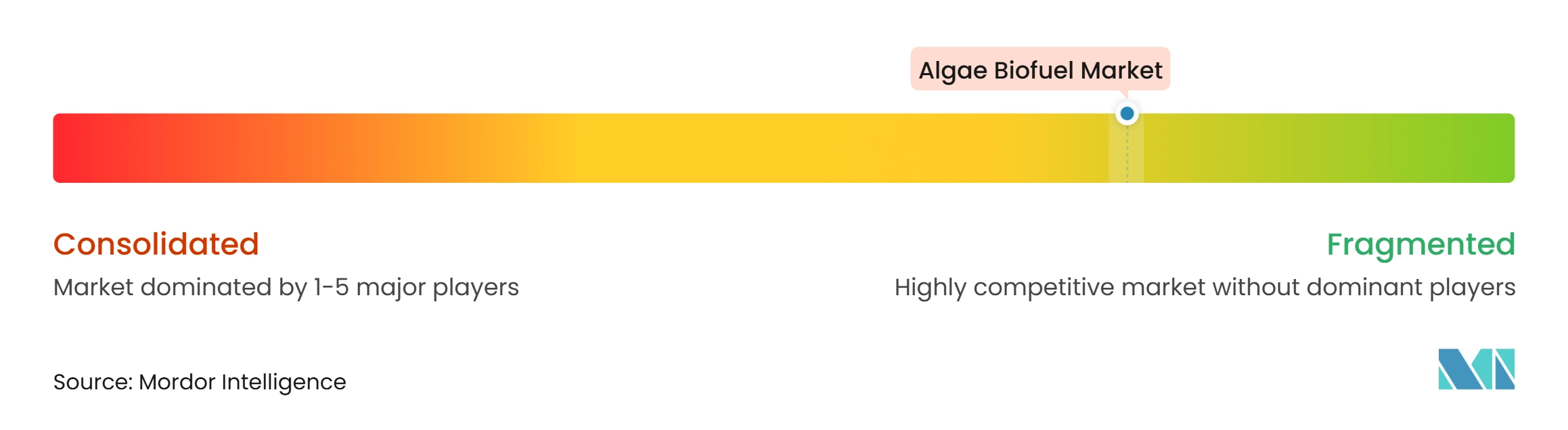
The algae biofuel market is highly fragmented, and companies generally focus on a specific cultivation method, location, or fuel end use. Vertically integrated operators have an advantage because they can link strain development, cultivation, processing, and fuel offtake within one operating model. International Sustainability and Carbon Certification EU (ISCC EU), Roundtable on Sustainable Biomaterials (RSB), and similar certification systems raise the entry threshold for companies seeking European aviation fuel demand. Smaller algae biofuel market cultivation specialists can therefore need partners with downstream processing and regulatory capability.
HutanBio AS is pursuing process engineering through a redesigned photobioreactor bag that it says halved algae oil production costs at its Malaysian pilot site. The company also signed a memorandum of understanding with Utopia World Investment in Oman to commercialize algae biofuel production using solar-powered photobioreactors and saline water. Chitose is expanding in Sarawak after securing USD 50 million from Japanese investors in March 2025. These moves show 2 different paths, with one centered on improving equipment performance and the other on regional production scale. Both depend on proving reliable output beyond pilot conditions.
Government-supported programs also shape competition by helping developers reach demonstration scale. The MASY program directs funding toward cultivation and preprocessing barriers that constrain scale-up. The SusAlgaeFuel and COCPIT projects are building technical and regulatory evidence for algae-based aviation and marine fuel pathways. No commercially scaled operator has yet to establish a widely replicable and low-cost offshore model in the supplied research. Patent activity in strain development and closed-reactor design can further increase barriers for new entrants.
Algae Biofuel Industry Leaders
-
Algenol Biotech LLC
-
Solix Biofuels, Inc.
-
Viridos, Inc.
-
Genifuel Corporation
-
AlgaEnergy Corporation
- *Disclaimer: Major Players sorted in no particular order
Algae Biofuel Market Companies Covered in this Report
- A4F Algae for Future
- Algae Systems, LLC
- Algae.Tec Limited
- AlgaEnergy Corporation
- Algatec
- Algenol Biotech LLC
- Aurora Biofuels, Inc.
- Cellana, Inc.
- Cyanotech Corporation
- Exxon Mobil Corporation
- Genifuel Corporation
- Global Algae Innovations, Inc.
- Heliae Development, LLC
- HutanBio Limited
- Kiverdi, Inc.
- Manta Biofuel, LLC
- Pond Technologies Holdings Inc.
- Sapphire Energy, Inc.
- Solix Biofuels, Inc.
- Viridos, Inc.
Recent Industry Developments in Algae Biofuel Market
- August 2026: The EU Horizon-funded COCPIT project published a framework for producing sustainable aviation and marine fuels from algal biomass using a circular value chain, demonstrating a pathway that can serve both aviation certification requirements and International Maritime Organisation (IMO) fuel-intensity standards simultaneously, marking the first integrated design targeting dual hard-to-abate sectors from a single algal cultivation unit.
- November 2025: Eni, Euglena, and PETRONAS held a groundbreaking ceremony for a 650,000 metric tons per annum biorefinery in Pengerang, Johor, Malaysia. The facility, targeting a 2028 start of operations, will produce Sustainable Aviation Fuel (SAF), hydrogenated vegetable oil, and bio-naphtha using waste feedstocks, including used vegetable oils and animal fats, alongside algae-derived inputs, establishing one of Asia’s largest advanced biofuel production assets.
- October 2025: The International Maritime Organization (IMO) formally adopted the Net-Zero Framework at an extraordinary Marine Environment Protection Committee (MEPC) session, enshrining mandatory Greenhouse Gas (GHG) fuel-intensity standards and a global emissions-pricing mechanism for international shipping entering into force in 2027. The framework’s well-to-wake Greenhouse Gas (GHG) accounting methodology creates a direct compliance pathway for carbon-negative algae bunkering fuels, with financial rewards for ships using zero- or near-zero-emission technologies.
- September 2025: IATA, in partnership with Worley Consulting, published a study confirming that biomass feedstock is sufficient to produce over 300 million tonnes of bio-sustainable aviation fuel (SAF) annually by 2050, and that technology rollout speed, rather than feedstock scarcity, is the primary bottleneck.
Global Algae Biofuel Market Report Scope
Algae biofuels are renewable fuels produced from microalgae and macroalgae (seaweed) through biological, chemical, and thermochemical conversion processes. Algae can accumulate energy-rich compounds such as lipids, carbohydrates, and other organic materials that can be processed into liquid and gaseous fuels for transportation, power generation, and industrial energy applications. Depending on the algae species, cultivation conditions, and conversion technology, algae-derived feedstocks can be used to produce biodiesel, sustainable aviation fuel (SAF), renewable diesel, bioethanol, biogas, biogasoline, biobutanol, and other algae-based fuels. Algae biofuel production involves cultivation systems such as open raceway ponds, closed photobioreactors, hybrid cultivation systems, and offshore or marine cultivation systems, followed by harvesting, biomass processing, and fuel conversion. These fuels have the potential to diversify renewable energy feedstocks, utilize non-arable land or saline water in suitable production systems, and support efforts to reduce dependence on conventional fossil fuels. However, commercial viability depends on factors such as cultivation productivity, nutrient and water requirements, harvesting and processing costs, conversion efficiency, and the availability of suitable infrastructure.
The Global Algae Biofuel Market is segmented by algae type, fuel type, cultivation technology, and application. By algae type, the market is segmented into microalgae and macroalgae (seaweed). By fuel type, the market is segmented into biodiesel, sustainable aviation fuel (SAF) or biojet fuel, renewable diesel or green diesel, bioethanol, biogas or methane, biogasoline, biobutanol, and other algae-based fuels. By cultivation technology, the market is segmented into open raceway pond systems, closed photobioreactor systems, hybrid cultivation systems, offshore and marine cultivation systems, and other cultivation technologies. By application, the market is segmented into road transportation, aviation, marine transportation, power generation, industrial energy, and other applications. The report also covers the market size and forecasts for the global algae biofuel market across 26 countries in key regions. For each segment, market sizing and forecasts are provided on the basis of value (USD).
Segmentation Overview
| Microalgae |
| Macroalgae (Seaweed) |
| Biodiesel |
| Sustainable Aviation Fuel (SAF) / Biojet Fuel |
| Renewable Diesel / Green Diesel |
| Bioethanol |
| Biogas / Methane |
| Biogasoline |
| Biobutanol |
| Other Algae-Based Fuels |
| Open Raceway Pond Systems |
| Closed Photobioreactor Systems |
| Hybrid Cultivation Systems |
| Offshore and Marine Cultivation Systems |
| Other Cultivation Technologies |
| Road Transportation |
| Aviation |
| Marine Transportation |
| Power Generation |
| Industrial Energy |
| Other Applications |
| North America | United States |
| Canada | |
| Mexico | |
| Europe | Germany |
| France | |
| Italy | |
| Spain | |
| United Kingdom | |
| Norway | |
| Netherlands | |
| Russia | |
| Rest of Europe | |
| Asia-Pacific | China |
| India | |
| Japan | |
| South Korea | |
| Australia | |
| Indonesia | |
| Malaysia | |
| Singapore | |
| Rest of Asia-Pacific | |
| South America | Brazil |
| Argentina | |
| Colombia | |
| Rest of South America | |
| Middle East and Africa | Saudi Arabia |
| United Arab Emirates | |
| Qatar | |
| Kuwait | |
| Oman | |
| Egypt | |
| Nigeria | |
| Rest of Middle East and Africa |
| By Algae Type | Microalgae | |
| Macroalgae (Seaweed) | ||
| By Fuel Type | Biodiesel | |
| Sustainable Aviation Fuel (SAF) / Biojet Fuel | ||
| Renewable Diesel / Green Diesel | ||
| Bioethanol | ||
| Biogas / Methane | ||
| Biogasoline | ||
| Biobutanol | ||
| Other Algae-Based Fuels | ||
| By Cultivation Technology | Open Raceway Pond Systems | |
| Closed Photobioreactor Systems | ||
| Hybrid Cultivation Systems | ||
| Offshore and Marine Cultivation Systems | ||
| Other Cultivation Technologies | ||
| By Application | Road Transportation | |
| Aviation | ||
| Marine Transportation | ||
| Power Generation | ||
| Industrial Energy | ||
| Other Applications | ||
| By Geography | North America | United States |
| Canada | ||
| Mexico | ||
| Europe | Germany | |
| France | ||
| Italy | ||
| Spain | ||
| United Kingdom | ||
| Norway | ||
| Netherlands | ||
| Russia | ||
| Rest of Europe | ||
| Asia-Pacific | China | |
| India | ||
| Japan | ||
| South Korea | ||
| Australia | ||
| Indonesia | ||
| Malaysia | ||
| Singapore | ||
| Rest of Asia-Pacific | ||
| South America | Brazil | |
| Argentina | ||
| Colombia | ||
| Rest of South America | ||
| Middle East and Africa | Saudi Arabia | |
| United Arab Emirates | ||
| Qatar | ||
| Kuwait | ||
| Oman | ||
| Egypt | ||
| Nigeria | ||
| Rest of Middle East and Africa | ||
Key Questions Answered in the Report
What is the projected value of algae biofuel by 2032?
The sector is forecast to reach USD 20.56 billion by 2032, growing from USD 13.25 billion in 2027 at a 9.18% CAGR.
Which algae type has the largest role in biofuel production?
Microalgae lead with a 71.3% share in 2026 because they offer higher lipid content and established conversion pathways.
Why is algae-based sustainable aviation fuel attracting investment?
Sustainable aviation fuel and biojet fuel are forecast to grow at 10.3% through 2032, supported by aviation fuel mandates and certification-driven demand.
What is the major cost barrier for algae-derived fuels?
Cultivation, dewatering, and extraction remain the main barriers, with reported minimum selling prices of EUR 2.2 per liter for lipid extraction and EUR 3.4 per liter for hydrothermal liquefaction.
Which cultivation technology is growing fastest?
Closed photobioreactors are forecast to grow at 9.6% through 2032, supported by cleaner biomass requirements and modular production designs.
Which region is expected to expand fastest?
Asia-Pacific is expected to grow at 9.9% through 2032, helped by investment in Southeast Asian production capacity and favorable cultivation conditions.