
Algae-Based Building Materials Market Size and Share
Market Overview
| Study Period | 2022 - 2032 |
|---|---|
| Market Size (2027) | USD 1.08 Billion |
| Market Size (2032) | USD 2.25 Billion |
| Growth Rate (2027 - 2032) | 15.78 % |
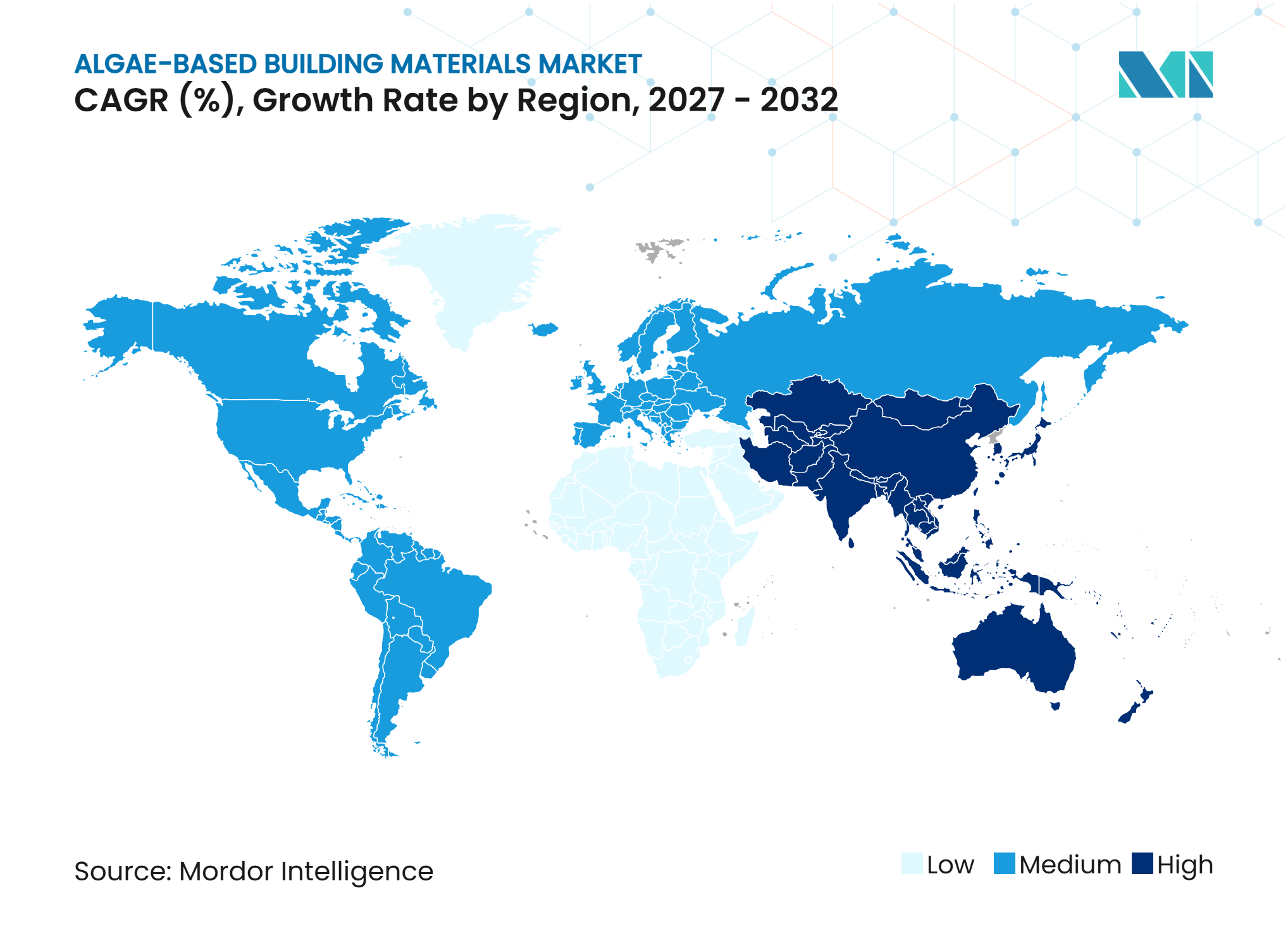
| Fastest Growing Market | Asia-Pacific |
| Largest Market | Asia-Pacific |
| Market Concentration | Low |
Major Players *Disclaimer: Major Players sorted in no particular order Image © Mordor Intelligence. Reuse requires attribution under CC BY 4.0. | |
Algae-Based Building Materials Market Analysis by Mordor Intelligence
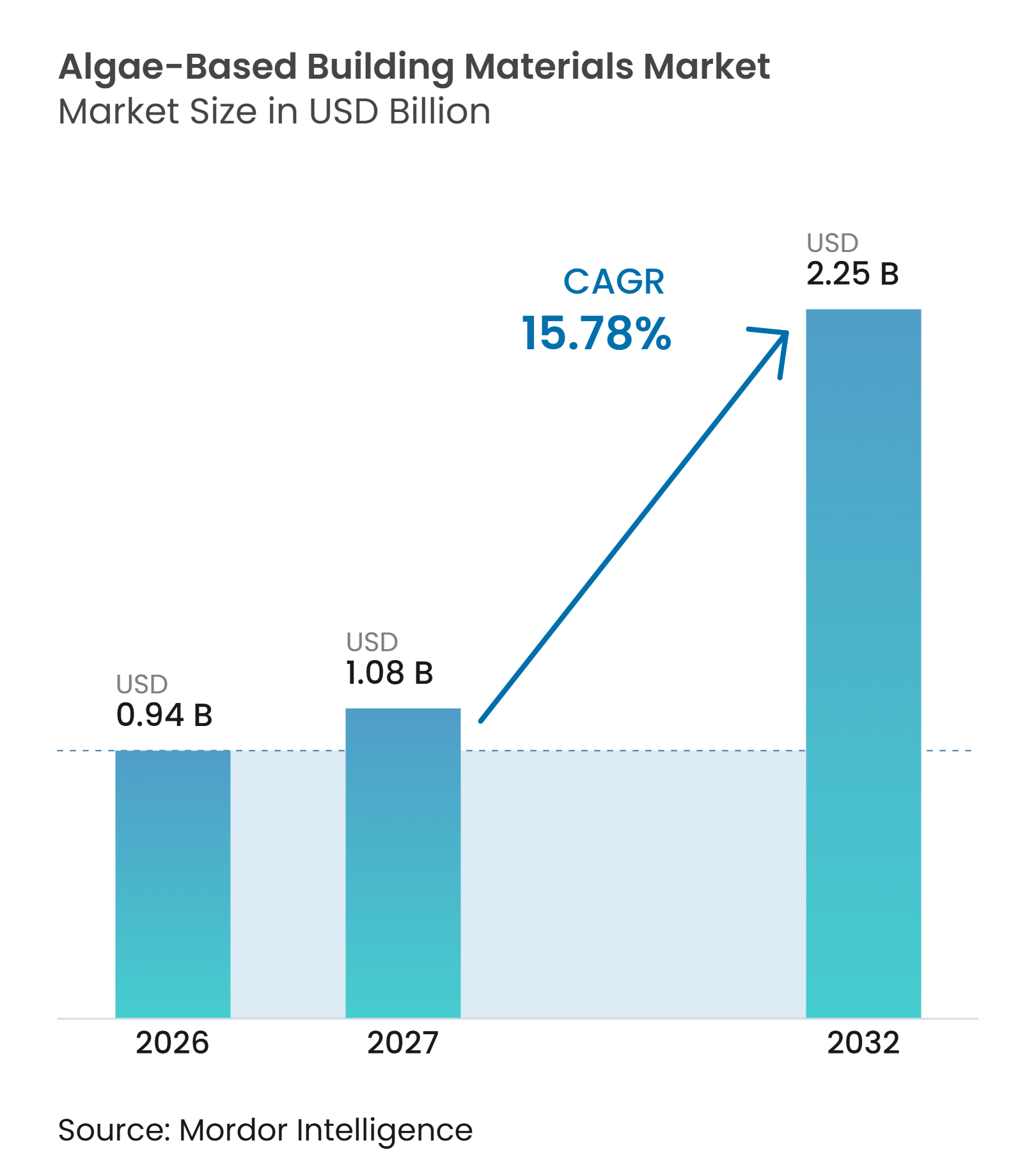
The algae-based building materials market size was valued at USD 0.94 billion in 2026 and is estimated to grow from USD 1.08 billion in 2027 to USD 2.25 billion by 2032, at a CAGR of 15.78% during the forecast period (2027-2032). The algae-based building materials market is gaining support from construction policies that require lower life-cycle emissions and more transparent material documentation. The European Commission has established a common approach for calculating whole-life global warming potential in buildings, giving material suppliers a clearer route to demonstrate carbon performance in project specifications. In January 2025, China expanded government procurement support for green building materials, creating a wider public procurement channel for verified low-carbon products. Algae-derived feedstocks support a range of products, including cement additives, interior composites, insulation, coatings, and pigments. Producers with controlled cultivation systems and credible bio-content documentation are better positioned to meet procurement requirements and reduce supply uncertainty.
Key Report Takeaways
- By product type, algae-based concrete and cementitious additives held 31.56% of the algae-based building materials market share in 2026, while algae-based bioplastics and biocomposites are forecast to grow at a 16.67% CAGR through 2032.
- By algae source, microalgae accounted for 55.13% of the algae-based building materials market share in 2026 and are projected to advance at a 16.26% CAGR through 2032.
- By end-user industry, residential construction accounted for 45.82% of demand in 2026, while commercial construction is forecast to grow at a 17.12% CAGR through 2032.
- By geography, Asia-Pacific captured 40.27% of market share in 2026 and is forecast to grow at a 16.83% CAGR through 2032.
Note: Market numbers in this report are based on Mordor Intelligence's proprietary estimation framework, which combines nine months of actuals with Q4 projections for base year 2026.
Market Trends and Insights
Drivers Impact Analysis of Algae-Based Building Materials Market*
| Drivers | (~) % Impact on CAGR Forecast | Geographic Relevance | Impact Timeline |
|---|---|---|---|
| Construction Decarbonization Targets | +4.5% | Global | Short term (≤ 2 years) |
| Green-Building Certification Adoption | +3.5% | North America, EU, Asia-Pacific (APAC) core | Short term (≤ 2 years) |
| Commercialization of Algae-Based Cementitious Materials | +3.0% | North America, Europe, Australia | Medium term (2-4 years) |
| Demand for Carbon-Storing Interior Materials | +2.5% | EU, APAC, with spill-over to MEA | Medium term (2-4 years) |
| Closed-Loop Algae Cultivation and Nutrient Recycling | +2.0% | Global, with early gains in China, India, Southeast Asia | Long term (≥ 4 years) |
| Source: Mordor Intelligence | |||
Construction Decarbonization Targets
Construction decarbonization targets are increasing the relevance of algae-based building materials in public and private building programs. In December 2025, the European Commission published a framework for calculating life-cycle global warming potential, making carbon performance more consistent within building assessments. This approach helps project teams compare conventional materials with alternatives that store biogenic carbon or reduce embodied emissions. A 2025 Science study found that building materials could store more than 16 billion metric tons of CO2 annually, indicating the scale of opportunity for carbon-storing products. Algae-derived additives can therefore compete for investment and project attention alongside other carbon-management approaches. The algae-based building materials market has a stronger foothold in infrastructure and public projects, where life-cycle reporting is becoming part of project selection.
Green-Building Certification Adoption
Green-building certification is creating more predictable specification routes for the algae-based building materials market. LEED v5 and BREEAM give greater attention to life-cycle carbon, materials data, and circularity, which improves the value of verified bio-based products in project design. Environmental Product Declarations and bio-content certificates help architects, contractors, and owners compare materials with less uncertainty. Suppliers that can document material composition and environmental performance are more likely to be included at an early design stage. Certification requirements also support repeat demand by establishing a common language between suppliers and project teams. This is important for the algae-based building materials market because novel products often require independent evidence before buyers will include them in standard specifications.
Commercialization of Algae-Based Cementitious Materials and Closed-Loop Cultivation
Commercial-scale cementitious products are moving algae-derived materials closer to standard construction procurement. In October 2025, Prometheus Materials installed its ProZERO cement and concrete at the New York Climate Exchange Climate Campus, in collaboration with Skidmore, Owings & Merrill (SOM), Skanska USA, and D'Annunzio Group. The project provides a visible reference for designers who need evidence that bio-cement can be used in real building environments. Research from the University of Washington and Microsoft Research reported that machine-learning-assisted formulation produced a seaweed-enhanced cement with a 21% lower global warming potential over 28 days[1]. Controlled algae cultivation can strengthen this commercialization path by using industrial CO2 and wastewater nutrients to support more consistent biomass production. The algae-based building materials market can benefit further from this model when nutrient recycling reduces feedstock costs or offsets wastewater treatment costs.
Demand for Carbon-Storing Interior Materials
Demand for carbon-storing interior materials is expanding beyond specialist green projects. Algae-derived acoustic panels, coatings, and interior composites can support material disclosures because their biogenic carbon was fixed during biomass growth. A 2025 study in Frontiers in Built Environment reported that a Chlorella-integrated enclosure achieved CO2 capture of 175 mg per liter per day, demonstrating the potential for building components with an active biological function. Such products are relevant to office fit-outs and institutional buildings where Scope 3 reporting and green lease requirements influence purchasing decisions. The algae-based building materials market also benefits when interior products have shorter replacement cycles than structural materials, enabling suppliers to establish project references before entering larger, more regulated applications.
Restraints Impact Analysis of Algae-Based Building Materials Market*
| Restraints | (~) % Impact on CAGR Forecast | Geographic Relevance | Impact Timeline |
|---|---|---|---|
| Scale-Up Cost and Production Consistency | -2.5% | Global | Short term (≤ 2 years) |
| Building-Code and Certification Lead Times | -2.0% | North America, EU | Medium term (2-4 years) |
| Feedstock Dewatering and Seasonal Biomass Variability | -1.5% | Global, most acute in tropical ASEAN and South America | Long term (≥ 4 years) |
| Source: Mordor Intelligence | |||
Scale-Up Cost and Production Consistency
Scale-up costs and production consistency remain major constraints for the algae-based building materials market. Commercial cultivation requires photobioreactors, controlled growth conditions, processing equipment, and reliable quality systems. Flora Materials reported completing its first 800-square-foot production run of algae-based polyurethane flooring tiles with PURforms in 2025. Early-stage suppliers must also absorb testing, certification, and manufacturing costs before output levels are sufficient to improve unit economics. Material properties can vary as biomass composition changes in response to nutrient availability, temperature, or cultivation conditions. These operating requirements make process standardization essential before suppliers can serve large projects with dependable compressive strength, thermal performance, or finish quality.
Building-Code and Certification Lead Times
Building code and certification lead times can delay otherwise viable product launches. Algae-derived construction materials generally pass through novel-material testing routes rather than a dedicated fast-track process. Code approval for bio-cement products can take 24 months or more in North America and Europe, delaying revenue even after technical performance is demonstrated. Product documentation must also address various compliance systems, including the USDA BioPreferred Program, EN 16785, and American Society for Testing and Materials (ASTM) D6866. These differing systems increase the administrative burden for suppliers selling across multiple regions. The algae-based building materials market may remain concentrated among producers that can absorb pre-certification costs and long approval cycles.
*Our forecasts treat driver/restraint impacts as directional, not additive. The impact forecasts reflect baseline growth, mix effects, and variable interactions.
Algae-Based Building Materials Market Segment Analysis
By Product Type:
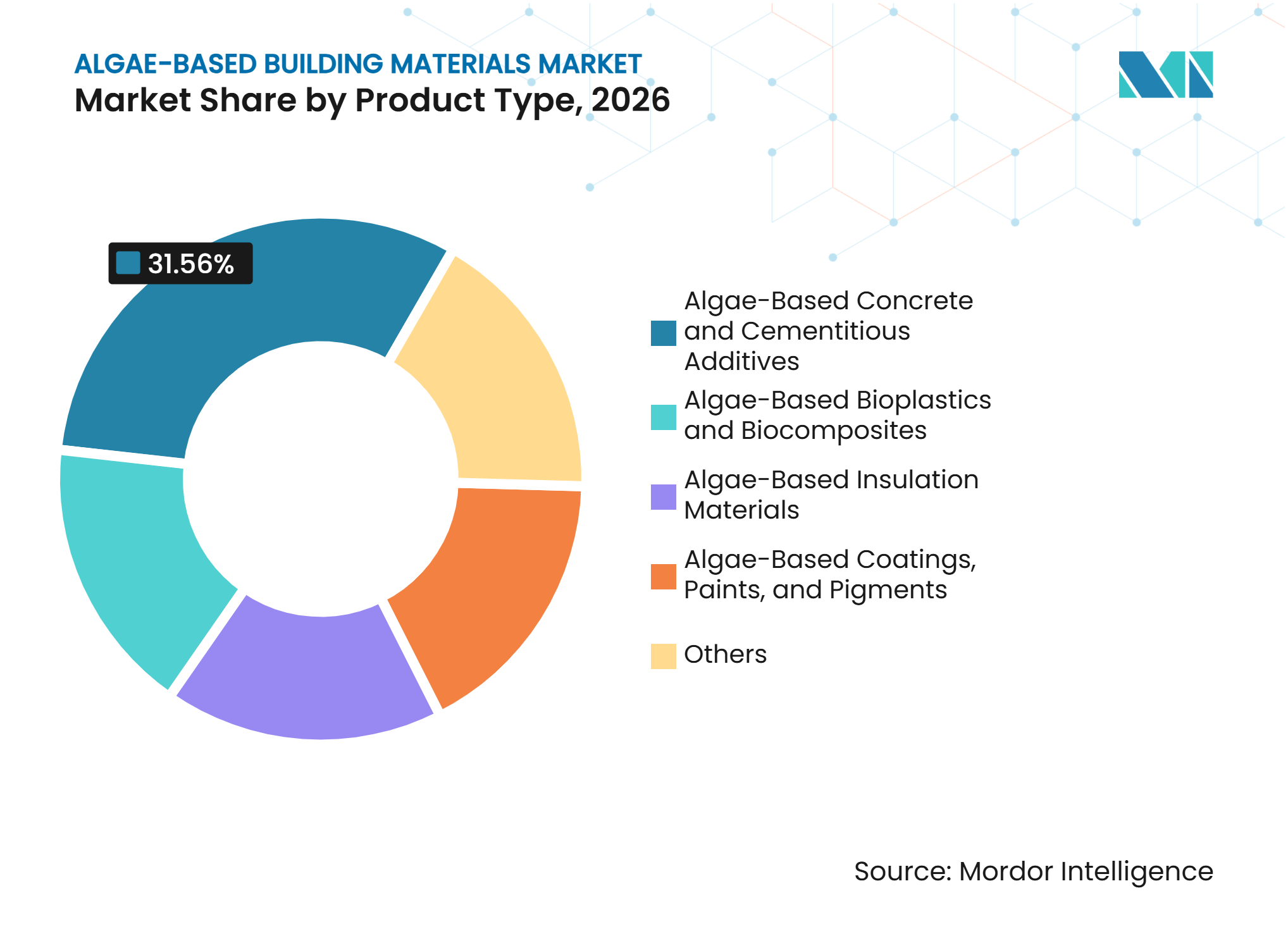
Cementitious Materials Lead, Biocomposites AccelerateAlgae-based concrete and cementitious additives held 31.56% of global revenue in 2026. Their position is linked to compatibility with existing batching and mixing systems, which lowers adoption barriers for concrete producers. A 2025 paper in ACS Sustainable Chemistry & Engineering reported that algal biochar can replace silica fume as a supplementary cementitious material and reduce cradle-to-grave embodied carbon. This compatibility is relevant in infrastructure-led construction markets where contractors prefer to avoid changes to established production processes. Algae-based bioplastics and biocomposites are forecast to expand at a 16.67% CAGR through 2032. Fully biogenic polyurethane platforms are supporting flooring, wall panels, and acoustic composites that can replace petroleum-derived ethylene-vinyl acetate (EVA) and polyvinyl chloride (PVC) in selected applications.
Algae-based insulation materials are supported by research on the thermal performance of seaweed and seagrass. A 2025 review found that prototypes incorporating Neptune grass achieved thermal conductivity of 0.044 W/mK, close to the 0.035-0.037 W/mK range reported for expanded polystyrene. Coatings, paints, and pigments stand to benefit from materials-circularity requirements and low-volatile organic compound (VOC) preferences in commercial interiors. Other applications include algae-stabilized compressed earth blocks. A 2025 study reported that these blocks achieved a compressive strength of 6.82 MPa and a 26% reduction in thermal conductivity relative to unstabilized blocks. These applications can broaden the algae-based building materials market into affordable housing and disaster-resilient construction where local material sourcing and thermal performance are priorities.



By Algae Source:
Microalgae Anchors Both Ends of the Value ChainMicroalgae represented 55.13% of global revenue in 2026. Coccolithophores, Chlorella, and Spirulina can be grown in closed photobioreactors using industrial CO₂ and wastewater nutrients. This approach reduces dependence on coastal access and seasonal harvesting, and can support year-round biomass production with more consistent material composition. Microalgae are projected to grow at a 16.26% CAGR through 2032. The combination of scale and growth rate reflects continued interest from upstream biomass producers and material formulators.
Macroalgae, including sargassum and sugar kelp, are being used in insulation, panels, and acoustic materials. The Nordic Innovation-funded MOBI project explored moldable sugar-kelp composites for construction components during 2025, reflecting continued public support for macroalgae applications. Cyanobacteria have a more specialized role, as certain strains can support photosynthesis-driven biomineralization. Prometheus Materials uses cyanobacteria in its ProZERO process to produce carbon-negative cement and concrete. The algae-based building materials market therefore comprises several feedstock pathways rather than a single uniform material platform. Suppliers will need to choose between controlled cultivation, marine harvesting, and biologically active mineralization based on the target product and regional supply conditions.
By End-User Industry:
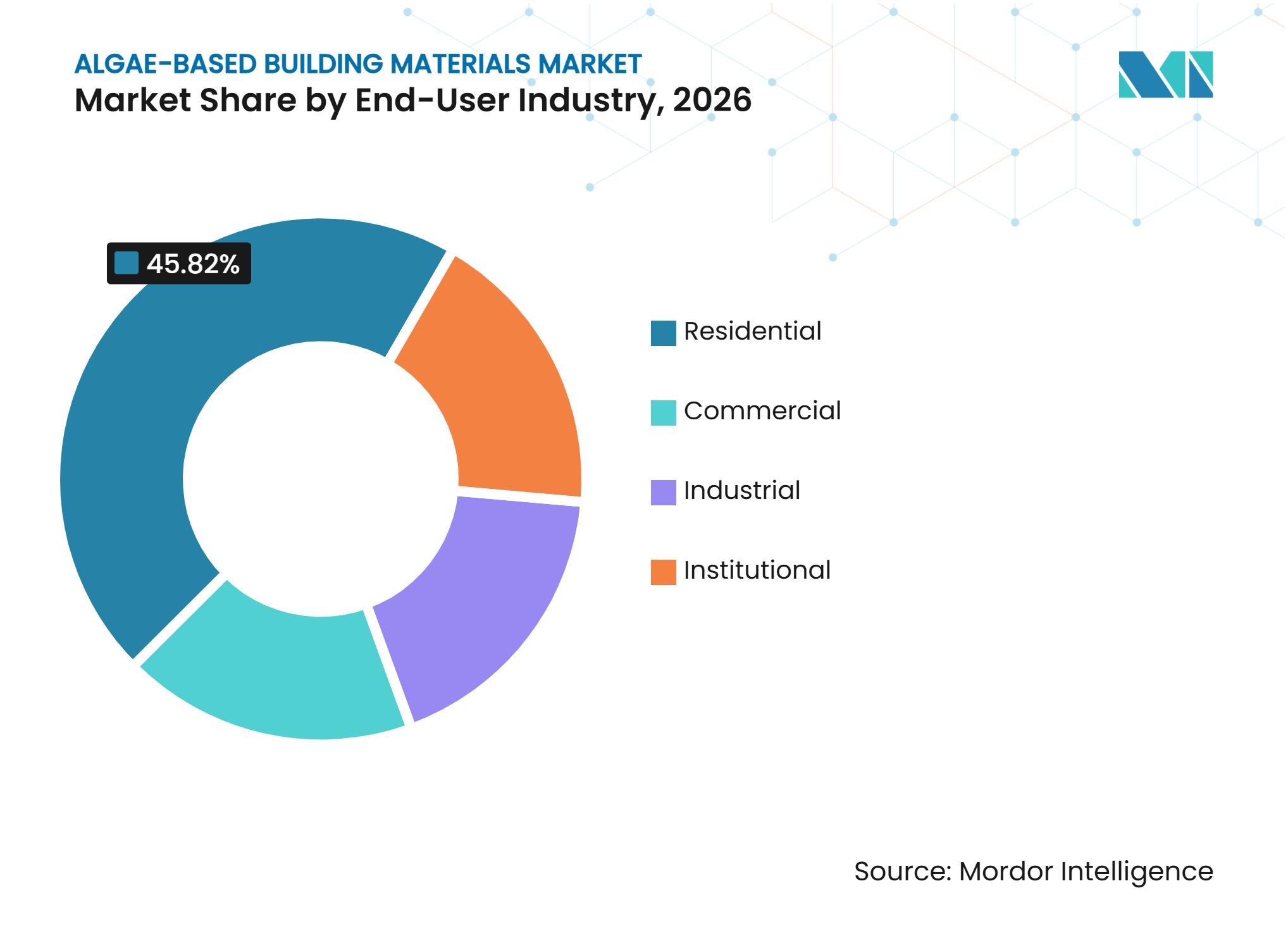
Residential Leads, Commercial Accelerates on ESG MandatesResidential construction accounted for 45.82% of algae-based building materials market demand in 2026. The segment benefits from the scale of housing construction and from policies that encourage low-carbon materials in new buildings and renovations. China's green building materials procurement policies support the use of verified products in public building activities, which also influence broader supply chains. The European Union is moving toward more consistent building decarbonization requirements through its updated policy framework. Asia-Pacific residential construction presents opportunities as urban development and national green-material regulations converge. These conditions can support broader adoption once costs and certification processes become more predictable.
Commercial construction is forecast to grow at a 17.12% CAGR through 2032. Corporate reporting requirements, green lease clauses, and voluntary certification schemes are increasing attention to embodied carbon in offices and institutional spaces. Interior products such as acoustic panels, coatings, flooring, and wall composites may be adopted earlier than structural products due to shorter specification cycles. Industrial users can evaluate algae-derived anti-corrosion coatings and cement replacements where project scale is large and aesthetic requirements are less central. Institutional buildings can serve as early reference points, as public procurement and green-certification criteria are common in schools, hospitals, and government facilities. The algae-based building materials market can benefit when successful institutional projects become accepted references for commercial specifications.

Geography Analysis
Asia-Pacific: The Market’s Largest and Fastest-Growing Region
Asia-Pacific held 40.27% of global revenue in 2026 and is forecast to grow at a 16.83% CAGR through 2032. In January 2025, China expanded green building materials procurement to 101 cities, providing a structured route for verified products in public projects. This regulatory influence spans healthcare, education, and commercial construction, giving suppliers multiple routes into the algae-based building materials market. Research in India has examined photobioreactor-integrated facades as a way to address urban heat and building sustainability objectives. Japan and South Korea are examining wastewater-integrated microalgae systems, while markets in Southeast Asia are beginning to apply green building requirements. The region combines high construction activity with growing interest in closed-loop production, supporting both material demand and local biomass supply.
North America: Policy Incentives and Commercial-Scale Demonstration
North America is supported by high-visibility bio-cement demonstrations and policy development. The US Department of Energy awarded USD 10 million to a consortium that includes Prometheus Materials to develop CO2 measurement and verification protocols for cement and concrete. In October 2025, Prometheus Materials installed ProZERO concrete at the Governors Island Climate Campus, providing architects and engineering firms with a commercial reference project. Compliance requirements such as ASTM testing and USDA BioPreferred certification remain important for suppliers seeking institutional and government projects. Canada is also developing a pathway for seaweed-based interior products. In November 2025, Seacork Studio received CAD 306,000 (~USD 220,000) from Natural Products Canada to improve manufacturing processes for seaweed acoustic panels.
Diverging Trajectories Across Remaining Geographies
Europe is preparing for increased demand as the EU framework for life-cycle global warming potential becomes more established in building practice. The Digital Product Passport framework and EN 16785 bio-content verification can support product documentation before broader regulatory requirements take full effect. Germany has potential as a scaling location due to its large construction base and BASF's bio-based dispersion portfolio for adhesives and interior paints[2]. Nordic markets are developing macroalgae construction programs through the MOBI initiative and related blue-biomass networks. Brazil and Argentina offer early demand for alternative cement additives, while the Middle East and Africa present longer-term opportunities through large construction programs and high-profile hospitality or institutional projects. Supply chains and certification systems remain less developed in these regions, so suppliers are likely to begin with projects that prioritize visible sustainability credentials.
Competitive Landscape
Market Concentration
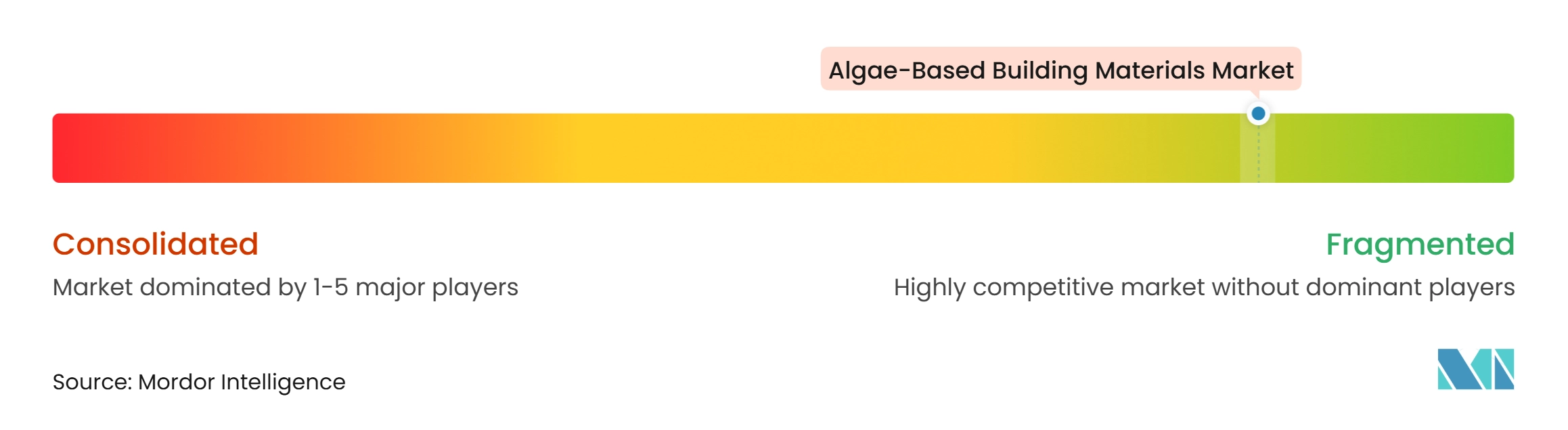
The algae-based building materials market is fragmented. Specialist companies compete on the basis of biological processes, product performance, patents, and application knowledge. Larger chemical and construction material suppliers can add bio-content to established product lines through feedstock changes and biomass-balance approaches. Prometheus Materials is developing biomineralized cement and concrete, while ecoLogicStudio has developed algae facade systems for architectural projects. BASF offers Acronal BC bio-based dispersions for tile adhesives, construction adhesives, and interior paints, with bio-content verified under ASTM D6866. ASTM and USDA BioPreferred certifications are increasingly important procurement qualifiers for US institutional and government channels.
Competition is strongest where suppliers can combine technical evidence with a viable route to market. Prometheus Materials used its October 2025 Governors Island installation to establish a commercial reference with SOM and Skanska USA. Algenesis Labs entered a European distribution partnership with Safic-Alcan in October 2025 to bring sustainable materials to European formulators. Seacork Studio received funding to improve seaweed panel manufacturing, supporting a more resilient regional supply chain. These developments indicate that distribution, project demonstration, and production engineering are as important as material science in determining competitive positioning.
Open opportunities remain in commercial-scale algae insulation, algae-composite cladding for mid-rise residential buildings, and pigment or coating systems that can reduce reliance on titanium dioxide and petroleum-derived binders. Machine-learning-assisted formulation can shorten development cycles, as demonstrated by research from the University of Washington and Microsoft Research. This capability may favor companies that can connect biological materials research with digital formulation methods.
Algae-Based Building Materials Industry Leaders
-
Prometheus Materials, Inc
-
Flora Materials
-
Algix LLC
-
Seacork Studio
-
ecoLogicStudio
- *Disclaimer: Major Players sorted in no particular order
Algae-Based Building Materials Market Companies Covered in this Report
- Algenesis
- Algix LLC
- Arup
- BASF
- Biomason
- Corbion N.V.
- dsm-firmenich
- ecoLogicStudio
- Flora Materials
- HOLCIM
- Oceangrows
- Prometheus Materials, Inc
- Seacork Studio
- SeaLumber
- SeaWood Materials
Recent Industry Developments in Algae-Based Building Materials Market
- November 2025: Algenesis Labs and P2 Science announced a strategic collaboration to commercialize algae-derived chemicals and 100% biobased, biodegradable polyurethanes for building materials. P2 Science synthesized algae-based azelaic acid at its Naugatuck, Connecticut facility to supply Algenesis with a key chemical for bioisocyanate production, establishing an integrated algae-to-urethane supply chain for construction and consumer applications.
- November 2025: Seacork Studio received CAD 306,000 (USD 220,000) from Natural Products Canada's Proof of Concept program to advance manufacturing innovation for its seaweed-based acoustic panels. The funding targeted dewatering efficiency and expansion of the seaweed supply chain across the Pacific Northwest, supporting the broader development of algae-based building materials in the region.
Global Algae-Based Building Materials Market Report Scope
Algae-based building materials are low-carbon alternatives derived from microalgae and macroalgae (seaweed). These materials are used in construction to sequester carbon dioxide, provide structural insulation, and serve as substitutes for traditional cement. Microalgae are single-celled organisms cultivated in controlled environments, while macroalgae, commonly known as seaweed, are harvested from marine and freshwater sources.
The algae-based building materials market is segmented by product type, algae source, end-user industry, and geography. By product type, the market is segmented into algae-based concrete and cementitious additives, algae-based bioplastics and biocomposites, algae-based insulation materials, algae-based coatings, paints, and pigments, and others. By algae source, the market is segmented into microalgae, macroalgae, and cyanobacteria. By end-user industry, the market is segmented into residential, commercial, industrial, and institutional. The report also covers market sizes and forecasts for algae-based building materials across 15 countries in major regions. The market sizes and forecasts are provided in terms of value (USD).
Segmentation Overview
| Algae-Based Concrete and Cementitious Additives |
| Algae-Based Bioplastics and Biocomposites |
| Algae-Based Insulation Materials |
| Algae-Based Coatings, Paints, and Pigments |
| Others |
| Microalgae |
| Macroalgae |
| Cyanobacteria |
| Residential |
| Commercial |
| Industrial |
| Institutional |
| Asia-Pacific | China |
| India | |
| Japan | |
| South Korea | |
| ASEAN Countries | |
| Rest of Asia-Pacific | |
| North America | United States |
| Canada | |
| Mexico | |
| Europe | Germany |
| United Kingdom | |
| France | |
| Italy | |
| NORDIC Countries | |
| Rest of Europe | |
| South America | Brazil |
| Argentina | |
| Rest of South America | |
| Middle East and Africa | Saudi Arabia |
| South Africa | |
| Rest of Middle East and Africa |
| By Product Type | Algae-Based Concrete and Cementitious Additives | |
| Algae-Based Bioplastics and Biocomposites | ||
| Algae-Based Insulation Materials | ||
| Algae-Based Coatings, Paints, and Pigments | ||
| Others | ||
| By Algae Source | Microalgae | |
| Macroalgae | ||
| Cyanobacteria | ||
| By End-User Industry | Residential | |
| Commercial | ||
| Industrial | ||
| Institutional | ||
| By Geography | Asia-Pacific | China |
| India | ||
| Japan | ||
| South Korea | ||
| ASEAN Countries | ||
| Rest of Asia-Pacific | ||
| North America | United States | |
| Canada | ||
| Mexico | ||
| Europe | Germany | |
| United Kingdom | ||
| France | ||
| Italy | ||
| NORDIC Countries | ||
| Rest of Europe | ||
| South America | Brazil | |
| Argentina | ||
| Rest of South America | ||
| Middle East and Africa | Saudi Arabia | |
| South Africa | ||
| Rest of Middle East and Africa | ||
Key Questions Answered in the Report
What is current market size of Algae-Based Building Materials Market?
The algae-based building materials market size was valued at USD 0.94 billion in 2026 and is estimated to grow from USD 1.08 billion in 2027 to USD 2.25 billion by 2032, at a CAGR of 15.78% during the forecast period (2027-2032).
Which product category leads algae-based construction materials?
Algae-based concrete and cementitious additives lead with a 31.56% share in 2026, supported by compatibility with existing concrete production systems.
Which algae source has the largest role in building materials?
Microalgae lead with a 55.13% share in 2026 and are forecast to grow at a 16.26% CAGR through 2032.
Which region is expanding fastest for algae-derived construction products?
Asia-Pacific holds 40.27% of global revenue in 2026 and is forecast to grow at a 16.83% CAGR through 2032.