
AI Vision For Manufacturing Market Size and Share
Market Overview
| Study Period | 2020 - 2031 |
|---|---|
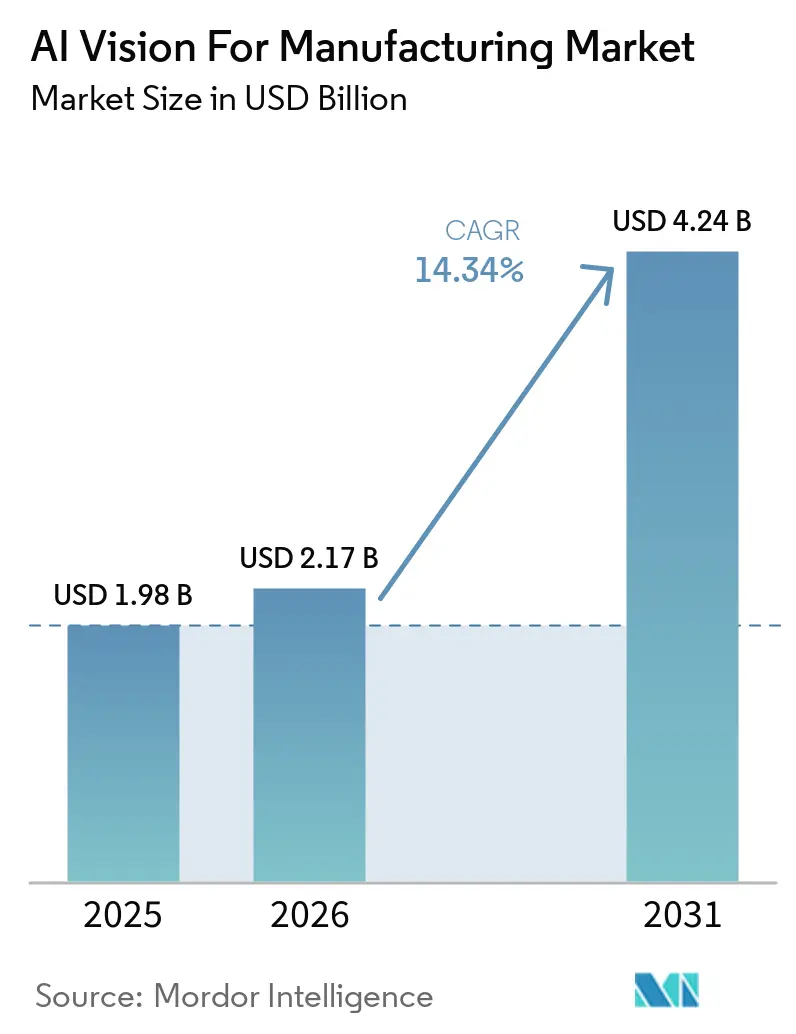
| Market Size (2026) | USD 2.17 Billion |
| Market Size (2031) | USD 4.24 Billion |
| Growth Rate (2026 - 2031) | 14.34 % |
| Fastest Growing Market | South America |
| Largest Market | Asia-Pacific |
| Market Concentration | Medium |
Major Players *Disclaimer: Major Players sorted in no particular order Image © Mordor Intelligence. Reuse requires attribution under CC BY 4.0. | |
AI Vision For Manufacturing Market Analysis by Mordor Intelligence
The AI Vision for Manufacturing Market size is expected to grow from USD 1.98 billion in 2025, and USD 2.17 billion in 2026, and is forecast to reach USD 4.24 billion by 2031 at a CAGR of 14.34% over 2026-2031. The AI vision for manufacturing market is moving from periodic manual checks toward continuous inspection that operates at production-line speed. Manufacturers are expanding deployments across plants because quality teams need consistent decisions, image records, and faster responses to defects. The growing use of industrial robots also creates more inspection points that require image interpretation beyond fixed rule-based thresholds. New battery plants and semiconductor facilities are specifying vision systems during design, which creates opportunities for hardware, software, and integration providers. Buyers are also placing greater weight on traceable model management, cybersecurity controls, and reliable deployment on existing lines.
Key Report Takeaways
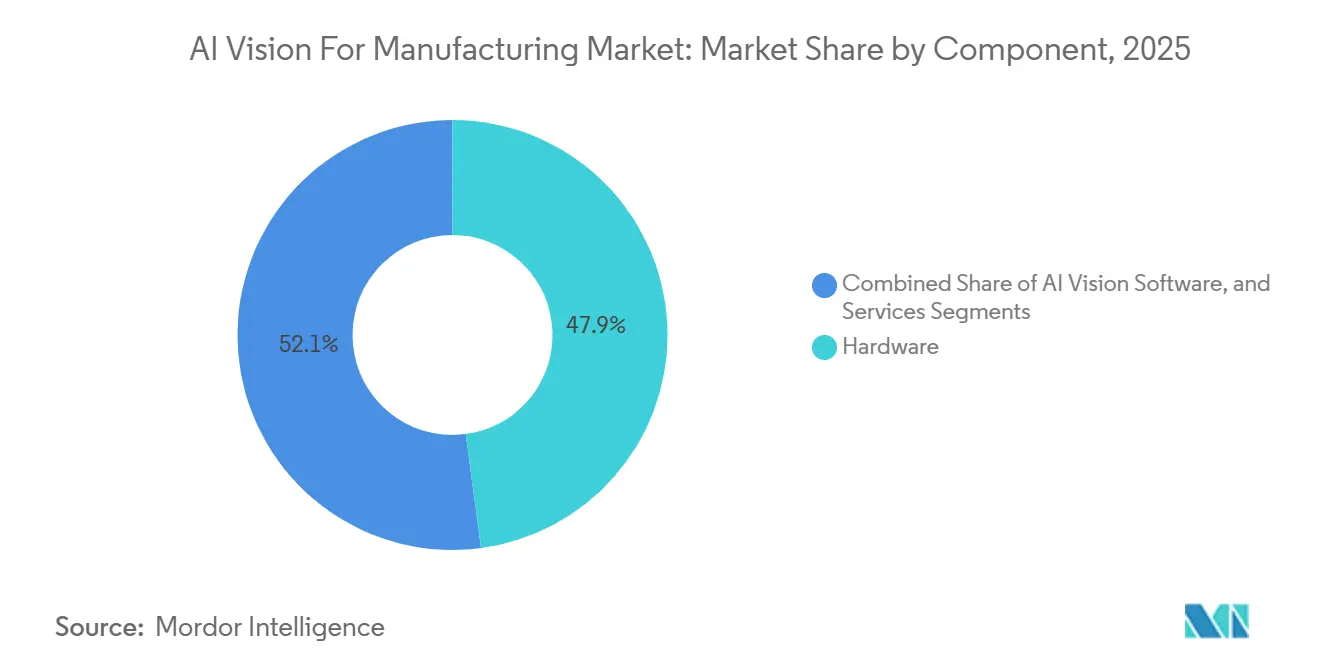
- By component, hardware held 47.89% of the AI vision for manufacturing market share in 2025, while AI vision software is projected to expand at a 16.37% CAGR through 2031.
- By vision type, 2D machine vision held 72.39% of revenue in 2025, while 3D machine vision is expected to grow at a 17.02% CAGR through 2031.
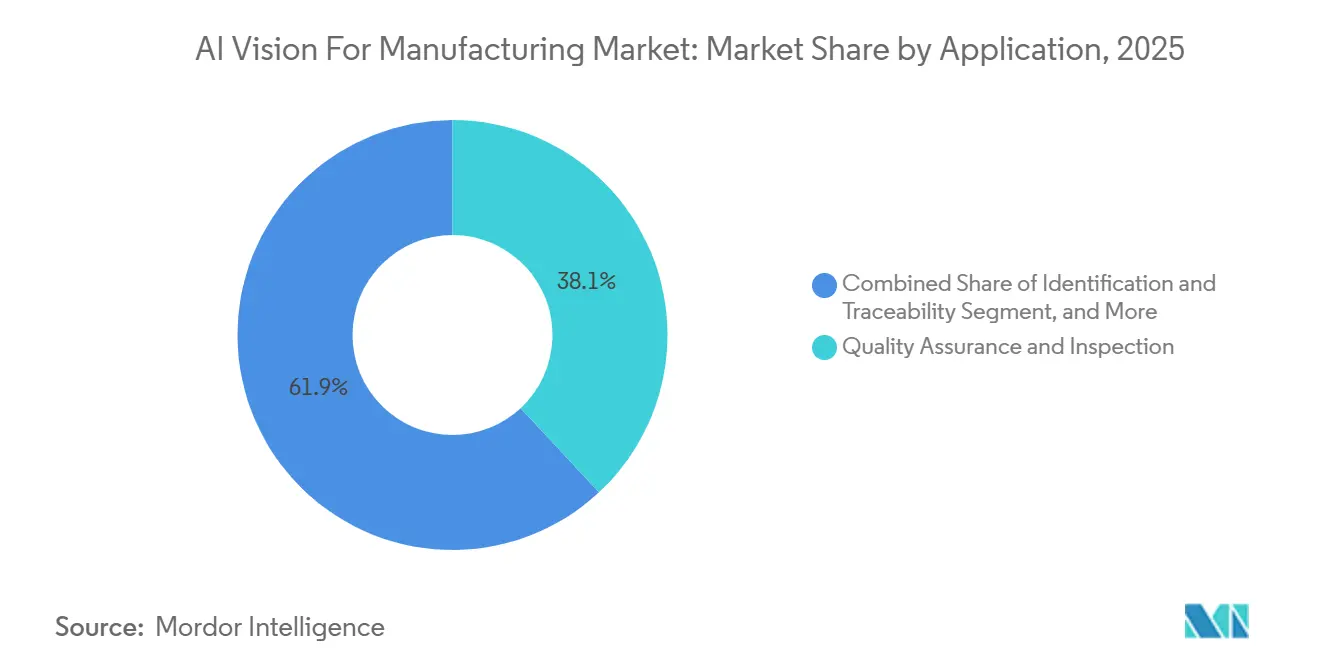
- By application, quality assurance and inspection accounted for 38.07% of the AI vision for manufacturing market size in 2025, while robotics guidance and pick-and-place are projected to grow at a 16.43% CAGR through 2031.
- By deployment mode, on-premises and edge systems accounted for 65.21% of revenue in 2025, while cloud-based deployment is projected to expand at a 17.27% CAGR through 2031.
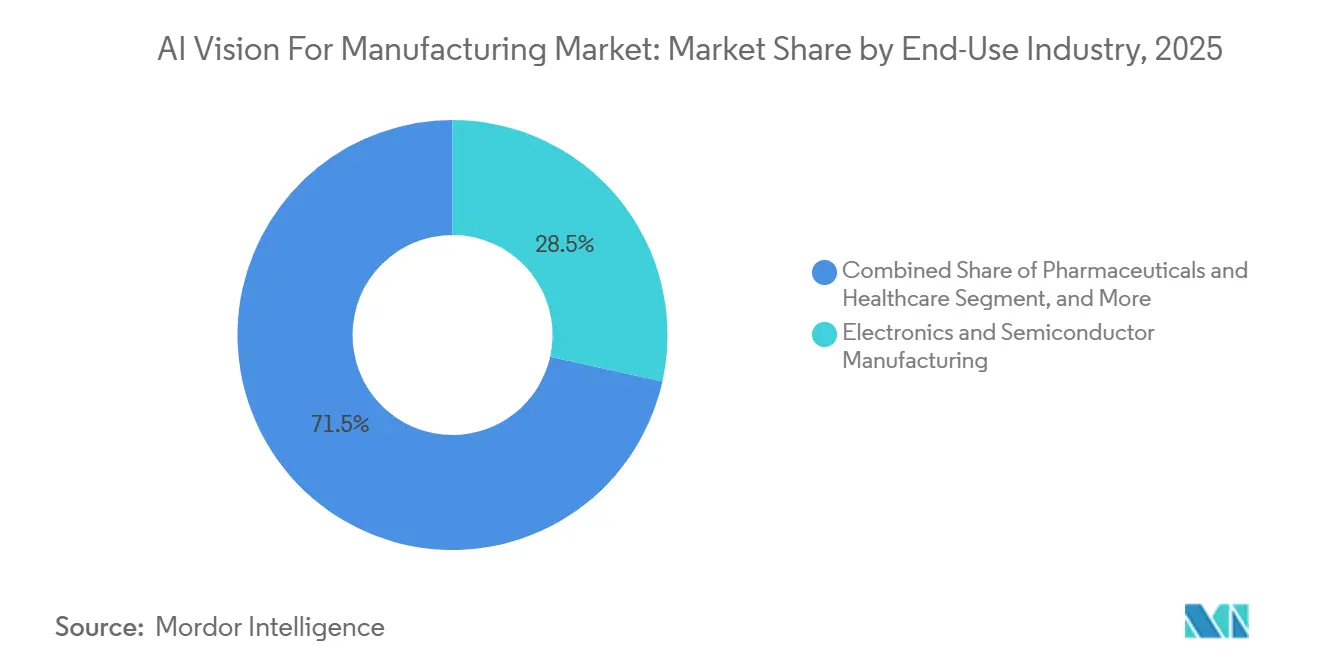
- By end-use industry, electronics and semiconductor manufacturing accounted for 28.47% of revenue in the AI vision for manufacturing market in 2025, while automotive and electric vehicles are forecast to grow at a 16.93% CAGR through 2031.
- By enterprise size, large enterprises held 74.12% of revenue in 2025, while small and medium enterprises are expected to grow at a 16.06% CAGR through 2031.
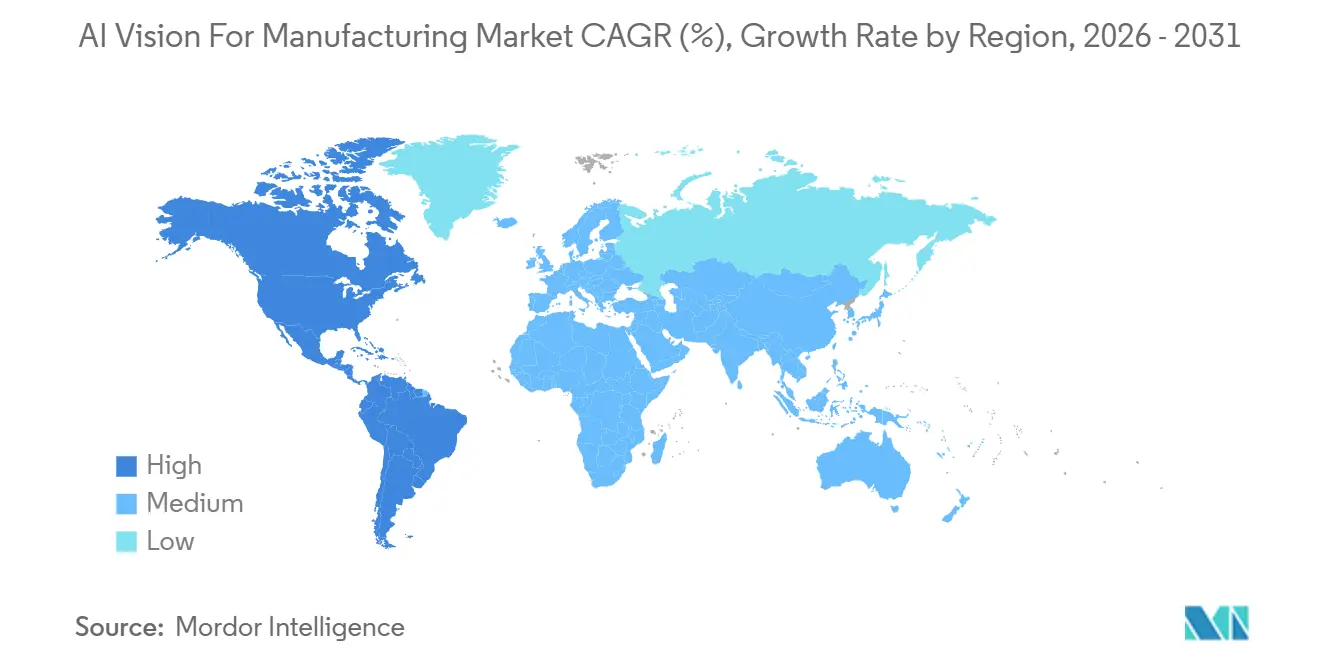
- By geography, Asia-Pacific held 38.12% of revenue in 2025, while South America is projected to grow at a 17.13% CAGR through 2031 in the AI vision for manufacturing market.
Note: Market size and forecast figures in this report are generated using Mordor Intelligence’s proprietary estimation framework, updated with the latest available data and insights as of January 2026.
Market Trends and Insights
Drivers Impact Analysis of AI Vision For Manufacturing Market*
| DRIVER | (~) % IMPACT ON CAGR FORECAST | GEOGRAPHIC RELEVANCE | IMPACT TIMELINE |
|---|---|---|---|
| Zero-Defect Manufacturing and Recall Avoidance | +2.8% | Global | Short term (≤ 2 years) |
| Semiconductor, Electronics, and EV Battery Inspection Expansion | +2.4% | APAC core, spill-over to North America and EU | Short term (≤ 2 years) |
| Vision-Guided Robotics and Flexible Automation | +2.1% | Global | Medium term (2-4 years) |
| Edge AI for Low-Latency Quality Decisions | +1.8% | North America and EU | Medium term (2-4 years) |
| Regulatory Traceability in Food and Pharmaceutical Production | +1.4% | North America and EU | Long term (≥ 4 years) |
| Synthetic Defect Data and No-Code Model Deployment | +1.1% | Global | Medium term (2-4 years) |
| Source: Mordor Intelligence | |||
Zero-Defect Manufacturing and Recall Avoidance
Recall costs in automotive and electronics production are making AI vision a quality-control and liability-management tool. Manufacturers also need detailed visual records as product-liability rules and recall reporting become more rigorous. A timestamped image and an inspection decision can support audits, root cause analysis, and supplier qualification. The AI vision for the manufacturing market, therefore, benefits when inspection data is incorporated into the quality record rather than a simple pass-or-fail result.
Semiconductor, Electronics, and EV Battery Inspection Expansion
Wafer fabrication, advanced packaging, and EV battery production operate with very low tolerance for missed defects. A May 2026 Scientific Reports study described a machine-vision battery-can inspection system that achieved 99.6% accuracy at 240 units per minute, which was a 71% improvement over previous methods.[1] Fraunhofer IPMS and DIVE imaging systems validated a hyperspectral AI inspection system in July 2025, which identified semiconductor wafer contamination and specification deviations within 20 seconds. These results support production use in applications where conventional inspection can struggle with subtle defects. Contracts in these facilities can remain in place after qualification because the system becomes part of yield management. This demand is directing supplier research and development toward battery and semiconductor workflows.
Vision-Guided Robotics and Flexible Automation
AI vision is becoming more closely linked with industrial robots in flexible production cells. The International Federation of Robotics reported that industrial robot installations reached a record value of USD 16.7 billion in 2025, and it reported continued positive momentum in preliminary 2026 data.[2] Vision models trained with synthetic data can be adapted to new tasks more quickly than traditional systems, which can improve the economics of high-mix production. ABB invested in LandingAI in September 2025 to integrate LandingLens models into RobotStudio and target an 80% reduction in robot application deployment time. ABB expanded this work with NVIDIA in March 2026 to support industrial physical AI deployments. Suppliers that combine vision, motion planning, and deployment tools can retain more integration work within their own offering.
Edge AI for Low-Latency Quality Decisions
High-speed production lines require local decisions because cloud latency can interrupt time-sensitive pass-or-fail processes. Cognex introduced the In-Sight 3900 in May 2026 with Qualcomm Dragonwing processing, up to 4× faster processing, and 25-megapixel imaging. It also launched the In-Sight 6900 Vision Controller, using NVIDIA Jetson to support transformer-based neural networks at the edge. The market direction is toward centrally trained models that operate locally on factory hardware. Cognex made OneVision generally available in May 2026 and reported more than 100 customers using the system to scale AI vision across sites. This architecture can standardize model control while protecting the line-speed performance needed in the AI vision for manufacturing market.
Restraints Impact Analysis of AI Vision For Manufacturing Market*
| RESTRAINT | (~) % IMPACT ON CAGR FORECAST | GEOGRAPHIC RELEVANCE | IMPACT TIMELINE |
|---|---|---|---|
| Scarcity of Representative Defect Data | -1.7% | Global | Short term (≤ 2 years) |
| Legacy-Line Integration and Production Downtime | -1.4% | Mature manufacturing economies, EU, North America, and Japan | Medium term (2-4 years) |
| High Total Cost of Ownership for SME Plants | -1.1% | Global, with concentration in South America and Middle East and Africa | Medium term (2-4 years) |
| Cybersecurity, Explainability, and Model-Validation Risk | -0.8% | North America and EU | Long term (≥ 4 years) |
| Source: Mordor Intelligence | |||
Scarcity of Representative Defect Data
Rare defects are difficult to gather in volumes that support dependable model training. Semiconductor, aerospace, and pharmaceutical production often have varied defect types, so general-purpose datasets do not provide enough coverage for each line. IHI reported in October 2025 that optical simulation enabled models trained only on synthetic images to perform competitively in real metal-component inspection.[3] The result supports synthetic-data approaches, but it also shows that plants need knowledge of their production process to construct useful training data. The FDA's current good manufacturing practice requirements under 21 CFR Parts 210 and 211 add validation and data-governance requirements for pharmaceutical visual inspection. Data scarcity will continue to slow the transition from proof of concept to production deployment until no-code synthetic data tools become easier to use.
Legacy-Line Integration and Production Downtime
Existing lines often need electrical, mechanical, network, and software changes before they can support AI vision. Plants must address PLC communications, lighting consistency, camera mounting, and data pipelines that operate under vibration and heat. Rockwell Automation introduced VisionLink in July 2026, allowing installed third-party cameras to connect with FactoryTalk Analytics VisionAI on Rockwell edge hardware. Retrofitting an AI layer on installed cameras can be 3 to 5 times faster than changing hardware, but it still requires network segmentation, model qualification, and production validation. Vendors that provide implementation services alongside software can address this barrier. The lack of certified integrators remains important in precision-manufacturing locations such as Japan and Germany.
*Our forecasts treat driver/restraint impacts as directional, not additive. The impact forecasts reflect baseline growth, mix effects, and variable interactions.
AI Vision For Manufacturing Market Segment Analysis
By Component:
Software Requirements Are Changing Hardware SelectionHardware held 47.89% of the AI vision for manufacturing market share in 2025. Cameras, illumination systems, embedded processors, and frame grabbers remain necessary for new lines and capacity additions. Every inference cycle ultimately depends on physical processing and imaging equipment. AI vision software is projected to grow at a 16.37% CAGR from 2026 to 2031. This growth is changing procurement because buyers increasingly start with the model, training workflow, and edge-compatibility requirements. They then select hardware that meets those software requirements.
KEYENCE launched the VS-G Series in 2026 with a 32-core AI engine, processing speeds up to 13× faster than previous systems, and built-in vision storage for traceability.[4] Services cover integration, recalibration, retraining, and lifecycle management. These services expand as companies extend systems across multiple sites and need governance for model updates. Buyers cannot assess the AI vision for manufacturing industry on hardware specifications alone. They must also consider licensing, support, and model-retraining costs through a 5-7-year deployment period.

By Vision Type:
3D Sensing Is Expanding Beyond Specialized Uses2D machine vision held 72.39% of revenue in 2025. Its installed base is supported by established lighting techniques and the broad use of area-scan cameras for surface inspection, barcode reading, and label verification. The technology remains suitable when a component has a flat surface and sufficient visual contrast. 3D machine vision is forecast to grow at a 17.02% CAGR through 2031. It addresses curved automotive parts, volumetric EV battery checks, and unstructured bin-picking tasks that 2D systems do not manage as well. The AI vision for manufacturing market size for 3D systems is supported by demand for deeper spatial information.
Research presented at ICCV 2025 showed that hybrid 3D CNN methods can localize defects in EV battery modules at the millimeter scale with multi-view stereo geometry. This capability supports digital twins and automated repair routing. Basler partnered with Orbbec in 2026 on industrial 3D stereo cameras for autonomous mobile robots and factory automation.[5] The partnership shows how suppliers are placing 3D sensing at the link between manufacturing and internal logistics. Lower sensor costs and better point-cloud software should widen the use of 3D systems. Automotive, aerospace, and electronics assembly are the clearest areas for this transition.
By Application:
Quality Assurance Leads While Robotics Guidance Grows FastestQuality assurance and inspection held 38.07% of the AI vision for manufacturing market size in 2025. It is the most established application across production settings. Manufacturers use these systems for surface defects, dimensional checks, label and print inspection, and contamination screening. These tasks offer clear quality-cost calculations and established payback cases. Robotics guidance and pick-and-place are projected to expand at a 16.43% CAGR through 2031. Large vision models and robot controllers are making it easier to grasp parts with variable shapes.
Identification and traceability are also gaining importance as regulators and original equipment manufacturers require serialization and visual records. Rockwell integrated the Plex Quality Management System with FactoryTalk Analytics VisionAI in August 2026, creating a connected workflow for AI inspection, traceability, and product serialization. Predictive maintenance, machinery inspection, safety monitoring, and inventory sorting add further uses. These applications extend AI vision from inspection points into operational decision-making. The AI vision for manufacturing market benefits when a single visual data stream can support several plant functions.
By Deployment Mode:
Edge Systems Lead While Cloud Tools Support ScaleOn-premise and edge deployment held 65.21% of revenue in 2025. Manufacturers use local inference to avoid dependence on network availability for pass-or-fail decisions. Packaging lines, wafer handling systems, and EV cell grading require sub-10-millisecond response times. Cloud-based deployment is projected to grow at a 17.27% CAGR through 2031. Its role is not to replace local inference. It supports central training, governance, and controlled distribution of models across device fleets.
On-camera inference is advancing as suppliers place models directly on sensors without an external gateway. This can reduce hardware complexity at the point of inspection. Cognex OneVision allows engineers to train models centrally and distribute them to edge devices with version control and audit trails. The platform reported scaling-cost reductions of up to 50% for customers. Hybrid deployment is becoming a practical enterprise approach because it combines cloud control with edge execution. This approach supports the AI vision for manufacturing market as global manufacturers standardize processes across sites.
By End-Use Industry:
Electronics Leads Revenue While Automotive and EV Demand ExpandsElectronics and semiconductor manufacturing held 28.47% of revenue in 2025. Wafer inspection, die-bond verification, PCB solder-joint analysis, and semiconductor packaging quality control support this position. Semiconductor production has many inspection steps across lithography, deposition, etch, and packaging. This creates higher AI vision spending per production unit than other end uses. Automotive and electric vehicles are projected to grow at a 16.93% CAGR through 2031. Battery cells and modules require inspection methods that can address varied formats and internal defects.
Atlas Copco offers VisionTools for EV battery assembly, using AI neural-network inspection for pack and subcomponent quality control. Pharmaceuticals and healthcare, food and beverage, metals and machinery, aerospace and defense, and other end uses also contribute to demand. Pharmaceutical inspection is particularly affected by the FDA's attention to AI and machine learning in drug manufacturing. Food producers require traceable inspection data, while aerospace producers need dependable defect detection for complex parts. The AI vision for the manufacturing industry, therefore, serves end users with different technical and compliance needs.
By Enterprise Size:
Large Enterprises Lead While SMEs Gain AccessLarge enterprises held 74.12% of revenue in 2025. These manufacturers typically have the investment capacity, IT infrastructure, and data governance needed for multisite programs. Schneider Electric, 3M, and Foxconn have shifted from single-line tests toward connected inspection programs. Cognex reported that early OneVision customers doubled yield and applied common quality standards across global operations. Small and medium enterprises are projected to grow at a 16.06% CAGR through 2031. This reflects a substantial underserved opportunity and improving access to simpler systems.
No-code platforms, pre-trained models, and as-a-service offerings can reduce the expertise required for adoption. The International Federation of Robotics identified a shortage of qualified vision-system integrators as a principal obstacle to small and medium enterprise robot adoption. This constraint concerns deployment and commissioning, not only the underlying technology. Specialist integrators and platform providers are creating packages intended for smaller plants. These offerings could lower the high total cost of ownership that currently limits adoption. The AI vision for manufacturing market can broaden as these customers gain practical implementation support.
Geography Analysis
APAC and Brazil AI Vision for Manufacturing Market
Asia-Pacific held 38.12% of the AI vision for manufacturing market share in 2025. China, Taiwan, South Korea, Japan, and India form a dense base for electronics and semiconductor production. Japan is supporting physical AI through its manufacturing data and industrial policy priorities. Mitsubishi Electric and Sony Semiconductor Solutions agreed in July 2026 to form Advanced Vision Solutions Co., Ltd., with Mitsubishi Electric holding 60% and Sony holding 40%. The venture is expected to develop AI-based vision sensors that analyze data directly on image sensors for factory automation. ViTrox also held a June 2026 event in Campinas, Brazil, with 76 participants from 37 electronics manufacturers, showing its regional expansion from an Asian technology base.
North America and Europe AI Vision for Manufacturing Market
North America and Europe are the second-largest revenue blocs. North American demand is tied to semiconductor reshoring, food-safety requirements, and pharmaceutical inspection compliance. Europe has strong automotive, precision-engineering, and aerospace applications. Siemens and NVIDIA expanded their Industrial AI Operating System partnership at CES 2026, and Siemens designated its Erlangen Electronics Factory in Germany as a blueprint for an adaptive AI-driven site. Germany, the United Kingdom, and France are major European contributors, while Eastern Europe is gaining attention through automotive supply-chain requirements. NTT, NTT West, and Nitto Kogyo demonstrated AI visual inspection and robotic-arm control across a 300-kilometer network connection in February 2026.
South America and MEA AI Vision for Manufacturing Market
South America is projected to grow at a 17.13% CAGR through 2031. Brazil is the region's central growth market, with Nova Indústria Brasil supporting digital transformation, cloud computing, Internet of Things, and AI adoption in manufacturing. LG Electronics deployed Vision AI inspection systems and industrial robotics at its smart factory in Paraná, Brazil, which serves as a production and export hub for South America. These facilities can extend inspection practices through local supplier networks. Middle East and Africa remain smaller in revenue terms. Saudi Arabia and the UAE are attracting investment through industrial diversification programs, while South Africa and Egypt are early adoption locations for electronics assembly and food processing.
Competitive Landscape
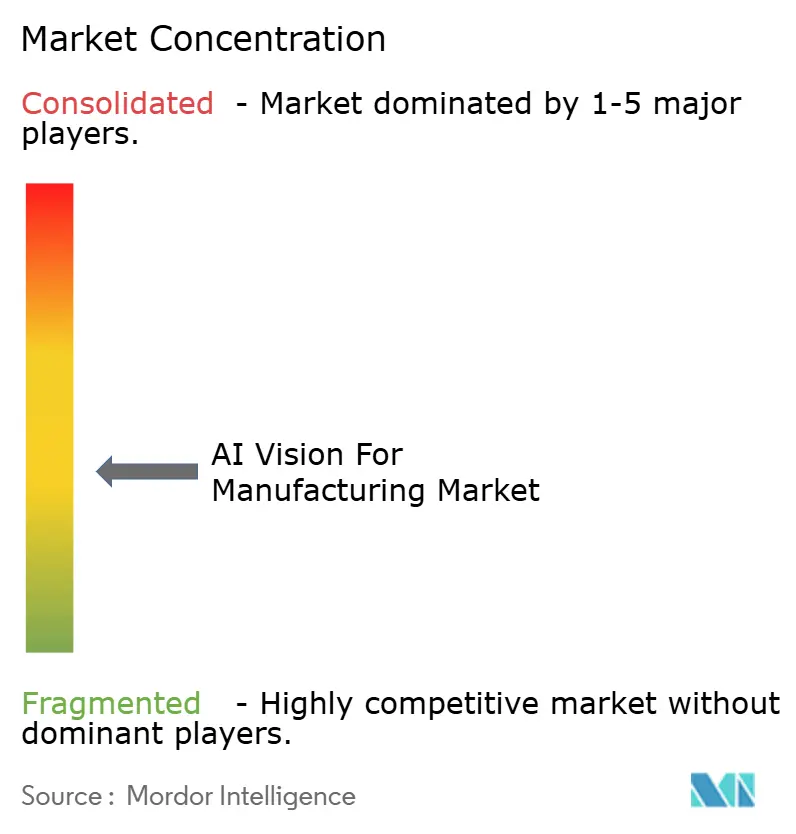
The AI vision for manufacturing market is moderately concentrated. Cognex Corporation and Keyence Corporation have broad capabilities in edge hardware, embedded software, and application libraries. Industrial automation groups, camera suppliers, and AI-native software providers compete in more specialized parts of the field. No supplier leads all components, vision, application, deployment, end-use, enterprise, and regional areas. This leaves room for 3D EV battery inspection, AI vision as a service for small and medium enterprises, and no-code deployment. Larger competitors are building or acquiring AI capabilities to retain software value within their platforms.
Cognex developed its portfolio through investments in ViDi Systems and Sualab AI. Rockwell Automation launched FactoryTalk Analytics VisionAI in 2024 after investing in Elementary, providing a no-code inspection platform.[6] Keyence introduced the VS-G Series in June 2026 with separate processing cores for inspection, compression, and storage. This design supports full visual traceability on the controller. These examples show that established suppliers are pairing hardware differentiation with software control. Their approach can simplify purchasing for plants that prefer a single provider.
AI-native entrants are taking a more open approach. Landing AI has embedded LandingLens within ABB Robotics' RobotStudio ecosystem, while Neurala expanded its OEM licensing program in July 2026 for third-party hardware and software platforms. Overview AI released OV Auto-Defect Creator Studio in June 2025 to generate synthetic defects from a defect-free reference image. Open suppliers can reach customers quickly through hardware partners, although they rely on those partners' distribution. The AI vision for manufacturing market is likely to include both integrated platform suppliers and hardware-neutral AI providers.
AI Vision For Manufacturing Industry Leaders
-
Cognex Corporation
-
Keyence Corporation
-
Teledyne Technologies Incorporated
-
Basler AG
-
OMRON Corporation
- *Disclaimer: Major Players sorted in no particular order
AI Vision For Manufacturing Market Companies Covered in this Report
- Cognex Corporation
- Keyence Corporation
- Teledyne Technologies Incorporated
- Basler AG
- OMRON Corporation
- SICK AG
- Datalogic S.p.A.
- FANUC CORPORATION
- Mitsubishi Electric Corporation
- Siemens AG
- Rockwell Automation, Inc.
- ABB Ltd
- Honeywell International Inc.
- Zebra Technologies Corporation
- LMI Technologies Inc.
- MVTec Software GmbH
- Allied Vision Technologies GmbH
- ISRA VISION AG
- National Instruments Corporation
- Landing AI
- Neurala, Inc.
- Ficosa International, S.A.
- Vitronic GmbH
- Baumer Holding AG
- Stemmer Imaging AG
Recent Industry Developments in AI Vision For Manufacturing Market
- August 2026: Rockwell Automation, Inc. announced an API-enabled integration between Plex Quality Management System and FactoryTalk Analytics VisionAI, enabling AI-driven quality workflows on new and existing camera systems with full inspection traceability and product serialization. The integration addresses the 80% effectiveness ceiling of traditional visual inspection by replacing it with timestamped AI decision records directly within the QMS audit trail.
- July 2026: Neurala, Inc. expanded its technology licensing program, making its Lifelong Deep Neural Network (L-DNN) edge-native vision AI engine available for embedding directly into third-party hardware and software platforms. FLIR Systems, IHI Logistics, and Sony Semiconductor Solutions had already validated the technology, enabling complete vision AI workflows, including on-device training and inference, without cloud infrastructure or GPU hardware.
- June 2026: Keyence Corporation launched the VS-G Series AI-Powered High-Performance Vision System, featuring a 32-core AI engine, processing speeds up to 13× faster than prior-generation models, and the industry's first built-in vision storage for 100% visual traceability directly on the controller. The system targets complete elimination of defect escapes and false over-detection through auto-tuning powered by accumulated production images.
- June 2026: Daihatsu Motor Co., Ltd. and VRAIN Solution, Inc. jointly deployed an AI image-recognition inspection system for transmission components at Daihatsu's Shiga (Ryuo) Plant, automating detection of scratches and machined-hole defects as small as 0.1 mm. The companies jointly filed patent applications covering the technology.
Global AI Vision For Manufacturing Market Report Scope
The AI Vision for Manufacturing Market encompasses software, hardware, and services that leverage computer vision and deep learning technologies across industrial production environments. These solutions support automated visual inspection, quality control, assembly verification, predictive maintenance, and safety monitoring. They analyze images and video captured by cameras, sensors, and production-line equipment to identify defects, measure tolerances, guide robotic systems, and optimize workflows in real time. Consequently, manufacturers can improve production yields, minimize scrap, and enhance throughput across industries, including automotive, electronics, semiconductors, food and beverage, and pharmaceuticals.
The AI Vision for Manufacturing Market Report is Segmented by Component (Hardware, AI Vision Software, and Services), Vision Type (2D Machine Vision, and 3D Machine Vision), Application (Quality Assurance and Inspection, Identification and Traceability, Robotics Guidance and Pick-and-Place, Predictive Maintenance and Machinery Inspection, Safety and Compliance Monitoring, and Inventory, Sorting, and Classification), Deployment Mode (On-Premise and Edge, Cloud-Based, and Hybrid), End-Use Industry (Electronics and Semiconductor Manufacturing, Automotive and Electric Vehicles, Pharmaceuticals and Healthcare, Food and Beverage, Metals and Machinery, Aerospace and Defense, and Other End-Use Industries), Enterprise Size (Large Enterprises, and Small and Medium Enterprises), and Geography (North America, South America, Europe, Asia-Pacific, Middle East, and Africa). The Market Sizes and Forecasts are Provided in Terms of Value in (USD).
| Hardware |
| AI Vision Software |
| Services |
| 2D Machine Vision |
| 3D Machine Vision |
| Quality Assurance and Inspection |
| Identification and Traceability |
| Robotics Guidance and Pick-and-Place |
| Predictive Maintenance and Machinery Inspection |
| Safety and Compliance Monitoring |
| Inventory, Sorting, and Classification |
| On-Premise and Edge |
| Cloud-Based |
| Hybrid |
| Electronics and Semiconductor Manufacturing |
| Automotive and Electric Vehicles |
| Pharmaceuticals and Healthcare |
| Food and Beverage |
| Metals and Machinery |
| Aerospace and Defense |
| Other End-Use Industries |
| Large Enterprises |
| Small and Medium Enterprises |
| North America | United States |
| Canada | |
| Mexico | |
| South America | Brazil |
| Argentina | |
| Rest of South America | |
| Europe | Germany |
| United Kingdom | |
| France | |
| Italy | |
| Spain | |
| Russia | |
| Rest of Europe | |
| Asia-Pacific | China |
| Japan | |
| South Korea | |
| Taiwan | |
| India | |
| Australia | |
| Rest of Asia-Pacific | |
| Middle East | Israel |
| Saudi Arabia | |
| United Arab Emirates | |
| Turkey | |
| Rest of Middle East | |
| Africa | South Africa |
| Egypt | |
| Rest of Africa |
| By Component | Hardware | |
| AI Vision Software | ||
| Services | ||
| By Vision Type | 2D Machine Vision | |
| 3D Machine Vision | ||
| By Application | Quality Assurance and Inspection | |
| Identification and Traceability | ||
| Robotics Guidance and Pick-and-Place | ||
| Predictive Maintenance and Machinery Inspection | ||
| Safety and Compliance Monitoring | ||
| Inventory, Sorting, and Classification | ||
| By Deployment Mode | On-Premise and Edge | |
| Cloud-Based | ||
| Hybrid | ||
| By End-Use Industry | Electronics and Semiconductor Manufacturing | |
| Automotive and Electric Vehicles | ||
| Pharmaceuticals and Healthcare | ||
| Food and Beverage | ||
| Metals and Machinery | ||
| Aerospace and Defense | ||
| Other End-Use Industries | ||
| By Enterprise Size | Large Enterprises | |
| Small and Medium Enterprises | ||
| By Geography | North America | United States |
| Canada | ||
| Mexico | ||
| South America | Brazil | |
| Argentina | ||
| Rest of South America | ||
| Europe | Germany | |
| United Kingdom | ||
| France | ||
| Italy | ||
| Spain | ||
| Russia | ||
| Rest of Europe | ||
| Asia-Pacific | China | |
| Japan | ||
| South Korea | ||
| Taiwan | ||
| India | ||
| Australia | ||
| Rest of Asia-Pacific | ||
| Middle East | Israel | |
| Saudi Arabia | ||
| United Arab Emirates | ||
| Turkey | ||
| Rest of Middle East | ||
| Africa | South Africa | |
| Egypt | ||
| Rest of Africa | ||
Key Questions Answered in the Report
What is the size of the AI vision for manufacturing market?
The AI Vision for Manufacturing Market size is expected to grow from USD 1.98 billion in 2025, and USD 2.17 billion in 2026, and is forecast to reach USD 4.24 billion by 2031 at a CAGR of 14.34% over 2026-2031.
Which component generates the most revenue?
Hardware led with 47.89% of 2025 revenue because cameras, illumination, embedded processors, and related equipment remain essential to each deployment. Software requirements are increasingly shaping which hardware buyers select, especially for multisite operations that need managed model updates.
Which application is growing fastest?
Robotics guidance and pick-and-place is projected to grow at a 16.43% CAGR through 2031 as large vision models support flexible robot handling. The application helps facilities manage variable part geometries that previously required longer reprogramming cycles and more specialized setup work.
Why do manufacturers use edge-based AI vision systems?
Edge systems provide local, low-latency decisions for high-speed inspection tasks and accounted for 65.21% of revenue in 2025. They enable pass-or-fail decisions without depending on cloud connectivity, while cloud tools can support centralized training, governance, and controlled software distribution.
Which end-use area is expected to expand fastest?
Automotive and electric vehicles is forecast to grow at a 16.93% CAGR through 2031, supported by inspection needs in battery-cell and module production. Cylindrical, pouch, and prismatic cells need different imaging methods, while modules can require three-dimensional localization of internal defects.
Which region is forecast to grow fastest?
South America is projected to grow at a 17.13% CAGR through 2031, with Brazil supported by industrial digitalization policies and manufacturing investment. Smart-factory deployments by multinational manufacturers can also extend AI inspection practices through domestic electronics and industrial supplier networks.