
AI Virtual Companions In Healthcare Market Size and Share
Market Overview
| Study Period | 2020 - 2031 |
|---|---|
| Market Size (2026) | USD 4.34 Billion |
| Market Size (2031) | USD 17.82 Billion |
| Growth Rate (2026 - 2031) | 32.66 % |
| Fastest Growing Market | Asia-Pacific |
| Largest Market | North America |
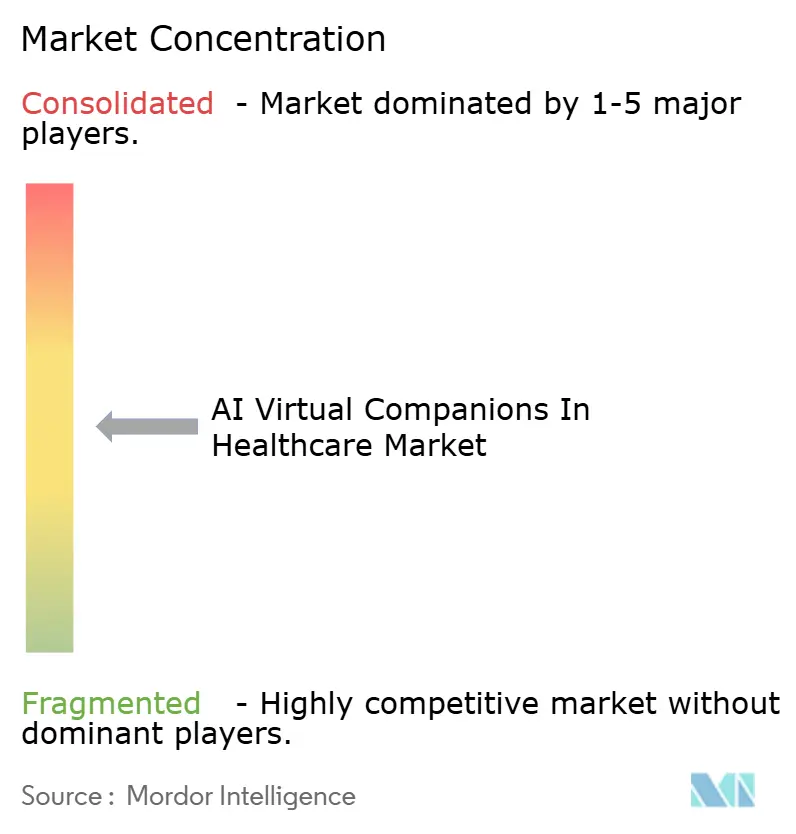
| Market Concentration | Medium |
Major Players *Disclaimer: Major Players sorted in no particular order Image © Mordor Intelligence. Reuse requires attribution under CC BY 4.0. | |
AI Virtual Companions In Healthcare Market Analysis by Mordor Intelligence
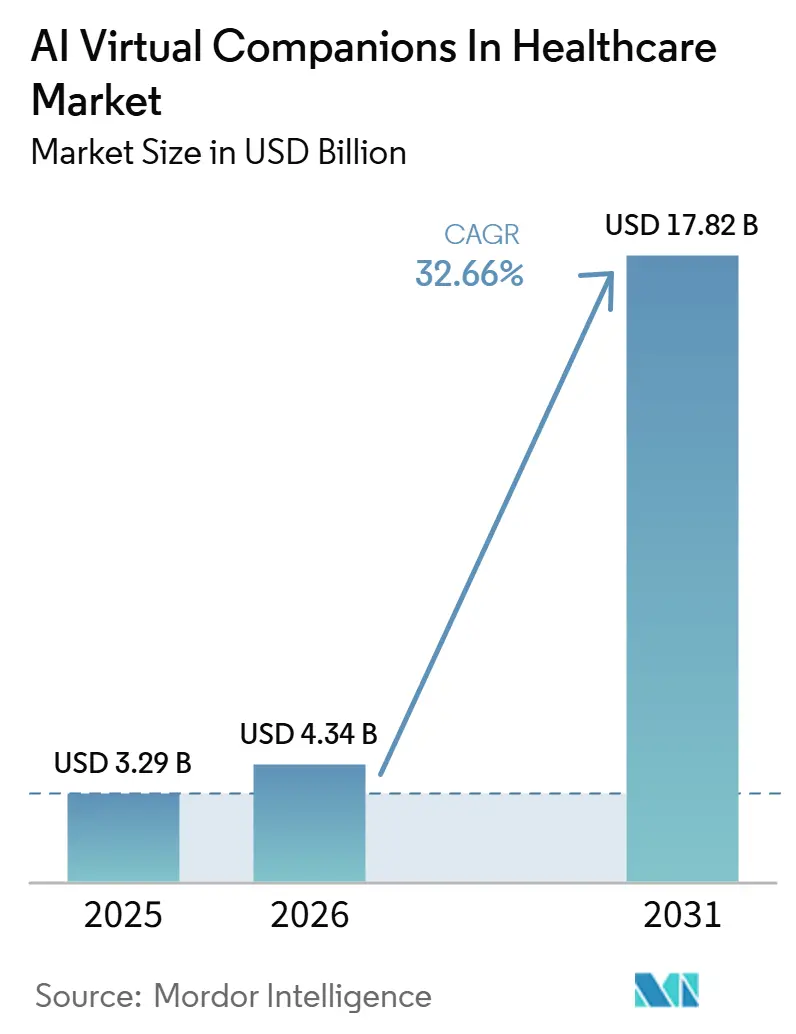
The AI Virtual Companions In Healthcare Market size is expected to grow from USD 3.29 billion in 2025 to USD 4.34 billion in 2026 and is forecast to reach USD 17.82 billion by 2031 at 32.66% CAGR over 2026-2031.
The AI virtual companions in the healthcare market are expanding because care systems are under pressure from staff shortages, higher patient follow-up needs, and a growing elderly population that needs more frequent but lower-touch support. Large language model tools have also made conversational systems more usable across triage, patient education, medication reminders, and post-discharge communication, which lowers deployment friction for hospitals and digital health platforms. The category is moving forward in both patient-facing and clinician-facing use cases, and that gives vendors more than one route to scale inside health systems and at home. Competitive activity is rising as specialist healthcare AI firms try to defend clinical depth while large platform companies use cloud distribution, workflow integration, and broader product ecosystems to widen adoption. Growth remains strong, but reimbursement clarity, safety validation, and trust in model outputs still shape how quickly the AI virtual companions in the healthcare market can move from pilot activity to wider institutional purchasing.
Key Report Takeaways
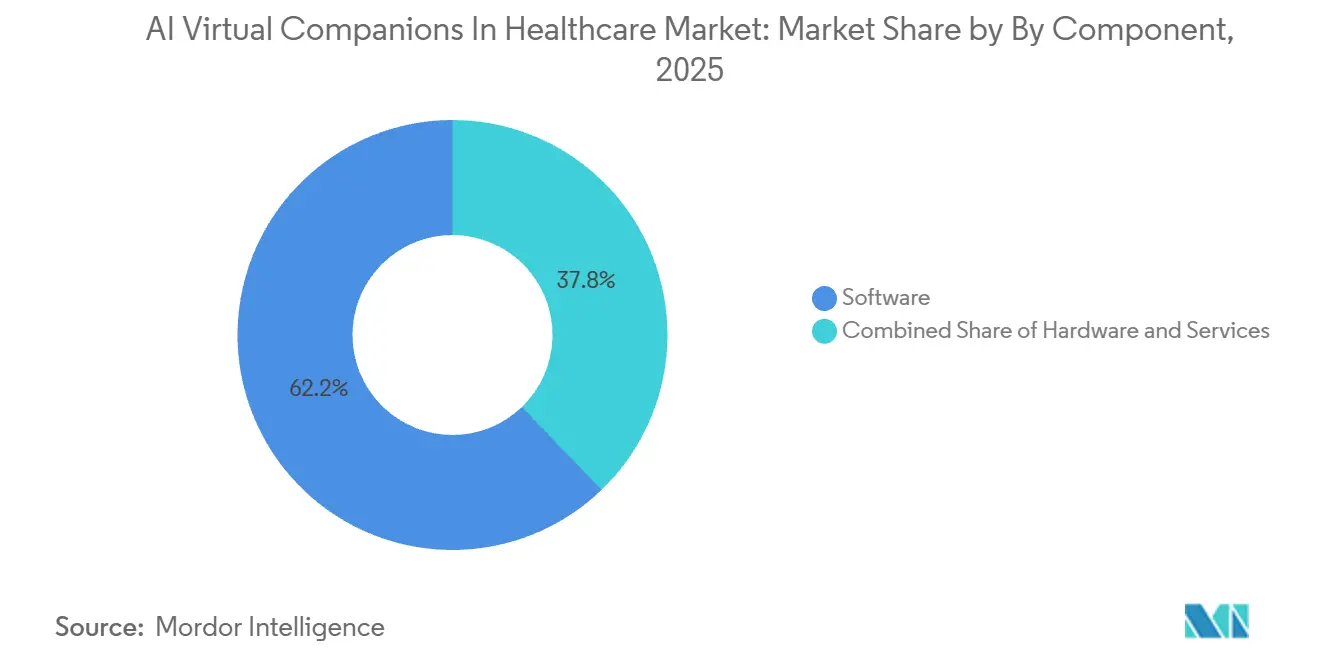
By component, software held 62.2% of AI virtual companions in healthcare market share in 2025 and was projected to grow at a 33.8% CAGR through 2031.
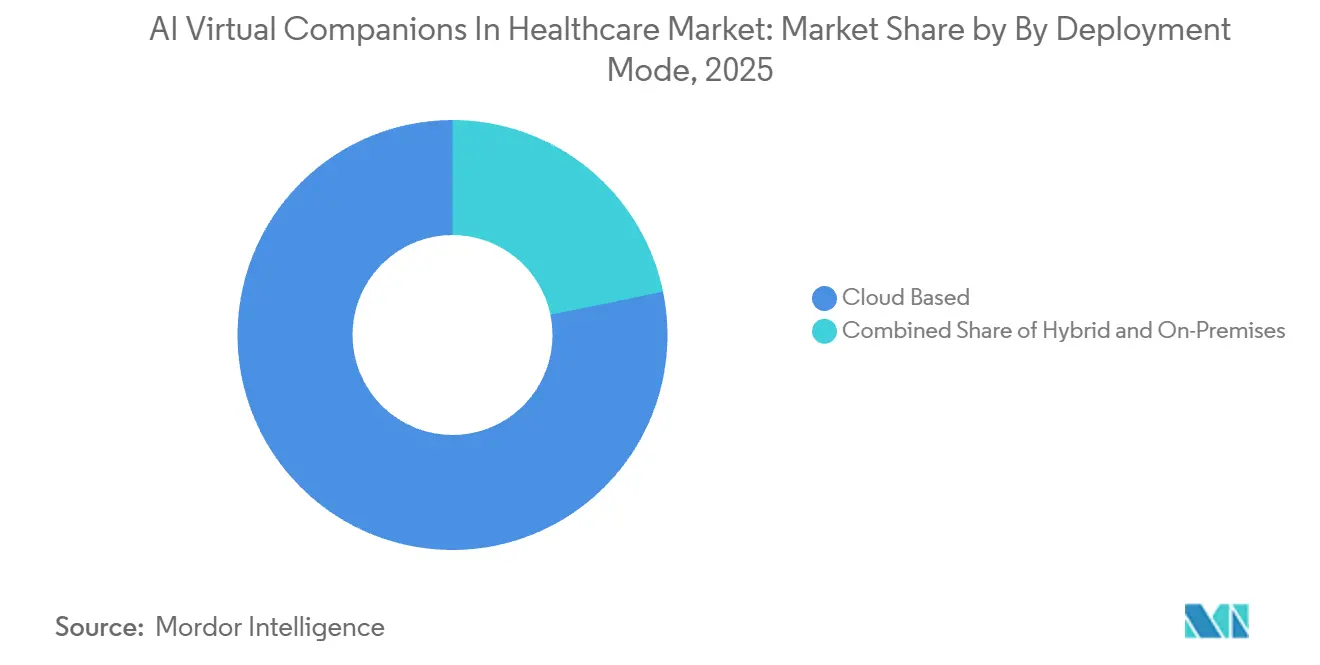
By deployment mode, cloud-based platforms accounted for 78.2% of the AI virtual companions in healthcare market size in 2025 and were also expected to expand at a 34.2% CAGR through 2031.
By companion type, chatbot-based solutions led with a 54.3% share in 2025, while multimodal avatars recorded the highest projected CAGR at 34.1% through 2031.
By application, mental health and emotional support captured 28.9% of revenue in 2025, while elder care and social companionship was forecast to grow at a 33.2% CAGR through 2031.
By end user, home care settings held 31.4% of revenue in 2025, while individual consumers were projected to advance at a 33.9% CAGR through 2031.
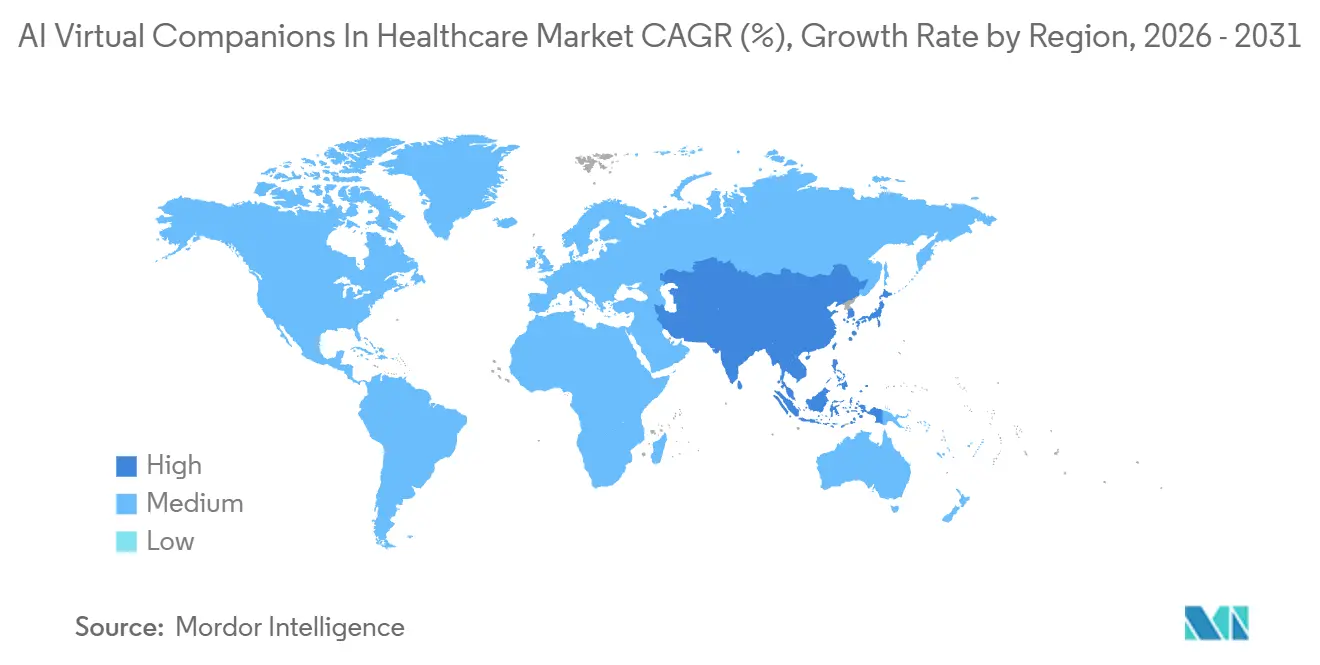
By geography, North America accounted for 38.1% of revenue in 2025, while Asia Pacific was forecast to expand at a 34.5% CAGR through 2031.
Note: Market size and forecast figures in this report are generated using Mordor Intelligence’s proprietary estimation framework, updated with the latest available data and insights as of January 2026.
Market Trends and Insights
Drivers Impact Analysis of AI Virtual Companions In Healthcare Market*
| Driver | (~) % Impact on CAGR Forecast | Geographic Relevance | Impact Timeline |
|---|---|---|---|
| Expanded Access to Personalized Patient Support | +6.2% | Global, accelerated uptake in North America and Europe | Medium term (2-4 years) |
| Rising Demand for Medication Adherence Support and Chronic Disease Self-Management | +5.5% | Global, led by North America, emerging in APAC | Short term (≤ 2 years) |
| Growing Adoption of AI-Based Behavioral Health Solutions | +5.0% | North America and EU, early adoption in APAC | Medium term (2-4 years) |
| Aging Population Requiring Continuous, Low-Touch Care Models | +7.0% | APAC core, spillover to EU and MEA | Long term (≥ 4 years) |
| EHR and Remote Monitoring Workflow Integration Enabling Deployment at Scale | +4.3% | North America, EU | Medium term (2-4 years) |
| Increasing Provider Pressure to Extend Workforce Capacity with AI-Driven Patient Touchpoints | +4.5% | Global | Short term (≤ 2 years) |
| Source: Mordor Intelligence | |||
Expanded Access to Personalized Patient Support
The AI virtual companions in the healthcare market is gaining from a long-standing gap between what patients need between visits and what clinical teams can realistically provide at scale. Traditional care models still concentrate meaningful interaction around appointments, which leaves many patients without structured support during preparation, recovery, and routine follow-up. That gap has become easier to address because conversational systems can deliver timely and context-aware guidance before and after treatment, often without adding direct pressure on physician schedules. A 2026 study at Mount Sinai Health System[1]Annapoorna Kini et al., “Conversational Artificial Intelligence for Pre-procedural Patient Preparation, Implementation, Validation and Patient Satisfaction,” npj Digital Medicine validated a voice-based assistant for pre-procedural preparation and showed that intervention failure rates fell from 6.0% in the initial phase to 2.6% after optimization, which suggests these tools can improve operational performance in real care settings. The same use case also gives providers richer intake data before the clinician encounter, which can shorten visit preparation time and improve context for decision-making. As health systems place more weight on workflow efficiency and patient readiness, the AI virtual companions in healthcare market is moving from basic chat support toward more structured care pathway support.
Rising Demand for Medication Adherence and Chronic Disease Management
The AI virtual companions in healthcare market is also being supported by the steady need for better medication adherence and day-to-day disease management outside the clinic. Chronic conditions often require repeated behavioral reinforcement rather than one-time education, and that makes conversational support useful because it can be repeated without a similar rise in delivery cost. A 2025 randomized clinical trial[2]L. Zhao et al., “Randomized Clinical Trial of a Digital Medication System to Enhance Adherence in Patients with Severe Mental Disorders,” npj Digital Medicinein npj Digital Medicine found that a digital medication system with audio reminders, real-time dose recording, and caregiver app connectivity improved adherence outcomes compared with controls over a 12-month period in patients with severe mental disorders. A 2026 scoping review in Digital Health also found measurable improvements across chatbot use cases in diabetes, hypertension, asthma, and cancer support, which strengthens the case for conversational tools in routine self-management. These findings matter because they support the idea that adherence support can become a scalable service layer rather than a labor-heavy outreach function. As care organizations look for low-friction ways to manage large patient panels, the AI virtual companions in healthcare market is finding a durable role in chronic disease support programs.
Growing Adoption of AI-Based Behavioral Health Solutions
Behavioral health remains one of the clearest demand areas because access gaps are still large and many patients need support outside normal clinic hours. The AI virtual companions in healthcare market already had a large mental health base in 2025, with mental health and emotional support holding the largest application share at 28.9%. Regulatory attention has also intensified, which indicates that the category is being treated as clinically relevant rather than peripheral. The FDA’s Digital Health Advisory Committee discussed generative AI therapy tools in November 2025 and flagged hallucinations, model drift, demographic performance gaps, and consent requirements as core safety issues that need formal control pathways. CMS also introduced billing codes G0552 to G0554 for digital mental health treatment devices in the 2025 Physician Fee Schedule, which suggests that reimbursement infrastructure is starting to form even if scale is still limited . This matters because products that secure stronger validation and regulatory positioning may gain better payer credibility than general-purpose tools with similar consumer interfaces.
Aging Population Requiring Continuous Low-Touch Care
The AI virtual companions in healthcare market is benefiting from a shift in elderly care where demand is being shaped by demographic pressure rather than by discretionary technology spending. In several Asian healthcare systems, the number of older adults is rising faster than caregiver capacity, which increases interest in tools that can provide companionship, reminders, and low-intensity monitoring. South Korea’s population aged 65 and older crossed 21.21% by the end of 2025, and the Korean Federation of Community Credit Cooperatives distributed 200 AI companion robots to isolated seniors in June 2026 with conversational features, medication reminders, and emergency alerts. Clinical outcomes from real deployments also support demand, as a South Jeolla Province pilot reported a 63% reduction in geriatric depression scores and showed that 97% of at-risk participants returned to normal score levels after using AI companion dogs. Those results matter because they frame companionship tools as part of welfare delivery rather than as optional digital engagement products. As aging pressures deepen across the Asia Pacific and later spread through other regions with similar workforce shortages, the AI virtual companions in the healthcare market is likely to keep seeing strong pull from elder care use cases.
Restraints Impact Analysis of AI Virtual Companions In Healthcare Market*
| Restraint | (~) % Impact on CAGR Forecast | Geographic Relevance | Impact Timeline |
|---|---|---|---|
| Clinical Trust Gaps in Generative AI Responses | -2.5% | Global | Short term (≤ 2 years) |
| Reimbursement Uncertainty for Conversational AI Tools | -2.1% | North America, emerging in EU | Medium term (2-4 years) |
| Data Privacy, Consent, and Model Governance Compliance Requirements | -1.8% | Global, stricter in EU and U.S. state jurisdictions | Medium term (2-4 years) |
| Limited Suitability for High-Acuity or Medically Complex Cases | -1.4% | Global | Long term (≥ 4 years) |
| Source: Mordor Intelligence | |||
Clinical Trust Gaps in Generative AI Responses
Clinical trust remains a core restraint because health systems do not judge these tools only by user engagement or language quality. They also judge them by whether responses can remain safe, stable, and clinically appropriate in sensitive situations such as medication guidance and mental health support. The AI virtual companions in healthcare market still faces caution because large language models can produce answers that sound credible even when they contain serious errors. The FDA advisory discussion in November 2025 highlighted hallucinations, context failures, demographic disparities, and model drift as risks that require adverse event reporting and clearer consent standards. A 2026 analysis hosted by the National Library of Medicine also concluded that existing regulatory approaches do not fully balance broad access against the range of clinical risks, and it recommended a hybrid model with ongoing monitoring and independent auditing . This has a direct commercial effect because providers and payers now place greater weight on published validation, auditability, and post-market oversight before they commit to scaled deployment.
Reimbursement Uncertainty for Conversational AI
The AI virtual companions in healthcare market also remains constrained by the limited maturity of reimbursement pathways for software-led patient interaction services. Many current billing structures were built around procedures, visits, and clinician time, which makes it harder to reimburse longitudinal conversational support in a standard way. The Health Tech Investment Act, introduced in April 2025, proposed a Medicare pathway for algorithm-based healthcare services delivered through FDA-authorized devices, but it had not been enacted as of mid-2026. Even where CMS codes exist for digital mental health treatment devices, claim volume and pricing clarity remain limited, which leaves many vendors dependent on enterprise contracts rather than broad reimbursement-backed scale. That funding pattern tends to favor larger vendors that can absorb long sales cycles and delayed monetization. Smaller companies may still find growth, but the lack of predictable reimbursement keeps adoption uneven across care settings and slows broader institutional rollout.
*Our forecasts treat driver/restraint impacts as directional, not additive. The impact forecasts reflect baseline growth, mix effects, and variable interactions.
AI Virtual Companions In Healthcare Market Segment Analysis
By Component:
Software Economics Sustain Market LeadershipThe software segment held 62.2% of the AI virtual companions in healthcare market in 2025, and it was forecast to grow at a 33.8% CAGR through 2031. That position reflects how software platforms can scale across multiple health system workflows without the manufacturing, maintenance, and deployment burdens attached to device-heavy models. Once a platform is embedded in triage, pre-visit intake, follow-up messaging, and support navigation, the vendor can expand account value through additional use cases rather than through separate product categories. This creates a reinforcing cycle where more usage produces more interaction data, and more interaction data can improve model performance, workflow tuning, and product credibility. The result is that established software vendors often gain quality and procurement advantages over smaller entrants that do not yet have similar dataset depth or deployment history.
The services side remains smaller, but it still plays an important role because enterprise implementation rarely ends with software access alone. Health systems often need integration support, workflow customization, governance design, privacy review, training, and ongoing model maintenance before they can use these tools widely. A 2026 study in Frontiers in Artificial Intelligence[3]K Health and Novant Health, “Novant Health Partners with K Health to Launch AI-Enabled 24/7 Virtual Primary Care,” HIT Consultantshowed that fully offline language models combined with virtual physician avatars could support privacy-preserving clinical interactions without cloud connectivity, which expands the software opportunity into bandwidth-constrained and data-residency-sensitive settings. That finding matters because it suggests the software layer can move into environments that were once seen as difficult for cloud-dependent conversational tools. The AI virtual companions in healthcare industry is therefore seeing software retain leadership not only because it is lighter to distribute, but also because new deployment architectures are widening its usable footprint. Over time, services revenue should remain attached to software growth because deeper adoption usually means deeper integration effort. The AI virtual companions in healthcare market should continue to favor vendors that can combine product scale with implementation discipline and privacy-ready deployment models.



By Companion Type:
Multimodal Avatars Gain Clinical Validation TractionChatbot-based solutions held 54.3% of the companion type segment in 2025, which shows the staying power of text-led interfaces in healthcare communication. Text chat remains the easiest format to place into patient portals, secure messaging tools, and mobile care pathways, and it can be deployed with little change to existing user behavior. It also allows vendors to scale basic support functions quickly across triage, education, navigation, and follow-up use cases. That first-mover advantage explains why chatbot formats still lead current revenue even as richer interaction models attract more clinical attention. For many providers, a text-based starting point remains the lowest-friction path into the AI virtual companions in healthcare market.
The faster expansion is expected in multimodal avatars, which were forecast to grow at a 34.1% CAGR through 2031. This reflects the view that voice, visual presence, and emotionally legible interaction may improve comprehension and comfort in ways that pure text cannot always match. A June 2026 ChristianaCare study[4]ChristianaCare, “ChristianaCare Study First to Show AI Avatar Can Help Cancer Patients Feel Less Anxious Before Radiation Visits” found that cancer patients who viewed AI physician avatar videos before radiation visits reported lower anxiety, stronger understanding of their treatment plan, and higher satisfaction than those who watched standard educational videos. A 2025 Frontiers in Public Health study also reported that avatar customization improved user intention to engage with virtual health systems by strengthening social presence. Voice-enabled systems continue to hold strategic value as well because they reduce interface barriers for older adults and for users who do not engage comfortably with touch-heavy applications. The AI virtual companions in healthcare market is therefore not shifting away from chat, but it is moving toward richer formats where clinical experience and engagement outcomes can be measured more directly. Vendors that prove outcome gains from multimodal delivery may win higher-value contracts even if text remains the broader installed base.
By Deployment Mode:
Cloud Concentration Creates Infrastructure Dependency RiskCloud-based deployment accounted for 78.2% of the AI virtual companions in healthcare market in 2025, and it was also the fastest-growing deployment model with a 34.2% CAGR through 2031. Buyers have leaned toward cloud delivery because it lowers upfront infrastructure burden, supports faster updates, and makes it easier to roll out new features across distributed care environments. The model also fits well with enterprise software buying behavior, where hospitals want subscription access, centralized oversight, and less local maintenance. These strengths explain why cloud platforms have become the default route for many providers entering this category. They also explain why cloud ecosystem access is turning into a major competitive advantage for firms that want wide institutional reach.
At the same time, this concentration introduces dependency risk because real-time conversational support in healthcare needs stable latency, secure data flow, and high service continuity. Rural environments, remote care programs, and institutions with strict data localization rules may not find the cloud-first model equally effective for every use case. Amazon Web Services launched Amazon Connect Health in March 2026 as a healthcare-specific AI agent platform for patient verification, scheduling, pre-visit summaries, ambient documentation, and medical coding, which showed how major infrastructure providers are building compliance layers directly around care workflows. That move matters because infrastructure scale can shorten the path from pilot to production for buyers that already trust large cloud environments. Even so, on-premises systems still retain relevance in high-acuity or privacy-sensitive settings where technical control and local data governance matter more than deployment speed. The AI virtual companions in healthcare market is therefore likely to remain cloud-led, but not cloud-exclusive. The smaller on-premises segment may still produce attractive contracts because buyers in that category often accept longer implementation work in exchange for tighter control.
By Application:
Mental Health Leads Volume, Elder Care Leads GrowthMental health and emotional support held 28.9% of the AI virtual companions in healthcare market in 2025, which made it the largest application area by current revenue. This reflects earlier commercialization, strong unmet demand, and the fact that many behavioral health interactions can be structured around frequent conversation, check-ins, and supportive reinforcement. These characteristics fit the medium well because the value often comes from continuity and accessibility rather than from one-time information delivery. The category also gained attention from regulators and payers, which supports the view that it is becoming a more formal part of digital treatment pathways. In practical terms, mental health remains the clearest proof point for how the AI virtual companions in healthcare industry can deliver frequent, low-friction patient support at scale.
Elder care and social companionship, however, was forecast to expand at a 33.2% CAGR through 2031, which made it the fastest-growing application segment. Growth here is being shaped by demographic pressure, care worker shortages, and the need for support models that can remain active in the home over long periods. Chronic disease management and medication adherence also sit close behind because conversational tools can reinforce behavior in daily routines where clinical staff cannot remain present. A 2026 meta-analysis of chatbot interventions hosted by the National Library of Medicine found consistent improvements in adherence and behavioral outcomes across diabetes, hypertension, asthma, and cancer populations. Patient education and care navigation is also gaining relevance, and a 2026 AAAI paper on SPASCA for persons living with dementia showed that conversational systems combining dialogue management and avatar interaction could support cognitive engagement and psychological well-being in complex care settings. The AI virtual companions in healthcare market size for elder care is being lifted by urgency, while mental health still sets the current revenue base. This creates a market structure where one application leads present scale and another leads forward acceleration. Vendors with cross-application capability may be better placed than those tied to a single narrow use case.
By End User:
Institutional Anchors, Consumers Drive Edge GrowthHome care settings held 31.4% of the market in 2025, which made them the largest end-user category in the AI virtual companions in healthcare market. This is consistent with the fact that many use cases, including elderly support, medication reminders, chronic disease reinforcement, and emotional companionship, happen outside hospitals and over extended periods. Home environments also suit conversational tools because interaction can be frequent, repeated, and lightweight without requiring a formal visit each time. The category benefits when families, community care providers, and digital health platforms all look for ways to extend support beyond direct clinician contact. That makes home care a natural base for volume adoption even when reimbursement models are still evolving.
Individual consumers were projected to grow at a 33.9% CAGR through 2031, which points to rising willingness to use direct-access health support tools through mobile apps, smart speakers, and dedicated devices. Consumer growth is important because it widens adoption pathways beyond institutional procurement and allows vendors to test engagement models outside slower enterprise sales cycles. Hospitals and clinics remain important buyers for triage navigation, intake support, and post-visit engagement, while payers and care management organizations represent a longer-term channel with strong value-based care logic. A pilot covered by CBS New York at RiverSpring Living reported statistically significant reductions in anxiety and depression severity among nearly 70 participating senior residents using the Meela AI companion program. That example is narrower than large health system deployment, but it still shows that end-user demand can strengthen when care outcomes and emotional support benefits are visible at the resident level. The AI virtual companions in healthcare market therefore relies on institutions for credibility and workflow access, while consumers increasingly provide an additional growth edge. Over time, vendors that can serve both enterprise and direct-user channels may reduce revenue concentration risk and improve resilience across policy cycles.
Geography Analysis
North America AI Virtual Companions in Healthcare Market
North America accounted for 38.1% of AI virtual companions in healthcare market share in 2025, which made it the largest regional market by current revenue. The region benefits from established digital health infrastructure, wider interoperability adoption, and stronger enterprise readiness for AI workflow integration than many other regions. Buyers in the United States increasingly expect these tools to connect with existing care systems rather than operate as isolated chat interfaces. That expectation favors vendors that can support documentation, pre-visit screening, summarization, and patient engagement within broader clinical workflows. Microsoft strengthened this enterprise-facing direction in June 2026 when it announced a collaboration with Mayo Clinic to build a frontier healthcare AI model that combines Mayo’s de-identified longitudinal clinical data with Microsoft’s AI and cloud engineering capabilities. Microsoft also launched Copilot Health in preview in May 2026 for U.S. Microsoft 365 subscribers, which signaled growing effort to normalize AI-supported health record interpretation and health query support in a HIPAA-compliant environment.
APAC AI Virtual Companions in Healthcare Market
Asia Pacific was forecast to grow at a 34.5% CAGR through 2031, which made it the fastest-growing geography in the AI virtual companions in healthcare market. Growth in this region is being pulled by aging population pressure, labor shortages in caregiving, and public interest in scalable support tools that can remain active in homes and community settings. South Korea has become one of the clearest examples because it entered super-aged society status by the end of 2025, and public distribution of AI companion robots has already moved beyond concept discussion. The South Jeolla Province outcome data showing a 63% drop in geriatric depression scores adds practical evidence that these tools can contribute to measurable well-being outcomes in elderly populations. Japan and China also add scale to the regional opportunity because aging and healthcare access pressure there support demand for assistive and low-touch care models. India and Australia contribute through different routes, with India offering a large digitally connected user base and Australia showing stronger institutional digital health purchasing capacity.
EMEA and South America AI Virtual Companions in Healthcare Market
Europe remains a maturing regional market where policy structure and reimbursement pathways carry more weight than pure novelty demand. EU digital health frameworks and country-level reimbursement routes give vendors a clearer route to formal market participation than in some earlier-stage regions. Germany’s DiGA pathway is especially relevant because it offers a structured route for reimbursable digital health applications, and that gives AI companion vendors a concrete market entry target. The United Kingdom also remains open to clinical AI deployment through NHS-linked partnerships and digital service pilots, which keeps the region commercially relevant even when adoption moves at a measured pace. Middle East and Africa is still earlier in development, but GCC investment in digital health transformation aligns well with mental health support and chronic disease management use cases. South America remains a smaller base today, yet large urban populations, growing digital health use, and underserved rural care needs support long-run room for expansion across the AI virtual companions in healthcare market.

Competitive Landscape
The AI virtual companions in healthcare market remains moderately fragmented, with competition split between specialist healthcare AI firms and larger platform companies that are entering through cloud, productivity, and consumer technology channels. Specialist vendors still hold an advantage in clinical workflow understanding, narrower care use case design, and evidence-building around specific patient needs. Companies such as Ada Health, Sensely, Youper, and Care Angel reflect this specialist pattern because they focus on defined value propositions rather than broad infrastructure positioning. At the same time, the barriers to entry are changing because the underlying language model layer is becoming more accessible, which reduces the exclusivity of basic conversational capability. That shift means competitive strength now depends more on clinical validation, integration depth, trust, privacy design, and the ability to secure recurring distribution.
Large technology companies are widening the competitive perimeter by treating healthcare companions as one application layer within broader AI ecosystems. Microsoft’s collaboration with Mayo Clinic in June 2026 was a strategic move because it linked cloud infrastructure, model development, and one of the strongest clinical data environments in the market. Microsoft’s Copilot Health preview in May 2026 was another important move because it pushed health-oriented assistance closer to mainstream productivity software and consumer-facing records interpretation. Google Cloud and CVS Health also formalized a strategic partnership in March 2026 to develop the Health100 platform using Gemini multimodal AI models, Cloud Healthcare API, and BigQuery for consumer engagement and clinical workflow optimization. These moves show that major players are not only launching tools, they are trying to anchor themselves deeper in data, workflow, and distribution infrastructure.
AI Virtual Companions In Healthcare Industry Leaders
Microsoft Corporation
Google LLC
Amazon
Apple Inc.
Ada Health GmbH
- *Disclaimer: Major Players sorted in no particular order
AI Virtual Companions In Healthcare Market Companies Covered in this Report
- Alphabet Inc. (Google Health / DeepMind)
- Microsoft
- NVIDIA
- Siemens Healthineers
- GE HealthCare Technologies Inc.
- Koninklijke Philips
- Roche
- Tempus AI, Inc.
- Aidoc Medical Ltd.
- Qure.ai Technologies Private Limited
- Heartflow
- PathAI, Inc.
- Paige.AI, Inc.
- Ada Health GmbH
- AliveCor
- Butterfly Network, Inc.
- Digital Diagnostics
- Lunit
- Ibex Medical Analytics Ltd.

Recent Industry Developments in AI Virtual Companions In Healthcare Market
- June 2026: Microsoft and Mayo Clinic announced a strategic collaboration to develop a purpose-built frontier healthcare AI model combining Mayo's de-identified longitudinal clinical data with Microsoft's AI and cloud engineering capabilities. The model, owned by Mayo Clinic and accessible globally via Azure Foundry APIs, is being iteratively tested within Mayo's clinical environment before broader rollout
- May 2026: Microsoft launched Copilot Health in preview for US Microsoft 365 subscribers, offering a health AI assistant capable of explaining health records, answering medical queries, and integrating wearable data in a HIPAA-compliant environment, following extensive safety testing and evaluation.
- March 2026: Google Cloud and CVS Health announced a strategic partnership to develop the Health100 platform, combining Gemini multimodal AI models, Cloud Healthcare API, and BigQuery to deliver integrated consumer health engagement and clinical workflow optimization.
- March 2026: UnitedHealthcare introduced Avery, a generative AI companion that creates a simpler, more coordinated health care experience for members while empowering customer advocates to more efficiently respond to members.


Global AI Virtual Companions In Healthcare Market Report Scope
| Software |
| Hardware |
| Services |
| In Vivo Diagnostics |
| In Vitro Diagnostics |
| Cloud Based |
| Hybrid |
| On Premises |
| Hospitals |
| Diagnostic Imaging Centers |
| Diagnostic Laboratories |
| Clinics and Other Healthcare Providers |
| North America | United States |
| Canada | |
| Mexico | |
| Europe | Germany |
| United Kingdom | |
| France | |
| Italy | |
| Spain | |
| Asia-Pacific | China |
| India | |
| Japan | |
| South Korea | |
| Australia | |
| Rest of Asia-Pacific | |
| Middle East & Africa | GCC |
| South Africa | |
| Rest of Middle East and Africa | |
| South America | Brazil |
| Argentina | |
| Rest of South America |
| By Component | Software | |
| Hardware | ||
| Services | ||
| By Application | In Vivo Diagnostics | |
| In Vitro Diagnostics | ||
| By Deployment Mode | Cloud Based | |
| Hybrid | ||
| On Premises | ||
| By Tend User | Hospitals | |
| Diagnostic Imaging Centers | ||
| Diagnostic Laboratories | ||
| Clinics and Other Healthcare Providers | ||
| By Geography | North America | United States |
| Canada | ||
| Mexico | ||
| Europe | Germany | |
| United Kingdom | ||
| France | ||
| Italy | ||
| Spain | ||
| Asia-Pacific | China | |
| India | ||
| Japan | ||
| South Korea | ||
| Australia | ||
| Rest of Asia-Pacific | ||
| Middle East & Africa | GCC | |
| South Africa | ||
| Rest of Middle East and Africa | ||
| South America | Brazil | |
| Argentina | ||
| Rest of South America | ||


Key Questions Answered in the Report
What is the projected value of AI virtual companions in healthcare by 2031?
The sector is projected to reach USD 17.8 billion by 2031, up from USD 4.3 billion in 2026, with a 32.7% CAGR over 2026-2031.
Which application area currently leads revenue?
Mental health and emotional support led in 2025 with a 28.9% share, reflecting early commercialization and large unmet behavioral care demand.
Which application is expected to grow the fastest through 2031?
Elder care and social companionship is expected to record the fastest growth at a 33.2% CAGR, supported by aging populations and caregiver shortages.
Why are cloud deployments leading adoption?
Cloud-based tools held 78.2% share in 2025 because buyers prefer lower infrastructure burden, easier updates, and faster rollout across distributed care settings.
Which region is growing the fastest?
Asia Pacific is expected to expand at a 34.5% CAGR through 2031, driven mainly by demographic pressure and the need for scalable elderly care support.
What is the main barrier to wider adoption in hospitals and payer systems?
Clinical trust and reimbursement remain the biggest hurdles because buyers want stronger validation, clearer governance, and better payment pathways before scaling deployments.
Page last updated on:





