
AI Training Data Provenance Software Market Size and Share
Market Overview
| Study Period | 2020 - 2031 |
|---|---|
| Market Size (2026) | USD 3.84 Billion |
| Market Size (2031) | USD 12.46 Billion |
| Growth Rate (2026 - 2031) | 26.54% CAGR |
| Fastest Growing Market | Asia-Pacific |
| Largest Market | North America |
| Market Concentration | High |
Major Players *Disclaimer: Major Players sorted in no particular order Image © Mordor Intelligence. Reuse requires attribution under CC BY 4.0. | |
AI Training Data Provenance Software Market Analysis by Mordor Intelligence
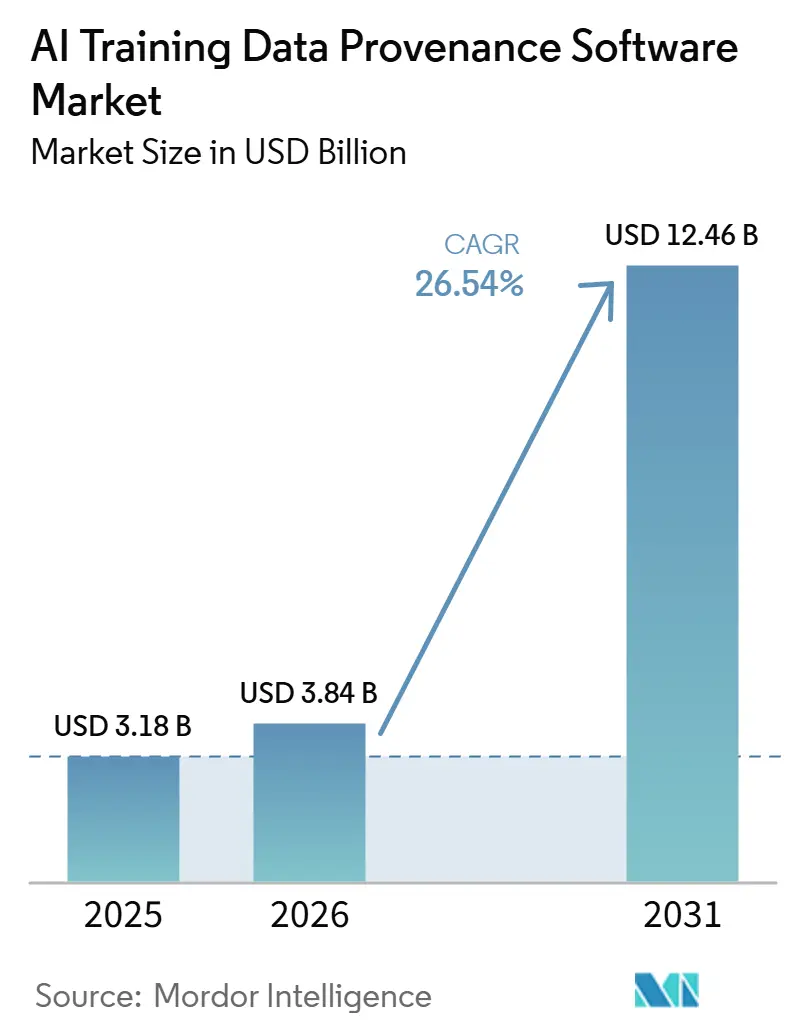
The AI Training Data Provenance Software Market size is projected to expand from USD 3.18 billion in 2025 and USD 4.03 billion in 2026 to USD 12.46 billion by 2031, registering a CAGR of 26.54% between 2026 and 2031. The AI Training Data Provenance Software Market is being shaped by requirements to document the source of training data, how it was prepared, and the rights that apply to it. Legal and copyright exposure is moving these records from a technical preference into a purchasing requirement for many organizations. Demand is also widening as developers fine-tune models with internal data, third-party content, and feedback datasets that require distinct records. Suppliers are responding by joining lineage, rights management, version control, and compliance functions in connected products. The AI Training Data Provenance Software Market also has an opportunity in public-sector AI programs that require documented data origin and rights status before systems are bought.
Key Report Takeaways
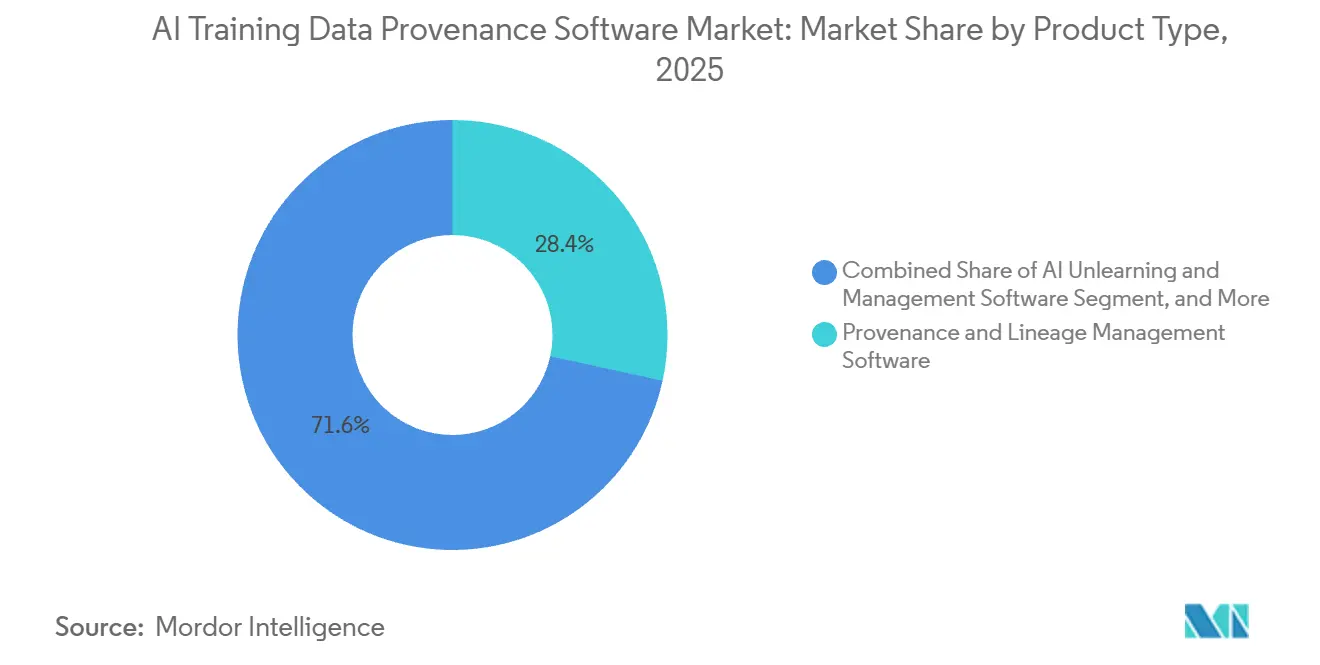
- By product type, Provenance and Lineage Management Software held 28.41% of the AI Training Data Provenance Software Market share in 2025, while AI Unlearning and Takedown Management Software is projected to expand at a CAGR of 28.42% through 2031.
- By deployment model, cloud accounted for 72.18% of the AI Training Data Provenance Software Market share in 2025, while hybrid is projected to expand at a CAGR of 27.83% through 2031.
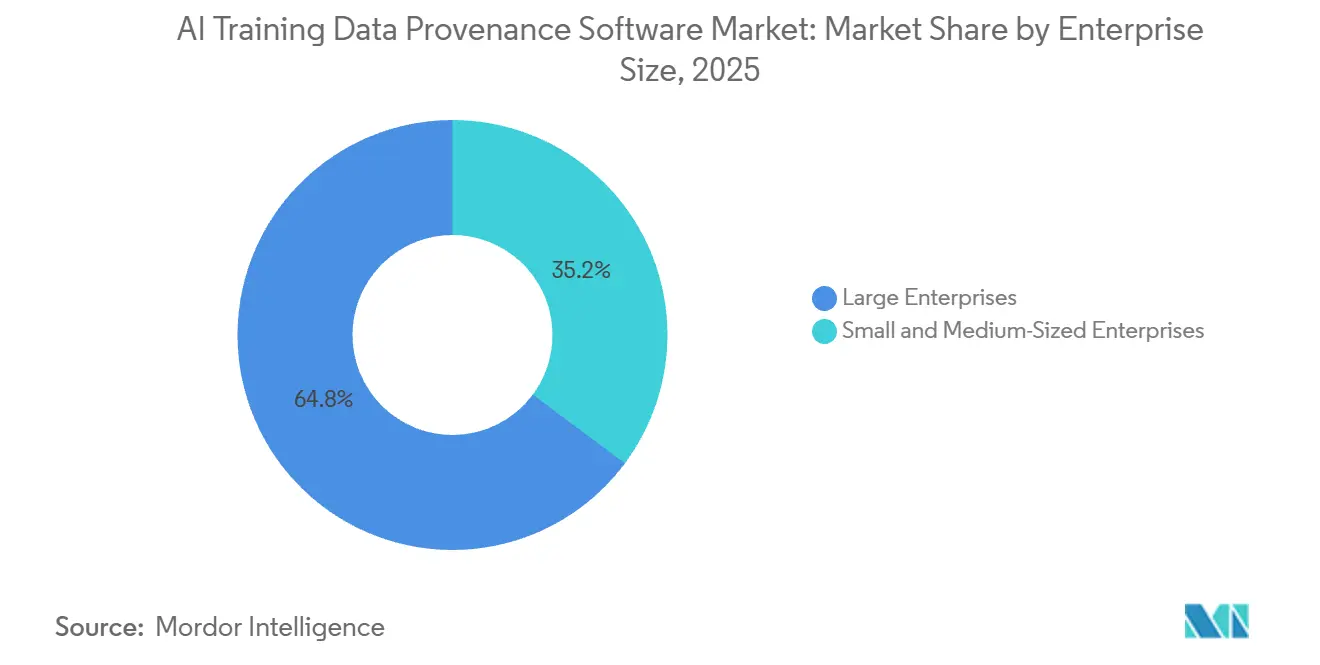
- By enterprise size, large enterprises held 64.82% of the market in 2025, while small and medium-sized enterprises are projected to expand at a CAGR of 28.14% through 2031.
- By end user, IT and Telecommunication accounted for 24.36% of the market in 2025, while Healthcare and Life Sciences are projected to expand at a CAGR of 27.69% through 2031.
- By geography, North America held 34.62% of the market in 2025, while Asia-Pacific is projected to expand at a CAGR of 28.31% through 2031.
Note: Market size and forecast figures in this report are generated using Mordor Intelligence’s proprietary estimation framework, updated with the latest available data and insights as of January 2026.
Global AI Training Data Provenance Software Market Trends and Insights
Drivers Impact Analysis*
| Driver | (~) % Impact on CAGR Forecast | Geographic Relevance | Impact Timeline |
|---|---|---|---|
| EU AI Act Data Governance Evidence Requirements | +5.5% | EU primary, global through multinational compliance spillover | Short term (≤ 2 years) |
| Copyright and License Traceability for Training Data | +4.8% | North America and Europe primary, global secondary | Short term (≤ 2 years) |
| Enterprise Scaling of Generative AI and Fine-Tuning Workloads | +4.2% | Global, led by North America and Asia-Pacific | Medium term (2-4 years) |
| Demand for Rights-Cleared Multimodal Datasets | +3.5% | North America and Europe primary, Asia-Pacific emerging | Medium term (2-4 years) |
| Provenance-Linked Unlearning and Takedown Operations | +2.8% | EU primary, North America secondary | Medium term (2-4 years) |
| Dataset Fingerprinting for Model Reproducibility | +2.1% | Global, led by North America and Asia-Pacific | Long term (≥ 4 years) |
| Source: Mordor Intelligence | |||
EU AI Act Data Governance Evidence Requirements
The AI Training Data Provenance Software Market is gaining support from rules requiring high-risk AI providers to document data origin, collection, labeling, bias review, and corrective action. These obligations move documentation into the training process rather than allowing teams to assemble records after deployment. General-purpose model transparency requirements also make training-data summaries a more visible governance matter. This timing shifts spending priorities because organizations need lineage tools while curating data, not only when an audit begins. Research on provenance disclosure found that complete records covering origin, transformation history, and rights status remained uncommon across public model repositories. The AI Training Data Provenance Software Market therefore benefits when organizations seek one workflow that supports data governance, deletion obligations, and operational logging.[1]Sivizaca Conde et al., “The Operationalization Gap: Auditing Provenance Transparency Under the AI Act,” AIS Electronic Library, aisel.aisnet.org
Copyright and License Traceability for Training Data
Copyright disputes are increasing the value of records that identify the source and license status of each training item. Organizations need to know whether an item was licensed, subject to an opt-out, or restricted by a later rights request. The U.S. Copyright Office identified attribution and recordkeeping issues as material questions in determining how generative AI training relates to copyright law.[2]U.S. Copyright Office, “Copyright and Artificial Intelligence, Part 3: Generative AI Training,” U.S. Copyright Office, copyright.gov This makes rights information important at the point where data is acquired and prepared. It also creates demand for systems that can preserve a clear record when content changes hands across teams or vendors. In the AI Training Data Provenance Software Market, rights, license, and copyright management tools help buyers connect individual content items to their permitted use at the time of training.
Enterprise Scaling of Generative AI and Fine-Tuning Workloads
The AI Training Data Provenance Software Market is supported by enterprise fine-tuning, which combines internal files, third-party material, preference data, and base-model outputs. Each training cycle can alter the source mix, making older records difficult to use. Microsoft’s Copilot Tuning program places tenant-specific model customization within a governed enterprise setting.[3]Microsoft, “Microsoft 365 Copilot Tuning,” Microsoft Learn, learn.microsoft.com That design reflects the need to treat lineage as part of the fine-tuning workflow. A Google research paper on adapting a model for enterprise software engineering also described formal dataset curation practices for a large proprietary corpus. As a result, the AI Training Data Provenance Software Market is drawing demand for dataset lifecycle and versioning tools that preserve reproducibility across repeated training runs.
Demand for Rights-Cleared Multimodal Datasets
Multimodal models require records for text, images, audio, video, and 3D assets, which makes rights checks more difficult than for a single content format. The AI Training Data Provenance Software Market serves this need by tracking clearances across content types and rights holders. Shutterstock expanded its licensed training dataset offering to include additional formats and categories for generative AI use. IBM also released ChartNet with licensing documentation for 4.2 million synthetic chart samples. These examples show that documented licensing can help datasets enter enterprise training workflows with fewer questions about permitted use. The resulting need is broader than regulatory compliance, as any developer seeking defensible intellectual property records may need the same controls.[4]Shutterstock, “Shutterstock Announces Major Expansion of Licensed Training Datasets to Power the Next Generation of Generative AI,” Shutterstock Investor Relations, investor.shutterstock.com
Restraints Impact Analysis*
| Restraint | (~) % Impact on CAGR Forecast | Geographic Relevance | Impact Timeline |
|---|---|---|---|
| Shortage of AI Governance and Data Engineering Skills | -3.2% | Global, most acute in the EU and North America | Short term (≤ 2 years) |
| Fragmented Legal Standards Across Jurisdictions | -2.5% | Global, most impactful for multinational operators | Medium term (2-4 years) |
| Proprietary Dataset Formats and Weak Cross-Platform Interoperability | -1.8% | Global | Medium term (2-4 years) |
| Provenance Metadata Leakage and Adversarial Manipulation Risk | -1.3% | Global, highest impact in healthcare and defense | Long term (≥ 4 years) |
| Source: Mordor Intelligence | |||
Shortage of AI Governance and Data Engineering Skills
The AI Training Data Provenance Software Market faces a deployment constraint because implementation requires data engineering, ML operations, and regulatory knowledge. Teams must configure data capture, connect it to training pipelines, and make the resulting record usable for review. This work is difficult when organizations assign governance duties to staff who lack experience with data systems. The shortage is especially important for smaller buyers who cannot maintain dedicated technical and compliance teams. It can leave organizations with software that has been purchased but not fully configured, leaving them without the evidence an auditor may request. Vendors can reduce this barrier through prebuilt templates, guided deployment, and automated evidence collection, thereby limiting the amount of specialist work required.
Fragmented Legal Standards Across Jurisdictions
The AI Training Data Provenance Software Market is also constrained by the different rules that global organizations must comply with across regions. The EU approach, U.S. policy direction, Chinese rules, and emerging national measures do not use one shared documentation model. A legal analysis of 2026 data-law trends described policy areas that both align and conflict across AI governance, data transfers, cybersecurity, and consumer protection. Buyers may respond by building to the strictest expected standard or by maintaining separate processes for each jurisdiction. Both choices increase cost and extend decision cycles. This is particularly difficult for first-time buyers that lack an internal team to translate legal requirements into technical controls.
*Our forecasts treat driver/restraint impacts as directional, not additive. The impact forecasts reflect baseline growth, mix effects, and variable interactions.
Segment Analysis
By Product Type: Takedown Automation Expands the Software Stack
Provenance and Lineage Management Software held 28.41% of the market in 2025. This category meets the basic need to follow data from collection through preparation and training. Organizations use it to record source information, collection methods, annotations, and preprocessing steps. The category is important because foundational records support later rights review, quality checks, and compliance reporting. Rights, License, and Copyright Management Software and AI Data Governance, Quality, and Compliance Software form the next part of the product mix. BFSI and healthcare buyers are using these products as their model risk practices increasingly focus on training data documentation.
AI Unlearning and Takedown Management Software is projected to expand at a 28.42% CAGR through 2031, contributing to the AI Training Data Provenance Software Market. The category addresses requests to remove data and demonstrates that the request was handled. The European Data Protection Board made the right to erasure a coordinated enforcement priority for 2025 and 2026. Removing a training item requires a record of where it was used and how it affected later processes. Research presented at NeurIPS identified per-example training provenance as a central barrier to verifying regulatory-grade erasure. The category, therefore, depends on the same records that underpin lineage management, rather than operating as an isolated compliance function.



By Deployment Model: Hybrid Responds to Regulated-Sector Needs
Cloud deployment accounted for 72.18% of the market in 2025. Cloud systems fit enterprise ML environments because they can connect through APIs to managed training and fine-tuning services. They also give development teams a common governance layer across distributed projects. This approach remains useful for organizations that need rapid access to compute and collaboration tools. The market position does not mean every dataset or provenance record can leave the organization’s own environment. Data residency, sector rules, and internal security policies still influence where sensitive records are stored.
Hybrid deployment is projected to expand at a CAGR of 27.83% through 2031. It enables organizations to retain sensitive training data and lineage records in private environments while using public cloud resources for demanding compute tasks. This model is relevant to BFSI, healthcare, government, and other organizations with strict custody requirements. It can also support developer control of the documentation that regulators or customers may need to review. The AI Training Data Provenance Software Market is seeing this architecture gain attention as organizations balance cloud efficiency against the need to maintain control over data records. On-premises options continue to serve sovereign AI programs where national boundaries determine where training data documentation must remain.
By Enterprise Size: SMEs Address an Expanding Compliance Need
Large enterprises held 64.82% of the market in 2025. Their position reflects larger AI programs, greater regulatory exposure, and IT budgets that can support multiyear platform deployments. Organizations with many fine-tuning pipelines often need records that connect datasets across business units and models. Standard data catalogs may not capture the training-specific lineage required for these workflows. Large buyers can also maintain teams that manage integrations, policy controls, and formal reviews. These conditions make it easier to justify dedicated provenance infrastructure.
Small and medium-sized enterprises are projected to expand at a CAGR of 28.14% through 2031. High-risk AI obligations apply to an organization after it deploys a covered system, regardless of its size. Smaller organizations, therefore, need accessible tools that translate documentation requirements into manageable steps. SaaS delivery is reducing the initial implementation burden by providing basic controls without a lengthy on-premises project. Law firms and professional service providers also create demand when they use AI for client work and must address heightened intellectual property scrutiny. The AI Training Data Provenance Software Industry is responding through automated templates for the EU AI Act, ISO 42001, and NIST AI RMF practices.
By End User: Healthcare and Life Sciences Gains Regulatory Support
IT and Telecommunication accounted for 24.36% of the market in 2025. The sector both develops AI infrastructure and uses AI for network optimization and customer experience work. This dual role creates extensive training-data activity and a need for repeatable documentation. BFSI is another important demand group because its model risk functions require evidence for validation and control. Automotive and Transportation buyers need traceability for data used in autonomous and assisted systems. Manufacturing, retail, and e-commerce add demand through predictive maintenance, quality inspection, and personalization use cases.
Healthcare and Life Sciences are projected to expand at a CAGR of 27.69% through 2031. The FDA and EMA published guiding principles in January 2026 that addressed AI use across research, manufacturing, and pharmacovigilance. The principles place training data integrity and fitness for purpose near the claims of safety and effectiveness. IEC PAS 63621:2026 also addresses data provenance, version control, and purpose limitation for AI-enabled medical devices. These requirements increase the cost of incomplete records in clinical development and medical device workflows. The AI Training Data Provenance Software Industry can therefore serve a sector where training data documentation is closely linked to product evidence.
Geography Analysis
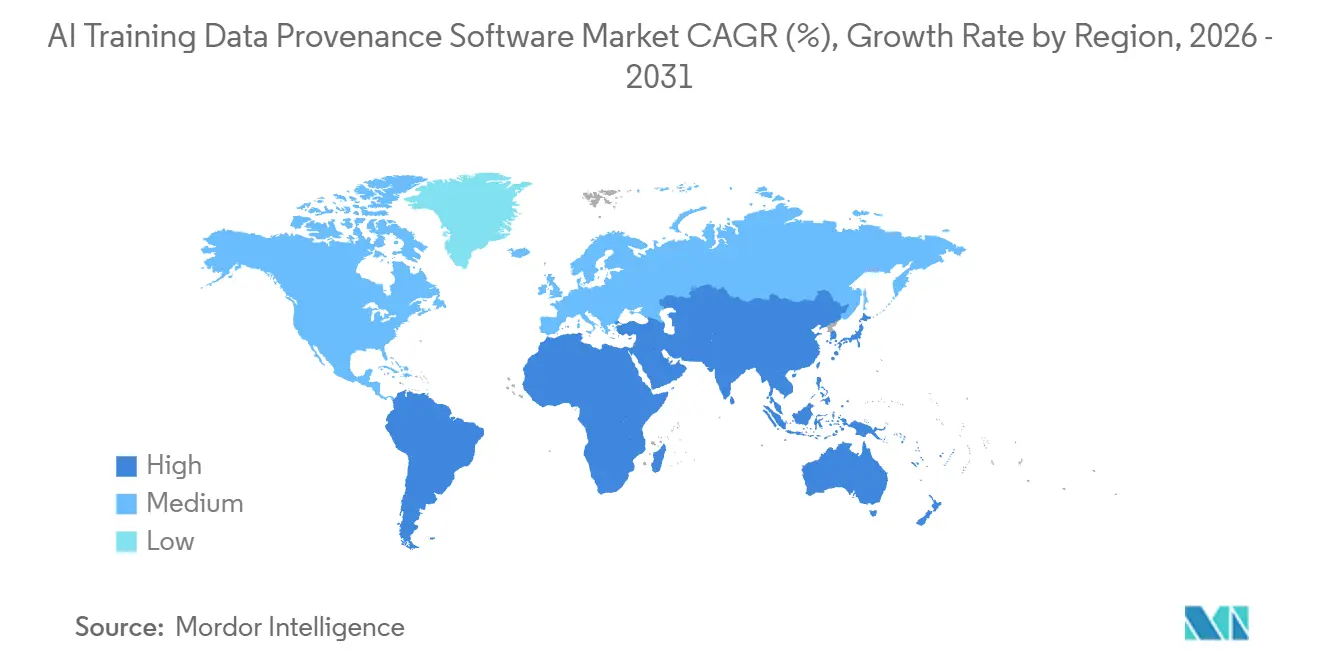
North America held 34.62% of the market in 2025. The region combines a large base of generative AI development with early enterprise adoption of governance practices. Copyright litigation is making training-data records an operational issue for developers and legal teams. NIST AI RMF use and government procurement expectations also support demand for documented data provenance. Canada adds interest through its AI and data policy work, while Mexico benefits as technology supply chains extend governance expectations. The region’s shortage of governance talent can slow deployments but also increases interest in software-led automation.
Europe was the second-largest geography in 2025. The AI Training Data Provenance Software Market is supported by EU AI Act requirements that encourage data documentation before high-risk systems enter the market. Germany, the United Kingdom, and France are the main demand centers. Germany’s industrial base supports demand for versioning and reproducibility tools. The United Kingdom’s financial services sector supports rights and license management needs. France’s Health Data Hub and the EU AI Factories initiative add a public-sector channel for suppliers that can support government technology requirements.
Asia-Pacific is projected to expand at a CAGR of 28.31% through 2031. China’s rules for generative AI services require providers to address the lawfulness and accuracy of their training data, which supports platform-level controls over provenance. India’s data-governance direction is increasing interest in data residency and documented records among AI startups. South Korea and Japan have published governance frameworks that reference training-data documentation. Singapore is becoming a regional center for governance-focused AI work, and Scale AI formalized an AI evaluation research collaboration with Singapore’s IMDA in April 2026. South America, led by Brazil, is emerging as privacy and AI policy measures create requirements in financial services and public administration. The Middle East and Africa are also early but important opportunities because Saudi Arabia and the UAE are developing sovereign AI programs that require documented data provenance for government systems.

Competitive Landscape
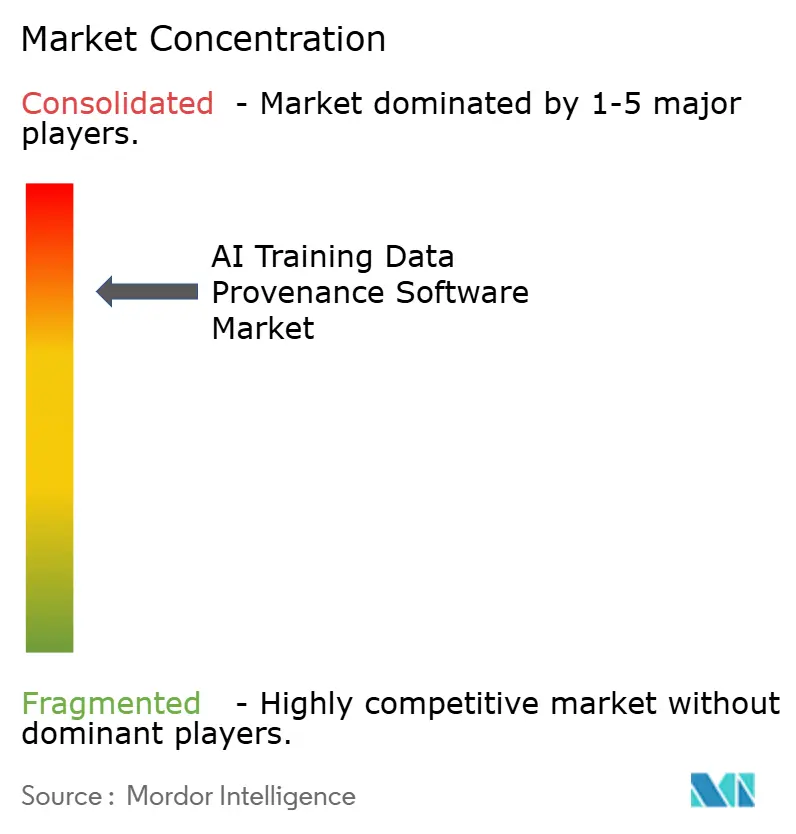
The AI Training Data Provenance Software Market is moderately consolidated because no vendor covers every step from raw-data intake to model-level rights attestation and unlearning verification. ML-native companies, including Scale AI, Encord, Labelbox, Snorkel AI, and SuperAnnotate, extend annotation and data-centric capabilities into lineage and compliance functions. Governance-oriented companies, including Collibra, Alation, Atlan, and Acryl Data, are extending their catalog and data-governance products to AI-specific use cases. These groups compete most directly in the dataset lifecycle and AI data-governance products. AI Unlearning and Takedown Management Software does not yet have a clear leading supplier. This gives specialized providers room to develop products for data removal and verification.
Collibra launched AI Command Center in May 2026 to provide real-time oversight and continuous control for agentic AI. In June 2026, Collibra and Databricks expanded their governance partnership, connecting AI Command Center with Databricks Agent Bricks and MCP Server. Alation launched AIOS in July 2026, combining data context, lineage, conversational analysis, and agent governance into a single architecture. These moves show that governance-focused vendors are seeking broader coverage across AI development and deployment. Annotation-focused vendors instead compete through automation, volume management of training data, and depth of data preparation. The AI Training Data Provenance Software Market is likely to reward products that join those strengths without forcing customers to maintain separate systems.
Policy templates are another route to differentiation, as buyers need to align technical records with the EU AI Act, NIST AI RMF, ISO 42001, and sector-specific rules. Credo AI and OneTrust illustrate compliance-led positioning through policy packs and connections to broader privacy and governance functions. Dataset watermarking and fingerprinting are also becoming relevant for customers who need to establish ownership of training material. Peer-reviewed research has examined black-box-verifiable dataset ownership under adversarial conditions. Other research has considered watermarking fine-tuning datasets for stronger provenance. A gap remains around legal holds, model provenance, and records that can link a specific training example to a model output.
AI Training Data Provenance Software Industry Leaders
Scale AI, Inc.
Appen Limited
Labelbox, Inc.
Encord Ltd.
Snorkel AI, Inc.
- *Disclaimer: Major Players sorted in no particular order

Recent Industry Developments
- July 2026: Alation launched the Alation Intelligence Operating System, a platform unifying data context, lineage, conversational analysis, and AI agent governance in an open architecture. The launch positions Alation to address the full AI governance lifecycle, from training data lineage to deployed agent oversight, on a single platform.
- June 2026: Collibra and Databricks deepened their governance partnership. Databricks named Collibra its Governance Partner of the Year. The expanded collaboration integrates Collibra's AI Command Center with Databricks' Agent Bricks and MCP Server, extending AI governance coverage across the Databricks Data Intelligence Platform.
- June 2026: Dataiku announced the general availability of Dataiku Cobuild, an AI building agent enabling enterprise teams to develop governed, production-ready AI projects without bypassing compliance and governance controls, available to all Designer-level users from June 18, 2026.
- May 2026: Collibra launched the AI Command Center, providing real-time automated control over agentic AI with continuous lifecycle management, alongside a new strategic partnership with AI testing firm Giskard.


Global AI Training Data Provenance Software Market Report Scope
The AI training data provenance software market refers to the ecosystem of software solutions designed to track, manage, and verify the origin, ownership, licensing, and lifecycle history of datasets used to train artificial intelligence and machine learning models. This market addresses the growing legal, ethical, and regulatory challenges associated with AI data sourcing by providing tools for provenance and lineage tracking, intellectual property and copyright management, dataset versioning, and comprehensive data governance. A critical emerging capability within this market is AI unlearning and takedown management, which allows organizations to systematically remove the influence of specific copyrighted, biased, or compromised data points from already-trained models. Deployed across cloud, hybrid, or on-premises environments, these solutions cater to organizations of all sizes across industries such as IT, BFSI, healthcare, and automotive. By ensuring transparent and auditable data supply chains, these solutions enable enterprises to mitigate intellectual property infringement risks, maintain strict compliance with evolving AI regulations (such as the EU AI Act), and build highly trustworthy, ethical AI systems.
The AI Training Data Provenance Software Market Report is Segmented by Product Type (Provenance and Lineage Management Software, Rights, License, and Copyright Management Software, Dataset Lifecycle, Versioning and Reproducibility Software, AI Data Governance, Quality and Compliance Software, and AI Unlearning and Takedown Management Software), Deployment Model (Cloud, Hybrid, and On-Premises), Enterprise Size (Large Enterprises, and Small and Medium-Sized Enterprises), End User (IT and Telecommunication, BFSI, Automotive and Transportation, Healthcare and Life Sciences, Retail and E-Commerce, Industrial Manufacturing, and Other End Users), and Geography (North America, South America, Europe, Asia-Pacific, and Middle East and Africa). The Market Forecasts are Provided in Terms of Value (USD).
| Provenance and Lineage Management Software |
| Rights, License, and Copyright Management Software |
| Dataset Lifecycle, Versioning and Reproducibility Software |
| AI Data Governance, Quality and Compliance Software |
| AI Unlearning and Takedown Management Software |
| Cloud |
| Hybrid |
| On-Premises |
| Large Enterprises |
| Small and Medium-Sized Enterprises |
| IT and Telecommunication |
| BFSI |
| Automotive and Transportation |
| Healthcare and Life Sciences |
| Retail and E-Commerce |
| Industrial Manufacturing |
| Other End Users |
| North America | United States | |
| Canada | ||
| Mexico | ||
| South America | Brazil | |
| Argentina | ||
| Rest of South America | ||
| Europe | Germany | |
| United Kingdom | ||
| France | ||
| Russia | ||
| Spain | ||
| Rest of Europe | ||
| Asia-Pacific | China | |
| Japan | ||
| India | ||
| South Korea | ||
| Southeast Asia | ||
| Rest of Asia-Pacific | ||
| Middle East and Africa | Middle East | Saudi Arabia |
| United Arab Emirates | ||
| Rest of Middle East | ||
| Africa | South Africa | |
| Nigeria | ||
| Rest of Africa | ||
| By Product Type | Provenance and Lineage Management Software | ||
| Rights, License, and Copyright Management Software | |||
| Dataset Lifecycle, Versioning and Reproducibility Software | |||
| AI Data Governance, Quality and Compliance Software | |||
| AI Unlearning and Takedown Management Software | |||
| By Deployment Model | Cloud | ||
| Hybrid | |||
| On-Premises | |||
| By Enterprise Size | Large Enterprises | ||
| Small and Medium-Sized Enterprises | |||
| By End User | IT and Telecommunication | ||
| BFSI | |||
| Automotive and Transportation | |||
| Healthcare and Life Sciences | |||
| Retail and E-Commerce | |||
| Industrial Manufacturing | |||
| Other End Users | |||
| By Geography | North America | United States | |
| Canada | |||
| Mexico | |||
| South America | Brazil | ||
| Argentina | |||
| Rest of South America | |||
| Europe | Germany | ||
| United Kingdom | |||
| France | |||
| Russia | |||
| Spain | |||
| Rest of Europe | |||
| Asia-Pacific | China | ||
| Japan | |||
| India | |||
| South Korea | |||
| Southeast Asia | |||
| Rest of Asia-Pacific | |||
| Middle East and Africa | Middle East | Saudi Arabia | |
| United Arab Emirates | |||
| Rest of Middle East | |||
| Africa | South Africa | ||
| Nigeria | |||
| Rest of Africa | |||


Key Questions Answered in the Report
What is the AI Training Data Provenance Software Market size?
The AI Training Data Provenance Software Market was USD 3.18 billion in 2025, is USD 4.03 billion in 2026, and is projected to reach USD 12.46 billion by 2031 at a CAGR of 26.54%. The projection reflects growing demand for dataset lineage, rights controls, version histories, and documented governance workflows.
What is driving demand for AI training data provenance software?
Documentation requirements, copyright and licensing controls, enterprise fine-tuning, and rights-cleared multimodal datasets are expanding demand. Buyers also need usable records that identify data origin, preparation steps, permitted use, and any later request to remove material.
Which product type leads AI training data provenance software adoption?
Provenance and Lineage Management Software led with 28.41% share in 2025, while AI Unlearning and Takedown Management Software is projected to grow at a CAGR of 28.42% through 2031. The two categories are linked because targeted removal depends on knowing where training data was used.
Why is hybrid deployment gaining importance for provenance software?
Hybrid deployment is projected to grow at a CAGR of 27.83% because regulated users can retain sensitive records in controlled environments while using cloud compute. This approach helps healthcare, BFSI, government, and sovereign AI users balance scalable model development with custody requirements.
Which end user is growing fastest in this field?
Healthcare and Life Sciences is projected to expand at a CAGR of 27.69% through 2031 as training-data integrity and documentation become more important in regulated development workflows. The sector needs records that can support product evidence across research, clinical development, manufacturing, and pharmacovigilance.
Which region is expected to grow fastest?
Asia-Pacific is projected to expand at a CAGR of 28.31% through 2031 as regional AI governance frameworks and data-residency needs advance adoption. Demand is supported by regulatory activity in China, India, South Korea, Japan, and Singapores work on AI evaluation.
Page last updated on:






