
AI-Powered Marketing Services Market Size and Share
Market Overview
| Study Period | 2020 - 2031 |
|---|---|
| Market Size (2026) | USD 28.90 Billion |
| Market Size (2031) | USD 78 Billion |
| Growth Rate (2026 - 2031) | 21.97 % |
| Fastest Growing Market | Middle East |
| Largest Market | North America |
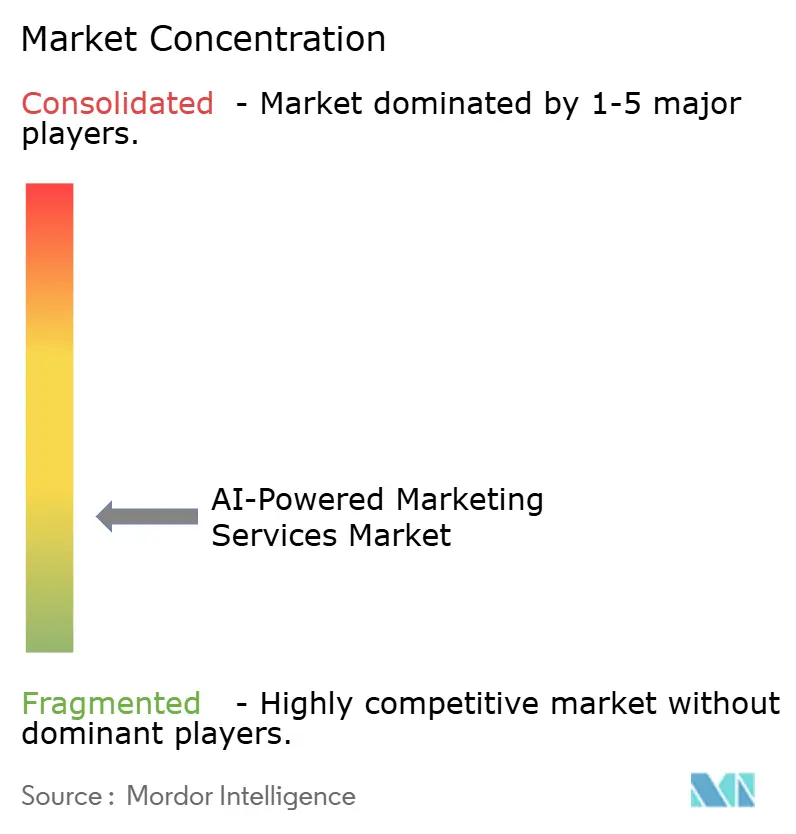
| Market Concentration | Low |
Major Players *Disclaimer: Major Players sorted in no particular order Image © Mordor Intelligence. Reuse requires attribution under CC BY 4.0. | |
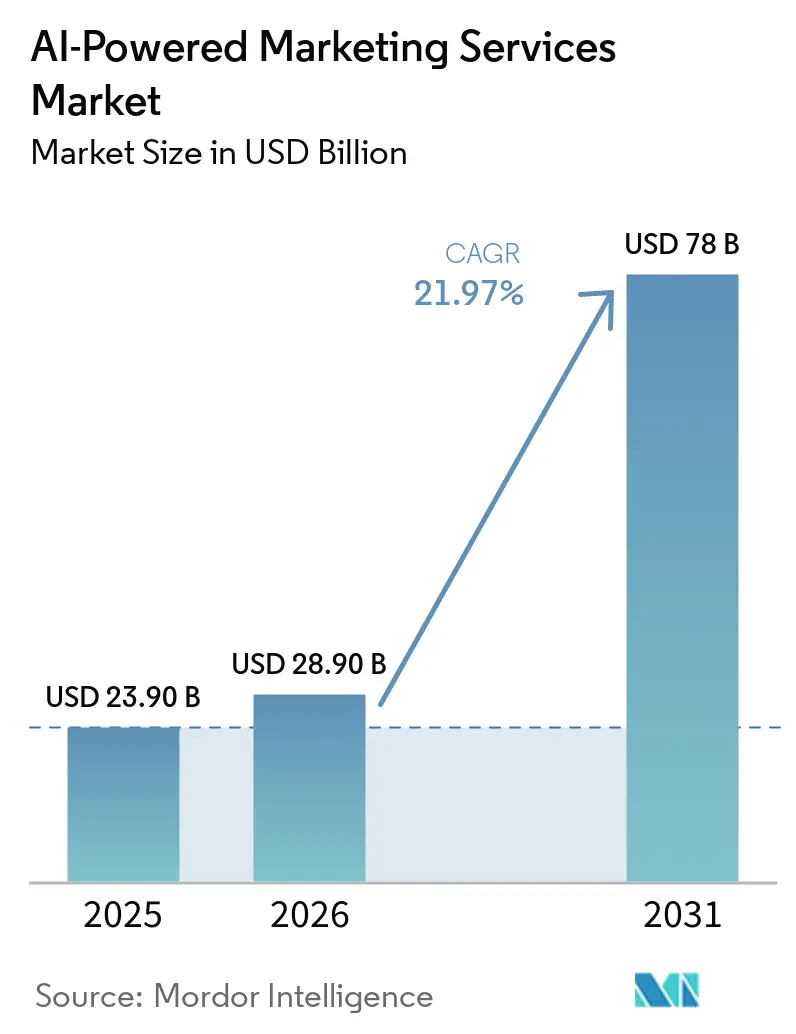
AI-Powered Marketing Services Market Analysis by Mordor Intelligence
The AI-powered marketing services market size is expected to grow from USD 23.9 billion in 2025 to USD 28.9 billion in 2026 and is forecast to reach USD 78 billion by 2031 at 21.97% CAGR over 2026-2031. The AI-powered marketing services market is moving forward on the back of generative AI adoption, large language model infrastructure, and stronger use of first-party data across enterprise systems. A larger share of marketing budgets is shifting away from labor-heavy execution and toward software, automation, and orchestration layers that can scale work faster. Agentic systems are also changing how campaigns are built and managed, because they can connect content creation, decisioning, and activation in a more continuous workflow. Competition in the AI-powered marketing services market is increasingly shaped by data architecture, since vendors with stronger identity resolution, behavioral signals, and measurement capabilities hold a clearer edge in retention and upsell. Regulatory pressure around profiling and AI-generated content, along with weaker click-level visibility in AI search environments, is raising execution complexity, yet the wide gap between pilot adoption and scaled value capture continues to leave room for expansion across the AI-powered marketing services market.
Key Report Takeaways
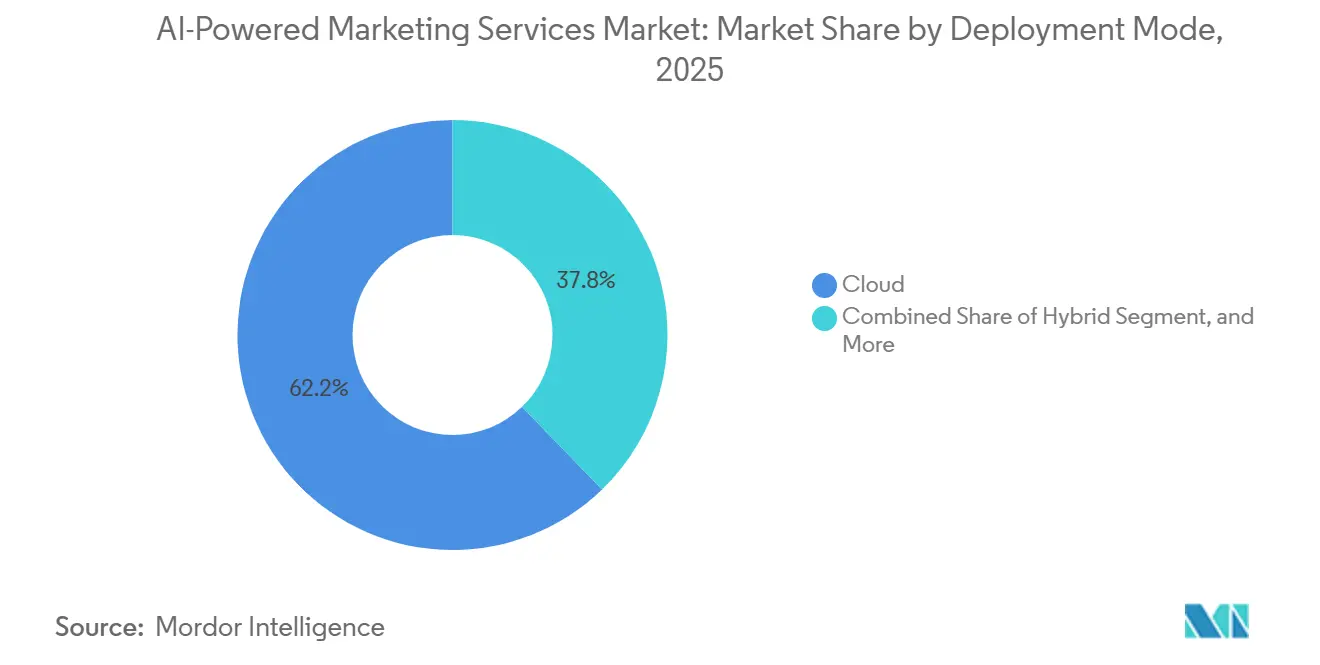
- By deployment mode, cloud held 62.24% of the AI-powered marketing services market in 2025, while hybrid is projected to expand at a 24.91% CAGR through 2031.
- By organization size, large enterprises accounted for 66.78% of revenue in 2025, while SMEs are expected to expand at a 26.61% CAGR from 2026 to 2031.
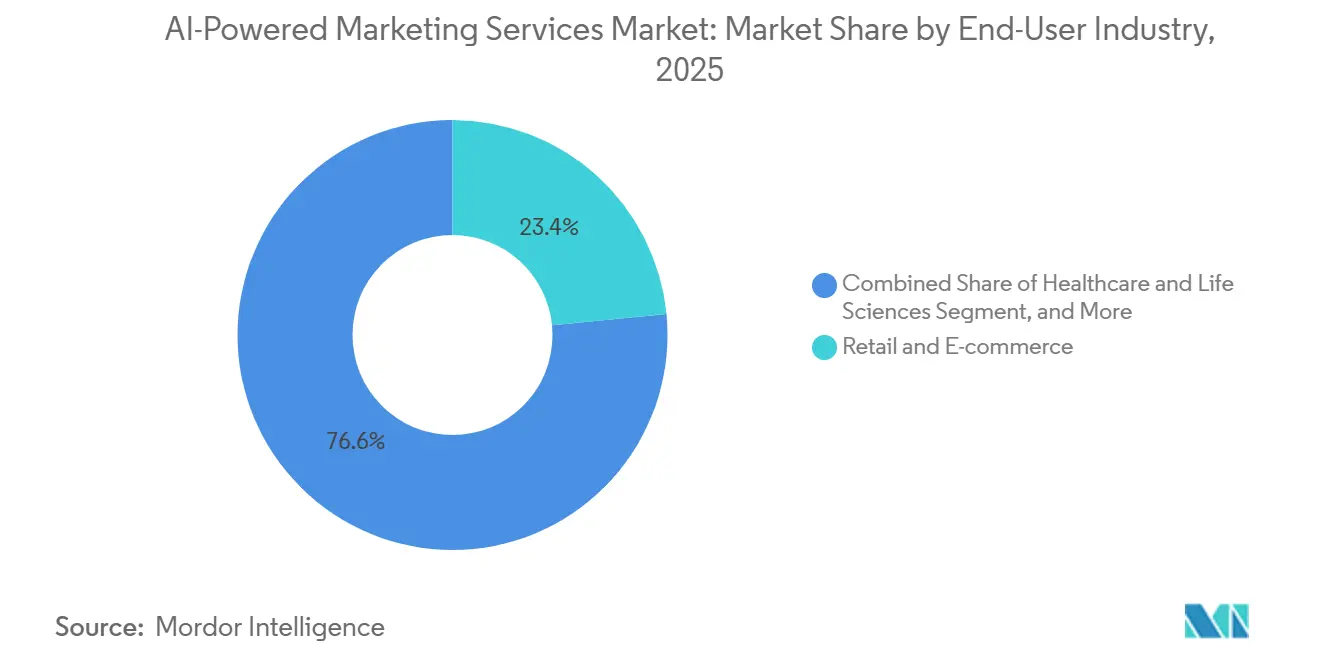
- By end-user industry, retail and e-commerce held 23.44% share in 2025, while healthcare and life sciences is projected to record the fastest growth at 26.88% CAGR through 2031.
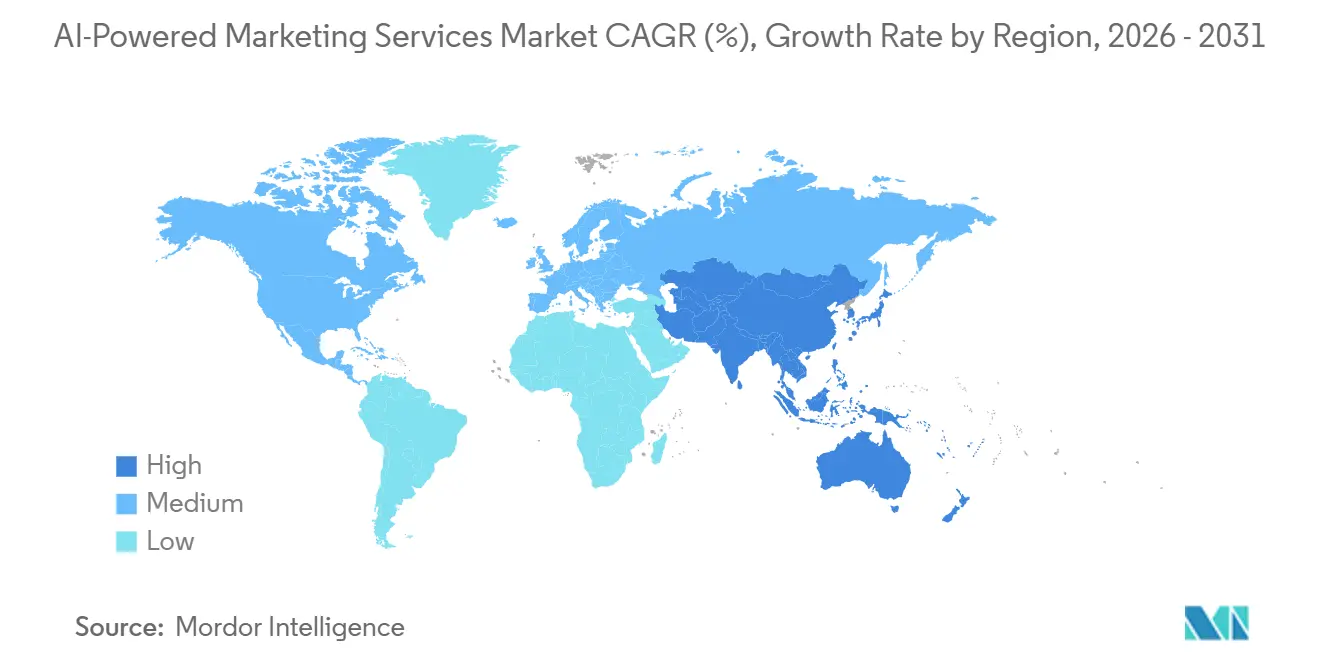
- By geography, North America accounted for 47.78% of global revenue in 2025, while the Middle East is projected to advance at a 25.56% CAGR from 2026 to 2031.
Note: Market size and forecast figures in this report are generated using Mordor Intelligence’s proprietary estimation framework, updated with the latest available data and insights as of January 2026.
Market Trends and Insights
Drivers Impact Analysis of AI-Powered Marketing Services Market*
| Driver | (~) % Impact on CAGR Forecast | Geographic Relevance | Impact Timeline |
|---|---|---|---|
| Rising Demand for Hyper-Personalized Customer Engagement | +4.8% | Global, led by North America and Asia-Pacific | Medium term (2-4 years) |
| Generative AI-Driven Content Production Efficiency | +4.2% | Global, with early concentration in North America and Europe | Short term (≤ 2 years) |
| Expansion of Omnichannel Commerce and Performance Marketing | +3.5% | North America, Asia-Pacific, Middle East | Medium term (2-4 years) |
| Integration of AI With CRM and Marketing Automation Platforms | +2.8% | Global, with enterprise concentration in North America and Europe | Short term (≤ 2 years) |
| Generative Engine Optimization and AI Search Visibility Spend | +2.2% | North America, EU, APAC core | Short term (≤ 2 years) |
| Agentic Campaign Execution and Human-in-the-Loop Productivity Gains | +1.7% | North America and Europe, with spillover to the Middle East | Long term (≥ 4 years) |
| Source: Mordor Intelligence | |||
Rising Demand for Hyper-Personalized Customer Engagement
The AI-powered marketing services market is benefiting from the shift in personalization from an optional tactic to a core part of customer engagement. Brands are now under pressure to respond to behavior in real time across channels, which raises demand for platforms that can unify identity, content, and decisioning in one workflow. Adobe reported in 2025 that 63% of organizations were already using or piloting AI-powered personalization, and 86% had pilot or working solutions in place to analyze customer interactions, which shows that enterprise adoption has moved past early exploration.[1] The main bottleneck is no longer model access alone, because the stronger differentiator sits in identity resolution and real-time signal ingestion across the stack. That dynamic favors vendors in the AI-powered marketing services market that can connect customer data cleanly before applying personalization logic. It also raises the retention risk for brands that still operate with fragmented customer records, because more consistent experiences on larger platforms are resetting user expectations across the AI-powered marketing services market.
Generative AI-Driven Content Production Efficiency
The AI-powered marketing services market is also gaining from the move away from content creation as a fixed operational bottleneck. Generative tools are making it possible to produce more variations, localizations, and audience-specific assets without expanding teams at the same pace. Adobe said in June 2025 that Lumen Technologies cut campaign launch time from 25 days to 9 days after deploying Adobe GenStudio for Performance Marketing, while ad variation production time for Meta properties across 2 target personas fell by 65%.[2] Adobe also expanded GenStudio in October 2025 with scaled content production capabilities, Firefly Design Intelligence, Firefly Creative Production for Enterprise, and a wider ad delivery ecosystem, which points to growing demand for content operations that behave more like infrastructure. As content velocity rises, the AI-powered marketing services market is seeing stronger demand for measurement, governance, and performance feedback layers that can keep pace with asset output. This means content automation is not reducing platform demand; it is broadening the number of adjacent systems that enterprise buyers need across the AI-powered marketing services market.
Expansion Of Omnichannel Commerce And Performance Marketing
The AI-powered marketing services market is being pushed forward by the need to manage customer journeys across retail media, commerce platforms, programmatic channels, and owned properties in one coordinated flow. Omnichannel execution now depends less on static channel planning and more on systems that can adjust audience, content, and bidding decisions in real time. The Trade Desk said in May 2026 that it integrated with Pacvue and Skai so shared clients could manage programmatic activity within broader commerce media workflows, which reflects a wider move toward unified activation and measurement.[3] The Trade Desk also highlighted additional AI-led optimization controls and contextual marketplace updates in its Q2 2026 release cycle, reinforcing the direction of automated cross-channel optimization. In practical terms, the AI-powered marketing services market is gaining from clients that no longer want separate tools for retail media, open web buying, and commerce analytics. This is especially relevant in verticals where timing, inventory context, and revenue attribution all matter at once, which keeps omnichannel coordination central to growth across the AI-powered marketing services market.
Integration Of AI With CRM And Marketing Automation Platforms
Tighter links between AI systems, CRM records, and campaign automation layers are reshaping the AI-powered marketing services market. Enterprises increasingly want AI agents to act on live customer and revenue data without relying on exports, batch handoffs, or disconnected middleware. Salesforce completed its Informatica acquisition in November 2025 to bring data cataloging, governance, quality, and master data management into its platform, directly supporting safer AI execution across marketing, sales, and service workflows. HubSpot said in April 2026 that organic traffic for its customers fell 27% year over year while AI referral traffic generally tripled, and it used that change to position answer engine optimization as part of a CRM-connected response to shifting discovery behavior. The supply side of the AI-powered marketing services market is responding by closing the loop across fewer platforms for customer data, content generation, activation, and reporting. That makes integration depth more valuable than feature breadth, and it helps explain why consolidation activity has become a defining pattern in the AI-powered marketing services market.
Restraints Impact Analysis of AI-Powered Marketing Services Market*
| Restraint | (~) % Impact on CAGR Forecast | Geographic Relevance | Impact Timeline |
|---|---|---|---|
| Data Privacy, Consent, and Automated Profiling Scrutiny | -3.5% | EU, North America, APAC data privacy markets | Short term (≤ 2 years) |
| High Implementation Costs and AI Talent Gaps | -2.6% | Global, with stronger pressure in South America, Africa, and smaller Asia-Pacific markets | Medium term (2-4 years) |
| Zero-Click AI Search and Attribution Compression | -1.8% | North America and Europe primary, with global spillover | Short term (≤ 2 years) |
| Synthetic Media Disclosure and Brand Trust Burden | -1.1% | North America and EU | Long term (≥ 4 years) |
| Source: Mordor Intelligence | |||
Data Privacy, Consent, And Automated Profiling Scrutiny
The AI-powered marketing services market is facing heavier compliance pressure as privacy rules move closer to how automated profiling and content generation work in practice. The next implementation phase of the EU AI Act begins in August 2026, and that raises the burden on enterprises that use AI for segmentation, personalization, and automated decision support. The European Data Protection Supervisor published updated orientations in October 2025 on using generative AI systems in a compliant way, with a focus on lawful processing, governance, and data protection controls that directly affect enterprise deployment standards. This pushes buyers in the AI-powered marketing services market to redesign data pipelines, consent flows, and human oversight mechanisms before scaling automation more broadly. It also strengthens the position of vendors that already offer auditability, documentation, and policy controls as part of their delivery model. For many enterprise deals in the AI-powered marketing services market, compliance features are moving from procurement preference to a minimum entry requirement.
High Implementation Costs And AI Talent Gaps
The AI-powered marketing services market still faces a practical adoption gap between what tools can do and what organizations can operationalize at scale. Licensing is only one part of the expense, because meaningful deployment also requires workflow redesign, training, governance, and cross-functional alignment. Many teams still struggle to connect marketing, sales, analytics, and legal functions around shared execution rules, which slows rollout even when technology is available. This is especially difficult for smaller companies and regional agencies, because they have less room to absorb the cost of specialist talent, change management, and ongoing experimentation. The result is that the AI-powered marketing services market can show strong interest and active pilots at the same time that full production adoption remains uneven. It also means vendors that simplify implementation, reduce technical overhead, and package repeatable use cases will be better placed to convert demand into contracted revenue across the AI-powered marketing services market.
*Our forecasts treat driver/restraint impacts as directional, not additive. The impact forecasts reflect baseline growth, mix effects, and variable interactions.
AI-Powered Marketing Services Market Segment Analysis
By Deployment Mode:
Hybrid Architecture Gains Ground As A Compliance ChoiceCloud deployment held 62.24% of the AI-powered marketing services market share in 2025, reflecting the strong preference for scalable, API-first environments that can support frequent model updates and high-volume processing. Cloud also suits the pace of this category, because vendors can push feature changes, security updates, and compliance controls across customers without long upgrade cycles. On-premises setups still matter in financial services, defense, and regulated healthcare, where customer data handling rules remain strict and internal control is prioritized. Even so, the center of gravity in the AI-powered marketing services market remains with cloud platforms, which offer faster deployment and broader integration across customer engagement stacks.
Hybrid deployment is expected to post the fastest growth in the AI-powered marketing services market size at a 24.91% CAGR from 2026 to 2031, because many enterprises now want sensitive identity data to remain in controlled environments while inference and content generation move to the cloud. This architecture is becoming more relevant as multinational organizations face different privacy and residency requirements across regions. Adobe and NVIDIA announced a strategic partnership in March 2026 to support next-generation Firefly models and cloud-native 3D digital twin workflows, pointing to the type of connected environment large brands are preparing to use for more complex marketing operations. In the AI-powered marketing services industry, vendors that can orchestrate compliant movement between on-premises data stores and cloud-based execution layers are likely to hold a stronger position as regulatory expectations tighten.

By Organization Size:
SMEs Move Into The Next Adoption WaveLarge enterprises accounted for 66.78% of revenue in 2025, supported by multi-year contracts, broader omnichannel needs, and the internal resources required to operationalize custom data models. Their current lead in the AI-powered marketing services market reflects both budget scale and the complexity of managing large customer bases across regions and business units. At the same time, that lead is no longer widening, because access to generative AI tools and subscription-based software has lowered the threshold for sophisticated personalization and automation. The AI-powered marketing services market is therefore moving into a phase where adoption depth in smaller organizations matters more than simple enterprise presence.
SMEs are projected to expand at a 26.61% CAGR from 2026 to 2031, which makes them the fastest-growing organizational cohort in the AI-powered marketing services market size outlook. This shift reflects the falling minimum spend needed to deploy useful AI workflows and the rise of products built for lean teams rather than dedicated data science units. Specialized vendors are benefiting from this opening because they can package high-value use cases such as personalization, segmentation, and send-time optimization into simpler interfaces. That dynamic increases competitive pressure on large horizontal platforms, especially in e-commerce and direct-to-consumer settings where smaller teams want quick activation rather than long implementation programs. The AI-powered marketing services industry is therefore seeing a more balanced demand profile, with enterprise value still concentrated at the top while incremental growth comes from a wider base of smaller customers.
By End-User Industry:
Healthcare And Life Sciences Takes The Lead In GrowthRetail and e-commerce accounted for 23.44% of the AI-powered marketing services market in 2025, underscoring the direct link between personalized engagement and measurable transaction outcomes. That vertical still offers the clearest ROI path, because product discovery, conversion, and repeat purchase behavior can be observed and optimized in a relatively tight loop. It also remains the most competitive part of the AI-powered marketing services market, since performance benchmarks are visible and vendors can prove value more quickly. This strength should keep retail and e-commerce central to product development, especially for campaign automation, recommendation logic, and audience activation tools.
Healthcare and life sciences are projected to expand at a 26.88% CAGR from 2026 to 2031, making it the fastest-growing end-user segment in the AI-powered marketing services market. Growth is being supported by more compliant personalized outreach in pharmaceutical detailing and by patient engagement platforms that need to manage communications with greater precision. IT and telecommunications, BFSI, and media and entertainment remain important demand centers, but they are working from a more mature base of earlier automation adoption. Travel and hospitality are moving into stronger commercial use as real-time pricing, loyalty targeting, and multi-step journey content become easier to automate. Manufacturing and industrial still trail other verticals in marketing maturity, although B2B demand generation and account-based marketing use cases are creating clearer adoption signals. Compliance expectations in health communication also favor vendors with established governance models, which gives incumbents with stronger healthcare data controls a more durable advantage in this part of the AI-powered marketing services market.
Geography Analysis
The Americas AI-Powered Marketing Services Market
North America accounted for 47.78% of the AI-powered marketing services market share in 2025, making it the largest regional contributor by a wide margin. The region benefits from deep enterprise software spending, a large concentration of digital advertising budgets, and a dense base of AI-native marketing technology vendors. The United States remains the main proving ground for newer categories such as answer engine optimization, agentic campaign management, and AI-native CRM. Canada and Mexico add to regional depth, with visible adoption in retail and financial services use cases. South America is at an earlier stage of commercialization, but Brazil is creating localized demand as digital commerce and telecom marketing become more data-driven.
Europe AI-Powered Marketing Services Market
Europe holds a distinct place in the AI-powered marketing services market because adoption there is being shaped as much by governance requirements as by pure demand growth. GDPR enforcement, the phased rollout of the EU AI Act, and stricter guidance on AI-driven profiling have pushed buyers toward more controlled deployment models. That creates friction for aggressive personalization, but it also supports premium demand for vendors that can document compliance and reduce procurement risk. Germany and the United Kingdom remain the two largest European markets, with Germany tied more closely to industrial-sector automation needs and the United Kingdom to advanced digital advertising demand.
APAC and MEA AI-Powered Marketing Services Market
Asia-Pacific is the second-largest regional market, although adoption patterns vary widely by country and platform structure. China remains dominated by domestic ecosystems that combine commerce, social engagement, and AI recommendations in closed loops, which limits direct access for many global vendors. India and Southeast Asia offer greater growth opportunities for cloud-based platforms as internet users move deeper into digital commerce and services. The Middle East is projected to record the fastest expansion in the AI-powered marketing services market, with a 25.56% CAGR from 2026 to 2031, supported by state-backed digital economy programs in Saudi Arabia and the United Arab Emirates. Africa remains the smallest region, but South Africa, Nigeria, and Egypt are creating demand in telecommunications and financial services where AI-led segmentation and localized content can scale efficiently.
Competitive Landscape
The AI-powered marketing services market has a bimodal structure, with large horizontal platforms on one side and specialized engagement vendors on the other. The largest vendors are trying to assemble agentic stacks that combine CRM, content, data, and decisioning inside more unified environments. Salesforce completed the Informatica acquisition in November 2025 and later moved on to Momentum and Qualified in 2026, which shows how fast leading vendors are filling capability gaps through inorganic moves. Adobe completed its acquisition of Semrush in April 2026 and tied that move directly to stronger brand visibility across SEO, generative SEO, and agentic search optimization, which speaks to how discovery itself is changing in the AI-powered marketing services market. The competitive center of the AI-powered marketing services market has therefore moved beyond feature parity and toward control over data, discoverability, orchestration, and measurable execution.
A second layer of competition comes from focused platforms that aim to outperform larger suites in specific customer engagement use cases. Braze launched BrazeAI Operator, BrazeAI Agent Console, and Creative Studio in April 2026, positioning itself more directly against broader enterprise orchestration vendors. Microsoft also expanded its partnership with Publicis Groupe in April 2026, combining Microsoft 365 Copilot, Azure, and Epsilon data capabilities in a way that brings hyperscale cloud infrastructure closer to campaign execution. These moves suggest that competitive pressure in the AI-powered marketing services market is no longer coming only from software peers, because agencies, cloud providers, and data-led service networks are also shaping delivery models.
White space still exists in areas where implementation and compliance remain hard to solve. Healthcare-compliant stacks, mid-market agentic platforms, and measurement systems built for zero-click discovery all remain open opportunities in the AI-powered marketing services market. Adobe also expanded its partner ecosystem in April 2026 by bringing in system integrators such as Accenture, Capgemini, IBM, and PwC to package agentic customer experience solutions for large enterprises, which indicates that scale deployment still needs service-led support. Oracle added Fusion Agentic Applications in March 2026 and role-based AI agents earlier in February 2026, reinforcing that major enterprise software vendors are treating AI-led marketing execution as part of a wider business application stack. This leaves the AI-powered marketing services market highly active, strategically contested, and still open to both scale-driven consolidation and focused specialist gains.
AI-Powered Marketing Services Industry Leaders
-
Salesforce, Inc.
-
Adobe Inc.
-
Google LLC
-
Microsoft Corporation
-
HubSpot, Inc.
- *Disclaimer: Major Players sorted in no particular order
AI-Powered Marketing Services Market Companies Covered in this Report
- Salesforce, Inc.
- Adobe Inc.
- Google LLC
- Microsoft Corporation
- HubSpot, Inc.
- Oracle Corporation
- SAP SE
- International Business Machines Corporation
- Amazon.com, Inc.
- Accenture plc
- Publicis Groupe S.A.
- WPP plc
- Omnicom Group Inc.
- The Interpublic Group of Companies, Inc.
- The Trade Desk, Inc.
- Klaviyo, Inc.
- Sprinklr, Inc.
- Braze, Inc.
- ActiveCampaign, Inc.
- Bloomreach, Inc.
- Zoho Corporation Pvt. Ltd.
Recent Industry Developments in AI-Powered Marketing Services Market
- June 2026: Globant launched FUSION, a suite of AI agents for full-funnel marketing and advertising covering research, content creation, hyper-segmentation, and media assets. Early deployment metrics reported a 23% click-through rate improvement, 4x the number of assets created, and a 3x reduction in production time for client campaigns.
- May 2026: The Trade Desk released Q2 2026 Kokai platform updates, including advanced Koa AI optimization controls (closed beta), improved ad quality signals through Sincera data integration, and an updated Contextual Marketplace with multi-provider bidding logic.
- April 2026: The Trade Desk announced integration with Pacvue and Skai, enabling mutual clients to execute programmatic campaigns on The Trade Desk within Pacvue's and Skai's commerce media platforms, a step toward unified planning, activation, and measurement across retail media and open-web programmatic channels.
- April 2026: Braze launched BrazeAI Operator, BrazeAI Agent Console, and the Braze Creative Studio, introducing a new centralized environment to build, manage, and deploy AI agents that generate content, interpret data, and adapt campaigns in real time. The BrazeAI Decisioning Studio also received EU hosting on Google Cloud, addressing data residency requirements for European enterprise clients.
Global AI-Powered Marketing Services Market Report Scope
The AI-Powered Marketing Services Market Report is Segmented by Deployment Mode (Cloud, On-premises, and Hybrid), Organization Size (Large Enterprises, and Small and Medium-sized Enterprises), End-User Industry (Retail and E-commerce, IT and Telecommunications, BFSI, Healthcare and Life Sciences, Media and Entertainment, Travel and Hospitality, and Manufacturing and Industrials), and Geography (North America, South America, Europe, Asia-Pacific, Middle East and Africa). The Market Forecasts are Provided in Terms of Value (USD).
Segmentation Overview
| Cloud |
| On-premises |
| Hybrid |
| Large Enterprises |
| Small and Medium-sized Enterprises |
| Retail and E-commerce |
| IT and Telecommunications |
| BFSI |
| Healthcare and Life Sciences |
| Media and Entertainment |
| Travel and Hospitality |
| Manufacturing and Industrials |
| Others (Automotive, Public Sector, Others) |
| North America | United States |
| Canada | |
| Mexico | |
| South America | Brazil |
| Argentina | |
| Chile | |
| Rest of South America | |
| Europe | Germany |
| United Kingdom | |
| France | |
| Italy | |
| Spain | |
| Rest of Europe | |
| Asia-Pacific | China |
| Japan | |
| India | |
| South Korea | |
| Australia | |
| Rest of Asia-Pacific | |
| Middle East | United Arab Emirates |
| Saudi Arabia | |
| Qatar | |
| Rest of Middle East | |
| Africa | South Africa |
| Egypt | |
| Nigeria | |
| Rest of Africa |
| By deployment mode | Cloud | |
| On-premises | ||
| Hybrid | ||
| By organization size | Large Enterprises | |
| Small and Medium-sized Enterprises | ||
| By End-User Industry | Retail and E-commerce | |
| IT and Telecommunications | ||
| BFSI | ||
| Healthcare and Life Sciences | ||
| Media and Entertainment | ||
| Travel and Hospitality | ||
| Manufacturing and Industrials | ||
| Others (Automotive, Public Sector, Others) | ||
| By Geography | North America | United States |
| Canada | ||
| Mexico | ||
| South America | Brazil | |
| Argentina | ||
| Chile | ||
| Rest of South America | ||
| Europe | Germany | |
| United Kingdom | ||
| France | ||
| Italy | ||
| Spain | ||
| Rest of Europe | ||
| Asia-Pacific | China | |
| Japan | ||
| India | ||
| South Korea | ||
| Australia | ||
| Rest of Asia-Pacific | ||
| Middle East | United Arab Emirates | |
| Saudi Arabia | ||
| Qatar | ||
| Rest of Middle East | ||
| Africa | South Africa | |
| Egypt | ||
| Nigeria | ||
| Rest of Africa | ||
Key Questions Answered in the Report
What is the current and forecast size of the AI-powered marketing services space?
The AI-powered marketing services market was valued at USD 23.9 billion in 2025, stood at USD 28.9 billion in 2026, and is projected to reach USD 78 billion by 2031 at a 21.97% CAGR.
Which deployment model leads demand today?
Cloud led deployment with 62.24% share in 2025, supported by scalable infrastructure, faster updates, and easier integration across enterprise marketing systems.
Which customer group is expanding the fastest?
SMEs are projected to grow at a 26.61% CAGR from 2026 to 2031, as lower-cost AI tools make advanced personalization and automation more accessible.
Which end-user sector is growing the fastest?
Healthcare and life sciences is expected to grow at a 26.88% CAGR through 2031, driven by compliant personalized outreach and expanding patient engagement use cases.
Which region offers the strongest growth outlook?
The Middle East is projected to grow at a 25.56% CAGR from 2026 to 2031, supported by state-backed digital economy and AI transformation programs.
What is shaping vendor competition most strongly in 2026?
Vendor competition is being shaped by platform consolidation, deeper CRM and data integration, and new tools built for AI search visibility, agentic execution, and compliance-led deployment.