
AI-Powered Gait and Mobility Analytics Market Size and Share
Market Overview
| Study Period | 2020 - 2031 |
|---|---|
| Market Size (2026) | USD 0.94 Billion |
| Market Size (2031) | USD 1.72 Billion |
| Growth Rate (2026 - 2031) | 12.85 % |
| Fastest Growing Market | Asia-Pacific |
| Largest Market | North America |
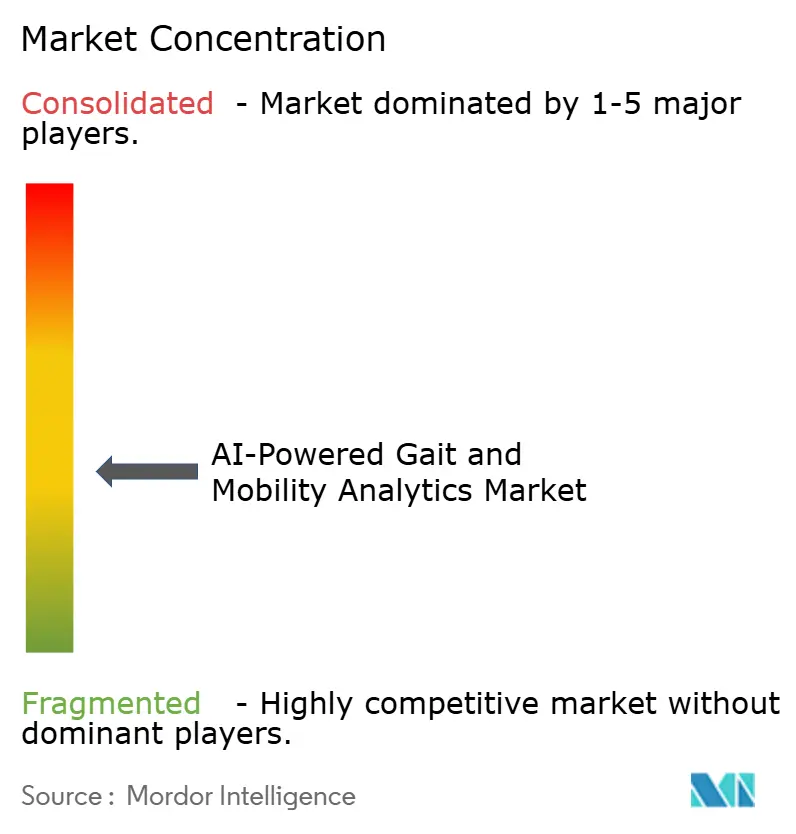
| Market Concentration | Medium |
Major Players *Disclaimer: Major Players sorted in no particular order Image © Mordor Intelligence. Reuse requires attribution under CC BY 4.0. | |
AI-Powered Gait and Mobility Analytics Market Analysis by Mordor Intelligence
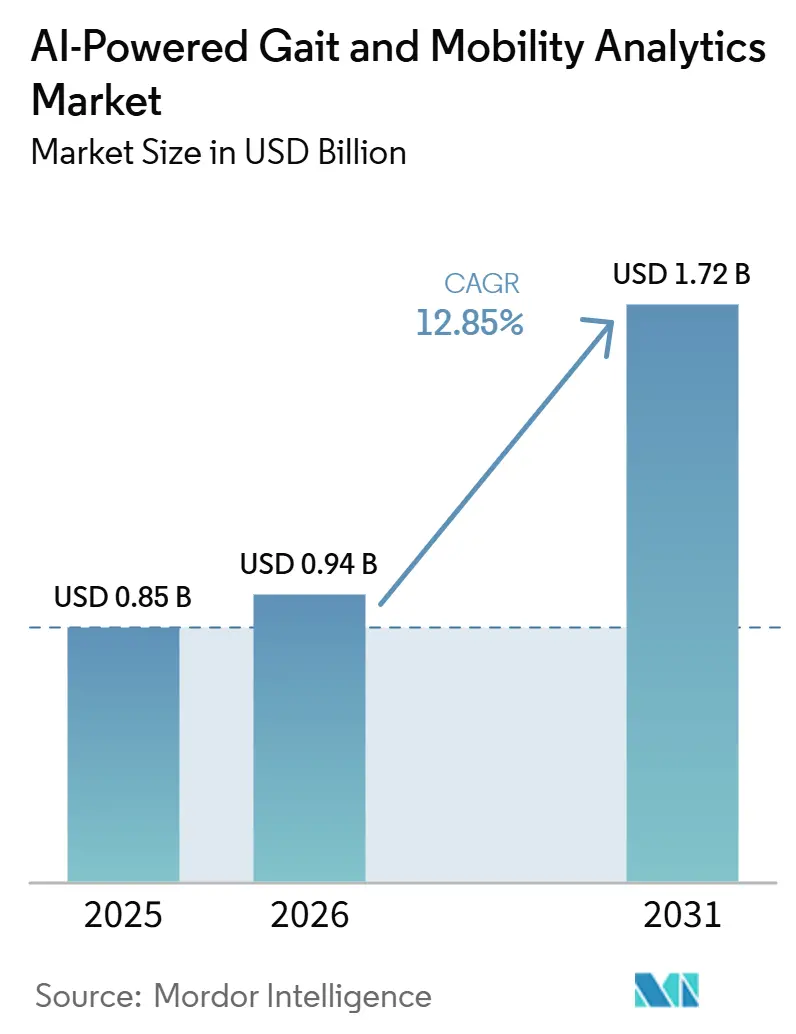
The AI-powered gait and mobility analytics market is expected to grow from USD 0.85 billion in 2025 to USD 0.94 billion in 2026 and is forecasted to reach USD 1.72 billion by 2031 at 12.85% CAGR over 2026-2031. Clinical adoption is rising as hospitals and rehabilitation networks face more pressure to measure patient mobility with objective and repeatable data instead of relying only on observation. The aging trend remains one of the clearest demand anchors because older populations carry a higher fall burden and need more structured mobility assessment across prevention, rehabilitation, and long-term care pathways. Regulatory conditions are also becoming more workable for software vendors, especially in the United States, where the FDA’s January 2026 clinical decision support guidance gave more clarity around explainable and clinician-reviewable AI tools. Competition is centered on how well vendors combine sensor precision, explainable analytics, and workflow fit, while the strongest near-term opportunity sits in moving gait assessment from fixed lab settings into routine hospital, outpatient, and home-based care. The long-term outlook remains favorable because the market is being supported at the same time by demographic demand, reimbursement alignment, and better wearable hardware performance.
Key Report Takeaways
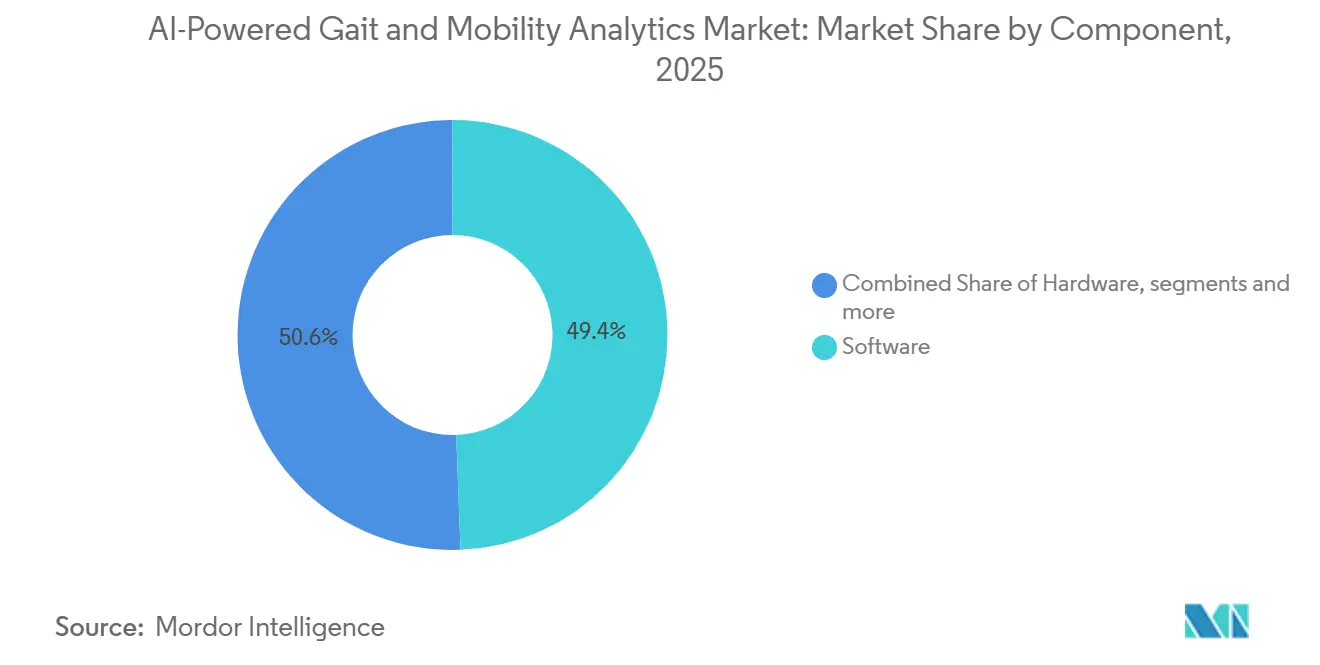
- By component, software led with 49.37% share in 2025, while hardware is forecasted to expand at 12.94% CAGR through 2031.
- By deployment mode, cloud held 51.27% share in 2025, while hybrid deployment is projected to grow at a 13.12% CAGR through 2031.
- By technology, computer vision-based analytics accounted for 43.62% share in 2025, while wearable sensor analytics is expected to advance at a 13.67% CAGR through 2031.
- By mobility assessment type, gait analysis held 40.15% share in 2025, while joint movement analysis is expected to grow at a 14.07% CAGR through 2031.
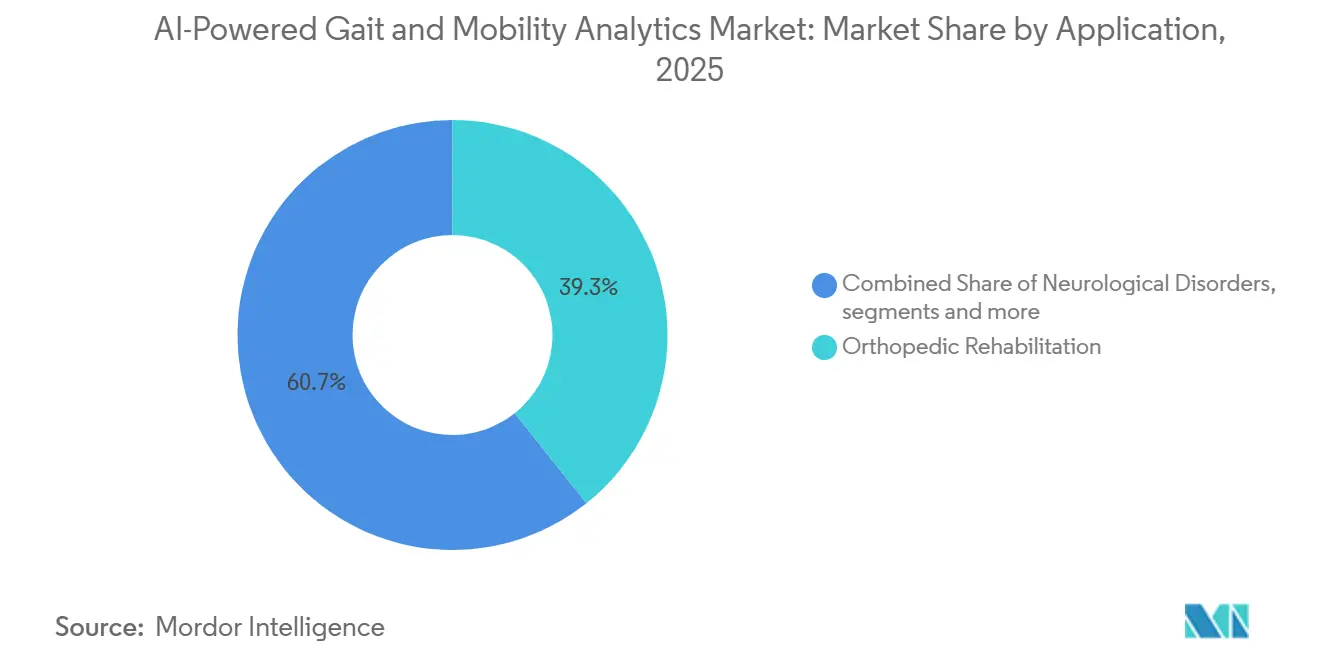
- By application, orthopedic rehabilitation captured 39.26% share in 2025, while geriatric care is projected to expand at a 15.24% CAGR through 2031.
- By end-user, hospitals led with 45.23% share in 2025, while rehabilitation centers are forecasted to grow at a 15.66% CAGR through 2031.
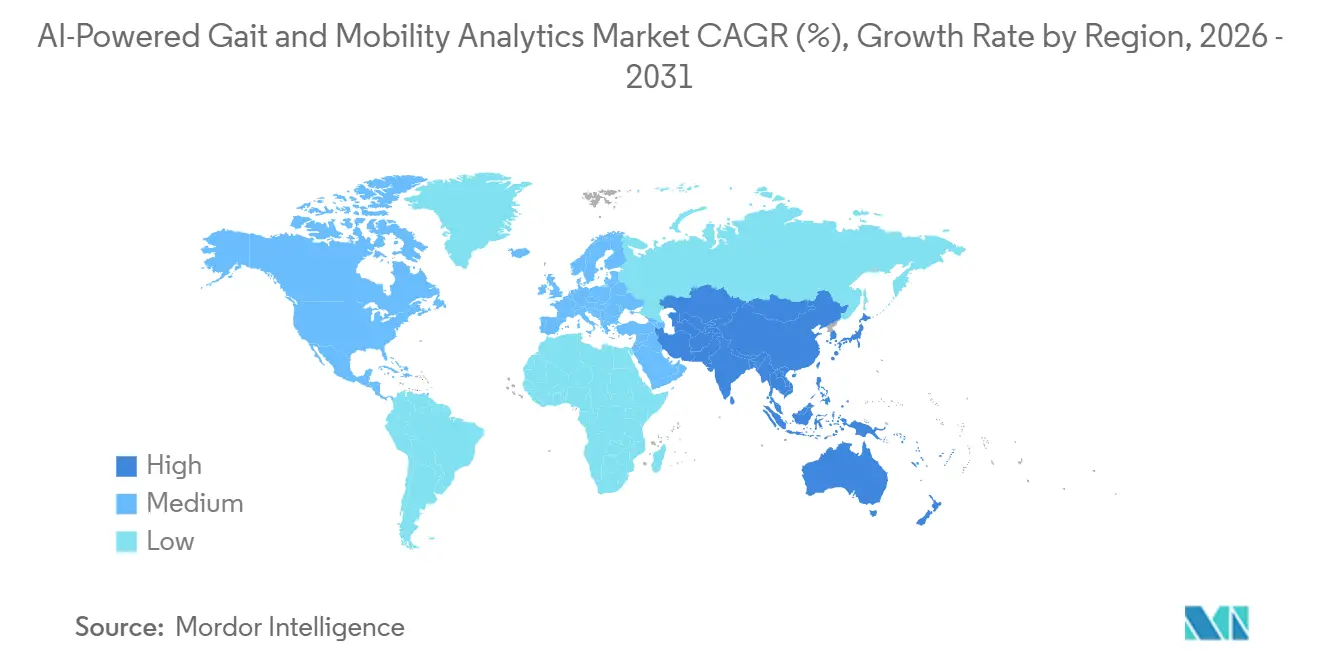
- By geography, North America held 43.42% share in 2025, while Asia-Pacific is expected to grow at a 16.13% CAGR through 2031.
Note: Market size and forecast figures in this report are generated using Mordor Intelligence’s proprietary estimation framework, updated with the latest available data and insights as of January 2026.
Global AI-Powered Gait and Mobility Analytics Market Trends and Insights
Drivers Impact Analysis*
| Driver | (~) % Impact on CAGR Forecast | Geographic Relevance | Impact Timeline |
|---|---|---|---|
| Rising Adoption of AI-Assisted Biomechanical Diagnostics | +4.5% | Global, with concentration in North America and Europe | Medium term (2-4 years) |
| Expansion of Remote Rehabilitation and Home Monitoring Workflows | +3.2% | North America, Europe, and APAC urban centers | Short term (≤ 2 years) |
| Increasing Demand for Wearable IMU and Insole-Based Gait Assessment | +2.8% | Global, early adoption in APAC and North America | Medium term (2-4 years) |
| Growth in Fall-Risk Screening Across Aging Care Pathways | +2.1% | Global, concentrated in South Asia, East Asia, and North America | Long term (≥ 4 years) |
| Need for Longitudinal Mobility Tracking in Post-Acute Care | +1.5% | North America and EU, with spillover to MEA | Medium term (2-4 years) |
| Clinical Preference for Explainable Mobility Scoring and Audit Trails | +1.0% | North America and EU regulatory jurisdictions | Short term (≤ 2 years), Medium term (2-4 years) |
| Source: Mordor Intelligence | |||
Rising Adoption of AI-Assisted Biomechanical Diagnostics
The AI-powered gait and mobility analytics market is benefiting from a shift in biomechanical assessment from specialist labs into normal clinical use. AI is lowering the skill burden required to extract useful gait parameters, which makes advanced assessment more practical for hospitals and outpatient settings. Qualisys launched OnTraq in January 2026 with a markerless functional assessment that can evaluate 20 athletes in 30 minutes without interrupting training, and that product example shows how throughput has become a commercial advantage alongside accuracy.[1]Qualisys, “Qualisys Launches OnTraq, Redefining Functional Assessment in Elite Sport,” Qualisys Newsroom, newsroom.qualisys.com The same markerless approach also lowers the entry barrier for clinics that could not previously justify a full motion capture installation, which broadens the addressable base for the AI-powered gait and mobility analytics market. Vendors that can prove clinical equivalence against force-plate-based systems are likely to win more hospital demand as providers move away from manual observational tools.
Expansion of Remote Rehabilitation and Home Monitoring Workflows
The AI-powered gait and mobility analytics market is also being lifted by the fast buildout of remote rehabilitation models. Providers are structuring care around continuous movement data, and that supports software that can follow patients outside formal lab or clinic settings. Net Health expanded Limber Health in February 2026 as a remote therapeutic monitoring platform for rehabilitation providers, and this shows that digital rehab pathways are becoming a stable demand channel rather than a temporary pilot trend.[2]Net Health / Limber Health, “Net Health Scales Limber Health for Rehab Therapy Providers,” Limber Health, limberhealth.com This shift matters because home-based monitoring increases the need for standard scores, longitudinal reporting, and workflow-ready dashboards across the AI-powered gait and mobility analytics market. Platforms that align mobility metrics with payer and provider documentation needs are likely to hold a structural advantage as digital rehab models mature.
Growth in Fall-Risk Screening Across Aging Care Pathways
The AI-powered gait and mobility analytics market is closely tied to fall-risk screening because falls remain a measurable and rising burden in older adult care. A 2025 Nature Communications study reported that wearable AI devices could classify frailty with 91.33% accuracy and cut wireless data transmission by 99% through on-device inference, which addresses a key barrier to continuous monitoring in real-world settings.[3]Kasper K.A. et al., “Wearable AI for On-Device Frailty Assessment,” Nature Communications, nature.comAs a result, the AI-powered gait and mobility analytics market is moving closer to prospective fall prevention rather than post-event assessment alone.
Clinical Preference for Explainable Mobility Scoring and Audit Trails
The AI-powered gait and mobility analytics market is being shaped by clinician demand for outputs that are easy to review and justify. The FDA’s revised January 2026 guidance made it more important for clinical decision support software to present reasoning that a clinician can independently assess at the point of care. That requirement turns explainability into a product design issue rather than a simple marketing claim. A 2026 scoping review of AI-enabled wearables in Parkinson's disease found that 62.12% of studies used machine learning only, while external clinical validation was reported in just 6.06% of cases, which shows the gap between published development work and deployment-ready evidence. Vendors in the AI-powered gait and mobility analytics market that build traceable and transparent inference workflows are likely to face lower adoption friction in regulated care settings.
Restraints Impact Analysis*
| Restraint | (~) % Impact on CAGR Forecast | Geographic Relevance | Impact Timeline |
|---|---|---|---|
| High Hardware Capex and Calibration Burden | -2.3% | Global, most acute in emerging markets and smaller rehabilitation centers | Medium term (2-4 years) |
| Stringent Clinical Validation and Data Privacy Requirements | -1.8% | North America and EU, increasingly in APAC regulatory jurisdictions | Short term (≤ 2 years), Medium term (2-4 years) |
| Interoperability Gaps with EHR and Rehab Software | -1.4% | Global, highest friction in fragmented provider networks | Medium term (2-4 years), Long term (≥ 4 years) |
| Limited Diverse Annotated Gait Datasets for Model Training | -0.9% | Global, affects model generalization across demographic groups | Long term (≥ 4 years) |
| Source: Mordor Intelligence | |||
High Hardware Capex and Calibration Burden
The AI-powered gait and mobility analytics market still faces a practical barrier in the cost of clinical-grade equipment. Force plates, multi-camera systems, and dense IMU setups remain expensive for providers below the secondary-care level, which limits adoption outside well-funded hospitals and specialty centers. A 2024 technoeconomic study in Catalonia found that full gait-oriented wearable medical IoT systems carried capital cost uncertainty of ±20% to ±30%, and that raised total ownership risk for care facilities working with tight budgets. The burden is not only the purchase price because recurring recalibration and maintenance are also required to preserve clinical accuracy, and that adds friction for the AI-powered gait and mobility analytics market in smaller sites. Wearable alternatives are improving, but many buyers still view them as not fully equivalent to lab systems for advanced joint kinematics and diagnostic use.
Limited Diverse Annotated Gait Datasets for Model Training
The AI-powered gait and mobility analytics market is also constrained by the limited supply of diverse and clinically labeled gait datasets. A 2025 IEEE Access study noted that many clinical gait datasets have small participant numbers, limited pathology variety, and access restrictions related to privacy, which weakens model generalization across settings and populations. This matters because models trained on narrow lab cohorts often perform less reliably when they are exposed to different demographics, disease states, and care environments. Vendors with strong multisite data partnerships or validated synthetic data pipelines are likely to build a more durable advantage than firms that depend only on standard open datasets.
*Our forecasts treat driver/restraint impacts as directional, not additive. The impact forecasts reflect baseline growth, mix effects, and variable interactions.
Segment Analysis
By Component: Software Leads While Hardware Draws New Investment
Software held 49.37% of revenue in 2025, which kept it as the largest component in the AI-powered gait and mobility analytics market. That position reflects where value is created, since clinical usefulness depends more on data processing, scoring, and reporting than on raw signal capture alone. Subscription-based software models also support recurring revenue and tighter customer retention than hardware-only sales. The AI-powered gait and mobility analytics industry is therefore monetizing clinical interpretation layers more effectively than device sales alone.
Hardware is expected to be the fastest-growing component at a 12.94% CAGR through 2031, and that rise shows where fresh capital is moving inside the AI-powered gait and mobility analytics market. Demand is being lifted by smaller sensors, lower setup burden, and the spread of community-based monitoring workflows that need wearable capture. Services continue to fill the middle ground because deployment, calibration, and staff training remain necessary in many installations, even when software remains the main revenue anchor.



By Deployment Mode: Cloud Leads While Hybrid Gains Strategic Weight
Cloud deployment accounted for 51.27% of revenue in 2025, which gave it the lead across the AI-powered gait and mobility analytics market. Its advantage comes from easier scaling, lower local IT burden, and better fit with software-as-a-service operating models. Cloud systems also support longitudinal patient tracking across repeated sessions, which matters when clinicians need easy access to data from both clinical and home-based use.
Hybrid deployment is anticipated to be the fastest-growing model at a 13.12% CAGR through 2031, and that reflects operational limits that pure cloud delivery cannot always solve in the AI-powered gait and mobility analytics market. Real-time biofeedback, low-latency processing, and country-specific data residency rules all support a mix of local edge processing with selective cloud aggregation. On-premises setups still hold a place in high-security academic medical centers and specialized programs, but their overall role is narrowing as hosted platforms improve their governance standards.
By Technology: Computer Vision Holds Scale While Wearables Expand Faster
Computer vision-based analytics held 43.62% share in 2025, which made it the leading technology in the AI-powered gait and mobility analytics market. Its lead comes from the familiarity of video-based observation in clinical care and the installed base of camera systems in hospitals, research sites, and sports science settings. Markerless pose estimation is also reducing setup complexity, which makes routine use more practical than older marker-heavy workflows.
Wearable sensor analytics is projected to grow at 13.67% CAGR through 2031, which marks it as the fastest-moving technology layer in the AI-powered gait and mobility analytics market. A 2026 scoping review in Parkinson's disease reported that accelerometers were used in 92.42% of studies, while the field was shifting from single-session clinical use toward continuous home monitoring and combined clinical-home models. Pressure mapping and plantar sensor systems still serve narrower orthopedic and diabetic foot niches, but the larger growth pattern is clearly moving toward always-on, lower-friction wearable capture.
By Mobility Assessment Type: Gait Analysis Anchors Demand While Joint Movement Broadens Use Cases
Gait analysis accounted for 40.15% share in 2025, which kept it as the base assessment category in the AI-powered gait and mobility analytics market. It has the deepest clinical history, the most familiar protocols, and the strongest fit with established neurological and orthopedic outcome tracking. Balance assessment and fall-risk assessment serve many of the same patient groups, and they are often packaged within the same platform.
Joint movement analysis is expected to grow at a 14.07% CAGR through 2031, which makes it the fastest-advancing assessment type in the AI-powered gait and mobility analytics market. Providers are adopting more granular kinematic tracking in post-surgical recovery because detailed movement data is replacing visual estimation in many rehabilitation settings. As this overlap expands, joint movement analytics is likely to extend beyond orthopedic tracking into broader neurological and rehabilitation applications.
By Application: Orthopedic Rehabilitation Provides Scale While Geriatric Care Drives Momentum
Orthopedic rehabilitation held 39.26% share in 2025, which made it the leading application across the AI-powered gait and mobility analytics market. Recovery after knee and hip replacement creates structured milestones, repeated evaluations, and a clear need for objective mobility data, which supports steady use of gait analytics. Neurological disorders form the next major application group, especially in Parkinson's disease, stroke, and multiple sclerosis. The AI-powered gait and mobility analytics industry also gains from sports medicine, but that demand is usually more cyclical and linked to training and performance budgets.
Geriatric care is forecasted to grow at a 15.24% CAGR through 2031, and that marks it as the strongest growth application in the AI-powered gait and mobility analytics market. The demand case is tied directly to aging populations and the rising burden of falls, mobility decline, and frailty monitoring in older adults. As providers shift from reactive treatment to earlier risk identification, geriatric mobility monitoring is likely to become a more important revenue driver than it was in earlier market stages.
By End-User: Hospitals Hold Share While Rehabilitation Centers Grow Faster
Hospitals represented 45.23% of revenue in 2025, which gave them the largest end-user share in the AI-powered gait and mobility analytics market. Their lead comes from stronger capital budgets, better IT infrastructure, and the ability to support high-fidelity motion capture and reimbursable diagnostic workflows. Hospitals also remain the main anchor for formal gait labs, which gives them a central role in validation, procurement, and referral patterns.
Rehabilitation centers are projected to grow at a 15.66% CAGR through 2031, which makes them the fastest-growing end-user in the AI-powered gait and mobility analytics market. Growth is being supported by the shift of post-acute care from inpatient settings into ambulatory and community-based models. Medbridge expanded its remote therapeutic monitoring ecosystem in June 2026, and that kind of platform move improves the business case for rehabilitation networks that want to scale across multiple sites rather than build each location from scratch. This change is important because rehabilitation centers are adopting lower-cost hardware combined with software-led analytics, which gives them a different but faster-moving revenue profile than hospitals.
Geography Analysis
North America held 43.42% share in 2025, which kept it as the largest regional block in the AI-powered gait and mobility analytics market. The region benefits from well-funded hospital infrastructure, established remote therapeutic monitoring pathways, and stronger readiness for digital clinical workflows. The FDA’s January 2026 clinical decision support guidance also reduced some regulatory uncertainty for explainable AI software that clinicians can independently review and that supports faster commercialization cycles. Canada and Mexico remain smaller within the regional total, but they add to the broader North American demand base through public and private care channels.
Europe remains an important part of the AI-powered gait and mobility analytics market because public health systems are under steady pressure from aging populations and rising rehabilitation needs. Reimbursement structures are more national in character than in North America, which changes how vendors approach contracting and rollout. The United Kingdom, Germany, France, Italy, and Spain remain the main revenue contributors, though they are moving at different speeds in formalizing quantitative mobility assessment in rehabilitation pathways. Europe’s opportunity is therefore tied less to single-facility purchasing and more to system-level adoption once evidence, workflow fit, and procurement standards align.
Asia-Pacific is projected to expand at 16.13% CAGR through 2031, which makes it the fastest-growing region in the AI-powered gait and mobility analytics market. Japan’s aging population supports strong demand for fall-risk and longitudinal mobility tracking, while South Korea and China add momentum through broader digital health investment and local innovation activity. India also matters because the country’s fall burden is high, which strengthens the case for scalable screening and rehabilitation tools over time. The region’s growth is not coming from a single pattern, since mature health systems, rapidly scaling outpatient networks, and cost-sensitive buyers are all part of the story. South America, the Middle East, and Africa remain smaller and earlier-stage, with adoption concentrated in private hospital systems and premium care networks.

Competitive Landscape
The AI-powered gait and mobility analytics market remains moderately fragmented, and no single company controls both the hardware and software layers at a dominant global level. Established motion capture, force measurement, and EMG players still hold an advantage in precision equipment and installed base relationships. At the same time, software-focused entrants are widening access by building analytics on top of simpler and lower-cost sensor inputs. This keeps competition active across pricing, workflow integration, and evidence quality. The AI-powered gait and mobility analytics market therefore rewards vendors that can connect device performance with credible clinical reporting rather than those relying on hardware alone.
A common strategy in the AI-powered gait and mobility analytics market is platform expansion that makes existing ecosystems more useful to current customers. Noraxon’s Spring 2026 MR4 release added golf swing analysis, horizontal jump assessment, and MANUS glove integration for finger motion capture, which shows how incumbents are broadening feature sets to reduce switching risk and deepen user dependence on one platform. Qualisys also strengthened its position through OnTraq, where markerless functional assessment and subscription packaging combined product accessibility with recurring revenue logic. These moves show that product breadth and workflow fit are becoming as important as measurement fidelity in vendor positioning.
The AI-powered gait and mobility analytics market also has open space in continuous community monitoring, linked clinical-to-home pathways, and crossover use between sports performance and rehabilitation. Xsens improved commercial relevance by reducing setup time in its Next-Generation Link system, which made hardware throughput more attractive in high-volume settings. Patent activity and product differentiation are increasing in markerless vision, edge inference, and wearable design, which raises the importance of proprietary data and clinical validation. Vendors without strong regulatory positioning or workflow-ready evidence are likely to face longer hospital sales cycles even if their algorithms perform well in controlled settings.
AI-Powered Gait and Mobility Analytics Industry Leaders
Vicon Motion Systems Ltd
Noraxon Inc.
BTS Bioengineering Corp.
Tekscan Inc.
Qualisys AB
- *Disclaimer: Major Players sorted in no particular order

Recent Industry Developments
- July 2026: Sword Health integrated its AI-supported musculoskeletal care platform into Portugal's National Health Service (NHS), enabling physicians to prescribe AI physical therapy for common pain and injury conditions. The partnership represents the first national-level AI physiotherapy integration within an NHS system, establishing a reimbursement template that other European markets are likely to follow.
- July 2026: MindMaze Therapeutics enrolled the first patients in its SwissNeuroRehab study as part of the pan-European Neurorehab4EU consortium. The study targets at-home neurorehabilitation reimbursement across Switzerland, France, and Italy, with the company partnering with approximately 100 hospitals and care facilities across Europe to extend inpatient rehabilitation pathways into the home.
- June 2026: RevelAi Health was selected for the CMS ACCESS Model, bringing AI-enabled bone, joint, and behavioral health coaching to Medicare beneficiaries across all 50 US states from July 5, 2026. The platform pairs AI health coaching with physician-supervised digital exercise programs within a value-based payment structure.


Global AI-Powered Gait and Mobility Analytics Market Report Scope
According to the report’s scope, the AI-powered gait and mobility analytics market comprises artificial intelligence-based software, sensors, and computer vision solutions that assess gait, balance, posture, and movement patterns to support clinical diagnosis, rehabilitation, fall risk assessment, and mobility monitoring across healthcare settings.
The AI-powered gait and mobility analytics market is segmented into component, deployment mode, technology, mobility assessment type, application, end-user, and geography. By component, the market is segmented into software, hardware, and services. By deployment mode, the market is segmented into cloud-based, on-premises, and hybrid. By technology, the market is segmented into computer vision-based analytics, wearable sensor analytics, machine learning-based predictive analytics, deep learning, and other technologies. By mobility assessment type, the market is segmented into gait analysis, balance assessment, fall risk assessment, posture analysis, joint movement analysis, functional mobility assessment, and other mobility assessment types. By application, the market is segmented into neurological disorders, orthopedic rehabilitation, geriatric care, sports medicine & performance, parkinson's disease management, and other applications. By end-user, the market is segmented into hospitals, rehabilitation centers, long-term care facilities, sports performance centers, and other end-users. By geography, the market is segmented into North America, Europe, Asia-Pacific, the Middle East and Africa, and South America. The report also covers the estimated market sizes and trends for 17 countries across major regions globally. The report offers values (USD) for all the above segments.
| Software |
| Hardware |
| Services |
| Cloud-Based |
| On-Premises |
| Hybrid |
| Computer Vision-Based Analytics |
| Wearable Sensor Analytics |
| Machine Learning-Based Predictive Analytics |
| Deep Learning |
| Other Technologies |
| Gait Analysis |
| Balance Assessment |
| Fall Risk Assessment |
| Posture Analysis |
| Joint Movement Analysis |
| Functional Mobility Assessment |
| Other Mobility Assessment Types |
| Neurological Disorders |
| Orthopedic Rehabilitation |
| Geriatric Care |
| Sports Medicine & Performance |
| Parkinson's Disease Management |
| Other Applications |
| Hospitals |
| Rehabilitation Centers |
| Long-Term Care Facilities |
| Sports Performance Centers |
| Other End-Users |
| North America | United States |
| Canada | |
| Mexico | |
| Europe | Germany |
| United Kingdom | |
| France | |
| Italy | |
| Spain | |
| Rest of Europe | |
| Asia-Pacific | China |
| Japan | |
| India | |
| Australia | |
| South Korea | |
| Rest of Asia-Pacific | |
| Middle East and Africa | GCC |
| South Africa | |
| Rest of Middle East and Africa | |
| South America | Brazil |
| Argentina | |
| Rest of South America |
| By Component | Software | |
| Hardware | ||
| Services | ||
| By Deployment Mode | Cloud-Based | |
| On-Premises | ||
| Hybrid | ||
| By Technology | Computer Vision-Based Analytics | |
| Wearable Sensor Analytics | ||
| Machine Learning-Based Predictive Analytics | ||
| Deep Learning | ||
| Other Technologies | ||
| By Mobility Assessment Type | Gait Analysis | |
| Balance Assessment | ||
| Fall Risk Assessment | ||
| Posture Analysis | ||
| Joint Movement Analysis | ||
| Functional Mobility Assessment | ||
| Other Mobility Assessment Types | ||
| By Application | Neurological Disorders | |
| Orthopedic Rehabilitation | ||
| Geriatric Care | ||
| Sports Medicine & Performance | ||
| Parkinson's Disease Management | ||
| Other Applications | ||
| By End-User | Hospitals | |
| Rehabilitation Centers | ||
| Long-Term Care Facilities | ||
| Sports Performance Centers | ||
| Other End-Users | ||
| By Geography | North America | United States |
| Canada | ||
| Mexico | ||
| Europe | Germany | |
| United Kingdom | ||
| France | ||
| Italy | ||
| Spain | ||
| Rest of Europe | ||
| Asia-Pacific | China | |
| Japan | ||
| India | ||
| Australia | ||
| South Korea | ||
| Rest of Asia-Pacific | ||
| Middle East and Africa | GCC | |
| South Africa | ||
| Rest of Middle East and Africa | ||
| South America | Brazil | |
| Argentina | ||
| Rest of South America | ||


Key Questions Answered in the Report
What is the current size of the AI-powered gait and mobility analytics market?
The AI-powered gait and mobility analytics market was valued at USD 0.85 billion in 2025 and stands at USD 0.94 billion in 2026 and is forecasted to reach USD 1.72 billion by 2031 at a 12.85% CAGR.
Which component contributes the most revenue?
Software led with 49.37% share in 2025 because vendors capture value through analytics, reporting, and subscription-based monitoring workflows.
Which technology is growing the fastest?
Wearable sensor analytics is expected to be the fastest-growing technology at a 13.67% CAGR through 2031, supported by rising use in continuous home and community monitoring.
Which region offers the strongest growth outlook through 2031?
Asia-Pacific is forecasted to grow the fastest at 16.13% CAGR, while North America remains the largest regional revenue base with 43.42% share in 2025.
Page last updated on:





